
















Hatley Castle in Canada: gardens free, castle only with a guide
Hatley Park in Colwood is known for the Dunsmuir castle and its free gardens.
The estate covers about 229 hectares (565 acres) on the ocean shore of Vancouver Island (as of 09/2026, Hatley Park visit page). It takes about 25 minutes to get here from downtown Victoria. Below: what to see in the park, how the Dunsmuir castle is organized, and when registration for tours opens again.
Where Hatley Park is located
💡 In short:
- The gardens are open free of charge, from 10:00 until dusk, dogs are not allowed in the fenced gardens (as of 09/2026, estate website)
- The castle is accessible only with a guide: Hatley Castle remains an active university building
- Address: 2005 Sooke Road, Colwood, British Columbia; about 25 minutes by car from downtown Victoria (as of 09/2026, how to get there)
- Prices, hours of operation and access: 09/2026, verified on the official estate website
 © Ymblanter · CC BY-SAPhoto: Ymblanter, CC BY-SA (https://creativecommons.org/licenses/by-sa/4.0), Wikimedia Commons
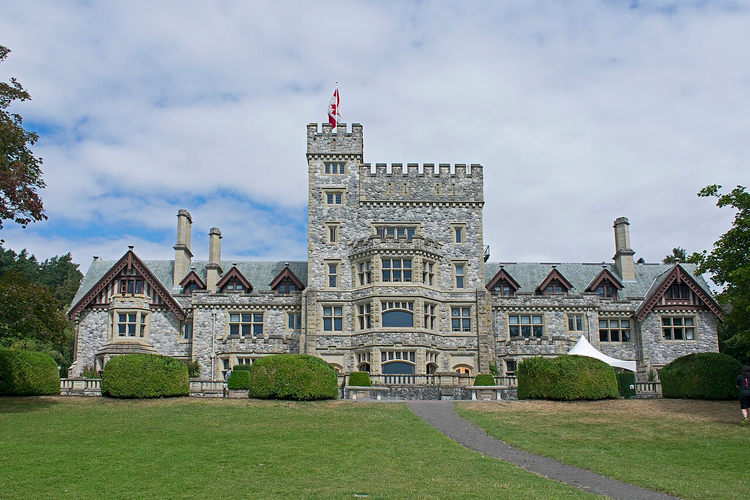
Hatley Park is located in Colwood, in the south of Vancouver Island, near Greater Victoria. It is a national historic site of Canada and at the same time the campus of Royal Roads University (as of 09/2026, Hatley Park, Royal Roads University). The grounds face Esquimalt Lagoon, and across the Strait of Juan de Fuca you can see the Olympic Mountains.
These lands belong to the Lekwungen peoples, related to the Songhees and Esquimalt Nations. If you are coming from Victoria, allow half an hour for the drive with a buffer for traffic.
History: from coal magnate to university
Western Canada was covered by dense forests of Douglas fir and western red cedar. Cedar gave people material for homes and canoes, bark was used for clothing, and herbs and berries for medicinal infusions. With the arrival of Europeans, these lands began to be cultivated for pastures, farms and estates.
In the early 20th century, the property was purchased by James Dunsmuir, of Scottish descent and one of the wealthiest men in British Columbia. Together with his wife Laura, he envisioned a family estate and commissioned the project from Canadian architect Samuel Maclure. The 40-room castle was completed in 1908 (as of 09/2026, Hatley Park, Wikipedia).
The family lived on the estate for more than thirty years. In 1940, the Dunsmuirs sold the property to the Government of Canada on one condition: the park would remain open to visitors (as of 09/2026, Dunsmuir family history). The mansion was being prepared as a residence for King George VI and Queen Elizabeth, who were to be moved away from the war in Europe. The royal family stayed in London, and the estate was handed over to the military.
In 1940, the Royal Roads Naval College opened here and trained officers until 1995. That same year, in 1995, Hatley Park was designated a National Historic Site of Canada (as of 09/2026, article about the estate). Royal Roads University has operated here since that year: the university covers the costs of maintaining the castle and gardens, restoration, and heritage preservation. That is how a private estate became a university campus.
Castle architecture
The castle was built in the Scottish baronial style, fashionable during the Edwardian era. Dunsmuir chose this style out of affection for Scotland and spared no expense. The walls are made of sandstone with varying textures, so from a distance the house looks like it was built from several different materials (as of 09/2026, description of the estate's architecture).
Inside, rare woods and Canadian red cedar were used. You will notice the light fixtures right away: they were custom-made for these interiors, as was the decoration of the great hall with its fireplace. There is no museum inside; Hatley Castle remains a living building with university offices, classes, and receptions (as of 09/2026, tours page). That is why visitors are only allowed inside with a guided group.
Hatley park gardens: Italian, Japanese, and rose garden
In 1912, the Dunsmuirs hired the Boston firm Brett and Hall: American landscape architects Franklin Brett and George D. Hall had studied under Frederick Law Olmsted. They planned the estate as an Edwardian park made up of separate "rooms" (as of 09/2026, 1912 estate plan). The garden itself was laid out between 1912 and 1914, and its appearance continues to change to this day.
 © User:P199 · CC BY-SAPhoto: User:P199, CC BY-SA (https://creativecommons.org/licenses/by-sa/4.0), Wikimedia Commons
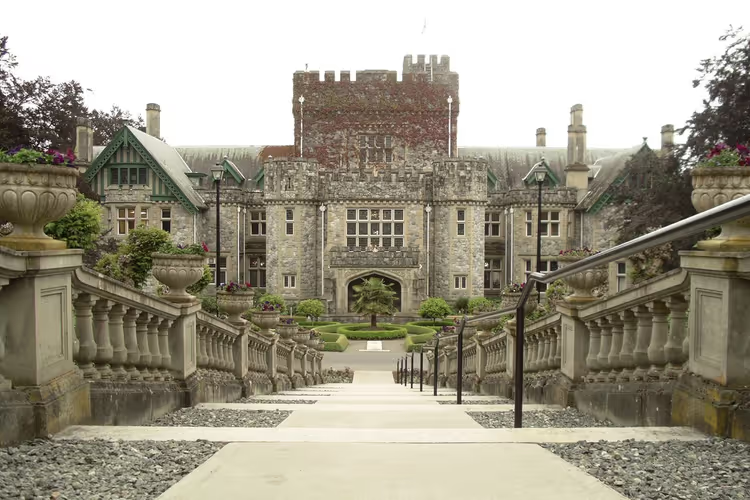
The layout divides the grounds into distinct landscape zones. The most famous areas are the Italian garden, Japanese garden, and Rose garden (as of 09/2026, description of the estate's gardens). The Rose garden was designed in 1913 by the same Brett and Hall, and its structure reflects the romantic taste of the Edwardian era. Many old rose varieties proved not hardy enough for the winters, so not all of the original plantings have survived.
In front of the main entrance lies a smooth emerald lawn with boxwood borders trimmed according to the canons of topiary art. The castle is covered in ivy and does not look heavy, even though its style is austere. Further on, the garden opens up like a labyrinth: behind the lawns hide ponds, streams, and benches in secluded corners. It is easy to spend half a day here.
In the early 20th century, dozens of gardeners tended the garden. Today the team is noticeably smaller: a few gardeners, an arborist who treats and shapes the trees, a caretaker, and seasonal workers during mass planting periods (as of 09/2026, Hatley Park grounds and gardens). Work goes on year-round, and the university covers the maintenance costs.
The park feels lived-in and alive. Peacocks strut importantly across the lawns, ducks stay on the ponds, and a wooden tea house stands in the Japanese garden. In summer the garden smells of roses, in autumn the red and yellow maples light up, and in spring rhododendrons and cherry trees bloom. For landscape design enthusiasts, there is plenty to learn here: evergreen native species sit alongside exotic plants that have adapted to the climate of British Columbia.
The estate has long been a filming location. In 2000, X-Men was shot here, and the estate's website has a dedicated list of films made at the castle and gardens (as of 09/2026, Hatley Park history). From here it's easy to walk out to Esquimalt Lagoon and take in the water and the Olympic Mountains in the distance.
Hours and tickets
The gardens are free to visit: the gates are open from 10:00 until dusk. Dogs are not allowed in the fenced gardens to protect the lawns and plantings (as of 09/2026, tours and visiting page). The castle can only be entered with a guide, because it's an active university building, not a museum.
The 2026 daily tour season has already ended, and the 2027 schedule will be announced in the spring. Keep an eye on announcements on the official website so you don't miss when booking opens. Tickets for group visits are sold in advance, and slots go quickly in high season.
The estate address is 2005 Sooke Road, Colwood, British Columbia. It's about a 25-minute drive from downtown Victoria (as of 09/2026, how to get to the park). You can arrive by car, by bike along Greater Victoria's bike routes, or by public transit; routes and parking are described on the Directions page.
Ad: this article contains affiliate links, we earn a commission if you book through them, at no extra cost to you.
If you'd like to add other island destinations to your castle visit, check out Victoria and Vancouver Island tours on GetYourGuide.
Tours and tickets in Victoria
Guided tours, skip-the-line tickets and activities — most offers can be cancelled free of charge.
See offers on GetYourGuideThe widget loads once you give your consent.
⁉️🤔 Frequently asked questions
How much does it cost to visit Hatley Park?
The gardens and park are free, no admission fee is required (as of 09/2026, admission information). Only the castle tour is paid. Budget for the trip there: a bus from Victoria will cost less than a taxi.
Can you go inside Hatley Castle?
Only with a guide. The castle is an active Royal Roads University building: it houses offices, classes, and receptions (as of 09/2026, castle visit conditions). Plan your visit around the tour schedule. The gardens, however, are accessible any day.
When will tour bookings open again?
The 2027 schedule will be released in the spring (as of 09/2026, Hatley Park, guided tours). Dates and prices are published on the estate's official website. Booking in advance is worth it if you're traveling to Victoria in the peak of summer.
How do you get to Hatley Park from Victoria?
Address: 2005 Sooke Road, about 25 minutes from downtown by car (as of 09/2026, Directions). Public transit and cycling both work: Greater Victoria bike paths lead right to the campus. Parking is available on site, but lots near the garden gates fill up by midday.
What should you see in the gardens first?
The Italian garden, Japanese garden, and Rose garden are considered the highlights (as of 09/2026, Hatley Park gardens). The Japanese garden has a tea house, and the rose garden is at its best in June. Allow half a day to explore: the grounds are large, and the trails lead down to the water.
Can you bring a dog?
Dogs are not allowed in the enclosed gardens (as of 09/2026, visitor information). The rest of the campus grounds and trails are open, but check the leash rules at the entrance. With a pet, you'll need to take turns seeing the gardens.
In short: what's worth booking
The one-day plan is simple: free gardens in the morning, the castle exterior and waterfront paths in the afternoon, and you'll return to go inside the castle in the spring, when tour bookings open.
If you plan to explore the island on your own, a car makes things easier: compare car rental prices for your travel dates.

A small editorial team writing guides for independent travel. We travel ourselves, but we haven’t been everywhere, so we check prices, opening hours and how to get there against official sources.