

















ESIM while traveling: how not to overpay for internet abroad
Internet abroad is expensive if you don't prepare anything in advance. Roaming is free within the European Union, but Turkey, Thailand, and the US are not part of that zone. An hour of navigation and a couple of video calls home is enough for your home carrier to bill you tens of euros.
There is a solution, and you don't need a second SIM card for it. A digital eSIM is installed on your phone before departure and connects to local networks using a prepaid package. You pay a fixed amount for data and stop watching the meter.
Ad: this article contains affiliate links, we earn a commission if you book through them, at no extra cost to you.
What an eSIM gives you on a trip outside the EU
💡 In short:
- An eSIM replaces a physical SIM card and is installed on your phone before the trip.
- Within the EU, roaming works at home rates; outside the EU, an eSIM package is cheaper than home carrier rates.
- Before you leave, check eSIM support and whether your phone is locked to a carrier.
- The "roam like at home" rule in the EU: 10/2026, according to the European Commission.
The eSIM module is built into the phone and replaces a physical SIM card. The carrier profile is downloaded via a QR code or through an app, and you don't need to remove the physical card. It works on iPhone XS, XR, and newer models: the phone keeps the digital and home lines active at the same time, and the purchased package turns off when you return home, as described by Apple. The phone must be unlocked for use with a third-party carrier.
For travel, this offers several benefits: you don't have to look for a SIM card kiosk at the airport after your flight, and your home number stays in place, so bank verification codes arrive as usual. You pay a fixed amount for internet instead of a per-megabyte rate.
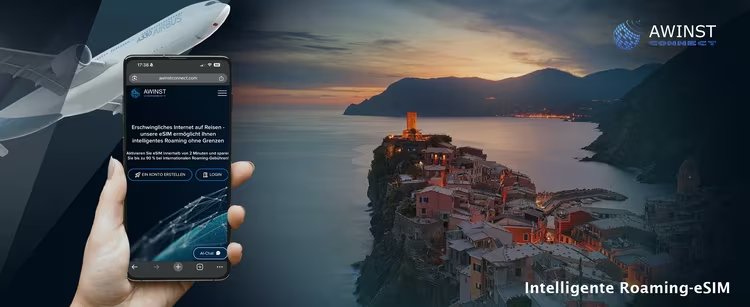
Dedicated packages for such trips are sold by specialized services: for example, Awinst Connect offers eSIMs for Turkey, Thailand, and the US with QR-code activation and payment for a fixed data allowance. According to the service description, setup takes a couple of minutes, and you can find rates and terms on Awinst Connect.
Roaming in the EU: what's covered and what's not
Within the European Union, mobile service works at home rates. The "roam like at home" rule covers 27 EU countries, plus Norway, Iceland, Liechtenstein, and, starting January 1, 2026, Ukraine and Moldova. Carriers may apply a fair use limit for unlimited plans, and the wholesale cap for carriers drops from €2 per gigabyte to €1 by 2027. Details of the rule are available on the European Commission website.
Outside the EU, the rule doesn't apply: your home carrier charges per megabyte or sells a separate package. Roaming also doesn't help with satellite networks on board planes and ships: rates there are higher, and usage easily runs into tens of euros. That's where a digital profile purchased before departure comes in handy.
Popular destinations outside the EU
Three destinations are most often chosen by tourists from Germany and Austria: Turkey, Thailand, and the US. For each, it's worth buying a package in advance, because the local network connects automatically and the price is known before you leave.
Turkey
Istanbul, Antalya, and Bodrum remain classics for short and long vacations. In Istanbul, you need navigation constantly: the old town winds around, and without a map it's easy to head the wrong way from the Grand Bazaar. An eSIM package for Turkey eliminates roaming bills and doesn't depend on your home carrier.
Thailand
Bangkok, Chiang Mai, and the southern islands attract both digital nomads and families. Here it's important to stay connected for booking accommodation, transfers, and online maps. A package for Thailand connects to the local network right after landing, and offline maps help on the islands.
USA
New York, Los Angeles, and California's national parks require reliable internet on the road. On a road trip between cities, coverage drops in places, so pre-downloaded offline maps save both nerves and data. For the US, get a package with extra gigabytes.
How to choose an eSIM plan
The package price depends on the country, data allowance, and duration, so it's convenient to compare options using four criteria.
Criterion | What to look at | Why it matters |
|---|---|---|
Country or region | Local package or multi-region | A regional plan costs more, but works in several countries |
Data allowance | Gigabytes and speed after the limit | After the limit, speed usually drops, but the connection stays |
Validity period | Days from activation | Different providers start the countdown differently |
Profile type | Data only or data with calls | Most tourist eSIMs don't include a local number |
Most tourist packages are data-only, so it's more convenient to make calls through messaging apps. These profiles can be purchased before departure, and they work in more than 190 countries, according to Apple. You can also compare rates from different providers for your destination in the eSIM selection.
How to install an eSIM before departure
The process is almost always the same.
- Check support. Open your phone settings and find the eSIM section; on iPhone it's "Cellular".
- Make sure the phone is unlocked. If the device is tied to a carrier, a third-party profile won't install.
- Buy a package. Choose the country, data allowance, and duration, then pay by card.
- Install the profile. Scan the QR code and wait a couple of minutes for the phone to connect the line.
- Turn off what you don't need. Before departure, disable background sync and automatic app updates.
After landing, turn on the eSIM for data, and your home line stays available for calls. Set data to use the digital profile in settings, and roaming charges won't come back.
How to save data while traveling
A fixed package can be stretched if you eliminate unnecessary usage.
- Download offline maps. Google Maps saves the area you need and works without a connection.
- Turn off automatic app updates and cloud photo sync; they consume gigabytes in the background.
- Lower video and music quality. High-quality streaming uses the most data.
- Use Wi-Fi at hotels and cafes for large downloads, and keep the eSIM for navigation and messaging.
- Watch the counter in your phone settings to see your remaining data.
⁉️🤔 Frequently asked questions
What is an eSIM in simple terms?
It's a digital SIM card inside your phone: the carrier profile is downloaded via a QR code or through an app, so you don't need to insert or swap a physical card. One device stores multiple profiles and keeps the home and travel lines active at the same time.
How much does internet abroad cost with an eSIM?
The price depends on the country, data allowance, and duration. For reference: at Awinst Connect, packages for Turkey start at $2.30, for Thailand from $2.90 (according to the service website, 10/2026). Check the exact price of a specific plan before paying.
Does eSIM work in Turkey, Thailand, and the US?
Yes, separate packages are sold for these countries, and they connect to the local network after landing. Your home line stays active for calls and messages. Major providers have broad coverage, so you don't need to worry about connectivity in cities and resorts.
Do I need to remove my regular SIM card?
No: if your phone has a tray, the physical card and eSIM work together. Your home number stays connected, and internet goes through the digital profile. In settings, you choose which line handles data.
What should I do if the eSIM won't connect?
Check that your phone is unlocked and supports the technology, then restart the device and select the data line again. Manually choosing the carrier in network settings often helps. If the profile still won't install, contact the provider's support.
In short: what to book
Before a trip outside the EU, decide three things: whether you need a local number, how many gigabytes you actually use, and for how long, after which choosing a package becomes simple.
- Flying to Turkey: get a package for the whole vacation and an offline map of Istanbul.
- Going to Thailand: a package for the entire stay will be enough, and hotel Wi-Fi will cover downloads.
- Planning a US trip: get a package with extra data; coverage between cities isn't available everywhere.
One final tip: choose an eSIM for trips outside the EU in advance, so you're already online at the airport.

A small editorial team writing guides for independent travel. We travel ourselves, but we haven’t been everywhere, so we check prices, opening hours and how to get there against official sources.