
















The Curse of Gaiola: why the island in Naples is considered unlucky
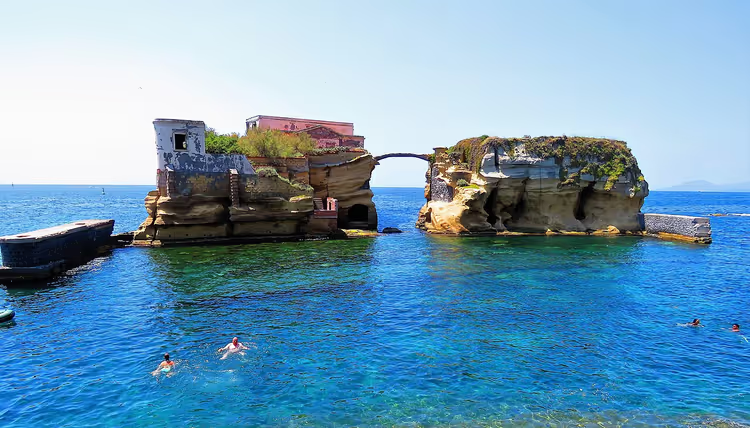
Gaiola looks like a postcard. Two tiny islets in the Gulf of Naples are connected by a narrow stone bridge, and a white villa stands above the water. Locals call this place cursed.
At the same time, Gaiola is open to visitors. It is part of the protected marine area off the coast of Posillipo. Park entry is free, you just need to book your visit online. From the water, the island looks peaceful, but behind it stretches a long chain of strange deaths.
Below you will read where Gaiola is located, what is known about the villa's owners, where the legend of the curse came from, and how to see the island with your own eyes.
Ad: this article contains affiliate links, we earn a commission if you book through them, at no extra cost to you.
Where Gaiola is located
💡 In short:
- Gaiola lies in the Gulf of Naples, off the coast of the Posillipo district, near the Naples waterfront.
- In summer, the marine park is open every day.
- Tickets and opening hours: 09/2026, verified on the official website
Gaiola is two small rocky islets connected by an arched stone bridge. They sit directly opposite Posillipo Hill, and they are easy to reach by swimming from the shore. The distance to the shore is short, but the water here is cool and has currents.
It is believed that Gaiola was once part of the mainland. The hill was separated back in antiquity, under Lucullus. The small caves in the rocks gave the island its name: in Latin, cavea means "small cave," and the local caviola eventually evolved into Gaiola.
In the 17th century, ruins of Roman buildings stood here. Two centuries later, the island served as a battery defending the gulf. As recently as the 1920s, the island was connected to the shore by a cable car.
 © Gianfranco Vitolo · CC BYPhoto: Gianfranco Vitolo, CC BY (https://creativecommons.org/licenses/by/2.0), Wikimedia Commons
History of the island: hermits and the villa
In the early 19th century, a hermit lived on Gaiola. Locals called him Lo Stregone, meaning "the sorcerer," and he lived on alms from fishermen. At that time, the island belonged to archaeologist Guglielmo Bechi, who bought it along with part of the cape in 1820.
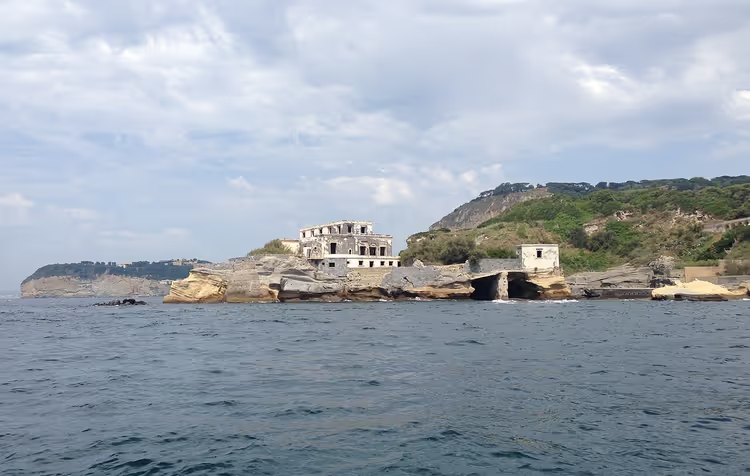
In 1874, the island was sold to Luigi de Negri. He built the villa that can still be seen on Gaiola today. The next owner bought the building after de Negri went bankrupt and set up a pozzolana quarry on the island. Later, the villa belonged to writer Norman Douglas, author of a book about the Gulf of Naples.
In 1910, the island passed to the family of Senator Paratore. The senator himself lived in a house on the shore, not on the island. After that, the villa changed owners many more times, as described below.
The islets sit in a fully protected zone of the marine reserve, and nature there is recovering on its own. The rocks are becoming overgrown, and fish are returning to the water.
Why Gaiola is called the cursed island
Residents of Naples rarely look at Gaiola with admiration. The beautiful facade hides a bad reputation: the villa's owners died young and unexpectedly, and the legend of the curse is still alive today.
The name also has a sinister variant. In late Latin, galiola meant "prison": the islands often housed fortresses for prisoners. This is the origin of the old saying about maledizione della Gajola, meaning the curse of Gaiola, which catches up with every new owner.
For locals, this is not just a scary story. City newspapers wrote about it, and the legend itself has been tied to the villa's owners for two centuries. Below: the main figures in this chain, the ones they will tell you about even in the port of Posillipo.
Legends about the villa's owners
The legend is usually traced back to Luigi de Negri. He built the villa in 1874 and soon went bankrupt.
The next owner was a wealthy Swiss man, Hans Braun. He was happy: he settled on the island with his young wife and planned to start a new life there. One day his wife went to the mainland on business, and when she returned, she found her husband dead. According to the stories, the body lay wrapped in a rug by the bed.
A week later, the body of Mrs. Braun herself was found in the gulf. Whether she drowned on her own or the island got rid of its guest, no one knows for sure. The story quickly spread throughout the area, and it is still repeated in Naples today.
The villa did not stand empty for long. It was bought by a German, Otto Grunback, a committed atheist and skeptic. He laughed at the stories about spirits, and soon died of a heart attack right in the house (according to Italian Wikipedia).
Then the island was bought by Maurice Sandoz, a pharmaceutical industrialist from Switzerland. He chose Gaiola as a summer home, but never got to rest there: shortly after the purchase, he took his own life. It happened in a psychiatric clinic in Switzerland.
Later, the villa passed to a German industrialist, Baron Paul Karl Langheim. He went bankrupt on receptions and his entourage. Then the island belonged to Gianni Agnelli, the head of Fiat. He himself rarely visited Gaiola, but he survived the deaths of many relatives, and later sold the island.
The next owner was American billionaire Jean Paul Getty. His grandson was kidnapped by the Calabrian mafia, and this story also made the list of misfortunes attributed to the island. The last private owner is said to be Giampasquale Grappone: in 1978, his insurance company Lloyd Centauro was declared bankrupt.
After that, the villa was put up for auction, and it now belongs to the Campania region. In 1996, it was given to the Marevivo association for a marine resources museum, but the project never materialized. Since 2009, the area has been managed by the reserve together with the Gaiola study center.
Tickets and opening hours: how to get to Gaiola
The villa is closed, and visitors are not allowed inside. But the marine park around the island is open: you can get to the shore of Gaiola and the swimming area below. Entry is free, you just need to book your visit online.
 © Giuseppe Guida · CC BY-SAPhoto: Giuseppe Guida, CC BY-SA (https://creativecommons.org/licenses/by-sa/4.0), Wikimedia Commons
In summer, from May to September, the park is open every day: morning from 9:00 to 13:00, afternoon from 14:00 to 18:00 (as of 09/2026, reserve website). In winter, hours are shorter: in October, November, March, and April from 10:00 to 17:00, in December and January from 10:00 to 15:00.
A staircase of about 150 steps leads down to the water. The site has a free electric bus and free umbrellas. In severe weather, the park is closed, so check the forecast before your trip.
Want to see the island from the water and take a look underwater? Boat and diving excursions along Posillipo start right from the shore.
Tours and tickets in Naples
Guided tours, skip-the-line tickets and activities — most offers can be cancelled free of charge.
See offers on GetYourGuideThe widget loads once you give your consent.
⁉️🤔 Frequently asked questions
Why is Gaiola Island called cursed?
Residents of Naples linked Gaiola to a series of unexpected deaths of the villa's owners. According to city stories, the owners died young, and the island became a symbol of bad fate. This is the origin of the old saying about the curse of Gaiola, which catches up with every new owner. Today it is more of a legend than a verified fact, but it is well known in Naples.
Can you visit Gaiola Island?
Yes, but only the shore and the marine park around the islets. The villa itself is closed, and visitors are not allowed inside. Park entry is free, you just need to book your visit online (as of 09/2026, reserve website). In summer, you can enter the park any day, morning and afternoon.
Do you need to book entry in advance?
Yes. Even free entry requires online booking on the reserve's website. In summer, it is better to book in advance. In severe weather, the park is closed, so check the forecast.
How much does entry to Gaiola cost?
Entry to the marine park is free. You only pay for additional services, such as boat and diving excursions from the shore. Umbrellas and the electric bus on site remain free. There is no ticket for the villa, because visitors are not allowed inside.
How do you get to Gaiola?
The park is in the Posillipo district, and the descent starts at Discesa Gaiola on the shore of the gulf. Buses run from the Naples waterfront, followed by a short walk. A staircase of about 150 steps leads down to the water. Check exact routes on the reserve map.
In short: what to book
If you want to see the island from the water: take a boat excursion along Posillipo. If you want to swim near the rocks: book free entry to the marine park in advance. If you are going for the legend: come to the shore of Gaiola in the afternoon, before the park closes.
The main rule is simple: the villa is closed, but the sea will show you the island itself. See Naples tours on GetYourGuide.

A small editorial team writing guides for independent travel. We travel ourselves, but we haven’t been everywhere, so we check prices, opening hours and how to get there against official sources.