
















 AIIllustrative image: AI-generated
How to get from Narita to Tokyo: train, bus or transfer in 2026
Narita is about 60 kilometers from central Tokyo. That is farther than most major international airports in the world. After a long flight, the trip to your hotel feels like a separate ordeal, especially when you are traveling with suitcases.
The good news: several routes lead into the city, and there is a suitable one for any time and budget. The express train gets you to Ueno in 41 minutes (as of 09/2026, Keisei schedule), and the bus to Tokyo Station costs 1,500 ¥ (as of 09/2026, TYO-NRT bus).
Below we break down every way to get from Narita to Tokyo, from the fastest to the cheapest. For each one you will see the time, price, and the honest catch.
Spoiler: there is no single best option. The express train wins on time, the bus wins on price, and a private transfer wins on peace of mind. The choice depends on which part of Tokyo you are heading to and how much luggage you have.
Ad: this article contains affiliate links. We earn a commission if you book through them, at no extra cost to you.
 AIIllustrative image: AI-generated
First, check your arrival terminal
💡 In short:
- Skyliner: 41 minutes to Ueno, reserved seat.
- Narita Express: about an hour, no transfers.
- TYO-NRT bus: 1,500 ¥ during the day, the cheapest option.
- Sky Access: direct to the Asakusa line, no reservation and cheaper.
- Prices and operating hours: 09/2026, verified against Skyliner fares on the Keisei website.
Before choosing your transport, check which terminal your flight arrives at. Terminals 1 and 2 have their own underground stations, where the Skyliner, Narita Express, and regular Keisei trains to the center all depart from.
Terminal 3 serves low-cost carriers, including Jetstar and Peach, and has no station of its own. From there you walk about ten minutes to Terminal 2 or take a free shuttle. Keep this in mind if you are counting on the last train into the city: moving between terminals eats into your time buffer.
Check your terminal in advance in your flight booking. This detail determines which station you start from and how many minutes to allow for the transfer. The summary table below will help you compare options quickly.
Option | Time to center | Price | Best for |
|---|---|---|---|
Keisei Skyliner | 36-41 min | 2,470 ¥ (current Keisei fares) | eastern Tokyo: Ueno, Asakusa |
Narita Express (N'EX) | about an hour | 3,070 ¥ (JR East fares) | west: Shinjuku, Shibuya, Shinagawa |
TYO-NRT | 65-120 min | 1,500 ¥ (TYO-NRT schedule) | budget and traveling light |
Airport Limousine Bus | about two hours | depends on the stop (Limousine Bus fares) | hotel far from a station |
Private transfer | depends on traffic | fixed price | late-night arrivals, families, groups |
Keisei Skyliner and Sky Access
For eastern Tokyo (Ueno, Asakusa, Akihabara), take the Skyliner: it is the fastest ground option. The train takes 36 minutes to Nippori Station and about 41 minutes to Ueno (as of 09/2026, Keisei official website). All seats here are reserved, so you are guaranteed to ride sitting down.
The train is built for passengers with luggage: soft seats, power outlets, luggage racks, and free Wi-Fi. Inside, you are not hunting for a free seat with a suitcase in your hands and not standing in the aisle.
Trains run from early morning until late evening, usually one to three per hour. A ticket costs 2,470 yen (as of 09/2026, Keisei fare page). It is convenient to combine it with a Tokyo Subway Ticket if you plan to ride the metro a lot (combo options on the Keisei website).
From Ueno or Nippori, you transfer to the Yamanote Line or the city metro and ride to any part of the city. The transfer takes a couple of minutes, but allow extra time with suitcases.
The catch: the Skyliner only works for the east side of the city. If your hotel is in the west or south, you will still go through the center with a transfer, and then the Narita Express will be more convenient.
Sky Access is slower than the Skyliner, but it goes directly onto the Asakusa Line without transfers. For a hotel near Asakusa, this train is more convenient. It is an express train without reserved seating, so at rush hour the car gets packed tight and finding a seat is hard. But the ticket is noticeably cheaper than the Skyliner.
Narita Express (N'EX): a train without transfers
If your hotel is in western Tokyo (Shinjuku, Shibuya, Shinagawa), take the Narita Express. All N'EX trains stop at Tokyo Station, and many continue further without transfers, all the way to Yokohama.
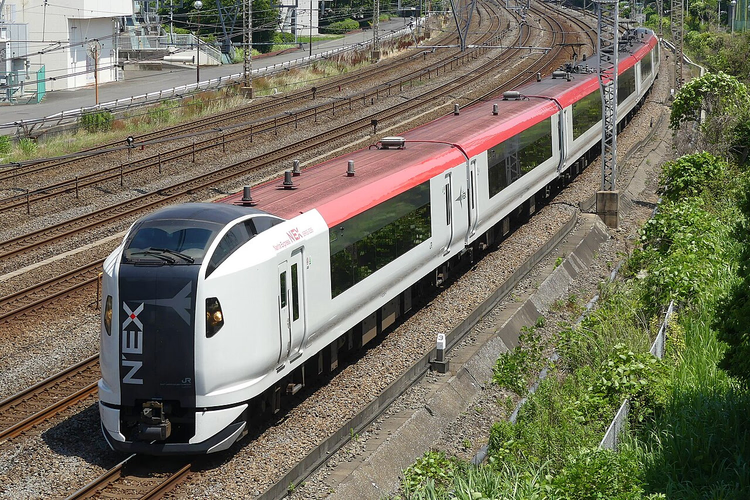 © MaedaAkihiko · CC BY-SAPhoto: MaedaAkihiko, CC BY-SA (https://creativecommons.org/licenses/by-sa/4.0), Wikimedia Commons
The ride to Tokyo Station takes about an hour, and trains depart roughly every half hour. Seats are reserved, and there are power outlets, Wi-Fi, and plenty of luggage space. A ticket to Tokyo Station costs 3,070 yen (as of 09/2026, N'EX fares), and to Shinjuku and Shibuya 3,250 yen; during peak and low seasons the amount changes by 200 to 400 yen.
After a long flight, a ride without transfers is worth a lot: you board at the terminal and get off at the station you need, without dragging your suitcase across platforms. That is exactly why N'EX is chosen by those heading to the west side of the city.
A return N'EX TOKYO Round Trip Ticket costs 5,200 yen (as of 09/2026, JR East ticket) if you return within 14 days. Tickets are digital, so you board without waiting in line at the ticket office. You can check train tickets on Trip.com in advance.
The catch: N'EX does not cover eastern Tokyo, and activating a Japan Rail Pass for a single trip into the city is not worth it.
TYO-NRT bus: the cheapest daytime option
During the day, the cheapest way to get to Tokyo is the Airport Bus TYO-NRT. The bus connects Narita with Tokyo Station and Ginza, and a daytime ticket costs 1,500 yen (as of 09/2026, TYO-NRT official website).
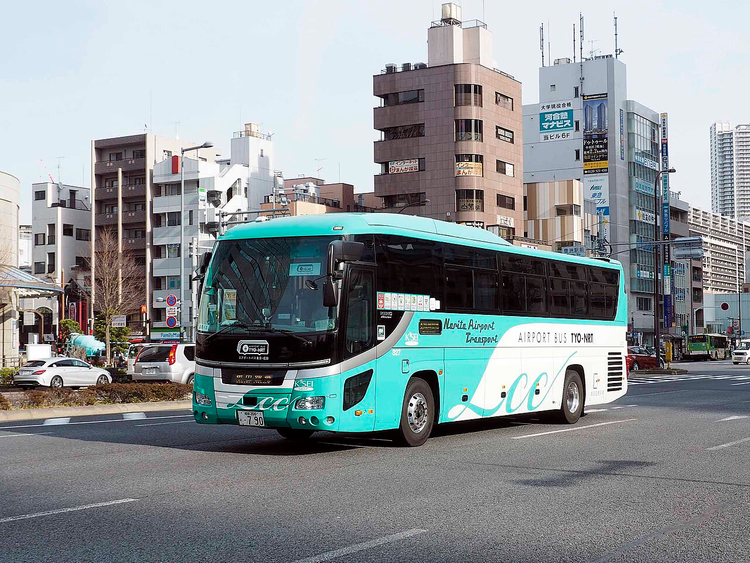 © Comyu · CC BY-SAPhoto: Comyu, CC BY-SA (https://creativecommons.org/licenses/by-sa/4.0), Wikimedia Commons
Buses run several times an hour, but on the road you are entirely dependent on traffic. According to the carrier, the minimum travel time between Tokyo Station and Narita Airport is 65 minutes, and in traffic the trip stretches to two hours.
In the evening and early morning the fare is higher, so a late arrival makes the bus less cost-effective. You buy a ticket at the counter or pay with a Suica card when boarding.
The catch: seats are not reserved, boarding is first come, first served, and one suitcase per person is subject to size limits. Take this bus if you are traveling light, are not in a hurry, and want to save money.
Airport Limousine Bus to hotels
The Limousine Bus runs every 10-30 minutes and stops at major hotels and stations: Shinjuku, Tokyo Station, Ginza, Shibuya, Ikebukuro.
The main advantage is that the bus drops you right at the hotel, which may be far from a station. You do not have to drag suitcases across platforms and look for elevators in the passageways.
The interior resembles a tour bus: soft seats, air conditioning, and a restroom. Suitcases are loaded into the luggage compartment below, so you do not touch them until you get off. Keep the baggage stub so you can collect your suitcase at the stop.
Another plus is that you see the city along the way: most trains go underground closer to the center. The fare depends on the stop, so it is best to check your rate on the official Limousine Bus website before buying.
The catch: the bus sits in the same traffic, and the trip to western Tokyo takes about two hours. If your hotel is near a station, the train will get you there faster and cheaper.
Private transfer with no connections and no stress
A private transfer costs more than all the other options, but it removes almost all the logistics. The driver meets you in the arrivals hall with a sign and takes you straight to your hotel, regardless of traffic or time of day.
You don't need to figure out an unfamiliar transit system, stand in line for a ticket, or worry about a connection. For a family or a group of four, the fixed price is often comparable to the total cost of tickets for everyone.
A metered taxi works the opposite way. The rate is the highest here, and toll roads are added on top, so a pre-booked transfer is usually cheaper. It's especially useful for late arrivals, when the last train has already left and you got stuck at passport control longer than planned.
The price is fixed and agreed before the trip, so the driver won't change it because of traffic. For a group, this ride works out cheaper than it seems based on the per-person price.
Keep a messenger app handy to reach the driver. Confirm how long they'll wait after landing if you get held up at passport control or at the baggage carousel.
Tours and tickets in Tokyo
Guided tours, skip-the-line tickets and activities — most offers can be cancelled free of charge.
See offers on KiwitaxiThe widget loads once you give your consent.
Bonus: luggage delivery to your hotel
If you land in the morning but check-in isn't until the afternoon, you can send your suitcase to the hotel using a luggage delivery service. Counters operate in the Narita arrivals halls, and your suitcase arrives at the hotel the same day or the next day.
That way you can walk around Tokyo hands-free instead of hauling bags until evening. The cost depends on the suitcase size and the address; the exact rate is quoted at the counter. For your first day in Japan, this noticeably changes your impression of the city.
Late-night arrival and lots of luggage
A late arrival changes your options. Trains and buses don't run around the clock, and after the last departure only a taxi or a pre-booked transfer remains. If your plane lands late, don't count on a cheap bus.
With luggage it's the opposite: the more suitcases you have, the more a no-connection option matters. Narita trains have enough luggage space, but a connection in the center with two suitcases at rush hour gets tiring fast.
For a family with kids and large luggage, door-to-door options work better. A private transfer and the Limousine Bus take you right to the hotel, and luggage delivery frees up your hands on arrival day.
If you're landing at night and aren't sure, price out two options: a fixed-price transfer and a metered taxi. The latter is almost always more expensive because of the nighttime surcharge and toll roads.
Allow time for passport control and baggage claim. After landing, it can take over an hour to get out of the terminal, and the last scheduled train will already be gone.
Check how late your hotel front desk is open: a late-night check-in sometimes requires a separate arrangement. Keep a phone charger handy, because you'll be opening the map, your booking, and messages to the driver while you're on the move.
⁉️🤔 Frequently asked questions
Is there a shinkansen from Narita to Tokyo?
There is no direct shinkansen from Narita. The Narita Express (N'EX) plays that role: it's comfortable and has plenty of luggage space. The N'EX takes you to Tokyo Station or Shinagawa, where you transfer to a shinkansen for Kyoto, Osaka, or other cities.
How much is a taxi from Narita to Tokyo?
A metered taxi costs more than all the other options, and toll roads are added on top. You can't name the exact amount in advance: it depends on the part of Tokyo and the time of day, and a surcharge applies at night and in the early morning. A pre-booked transfer with a fixed price is almost always cheaper.
Do I need to buy tickets in advance?
It's better to reserve a seat on the Skyliner and N'EX ahead of time, especially in high season: that way you're sure to get the departure you need. TYO-NRT and Limousine Bus sell tickets on the spot; no reservation is needed. Book a private transfer in advance so the driver is waiting in the arrivals hall.
Is Narita Airport in Tokyo?
No. Narita Airport is located in the city of the same name in Chiba Prefecture, about 60 kilometers from central Tokyo. Technically, Narita is a separate city, not a district of the capital. You get to central Tokyo by train or bus.
What to do in Narita during a long layover?
The city of Narita is home to the Buddhist temple Naritasan Shinshoji, with a long approach lined with shops. Nearby there's an old quarter with stores and restaurants, a convenient place to eat before a flight. From the airport, the train takes about 10 minutes to Narita Station. From there it's about a 15-minute walk to the temple.
Which airport is more convenient for Tokyo: Narita or Haneda?
Haneda is closer to the center, so the trip takes less time and costs less. Narita, on the other hand, is bigger: it has more shops, cafes, and flights, and tickets are sometimes cheaper. The choice depends on what matters more to you: proximity to the city or the ticket price.
In short: what to book
The choice comes down to three questions: how much time you're willing to spend, how much money, and which part of Tokyo you're heading to. If you're torn between train and bus, compare your hotel with a station map: distance from the station often matters more than price.
If you're headed to the east side of the city (Ueno, Asakusa), take the Skyliner: it's the fastest and holds your seat for you. If you're headed west (Shinjuku, Shibuya, Shinagawa), take the Narita Express: it runs without connections. If budget matters more than time, take the TYO-NRT bus. If your hotel is far from a station and you have a lot of luggage, take the Limousine Bus. If you're flying at night, with kids, or in a large group, take a private transfer with a fixed price.
Before you leave, check your arrival terminal: from Terminal 3 you first need to get to the neighboring one. And to make the trip go smoothly, book a transfer on Kiwitaxi.

A small editorial team writing guides for independent travel. We travel ourselves, but we haven’t been everywhere, so we check prices, opening hours and how to get there against official sources.