
















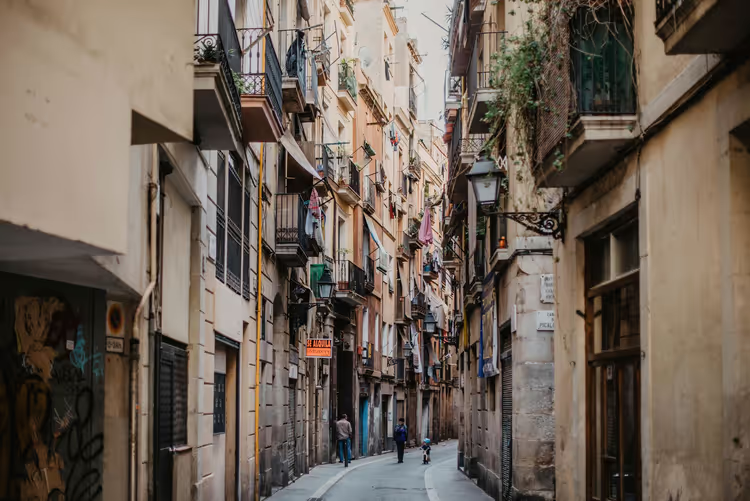
Barcelona Gothic Quarter: a route from the Roman columns to the cathedral
Gothic Quarter occupies the oldest part of Barcelona between La Rambla and the waterfront. Here you will find Roman columns, medieval palaces, and the city's main cathedral.
It is best to explore this area with a plan, because the alleys wind around. Below is a route through ten places in the quarter with opening hours, prices, and metro stations.
Ad: this article contains affiliate links, we earn a commission if you book through them, at no extra cost to you.
What to know about the Gothic Quarter
💡 In short:
- You can realistically walk this quarter route in half a day if you start in the morning.
- Admission to the Cathedral starts at 11 € (as of 09/2026, cathedral rates).
- The closest metro stations are Liceu (line L3) and Jaume I (line L4) (as of 09/2026, TMB).
The quarter stretches from Plaça Nova to the Port Vell waterfront. Its core grew up around the Roman city of Barcino, which expanded into medieval Barcelona.
The boundaries are simple. On the left the quarter is bordered by La Rambla, on the right by Via Laietana. There are almost no cars inside, so it is easy to get around on foot.
History of the quarter
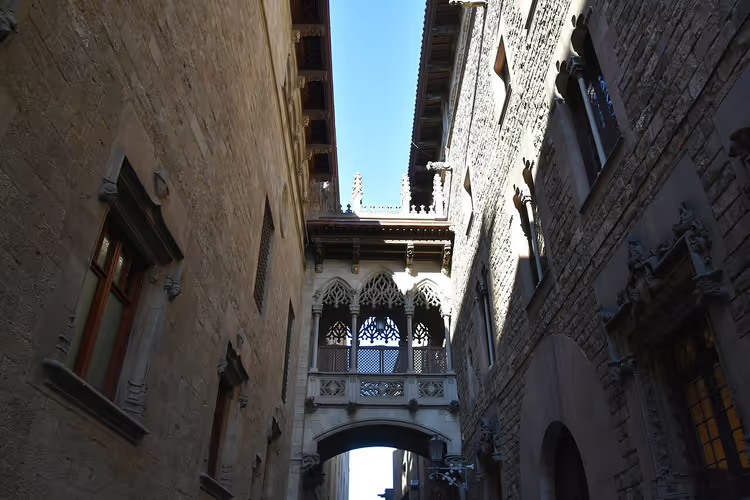
A settlement on this site was founded more than two thousand years ago. Barcino was established as a city for retired Roman legionaries, surrounded by a wall and built up with houses, temples, and baths (according to the official Barcelona tourism portal).
 © Richard Mortel from Riyadh, Saudi Arabia · CC BYPhoto: Richard Mortel from Riyadh, Saudi Arabia, CC BY (https://creativecommons.org/licenses/by/2.0), Wikimedia Commons
By the third century AD, several thousand people already lived in the city. Then the Visigoths arrived, and from the 12th century Barcino became part of the Kingdom of Aragon. That marked the start of its economic rise.
Gothic palaces and churches rose on the site of Roman buildings. You will find traces of them on every street in the quarter.
What to see in the Gothic Quarter
The Gothic Quarter is not a single attraction but a whole labyrinth of streets and squares. Below are ten places that give you a full picture of it. Follow them in order, so you do not miss the highlights.
Plaça Nova
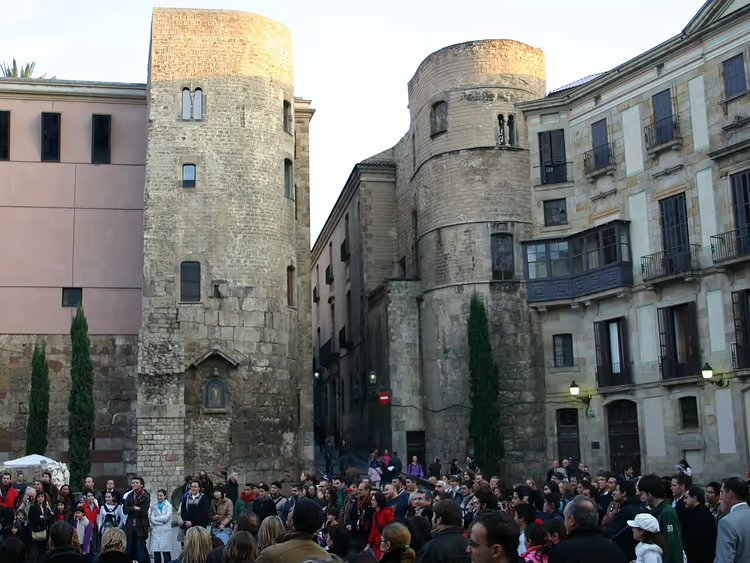
Plaça Nova opens the entrance to the quarter. The city's oldest square has been known since the 14th century: back then a market bustled here (according to the city tourist office).
 © Josep Panadero · CC BY-SAPhoto: Josep Panadero, CC BY-SA (http://creativecommons.org/licenses/by-sa/3.0/), Wikimedia Commons
You will see the Roman towers of the city wall right from the square. On the right stands the 13th-century Archbishop's Palace with its baroque facade, on the left the Archdeacon's Palace with the City History Archive.
The Col·legi d'Arquitectes stands out from the historic row. Its facade is decorated with a frieze by Pablo Picasso depicting scenes of Catalan folklore (according to the Barcelona tourist office).
Plaça de Sant Jaume
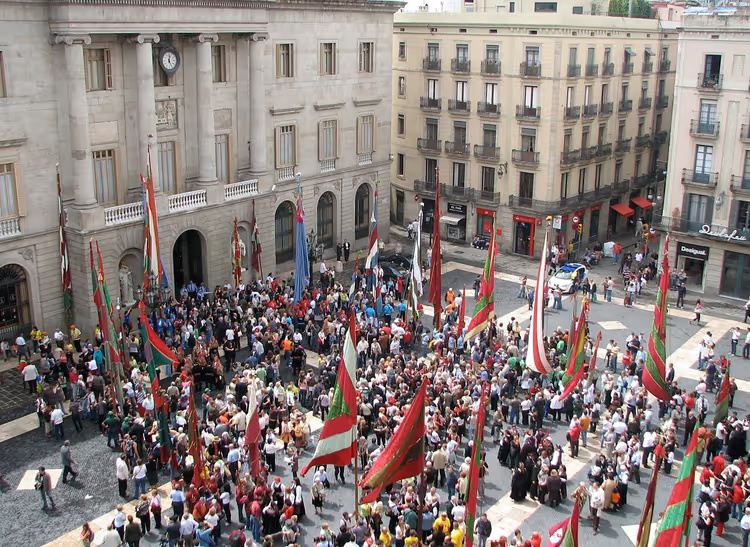
Plaça de Sant Jaume serves as the center of the quarter and of all city government. Here you will find yourself between the City Hall and the Palace of the Government of Catalonia. The square got its name from the Church of St. James, which stood here until the 19th century (according to the official tourism portal).
 © Axelv · CC BY-SAPhoto: Axelv, CC BY-SA (https://creativecommons.org/licenses/by-sa/3.0), Wikimedia Commons
In Roman times this was the forum at the crossroads of Barcino's main streets, and government has sat on this spot since the 14th century. The square got its modern appearance in the early 19th century, when the stalls were removed and the church was relocated.
Cathedral
The cathedral is dedicated to Saint Eulalia. It took more than a century to build, from 1298 to 1420, and is considered the prime example of Catalan Gothic (according to the cathedral's website).
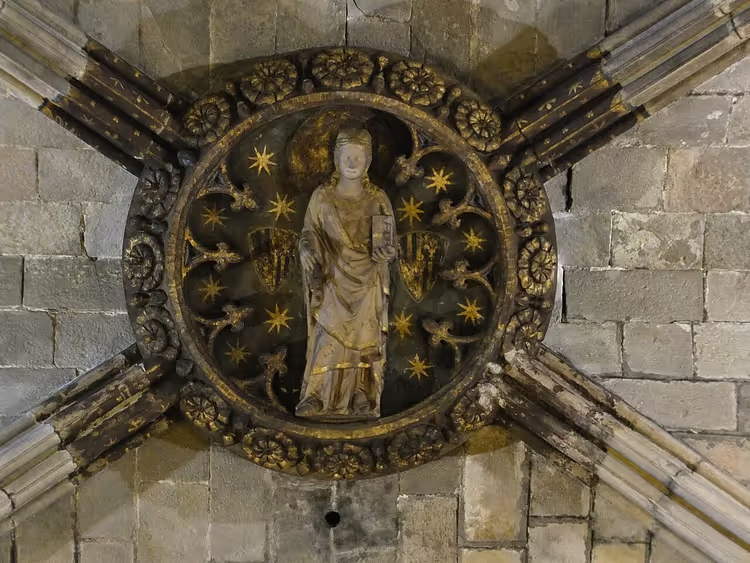 © Euku · CC BY-SAPhoto: Euku, CC BY-SA (https://creativecommons.org/licenses/by-sa/3.0), Wikimedia Commons
The facade is supported by eight bell towers, and the interior is divided into three naves. You'll see a wooden figure of Christ that was brought from the bow of a ship after the Battle of Lepanto (according to the cathedral's website).
White geese live in the inner courtyard. There are always thirteen of them, matching the age of Saint Eulalia. A marble sarcophagus with her relics has adorned the cathedral for several centuries.
Opening hours: on weekdays the cathedral is open for cultural visits from 9:30 to 18:30, with last entry at 17:45 (as of 09/2026, visit schedule). Tickets start at 11 € and include the cloister with the geese and the rooftop viewing terrace (as of 09/2026, cathedral rates).
- The catch: without a timed ticket in summer, you'll stand in line at the entrance.
Get tickets in advance: buy timed tickets on Tiqets.
Grand Royal Palace
The Grand Royal Palace (Palau Reial Major) occupies several buildings at Plaça del Rei. The main building was erected in the 12th century as a residence for counts, and later became the palace of the kings of Aragon (according to MUHBA).
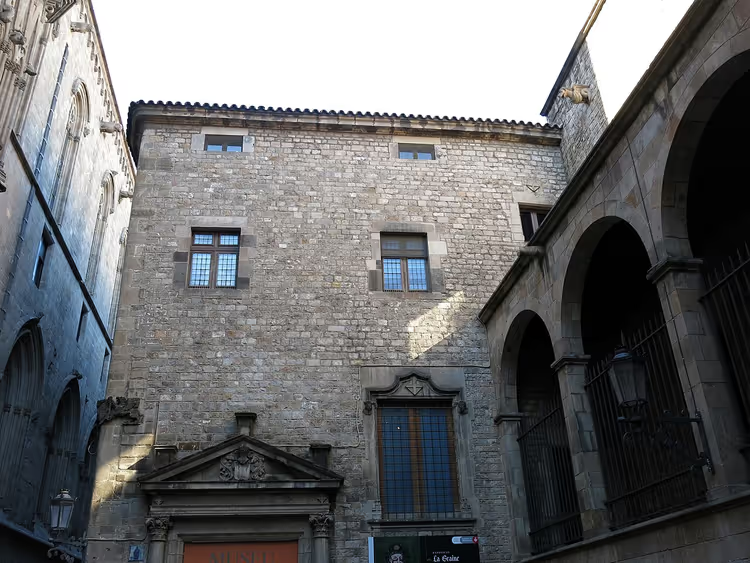 © Enfo · CC BY-SAPhoto: Enfo, CC BY-SA (https://creativecommons.org/licenses/by-sa/4.0), Wikimedia Commons
In the throne hall of Saló del Tinell at the end of the 15th century, Ferdinand and Isabella received Columbus after his first voyage (according to the tourism portal). Nearby rises the tower of Martin the Saint with 16th-century galleries and the Santa Àgata chapel with its bell tower.
City hall and the Palace of the Government
City hall (Casa de la Ciutat) brings together three buildings from different eras. Its neoclassical facade appeared in the first half of the 19th century, but behind it hides a 14th-century structure with a Gothic portal (according to the city tourism office).
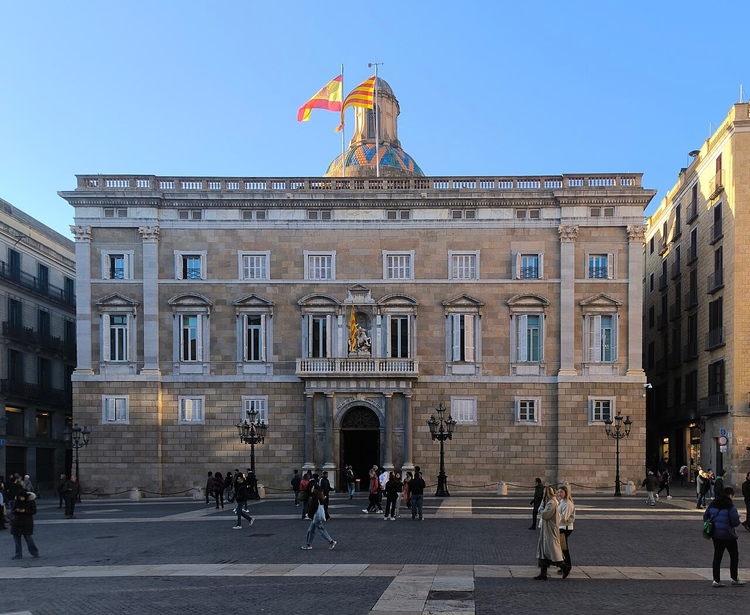 © Reda Kerbush · CC BY-SAPhoto: Reda Kerbush, CC BY-SA (https://creativecommons.org/licenses/by-sa/4.0), Wikimedia Commons
Across from it stands the Palace of the Government (Palau de la Generalitat), where the government of Catalonia works. One of its facades is in the Renaissance style, designed by Pere Blai in the late 16th century, while the other, Gothic, dates to the early 15th century.
On the Gothic facade you can make out a sculpture of Saint George, the patron saint of Catalonia, slaying the dragon (according to the Barcelona tourism office). Inside the palace is the 15th-century Chapel of Saint George.
Plaça del Rei
Plaça del Rei is a small square almost entirely enclosed by medieval buildings. It is always quiet and cool here, and you can rest at an open-air cafe.
 © Josep Bracons from Barcelona, Catalonia · CC BY-SAPhoto: Josep Bracons from Barcelona, Catalonia, CC BY-SA (https://creativecommons.org/licenses/by-sa/2.0), Wikimedia Commons
On the left is the 16th-century Palau del Lloctinent with an Italian courtyard. The king's viceroys, who governed Barcelona on his behalf, lived here. The palace now houses the Royal Archive of Aragon.
The Clariana-Padellàs Palace is home to the Museu d'Història de Barcelona (MUHBA). In the museum's basement you will see Roman streets and the remains of the Temple of Augustus. Last entry here is 45 minutes before closing (as of 09/2026, MUHBA website).
Museu Frederic Marès
Museu Frederic Marès opened in the mid-20th century in part of the Royal Palace. The sculptor Frederic Marès donated his collection to the city: sculpture, crucifixes, and crosses from antiquity to the 15th century (according to the official website).
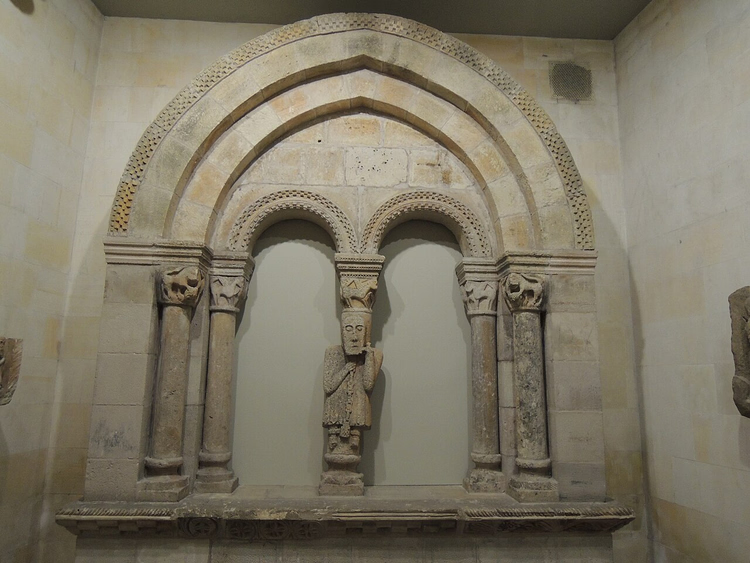 © José Antonio Gil Martínez from Vigo, Spain · CC BYPhoto: José Antonio Gil Martínez from Vigo, Spain, CC BY (https://creativecommons.org/licenses/by/2.0), Wikimedia Commons
The second and third floors are occupied by a "sentimental museum" with everyday objects from the 15th to 20th centuries: dishes, keys, postcards, and fans. Admission costs €4.40, and on the first Sunday of the month it is free (as of 09/2026, official website). Opening hours: Tue-Sat 10:00-19:00, Sunday and holidays 11:00-20:00, closed Monday.
Roman columns of the Temple of Augustus
The Roman columns of the Temple of Augustus are what remains of a large ancient temple. The temple was built in Barcino in the late 1st century BC in honor of the emperor (according to the Barcelona History Museum).
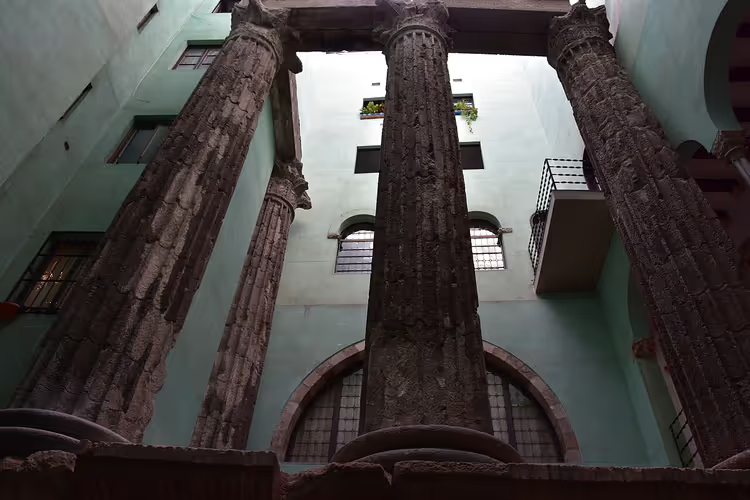 © Richard Mortel from Riyadh, Saudi Arabia · CC BYPhoto: Richard Mortel from Riyadh, Saudi Arabia, CC BY (https://creativecommons.org/licenses/by/2.0), Wikimedia Commons
Four Corinthian columns, nine meters high, have survived. You'll find them in the courtyard of the Catalan Tourist Center on Carrer del Paradís. This courtyard is located next to Plaça de Sant Jaume.
El Call Jewish Quarter
El Call occupies several narrow streets next to Plaça Nova. This is where Barcelona's Jewish community lived, kept behind a separate wall by the Christians (according to the MUHBA website).
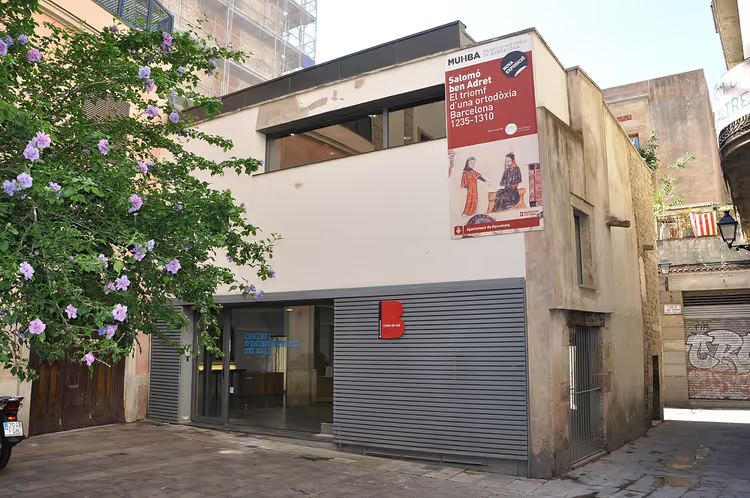 © Josep Bracons · CC BY-SAPhoto: Josep Bracons, CC BY-SA (https://creativecommons.org/licenses/by-sa/3.0), Wikimedia Commons
In the late 14th century, the quarter was destroyed during a pogrom, and the synagogue was only restored in the 20th century. Today it is active, and the Museu d'Història de Barcelona in El Call tells the story of the community's daily life.
Basílica de la Mercè
Basílica de la Mercè stands on Plaça de la Mercè and is dedicated to Our Lady of Mercy. It was built in 1765-1775 on the site of a 13th-century church (as of 09/2026, official website).
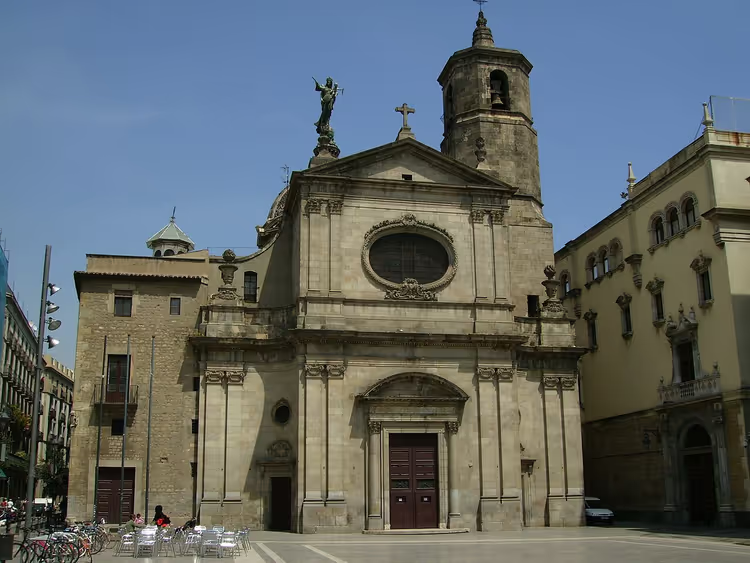
The Mercedarian order, which gave the church its name, was founded in the early 13th century to ransom Christians from captivity (according to the official website). In the late 17th century, Our Lady of Mercy became the patron saint of Barcelona, and a bronze statue of her crowns the basilica's dome.
Tours and tickets in Barcelona
Guided tours, skip-the-line tickets and activities — most offers can be cancelled free of charge.
See offers on GetYourGuideThe widget loads once you give your consent.
How to plan your walk
In summer the neighborhood gets crowded, and by midday the alleys feel tight. It is calmest early in the morning, before the shops open. Go on a weekday if you want to avoid the crowds.
Wear comfortable shoes: the pavement is uneven, and the street leading to the cathedral goes uphill. The squares have cafes where you can rest in the shade.
Do not try to cover the neighborhood in an hour. Set aside three to four hours and take your time: that way you will see the columns, the sarcophagus, and the Roman streets under the museum.
How to get to the Gothic Quarter
The neighborhood lies in the center of the old town, between La Rambla and Via Laietana. The easiest way is by metro (as of 09/2026, TMB website).
The closest stations are Liceu (line L3) on La Rambla and Jaume I (line L4) on Via Laietana. From each one it is a five to ten minute walk to the quarter. From Plaça de Catalunya you can walk there in ten minutes.
Lines L1 and L3 run above, and city buses cross the center with a stop at "Barri Gòtic". It is better to leave your car near the waterfront: you will hardly be able to drive into the quarter itself.
Gothic Quarter on the map
Below is a map of the quarter. It is handy for planning a route between the squares and the cathedral.
⁉️🤔 Frequently asked questions
How much time do you need for the Gothic Quarter?
Time estimates for the walk are given in the "How to plan your walk" section. If you go into the cathedral and the Museu d'Història de Barcelona, plan for four to five hours. The quarter itself is small, but distances feel longer because of the alleys.
How much does it cost to enter the Cathedral?
Ticket prices and opening hours are in the "Cathedral" section above. It is better to buy a ticket in advance, otherwise in summer you will stand in line.
Which metro is closest?
The closest stations and walking times are listed in the "How to get to the Gothic Quarter" section.
When is the best time to come to avoid crowds?
Early morning, before the shops open. That is when the alleys are almost empty. In summer it is already crowded after 11:00, and on weekends the squares host festivals. Weekdays are calmer for walking.
What can you see in the quarter for free?
For free you can walk through the streets of El Call, see the Roman columns of the Temple of Augustus in the courtyard on Carrer del Paradís near Plaça de Sant Jaume, and visit Plaça del Rei. The Museu Frederic Marès is free on the first Sunday of the month.
In short: what to book
You can cover the Gothic Quarter in half a day. Start at Plaça Nova, save the Cathedral for the middle, and finish at Basílica de la Mercè.
If you want to hear the stories behind the streets, book a Gothic Quarter tour on GetYourGuide.

A small editorial team writing guides for independent travel. We travel ourselves, but we haven’t been everywhere, so we check prices, opening hours and how to get there against official sources.