
















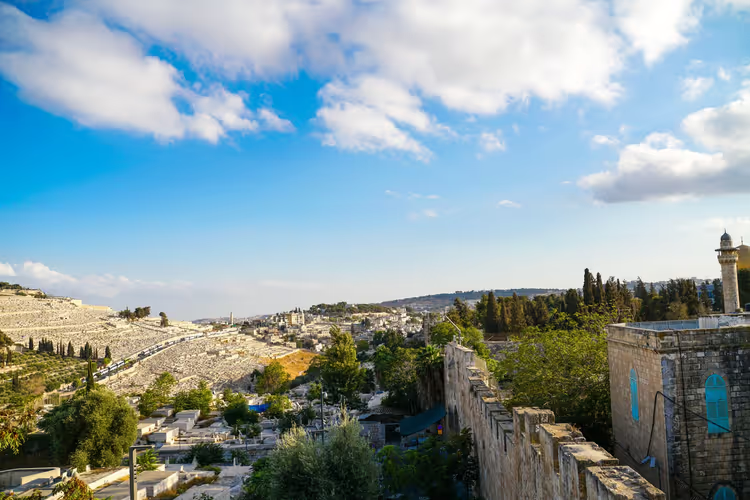
40 Attractions in Jerusalem: what to see in the Old City and around
The Old City of Jerusalem covers less than one square kilometer. You can walk around it in a day, but you won't be able to see everything in a single visit. We've put together 40 of the main Jerusalem attractions: from the Garden of Gethsemane and the Western Wall to the Israel Museum and the Chords Bridge.
An adult ticket to the Israel Museum costs 54 ILS (as of 09/2026, tickets and opening hours). Entry to the Western Wall and the Church of the Holy Sepulchre is free. Everything else depends on the area: half of the sites lie inside the city walls, half outside them.
Below you'll find a breakdown by area, opening hours, how to get there, and the honest catch of each place.
Ad: this article contains affiliate links, we earn a commission if you book through them, at no extra cost to you.
Overview: how to plan your visit
💡 In short:
- More than half of the sites are inside the Old City walls, and they're easy to cover in one long day.
- A dozen important places lie outside the walls: the Mount of Olives, Yad Vashem, the Israel Museum, the Mahane Yehuda market.
- Museum prices and opening hours: 09/2026, verified on the Israel Museum website and the Yad Vashem website.
Area | What to see | When to go |
|---|---|---|
Christian Quarter | Church of the Holy Sepulchre, Via Dolorosa, Basilica of St. Anne | early morning |
Muslim Quarter | Damascus, Lions' and Golden Gates, Dome of the Rock, al-Aqsa | before noon |
Western Wall and tunnels | Western Wall, Western Wall Tunnel, City of David | separate visit |
Mount Zion | Cenacle, Dormition Abbey, Church of St. Peter | before sunset |
Mount of Olives | Garden of Gethsemane, Church of All Nations, Mary Magdalene, Pater Noster | evening |
City center and west | Israel Museum, Knesset, Mahane Yehuda, Yad Vashem, Chords Bridge | day off |
1. Garden of Gethsemane
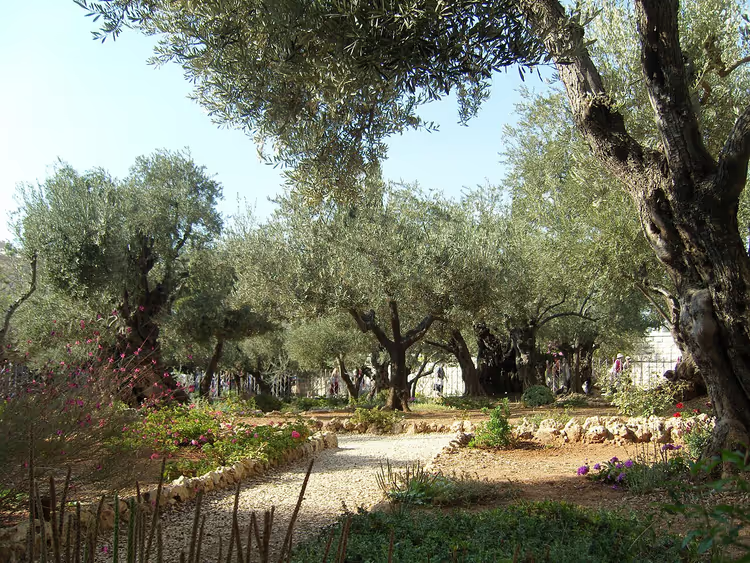 © Mewasul · CC BY-SAPhoto: Mewasul, CC BY-SA (https://creativecommons.org/licenses/by-sa/3.0), Wikimedia Commons
The Garden of Gethsemane lies at the foot of the Mount of Olives, in the Kidron Valley. According to the Gospel account, Jesus prayed here on the night before his arrest while his disciples slept. The old olive trees are considered living witnesses to those events: a tree can regrow even from a root fragment, so the garden renews itself.
Next to it stands the Church of All Nations with a mosaic on its pediment. Go early in the morning; during the day tour groups arrive and the paths get crowded. From the Lions' Gate the descent takes about 15 minutes (on the map), and the climb back up is harder.
The garden belongs to the Franciscans, and entry is free. Paths are laid between the beds, and you can walk around the site in twenty minutes. You can't go beyond the fence; the olive trees are protected as a relic.
- How to get there: from the Lions' Gate down through the Kidron Valley, then follow the signs.
- The catch: there's almost no shade, so bring water in summer.
2. Mount Zion
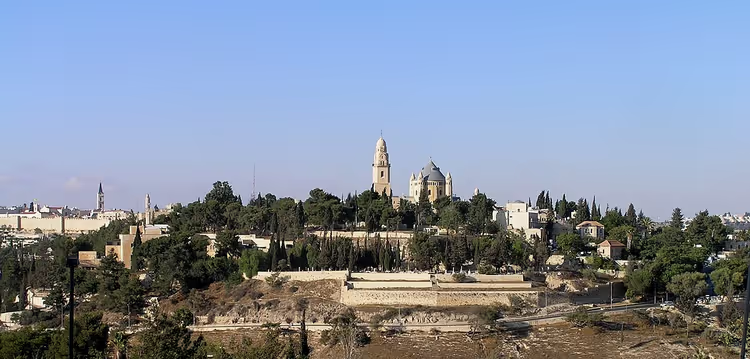
Zion is called a mountain, although in reality it's a low hill south of the Old City. The first Christian communities of Jerusalem lived here. The slopes are home to the Cenacle, Dormition Abbey, and the Church of St. Peter in Gallicantu.
Walk up to King David's Tomb: historians dispute the authenticity of the burial, but the building is open to visitors. From there, continue on foot; cars rarely pass through the narrow lanes. You'll spend half a day visiting all three churches, so don't leave Zion for the last hour.
- The catch: the Cenacle's opening hours change, so check them in advance.
3. Western Wall
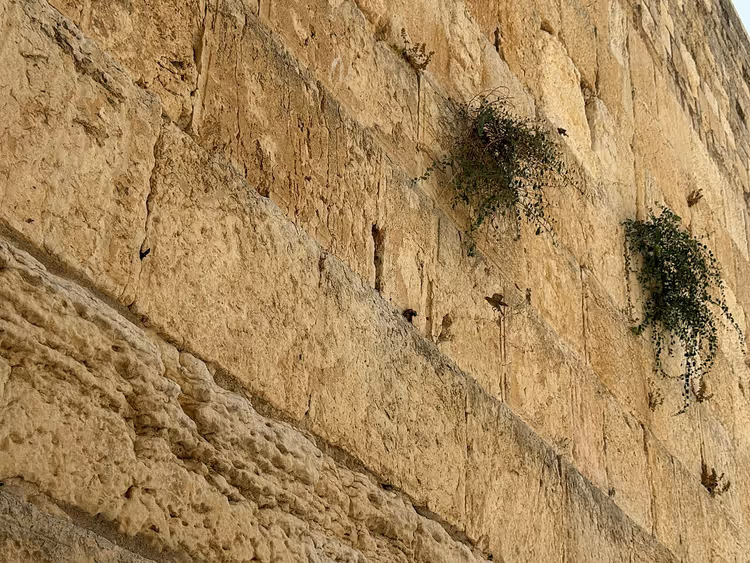 © שלמה רודד · CC BYPhoto: שלמה רודד, CC BY (https://creativecommons.org/licenses/by/2.5), Wikimedia Commons
The Western Wall is the surviving remnant of the Temple Mount retaining wall, built under King Herod. The blocks are dressed and laid without mortar, which is why the masonry has held for two thousand years. People come here to pray around the clock, and entry is free for everyone.
Men are given a kippah at the entrance; women should bring a headscarf. You can leave a note with a request between the stones, that is a local tradition. Come at dawn, when you can stand quietly by the wall instead of pushing through tour groups.
- How to get there: about a 10-minute walk from Jaffa Gate (follow the map).
- The catch: during the day there are many groups at the stones, so do not expect silence.
4. Via Dolorosa
 © Diego Delso · CC BY-SAPhoto: Diego Delso, CC BY-SA (https://creativecommons.org/licenses/by-sa/3.0), Wikimedia Commons
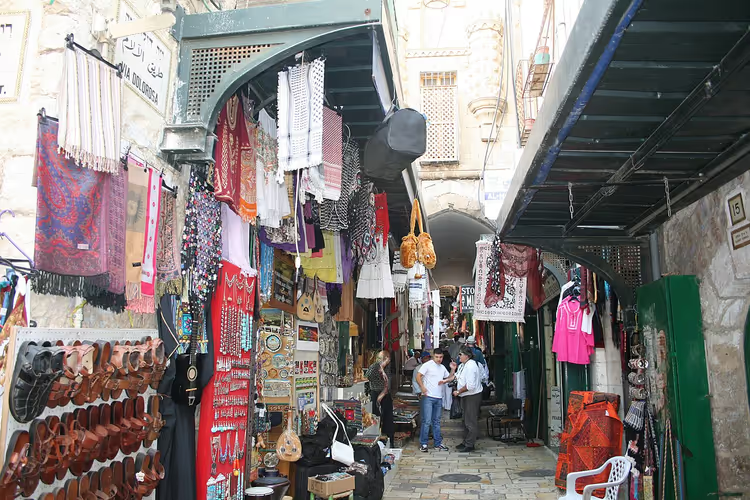
The Via Dolorosa runs through the entire Old City, from the Lions' Gate to the Church of the Holy Sepulchre. According to tradition, this is the path along which Christ was led to his execution at Golgotha. Fourteen stations are marked by chapels, bell towers, and monasteries.
On your own, you can walk the route in an hour, but you will miss half of its meaning without a guide. The best time for the walk is early morning: the merchants have not yet opened their stalls, and the pilgrims have not yet arrived. Wear comfortable shoes, the stones are polished and slippery.
- The catch: in summer the stones get very hot, so bring water with you.
5. Damascus Gate
 © Berthold Werner · CC BY-SAPhoto: Berthold Werner, CC BY-SA (https://creativecommons.org/licenses/by-sa/3.0), Wikimedia Commons
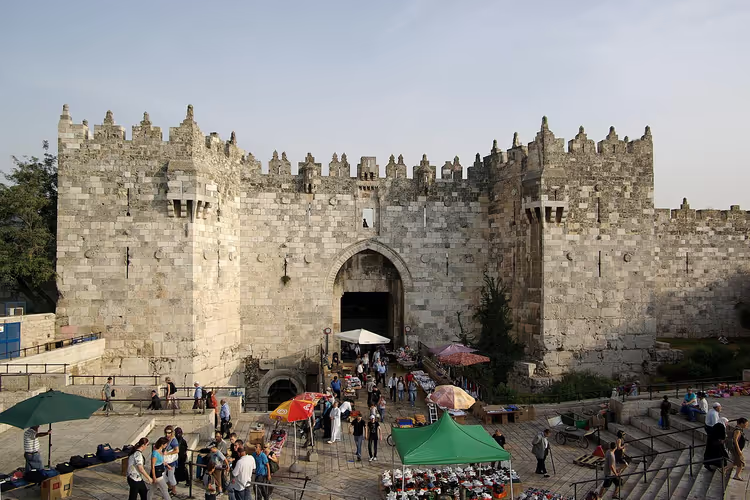
Damascus Gate opens into the Muslim Quarter from the north side. It was first built by the Romans, and its current appearance with two towers dates from the era of Suleiman the Magnificent. From morning to evening, a stream of people and goods flows through the arch.
Inside the complex there is a history museum and underground passages. This is a convenient starting point for a route to the Western Wall or the Via Dolorosa. Spend some time at the market by the entrance: spices, sweets, and cookware are sold directly from the shops.
- The catch: in the evening the area is noisy and crowded; with children it is better to go during the day.
6. Ticho House
 © Talmoryair · CC BY-SAPhoto: Talmoryair, CC BY-SA (https://creativecommons.org/licenses/by-sa/3.0), Wikimedia Commons
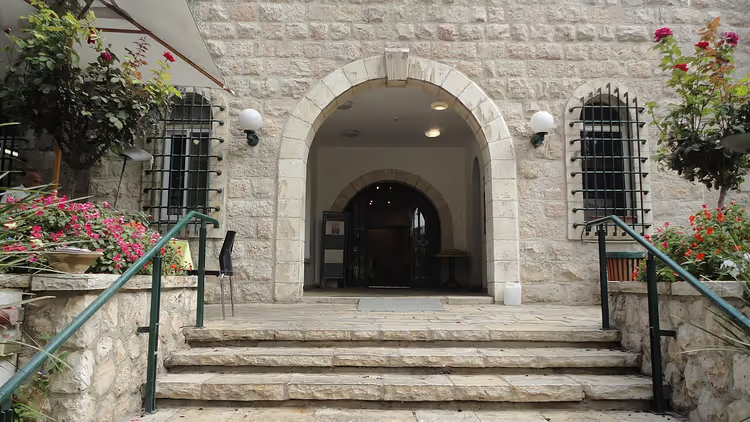
Ticho House stands outside the Old City, on Jaffa Street. The late 19th-century mansion became a center of Jerusalem's cultural life in the 20th century. The artist Anna Ticho and her husband, the physician Avraham Ticho, lived here and left the house to remain a place of art.
Today the building houses a museum with changing exhibitions, and concerts are held in the evenings. On the ground floor there is a cafe with a courtyard. You can stop here on your way from the Mahane Yehuda Market to the city center; no separate trip is needed.
- The catch: the galleries are small, so check the schedule before a concert.
7. City of David
 © Eitan cohen · CC BY-SAPhoto: Eitan cohen, CC BY-SA (https://creativecommons.org/licenses/by-sa/4.0), Wikimedia Commons
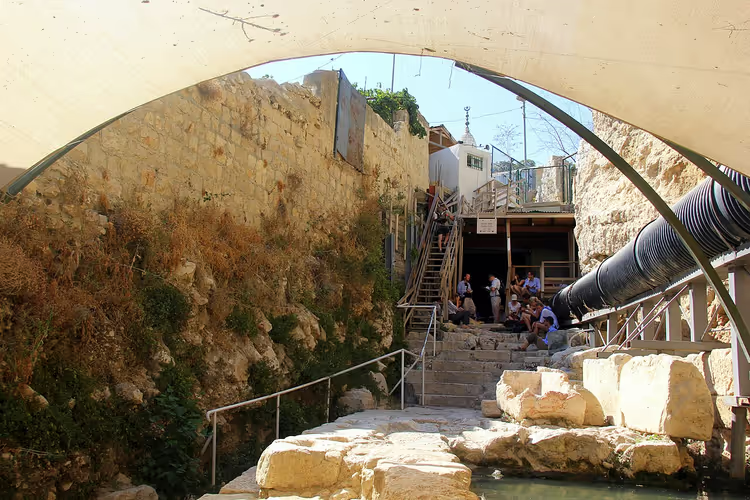
The City of David is an archaeological park on the site of the earliest Jerusalem. The city was founded here three thousand years ago, and excavations continue to this day. An adult ticket costs from 45 ILS (as of 09/2026, City of David tickets).
Inside the park there is a visitor center with a ticket office and a souvenir shop. Guided tours run on a schedule, and you can build your own self-guided route. In summer, bring a hat: there is almost no shade at the excavation site.
The visit is divided into two parts: the ruins with watchtowers and the underground tunnel from the 8th century BC. Walking through the ruins takes up to two hours; the tunnel goes faster. You will be offered the dry Canaanite route or the wet Hezekiah's Tunnel, where the water reaches your waist.
- How to get there: through the Dung Gate, then left following the signs.
- The catch: the wet tunnel does not allow open shoes with slippery soles.
8. Akeldama
Akeldama translates as the Field of Blood. Tradition links the site to Judas's thirty pieces of silver. Burials of pilgrims and foreigners were held here to keep diseases from spreading through the overcrowded city.
Akeldama acquired its current appearance in the 19th century. A terrace with rock-cut tombs hangs over the Valley of Hinnom. Entry is free, but it is customary to leave a donation at the gate. Spend some time at the observation point: from here you can see Gehenna in its entirety.
- The catch: this is an active and quiet site, so loud tours are out of place here.
9. Church of the Holy Sepulchre
 © https://www.flickr.com/photos/jlascar/ · CC BYPhoto: https://www.flickr.com/photos/jlascar/, CC BY (https://creativecommons.org/licenses/by/2.0), Wikimedia Commons
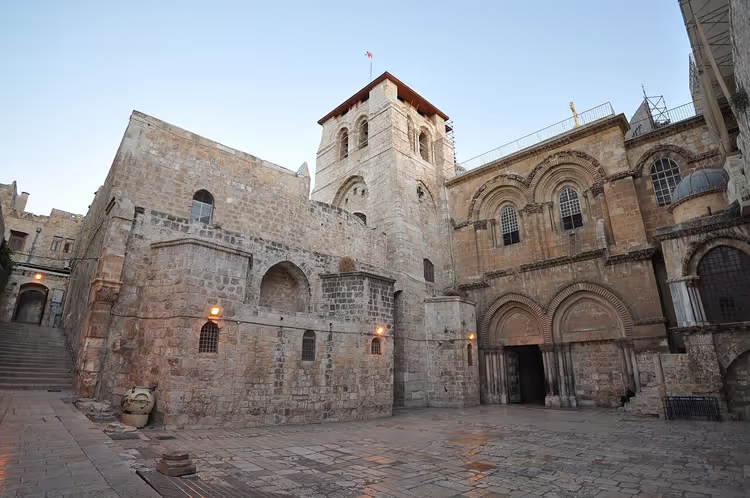
The Church of the Holy Sepulchre, Christianity's holiest site, stands on the place of Christ's crucifixion and burial. Over two thousand years, the building has burned repeatedly, changed owners, and been rebuilt. At the base of the masonry lie the remains of a Roman temple to Venus.
The complex is maintained by six denominations, so services run on a schedule and often follow one another. Entry is free, the doors are open from early morning to evening, and the hours change by season. The Aedicule with Christ's burial bed is protected by a marble slab from attempts to chip off a fragment.
- The catch: the line to the Aedicule in the morning can stretch to an hour or more.
10. Rockefeller Museum
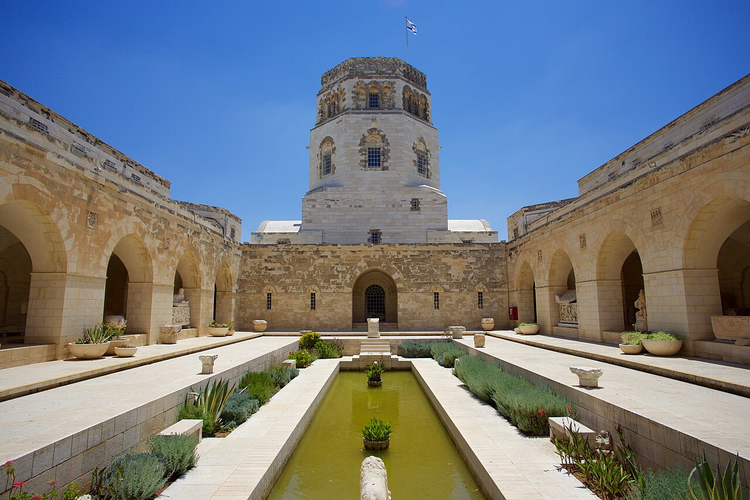
The Rockefeller Archaeological Museum opened in 1938 with funding from an American philanthropist. It houses finds from Jerusalem, Megiddo, and Samaria, spanning from the Stone Age to the Mamluk period. During construction, workers stumbled upon ancient tombs, and these also became part of the exhibition.
 © Zachary Ka-Tsun Wong · CC BY-SAPhoto: Zachary Ka-Tsun Wong, CC BY-SA (https://creativecommons.org/licenses/by-sa/4.0), Wikimedia Commons
Admission is free, which makes the museum a convenient stop on the way to the Lions' Gate. It opens at ten in the morning and closes at varying times, usually after noon. Buses 1, 3, and 51 will get you there from the center in a few minutes.
- The catch: the schedule is inconsistent, so check the hours before your visit.
11. Golden Gate
The Golden Gate remains the only sealed gate of the Old City. Tradition holds that Christ entered Jerusalem through it on a donkey. Suleiman the Magnificent ordered the opening to be walled up with stones and a Muslim cemetery to be built nearby.
You cannot walk through the arch, but it is worth a closer look. The two arches with carved ornaments are called the Gate of Mercy and the Gate of Repentance. You will see them from the outside of the eastern wall, on the side of the Kidron Valley.
- The catch: the nearest public transport stop is far away, so plan to walk.
12. Lions' Gate
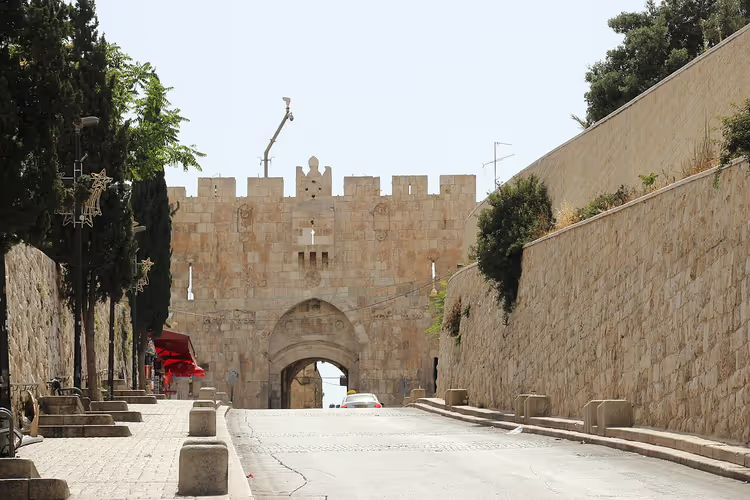
The Lions' Gate adorns the eastern section of the city wall. It was built in the 16th century by order of Suleiman the Magnificent. The name took hold in the 19th century thanks to the bas-reliefs of lions on both sides of the arch.
This gate is a convenient way to enter the city and head straight to the Via Dolorosa. That way you start the route from the first station rather than the middle. Bring your group in the morning: by midday the passage is clogged with cars and merchants' carts.
- The catch: there is no parking nearby, so leave your car outside the walls.
13. Western Wall Tunnel
 © Susanna Feldman · CC BY-SAPhoto: Susanna Feldman, CC BY-SA (https://creativecommons.org/licenses/by-sa/4.0), Wikimedia Commons
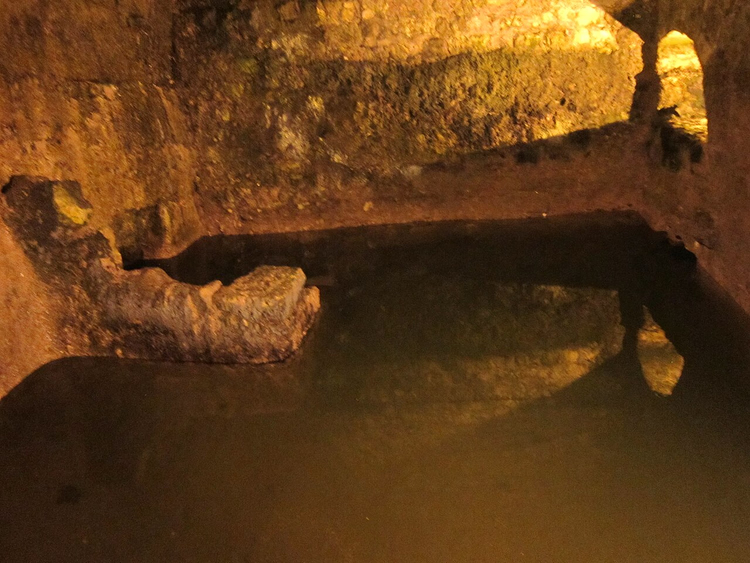
The Western Wall Tunnel runs beneath the Muslim Quarter along the Temple Mount. It was discovered by British archaeologists in the 19th century. The tour lasts about an hour and costs roughly 40-45 ILS (as of 09/2026, schedule and tickets).
Groups are organized by language, with sessions available in English and Russian. The descent into the tunnel begins at the Western Wall, so there is no need to look for a separate entrance. Children under five get in free, but you still need to reserve a ticket for them in advance.
Underground you will see monolithic blocks of Herodian masonry, an ancient water channel, and a cave synagogue. One stone block weighs hundreds of tons and is still called the Master Stone. Book ahead: in high season, available slots run out several days in advance.
- The catch: without a reservation, you will most likely be turned away on the spot.
14. Valley of Hinnom
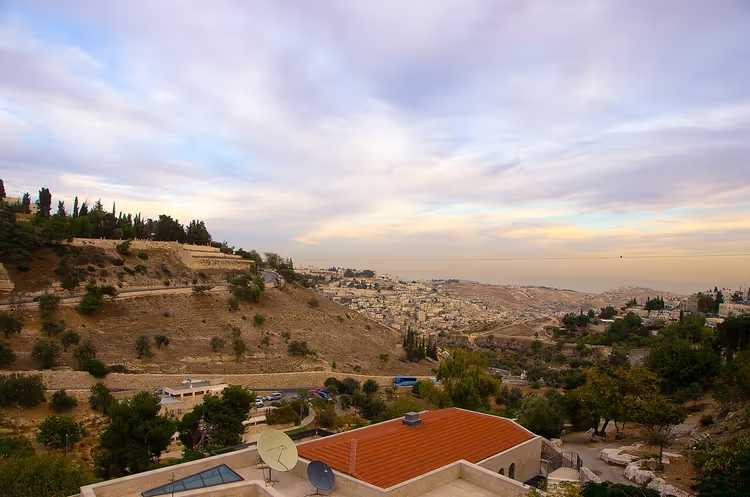 © Michal Levinsky · CC BY-SAPhoto: Michal Levinsky, CC BY-SA (https://creativecommons.org/licenses/by-sa/3.0), Wikimedia Commons
The Valley of Hinnom stretches between Mount Zion and the Abu Tor neighborhood. In ancient times, garbage and the bodies of executed criminals were burned here, which gave the place the name Gehenna of Fire. For believers, it became a symbol of the threshold of hell.
Today, trails wind along the slopes among conifers and rocks. You will see the ruins of old burial caves and monastery remains. The valley floor can be crossed in an hour, but steep sections require proper footwear.
- The catch: there is almost no shade in the heat, so plan your walk for the evening.
What to bring with you
Jerusalem is a walking city, so footwear matters more than clothing. The stone streets of the Old City are polished smooth, and new sneakers will make you slip. Bring broken-in shoes with thick soles and spare socks.
Bring a hat and a water bottle from April through October. There is little shade in the Old City, and the climb up the Mount of Olives takes effort. Refill water at machines and fountains; it is cheaper than buying bottles at the gates. Sunscreen is useful even in winter.
Bring a light wrap or a large scarf. In churches, mosques, and at the Western Wall, bare shoulders and knees are inappropriate, and women sometimes need a head covering. Men are given a kippah at the Western Wall, but having your own is more reliable.
Keep cash in shekels handy. Cards are accepted at museums, hotels, and larger cafes, but in small shops and at the market, paying in cash is easier. Small bills come in handy for water, snacks, and donations.
A power bank and an offline map will save you in the Old City. Internet sometimes drops out in the narrow alleys, and navigation in unfamiliar quarters can be unreliable. Save the map and tickets in advance so you do not depend on a connection.
How to get from the airport
Israel's main air gateway, Ben Gurion Airport, lies between Tel Aviv and Jerusalem. You can reach the city by train, bus, or taxi. The train arrives at an underground station near the Central Bus Station, from where it is easy to walk to the market and the tram.
The train is faster than the bus and does not get stuck in traffic. But it does not run on Shabbat and holidays, so plan differently for a late Friday arrival. The airport bus runs on a schedule, and shared taxis will take you to your address when public transport has stopped for the day.
Taxis and ride-hailing apps operate around the clock, but the trip drags on during rush hour. Keep your hotel address in Hebrew or Latin script; many drivers struggle with Cyrillic. Clarify payment terms before getting in: fixed fares and meters vary from driver to driver.
Booking a transfer from the airport in advance is convenient, especially if you are traveling with children or a lot of luggage. The driver will meet you in the arrivals hall and take you to the door of your hotel. That way you will not have to hunt for transport after a long flight.
15. Yad Vashem
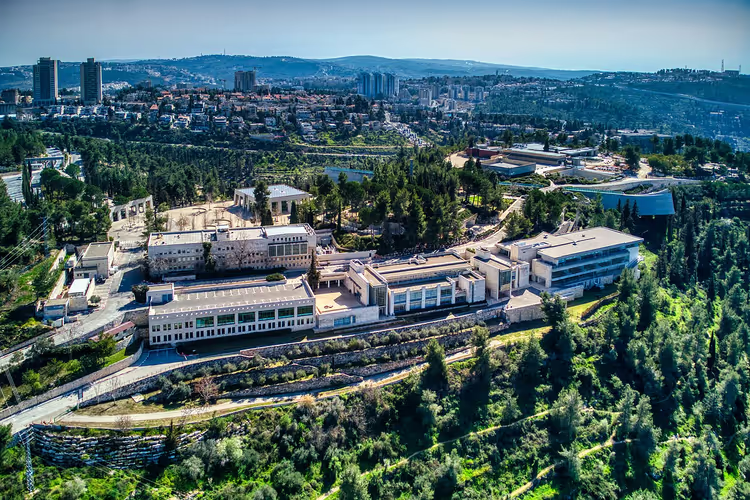 © Hagai Agmon-Snir حچاي اچمون-سنير חגי אגמון-שניר · CC BY-SAPhoto: Hagai Agmon-Snir حچاي اچمون-سنير חגי אגמון-שניר, CC BY-SA (https://creativecommons.org/licenses/by-sa/4.0), Wikimedia Commons
Yad Vashem spreads across the slope of Mount Herzl and covers 18 hectares. It is the national memorial to the victims of the Holocaust. Admission to all pavilions is free, but for the museum it is recommended to reserve a visit time in advance (as of 09/2026, official website).
The central feature of the complex, the Hall of Remembrance, shelters the Eternal Flame under a basalt canopy. The names of death camps and sites of mass executions are engraved on the black floor. The park's paths are filled with sculptures and obelisks. Allow at least two hours for your visit.
- The catch: children under ten are not admitted to the Holocaust History Museum.
16. Via Dolorosa
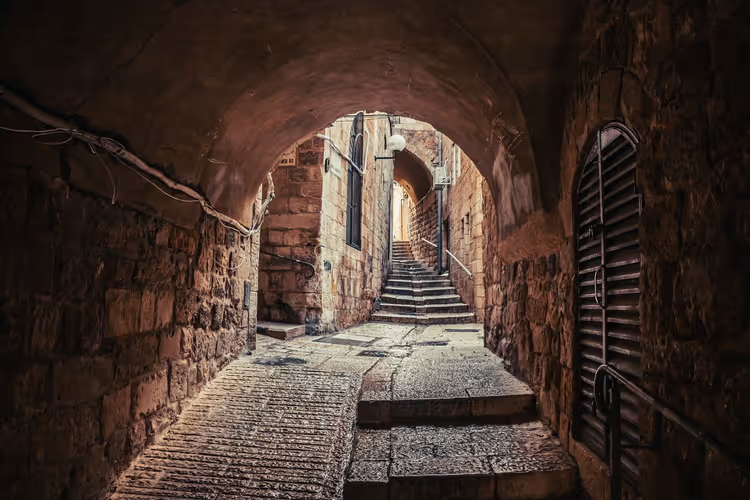
The Via Dolorosa, the Latin name for the Way of Sorrow, today looks like an ordinary market street. Shops selling dishes, spices, and souvenirs line the entire stretch of pavement. Nine of the fourteen Stations of the Cross are located right here.
The bustle makes it hard to take in the route, so choose early morning or late evening. By then the vendors have dispersed and the stone street empties out. The significant stations are marked by chapels and carved signs on the walls.
- The catch: during the day, you will not be able to walk the street quickly.
17. Jewish cemetery on the Mount of Olives
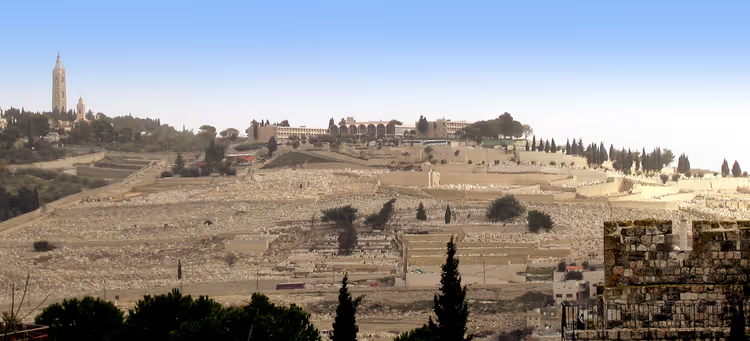 © The original uploader was תמרה at Hebrew Wikipedia . · CC BYPhoto: The original uploader was תמרה at Hebrew Wikipedia ., CC BY, Wikimedia Commons
The Jewish Cemetery on the Mount of Olives, one of the most revered in the world, grew on the slope two and a half thousand years ago. More than one hundred and fifty thousand graves made of Jerusalem stone stand on its terraces. The tombs of Old Testament prophets are also located here.
Plots on the upper tiers are bought up decades in advance, so there are almost no vacant spots. You will only see the outer row of headstones; visitors do not enter the fenced-off sections. From the cemetery there is a view of the Kidron Valley and the domes of the Old City.
- The catch: respect the nature of the site; photo shoots at the graves are inappropriate.
18. Mount of Olives observation deck
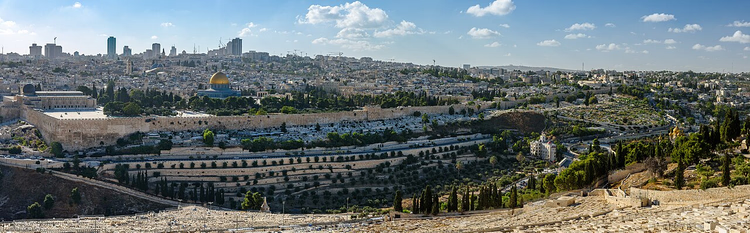
The observation deck at the top of the Mount of Olives serves as the classic first stop on the route. From here the city opens up in full: the Temple Mount, the Dome of the Rock, the minarets and bell towers of the Old City. The Kidron Valley reads as a distinct feature as well.
Go up to the terrace at sunset, when the light falls on the stone and turns the dome golden. Morning is also good here, but the sun hits the lens. Anyone can reach the deck; the climb requires no special fitness.
- The catch: at sunset, a line forms at the railing for the best shot.
19. The Garden Tomb
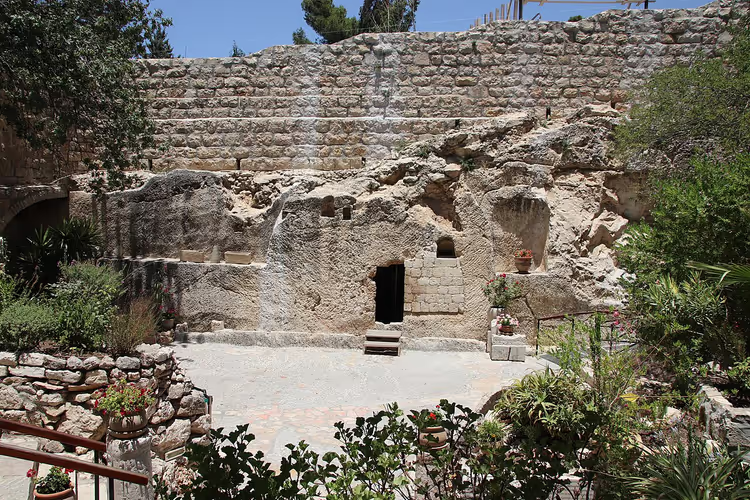
The Garden Tomb serves as a Protestant alternative to the Church of the Holy Sepulchre. The site was discovered in the 19th century by British General Charles Gordon. A rock with crevices reminded him of a skull, so he connected the site with Golgotha.
Excavations here uncovered an ancient tomb, an olive press, and the remains of a winery. Research dates the burial to the 8th-6th centuries BC, meaning before the time of Christ. A well-kept garden surrounds the site, where you can rest on a bench under the trees. Admission is free.
- The catch: the grounds close early, so arrive well before the end of the day.
20. Tomb of the Virgin Mary
 © Юкатан · CC BY-SAPhoto: Юкатан, CC BY-SA (https://creativecommons.org/licenses/by-sa/3.0), Wikimedia Commons
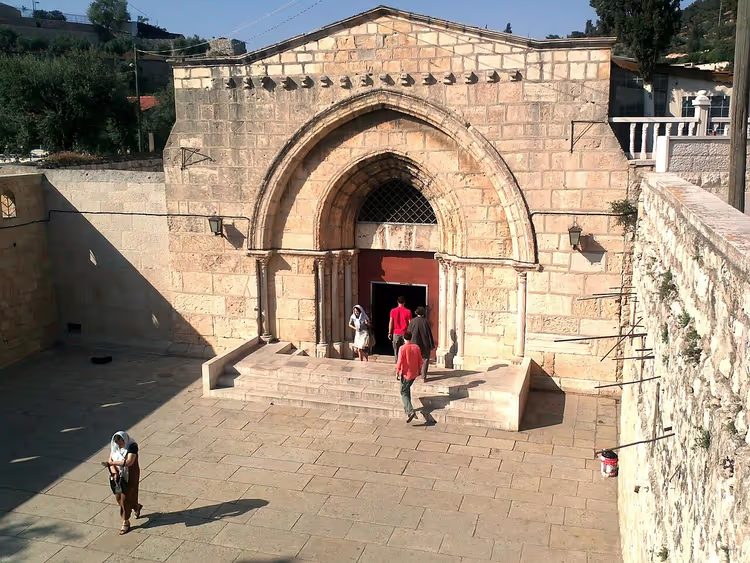
The Tomb of the Virgin Mary is tucked away at the foot of the Mount of Olives, in the Kidron Valley. Above ground, only an arched portal is visible; the church itself is carved into a cave. A wide staircase of 48 steps leads down from the entrance.
Underground, you are greeted by hundreds of oil lamps and ancient icons in gilded frames. Soot on the walls gives the halls a dim, solemn look. The basilica was built under Emperor Constantine and later restored by the Crusaders. Entry is free; modest dress is required.
- The catch: the descent is steep and slippery, so hold onto the handrail.
Getting around Jerusalem
The Old City is closed to cars, so you explore it only on foot. Inside the walls there are no buses or trams, and you can only drive up to the gates. Outside the walls, public transport runs reliably, with one caveat, more on that below.
There is a single tram line, running from Pisgat Ze'ev through the center to Mount Herzl. It gets you quickly from the Central Station to the Mahane Yehuda Market and the Israel Museum. Buses connect the center with the Mount of Olives, Yad Vashem, and the zoo. Tickets are sold at stop machines and in the operator's app.
From the Central Bus Station to Jaffa Gate is about a 20-minute walk (on the map). Taxis and ride-hailing apps operate around the clock, but they do not enter the Old City. The most convenient way to see outlying areas is to rent a car for the day or take a bus.
The main caveat concerns Shabbat. From Friday evening to Saturday evening, public transport does not run, and some shops and cafes are closed. Plan long trips for weekdays. On Saturday, you are left with walking routes, taxis, and areas like Mahane Yehuda, where life does not fully stop.
Dress code and visiting rules
Many places in Jerusalem have clothing requirements. In churches and mosques, you will be asked to cover your shoulders and knees, so bring a light wrap in summer. At the Western Wall, men are given a kippah at the entrance, and women should bring a headscarf or shawl. Shorts and open tops are inappropriate at holy sites.
Religious items, food, and drinks are not allowed onto the Temple Mount, and bags are checked at the entrance. Non-Muslims are admitted only during certain hours and through a separate passage near the Western Wall. Tourists are not allowed inside the mosques themselves, the Dome of the Rock and al-Aqsa, at all. Access rules change, so check them on the day of your visit.
Services of different denominations take place in the Church of the Holy Sepulchre, so some halls are closed at times. Be quiet, do not block passageways, and do not disturb worshippers. Photography is usually allowed, but tripods and flash are often asked to be put away in churches. At Yad Vashem, children under ten are not admitted to the History Museum.
21. Dome of the Rock
 © Мазур Владимир · CC BY-SAPhoto: Мазур Владимир, CC BY-SA (https://creativecommons.org/licenses/by-sa/4.0), Wikimedia Commons
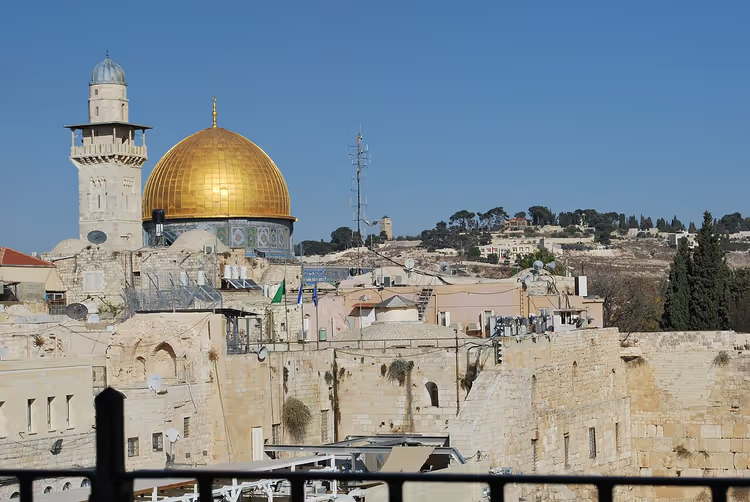
The Dome of the Rock rises on the Temple Mount and serves as the main landmark of the Old City. The mosque was built in the late 7th century on the rock from which, according to tradition, the Prophet Muhammad ascended to heaven. The golden dome, twenty meters in diameter, is visible from anywhere.
The octagonal building is clad in colored ceramic tiles, and the windows are filled with stained glass. Inside, two rows of marble columns surround the sacred Rock. Non-Muslims are allowed onto the Temple Mount only during certain hours and through a separate entrance.
- The catch: during prayer times and on Fridays, tourist access is closed.
22. Al-Aqsa Mosque
 © Godot13 · CC BY-SAPhoto: Godot13, CC BY-SA (https://creativecommons.org/licenses/by-sa/4.0), Wikimedia Commons
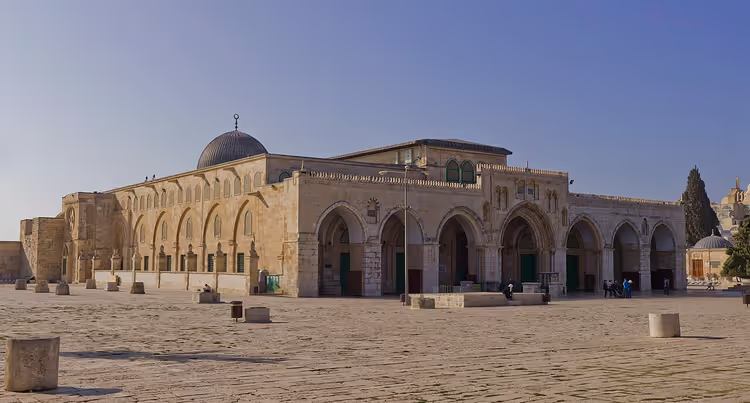
Al-Aqsa Mosque, together with the Dome of the Rock, forms a single complex on the Temple Mount. Construction was completed in 705. It is one of the largest and most significant mosques in the Muslim world.
The main hall is supported by marble columns and seven galleries, and it holds about five thousand worshippers. The floors are covered with red carpets, and the walls and ceilings are decorated with patterned paintings. Outside, the facade is pierced by dozens of arched stained-glass windows. Only Muslims are allowed inside the mosque, so you will have to settle for viewing it from outside.
- The catch: access to the grounds depends on the current situation, so check before your visit.
23. Church of Saint Anne
 © Chris06 · CC BY-SAPhoto: Chris06, CC BY-SA (https://creativecommons.org/licenses/by-sa/4.0), Wikimedia Commons
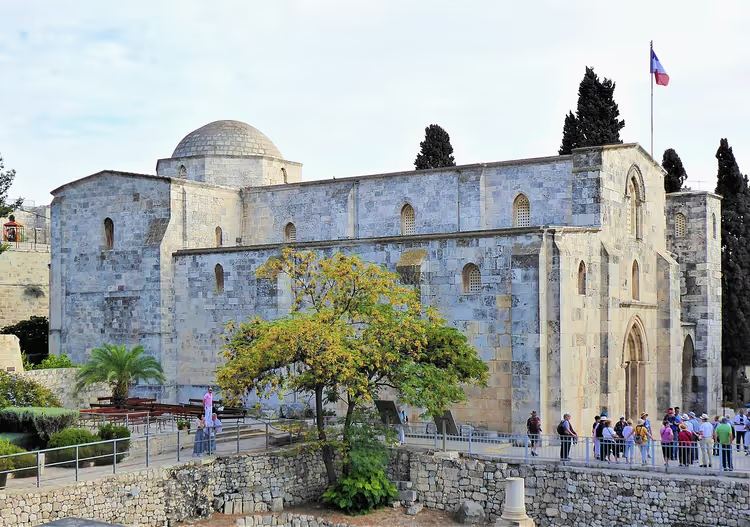
The Church of Saint Anne stands at the beginning of the Via Dolorosa, near the Lions' Gate. The Crusaders built it in 1142. The site is associated with the home of Joachim and Anne, the parents of the Virgin Mary.
The Romanesque walls with massive pillars resemble a fortress. The interior is austere: three chapels, a marble altar, and high vaults. Nearby, the Pool of Bethesda with its columns has been preserved. Inside, you will be asked to keep quiet; the hall is used for prayer.
- The catch: at the entrance, you are asked to cover your shoulders and knees.
24. Church of All Nations
 © xiquinhosilva · CC BYPhoto: xiquinhosilva, CC BY (https://creativecommons.org/licenses/by/2.0), Wikimedia Commons
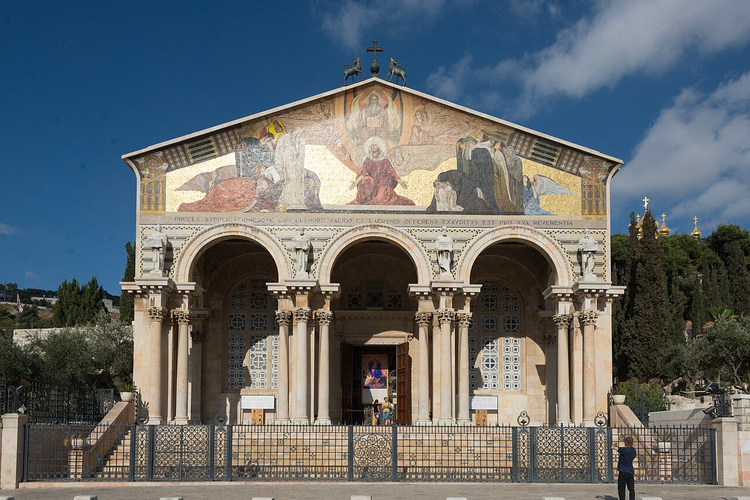
The Church of All Nations stands by the Garden of Gethsemane, on the site of Christ's night prayer before his arrest. Construction was funded by twelve nations, hence the name. The basilica was consecrated in the first half of the 20th century.
Twelve gray domes crown the roof, and the pediment is decorated with a mosaic depicting scenes from the Savior's final days. Inside, behind a wrought-iron railing, lies a fragment of the rock where Christ prayed. Pink-toned marble columns and stained glass give the hall a solemn look. Go before the tour groups arrive, meaning in the morning.
- The catch: in the evening, the church closes earlier than the nearby Garden of Gethsemane.
25. Abbey of the Dormition
 © Путеводитель по Изра… · CC BY-SAPhoto: Путеводитель по Изра…, CC BY-SA (https://creativecommons.org/licenses/by-sa/3.0), Wikimedia Commons
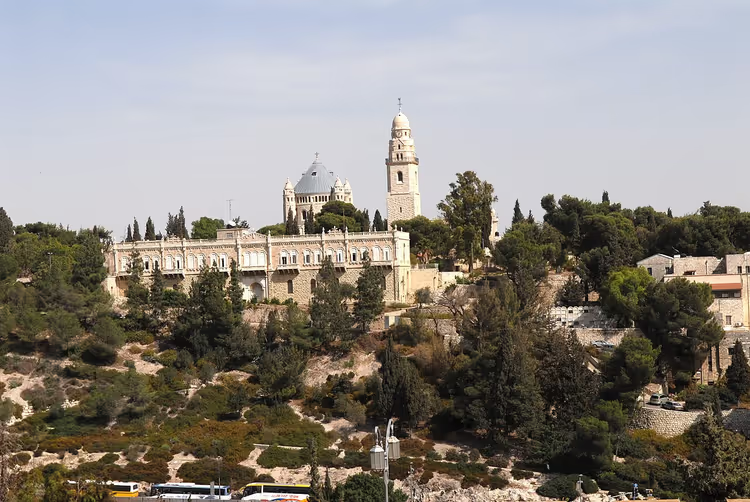
The Abbey of the Dormition occupies the summit of Mount Zion. German Catholics began construction in the late 19th century. According to tradition, this is where the Virgin Mary ended her earthly life.
The round building of light brick resembles a medieval castle with towers and narrow windows. In the crypt is a sculpture of the Virgin Mary made of ivory and wood. The main altar is surrounded by six chapels with mosaics. The visit takes less than an hour, so you can combine it with the Cenacle.
- The catch: entry to the active monastery is limited during service times.
26. The Cenacle
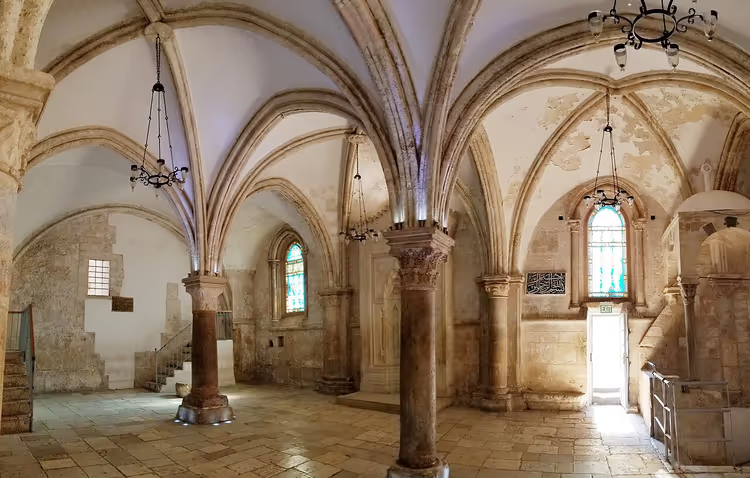 © אושרה דיין · CC BYPhoto: אושרה דיין, CC BY (https://creativecommons.org/licenses/by/2.5), Wikimedia Commons
The Cenacle preserves the memory of Christ's Last Supper with his disciples. The room on Mount Zion became the prototype for the first Christian churches. The current two-story building was erected by the Crusaders in the 12th century; nothing remains of the original hall.
Gothic arches, white vaults, and a stone floor recreate the atmosphere of the sacred meal. You climb to the second floor via a short staircase. Directly below the hall is the Tomb of King David, so both sites are visited in one go.
- The catch: the Cenacle closes in the evening; morning hours are the most convenient.
27. Church of saint peter in gallicantu
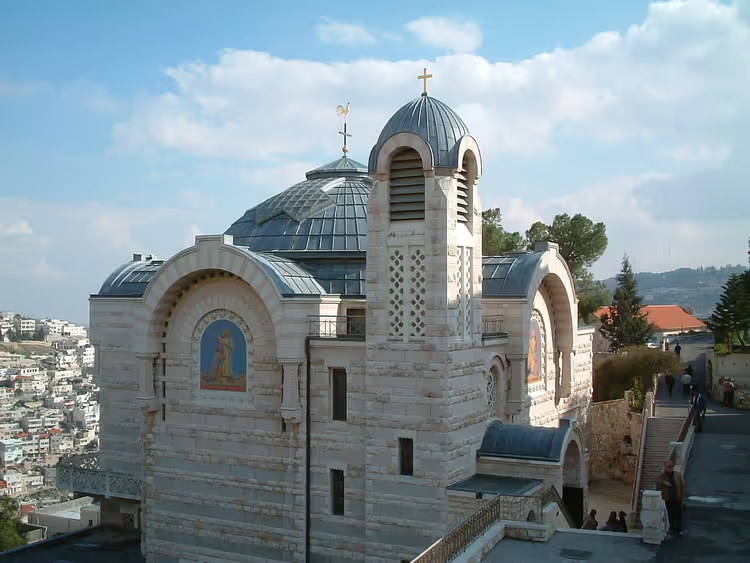 © Victor Rivera Melendez · CC BY-SAPhoto: Victor Rivera Melendez, CC BY-SA (http://creativecommons.org/licenses/by-sa/3.0/), Wikimedia Commons
The Church of Saint Peter in Gallicantu stands on the eastern slope of Mount Zion. The name translates as "at the cock's crow." Here the Apostle Peter denied Christ three times before the rooster crowed.
The basilica was built in the 1930s on the site of a Byzantine church. The building forms an equilateral cross in plan under a massive dome. The facade is decorated with stained glass, relief stonework, and paintings, while the interior is covered with mosaics of biblical scenes. A gilded rooster is mounted on the dome. Admission is free.
- The catch: the church is active, so visits are limited during services.
28. Church of the Pater Noster
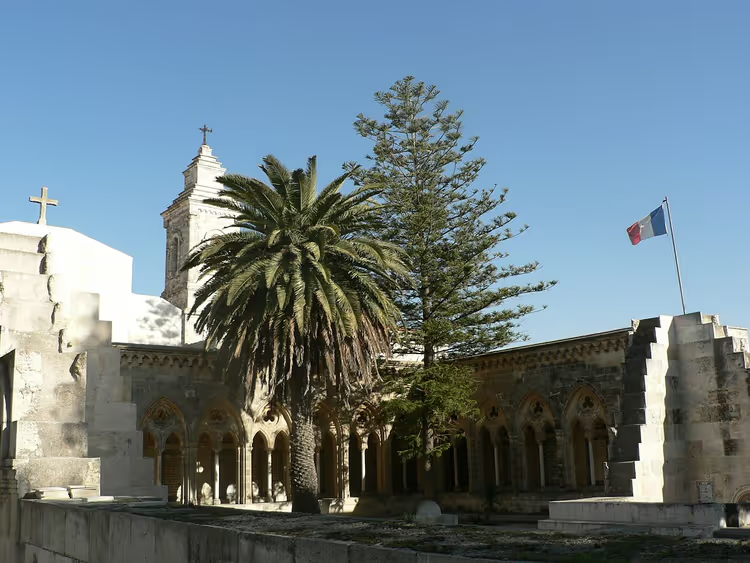 © W. Robrecht · CC BY-SAPhoto: W. Robrecht, CC BY-SA (http://creativecommons.org/licenses/by-sa/3.0/), Wikimedia Commons
The Church of the Pater Noster is dedicated to the prayer Christ taught his disciples. It stands above a cave on the Mount of Olives where, according to tradition, this took place. The first church was founded in the 4th century by Saint Helena and later destroyed by the Persians.
Its revival began in the 19th century with funds from the French aristocrat Aurelia de Bossi. The main feature of the interior is ceramic plaques with the text of the prayer in different languages. There are about 140 of them, including Slavic lines. You will be led through a Gothic gallery around the courtyard.
- The catch: the plaques are scattered across the walls, so take your time looking for your language.
29. Church of St. Mary Magdalene
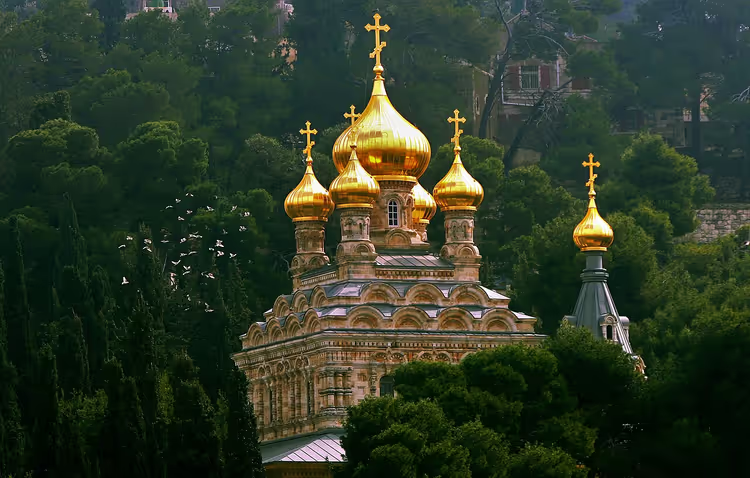 © Jamal Aruri · CC BY-SAPhoto: Jamal Aruri, CC BY-SA (https://creativecommons.org/licenses/by-sa/4.0), Wikimedia Commons
The Church of St. Mary Magdalene rises among the evergreen forest on the slope of the Mount of Olives. The construction was initiated by Emperor Alexander III, who dedicated the church to the memory of his mother. The building is made of sand-colored Jerusalem stone.
Seven golden domes of different sizes and a tented bell tower are clearly visible from the city wall. Inside, you will find wall paintings, frescoes, and a marble iconostasis. Near the altar hangs a panel titled "St. Mary Magdalene before the Roman Emperor Tiberius." The dress code is strict: cover your shoulders and knees.
- The catch: entry is usually open in the morning; the grounds close in the afternoon.
30. The Knesset
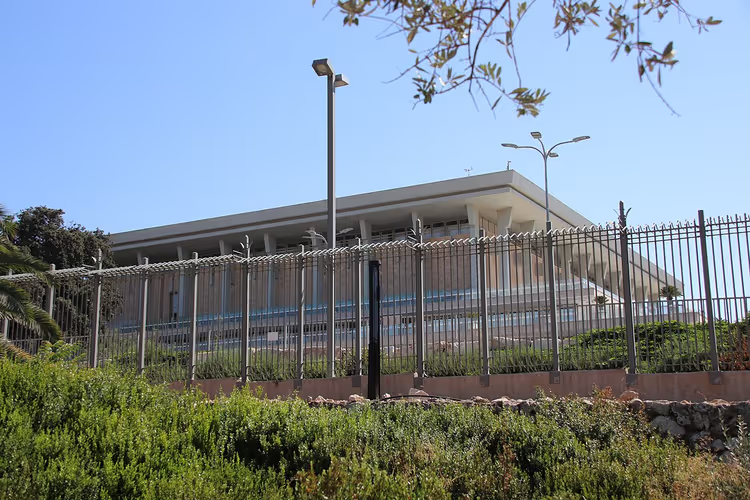
The Knesset serves as the parliament of Israel and sits in the western part of the city. The chamber houses 120 members, elected by direct vote. The members pass laws and form the government.
The seven-story building is clad in Jerusalem limestone, with columns supporting the roof canopy over the facade. Marc Chagall worked on one of the halls: he created mosaic panels and tapestries. Tourists are admitted only on a guided tour by prior reservation. Bring your passport; it is checked at the entrance.
- The catch: without a reservation you will not be allowed inside, so plan your visit in advance.
31. Mahane Yehuda Market
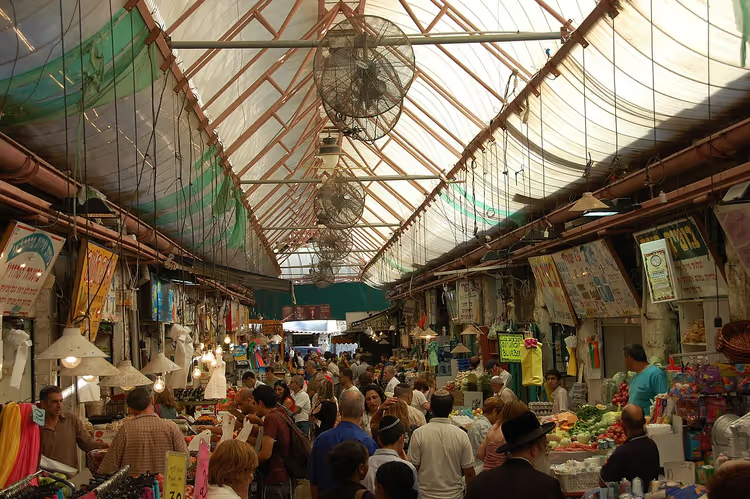
Mahane Yehuda Market occupies an entire block between Jaffa Street and the city center. It is Jerusalem's main bazaar, not just a produce market. The labyrinth of stalls stretches from fish counters to jewelry displays.
Here you can buy vegetables, fruit, spices, cheeses, baked goods, and dried fruit. Vendors loudly call out to shoppers, and the aromas of coffee and sweets compete with each other. You will find eateries, bars, and pastry shops where locals themselves eat. Come in the morning for fresh goods or in the evening for the atmosphere.
- The catch: on Friday afternoon the market closes until the end of Shabbat.
32. Bible Lands Museum
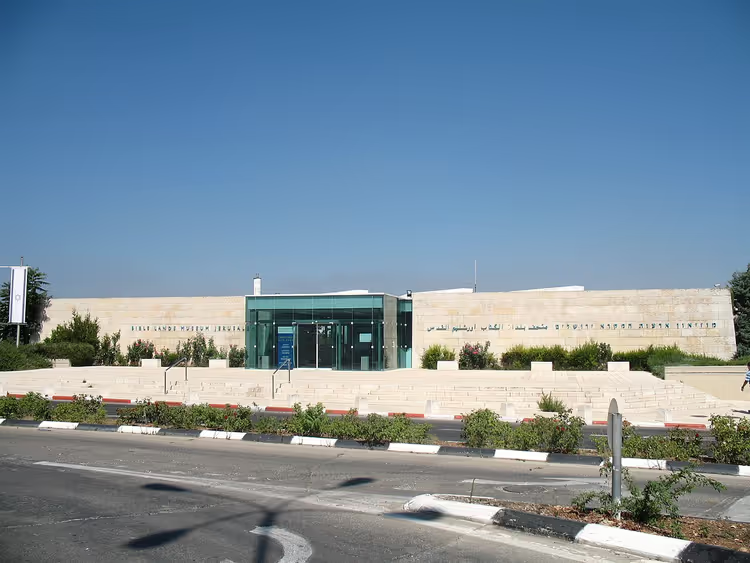
The Bible Lands Museum has gathered artifacts of the Middle East in a single building of Jerusalem limestone. The exhibition tells the story of thousands of years of history, philosophy, and religion of the peoples of the region. The collection is divided into 21 thematic sections.
Among the exhibits you will see clay pottery, idol figurines, seals, coins, weapons, and ancient manuscripts. Jewelry, Egyptian sarcophagi, and stone reliefs are displayed separately. Some objects are more than three thousand years old. The museum stands next to the Israel Museum, so both can be visited in one day.
- The catch: the museum is closed on Saturdays, so check the hours in advance.
33. Israel Museum
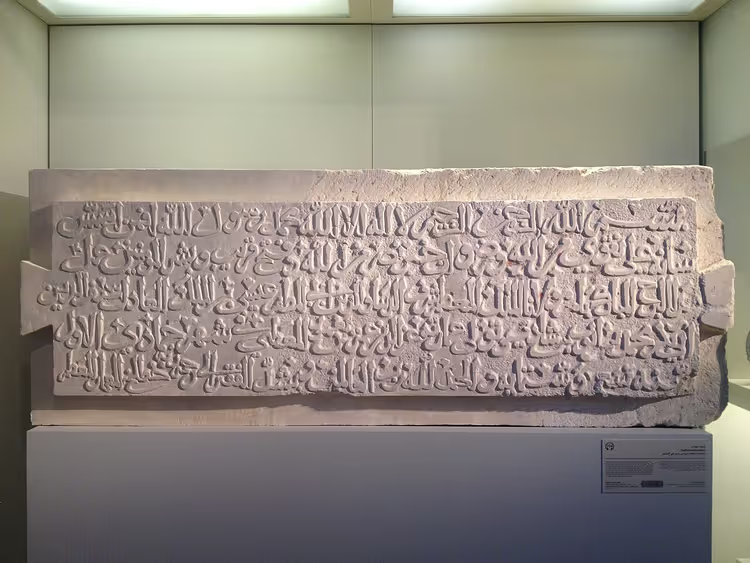
The Israel Museum, the country's main cultural institution, holds about half a million objects. The collection covers archaeology, fine art, Judaica, and ethnography. The complex occupies an area of 50,000 square meters.
An adult ticket costs 54 ILS (as of 09/2026, official website). The Shrine of the Book with the Dead Sea Scrolls and the model of Jerusalem in the Second Temple period deserve special attention. Allow at least three hours for your visit. Jerusalem museum tickets on Tiqets are convenient to compare in advance.
- The catch: on Saturdays the ticket office operates on a special schedule, so check the hours.
34. Bloomfield Science Museum
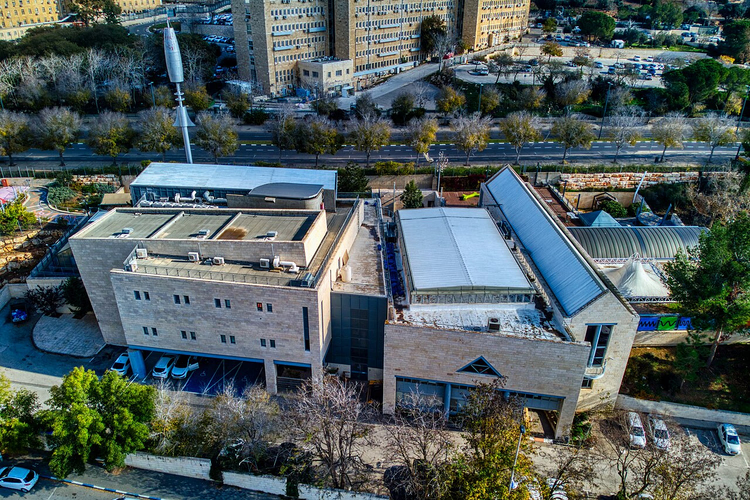 © Hagai Agmon-Snir حچاي اچمون-سنير חגי אגמון-שניר · CC BY-SAPhoto: Hagai Agmon-Snir حچاي اچمون-سنير חגי אגמון-שניר, CC BY-SA (https://creativecommons.org/licenses/by-sa/4.0), Wikimedia Commons
The Bloomfield Science Museum is aimed primarily at children and families. It is an exhibition of interactive exhibits covering more than five thousand square meters. It presents the laws of physics, chemistry, and electricity in a playful way.
Visitors are allowed to touch, turn, push, and rock the exhibits. Some mechanisms run on sunlight or magnetic fields. The museum is one block from the Israel Museum, which is convenient for families.
- The catch: on weekends the halls are packed with school groups.
35. Montefiore Windmill
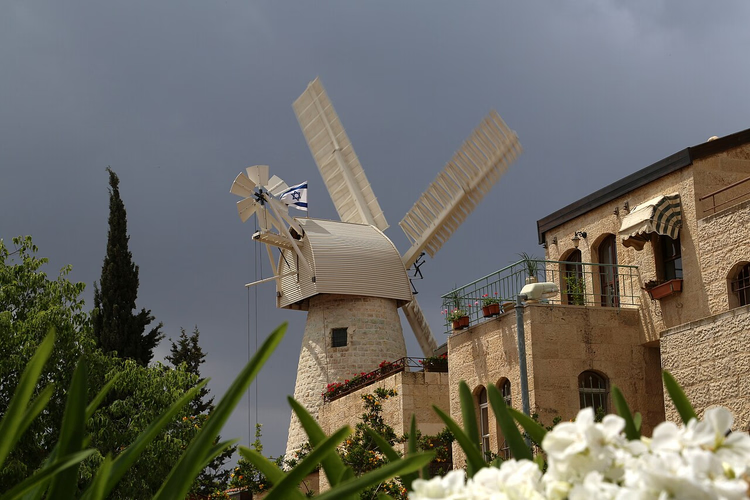 © Meirbarel · CC BY-SAPhoto: Meirbarel, CC BY-SA (https://creativecommons.org/licenses/by-sa/3.0), Wikimedia Commons
The Montefiore Windmill recalls the first neighborhood built outside the walls of the Old City. British financier Moses Montefiore bought the plot from a wealthy Muslim in the 19th century. Residential buildings, synagogues, and a garden soon rose nearby.
The windmill was intended to provide residents with cheap flour, but the location turned out to be windless and the venture failed. Today it is a monument in a quiet park in the Mishkenot Sha'ananim neighborhood. Inside, a small museum about Montefiore's life features books, photographs, and personal belongings. A visit takes about half an hour.
- The catch: the climb to the windmill is uphill, which is tiring in the heat.
36. Museum for Islamic Art
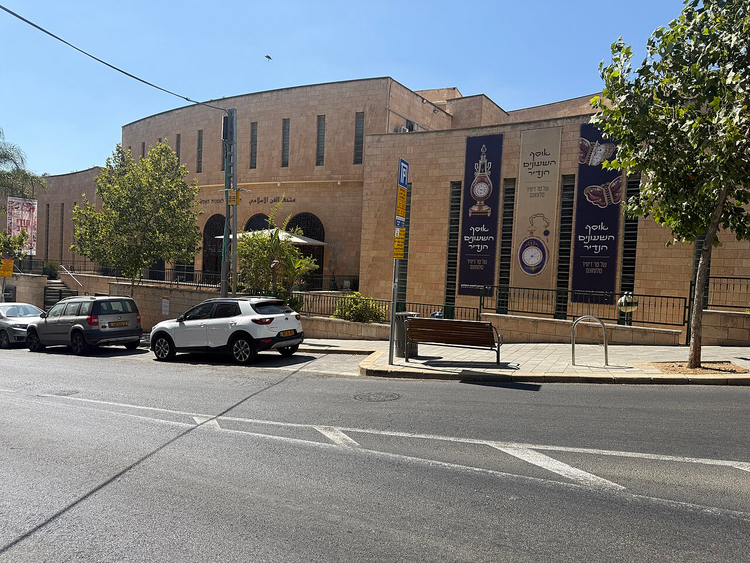 © שלמה רודד · CC BYPhoto: שלמה רודד, CC BY (https://creativecommons.org/licenses/by/2.5), Wikimedia Commons
The L. A. Mayer Museum for Islamic Art opened in 1974 and houses a collection of objects from the Muslim world. Its nine galleries display textiles, ceramics, weapons, tableware, manuscripts, and jewelry. The museum is dedicated to the memory of Professor Leo Aryeh Mayer, who studied Islamic art.
A particular pride of the collection is its assortment of clocks and mechanical devices, including rare eighteenth-century pieces. You will see belts, bracelets, earrings, and tiaras with gold, emeralds, and pearls. The exhibition is compact, and an hour and a half is enough to see it. The museum is located near the Israel Museum.
- The catch: the museum is closed on Saturday and opens later on weekdays.
37. Heichal Shlomo Museum
The Heichal Shlomo building was constructed in 1958 and for a long time served as the residence of Israel's Chief Rabbinate. Today it houses a museum of Jewish history and culture. The exhibition includes ritual objects, furniture, ornaments, clothing, manuscripts, and paintings.
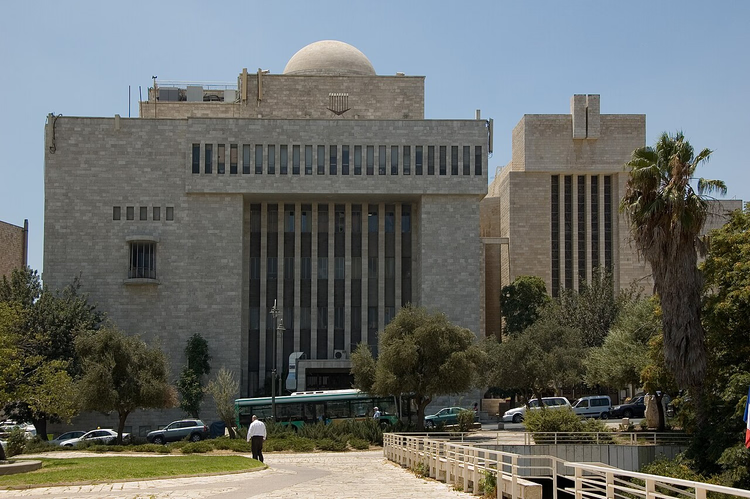 © Martin Vines, Montreal ( user:MartinVMtl ) · CC BY-SAPhoto: Martin Vines, Montreal ( user:MartinVMtl ), CC BY-SA (https://creativecommons.org/licenses/by-sa/3.0), Wikimedia Commons
On the ground floor there is a small synagogue with stained-glass windows. The central object in the hall is the Ark of the Covenant, brought from an Italian synagogue. Ancient parchment scrolls are kept inside. The museum is small, so you can see it in an hour and combine it with a walk through the city center.
- The catch: the exhibition occupies one floor, so plan for a short visit.
38. Zedekiah's Cave
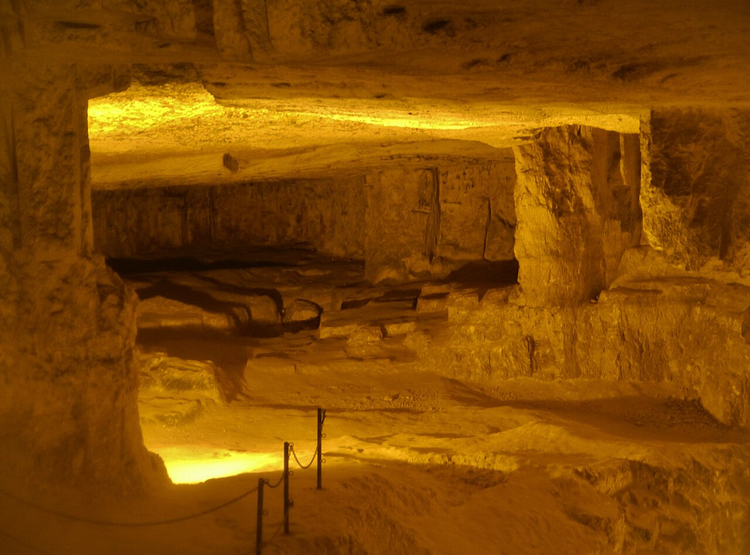 © Zairon · CC BY-SAPhoto: Zairon, CC BY-SA (https://creativecommons.org/licenses/by-sa/4.0), Wikimedia Commons
Zedekiah's Cave, one of the largest man-made caves in Israel, lies beneath the Arab quarter. It was named after the last king of Judah. According to legend, he tried to flee through this tunnel from the Babylonian siege in the sixth century BCE and was captured.
Since ancient times, white limestone was quarried here for building temples. The underground area reaches up to nine thousand square meters, and the drops falling from the ceiling are called "Zedekiah's tears." The entrance was walled up in the sixteenth century and reopened only in 1854. Today you can descend into halls and corridors that extend dozens of meters underground.
- The catch: it is cool and damp underground, so bring a jacket.
39. Biblical Zoo
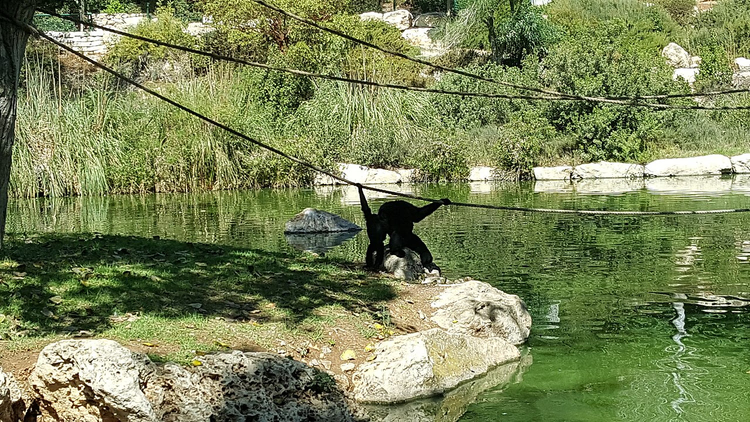 © Ovedc · CC BY-SAPhoto: Ovedc, CC BY-SA (https://creativecommons.org/licenses/by-sa/4.0), Wikimedia Commons
The Biblical Zoo spreads across 25 hectares in a canyon valley southwest of the city center. It is home to animals mentioned in the Bible. The habitats recreate savanna, desert, and jungle environments with boulders and grassy lawns.
You will see giraffes, hippos, lions, zebras, elephants, lemurs, and tapirs. Crocodiles and turtles live in separate terrariums. An artificial pond, a waterfall, and a greenhouse add to the atmosphere. With children, it is easy to spend half a day here, but go in the morning before it gets hot.
- Getting there: from the center, take a bus or tram to the Malha area, then walk.
- The catch: some enclosures are far from the entrance, so wear comfortable shoes.
40. Chords Bridge
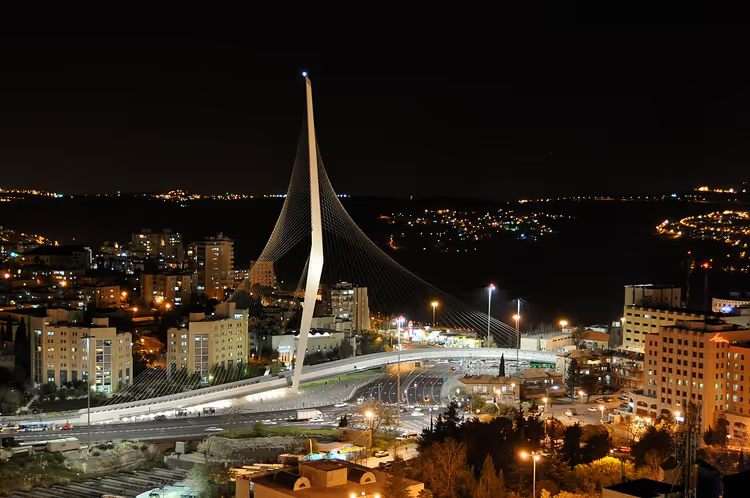 © Petdad · CC BY-SAPhoto: Petdad, CC BY-SA (https://creativecommons.org/licenses/by-sa/3.0), Wikimedia Commons
The Chords Bridge spans the entrance to the city from the highway, near the Central Bus Station. It was built in the early twenty-first century to a design by Spanish architect Santiago Calatrava. The structure's shape resembles a huge steel harp.
Its single support mast rises above all the buildings in Jerusalem, with white cables fanning out from it. A tram line runs across the bridge, along with a pedestrian walkway. You can walk across it for free and view the city from above. The best photo comes in the evening, when the lighting is switched on.
- The catch: during rush hour, the pedestrian section is crowded with people.
How much a visit to Jerusalem costs
Most of Jerusalem's holy sites are free. The Western Wall, the Church of the Holy Sepulchre, the Via Dolorosa, the Garden of Gethsemane, and the observation point on the Mount of Olives do not require a ticket. You only pay for museums and underground routes. Ticket offices usually close an hour before the site does.
An adult ticket to the Israel Museum costs 54 ILS (as of 09/2026, current museum prices). Entry to the City of David starts at 45 ILS (as of 09/2026, official website). A tour of the Western Wall Tunnels costs roughly 40-45 ILS (as of 09/2026, Western Wall Heritage Foundation).
Children and students get discounts almost everywhere. At the Israel Museum, tickets are cheaper for schoolchildren, students, and seniors, but those tickets are sold only at the ticket office. Bring a document that confirms your age or status. The City of David and the Western Wall Tunnels offer fewer discounts, but family tickets are sometimes a better deal than individual ones. Check the terms on site, they change from season to season.
Some museums keep special hours. The Rockefeller Museum opens later than the others and closes early, usually after midday. Yad Vashem is closed on Saturdays and Jewish holidays. The Israel Museum is open on Saturdays, but ticket offices run on a reduced schedule. Check the hours on the official website on the day of your visit.
Yad Vashem and the Rockefeller Museum are free, but it is better to reserve a time slot for the Holocaust museum in advance. Exchange currency at banks and exchange offices in the center; the rate at the market is usually worse. Cards are accepted at museums and hotels, but shops in the Old City more often ask for cash.
Lunch at the Mahane Yehuda Market will cost noticeably less than at restaurants near hotels. You can buy fruit, cheese, and baked goods by the piece and put together a snack for the whole day. Water at kiosks is inexpensive, but near the Old City gates they charge more for it.
When to go and how to avoid crowds
Spring and autumn are best for long walks. In summer the Old City gets stuffy, and the stone heats up and radiates warmth even in the evening. In winter rain is possible, so bring a jacket and an umbrella. In any season, comfortable shoes matter more than light clothing.
Religious holidays draw enormous crowds. During Passover and Sukkot, accommodation prices rise and lines form at the holy sites. If your trip falls on a holiday, book accommodation and tickets months in advance. On such days it is better to choose routes outside the walls, where there are fewer people.
The simplest way to avoid tour groups is to arrive at opening time. By nine in the morning the Western Wall and the Church of the Holy Sepulchre are still quiet. The crowd builds during the day and thins out again toward sunset. Leave Friday afternoon for rest: the city prepares for Shabbat and gradually quiets down.
Tours and tickets in Jerusalem
Guided tours, skip-the-line tickets and activities — most offers can be cancelled free of charge.
See offers on TiqetsThe widget loads once you give your consent.
⁉️🤔 Frequently asked questions
How many days do you need for Jerusalem?
One long day is enough for the Old City if you start at the Mount of Olives and finish at the Western Wall. Another day goes to the western museums and Yad Vashem, and a third is useful for the City of David and the market. In one visit you cover half of the forty sites.
When is the best time to go to the Western Wall and the Church of the Holy Sepulchre?
Both sites open early in the morning, and before nine there are almost no groups. The Wall is accessible around the clock, but at night access is partially restricted. On Friday evening Shabbat begins at the Wall, and the plaza fills with worshippers; it gets crowded and loud then.
Can a non-Muslim enter the Temple Mount?
Yes, but only through the entrance near the Western Wall and at specific hours. During prayer times and on Fridays tourists are not allowed in. Non-Muslims are not allowed into the mosques themselves, the Dome of the Rock and al-Aqsa, at all. Check the current access rules before your visit, they change.
Where do you buy museum tickets?
Tickets for the Israel Museum, the City of David, and the Western Wall Tunnels are sold on the official websites of those sites. It is worth checking them in advance: in season, available time slots run out several days ahead. Yad Vashem and the Rockefeller are free, but it is better to reserve a time slot.
What should you see in Jerusalem with children?
The Biblical Zoo and the Bloomfield Science Museum are designed specifically for families. Kids will also enjoy the Chords Bridge with the tram and the Mahane Yehuda Market with food for every taste. It is better to leave the historical holy sites for the morning, when children are fresh.
In short: what to book
In Jerusalem you pay only for museums and underground routes; religious sites are open for free. Book the most important things in advance: the Western Wall Tunnels, the City of David, and the Israel Museum sell out weekends ahead in season.
- If you are visiting for the first time, plan two days: the Old City in the morning, the western museums the next day.
- If you are traveling with children, put the Biblical Zoo and the Bloomfield Museum on the list.
- If you are interested in history and archaeology, take the City of David, the Western Wall Tunnels, and the Rockefeller Museum.
- If you are short on time, limit yourself to the Church of the Holy Sepulchre, the Western Wall, and the panorama from the Mount of Olives.
It is convenient to gather accommodation and tickets in one place so you do not have to fit your route around ticket offices. Compare tickets on Tiqets and plan your day in advance.

A small editorial team writing guides for independent travel. We travel ourselves, but we haven’t been everywhere, so we check prices, opening hours and how to get there against official sources.