
















Hampton Court near London: tickets, train from Waterloo and main halls
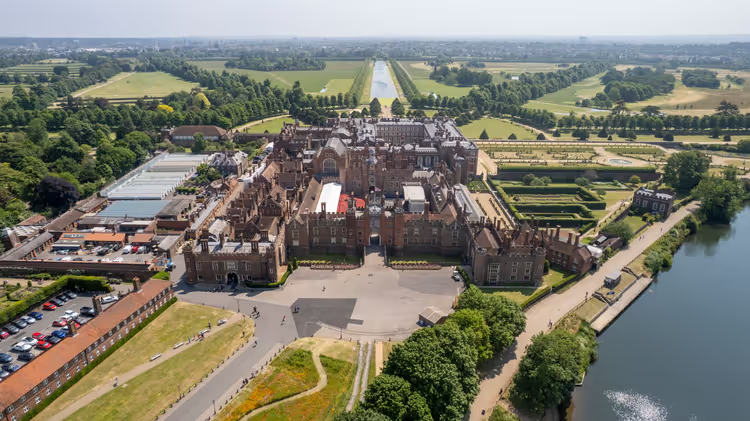
Hampton Court stands on the banks of the Thames, twenty kilometers southwest of central London (on the map). It is the country residence of Henry VIII, where the Great Hall with its oak ceiling and the astronomical clock showing the tide times on the Thames have survived. Today the palace is considered one of the most visited historic attractions in southwest London.
Allow four to five hours for a visit: one ticket covers the palace state rooms, gardens, and the maze. The journey from central London takes under an hour, and ticket offices and cafes are right by the entrance. Below we look at what to see first, how much tickets cost, and how to get there without a car.
Ad: this article contains affiliate links, we earn a commission if you book through them, at no extra cost to you.
Where Hampton Court is located
💡 In short:
- The palace is open every day from 10:00 (as of 09/2026, Historic Royal Palaces).
- Allow four to five hours for the visit including travel.
- Prices and opening hours: 09/2026, checked on the official website.
The palace stands almost at the water's edge and belongs to Richmond upon Thames in Greater London. Hampton Court station is on the other bank, in East Molesey, Surrey. From Charing Cross to the palace is twenty kilometers in a straight line (on the map). Around the palace lies Home Park: in summer it hosts flower shows and music festivals, and Londoners come here for the whole day with a picnic.
On weekends a queue forms at the main entrance before opening, and by midday the state rooms get noisy. Arrive for the first wave, just after 10:00: that way you can get through the rooms almost without the crowds.
 © Ricardalovesmonuments · CC BY-SAPhoto: Ricardalovesmonuments, CC BY-SA (https://creativecommons.org/licenses/by-sa/4.0), Wikimedia Commons
History of the palace
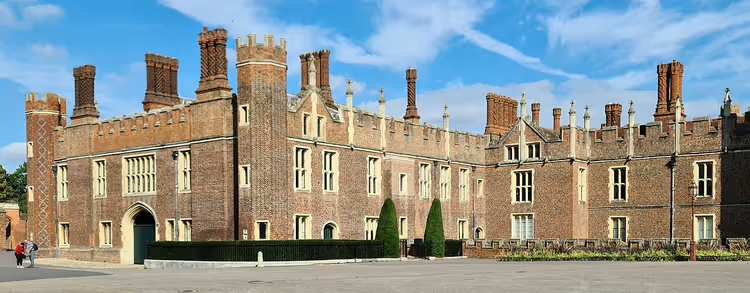
The first settlement on this site appeared in 1237: the land was bought by the Knights Hospitaller, who set up a farmstead here for storing supplies (as of 09/2026, Historic Royal Palaces). Later the estate passed to a noble family, and in the early 16th century Cardinal Thomas Wolsey took it on a lease. He rebuilt the modest manor into a palace complex with state rooms for guests, and it was under him that the first great halls appeared.
In 1528 Hampton Court became the main country residence of Henry VIII. The king expanded the palace for almost twenty years and completed the main construction by 1541 (as of 09/2026, Historic Royal Palaces). By this time it had tennis courts, bowling alleys, a chapel, huge kitchens, and halls for balls and receptions. Gardens and hunting grounds of about 1,100 acres were laid out around the palace (as of 09/2026, official palace website), which today have become Home Park and Bushy Park.
The palace layout resembles the monastic and university buildings of the time: several wings are connected around inner courtyards. For important guests Wolsey built separate apartments of two rooms with their own toilet, which by 16th-century standards was considered a luxury. The Great Hall and the king's state rooms have survived almost unaltered.
Royal life was noisy and crowded. The kitchens of Hampton Court prepared food for several hundred courtiers at once, and in the courtyard there were about thirty toilets, then called houses of easement. Separate halls were kept for receptions, so even by modern standards the palace looks enormous.
What to see in the palace
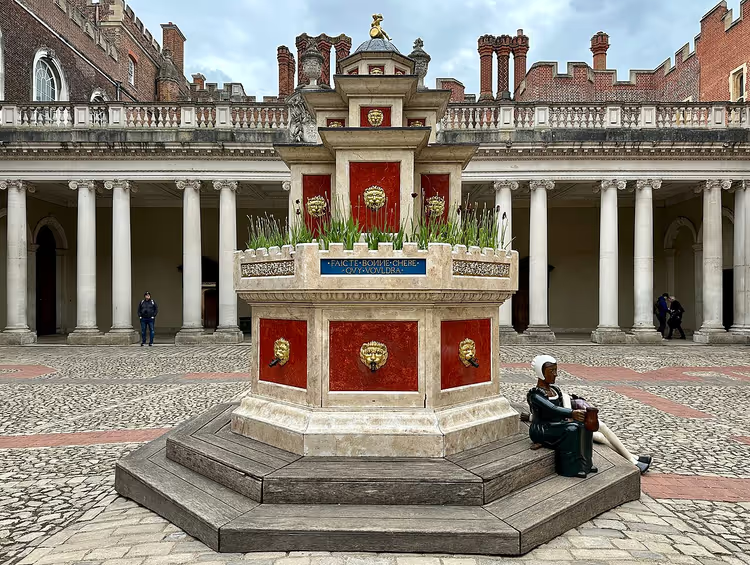
The tour starts at Base Court, the largest inner courtyard. It was built for the cardinal's guests and has preserved its original appearance better than other parts. Through the brick galleries you pass into Clock Court, where the astronomical clock of 1540 hangs above the arch (as of 09/2026, official palace history).
 © APK · CC BYPhoto: APK, CC BY (https://creativecommons.org/licenses/by/4.0), Wikimedia Commons
The dial shows the time, month, day number from the start of the year, moon phase, and the hour of high tide at London Bridge. The mechanism still runs, although it is almost five centuries old. It is best viewed from the courtyard, from below: that way you can see both sides of the dial.
You climb the King's Staircase to the second floor, to the state apartments. Here, one after another, are reception rooms, ballrooms, dining rooms, studies, and bedrooms. The walls are hung with portraits of English kings and courtiers from the Royal Collection. The Raphael Cartoons, commissioned for the Sistine Chapel by Pope Leo X, are not on display at Hampton Court: they are shown at the Victoria and Albert Museum.
The palace's main room, the Great Hall, has retained its oak ceiling and stained glass. Henry VIII loved this hall and commissioned tapestries and carved decoration for it. Today concerts are held here, and guides tell how guests were received and performances staged in the hall.
In the Tudor Kitchens you see spits, huge hearths, and meat-cutting tables. On reception days, cooks prepared two meals here for several hundred people. It is a separate stop along the route, so allow about thirty minutes for the kitchens.
From the halls you exit into the gardens: a formal park with fountains, greenhouses, and a maze (The Maze) made of yew hedges. The gardens and maze take about an hour, and the general ticket already includes them. In summer, cafes and a boat station on the Thames operate in the park, so after the palace you can stroll along the water.
How to get there from London
The easiest route from the center: a South Western Railway train from Waterloo station to Hampton Court station. Trains depart every 30 minutes, and the journey takes about 36 minutes (as of 09/2026, National Rail). You can pay for the fare with a bank card at the turnstile; a ticket from the machine is also available.
From the station to the palace you walk across the bridge over the Thames, about five minutes (on the map). The main gates are visible right from the station exit, and ticket offices are next to the entrance. A bus from south London neighborhoods also runs, but the journey takes longer and requires a transfer.

By car, arrive at opening time: on weekends the paid parking at the palace fills up by morning. If you are flying through Heathrow or Gatwick, first get to central London, then take the same train from Waterloo. From the airport it is more convenient to leave in the morning so that by lunchtime you are already at the palace.
Tickets and opening hours
The palace is open every day from 10:00. Closing time depends on the season: in winter the ticket offices and halls close earlier, in summer later, so it is best to check the exact slot in advance (as of 09/2026, official opening hours). Last entry is always before closing, usually about an hour before.
 © Ilya Grigorik · CC BY-SAPhoto: Ilya Grigorik, CC BY-SA (https://creativecommons.org/licenses/by-sa/3.0), Wikimedia Commons
The only days when Hampton Court is closed are December 24-26. At all other times the gardens are also open, and the ticket includes entry to the palace halls, park, maze, and Tudor kitchens.
It is cheaper to buy tickets online in advance: at the ticket office the price is higher, and on summer weekends morning slots sell out quickly. The Historic Royal Palaces annual pass costs from £65 and gives unlimited entry throughout the year (as of 09/2026, official tickets page). If you plan to return, the pass pays for itself in two visits.
If you need a guaranteed slot at a specific time, you can get a skip-the-line ticket on Tiqets in advance and avoid the ticket office queue.
Tours and tickets in Hampton Court Palace
Guided tours, skip-the-line tickets and activities — most offers can be cancelled free of charge.
See offers on TiqetsThe widget loads once you give your consent.
⁉️🤔 Frequently asked questions
How much time do you need to see Hampton Court?
Plan for four to five hours. Two and a half hours go to the palace state rooms, an hour to the gardens and the maze, and the rest to travel, the cafe, and photos.
When is the palace closed to visitors?
Hampton Court is open every day except December 24-26 (as of 09/2026, Historic Royal Palaces). In winter the rooms and ticket offices close earlier, in summer later. Before your trip, check the last entry time on the official website: on concert days and holidays the schedule changes.
Can you visit with children?
Yes. Children usually remember the yew hedge maze and the Tudor kitchens rather than the state apartments. With a stroller it is easier to go through the gardens than up the narrow King's Staircase. Bring a snack with you: a picnic in Home Park helps when the cafes are packed.
Do you need to buy tickets in advance?
Yes, online is cheaper than at the ticket office, and on summer weekends morning slots sell out quickly (as of 09/2026, tickets page). If you live in London and plan to return, look into the Historic Royal Palaces annual membership: it gives you unlimited entry.
How do you get there without a car?
Take a South Western Railway train from Waterloo station (as of 09/2026, National Rail). From Hampton Court station you walk across the bridge, about five minutes (on the map), and you immediately see the main gates.
In short: what is worth booking
If you have one free day in London: take the train from Waterloo for opening time and allow four to five hours for the visit. If you want guaranteed entry without queuing at the ticket office, get a timed ticket on Tiqets in advance. If you visit London regularly, get a Historic Royal Palaces annual membership from £65 (as of 09/2026, official website): it pays for itself in two visits and works at all of the organization's palaces.

A small editorial team writing guides for independent travel. We travel ourselves, but we haven’t been everywhere, so we check prices, opening hours and how to get there against official sources.