
















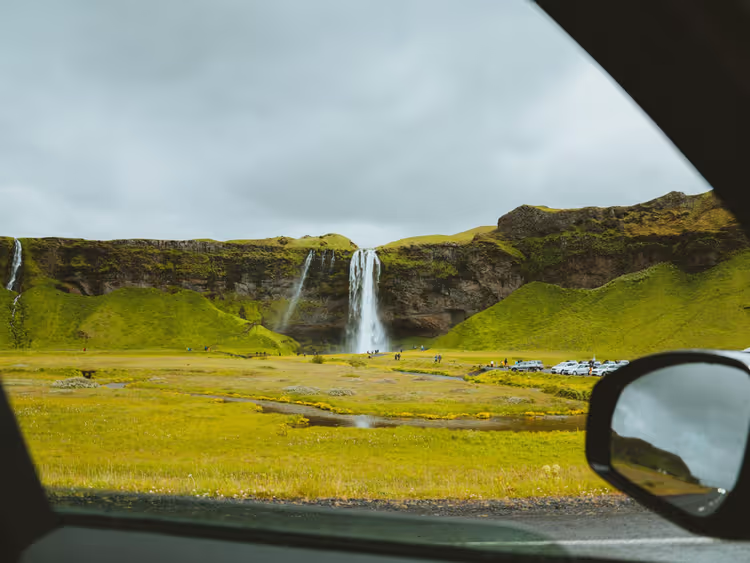
Iceland by car: compact or 4x4, F-roads and per-kilometer fee
A car in Iceland decides almost everything. Waterfalls, hot springs, and viewpoints are scattered across the island, and without a rental car you will only see Reykjavik and its surroundings.
The good news: the island is simpler than the stories make it sound. The bad news: starting January 1, 2026, a kilometer fee applies for every kilometer driven (as of 09/2026, Skatturinn). Insurance, paid parking, and fuel come on top of that.
Below we break down what car class to choose, what to insure, where you cannot go without all-wheel drive, and how to pay for fuel and parking. Also consider the season: in winter some roads close, and wind changes plans faster than a navigation app.
Ad: this article contains affiliate links, we earn a commission if you book through them, at no extra cost to you.
Compact or all-wheel drive: what to choose
💡 In short:
- The Ring Road is passable in a regular compact in summer.
- Only all-wheel drive vehicles are allowed in the highlands and on roads with the letter F.
- Speed limits, kilometer fee, and rules: 09/2026, verified on island.is.
The classic route around the island does not require an SUV. In summer, most of the Ring Road is paved, and short gravel sections are easy to handle if you slow down and keep your distance. We would not pay for all-wheel drive just for this road.
A different story begins higher up, in the highlands. Roads with the letter F in their number are open only to all-wheel drive vehicles. A regular compact and even a crossover without all-wheel drive are not allowed there under rental terms: insurance does not apply in this case, and the driver pays for repairs and towing.
Luggage also affects the choice. Two people with backpacks fit comfortably in a compact. For three or four people with cameras, trekking boots, and sleeping bags, go one class up: in Iceland you carry more with you than on a regular trip.
We would not overpay for a large SUV just for the Ring Road. The premium for all-wheel drive is significant, and the benefit only appears on F-roads, in winter, and in strong wind. If your route follows the Ring Road, a compact is enough.
What people rent | When it works | What to consider |
|---|---|---|
Compact without all-wheel drive | Ring Road from June to August | two people with light luggage, book in advance |
Station wagon or SUV | three to four people, lots of gear | higher fuel consumption |
All-wheel drive | F-roads, highlands, travel outside summer | list of permitted roads from the rental company |
Where to book a car and what to insure
The car gets more expensive along with demand. A compact in July and August costs noticeably more than in the shoulder season, and popular classes for the dates you need sell out weeks before the trip. The earlier you book, the easier the choice.
Do not look only at the daily price. On the island, the insurance package matters more: full insurance with no deductible, glass, tires, and underbody. Gravel flies from under the wheels of oncoming cars, and a gust of wind easily rips a door open and slams it into the neighboring car. Without coverage, such a repair becomes a separate budget line.
Also check sand and volcanic ash insurance. You need it if you drive along the south coast or in windy weather: near Vik, wind kicks up sand that damages paint and glass. The rate is calculated per rental day, and you will see the exact amount when booking.
It is more convenient to compare options in one place: compare prices on DiscoverCars. The listing shows whether tires, underbody, and full insurance are included in the rate. In our travel experience, a rate with insurance included came out cheaper than renting with an add-on at the counter.
Another factor that affects the price: rental duration. For a week or longer, the daily rate is lower, while a short rental with add-ons costs more. If you are planning the Ring Road, take the car for the entire period at once.
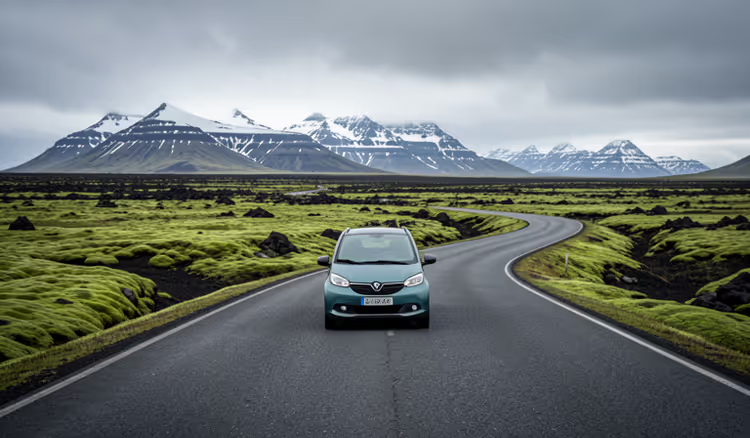 AIIllustrative image: AI-generated
What makes up the budget and the kilometer fee
The trip budget is not made up of a single number. First, the daily rate, which depends on the season and car class. Then insurance, and in Iceland it is more expensive than in most European countries. Next comes fuel, parking, and the kilometer fee.
Starting January 1, 2026, you pay separately for every kilometer driven: 6.95 ISK for passenger cars up to 3.5 tons (as of 09/2026, official fee page). For rental cars, the fee is included in the daily rate or recalculated by kilometers, so check the payment mechanism in your contract.
In high season, the difference from the shoulder season is noticeable. Calculate your budget not by the rental price, but by the total trip amount: car, insurance, fuel, and parking for each day of the route. Water and coffee for the road add a bit more, and paid lots at waterfalls make this line item significant.
For two people on the Ring Road, the budget breaks down like this: a week of rental, full insurance, a tank of fuel every few days, and several paid parking lots daily. A separate item, the tunnel toll in the north of the island, is covered below.
The price rises most sharply in the main season. From June to September, demand for cars is at its peak.
F-roads: where you need all-wheel drive
Roads with the letter F lead into the interior of the island, into the highlands. The letter stands for Fjallvegur, meaning mountain road. Almost all of them are unpaved, some cross streams and small rivers, and the surface changes from year to year.
You can drive there only in an all-wheel drive vehicle that the rental company permits on such routes. A regular compact, station wagon, and some crossovers without all-wheel drive stay off these roads: rental companies have a separate list of models.
Do not take risks or decide on the spot that your car can handle it. If you bottom out or stall at a river crossing, you pay for repairs, towing, and vehicle downtime, and the insurance claim will not be recognized.
The season is short: in winter the highland roads are closed, usually they open by summer and close in early fall (as of 09/2026, official safety portal). Before heading out, check road status: safetravel.is publishes warnings, vedur.is gives regional forecasts. Check road conditions and open highland routes on road.is and umferdin.is.
Another common mistake: driving into the highlands in a car that fits the class but not the rental agreement terms. Check this in the documents, not by the car's appearance. These restrictions don't apply to the Ring Road, so most trips don't need all-wheel drive.
River crossings change faster than the map. After rain, the depth and current at the same crossing are different, so stop before entering and assess the flow. If in doubt, turn around: an extra two hours on the road is cheaper than repairs and a tow.
 © NOTE: This image is a panorama consisting of multiple frames that were merged or stitched in Panorama Studio. As a resul · CC BY-SAPhoto: NOTE: This image is a panorama consisting of multiple frames that were merged or stitched in Panorama Studio. As a resul, CC BY-SA (https://creativecommons.org/licenses/by-sa/3.0), Wikimedia Commons
Speed and rules that are enforced
Speed limits on the island are low and enforced year-round. In built-up areas it is usually 30-50 km/h, on gravel roads 80 km/h, on paved roads outside towns 90 km/h (as of 09/2026, speed limits on Ísland.is). Fines are higher than in Germany, and there are no discounts for tourists.
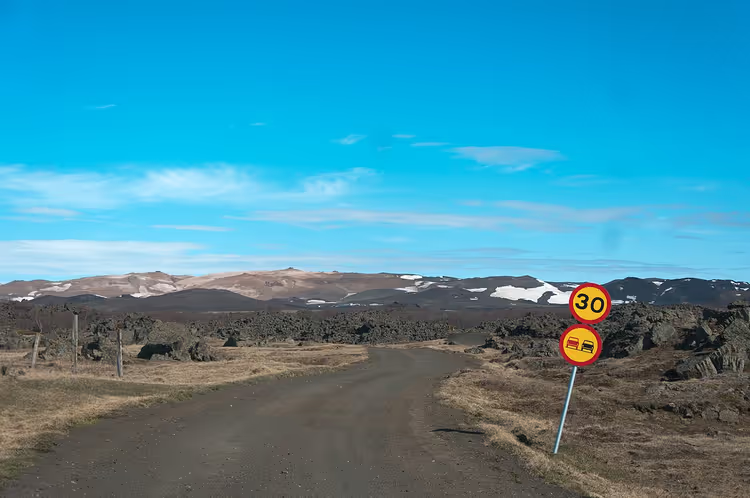 © Hansueli Krapf This file was uploaded with Commonist . · CC BY-SAPhoto: Hansueli Krapf This file was uploaded with Commonist ., CC BY-SA (https://creativecommons.org/licenses/by-sa/3.0), Wikimedia Commons
Road | Limit | What to keep in mind |
|---|---|---|
In built-up areas | 30-50 km/h | signs vary from town to town |
Gravel outside towns | 80 km/h | slow down well in advance |
Paved roads outside towns | 90 km/h | keep your distance, overtake in your lane |
Source: Ísland.is, speed section, as of 09/2026.
Low beams are on year-round, including during the day. Seat belts are mandatory for everyone, and you may only use your phone via hands-free. Some fines are issued remotely, so relying on luck does not work.
After that come the local specifics. On single-lane bridges and in narrow tunnels, traffic takes turns, and the order is shown on signs before the entrance. Sheep come out onto the shoulder and sometimes cross the road in groups: slow down and wait until the animal moves away.
Another habit of visitors creates dangerous situations: stopping right on the roadway for a photo. There is always a parking lot at waterfalls and viewpoints, so leave your car there. Driving off roads and marked trails is not allowed: off-road driving carries fines, and tire tracks remain in lava fields for decades.
On a stormy day we would not drive at all. Wind gusts on open stretches push the car out of its lane, and a high-profile vehicle loses stability before you notice it. Check warnings in the morning and postpone the drive if the forecast is bad.
In winter, extra caution applies on top of the rules. Some roads are closed, on open stretches you keep a larger following distance, and before bridges and tunnels you do not brake sharply: the surface at the entrance can be slippery.
Refueling: self-service machines, card, and PIN
There are enough gas stations along the ring road. Outside towns they often operate without staff, and then you need a card with a PIN: without the code, the machine will not dispense fuel. Debit cards are also accepted, but it is better to keep your banking app handy.
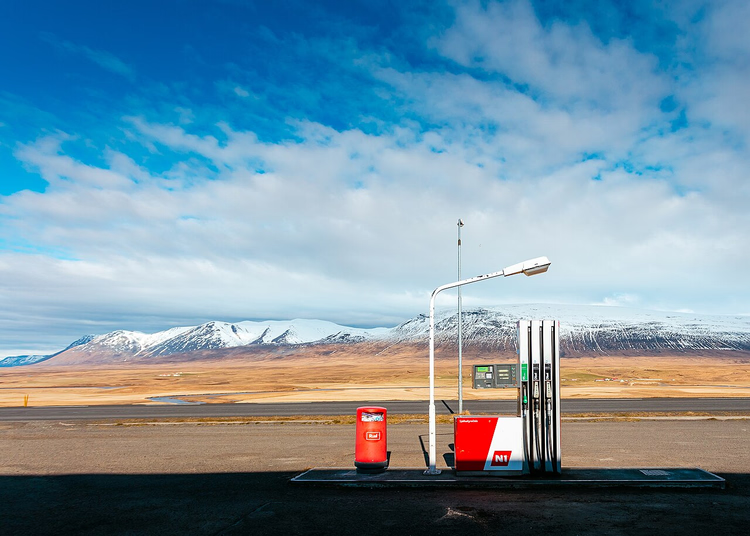
The refueling process is almost the same at all stations:
- Insert your card or tap it on the terminal.
- Enter your PIN.
- Select a full tank (Fill up) or the amount you need.
- Check the pump number and start refueling.
The menu switches to English almost everywhere, and sometimes German is available. If the terminal does not read your card, try the machine next to it: at remote stations the connection sometimes drops. Refueling on the island takes longer than you are used to, so do not leave it until late in the evening.
Fuel in Iceland is expensive, and at remote stations the price differs from urban ones. We recommend not waiting until the tank is down to a quarter: in the east and north of the island, distances between gas stations are greater than you are used to. Prices at N1, Orkan, and Olís differ slightly, so you can compare them on the spot.
Parking and the toll tunnel
Parking has become the most overlooked budget item. Access to many natural sites is paid: at waterfalls, black sand beaches, and hot springs there are machines or cameras with license plate recognition. You pay by license plate, most often through an app.
The most convenient apps are Parka, EasyPark, and Autopay. Install them at home and link your card in advance: at some parking lots payment works only by phone, and there may be no internet on site. See rates and zones in the Parka app.
Reykjavik has different parking zones with different rates and hours, so read the signs at your spot. Park only in marked areas: parking on moss, in a lava field, or on the shoulder results in a fine, and nature takes decades to recover.
There is currently one toll section on the island: the Vaðlaheiðargöng tunnel in the north. Passage for a vehicle up to 3.5 tons costs 2,216 ISK (as of 09/2026, tunnel operator). Payment is tied to the license plate, so the bill goes to the vehicle owner, meaning the rental company. The rental company pays the toll and passes the amount on to you. The charge usually appears in your billing within a day after passage.
Navigation, internet, and wind
Navigation on the island works more simply than you might expect. Google Maps guides you along the ring road and to most attractions, but you should download maps offline: in the highlands, connection drops in patches. A backup option for weak spots: screenshots of tricky junctions.
Internet is also straightforward. Iceland is part of the EEA, so your EU home plan works here as well, including roaming. If your primary SIM does not provide data, set up an eSIM before departure, so maps and messengers work from the first minute.
Take wind most seriously. Storm warnings close roads, and high-profile vehicles are sometimes not allowed onto mountain passes. Check your plan for the day in the evening: vedur.is gives the forecast, and road conditions and closed sections can be checked on road.is. If a section is closed, the route changes, and no point on the map is worth the risk.
Checklist before departure
Preparation takes half an hour in the evening and saves hours on the road. Check the car in the yard, set up your phone, and only then head out.
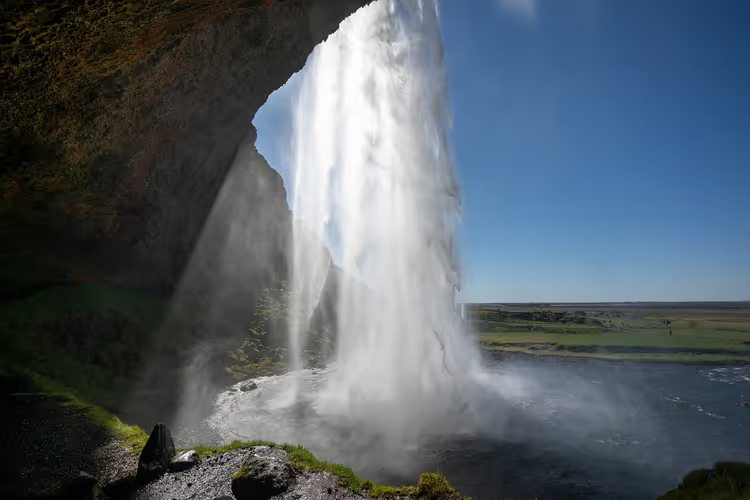
- Download offline maps and parking apps.
- Check road status and the wind forecast for the morning.
- Refuel in advance, do not wait for an empty tank.
- Put water, a warm layer, and a charger in the cabin.
- Check the rental agreement for which roads your car is allowed on.
Separately, review the rental agreement. It states whether gravel roads and F-roads are allowed, whether there are wind restrictions, and how damage is handled. If the highlands are in your plans, take a four-wheel-drive car and ask for a list of permitted routes.
⁉️🤔 Frequently asked questions
Do I need an SUV for a trip around Iceland?
For the ring road in summer, a compact car is enough, and you can comfortably reach most waterfalls and viewpoints. Four-wheel drive is needed for the highlands, F-roads, and winter trips, where passes open with restrictions. If your route includes F-roads, take a four-wheel-drive car from the list approved by the rental company.
Do I need sand and ash insurance?
It is not mandatory, but on the south coast it is useful: near Vík, wind kicks up sand that damages paint and windows. If you are traveling in the shoulder season or in windy weather, the policy covers the risk of expensive repairs. The decision depends on your route and trip budget.
Is driving in Iceland dangerous?
The traffic itself is calm, and the main challenges come from weather, wind, and gravel sections. Speed limits are low, but they are enforced, and some fines are issued remotely. Keep your distance, slow down before bridges, and always check the forecast.
Are EU driver's licenses sufficient?
Yes, a regular EU or German driver's license is valid for renting and driving around the island. An international driving permit is not required if the document is issued to the EU standard. Bring your license and passport or ID card to avoid disputes at the rental counter.
Are there many gas stations on the island?
Along the ring road there are enough gas stations, and around major towns you will not feel a shortage. In the east and north, distances between stations are greater, especially in winter. Do not wait until the tank is down to a quarter; refuel in advance.
Can you drive off-road?
No, off-road driving is prohibited in Iceland, and fines for leaving the road are high. The reason is the fragile nature: tire tracks in lava fields and on moss remain for decades. Stay on marked roads and parking areas.
How much time do you need for the ring road?
Just the driving takes several days, so a week is the minimum for a relaxed trip. It is more comfortable to plan about two weeks: that leaves energy for waterfalls, hot springs, and unhurried stops. Many people underestimate the distances and travel time.
Find hotels
Compare prices across booking sites and filter for rooms with free cancellation.
Compare prices on Discover CarsThe widget loads once you give your consent.
In short: what is worth booking
If you are driving the Ring Road as a couple from June through August, get a compact car and full insurance with no deductible. If you are planning to visit the highlands and F-roads or traveling as a group of three, look at all-wheel drive and check the list of permitted routes in advance. In winter, add extra time and keep an eye on wind warnings.
It is easier to put together your budget in one place: check car prices for your dates and activate an eSIM before your flight.
Before signing the contract, compare insurance terms.

A small editorial team writing guides for independent travel. We travel ourselves, but we haven’t been everywhere, so we check prices, opening hours and how to get there against official sources.