
















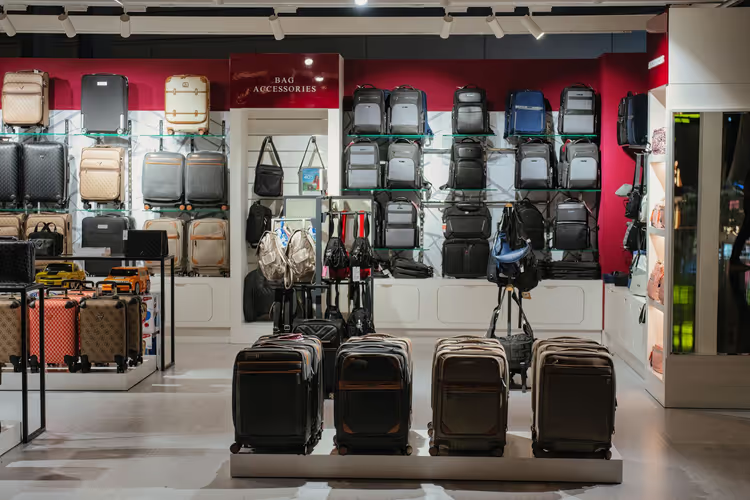
What cannot be checked in luggage: list of items for carry-on
Baggage is checked at the counter, and from there your suitcase flies without you. Airports regularly report thefts from checked baggage, and some items go missing during transfers and security inspections. Getting them back afterwards is almost impossible.
We put together a list of items worth taking into the cabin with you, and the steps to follow if your suitcase is opened anyway. The advice is based on IATA rules and guidance from German consumer organizations.
Ad: this article contains affiliate links, we earn a commission if you book through them, at no extra cost to you.
Why valuables don't belong in checked baggage
💡 In short:
- Take valuables, documents, and electronics in your carry-on: carriers often aren't liable for them in checked baggage (Verbraucherzentrale, 09/2026).
- Power banks and spare batteries may only be carried in the cabin (IATA data, 09/2026).
Checked baggage travels separately from you. Your suitcase goes through sorting, transfers, and security inspections, and at every stage staff have access to it. According to German consumer organizations, airlines routinely exclude liability for valuables in checked baggage (Verbraucherzentrale guidance, 09/2026).
In practice, this means jewelry or expensive electronics are far from always compensated. An exclusion for valuables is often written into the conditions of carriage (ADAC, 09/2026). It's easier to put everything expensive in the cabin beforehand.
Take with you what can't be quickly replaced. You control your money, passport, medication, and electronics yourself. Check the rest without worry.
What to put in your carry-on: a list
Below are items that are better not left in checked baggage. This is a list from an air passenger guide, supplemented with carrier rules.
Item | Why keep it with you |
|---|---|
Cash | Money in baggage is almost impossible to trace |
Documents and securities | Without a passport and tickets, your trip comes to a halt |
Jewelry and gemstones | Small and expensive, they disappear first |
Expensive watches | A frequent target of baggage theft |
Phone, laptop, tablet | Expensive electronics, often stolen from baggage |
Camera equipment and storage media | Fragile and expensive equipment, photos can't be recovered |
Optics and binoculars | Expensive lenses break in baggage |
Paintings, engravings, sketches | Fragile and unique items |
Antiques and collections | There is no replacement for such items |
Rare books and manuscripts | They deteriorate from moisture and pressure |
House and car keys | Losing keys costs more than their value |
Medication | You may need it right during the flight |
The rule is simple: an expensive or irreplaceable item travels with you. Everything else can be checked without worry.
Cash, documents, and jewelry
Money and valuables most often appear in conditions of carriage as prohibited from being checked. For example, Malaysia Airlines explicitly does not accept cash, jewelry, documents, and electronics in checked baggage (Malaysia Airlines conditions of carriage, 09/2026).
What to do before departure:
- Count your cash and don't keep the entire amount in one place.
- Put a large sum on a card, keep a small amount in your carry-on.
- Photograph your documents and send copies to your email.
- Leave jewelry you don't need on the trip at home.
This reduces your risk and simplifies any dispute if something does go missing.
Electronics and lithium batteries
Power banks and spare batteries cannot be checked in baggage. A switched-off phone and laptop can be checked, but expensive electronics are safer in the cabin. Batteries over 100 Wh require airline approval (IATA battery guide, 09/2026).
Before the flight, check that your power bank is in your carry-on. At the counter, such batteries are confiscated, and you may not get them back. Keep your laptop and camera with you: they are often taken out of the bag for separate screening at security.
Medication, keys, and fragile items
Take medication into the cabin, even if it's just ordinary pills. You may need it during the flight, and your suitcase is inaccessible. For prescription drugs, take the prescription or a doctor's note.
House or car keys will be lost along with your suitcase, and you'll be left standing at a locked door. Keep them in your carry-on next to your documents. For fragile items that can't be taken into the cabin, ask for separate packaging at the counter.
What to do if your baggage was opened
Check your suitcase before leaving the arrivals area. If the lock is broken or items are missing, file a Property Irregularity Report (PIR) immediately. Without this document, your claim will almost certainly not be considered.
Then proceed as follows:
- Photograph the damage and the opened suitcase.
- Keep your baggage tag and boarding pass.
- Submit a written claim to the carrier.
Under the Montreal Convention, a claim for damage must be filed within 7 days, and for delay within 21 days (ADAC guidance, 09/2026). According to consumer organizations, your chances are higher when you have a report, photos, and receipts for the lost items.
⁉️🤔 Frequently asked questions
Can I put money in checked baggage?
It's better not to check cash. Many airlines explicitly prohibit money in checked baggage, and the carrier is often not liable for its loss (Verbraucherzentrale data, 09/2026). How to store money while traveling is described in the section on cash.
What items can't be taken in carry-on?
Liquids above the specific airport's limit, sharp objects, weapons, and explosives are prohibited. Power banks and spare batteries cannot be checked in baggage; they may be taken into the cabin up to a certain capacity (IATA, 09/2026). Check the exact list with your airline before departure.
What compensation can I get for lost items?
For valuables in checked baggage, carrier liability is often excluded (ADAC on baggage, 09/2026). A claim for damage must be filed within 7 days, and for delay within 21 days. The procedure is described in the section on opened baggage.
Can I check a power bank in baggage?
No. Power banks and spare batteries may only be carried in carry-on (IATA on lithium batteries, 09/2026). A switched-off phone or laptop can be checked in baggage. Capacity limits are described in the section on electronics.
What should I do if my suitcase arrives opened?
Don't leave the arrivals area until you file a PIR report. Photos, the tag, and claim deadlines are described in the section on opened baggage (ADAC data, 09/2026).
In short: what's worth booking
Valuables are the hardest to recover, so it's easier to protect them in advance. If you're carrying electronics, jewelry, or a large sum of money, compare insurance options for lost baggage in advance.
Remember the key points:
- Take documents, money, medication, and electronics into the cabin.
- Power banks and spare batteries cannot be checked in baggage.
- Check your suitcase before leaving the arrivals area and file a report immediately.
Take everything irreplaceable in your carry-on, and your trip will go more smoothly.

A small editorial team writing guides for independent travel. We travel ourselves, but we haven’t been everywhere, so we check prices, opening hours and how to get there against official sources.