
















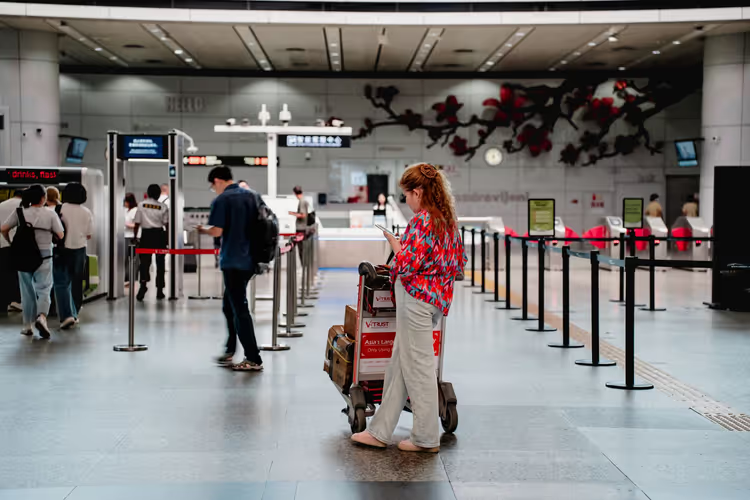
Flight check-in: how much time to allow and how not to be late
Your first solo flight is scarier than the trip itself. At the airport, you'll go through the check-in counter, security screening, passport control, and the gate. Each stage closes on its own schedule, and missing one of them means losing your flight.
A common beginner mistake: arriving "like for a train," half an hour before departure. That buffer doesn't work at an airport. You should arrive at security screening no later than two hours before departure (as of 09/2026, Frankfurt Airport official website).
Below you'll find both check-in methods, deadlines, documents, and rules for carry-on luggage. With online check-in and no checked baggage, two hours before departure is usually enough.
Ad: this article contains affiliate links, we earn a commission if you book through them, at no extra cost to you.
How airline check-in works
💡 In short:
- Check in online 24 hours before departure or at the airport counter.
- Arrive 2 hours early with carry-on luggage and 3 hours early for a long-haul flight.
During check-in, the airline confirms that you're flying on that flight. It verifies your documents, adds you to the passenger list, and issues your boarding pass. You can check in two ways: at the airport counter or online in advance.
The online option is convenient if you're flying with carry-on luggage only. With a suitcase, you'll still need to go to the counter to drop off your bags. Choose the method based on your luggage, not out of habit.
How much time to allow at the airport
Who's flying | When to arrive (as of 09/2026, airport guide) |
|---|---|
Flight outside Schengen / long-haul flight | at least 3 hours before |
EU passenger with checked baggage | about 2.5 hours |
EU passenger with carry-on only | about 2 hours |
Frankfurt Airport provides three benchmarks, and they work for any major hub. The more luggage you have and the farther the flight, the earlier you should arrive. Check the exact check-in deadline in your booking and on the airline's website (Lufthansa).
You need a separate buffer for security screening and passport control. On peak days, the line at the scanners eats up an extra hour, and you risk being the last one to reach the gate.
Arriving too early is also inconvenient. You'll spend extra hours in the terminal and get tired before boarding even starts. Arrive when your check-in counter opens, not when the terminal opens.
Counter check-in: what happens step by step
 © Sunnya343 · CC BY-SAPhoto: Sunnya343, CC BY-SA (https://creativecommons.org/licenses/by-sa/4.0), Wikimedia Commons
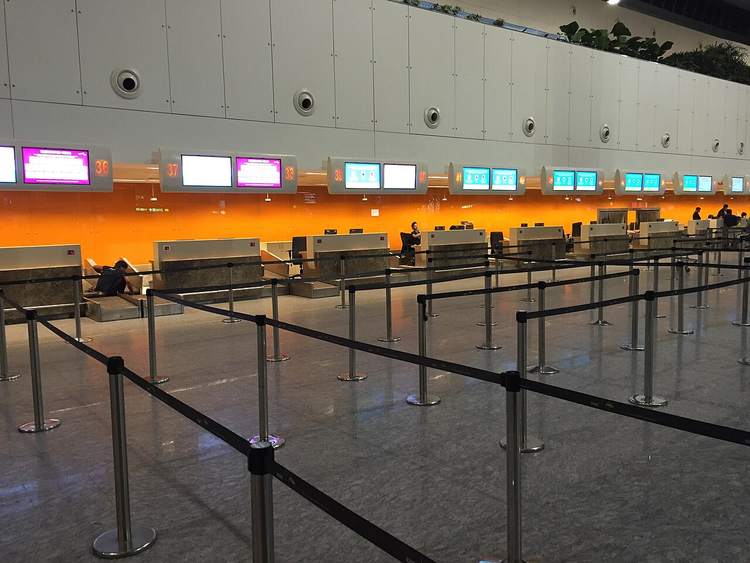
Step one: find your flight on the information board. Next to it, you'll see the counter number where check-in is taking place. You can see the flight number and airline name on your ticket or in the booking confirmation email.
Step two: go to the counter and present your documents. If you're flying with family or a group, present everyone's passports at once. That way, you'll get seats together in the cabin.
Step three: receive your boarding pass. It shows your seat number, terminal, and boarding start time. Keep your boarding pass handy until the end of the flight.
After that, you drop off your suitcase and head to security screening. Business class passengers are usually served at separate counters, without the general line.
Online check-in: how to check in in advance
Online check-in opens 24 hours before departure, sometimes earlier. At Lufthansa, it's available as early as 30 hours before departure (as of 09/2026, Lufthansa online check-in page). It closes, just like at the counter, about an hour before departure.
You'll need your booking reference and the passenger's last name. Choose a window seat or an aisle seat and confirm your details. Your boarding pass will arrive in the carrier's app, by email, or via messenger.
If you have no checked baggage, the pass on your screen is enough. With a suitcase, first go to the baggage drop-off counter, show your boarding pass, and check your bags. Only then head to security screening. Your phone with the boarding pass needs to be charged. Set up a virtual SIM card for your trip in advance so you have internet right after landing.
Which documents to prepare in advance
 © Wei-Te Wong · CC BY-SAPhoto: Wei-Te Wong, CC BY-SA (https://creativecommons.org/licenses/by-sa/2.0), Wikimedia Commons
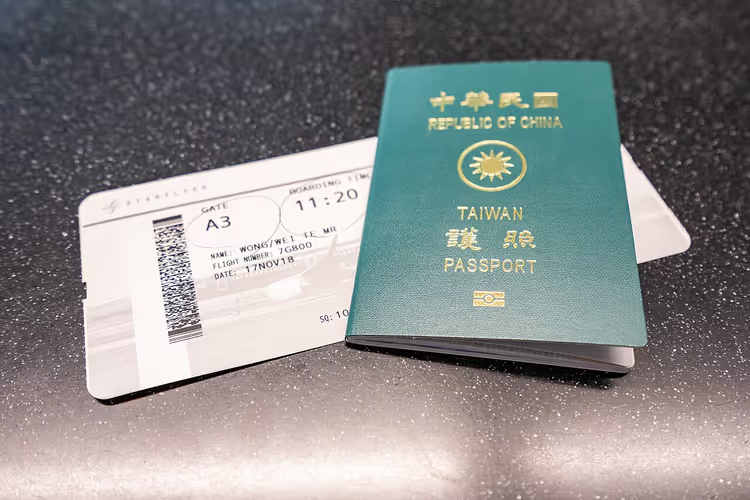
The basic set: passport or ID card, ticket, and boarding pass. For a child, bring the birth certificate. For an international flight, check your passport's validity: some countries require it to be valid for several more months after your trip.
Gather your documents in one place at home, before heading to the airport. That way you won't be searching for your passport at the counter while the line watches.
Check the entry requirements for your destination country. Many countries now require digital registration or a visa; without them, you won't be allowed on the flight (as of 09/2026, entry requirements on the Frankfurt Airport website).
What to take in carry-on and what to check
Liquids, gels, and aerosols must be in containers no larger than 100 ml. All bottles go into one transparent bag with a capacity of no more than 1 liter (as of 09/2026, Your Europe).
Power banks, lithium batteries, and e-cigarettes are allowed in carry-on luggage only. Putting them in checked baggage is prohibited (as of 09/2026, airport baggage page).
Check your suitcase at the baggage drop-off counter and keep your baggage tag. You'll use it to locate your belongings if they're sent on a different flight.
If your flight is delayed or canceled
A delay or cancellation costs you more than just time. Under EC Regulation 261/2004, you can claim compensation from 250 to 600 € (as of 09/2026, EUR-Lex). The amount depends on the distance and the length of the delay.
You're generally entitled to compensation if the delay exceeds three hours or if the flight is canceled. This applies to cancellations announced less than 14 days in advance. Keep your boarding pass and all receipts for food, taxis, and hotels.
If your flight is canceled on the day of departure, check your right to compensation and file a claim for expenses with the carrier.
⁉️🤔 Frequently asked questions
How far in advance does online check-in open?
At most airlines, check-in opens 24-48 hours before departure. Check the exact time in the carrier's app or in the booking confirmation email.
Can I board without a printed boarding pass?
Yes, the code on your phone screen is scanned at security and at the gate. Printing your boarding pass is worth it if your phone might run out of battery or if the airport has unstable internet. Bring a power bank with you.
What happens if you miss check-in?
The counter closes several dozen minutes before departure, and the flight won't be held for one passenger. If you checked in online but didn't make it to the gate, boarding is also closed. Go to the carrier's counter: sometimes they'll help you rebook onto the next flight.
Do I need a passport for flights within Europe?
Within the Schengen Area, a national ID card is often enough. For flights outside the EU, you need a passport with remaining validity. Check the country's requirements in advance; sometimes a visa or digital registration is also required.
Where do I drop off baggage after online check-in?
The baggage drop-off process is described in the online check-in section. The counter stays open until check-in closes, so don't be late.
In short: what's worth booking
If you're flying for the first time and without checked baggage, check in online 24 hours ahead and arrive two hours early. With a suitcase, add half an hour and allow time for the baggage drop-off counter. For a long-haul flight, arrive three hours early.
Before your trip, compare insurance options to cover medical expenses abroad. And if your flight is delayed or canceled, check your right to compensation under EC 261/2004.

A small editorial team writing guides for independent travel. We travel ourselves, but we haven’t been everywhere, so we check prices, opening hours and how to get there against official sources.