
















Knossos palace: tickets, opening hours and the road from Heraklion
The Palace of Knossos stands 5 km south of Heraklion (according to the municipality of Heraklion). It is the main monument of the Minoan civilization and, according to historians, one of the oldest cities in Europe (Wikipedia). In 2025, Knossos, together with the palaces of Phaistos, Malia, and Zakros, was added to the UNESCO World Heritage List (article on Knossos).
The lines here are real, especially from 10:00 to 14:00 in season. Below you will find a short history of the excavations and practical information: opening hours, prices, how to get there from the city without a car, and the main halls worth seeing.
Ad: this article contains affiliate links, we earn a commission if you book through them, at no extra cost to you.
Palace of Knossos: key information for visiting
💡 In short:
- Ticket: 20 € for adults and 10 € at the reduced rate (as of 09/2026, Ministry of Culture website).
- Hours: in summer from 08:00 to 20:00, in winter from 08:30 to 17:00 (as of 09/2026, Ministry of Culture data).
- Getting there: bus No. 2 "Knossos" from Heraklion, the final stop is at the entrance to the complex.
Knossos is not a single palace but a whole complex on the Kephala hill: a central court, throne room, residential quarters, storerooms, and workshops. A visit takes one and a half to two hours. Go in the morning or evening: during the day there is little shade in the open areas, and in extreme heat the site is sometimes closed for several hours (according to the Ministry of Culture).
History of the palace's construction
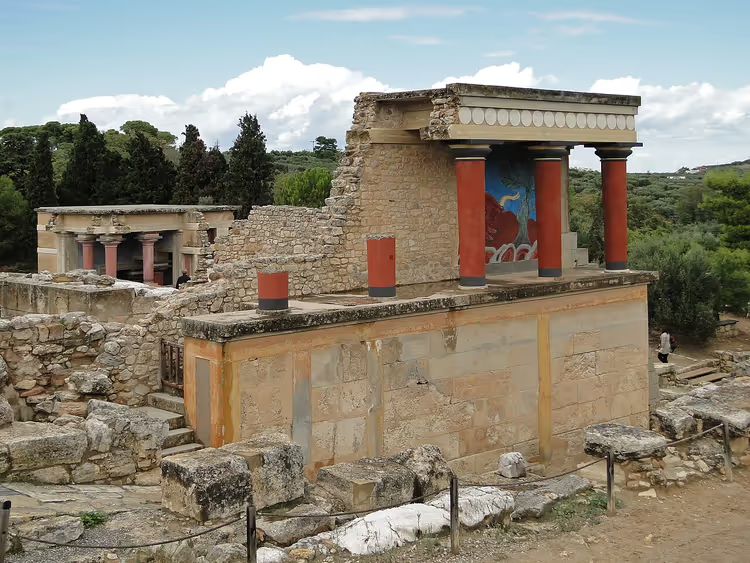
The first settlement on the Kephala hill appeared around 7000 BC (according to the official website of the Heraklion municipality). By the end of the 3rd millennium BC, the site was leveled for a large palace. The first Palace of Knossos was built around 1900 BC, and around 1700 BC it was destroyed by an earthquake (Heraklion city portal, English Wikipedia).
 © Bernard Gagnon · CC BY-SAPhoto: Bernard Gagnon, CC BY-SA (https://creativecommons.org/licenses/by-sa/3.0), Wikimedia Commons
A second palace was built on the ruins, larger and richer than the first. It survived two more upheavals: around 1450 BC it was partially destroyed, and around 1350 BC a major fire finished it off for good (according to the Heraklion municipality). After that, Mycenaeans settled at Knossos, and life on the hill continued uninterrupted until Roman times.
Arthur Evans's discovery
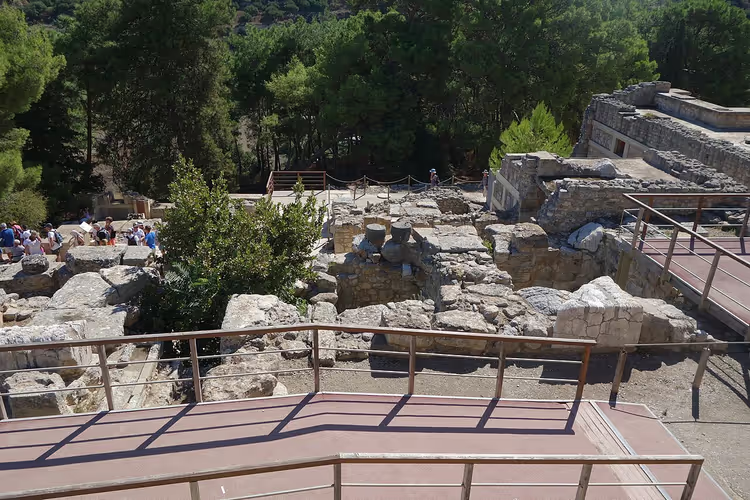
The first excavation at the palace site was carried out by the Greek Minos Kalokairinos in 1878 (according to the Knossos page on the city website). The finds made the newspapers, and European researchers began flocking to the hill. The Englishman Arthur Evans bought up plots of land and excavated from 1900 to 1913, then again from 1922 to 1930 (Heraklion municipality guide).
 © Александр Спиридонов · CC BYPhoto: Александр Спиридонов, CC BY (https://creativecommons.org/licenses/by/3.0), Wikimedia Commons
Evans did not stop at excavation. He carried out a large-scale reconstruction and acted as the architect himself (according to the Heraklion municipality website). The Minoans used wooden columns that have not survived, so the ancient supports are now replaced by Evans's stone and concrete replicas (encyclopedia).
This reconstruction added details to the complex that did not exist in antiquity. Some scholars believe the site should simply have been conserved and the finds transferred to museums (Wikipedia article). Today, copies of the frescoes and the throne adorn Knossos, while the originals are on display at the Heraklion Archaeological Museum (according to the Region of Crete).
Theories about the palace's destruction
Historians still argue about why the palace was destroyed. There are several theories, each based on its own set of finds.
- Fire. Around 1450 BC the island suffered severe destruction, and a fire may have destroyed Knossos (Heraklion city website).
- Invasion from the mainland. Around the same time, the Mycenaeans established themselves on Crete (Heraklion city portal).
- Natural disaster. Some researchers link the island's troubles to earthquakes and volcanic activity in the Aegean Sea (free encyclopedia).
- Decline. After a major fire around 1350 BC, the palace was abandoned, and the hill was later settled by other peoples (Heraklion city administration).
Scholars have not reached a definitive conclusion. But one thing is clear: by 1350 BC the palace complex had ceased to exist as a center of power (according to the Heraklion administration).
The labyrinth of the Minotaur at Knossos
Knossos is often called the very labyrinth from the myth of the Minotaur. The reasoning is simple: the palace plan is confusing, and the corridors and passageways branch off in different directions (official Crete tourism website).
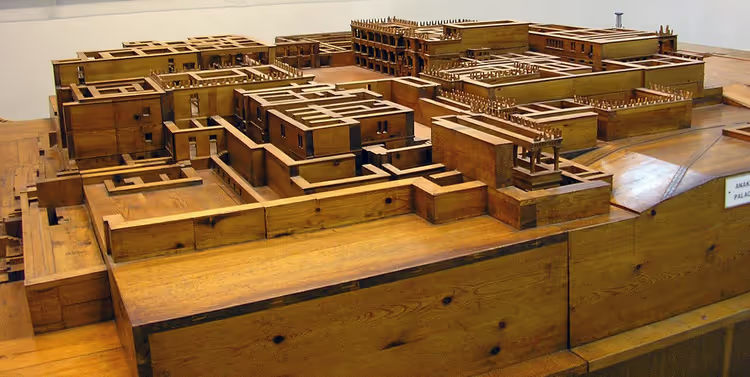
There is another version. According to it, the Minotaur was "hidden" not in the palace, but in caves (page about the Palace of Knossos). While scholars argue, tourists walk through the same halls and remember Ariadne's thread.
Architecture of the Palace of Knossos
Modern architects believe that calling Knossos a palace is not entirely accurate. Rather, it is a whole city capable of existing autonomously (Crete region portal). From the outside, the complex looks confusing, but all paths converge on a large central courtyard (Heraklion city website).
The complex had plumbing, sewerage, ventilation, and lighting (according to the Crete region website). The built-up area was about 20,000 square meters, and there were several floors (Crete tourism portal). Evans estimated that about 80,000 people lived in the city (Crete region overview).
Throne room and other rooms
The throne room has survived better than the other rooms. It got its name from a massive gypsum chair with stone benches on either side, and a lustral basin stands nearby (Heraklion municipality). The rulers of Knossos probably held audiences here.
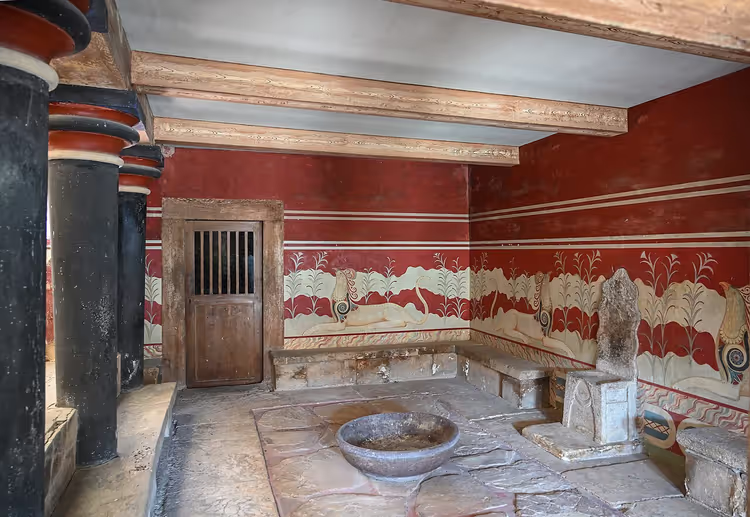 © Cayambe · CC BY-SAPhoto: Cayambe, CC BY-SA (https://creativecommons.org/licenses/by-sa/4.0), Wikimedia Commons
The other chambers were divided by purpose. The west wing held storerooms with large pithoi, while the east wing contained living quarters and reception halls, including the Hall of the Double Axes and the queen's apartments (official website of the city of Heraklion). At the north entrance, a kind of customs post operated, where goods arriving from the port were inspected (note on Knossos on the Crete website).
Legends and myths of Crete
The Palace of Knossos is tied to one of the key myths of Greece. Its characters include King Minos, his wife Pasiphae, the monster Minotaur, the craftsman Daedalus, and the Athenian hero Theseus (overview of the myth of Knossos).
- Minos was considered the son of Zeus and the beautiful Europa. According to legend, the gods made him the rightful ruler of Crete.
- Poseidon gave Minos a white bull and demanded that the animal be sacrificed. Minos took pity on the bull and substituted the sacrifice, and as punishment his wife gave birth to a monster with a human body and a bull's head.
- The Minotaur was imprisoned in a labyrinth built by Daedalus. No one could find a way out.
According to the myth, after defeating Athens, Minos demanded tribute: seven girls and seven young men were sent into the labyrinth (Wikipedia). The third time, Theseus was among the young men. He killed the Minotaur and escaped with the help of Ariadne's thread. The legends do not say how Minos himself died, but after death he became a judge in the realm of the dead.
Interesting facts about Knossos
- Evans's excavations were funded with his own money (Wikipedia data).
- The archaeologist spared no expense or time, but sometimes rushed and filled in missing details himself (Wikipedia article).
- The Minotaur from the Cretan myth later appeared in Dante's "Divine Comedy" (description of the palace in Wikipedia).
Excavations at the site continue to this day (Wikipedia). Many finds have already been documented, but some of Knossos's mysteries still await answers.
Opening hours and ticket prices
An adult ticket costs 20 €, a reduced ticket 10 € (as of 09/2026, Ministry of Culture catalog). Buying tickets in advance is easier online, through the official service. Children and reduced-rate categories enter at a lower price or free of charge.
Season | Hours | Last entry |
|---|---|---|
From April 1, high season | 08:00-20:00 | 19:45 |
From September 1 | 08:00-19:30 | 19:15 |
From September 16 | 08:00-19:00 | 18:45 |
From October 1 | 08:00-18:30 | 18:15 |
From October 16 | 08:00-18:00 | 17:45 |
From November 1, winter | 08:30-17:00 | 16:45 |
The monument is free on March 6, April 18, May 18, the last weekend of September, and October 28 (according to the official monument page). The complex is closed on January 1, March 25, December 25 and 26, and on Easter Sunday.
Tickets with a time slot are convenient to book in advance: tickets and time slots on Tiqets. In high season there can be a line at the ticket office, while online you get in faster.
Tours and tickets in Knossos
Guided tours, skip-the-line tickets and activities — most offers can be cancelled free of charge.
See offers on TiqetsThe widget loads once you give your consent.
How to get there from Heraklion
The palace is located at T.K. 71409, Knosos, 5 km south of central Heraklion (according to the official Ministry of Culture portal). You can get there in several ways:
- By bus. Route No. 2 "Knossos" runs from Heraklion to the final stop at the entrance (according to the ministry website).
- By taxi. From the city center the ride is short, since it is only a few kilometers.
- By car. There is parking near the monument, and the drive from Heraklion takes little time.
If you are coming from another city, first get to the Heraklion bus station, then transfer to a city bus to Knossos. From the airport it is convenient to take a transfer to Heraklion on Kiwitaxi, especially with luggage and a late-night arrival.
Knossos Palace on the map
Palace coordinates: 35°17′53″N 25°9′47″E (Knossos page on Wikipedia). For a GPS navigator, use the address T.K. 71409, Knosos.
Knossos Palace
Places on the map
- Knossos Palace Minoan palace complex 5 km south of Heraklion
⁉️🤔 Frequently asked questions
How much does a ticket to Knossos Palace cost?
Prices for adult and reduced tickets are listed in the "Opening hours and ticket prices" section. The monument is free on several dates: March 6, April 18, May 18, the last weekend of September, and October 28. A ticket with a time slot is convenient to book online in advance.
How do I get from Heraklion without a car?
Bus No. 2 "Knossos" runs from central Heraklion, with the final stop at the entrance (according to Ministry of Culture information). The distance is about 5 km, so the ride is short. Take a taxi in the morning when there is no traffic, and buy your bus ticket from the driver.
How much time do I need to see it?
Two hours is enough to walk around the central court, the throne room, and the residential quarters. If you read every sign and photograph every fresco, allow more time. Bring water and a hat: there is little shade in the open areas, and it gets hot here in summer.
Can you see the original frescoes at Knossos?
No. The palace itself displays copies, while the original frescoes, seals, and Linear B tablets are kept in the Heraklion Archaeological Museum (according to the official Crete travel site). The museum is located in the city center, so it is easy to combine it with a trip to Knossos in one day.
Are Knossos and the Minotaur's labyrinth connected?
Strictly speaking, they are different things. The labyrinth is known only from myth, while Knossos is a real archaeological site (Wikipedia). The palace's confusing layout suggested the image of a labyrinth to the ancient Greeks, which is why Knossos is now called the home of the Minotaur.
When should you arrive to avoid crowds?
Come at opening time or in the afternoon: tour groups gradually leave at that time, and the heat subsides. In high season, it is better to book a timed ticket in advance. In winter, the site closes early, so plan your visit for the first half of the day.
In short: what to book
If you are going from Heraklion for one day: book your Knossos ticket in advance, and return by the same bus to the city. If you want to see the originals: add the Heraklion Archaeological Museum to your trip. If you are arriving with luggage: it is more convenient to book an airport transfer.
The bottom line is simple: the best time to visit the Palace of Knossos is morning or evening. Plan your trip in advance, and you will avoid the lines and the midday heat.

A small editorial team writing guides for independent travel. We travel ourselves, but we haven’t been everywhere, so we check prices, opening hours and how to get there against official sources.