














Latvia: how to pay by card, how much to tip and where cash is needed
From Frankfurt to Riga it's a two-hour flight. No visa needed, the currency is already the euro, and you won't even notice the border inside Schengen.
A single ticket on Riga public transport costs €1.50 when you pay contactless by card on board (as of 09/2026, Rīgas Satiksme fares). Tipping here is lower than in Germany, and outside the city cards don't work everywhere.
Below is the practical part: entry, money, tipping, transport, internet, and ten things that surprise visitors from Germany.
Ad: this article contains affiliate links, we earn a commission if you book through them, at no extra cost to you.
What to check before the trip
💡 In short:
- No visa needed: an ID card is enough, the currency in the country is the euro.
- In Riga you can pay by card almost everywhere; outside the city keep cash on hand.
- On Riga transport, a single ride is easy to pay for by card right on board.
- Fares and rules: 09/2026, verified on the carrier's official website
Entry: what you actually need
Latvia is part of the EU and Schengen, so formalities for you are minimal. Citizens of Germany, Austria, and Switzerland don't need a visa, and no separate registration is required. A valid ID card is enough; a passport is more convenient but not mandatory.
One exception applies to children. Every child travels with their own document, and being listed on a parent's ID no longer works. This is checked at the border.
You'll receive medical care under the European Health Insurance Card on the same terms as locals. Private insurance that covers repatriation is still worth having: the standard card covers treatment, but not the trip home.
No special permits are needed for driving. Driver's licenses and vehicle documents from Germany, Austria, and Switzerland are recognized here, and there are no toll highways for passenger cars.
For pets, the EU rule applies: a veterinary passport, a microchip, and a valid rabies vaccination.
Money: euros, cards, and cash
Latvia has been using the euro for over ten years. You won't see an exchange office, and there's no exchange rate to calculate: the price on the tag is the price.
In Riga, cards work almost everywhere. Hotels, cafes, museums, ticket machines, and taxis all accept card payments. Contactless payment by phone has become the norm, and on some buses and trams you tap your bank card on the terminal right when you board.
Outside the capital, the picture is different. In small towns, at markets, at roadside shops, and with apartment hosts in Kurzeme and Latgale, cash is still preferred. If you're leaving Riga, keep a supply of small bills on you.
Two details about ATMs. Machines from major banks work without problems, but standalone terminals in the Old Town charge a noticeable fee. And if an ATM offers to charge you in your home currency, decline and choose euros.
Tipping: how much is customary
Tipping in Latvia isn't mandatory, but people leave it for good service. Amounts are slightly lower than in Germany, and there's no strict rule here.
- At a restaurant: round the bill up or add about a tenth.
- At a cafe or bar: loose change from your change is enough.
- In a taxi: round up, and on a long trip add a tenth.
- Hotel porter: a small coin per piece of luggage.
- On a city tour: a few euros per person if the tour runs longer than two hours.
An important detail: at some Riga restaurants, a service charge is already included in the bill, especially for large groups. In that case, no additional tip is expected. Check the bill before rounding up: it saves both money and awkwardness.
Riga: transport and getting from the airport
Riga's public transport is run by Rīgas Satiksme: trams, trolleybuses, and buses, with dozens of routes across the city. The fare depends on how you buy it, and that's the least obvious detail for a visitor. You can buy a ticket in advance at a kiosk or pay by card on board. A 24-hour ticket costs €3.60, and a monthly pass comes to €30 (as of 09/2026, carrier's price list).
Option | When it pays off |
|---|---|
Single ride paid by card on board | one or two rides per day |
Ticket bought in advance at a kiosk | when the route is already clear |
24-hour ticket | three or more rides per day |
Monthly pass | a long stay in Riga |
For a three-day trip, single tickets are usually more convenient: you'll walk through the Old Town and the Art Nouveau district on foot. A 24-hour ticket pays off if you're riding a lot and without a plan.
A city bus runs from the airport to the center, and the trip takes about 40 minutes (according to Riga Airport). A taxi booked through an app is faster, averaging about 20 minutes on the same route (same source). It's best to avoid drivers who offer a ride right in the arrivals hall: the official taxi stand is outside and marked with signs.
How to get there | Plus | The catch |
|---|---|---|
City bus to the center | cheapest, plenty of luggage space | slower than a taxi |
Taxi via app | fast and transparent pricing | more expensive than the bus |
Pre-booked transfer | met in the arrivals hall | the most expensive option |
Tours and tickets in Riga
Guided tours, skip-the-line tickets and activities — most offers can be cancelled free of charge.
See offers on KiwitaxiThe widget loads once you give your consent.
Trains and buses around the country
Latvia's rail network is small, but it covers the main routes. The most common trip for locals is Jūrmala: the electric train takes about half an hour from Riga, and you get off at Majori, a stone's throw from the beach. Check tickets and schedules on the carrier's website.
Other lines run to Sigulda in Gauja National Park, to Jelgava, Daugavpils, and Valga on the Estonian border. Tickets cost a few euros and can be bought right at the station.
For everything the train does not cover, there are intercity buses: Kuldiga, Ventspils, Liepaja, Cesis. The services are reliable, the buses are modern, and prices are low. Riga's bus station also has international routes to Tallinn and Vilnius, with a travel time of about four to five hours.
If you want to compare schedules and prices before your trip, check train schedules for Latvia.
Car rental: when you cannot do without a car
The Kurzeme coast, Kemeri National Park, and the lakes of Latgale are hard to explore without a car. Trains and buses will get you to the town, but not to the dunes or the lake trails.
The main road network is good, while secondary roads include many gravel sections. When booking, check the gravel road policy: not every rental company allows driving on them, and insurance does not always cover such cases.
From December 1 to March 1, winter tires are mandatory (according to CSDD). Low-beam headlights must be on year-round, including during the day. The legal alcohol limit is low, and roadside checks are frequent.
Rent a car if your route goes beyond Riga and Jurmala: compare car rental prices.
Internet, eSIM, and roaming
Latvia is in the EU, so roaming for EU SIM cards works under home conditions: you can call and use data without extra charges within your plan's limits.
A separate SIM card or eSIM is rarely needed. There are two reasons: a Swiss plan, which is not part of the EU roaming scheme, and a data allowance at home that is too small. Local prepaid SIM cards and eSIM packages are sold at the airport and in the city.
The network works surprisingly well across the whole country, with consistently fast speeds in Riga, and public Wi-Fi is available in cafes, at stations, and on buses. Latvia is one of the most digital countries in Europe, and you notice it when paying, buying tickets, and dealing with government services.
If your home data allowance runs out, compare eSIM options for Latvia.
Language: will English be enough
The official language remains Latvian, a Baltic language unrelated to German. For a visitor it is practically impossible to learn, and there is no need to struggle: two words will come in handy, and English will cover the rest.
"Thank you" and "please" sound like this: "paldies" and "lūdzu". Locals will appreciate the attempt, even if you switch to English right after.
In Riga, in the tourism sector and among younger people, English has become the norm. German is understood noticeably less than you might assume given the country's historical ties to the German language. Russian is widespread as an everyday language, especially in Riga and in the east, but you should not draw conclusions about the person you are talking to from that: stick to English.
10 Things that surprise visitors from Germany
1. Alcohol sales close early
In stores, alcohol is sold only in a narrow window between morning and 10 p.m. The rules were tightened in summer 2025, and in the evenings the shelves are simply closed off (according to the Saeima). Bars, restaurants and clubs are not affected by the ban. Drinking alcohol on the street is not allowed.
- The catch: after 10 p.m. you cannot buy wine for dinner at a store.
2. Riga leads Europe in art nouveau
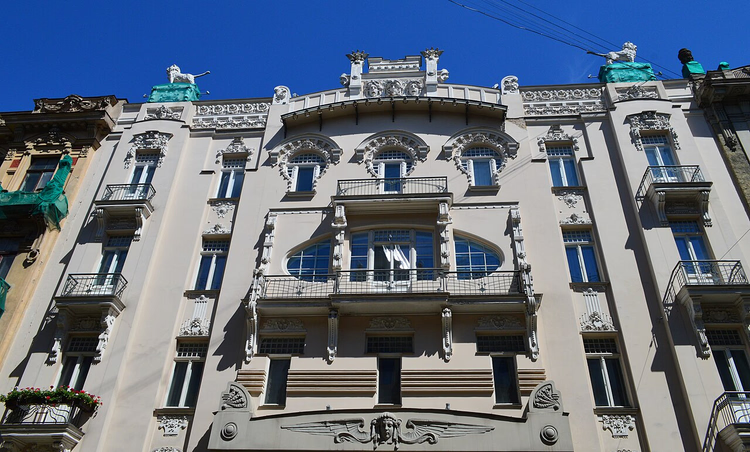
The capital of Latvia is the main Art Nouveau city on the continent. A significant part of the central district dates back to the early 20th century, and the densest concentration of buildings stands on Alberta iela and Elizabetes iela. If you only walk around the Old Town, you will miss the main thing.
 © Scotch Mist · CC BY-SAPhoto: Scotch Mist, CC BY-SA (https://creativecommons.org/licenses/by-sa/4.0), Wikimedia Commons
The simplest route looks like this: from the Old Town you walk along Elizabetes iela toward Alberta iela. It takes less than an hour, and the difference between the blocks is visible immediately.
3. More than half the country is forest
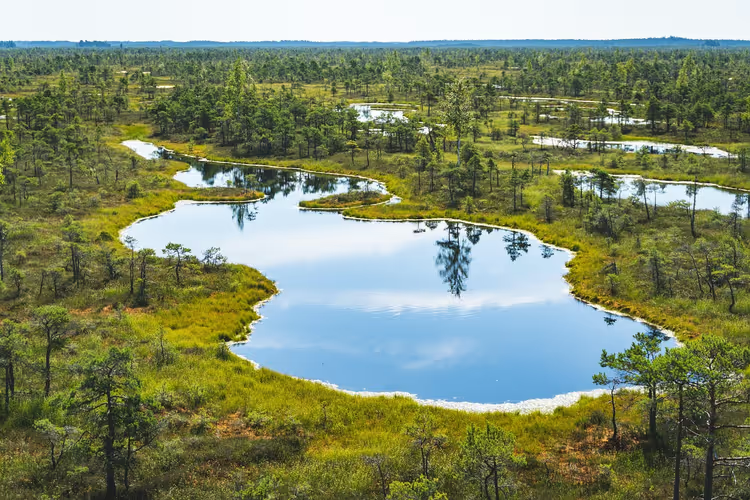
Latvia is among the most forested countries in Europe. Picking berries and mushrooms is allowed across most of the territory and has long been part of everyday life. In August and September, half the country heads into the forest with baskets. If you are here in season, this will be the first thing people tell you about.
4. The sea is half an hour from the center
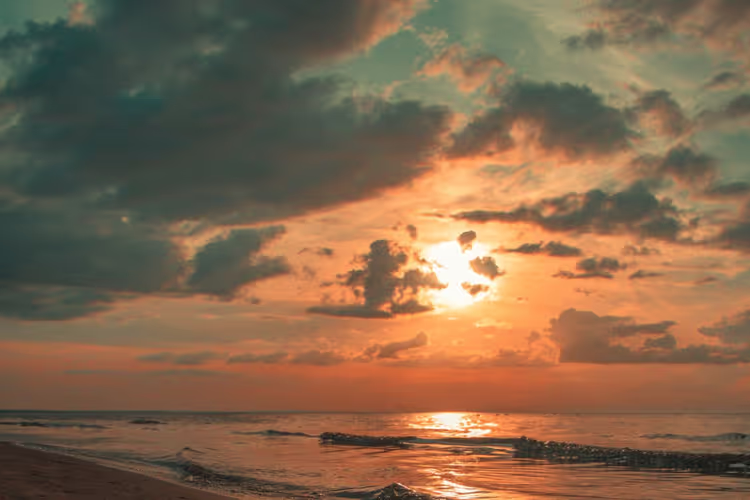
Jūrmala, with its wide white beach and wooden villas, is a half-hour drive from Riga. The water stays cool even at the height of summer, and swimming is more invigorating than relaxing. On the other hand, the beach is long, there are few people, and the pine park begins right behind the dunes.
- The catch: you will not get warm water in July and August.
5. Summer nights are almost without darkness
At the end of June it barely gets dark in Riga. The main holiday of the year, Jāņi, falls on the night of June 23 to 24: half the country leaves the city, and much of the city shuts down. If you are booking a trip for these dates, keep the changed schedule in mind.
6. Winter here is serious
From December to February, daytime temperatures often stay below freezing, and snow is common. It gets dark early, so city walks are best planned for the short daylight window. Winter is worth visiting for the architecture, museums and saunas, not for strolling around.
- The catch: daylight hours are short, and part of the trip happens in the dark.
7. The sauna here is a separate ritual
The Latvian pirts does not work like a spa treatment at a hotel. It is a multi-hour ritual with birch whisks, herbs and a sauna master who leads the process. If you are offered such an evening, say yes: the experience is stronger than a regular sauna.
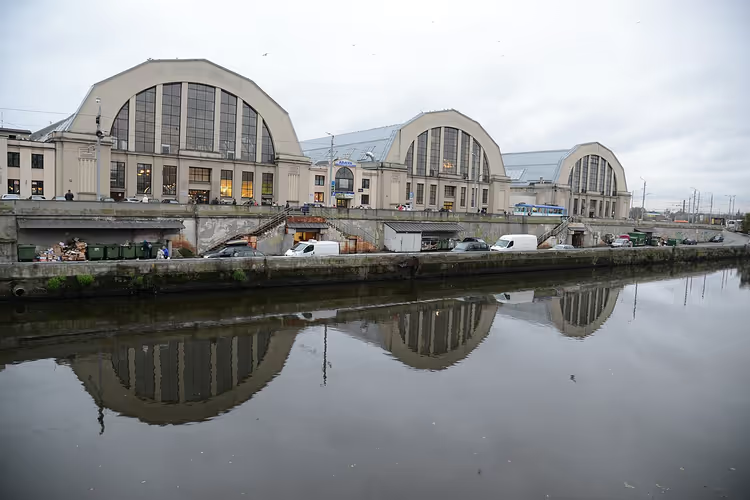
8. The Central Market sits in former airship hangars
Rīgas Centrāltirgus is one of the largest markets in Europe. Tourists and locals pay the same prices here, which is rare for the central part of the city. Lunch at the market is cheaper and better than at Old Town restaurants. Come before noon, while the selection is wider.
 © Jorge Láscar from Melbourne, Australia · CC BYPhoto: Jorge Láscar from Melbourne, Australia, CC BY (https://creativecommons.org/licenses/by/2.0), Wikimedia Commons
9. People take off their shoes at home here
If you are invited to someone's home or you rent an apartment, shoes are left at the door. This is a local norm, not a request from a particular host. A small thing, but it is exactly these details that make a guest feel at home.
10. The Old Town has its own traps
In the Old Town there are bars where guests are lured in from the street and where the bill turns out to be several times higher than expected. The rule is simple: do not go into places where you were invited from the street, and check prices before ordering. Otherwise Riga is a safe city, and the usual precautions against pickpockets are enough.
- The catch: in the bars that lure you in, the bill for a couple of cocktails can be an unpleasant surprise.
Location, safety and the border zone
Latvia borders Russia to the east and Belarus to the southeast. For planning purposes this matters for two reasons.
First: travel to Russia and Belarus is not recommended. The foreign ministries of Germany, Austria and Switzerland advise against such routes, and crossings on the eastern border are heavily restricted (according to the Auswärtiges Amt). You should not combine a trip to Latvia with a visit across the eastern border.
Second: a border zone runs along the frontier, and part of it requires separate registration. This does not affect ordinary tourist destinations: Daugavpils, Rēzekne, Rāzna National Park and the lakes of Latgale remain accessible. For the crossing itself, you need advance online registration in the queue system (according to the German embassy in Riga).
Separate from the border issue: Latvia remains a calm country with a low level of violent crime. Before departure, still check the current recommendations of your own foreign ministry: they change, while this text does not.
Practical notes
- The best time for the city and the coast is the period from May to September.
⁉️🤔 Frequently asked questions
Do I need a visa to travel to Latvia?
No. A valid identity document is enough, and a child needs their own document. Details in the "Entry: what you actually need" section.
Can I pay by card in Latvia?
In Riga cards work almost everywhere; outside the city keep cash on hand. Details in the "Money: euros, cards and cash" section.
How much should I tip?
In restaurants, people round up the bill or add about a tenth if the service charge is not included. Details in the "Tipping: how much to leave" section.
Do I need an eSIM for Latvia?
Usually not: roaming for EU cards works under home conditions. The exception is Swiss plans; details in the "Internet, eSIM and roaming" section.
How safe is travel to Latvia right now?
The country is calm, but travel to Russia and Belarus is not recommended. Details in the "Location, safety and the border zone" section.
In short: what to book
If you are going to Riga for a weekend, book central accommodation in advance: in summer, available rooms in the Old Town and the Art Nouveau district go quickly. For a short trip, public transport and walking will be enough. See accommodation options here: hotels in Riga on Trip.com.
If you are adding Jūrmala, the national parks or the Kurzeme coast, sort out the car and train question in advance. In season there are fewer available spots and prices are higher.

A small editorial team writing guides for independent travel. We travel ourselves, but we haven’t been everywhere, so we check prices, opening hours and how to get there against official sources.