
















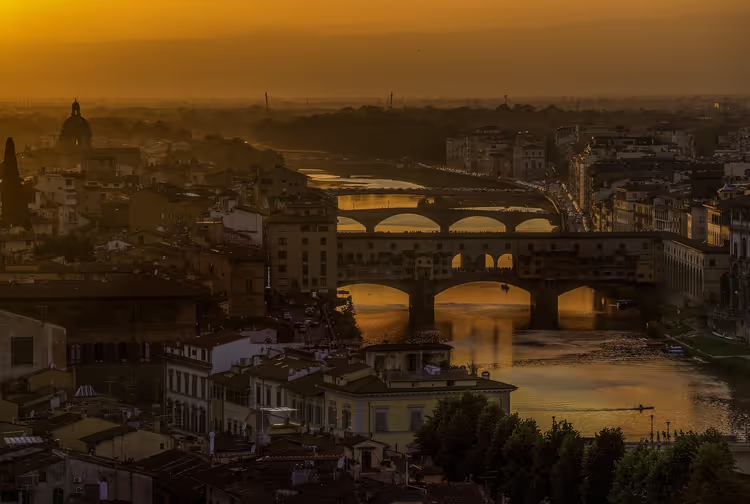
Palazzo Medici Riccardi: what to see and how much tickets cost
Palazzo Medici Riccardi stands five minutes from the Duomo. The line here is shorter than at the Uffizi Gallery, and the ticket is cheaper.
This is the first palace of the Medici family. Cosimo the Elder commissioned it in 1444 as the family residence and bank headquarters (source: palace history). People come here for the Chapel of the Magi with frescoes by Benozzo Gozzoli and the Hall of Mirrors with a ceiling painting by Luca Giordano. A full ticket costs €10 in low season and €15 in high season (as of 09/2026, museum rates).
Ad: this article contains affiliate links, we earn a commission if you book through them, at no extra cost to you.
Construction history
💡 In short:
- The palace is open every day except Wednesday, from 9:00 to 19:00 (as of 09/2026, ticket page).
- A ticket costs €10 in low season and €15 in high season (as of 09/2026, rates).
- Entry to the Chapel of the Magi is by timed slots: ten people every five minutes.
- Prices and opening hours: 09/2026, verified on the official website.
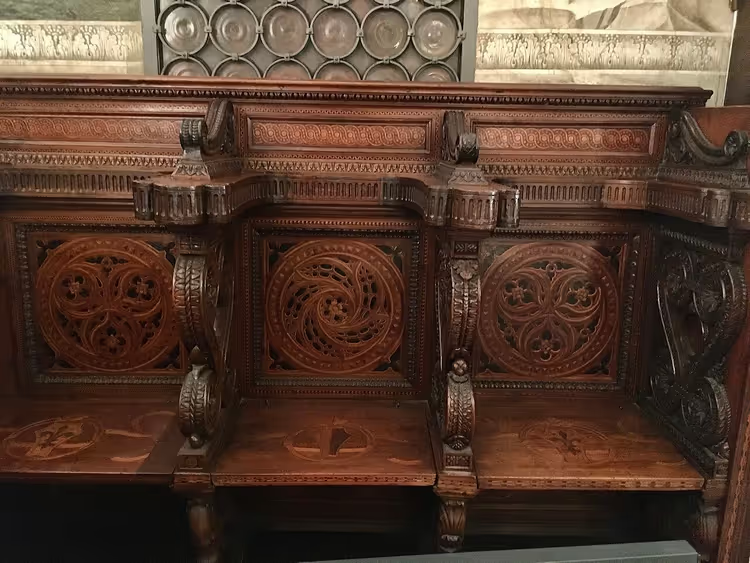
The palace's history is often told through the resentment of one architect. Cosimo de' Medici the Elder wanted the new family seat to be a statement of power, not wealth. According to Giorgio Vasari, he first commissioned Filippo Brunelleschi, who brought a model of a lavish palace with reliefs, stucco work, and statues (source: official palace website). The client found the model too ornate.
Brunelleschi did not take this turn of events well. Accounts say he smashed the finished model. The commission went to another master in the family's service, Michelozzo di Bartolomeo. He proposed a palace modest on the outside and majestic in its proportions, and Cosimo agreed at once.
 © Manuelarosi · CC BY-SAPhoto: Manuelarosi, CC BY-SA (https://creativecommons.org/licenses/by-sa/4.0), Wikimedia Commons
The first stone was laid in 1444 on Via Larga, now Via Cavour. Here you will see the rooms where Lorenzo de' Medici the Magnificent lived. Donatello, Michelangelo, Paolo Uccello, and Sandro Botticelli all worked in the palace (source: palazzo chronicle).
Part of the rooms were given over to the headquarters of the Medici bank. The family held the palace for almost two centuries. In 1494, when the Medici were expelled from Florence, the republic seized the building and all its property, including Donatello's bronze David (source: palazzo history).
In 1659, Marquis Gabriello Riccardi bought the palace for forty thousand scudi. By that time the building was considered gloomy, and the new owner rebuilt the interiors in the Baroque taste (source: museum information). In 1874, the palazzo passed to the province of Florence, and today its offices and the prefecture operate here.
Inner courtyard
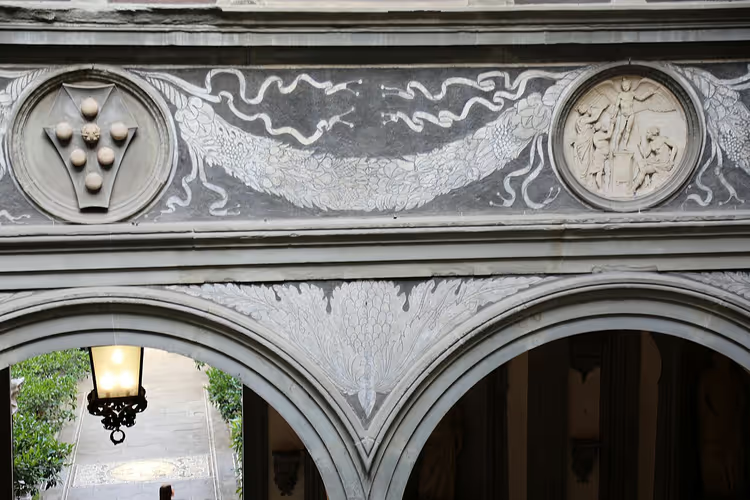
Behind the heavy facade lies a light courtyard with columns. It is called the Michelozzo courtyard after the architect, or the courtyard with columns.
 © Francesco Bini · CC BY-SAPhoto: Francesco Bini, CC BY-SA (https://creativecommons.org/licenses/by-sa/4.0), Wikimedia Commons
The first level of the courtyard is occupied by a covered arched gallery. The second level is taken up by windows, and the third opens up the gallery again. Reliefs and stucco decorate every level, and here you will spot quite a few sculptures.
The paths are paved with multicolored mosaic, the bushes are trimmed into shapes, and citrus trees grow in tubs. In the heat it stays cool here, and in windy weather there are no drafts. The Michelozzo courtyard set a trend: after it, an inner courtyard became a mandatory part of Florentine palazzos.
Architecture
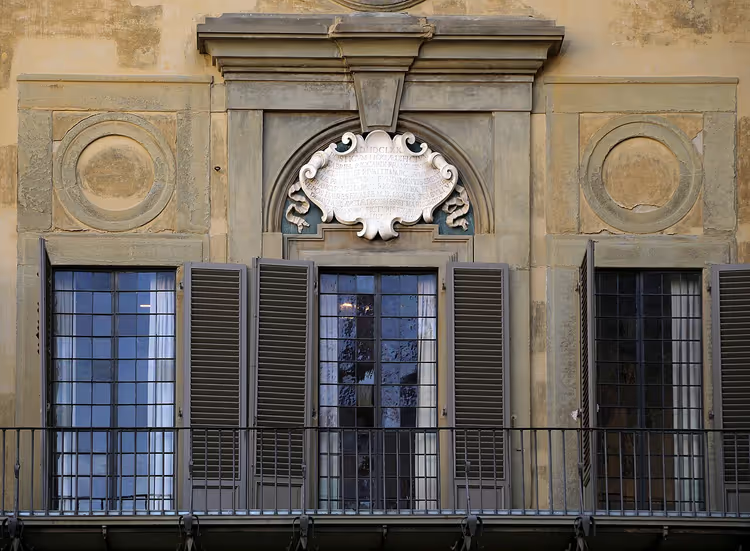
The facade is deliberately plain. Cosimo asked that it speak of reliability, not wealth.
 © Francesco Bini · CC BY-SAPhoto: Francesco Bini, CC BY-SA (https://creativecommons.org/licenses/by-sa/4.0), Wikimedia Commons
The palazzo is divided into three floors, and each is finished in its own way. The first is clad in rustication, that is, rough, unhewn stone. At the time, only public buildings were faced this way, and a private home received such treatment for the first time right here. With this cladding, Michelozzo was showing the weight of the Medici family.
The "kneeling" windows on the ground floor are attributed to Michelangelo. They were used to wall up the corner loggia on the ground floor, which is why you will not see it today.
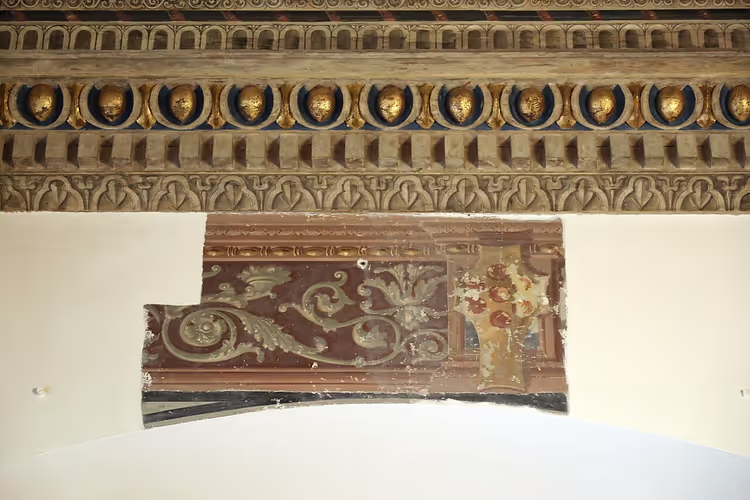
Medici coat of arms
On the second floor you will see the Medici coat of arms. It shows five red balls and one blue one with three golden lilies on a yellow field.
 © Francesco Bini · CC BY-SAPhoto: Francesco Bini, CC BY-SA (https://creativecommons.org/licenses/by-sa/4.0), Wikimedia Commons
Scholars still debate the exact meaning of the symbols, and there are many versions. According to one, the balls repeat the weapon of Averardo de' Medici, with which he defeated a giant. According to another, they are pills: the Medici were apothecaries and made their first fortune on medicines.
According to a third version, the balls represent coins or gold ingots, since the family ran one of the most influential banks in Florence. Where the truth lies is impossible to say now, but there is a grain of sense in each version.
Interior decoration
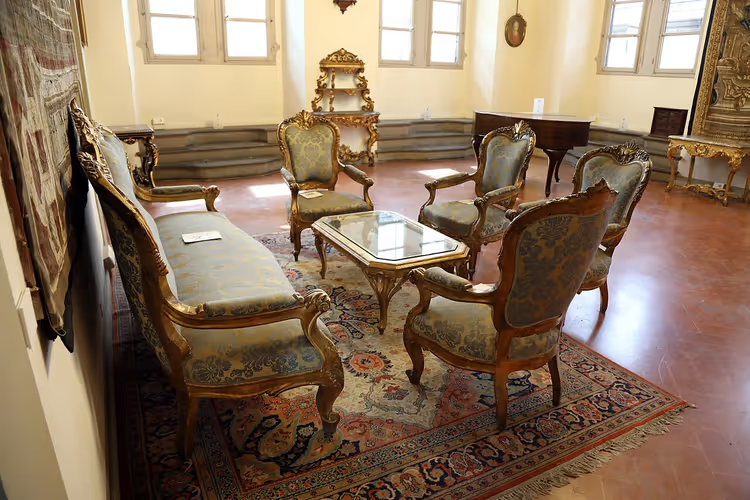
Most of the ground-floor rooms have kept their historic appearance. Here you will find luxury items and works of art collected by several generations of the Medici.
 © Francesco Bini · CC BY-SAPhoto: Francesco Bini, CC BY-SA (https://creativecommons.org/licenses/by-sa/4.0), Wikimedia Commons
Do not look for personal belongings from the Medici era on the second and third floors. The interiors were rebuilt more than once, and even the twentieth century added its own changes to the decor.
Hall of mirrors
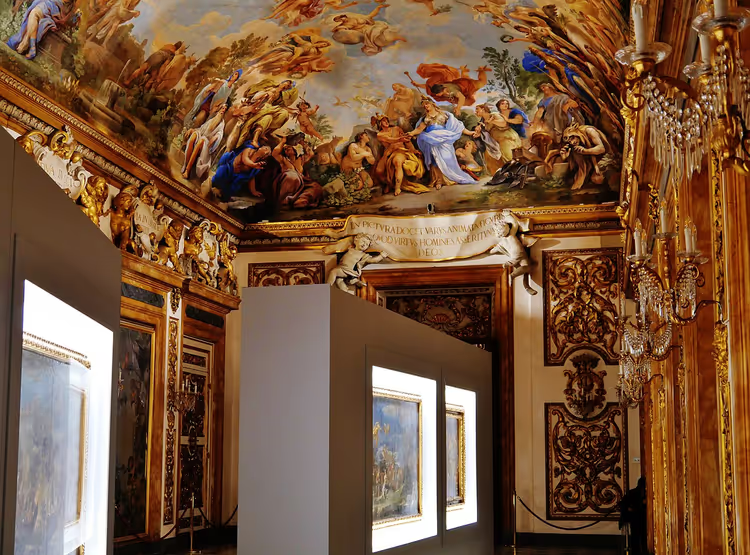
The Hall of Mirrors is also called the Giordano Gallery. Its vault was painted by Luca Giordano in 1682-1685, commissioned by the Riccardi family (source: page about the palace).
 © Zairon · CC BYPhoto: Zairon, CC BY (https://creativecommons.org/licenses/by/4.0), Wikimedia Commons
The frescoes combine allegorical subjects with portrait features of the Medici. You will see how Baroque painting took over the walls of a Renaissance palace.
Chapel of the Magi
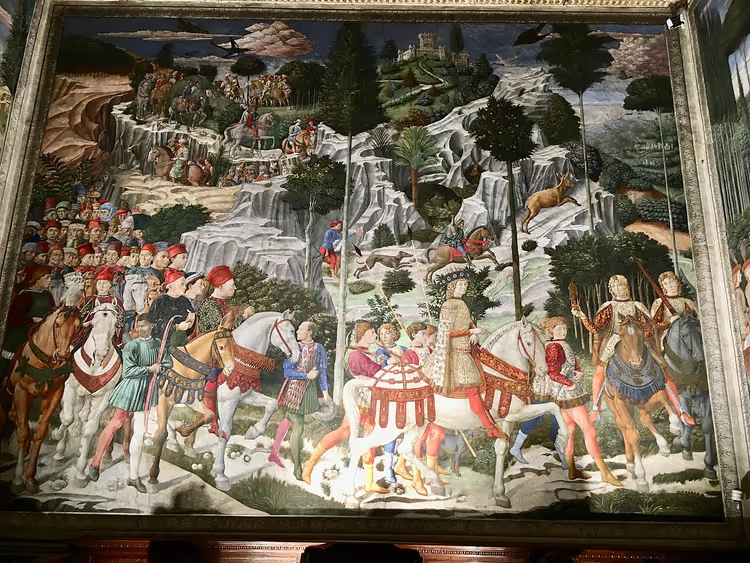
The Chapel of the Magi (Cappella dei Magi) is considered the palace's main treasure. Benozzo Gozzoli painted its walls in 1459 with the frescoes "Procession of the Magi to Bethlehem" (source: palazzo description).
 © Manuelarosi · CC BY-SAPhoto: Manuelarosi, CC BY-SA (https://creativecommons.org/licenses/by-sa/4.0), Wikimedia Commons
These are not separate paintings but a single composition. In the crowd of Magi you can easily recognize the features of the Medici, and among the riders there is a portrait of Galeazzo Maria Sforza. Above the altar you will see a copy of Filippo Lippi's "Nativity," installed in the twentieth century.
Entry is in small groups: ten people every five minutes (as of 09/2026, hours and tickets). Sometimes you are asked to wait a couple of minutes in the courtyard with columns.
Room of the Four Seasons
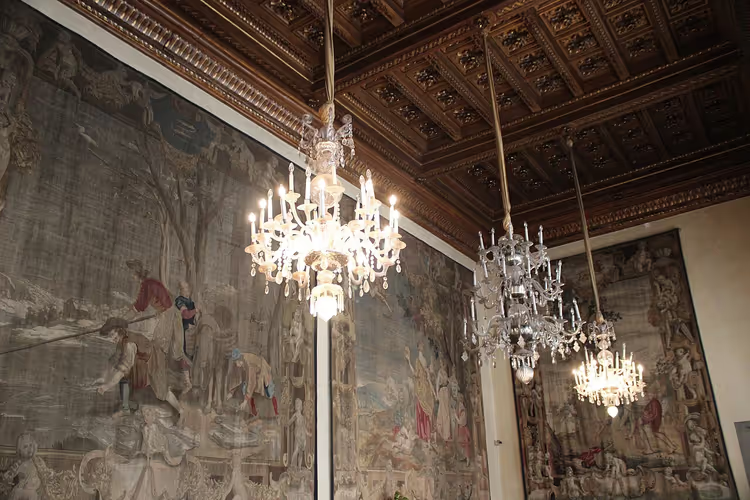
From the chapel, a grand staircase leads you to the Room of the Four Seasons.
 © Miguel Hermoso Cuesta · CC BY-SAPhoto: Miguel Hermoso Cuesta, CC BY-SA (https://creativecommons.org/licenses/by-sa/4.0), Wikimedia Commons
The walls are covered with Florentine tapestries depicting the four seasons. Here you can follow how one season gives way to the next in a single cycle.
Opening hours and ticket prices
The palace is open almost all week. There is only one closing day: Wednesday. The museum is also closed on December 25 (as of 09/2026, official website).
Day | Hours |
|---|---|
Monday, Tuesday, Thursday-Sunday | 9:00 AM-7:00 PM |
Wednesday | closed |
December 25 | closed |
January 1 | 2:00 PM-7:00 PM |
The ticket office closes one hour before the museum, at 6:00 PM. There are several types of tickets. A full ticket costs €10 from January 1 to February 28 and from November 2 to December 31, and from March 1 to November 1 its price is €15 (as of 09/2026, ticket prices).
A reduced ticket for ages 18-25 and students costs €7 in the low season and €10 in the high season. Children and teenagers up to 17, people with disabilities, and accompanying persons enter free of charge. A guided tour adds €4, and online booking adds another €1.50.
The catch: the ticket office closes at 6:00 PM, and the corner loggia on the ground floor is bricked up.
Tours and tickets in Florence
Guided tours, skip-the-line tickets and activities — most offers can be cancelled free of charge.
See offers on TiqetsThe widget loads once you give your consent.
Want entry with a fixed time slot? Tickets and guided tours on GetYourGuide.
Location and how to get there
Address of the palace: Via Cavour, 3 (as of 09/2026, palace website). This is the historic center of Florence, a few minutes from the Duomo, so walking routes almost always pass by it.
From Santa Maria Novella station you can walk to the palazzo in ten minutes. City buses 1, 6, 11, and 17 go past it. If you're driving, look for parking near the Central Market or near the station, both are paid.
Palazzo medici riccardi in florence on the map
Below is the palace's location on the map. From there you can build a walking route through the center of Florence.
⁉️🤔 Frequently asked questions
How much does a ticket to Palazzo Medici Riccardi cost?
A full ticket costs 10 € in low season and 15 € in high season. A reduced ticket for ages 18-25 and students costs 7 € or 10 €. Children under 17 and people with disabilities enter free. Online booking adds 1.50 € (as of 09/2026, ticket page).
What days is the palace closed?
The museum is closed on Wednesdays and on December 25. On Mondays, Tuesdays, and Thursday through Sunday, doors are open from 9:00 AM to 7:00 PM. The ticket office closes an hour earlier, at 6:00 PM, so arrive early (as of 09/2026, hours).
How much time do you need to visit?
For the palace with the Chapel of the Magi and the Hall of Mirrors, an hour and a half to two hours is enough. Entry to the chapel is by time slots, so allow extra time for waiting in the columned courtyard. With an audio guide, the visit takes longer, but you won't miss details in the frescoes.
Can you enter the Chapel of the Magi without a reservation?
The chapel is included in the general ticket; no separate reservation is needed. But entry is limited to ten people every five minutes, so in high season there may be a short line (as of 09/2026, entry rules).
Can you visit with children?
Yes, children and teenagers under 17 enter free. The Chapel of the Magi admits small groups, so it doesn't get crowded inside. With little ones, you may sometimes have to wait for your slot in the columned courtyard.
In short: what's worth booking
If you're going to Florence for a couple of days, get your ticket in advance. In high season, entry slots sell out, and online booking costs only 1.50 € extra (as of 09/2026, seasonal prices).
If you have one free day, put the palace in the morning and the Duomo in the afternoon. If you're traveling with kids, arrive at opening time at 9:00 AM: that's when it's least crowded. If you want more context, take a guided tour.

A small editorial team writing guides for independent travel. We travel ourselves, but we haven’t been everywhere, so we check prices, opening hours and how to get there against official sources.