
















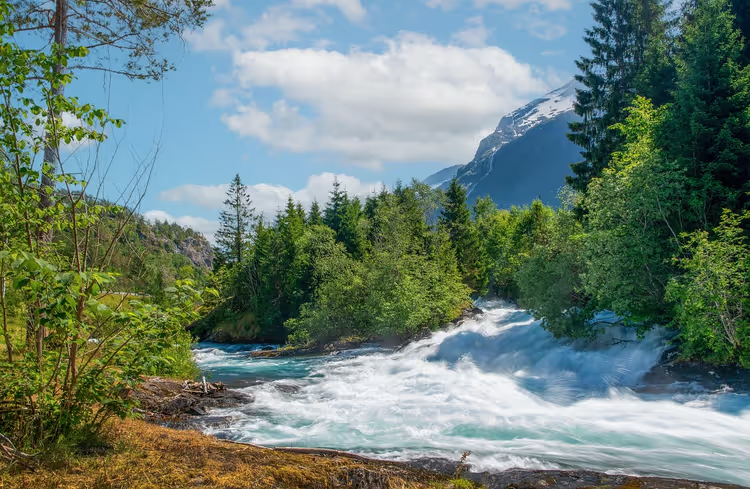
Preikestolen: how long to hike to the cliff, where to park and when there are fewer people
Preikestolen is a flat cliff above Lysefjord in Norway. The shape of the plateau is often compared to a preacher's pulpit, hence its second name. There is no elevator or cable car here: the only way to the top is a hiking trail.
The route starts at Preikestolen Base Camp near Stavanger, and you carry everything you need in your backpack.
Below we've put together the practical details: how to get to the trailhead, how long the hike takes, and when the plateau is least crowded.
Ad: this article contains affiliate links, we earn a commission if you book through them, at no extra cost to you.
What Preikestolen is
💡 In short:
- Parking at the trailhead is paid: 275 kroner per day, 40 kroner for 2 hours (as of 09/2026, parking rules).
- Route: 8 km round trip, about 4 hours, 500 m elevation gain.
- Bring water, food, and hiking footwear: there are no cafes or toilets on the trail.
- Start before 8:00 or after 16:00 to beat the crowds.
- Road, parking, and travel time: 09/2026, verified on the official website.
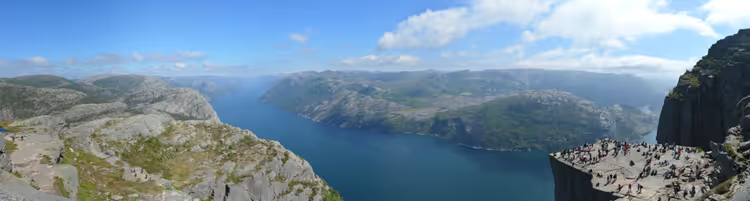
The plateau at the top is almost square, about 25 by 25 m. The English name Pulpit Rock and the Russian "Preacher's Pulpit" describe the same shape.
The cliff was shaped by glaciers and frost during the Ice Age. The glacier smoothed the slope, and frost weathering split a flat block off the plateau. A visible crack runs between the plateau and the main rock mass.
 © David Völgyes · CC BY-SAPhoto: David Völgyes, CC BY-SA (https://creativecommons.org/licenses/by-sa/2.0), Wikimedia Commons
Parts of the trail are laid with stone steps built by Sherpas from Nepal. There is no ticket office or turnstiles here: access to the trail is free. In summer 2022, 348,000 people hiked to the top (as of 09/2026, Preikestolen website).
How to get to the trailhead
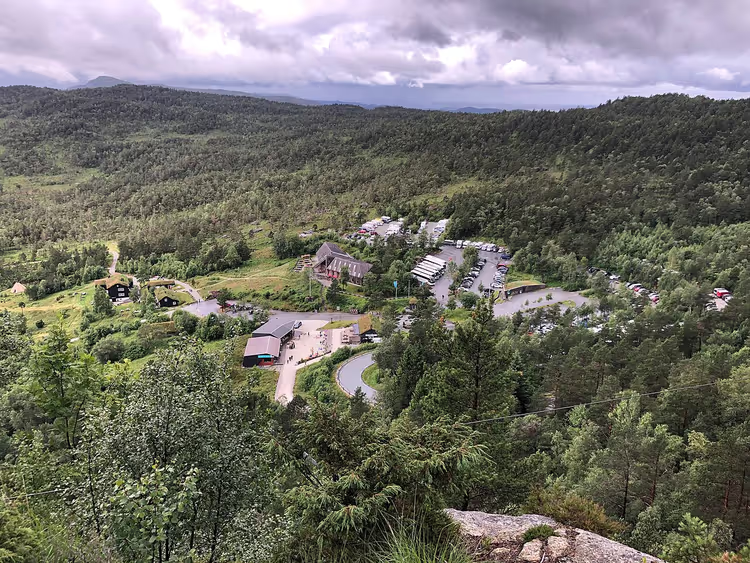
The starting point of the route is at Preikestolen Base Camp on the southern shore of Lysefjord. From Stavanger you get there by bus or car. You can't walk from the city.
The fastest option without a car: Preikestolen Express Bus. It runs from Stavanger bus station directly to Preikestolen Mountain Lodge, which is the trailhead. The bus operates from April to September, and tickets are sold online only. An adult round-trip ticket costs 550 kroner, a child ticket (0-17 years): 275 kroner (as of 09/2026, Fjord Norway). With this bus you have five hours for the ascent and return.
 © Davide Mauro · CC BY-SAPhoto: Davide Mauro, CC BY-SA (https://creativecommons.org/licenses/by-sa/4.0), Wikimedia Commons
By car you'll get there faster, but you need to pay for parking. The lot at Base Camp operates around the clock, with automatic barriers. A day rate for hikers costs 275 kroner, a stop of up to two hours: 40 kroner (as of 09/2026, parking rates). There are 1,000 spaces and 20 EV charging stations. In summer the lot fills up by morning.
By public transport from Stavanger, you take a bus directly to the trailhead. Since 2019, the route goes through the Ryfast tunnel, so the ferry is no longer needed. The schedule changes by season, so check it with the carrier Kolumbus. In high season, tickets sell out in advance, so buy them online rather than on the spot.
How long the hike takes and what the trail is like
The full route to the platform and back: 8 km and about 4 hours of walking (as of 09/2026, route page). Total elevation gain: 500 m. The start at Preikestolhytta is at about 270 m, the finish at 604 m (as of 09/2026, elevation profile).
The trail is moderate in difficulty, but it is not an easy walk. At first the path goes through forest and marsh, then rocks and stone steps begin. After rain the rocks are slippery, so bring proper footwear.
Hiking boots that cover the ankle, a rain jacket, and enough water matter more than being in good shape. There are no shops, cafes, or toilets on the route, and you carry all your trash out with you. There are benches with tables along the way for breaks.
- Who it's for: those who are ready for 4 hours of walking over rocks.
- Not for: travelers with a stroller or without proper footwear.
Tourists used to stack small cairns on the slopes. This is now prohibited: the rocks belong where nature put them, not in figures along the trail. Bring water with you and leave nothing unnecessary behind.
What you can see from the platform
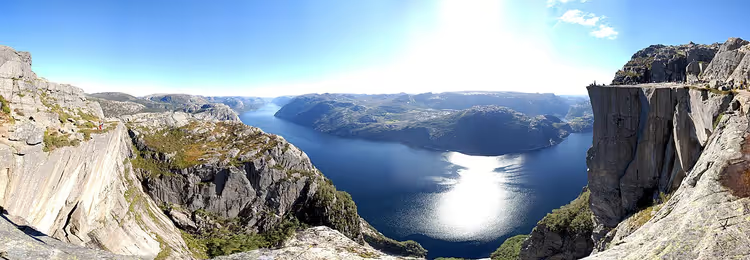
From the ledge you get a view of Lysefjord and sheer cliffs. The fjord stretches into the distance between the rock walls, with boats and excursion vessels visible below.
There are no railings on the platform. This is a deliberate choice by the Norwegians: a fence would not make the cliff safer, but it would ruin the view. Stay a couple of meters from the edge and keep an eye on children.
 © Carsten Steger · CC BY-SAPhoto: Carsten Steger, CC BY-SA (https://creativecommons.org/licenses/by-sa/4.0), Wikimedia Commons
The platform looks like a natural viewing point. From it you can see valleys, lakes, and the neighboring plateau. On a clear day the horizon stretches far, and clouds sometimes pass below you.
A crack runs right here between the platform and the main rock mass. The block rests on a solid base, so for a tourist the drop at the edge remains the main risk, not the rock itself.
In summer the platform gets crowded: in high season, crowds come up here. The catch: in June, July, and August a photo line forms at the edge, so arrive before 8:00 or after 16:00.
Kjeragbolten and neighboring peaks
Across the fjord from Preikestolen lies the Kjerag plateau. Its main landmark is Kjeragbolten, a boulder wedged between two cliffs high above the water. From there you get a separate view of Lysefjord.
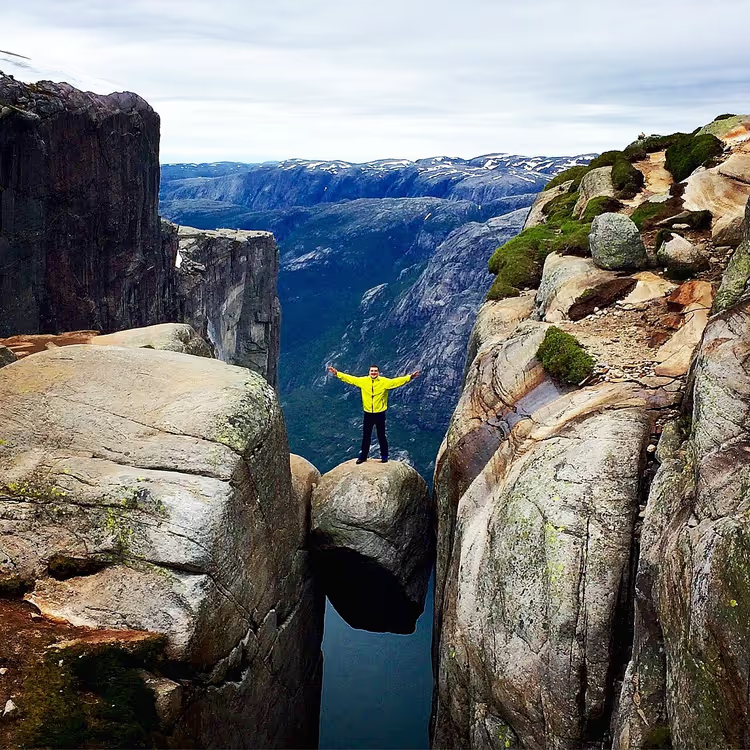 © Scoundrelgeo · CC BY-SAPhoto: Scoundrelgeo, CC BY-SA (https://creativecommons.org/licenses/by-sa/4.0), Wikimedia Commons
The hike to Kjerag is a separate route in the area. It is longer and steeper than the hike to Preikestolen, so it requires more time and experience. Many people combine both peaks into one trip through Rogaland.
Between the two hikes, people rest at Preikestolen Base Camp. The Adventure Center operates here year-round: you can buy or rent gear on site (as of 09/2026, hiker information). This break helps you save energy for the second peak.
In winter and the off-season
The trail is open year-round, but in winter the ascent requires gear. The rocks become covered in ice, so you need spikes for your boots. In winter, the official site does not recommend bringing children under 5 (as of 09/2026, winter hiking rules).
From September to March, daylight hours are short. Start early and plan to return before dark. Weather in the mountains changes quickly, so check the forecast before you set out.
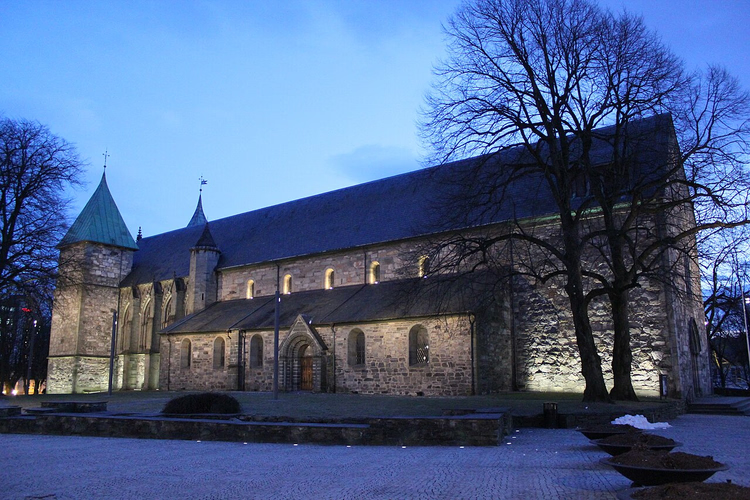 © Mathieu Marquer from Paris, FRANCE · CC BY-SAPhoto: Mathieu Marquer from Paris, FRANCE, CC BY-SA (https://creativecommons.org/licenses/by-sa/2.0), Wikimedia Commons
In spring and fall the trail has more water and mud than in summer. On the plus side, there are noticeably fewer people. A guide in the off-season is not mandatory, but useful if you are not confident in your navigation.
Preikestolen in winter looks different: snow, ice, and a short day. Without experience and gear, a hike like that turns into a risk, so many people hire a guide.
Cliff jumping and the view from the water
The cliff also attracts base jumpers. But this is not a tourist activity. Only trained athletes jump, as part of organized events, after registration and qualification checks. You cannot just show up and jump.
If you want to see the cliff from below, take a Lysefjord cruise from Stavanger. From the water the rock looks completely different and seems even taller. See cruises and tours on GetYourGuide.
A cruise like that takes several hours and works well if you do not have the time or energy for the hike up.
Tours and tickets in Stavanger
Guided tours, skip-the-line tickets and activities — most offers can be cancelled free of charge.
See offers on GetYourGuideThe widget loads once you give your consent.
⁉️🤔 Frequently asked questions
How long does the hike to Preikestolen take?
Fit hikers complete the trail in 3 hours, families with children take 5-6. Allow extra time for photos and rest stops.
Do I need a car to get to the trailhead?
No. The Preikestolen Express Bus runs from Stavanger directly to the trailhead from April through September. Having your own car is more convenient, but then you pay for parking.
How much do parking and trail access cost?
Trail access is free, you only pay for parking. There is no ticket office on site, payment is automatic, and the barrier opens based on your license plate.
Can you hike Preikestolen in winter?
Yes, the trail is open year-round. In winter the rocks are covered with ice, so you need crampons for your boots and warm clothing. From September through March daylight hours are short: start early and return before dark. Winter hikes with children under 5 are not recommended.
Is it dangerous to stand on the edge without railings?
There are indeed no railings on the plateau. Stay a couple of meters from the edge, do not approach the rim in rain or wind, and keep an eye on children. Otherwise, the plateau sits on solid ground.
What should I bring on the hike?
Bring hiking footwear, a rain jacket, water, and food. There are no shops, cafes, or toilets on the trail. In summer, add sunscreen; in winter, crampons, a hat, and gloves. Pack out all your trash and do not leave it along the trail.
In short: what to book
The cliff does not sell tickets, so what you need to book here is transportation and experiences. The decision process is simple.
- If you don't have a car: take the Preikestolen Express Bus from Stavanger, it goes directly to the trailhead.
- If you have a car: plan for parking and start before 8:00 or after 16:00.
- If you want to see the cliff from below: choose a Lysefjord cruise.
- If you're hiking in winter: find a guide and gear first.
Whatever you choose, start the trail with extra time and water. Book a cruise or guided hike.

A small editorial team writing guides for independent travel. We travel ourselves, but we haven’t been everywhere, so we check prices, opening hours and how to get there against official sources.