















Palio di Siena: how the bareback horse race in Siena works
Twice a year, Siena lives by special rules. On July 2 and August 16, Piazza del Campo hosts the Palio di Siena, a bareback horse race that lasts about 90 seconds (according to Wikipedia). Preparation takes almost the entire year, and the race itself sets the mood of the city's districts for months ahead.
There's a catch for tourists here. The center of the square is free to enter, but grandstand seats and balconies are sold in advance, and prices run into the hundreds of euros. We've gathered the facts, the history of the contrade, and practical ticket information so you know what to expect and when to come.
Ad: this article contains affiliate links, we earn a commission if you book through them, at no extra cost to you.
The essentials of Palio di Siena
💡 In short:
- The dates are fixed: July 2 (Palio di Provenzano) and August 16 (Palio dell'Assunta), per the official Palio calendar.
- Each race features 10 horses from the 17 contrade: seven qualify automatically, three are determined by draw (according to Wikipedia).
- Entry to the central part of Piazza del Campo is free; paid grandstand seats are sold by private owners.
- Dates, entry, and rules: as of 09/2026, verified on the official Palio website.
The Palio di Siena is held twice a year, and each race has its own name. The July race is called Palio di Provenzano, the August one Palio dell'Assunta, in honor of the Assumption of the Virgin Mary (according to Wikipedia). Both times, the square in front of the Palazzo Pubblico is covered with earth, and Piazza del Campo turns into an oval arena with sharp turns.
The race is short and brutal. The horses run three laps around the square, and it's usually all over in a minute and a half. The jockeys, who are called fantini here, ride bareback but with a bridle, so falls on the turns happen every year. You might be surprised that victory is awarded to the horse, not the rider, so the race is sometimes won by a horse without its jockey. The winner receives the palio, a hand-painted silk banner created by a new artist for each race.
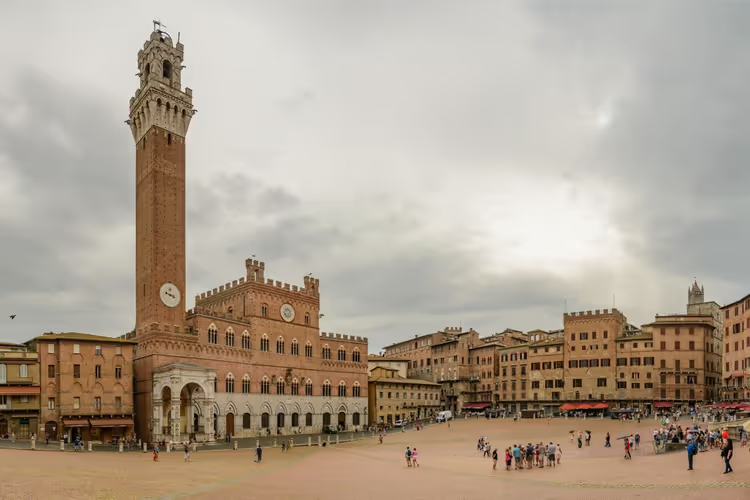
History: from races across the city
The prototype of the Palio appeared in the Middle Ages, and from the 14th century the contrade held the palio alla lunga, a long race through the entire city (according to Wikipedia). These were fairly rough spectacles, and later the center of events moved to the main square.
In 1590 the Tuscan duke banned the bullfights that had been held in Piazza del Campo. At first they competed on buffaloes (bufalate), then on donkeys (asinata), and the first modern horse race, palio alla tonda, took place in 1633 (according to Wikipedia). This date is considered the starting point of the current format.
A second annual race was added in 1701 and dedicated to the Assumption of the Virgin Mary. The modern framework was set in 1729: governor Violante of Bavaria fixed the boundaries of the contrade, reduced their number to seventeen, and limited the race to ten participants (according to Wikipedia). This limit is still in effect, and a third, extraordinary Palio is held only on a special occasion.
Contrade: seventeen city districts
The contrade run the Palio, not the city administration. These are not administrative districts but living communities with their own colors, coat of arms, church, and festival (according to Wikipedia). There are seventeen of them, and each takes pride in its history.
The names of the contrade come from animals and symbols: Aquila (eagle), Bruco (caterpillar), Chiocciola (snail), Civetta (owl), Drago (dragon), Giraffa (giraffe), Istrice (porcupine), Leocorno (unicorn), Lupa (she-wolf), Nicchio (shell), Oca (goose), Onda (wave), Pantera (panther), Selva (forest), Tartuca (turtle), Torre (tower), and Valdimontone (ram). Ten of them take part in the race.
The selection rule is simple: seven contrade that missed the previous equivalent Palio enter the race automatically, and three more are chosen by lot (according to Wikipedia). The draw also assigns horses to the districts after the captains have already selected ten horses of roughly equal class. This way the city is not divided once and for all into strong and weak.
The sharpest attention here falls on long-standing rivals. The contrade have pairs of enemies, and losing specifically to such a neighbor is felt more painfully than a defeat by any other district. You will feel it yourself: after the finish, joy and anger in Siena are visible in the streets, not only in the square.
How the Palio works: preparation and the race itself
The festival spans several days. The Corteo Storico, a historical procession in medieval costumes with flag bearers and musicians, moves through the city, and it serves as a reminder that the Palio here is a civic ritual, not a sports show (according to Wikipedia).
The race itself is full of tactics: ten horses line up between two ropes called the canapo. The start, the mossa, is often delayed because the jockeys bargain for an advantageous position and wait for the right moment. Sometimes the wait lasts several minutes, and the whole time the square roars.
Once the start is given, seconds decide everything. The riders go in tight, on the turns the horses slam into the protective mats, and jockeys fall to the ground. The winning district celebrates all night, while the losing one holds on until the next round.
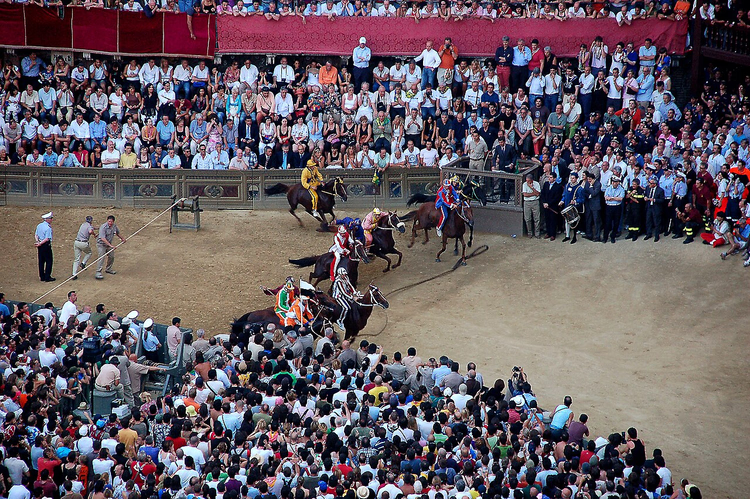 © Mirco · CC BY-SAPhoto: Mirco, CC BY-SA (https://creativecommons.org/licenses/by-sa/2.0), Wikimedia Commons
Tickets, seats, and how to watch
The main question for a visitor: how much does it cost to see the Palio di Siena. The answer depends on where you want to stand. Entry to the central part of Piazza del Campo is free, and you only pay for seats in the stands, on balconies, and on terraces around the square.
There is no single ticket office for these spots, and the regular stands, palchi, are sold by private owners. According to guidasiena.com, for August 2026 prices for private seats start at around 280 €, and seats on balconies and stands cost 450-690 € (as of 08/2026). These are commercial offers from operators, not an official city rate.
Ask for written confirmation of the deal. It should include the race date, the exact viewing point (Mossa, San Martino, Casato, or Fonte Gaia), the type of seat, and what happens if the race is postponed due to rain. Some operators keep the ticket valid for the rescheduled race but do not refund the missed hotel night (according to guidasiena.com).
The spot is chosen based on your goal: standing in the center, you are closest to the action, but you cannot see the entire track. The stands at Mossa give you a view of the start, while at San Martino and Casato you can see the most dangerous turns (according to guidasiena.com). Balconies are more comfortable, but the quality of the view depends on the specific building, not on the category name.
Arrive early. On race day, access to the center is closed off as it fills up, and from 3:00 PM on August 16, separate restrictions apply: children under 10 are not allowed into the central area even with adults, and chairs, umbrellas, and pets are prohibited in the square (according to guidasiena.com). The rules change every year, so check the city's announcements before your trip.
Tours and tickets in Siena
Guided tours, skip-the-line tickets and activities — most offers can be cancelled free of charge.
See offers on GetYourGuideThe widget loads once you give your consent.
The debate over horse protection and safety
Palio di Siena is regularly criticized for its treatment of horses. The sharp turns of the square and the high speeds have led to injuries and deaths of animals, and this topic has remained public for decades (according to Wikipedia).
The city responds by tightening the rules: horses are admitted to the race after veterinary checks and trial runs, the track is equipped with protective barriers and mats on dangerous sections, and jockeys are tested for alcohol and banned substances. A separate decree, updated in 2025, established requirements for the safety, health, and welfare of horses at public competitions (according to Grande Ippica Italiana).
The debate, however, is not settled. Palio supporters point to the centuries-old tradition and stricter oversight, while critics insist that the track itself, with its sharp turns, remains risky. For you, this leads to a simple takeaway: see Palio as a living city ritual, not as a show for tourists.
⁉️🤔 Frequently asked questions
When does Palio di Siena take place?
The races are held twice a year: on July 2 (Palio di Provenzano) and August 16 (Palio dell'Assunta). If a thunderstorm disrupts the race, it is moved to the nearest day, most often the next one. Exact dates are confirmed on the Palio website and in city announcements shortly before the race.
What are contrade?
Contrade are the seventeen historic districts of Siena. Each has its own coat of arms, colors, church, and festival, and it is they, not the city, that run the Palio. Ten contrade take part in each race, so getting into the race is already an event for a district.
Where does the race take place?
The race takes place on Piazza del Campo, Siena's main square in front of the Palazzo Pubblico. For the duration of the race, the square is covered with a thick layer of earth, turning it into an arena with sharp turns.
How much does it cost to watch the Palio?
Entry to the central part of Piazza del Campo is free. Paid seats in the stands are sold by private owners, and according to the 2026 price review for August, prices start at around €280 and go up to €690 for a balcony or stand (as of 08/2026). There is no single city tariff, so check the location before paying.
Is it true that horses get injured at the Palio?
Yes, the risk is real and openly discussed. Falls and collisions on the turns have led to injuries and deaths of animals, which is why the city has introduced veterinary checks, protective mats, and jockey inspections.
In short: what to book
The Palio di Siena itself does not require a ticket, and the center of the square works well for a budget trip. But if you want to sit comfortably and see the whole circuit, book a seat in a stand or on a balcony in advance and only through private owners.
If you are on a limited budget: arrive in the morning, take a spot in the center of the square, and follow the access rules. If comfort matters to you: book a balcony in advance and confirm the viewing point in writing. And if you also want to see Siena itself, add city tours on GetYourGuide to your trip.

A small editorial team writing guides for independent travel. We travel ourselves, but we haven’t been everywhere, so we check prices, opening hours and how to get there against official sources.