
















Peggy Guggenheim Museum in Venice: tickets, hours and main galleries
Peggy Guggenheim collected 20th-century art for almost her entire life. Today her home on the Grand Canal in Venice is open to everyone.
The museum is small, but in terms of the density of masterpieces it surpasses many galleries in Europe. It's worth planning your visit in advance: the museum is closed on Tuesdays, and during the season morning slots sell out several days ahead.
Ad: this text contains affiliate links, we earn a commission from them, the price for you does not change.
What to see at the museum
💡 In short:
- Viewing the collection and the Sculpture Garden takes about two hours, book a morning slot (official museum website).
- Adult admission is 17 €, students under 26 pay 9 €, children under 10 enter free (official museum website).
- Prices and opening hours: 09/2026, verified on the official website
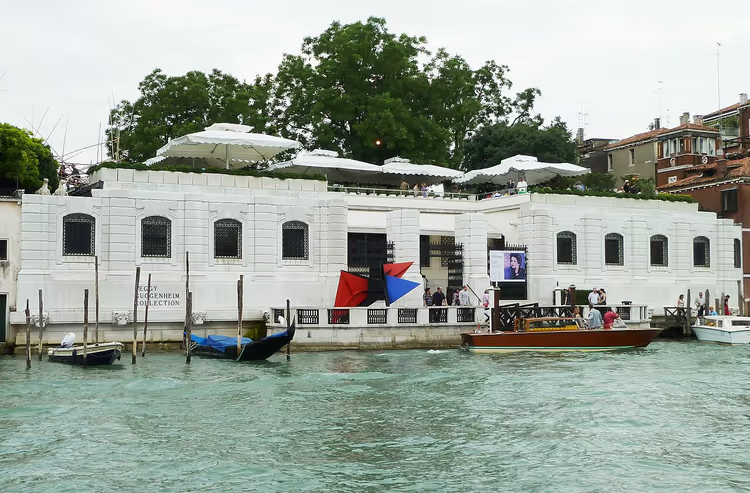
The visit begins in the inner courtyard, not in the galleries. Past the ticket office you enter the Nasher Sculpture Garden, a quiet green courtyard with modern sculptures. Here you'll find works by Caro, Moore, and other masters, and in the far corner lies Peggy Guggenheim's grave with the headstones of her Lhasa Apso dogs.
 © Abxbay · CC BY-SAPhoto: Abxbay, CC BY-SA (https://creativecommons.org/licenses/by-sa/3.0), Wikimedia Commons
From there the route leads inside the palazzo: several rooms are connected by a gallery, and paintings hang everywhere. On the terrace in front of the central part of the house you stand at the parapet directly above the Grand Canal. Vaporettos and gondolas pass by, and this is the best photo spot in the museum.
- Who it's for: those who love art from the first half of the 20th century and want to see Picasso, Pollock, and Dalí in a single visit.
- Not for: those who expect only palaces and churches from Venice; the museum is narrow in focus and small in size.
- The catch: Tuesday is a day off, and the ticket office closes at 5:00 PM, so a late evening visit won't work.
History: a palazzo on the Grand Canal
 © Dimitris Kamaras from Athens, Greece · CC BYPhoto: Dimitris Kamaras from Athens, Greece, CC BY (https://creativecommons.org/licenses/by/2.0), Wikimedia Commons
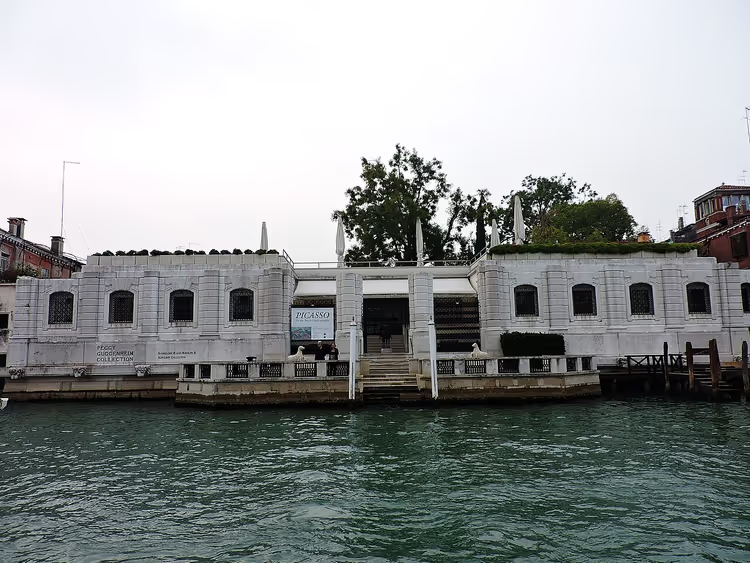
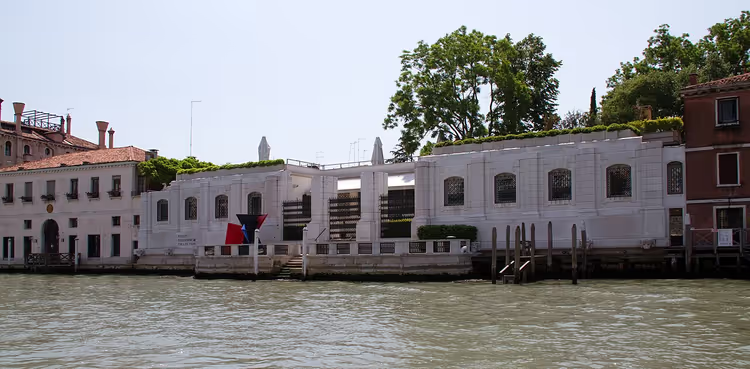
The museum occupies the Palazzo Venier dei Leoni, an unfinished palace on the Grand Canal. The architect Lorenzo Boschetti began building it, but construction never rose above the first floor. The white stone facade faces directly onto the water, and the museum entrance is located on the courtyard side. The name dei Leoni is linked to the lion heads on the facade and to a lion that, according to legend, was kept in the garden.
In the late 1940s the palazzo was bought by the American Peggy Guggenheim, niece of the industrialist and collector Solomon Guggenheim. She was born into the family of the magnate Benjamin Guggenheim and inherited her fortune after her father died in the sinking of the Titanic.
After receiving her inheritance, Peggy moved to Paris and entered the circle of artists, writers, and poets. She bought works by recognized masters and completely unknown authors, identifying talent almost without error. Over a quarter century, prices for many of these paintings rose tens and hundreds of times. Before German troops entered Paris, she bought paintings from people who urgently needed money, hid the canvases with acquaintances in the suburbs, and left for America.
After the war Peggy returned to Europe and settled in Venice. Here she housed her collection in the palazzo she had bought and lived in it until the end of her life. She opened the house to the public, and visitors could view the paintings. After her death the collection became a museum and came under the management of the Solomon R. Guggenheim Foundation.
Collection: from Cubism to abstraction
 © Tony Hisgett from Birmingham, UK · CC BYPhoto: Tony Hisgett from Birmingham, UK, CC BY (https://creativecommons.org/licenses/by/2.0), Wikimedia Commons
The core of the collection is European and American art from the first half of the 20th century. Here hang Picasso and Braque, Kandinsky and Malevich, Dalí, Magritte, and Pollock. Peggy knew some of these artists personally and bought their work long before it became expensive.
The rooms are organized by movement, so you don't need a complicated floor plan. In the Cubism room you'll see Braque, Picasso, and Léger; in the Surrealism room hang Dalí and Magritte. Abstraction is represented by works by Kandinsky, Malevich, and Pollock. A separate part of the exhibition is prints, drawings, and sketches by the artists.
Fans of ethnographic art will find wooden masks and figures of the indigenous peoples of the Americas and Oceania. In the late 1990s the collection was joined by the Gianni Mattioli collection of works by Italian Futurists, including Carrà, Boccioni, Russolo, and Severini.
Tickets and opening hours
The museum is open daily from 10:00 AM to 6:00 PM. Tuesday is a day off, the ticket office and last entry are at 5:00 PM (as of 09/2026, official museum website).
Visitor category | Price |
|---|---|
Adults | 17 € |
Seniors over 70 | 14 € |
Students under 26 | 9 € |
Children under 10 | free |
Audio guide | 7 € |
Prices as of 09/2026, museum rates.
It's better to buy a ticket in advance for a specific entry time before the slot sells out. Discounted tickets are checked at the entrance, so bring your ID. Large bags, backpacks, and suitcases are not allowed, leave them in the luggage storage at the entrance.
Tickets with time slots on Tiqets
Tours and tickets in Peggy Guggenheim Collection
Guided tours, skip-the-line tickets and activities — most offers can be cancelled free of charge.
See offers on TiqetsThe widget loads once you give your consent.
How to get to the museum
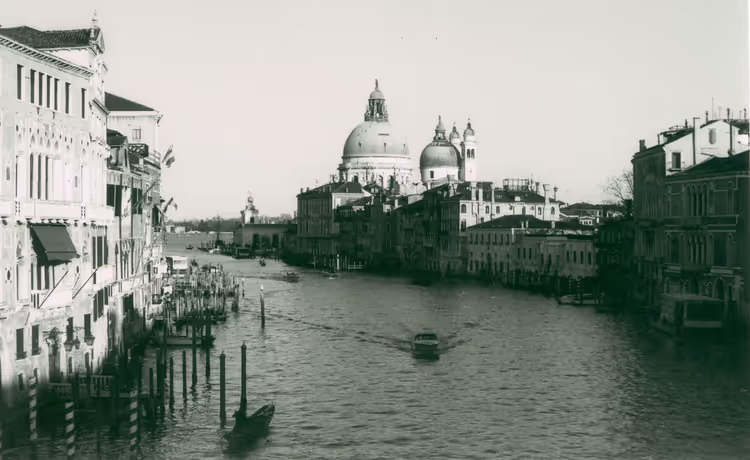
The museum stands on the Grand Canal in the Dorsoduro district, between the Accademia Bridge and the church of Santa Maria della Salute. From the Accademia Bridge, walk along the waterfront, keeping the water in sight. It's about 1.3 km on foot from St. Mark's Square.
Taking the vaporetto is easier. From Santa Lucia station and Piazzale Roma, take line 2 toward Lido and get off at Accademia. Line 1 stops at Accademia and Salute (as of 09/2026, vaporetto route map). From St. Mark's Square, the same route works, only the line goes toward Piazzale Roma.
Where the museum is on the map
Below is a map: the palazzo is marked right on the Grand Canal, next to the Accademia Bridge. Plan your route from your vaporetto stop so you don't get lost in the alleys of Dorsoduro.
⁉️🤔 Frequently asked questions
How much does a ticket to the Peggy Guggenheim museum cost?
An adult ticket costs 17 €, for students under 26 it's 9 € (museum's official website). Children under 10 enter free.
What day is the museum closed?
The museum is closed on Tuesdays and December 25 (museum's official website). The ticket office and last entry close at 5:00 PM, so arrive no later than four. If Tuesday is your only free day, move your visit to another day.
How to get to the museum from the train station?
From Santa Lucia station and Piazzale Roma, take vaporetto 2 toward Lido and get off at the Accademia stop (official museum website). From there, walk along the Grand Canal, past the Accademia Bridge.
How much time do you need to see it?
Viewing the collection and the Sculpture Garden easily fits into two hours (official museum website). The galleries occupy one floor, but the density of works is high: Picasso, Pollock, Dali and Kandinsky are gathered close together. If you take the audio guide for 7 €, plan another half hour.
Are there tours and an audio guide?
The audio guide costs 7 € and is available in Italian, English, French, German and Spanish (official museum website). Guided tours run from 10:00 to 17:00 and can be booked in advance by emailing the museum. Free short presentations about Peggy Guggenheim's life take place daily in the galleries.
In short: what's worth booking
If you have one free day in Venice: take a morning slot and arrive at opening time, while the galleries are still quiet. If you're traveling with children under 10: admission is free for them, and the short gallery presentations will help hold their attention. If you want to see more art during your trip: leave extra time for the Sculpture Garden and the terrace over the canal.
And if after the museum you feel like seeing the city with a guide, take a look at Venice tours on GetYourGuide.

A small editorial team writing guides for independent travel. We travel ourselves, but we haven’t been everywhere, so we check prices, opening hours and how to get there against official sources.