
















Santa Maria della Salute in Venice: what to see, hours and tickets
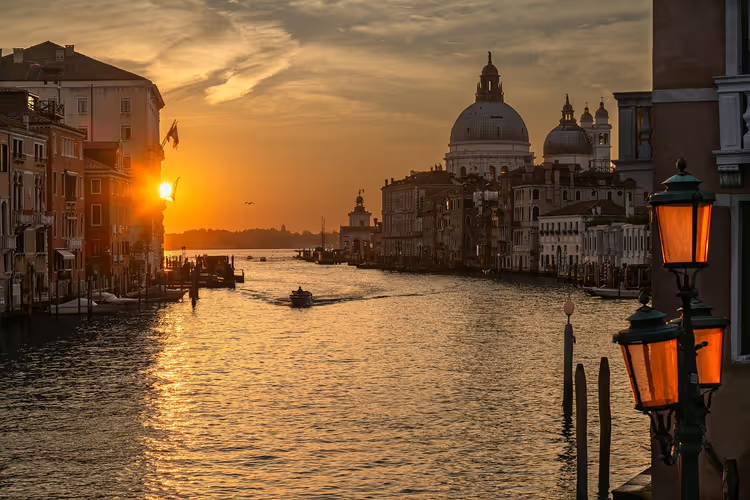
Venice stands on water, and its main symbol is instantly recognizable. The white dome of Santa Maria della Salute is visible from any point on the Grand Canal. The church was built as a votive offering to stop a plague epidemic.
In 1630, the disease killed about a third of the city's residents, and the Senate promised the Virgin Mary a church in exchange for deliverance from the disaster (history and the vow). Seeing the rotunda takes about twenty minutes (official website data, 09/2026).
You only pay for the Sacrestia with paintings by Titian and Tintoretto and for the dome climb. Below: what to see inside, when the church is open, how much the sacristy costs, and how to get there from the Salute dock.
Ad: this text contains affiliate links, we earn a commission from them, the price for you does not change.
History of the cathedral's construction
💡 In short:
- Entry to the main rotunda of the basilica is free, no ticket and no mandatory donation.
- The Sacrestia with Titian's paintings and the dome climb are paid separately.
- Prices and opening hours: 09/2026, verified on the official website.
In 1630, plague came to Venice. The nature of the infection was unknown at the time, and clean air was considered the main defense: ships were held in quarantine offshore, and doctors wore masks with long noses. The measures helped poorly, and in less than a year the epidemic killed about a third of the republic's population (chronicle of the epidemic).
Venetians saw the disease as punishment for sins. On October 22, 1630, the Senate made a vow to the Virgin Mary: if the city survived, the republic would build a magnificent church in her honor. The plague receded, and the nobility pledged to fulfill the promise (the Senate's vow).
The Great Council, led by Doge Nicolò Contarini, announced a competition for the best design. The winner was the young architect Baldassare Longhena. According to the brief, the church had to accommodate privileged communities, wealthy merchants, and ordinary Venetians alike (competition and architect).
The octagonal plan was not chosen by chance: it allows more people to fit in the hall, and you stand closer to the altar. Longhena's central idea was an enormous hemisphere: the dome served as a reminder that the Virgin Mary shelters Venice from harm (plan and dome).
 © Paul Colin Hennig firstdorsal.eu · CC BY-SAPhoto: Paul Colin Hennig firstdorsal.eu, CC BY-SA (https://creativecommons.org/licenses/by-sa/4.0), Wikimedia Commons
The site at the entrance to the Grand Canal turned out to be tight, and the lagoon soil was weak. By traditional estimates, more than a million wooden piles were driven under the foundation. The walls were built of brick and limestone and coated with marble dust so the facade would sparkle in the sun (materials and piles).
Construction was largely completed by 1681. Longhena died in 1682, five years before the consecration, and other masters finished the basilica; the church was consecrated in 1687 (construction timeline).
Architecture and interior of the church
The basilica is built in the Venetian Baroque style. The octagonal base is crowned by a dome about 60 meters high, covered in lead (church dimensions).
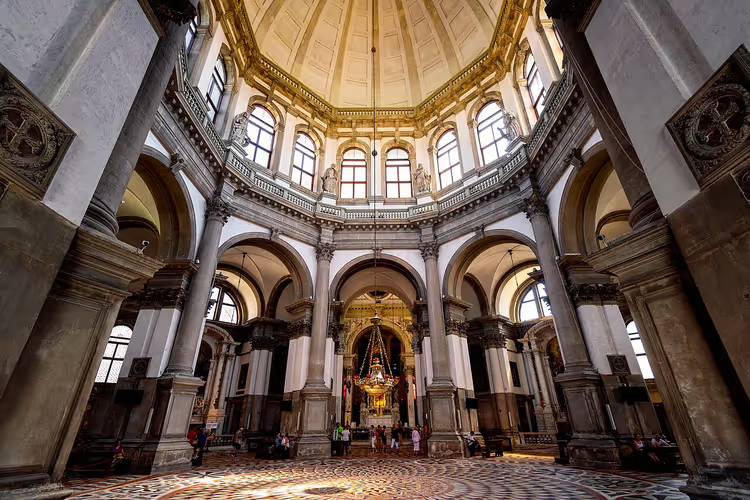
The dome rests on eight pillars, around which six side chapels open up. The large stone volutes near the drum are not decorative: they transfer the weight of the dome to the octagonal base (dome structure).
Arched windows are cut between the roof ribs, and during the day light floods the interior hall. The facade is decorated with cornices, buttresses, columns, and white marble statues, and the main entrance is designed as a triumphal arch (facade and windows).
The entrance is surrounded by sculptures of the Virgin Mary, the Archangel Michael, and John the Baptist, with Old Testament kings and prophets standing above. On the south side, an apse with the main altar is attached, crowned by a second, smaller dome, and two bell towers rise behind it (apse and sculptures).
Inside, you walk in a circle: six chapels open into the center, and the choir is sheltered by a smaller dome. The floor is paved with marble slabs, and concentric circles draw the eye to the middle of the hall (basilica interior).
The main altar holds a sculptural group by Giusto Le Court: the Virgin Mary with the infant receives a kneeling Venice and drives away the plague, shown as an old woman. Set into the center is the Byzantine icon Mesopanditissa, brought from Crete in 1670 (altar and icon).
The basilica's main treasure is in the Sacrestia. Three canvases by Titian hang from the ceiling: "Cain and Abel," "The Sacrifice of Abraham," and "David and Goliath." The figures are painted from below and heavily foreshortened, as a ceiling painting requires (sacristy paintings).
On the sacristy altar, Titian placed "Saint Mark Enthroned" with praying physicians and Saints Roch and Sebastian, patrons of the gravely ill. Opposite hangs "The Wedding at Cana" by Tintoretto, painted in 1561: the table recedes into the depth of the painting, and light pours from painted windows (sacristy canvases).
Three altarpieces were painted by the Neapolitan Luca Giordano: "The Assumption of the Virgin," "The Birth of the Virgin," and "The Presentation of Mary in the Temple." For his speed of work, contemporaries nicknamed him "Luca, who works fast" (Luca Giordano).
By day the marble gleams in the sun, and in the evening the walls reflect the canal water. From the water the basilica reads better than from the shore: Longhena conceived it as a set piece at the entrance to the Grand Canal (view from the water).
Tickets and opening hours
Entry to the main rotunda is free: no ticket is needed, and there is no mandatory donation either. The basilica remains a working church, and tourist viewing is paused during Mass (visiting rules).
Paid areas: the monumental Sacrestia and the climb to the dome. A sacristy ticket costs from 6 € (as of 09/2026, tickets on the official website), and a combined option with the dome is sold separately. Tickets are issued for fixed time slots, so get them in advance.
In summer, from April 1 to October 31, the basilica is open 9:00-12:00 and 15:00-17:30. In winter, from November 1 to March 31, the hours shift to 9:30-12:30 and 15:00-17:30 (opening hours).
The catch: in the middle of the day the church closes for a break, the sacristy is closed on Mondays, and the climb to the dome is by stairs with no elevator. Cover your shoulders and knees, and leave large backpacks and suitcases at your hotel: there is no luggage storage at the entrance (rules and dress code).
Tours and tickets in Venice
Guided tours, skip-the-line tickets and activities — most offers can be cancelled free of charge.
See offers on TiqetsThe widget loads once you give your consent.
Interesting facts about Santa Maria della Salute in Venice
Every year on November 21, Venice celebrates the Festa della Madonna della Salute. A pontoon bridge is laid across the Grand Canal from Santa Maria del Giglio, and thousands of people walk across it with candles to the basilica (festival and schedule).
On this day, people eat roasted chestnuts and castradina, a smoked mutton soup, near the church. For city life, the date is a must, but for a quiet viewing of the art it is the worst day of the year. The church is open, but there are a lot of people inside.
Where Santa Maria della Salute is and how to get there
The basilica stands in the Dorsoduro district, at the entrance to the Grand Canal and opposite St. Mark's Square (location).
The easiest way is to take vaporetto line 1 to the Salute stop: it is right at the foot of the marble staircase that leads up to the church (stop and route).
On foot, cross the Accademia Bridge from the San Marco district: from the bridge to the entrance is about 400 meters, roughly five minutes. The best view of the dome opens up from the water: line 1 passes Punta della Dogana, and from the Accademia Bridge the basilica is visible in full.
Santa Maria della Salute on the map
Check the route on the map in advance. In autumn and winter, the approaches to the pier are flooded by high water, so choose waterproof shoes.
⁉️🤔 Frequently asked questions
How much does it cost to enter Santa Maria della Salute?
Entry to the main rotunda of the basilica is free, no ticket is needed and no mandatory donation is collected either. You pay only to visit the monumental Sacrestia with paintings by Titian and Tintoretto and to climb the dome. Tickets are issued for fixed time slots, and it is best to book them in advance on the basilica's website.
When is the best time to come to avoid crowds?
It is quietest early in the morning, at opening time: the light comes from the east and the hall is almost empty. In the middle of the day the church closes for a break, so by 1:30 PM you risk finding a locked door. For the exterior, late afternoon is better, when the sun lights the facade from the west.
Is the sacristy open on Mondays?
No. The basilica is open daily, but the monumental sacristy is closed on Mondays.
How do I get to the basilica?
Take vaporetto line 1 to the Salute stop or walk across the Accademia Bridge from the San Marco area.
What should I see in the sacristy?
In the sacristy, look first at Titian's ceiling paintings "Cain and Abel", "David and Goliath" and "The Sacrifice of Abraham", his "Saint Mark Enthroned", and Tintoretto's "The Wedding at Cana". The order is: first the ceiling, then the altar, then Tintoretto.
In short: what is worth booking
Santa Maria della Salute offers a rare case: the main thing here is free. Pay only for what you actually need.
If you are short on time: stop by the rotunda on your way and see the altar.
If you are in Venice for art: get a ticket to the sacristy, and add the dome if you like.
If this is your first time in the city: see the dome from the water, from vaporetto line 1.
The combined ticket pays off when you plan to visit both the sacristy and the dome climb. Venice tours on GetYourGuide.

A small editorial team writing guides for independent travel. We travel ourselves, but we haven’t been everywhere, so we check prices, opening hours and how to get there against official sources.