
















St. Mark's Basilica in Venice: tickets, opening hours and what to see inside
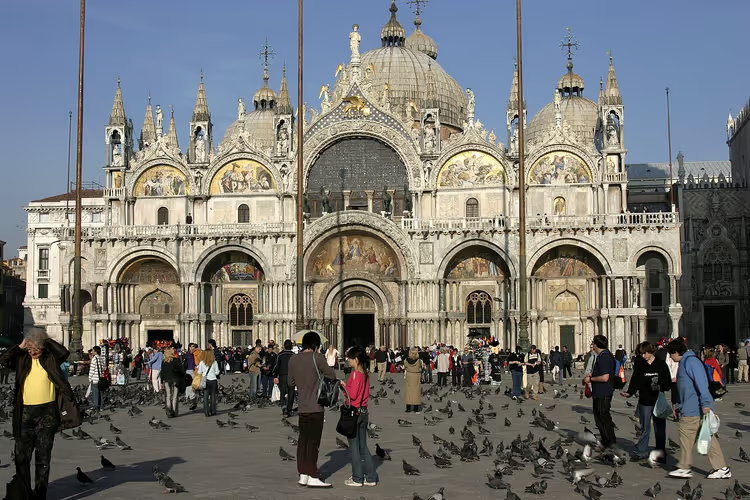
St. Mark's Basilica stands at the far end of St. Mark's Square, almost at the lagoon itself. Many tourists photograph the facade and leave without ever looking inside. Yet it is precisely inside that the reason to come back here is hidden.
Inside there are more than 8,000 m² of golden mosaics, five domes and the city's main relic, the remains of the Apostle Mark (as of 09/2026, Basilica di San Marco overview). Below you will find opening hours, prices and the route from the vaporetto.
💡 In short:
- Entry to the basilica is paid, a basic ticket with a time slot costs about 10 € (as of 09/2026, official ticket sales).
- A visit takes 30-60 minutes, and with the Pala d'Oro and the museum it stretches to two hours.
- The dress code is strict: shoulders and knees covered, photography inside is prohibited.
- Prices and opening hours: 09/2026, verified on the official ticket website.
Ad: the text contains affiliate links, we earn a commission from them, the price for you does not change.
Construction history
💡 In short:
- Entry to the basilica is paid, a basic ticket with a time slot costs about 10 € (as of 09/2026, official ticket sales).
- A visit takes 30-60 minutes, and with the Pala d'Oro and the museum it stretches to two hours.
- The dress code is strict: shoulders and knees covered, photography inside is prohibited.
- Prices and opening hours: 09/2026, verified on the official ticket website).
The cathedral came about because of a theft that Venice still considers pious to this day. In 828, two Venetian merchants brought the relics of the Apostle Mark out of Alexandria and hid them under pork carcasses so the Saracens would not inspect the cargo (as of: 09/2026, cathedral overview on Treffpunkt Venedig). The relics were delivered to the lagoon. Mark was declared the heavenly patron of the city, and the winged lion became his symbol.
 © Nino Barbieri · CC BY-SAPhoto: Nino Barbieri, CC BY-SA (https://creativecommons.org/licenses/by-sa/2.5), Wikimedia Commons
The first building was erected under doges from the Partecipazio family in roughly three years. It has not survived. A fire in 976 destroyed a significant part of the structure, and it was only restored by the end of the 10th century (as of: 09/2026, history of the basilica). The original appearance can only be judged from fragments of records and archaeological finds.
The current cathedral was founded in 1063 and consecrated in 1094 (as of: 09/2026, construction chronicle). Its appearance took shape over centuries: under Doge Domenico Selvo the first mosaic appeared, under his successor Vitale Falier the church was consecrated anew, and later the baptistery, chapels, and sacristy were added. The exterior was largely finished by the end of the 15th century. Later, Jacopo Sansovino worked on the cathedral in the 16th century and Baldassare Longhena in the 17th century.
Architecture and interior
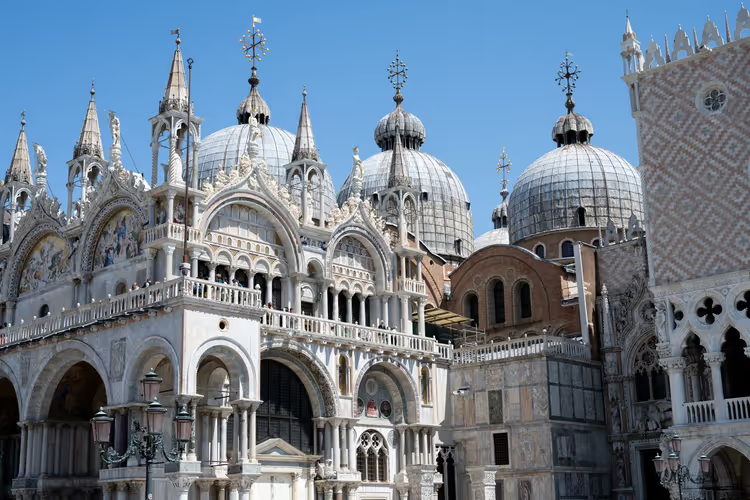
The cathedral is hard to assign to a single style, and that is its defining feature. The prolonged construction combined a Greek basilica, Eastern marble, Byzantine mosaics, and Romanesque bas-reliefs. The Church of the Holy Apostles in Constantinople served as a model, but the cathedral did not become an exact copy.
 © Prof. Mortel · CC BYPhoto: Prof. Mortel, CC BY (https://creativecommons.org/licenses/by/2.0), Wikimedia Commons
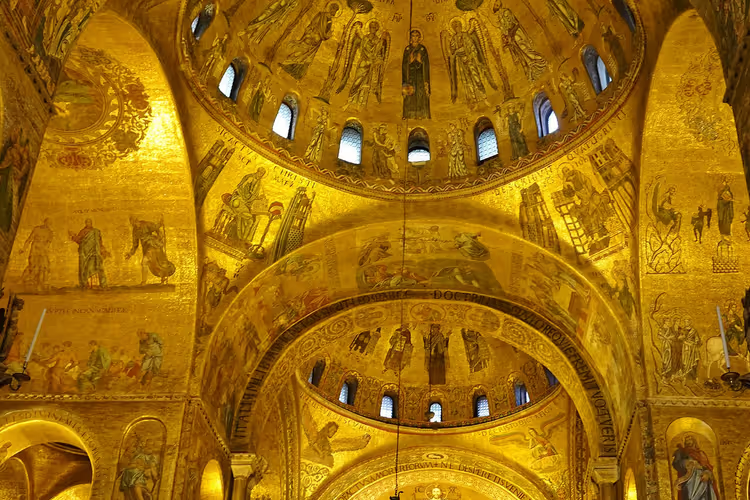
The building's composition is unusual for a Western church: in plan it is a Greek cross with five domes, without a long nave and without clustered columns (as of: 09/2026, cathedral architecture). Massive cruciform piers stand under each dome, and mosaic surfaces open above the pendentives. At the entrance you will see the porphyry sculpture of the Tetrarchs, a rare thing for a Latin church.
The central dome is inlaid with mosaic and rises higher than the others. The total area of the mosaics exceeds 8,000 m², and some fragments are made of glass from the island of Murano (as of: 09/2026, basilica mosaics). The subjects cover the Old and New Testaments, as well as the lives of Mark, Isidore, and John the Baptist. Each dome is responsible for its own narrative line: the dome of the Creation shows scenes from Genesis, and the three domes of Joseph tell the story of Joseph the Fair. The mosaics glow in reflected light, so come on a clear morning.
What to see
Inside, it is worth lingering on four things.
 © Daperro · CC BY-SAPhoto: Daperro, CC BY-SA (https://creativecommons.org/licenses/by-sa/4.0), Wikimedia Commons
Baptistery and mosaics
The baptistery is clad in marble, and its vaults are covered with mosaics in the Byzantine style. The tombs hold Andrea Dandolo and Giovanni Soranzo, the 54th and 51st doges of Venice (as of: 09/2026, baptistery description). In the center of the hall stands a font with a bronze lid, above which the faces of the twelve apostles are laid out under the dome.
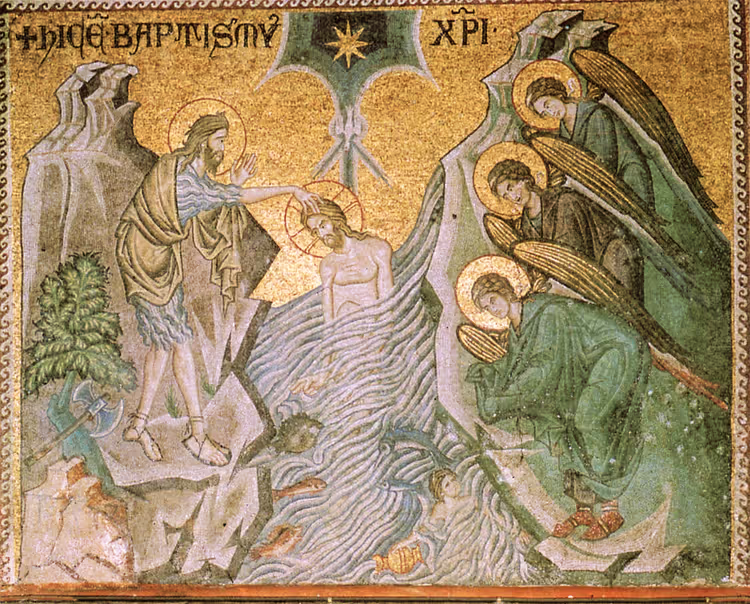 © {{anonymous · CC BY-SAPhoto: {{anonymous, CC BY-SA (https://creativecommons.org/licenses/by-sa/4.0), Wikimedia Commons
The golden altarpiece Pala d'Oro
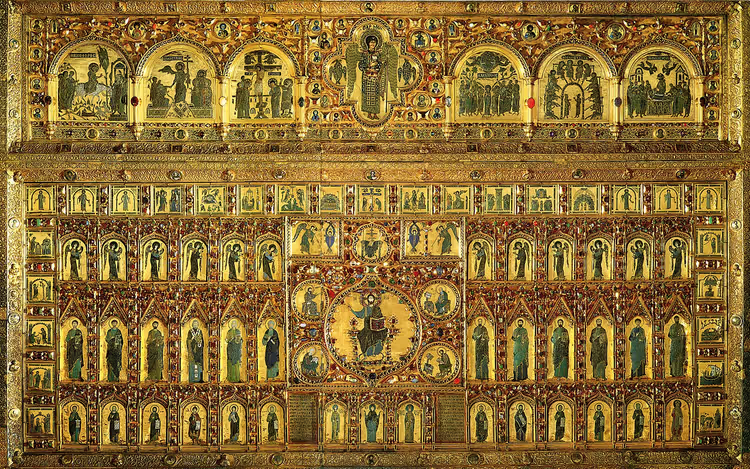
The Pala d'Oro, the golden altarpiece, stands behind the main altar. It measures 3.45 by 1.40 meters and consists of roughly 250 enamel miniatures in a gilded frame (as of 09/2026, Pala d'Oro: details). Some of the panels were brought from Constantinople after the Fourth Crusade of 1204. The altarpiece received its final form in 1345 under Doge Andrea Dandolo. It used to be opened only on major feast days; now anyone can see it.
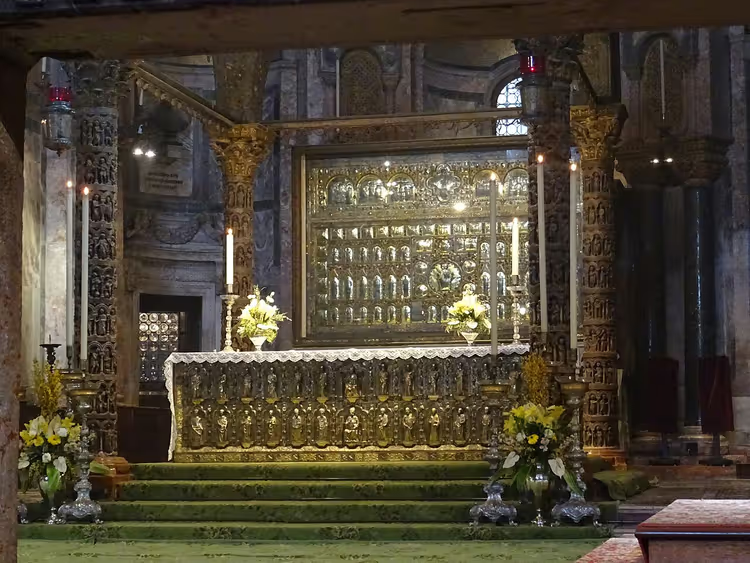 © Gérard · CC BY-SAPhoto: Gérard, CC BY-SA (https://creativecommons.org/licenses/by-sa/4.0), Wikimedia Commons
Treasury and relics
The treasury is located between the basilica and the Doge's Palace, and its door is decorated with a mosaic of angels in flames. Inside there are two rooms: the Sanctuary and the treasury itself. It holds church vessels, jewelry made of precious metals, reliquary caskets, chalices, and the throne reliquary of Saint Mark. Most of the collection was brought from Constantinople after it was sacked in 1204, but part of the collection was stolen, and metals and stones were sold off to pay for restoration work.
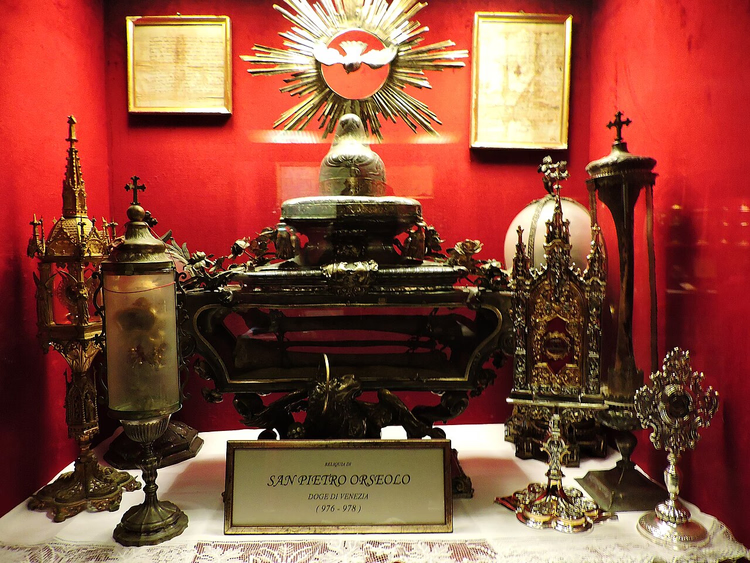 © Dimitris Kamaras from Athens, Greece · CC BYPhoto: Dimitris Kamaras from Athens, Greece, CC BY (https://creativecommons.org/licenses/by/2.0), Wikimedia Commons
The bronze horses and the Tetrarchs
Above the main portal of the facade stand four bronze horses, spoils from Constantinople in 1204. Napoleon took them to Paris in 1797, and after the Congress of Vienna in 1815 they returned. Since the 1980s, copies have stood on the facade; the originals were moved to the museum (as of 09/2026, the quadriga and the museum). At the southwest corner, on the passage to the Doge's Palace, you will see the porphyry sculpture of the Tetrarchs from the late 3rd century.
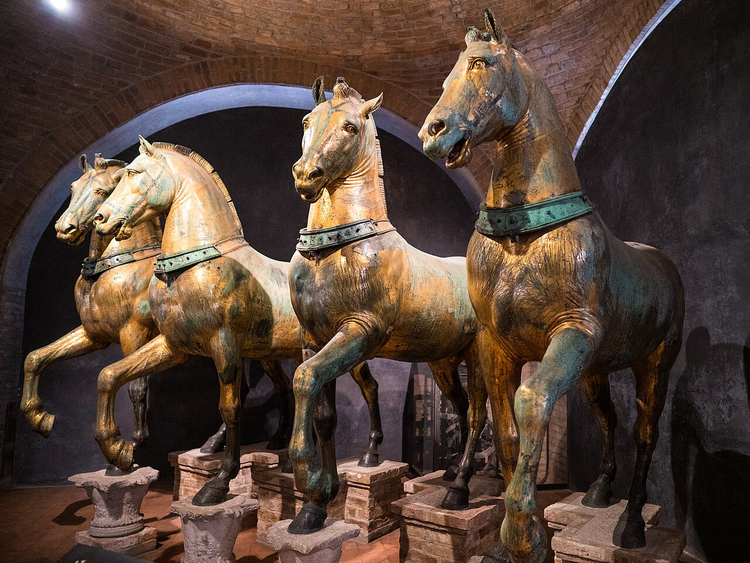 © Nan Palmero from San Antonio, TX, USA · CC BYPhoto: Nan Palmero from San Antonio, TX, USA, CC BY (https://creativecommons.org/licenses/by/2.0), Wikimedia Commons
Opening hours and ticket prices
The basilica is open on weekdays and Saturdays from 9:30 to 17:15, while on Sundays and holidays tourists are usually admitted only from 14:00, because a service takes place in the morning (as of 09/2026, basilica opening hours). Go in with the first morning wave. That way you will wait less.
What | Admission (as of 09/2026) | Hours |
|---|---|---|
Basilica, basic ticket | about €10 (admission prices) | Mon-Sat 9:30-17:15 |
Pala d'Oro | surcharge or combo | during basilica hours |
Museum and Loggia dei Cavalli | combo up to €30 for everything | during basilica hours |
Treasury | surcharge or combo | during basilica hours |
Remember the rules: you are allowed to stay inside the basilica for a limited time, photography and video recording are not allowed, large luggage will not be permitted, and shoulders and knees must be covered (as of 09/2026, visitor rules). Those arriving for a single day between April 3 and July 26, 2026 will also have to pay a city access fee of €5 or €10 in addition to the ticket (as of 09/2026, tourist access fee).
Timed-entry tickets are sold online, and in high season slots get booked up in advance. Timed-entry tickets on Tiqets
Tours and tickets in St. Mark's Basilica
Guided tours, skip-the-line tickets and activities — most offers can be cancelled free of charge.
See offers on TiqetsThe widget loads once you give your consent.
Location and how to get there
The basilica's address: Sestiere San Marco, 328, 30124 Venezia (as of 09/2026, address and ticket office). The nearest vaporetto stops, San Marco Vallaresso and San Marco Giardinetti, are served by lines 1 and 2. From the pier to the basilica entrance is a few minutes' walk.
If you are coming from Santa Lucia station, take vaporetto line 1 and get off at San Marco Vallaresso. The ride takes about half an hour along the Grand Canal (as of 09/2026, vaporetto routes). Lines 1 and 2 also go to Piazzale Roma, where buses arrive. Buy your vaporetto ticket in advance, the lines at the pier ticket office are longer.
St. Mark's Basilica on the map
The basilica occupies the eastern side of St. Mark's Square, between the Doge's Palace and the campanile. The map below will help you get your bearings and plan a route from your hotel.
⁉️🤔 Frequently asked questions
How much does it cost to enter St. Mark's Basilica?
A basic ticket with a time slot in 2026 costs about 10 €, and a combined ticket with the Pala d'Oro, museum, and treasury goes up to 30 € (as of 09/2026, ticket prices). Some discounted categories enter for free, but registration is required in advance. Check the exact price at the official ticket office before your trip.
What are the basilica's opening hours?
On weekdays and Saturdays, the basilica is open from 9:30 to 17:15. On Sundays and holidays, tourists are usually admitted only from 14:00, because a service takes place in the morning (as of 09/2026, visiting hours).
Do I need to book a ticket in advance?
Yes, in high season time slots sell out well before the date. An online ticket with a fixed entry time saves you from waiting in line at the ticket office. Choose morning intervals, they are the least crowded. If your plans change, check the exchange and refund terms for your specific ticket.
What is not allowed inside the basilica?
Photo and video shooting is prohibited, large luggage will not be allowed in, and shoulders and knees must be covered (as of 09/2026, basilica regulations). Loud conversations and tours without headsets inside are not welcome.
How do I get to St. Mark's Square?
The most convenient way is by vaporetto lines 1 and 2 to the San Marco Vallaresso or San Marco Giardinetti stops. From Santa Lucia station, line 1 runs along the Grand Canal for about half an hour (as of 09/2026, line 1 to San Marco).
Is it worth going up the campanile?
The campanile is separate from the basilica, and you buy a ticket for it independently. The viewing platform offers a view of the square and the lagoon. Choose a clear morning: by midday a line forms at the elevator. Check the exact schedule and price at the ticket office before going up.
In short: what to book
Before your trip, take care of three things. First, a time slot for the basilica, otherwise in July you will stand at the entrance for over an hour. Then decide whether you need the Pala d'Oro and the museum. If you have one day in Venice, get the combined ticket, it is cheaper than separate tickets. With children, plan the climb up the campanile, and for a relaxed viewing of the mosaics choose a weekday morning. A guided tour will help you understand the stories depicted in the mosaics, and a selection of Venice tours on GetYourGuide will save you from searching on the spot.

A small editorial team writing guides for independent travel. We travel ourselves, but we haven’t been everywhere, so we check prices, opening hours and how to get there against official sources.