
















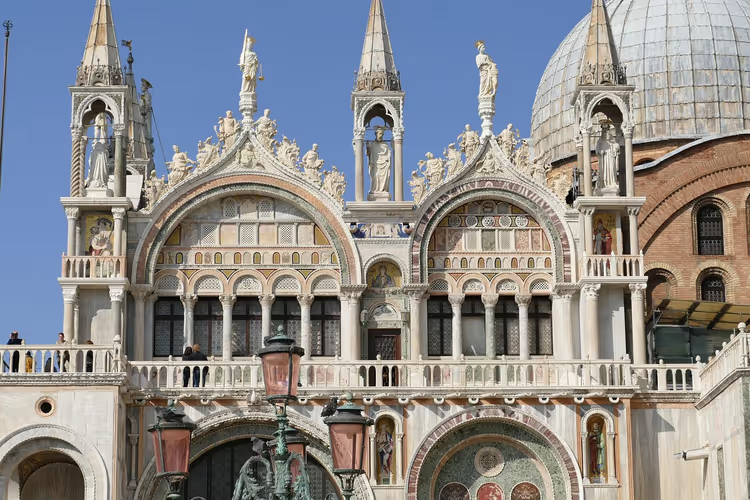
St. Mark's Square in Venice: tickets, hours and what to see
Piazza San Marco is open 24 hours a day and charges no entrance fee. You only pay once you go inside: for the basilica, the bell tower, and the Doge's Palace. San Marco remains the most recognizable spot in Venice, and nearly every visitor to the city stops here on their first day.
Putting together a complete picture from individual landmarks is not easy. On one small patch of ground stand the basilica with its Byzantine domes, the Doge's Palace, the Clock Tower, and the Campanile, the tallest structure in the city. Below we break down what to see first, how much entry to each site costs, and how to get there from the train station or from the airport.
Two to three hours is enough to see the square. If you plan to visit the Doge's Palace and go up the bell tower, set aside a full day.
Ad: this article contains affiliate links, we earn a commission if you book through them, at no extra cost to you.
San Marco: Venice's main square
💡 In short:
- The square is open 24 hours a day and is free. You only pay for entry to the basilica, the Doge's Palace, and the Campanile.
- St. Mark's Basilica: entry 3 €, Pala d'Oro 5 €, Campanile 10 € (as of 09/2026, basilica price list).
- The Doge's Palace is open daily: 09:00-19:00 in summer and 09:00-18:00 in winter (as of 09/2026, museum website).
- Prices and opening hours: 09/2026, verified on the basilica's official website
Only one square in Venice is called Piazza, meaning "square." All the others are called campi, which translates as "fields." This is how the city emphasizes the special status of this place, where the life of the republic flowed for centuries.
The Procuratie buildings line the perimeter, the basilica rises in the center, and on the lagoon side the Piazzetta opens up with its two columns. The square took its modern shape in 1810, when the Ala Napoleonica wing was added. Ceremonies, carnival, and public executions took place here, and today cafe orchestras play and city festivals are held.
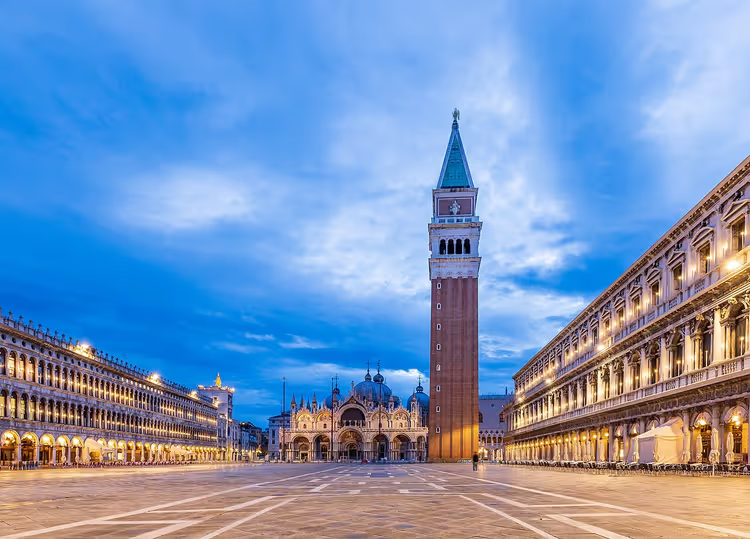 © Matthias Süßen · CC BY-SAPhoto: Matthias Süßen, CC BY-SA (https://creativecommons.org/licenses/by-sa/4.0), Wikimedia Commons
The square is long and not very wide, so it is easy to walk around the perimeter. First walk along the Procuratie, then turn toward the basilica. That way you will take in nearly all the facades and keep your bearings among the buildings.
History of the square
The square grew up around the basilica, which was founded in 829. Venetian merchants brought the relics of St. Mark the Evangelist from Alexandria and hid them in the hold among pork carcasses so that customs inspection would not touch the cargo. The first church was built for the relic, and the space in front of it was named after the saint.
A fire in 976 destroyed the building. A new basilica was erected in its place and consecrated in 1094. The square gradually expanded and became the political center of the republic: laws were proclaimed here, festivals were held, and sentences were carried out.
It was on this square that Venice received ambassadors, crowned its doges, and welcomed the fleet after victories. For the people of the lagoon, it was both the main stage and the main news market. Everyone who arrived in the city by sea passed through it.
Architectural landmarks
The introduction begins as soon as you step off the vaporetto onto the piazzetta. The square and its surroundings are home to Venice's main monuments. Below are eight sights worth seeing in order.
Columns of San Marco and Saint Theodore
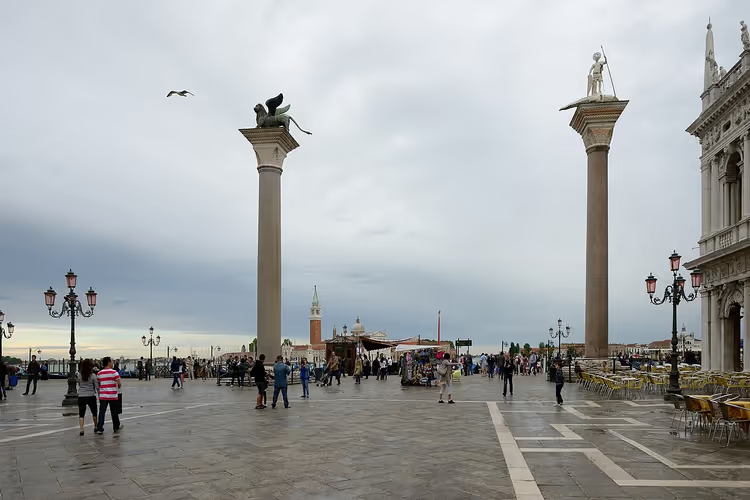 © This Photo was taken by Wolfgang Moroder . Feel free to use my photos, but please mention me as the author and send me a · CC BY-SAPhoto: This Photo was taken by Wolfgang Moroder . Feel free to use my photos, but please mention me as the author and send me a, CC BY-SA (https://creativecommons.org/licenses/by-sa/3.0), Wikimedia Commons
Visitors arriving at the piazzetta are greeted by two granite columns. They were brought from Constantinople in 1125, but were only erected in 1196. The monoliths are extremely heavy, each weighing over a hundred tons, which is why raising them proved difficult for a long time.
One column is topped by a statue of Saint Theodore with a spear, trampling a dragon. He was the city's first patron saint. On the other stands a bronze winged lion with an open Gospel, the symbol of Saint Mark the Evangelist and the coat of arms of Venice.
The space between the columns once served as an execution site. Venetians still avoid this spot and never arrange to meet there. The monuments stand in plain view, but touching them or climbing onto the pedestal is prohibited.
St. Mark's Basilica
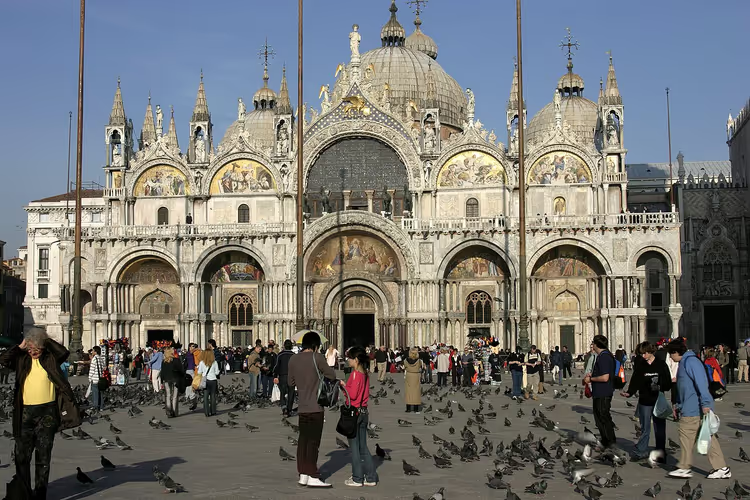 © Nino Barbieri · CC BY-SAPhoto: Nino Barbieri, CC BY-SA (https://creativecommons.org/licenses/by-sa/2.5), Wikimedia Commons
St. Mark's Basilica (Basilica di San Marco) serves as the city's main church and the burial place of its patron saint. According to legend, Saint Mark preached in the lagoon and received a sign that he would find his rest here. For over twelve centuries his relics have lain beneath the basilica's vaults.
The building was consecrated in 1094, after a fire in 976 destroyed the first church. It was built under the influence of Constantinople, which is why the church turned out Byzantine: five domes, a marble facade, numerous columns and bas-reliefs. The mosaics on the facade depict scenes of the Last Judgment and the translation of the saint's relics.
Five portals lead into the basilica. Above the main one stands a bronze quadriga, four horses that the Venetians brought from Constantinople as a war trophy. The domes are clad in silvery plates and are clearly visible from the water, so the basilica is recognizable even from the vaporetto.
Inside, the main treasure awaits you: the Pala d'Oro, a golden altarpiece with enamels and precious stones. Because of the abundance of gold in its decoration, the church is called the "Golden Basilica". Entry with a backpack or in revealing clothing is prohibited, and talking loudly or taking flash photos inside is not allowed.
The golden altarpiece Pala d'Oro was created in 1345. It depicts episodes from the Holy Scriptures and scenes from the life of Saint Mark the Evangelist. The setting contains enamels and more than two thousand stones: amethysts, emeralds, sapphires, rubies.
Entry to the basilica costs 3 €, and a separate ticket for the altarpiece costs 5 € (as of 09/2026, basilica ticket prices). Seeing the basilica itself takes about half an hour; add another fifteen minutes for the altarpiece.
Clock Tower
 © Paul Colin Hennig firstdorsal.eu · CC BY-SAPhoto: Paul Colin Hennig firstdorsal.eu, CC BY-SA (https://creativecommons.org/licenses/by-sa/4.0), Wikimedia Commons
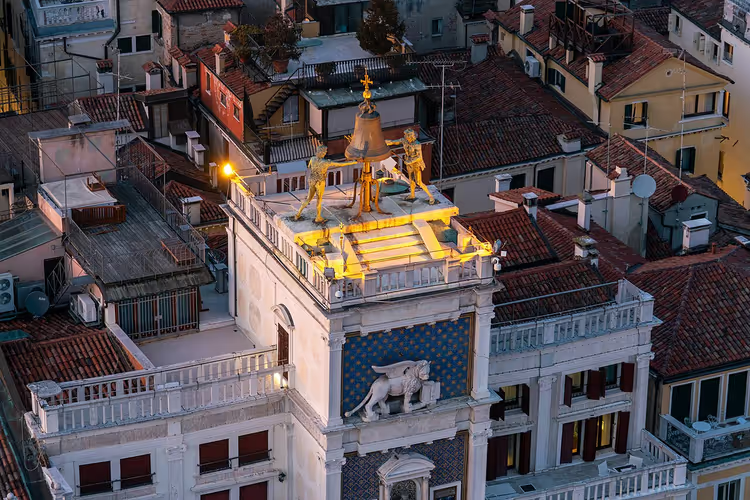
The Clock Tower, Torre dell'Orologio, has risen above the square since 1499. It was built under the direction of architect Mauro Codussi. The tower is adorned with a blue-and-gold astronomical clock: a golden hand shows the time on the outer circle, while the inner one is reserved for the zodiac signs and phases of the Moon.
Above the clock sits a copper Madonna with child. On Epiphany and Ascension, the Magi pass before her and bow to her. Higher up stands a winged lion with an open Gospel, and the tower is crowned by two bronze figures of Moors with hammers: they strike the bell every hour.
Marciana Library
 © This Photo was taken by Wolfgang Moroder . Feel free to use my photos, but please mention me as the author and send me a · CC BY-SAPhoto: This Photo was taken by Wolfgang Moroder . Feel free to use my photos, but please mention me as the author and send me a, CC BY-SA (https://creativecommons.org/licenses/by-sa/3.0), Wikimedia Commons
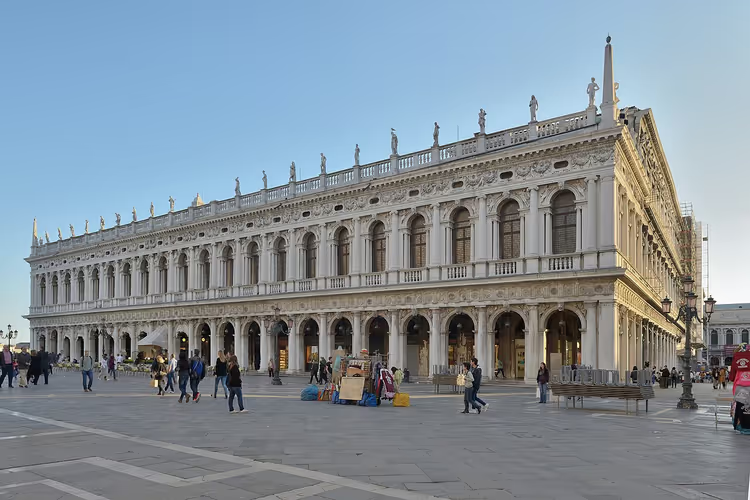
The Marciana Library (Biblioteca Marciana) occupies the western side of the piazzetta. It was built in 1537-1545 to a design by Jacopo Sansovino to house a collection of Greek and Latin manuscripts. The first books and manuscripts were given to the city by a cardinal whose collection became the core of the holdings.
Today about 40,000 rare editions are kept here. The white marble facade is decorated with statues and columns, and inside, in a gilded hall, manuscripts in precious bindings are on display. You can view the facade for free; access to the reading rooms is restricted and requires an appointment.
Doge's Palace
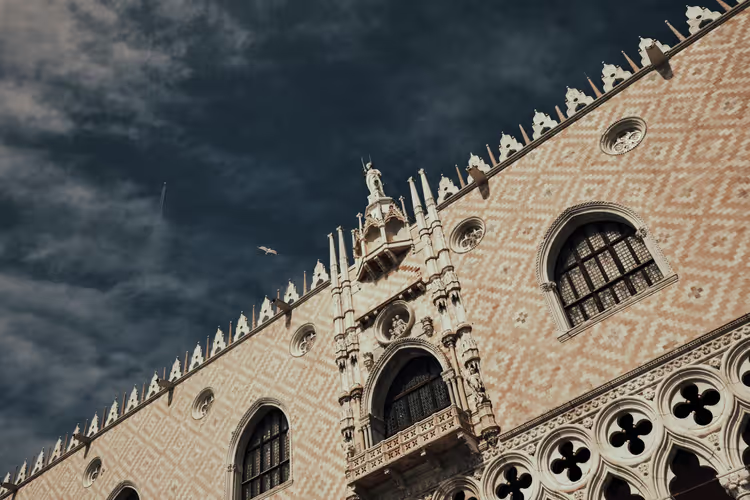
The Doge's Palace (Palazzo Ducale) stands on the piazzetta next to the basilica. It was built and rebuilt in the 14th and 15th centuries in the Venetian Gothic style. Light arches and columns support the massive upper level, so the stone building seems almost weightless. One side faces the lagoon, while the facade looks onto the square.
The Giants' Staircase, with two statues of Mars and Neptune, leads into the palace. They symbolize war and the sea. Elected doges took their oath here, and the halls themselves served as the parliament, court, and reception rooms for ambassadors.
Inside, the halls of the Great Council and the Senate await you. They are decorated with paintings by Titian, Tintoretto, and Veronese. A separate hall houses weapons: knightly armor, sabers, a Turkish standard, and muskets.
The Doge's Palace ticket is also valid for the Museo Correr, the Archaeological Museum, and the Marciana Library. For exact prices and concessions, see the museum's official website (as of 09/2026, palazzoducale.visitmuve.it). If you want to understand the halls with explanations, take a guided tour of Venice; it also covers the neighboring palaces.
Old and New Procuratie
 © Kasa Fue · CC BY-SAPhoto: Kasa Fue, CC BY-SA (https://creativecommons.org/licenses/by-sa/4.0), Wikimedia Commons
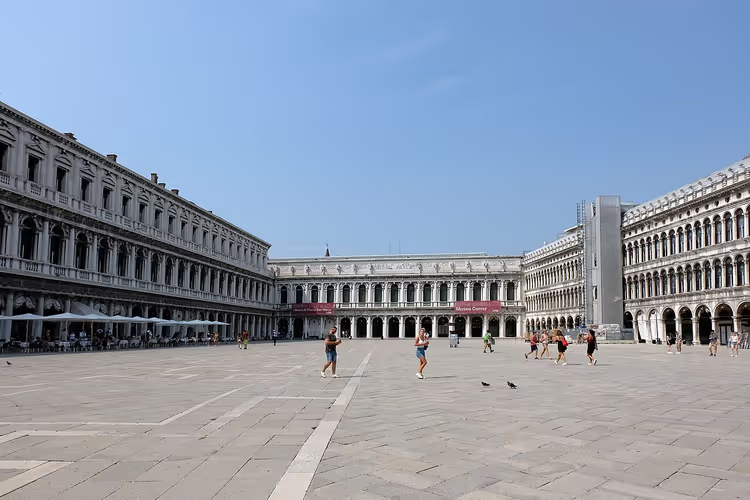
The Procuratie, the long three-story buildings along the square, served as offices for officials. Procurators met there to oversee the execution of decisions made by the Doge and the Senate. The upper floors housed administrative services, while the lower floors were used for trade.
The Old Procuratie were built on the north side in 1532. As the bureaucracy grew, the New Procuratie appeared opposite in 1586, and in 1810, by order of Napoleon, the Ala Napoleonica wing was added, connecting the two buildings. Today the upper floors are occupied by museums, and the lower floors are given over to cafes where orchestras play at the tables.
Loggetta del Sansovino
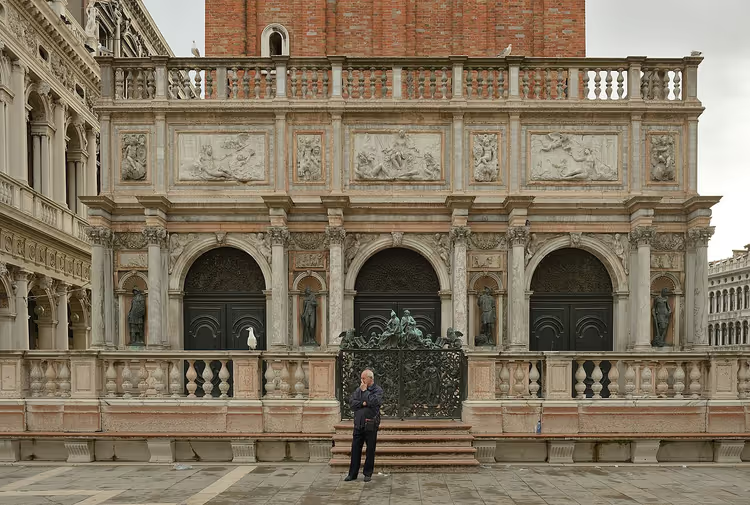 © This Photo was taken by Wolfgang Moroder . Feel free to use my photos, but please mention me as the author and send me a · CC BY-SAPhoto: This Photo was taken by Wolfgang Moroder . Feel free to use my photos, but please mention me as the author and send me a, CC BY-SA (https://creativecommons.org/licenses/by-sa/3.0), Wikimedia Commons
The Loggetta del Sansovino (Loggetta del Sansovino) adjoins the base of the Campanile. It was built in 1537-1540 in the Renaissance style. The facade is made of white and colored marble, decorated with columns, bas-reliefs, and statues of ancient gods.
In the past, noble patricians gathered in the Loggetta, and later it housed the guard of the Doge's Palace. Today visitors pass through it to reach the elevator that takes guests up to the bell tower observation deck. The building is small, but you definitely won't miss it.
St. Mark's Campanile
St. Mark's Campanile is considered the tallest structure in the city. It is a brick bell tower almost 99 meters high, topped with a marble belfry and a golden archangel on the spire. The platform at the top offers a view of the entire lagoon.
The first tower appeared here in the 9th century and served as a lighthouse. The 16th-century version stood for almost 400 years and collapsed in 1902. Within ten years, the bell tower was rebuilt exactly to its former appearance.
An elevator takes visitors to the top, and the ride takes less than a minute. A ticket costs 10 € (as of 09/2026, bell tower tickets). The platform closes in strong winds, so plan backup time on windy days.
St. Mark's Square and pigeons
Pigeons have become an inseparable part of the square. According to legend, two birds were released during the consecration of the basilica, and they perched on the cornice of the church. The Venetians took this as a good sign and declared pigeons untouchable.
Over time, the birds multiplied so much that the city began feeding them a special mixture. Until 2008, bags of feed were sold right on the square. Then the sale was stopped, and feeding pigeons was banned under sanitary regulations.
Today there are still many birds, especially in the morning. Don't feed them: feeding is prohibited here. You can photograph the pigeons as much as you like; they have long grown accustomed to people and cameras.
Opening hours and ticket prices
Opening hours for the sites on the square vary by season. The Doge's Palace stays open longer in summer, and the Campanile closes when it is windy. Below is a summary of the three main tickets.
Site | Admission | Opening hours |
|---|---|---|
St. Mark's Basilica | 3 €, Pala d'Oro 5 € | vary by season and day of the week |
St. Mark's Campanile | 10 € | depend on the season, closed in strong winds |
Doge's Palace | paid MUVE combined ticket | summer 09:00-19:00, winter 09:00-18:00 |
Prices for the Basilica and the Campanile are listed on the official website (as of 09/2026, basilicasanmarco.it), and the Doge's Palace hours are confirmed by the museum (as of 09/2026, visitmuve.it). At the Basilica, morning hours are shortened on Sundays and holidays.
In high season (April to October), entry lines are at their longest. At the Basilica, you can easily stand for an hour or more. To avoid wasting time, get a skip-the-line ticket to St. Mark's Basilica: it comes with a separate entrance.
Tours and tickets in Venice
Guided tours, skip-the-line tickets and activities — most offers can be cancelled free of charge.
See offers on TiqetsThe widget loads once you give your consent.
Where it is and how to get there
San Marco is in the very center of Venice, and cars do not reach it. From Santa Lucia station and from Piazzale Roma, you walk or take a vaporetto, the city water bus that runs along the canals.
Walking from the station takes about half an hour and goes over bridges. The vaporetto is faster but more expensive: a single ticket costs 9.50 € and is valid for 75 minutes, while a 24-hour pass costs 25 € (as of 09/2026, Venice tourist office). Tickets are sold at machines on the piers, and you need to validate them before boarding.
From Marco Polo Airport, buses run to Piazzale Roma, and the trip takes about half an hour. From Treviso Airport, the bus takes longer, about an hour. From Piazzale Roma, a vaporetto or a short walk through the streets will get you to the square.
If you want to see both the square and the lagoon islands in one day, take a boat tour to Murano and Burano. The boat departs near the square.
What to do near the square
Besides seeing the monuments, there is plenty to do on the square. Along the Molo, the stone waterfront, gondoliers offer canal rides. A ride is expensive, but Venice opens up differently from the water, and the views of the bridges from a gondola cannot be replicated on foot.
If you are short on time but still want to see the islands, there is a cheaper option: a vaporetto to Murano and Burano costs noticeably less than a gondola.
For a romantic evening, take a group canal tour. Departure is usually near the square, by the closest bridges.
⁉️🤔 Frequently asked questions
Do I need to buy a ticket to St. Mark's Basilica in advance?
Yes, in high season it saves time. The entry line at the Basilica can stretch to an hour or more, especially around midday. An online ticket with a time slot costs a little more, but you go through a separate line and do not stand in the sun. Take a morning slot and arrive right at opening.
How much does it cost to go up the Campanile?
The ticket costs 10 € (as of 09/2026, official website). Go up in the morning, while the weather is calm and the viewing platform has not been closed due to wind.
How much time do I need for St. Mark's Square?
For the Basilica and the square itself, two to three hours is enough. If you add the Doge's Palace and the bell tower climb, plan for a full day. In high season, add time for entry lines.
Can I enter the Basilica in shorts and with a backpack?
You will not be allowed in with a backpack or a large bag. Bare shoulders and knees are also not allowed, so bring a cover-up. Talking loudly and taking flash photos inside are not permitted. Some of these rules also apply at the Doge's Palace. The dress code is checked at the entrance, so dress accordingly in advance.
How do I get to the square from the station?
From Santa Lucia station, walk for about half an hour or take a vaporetto. A single vaporetto ticket costs €9.50 (as of 09/2026, tourist office).
Video and map of St. Mark's Square
A short video shows St. Mark's Basilica from land and water. Watch it before your trip: you'll recognize the church and its domes faster when you see them in person.
In short: what's worth booking
If you only have a couple of hours, start with the basilica and go up the Campanile: those are the two strongest impressions of the square. History lovers should give the Doge's Palace a separate day, as the ticket also covers the Correr Museum.
For the evening, save a gondola ride or a lagoon cruise. Morning slots for the basilica are shorter, and it's better to go up the bell tower before noon, before the wind picks up. That way you can cover the whole square without rushing.
One last quick tip: get a St. Mark's Basilica ticket with a time slot, it will save you from the longest line on the square.

A small editorial team writing guides for independent travel. We travel ourselves, but we haven’t been everywhere, so we check prices, opening hours and how to get there against official sources.