
















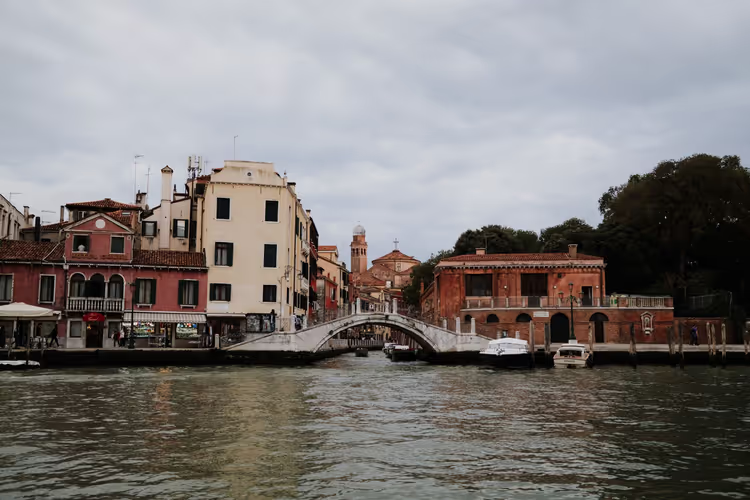
One day in Venice: twenty two places and timed entry tickets
One day in Venice can easily turn into a series of lines. By 11:00, the line at the Doge's Palace stretches for an hour, and you lose half a day just standing around.
We put together a route that covers the main sights from the Grand Canal to Ca' d'Oro and fits into daylight hours. St. Mark's Square, the Rialto district, a dozen churches, and two art collections all fit in without rushing.
It only works if you start early. By 8:30 you're among the first in line, and by noon tour groups fill everything around you.
Ad: this article contains affiliate links, we earn a commission if you book through them. At no extra cost to you.
How to fit Venice into one day
💡 In short:
- Arrive by 8:30: before 10:00 there are almost no lines at the Doge's Palace and the Campanile.
- Follow the direction Grand Canal, St. Mark's Square, Rialto, Frari, Ca' d'Oro: this way you circle the city and never backtrack.
- A 24-hour vaporetto pass costs 25 € (as of 09/2026, ACTV) and pays for itself by the third ride.
- Prices and opening hours: 09/2026, verified on the official Doge's Palace website.
Below are twenty-two sights in the order that makes them easiest to visit. Between them you either walk or take the vaporetto.
Part of the day | What you cover |
|---|---|
Morning | Grand Canal, St. Mark's Square, Doge's Palace, basilica, and Campanile |
Midday | Rialto Bridge, Ca' d'Oro |
Afternoon | San Giacomo di Rialto, Frari, Scuola Grande di San Rocco, Gallerie dell'Accademia |
Evening | Santa Maria della Salute, Santo Stefano, and dinner away from St. Mark's |
Grand Canal
 © Martin Falbisoner · CC BY-SAPhoto: Martin Falbisoner, CC BY-SA (https://creativecommons.org/licenses/by-sa/4.0), Wikimedia Commons
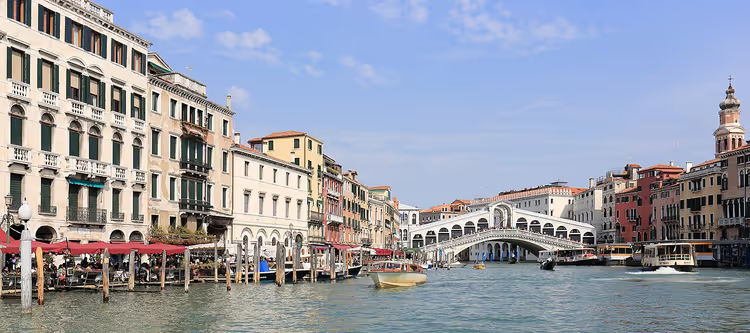
The Grand Canal is the city's main water artery, and it has no embankments at all. Palace facades face directly onto the water, and buildings have two entrances: one from land and one from water.
You can't walk along the canal, but you can sail it. Vaporetto line 1 runs from Piazzale Roma to St. Mark's and gives the most complete view. A single ride costs 9.50 € (as of 09/2026, official ACTV website), and in 75 minutes you pass almost all the palazzos.
A romantic alternative: a gondola ride through the smaller canals. It costs several times more than the vaporetto, but the route goes through quiet waterways that public transport doesn't reach.
Four bridges cross the canal: Rialto, Scalzi, Accademia, and Constitution.
- The catch: at rush hour, crowds pile up at the docks and the vaporetto gets packed. Grab a spot on the open stern right after boarding.
St. Mark's Square
 © Matthias Süßen · CC BY-SAPhoto: Matthias Süßen, CC BY-SA (https://creativecommons.org/licenses/by-sa/4.0), Wikimedia Commons
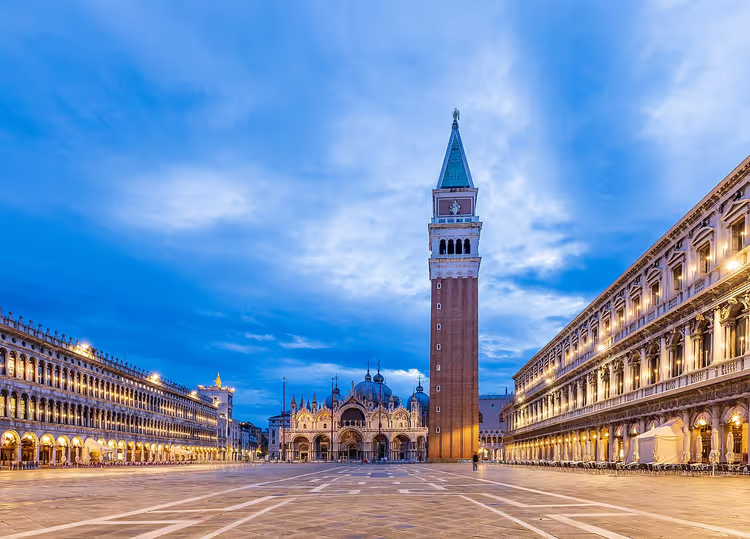
St. Mark's Square is the heart of the city and its main focal point. A small patch of ground holds the Doge's Palace, St. Mark's Basilica, the Campanile bell tower, the Clock Tower, and the old Marciana Library.
The waterfront with its two columns and the entrance to the Grand Canal also opens onto the square. You can walk across the square in five minutes, but seeing everything around it will take half a day.
Go in the morning: from 8:30 to 10:00 you can photograph the facades with almost no people around. By 11:00 the square is packed, especially in high season.
The square has appeared in dozens of films and accumulated plenty of local lore.
- The catch: cafes right on the square charge several times more. Walk two streets toward Rialto and you'll pay noticeably less.
Doge's Palace
 © Didier Descouens · CC BY-SAPhoto: Didier Descouens, CC BY-SA (https://creativecommons.org/licenses/by-sa/4.0), Wikimedia Commons
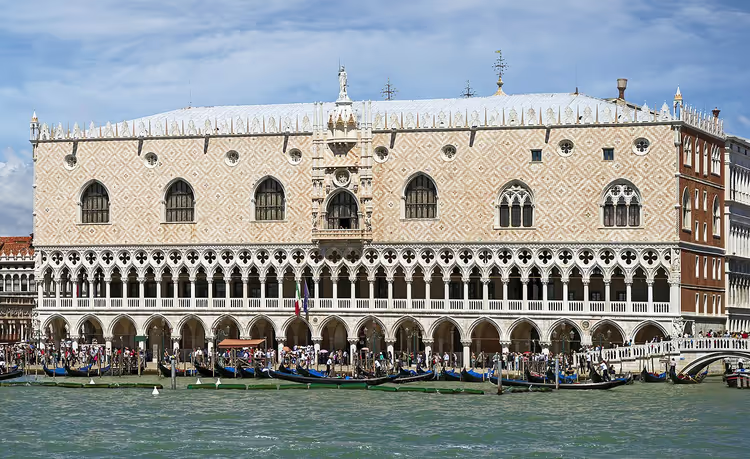
The Doge's Palace (Palazzo Ducale) is the residence of Venice's rulers and one of the most recognizable buildings in Europe. The first structure appeared here back in the 12th century, and the palace acquired its current Gothic appearance after a fire in the 15th century.
Looking at it from the outside is pointless: all the value is inside. The Great Council Hall, the map room with works by Italian masters, ceilings by Veronese and Tintoretto, the Golden Staircase, and the Bridge of Sighs.
Century after century, the building housed the Senate, ministries, the Supreme Court, and the secret police. Today it is entirely open to visitors.
The combined ticket also includes the Museo Correr, the Archaeological Museum, and the halls of the Marciana Library (as of 09/2026, official MUVE website). One purchase covers four San Marco sites at once.
Skip-the-line Doge's Palace tickets should be bought in advance: in July and August the line takes over an hour.
- Who it's for: those who want to understand Venice's political history, not just its facades.
- The catch: the exhibition is huge, and seeing it takes at least two hours.
St. Mark's Basilica
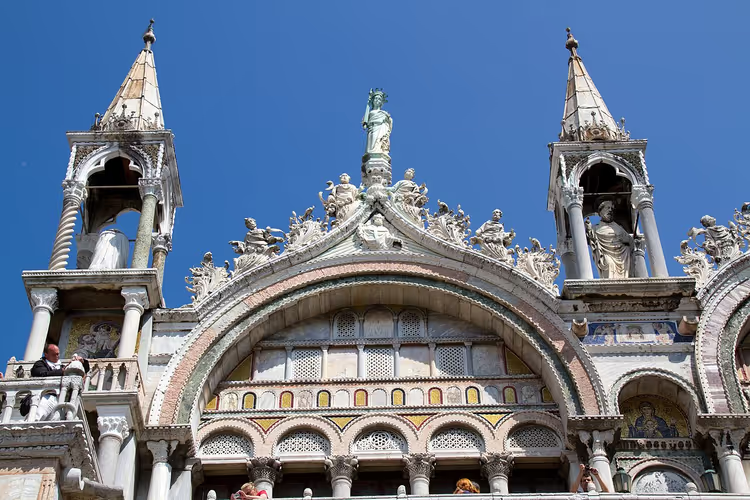 © Tony Hisgett from Birmingham, UK · CC BYPhoto: Tony Hisgett from Birmingham, UK, CC BY (https://creativecommons.org/licenses/by/2.0), Wikimedia Commons
St. Mark's Basilica stands on the square of the same name and holds the relics of the Apostle Mark, the city's patron saint. The first church appeared here in the 9th century, and the building acquired its current appearance after reconstructions between the 11th and 15th centuries.
Outside, you are greeted by Byzantine domes and the quadriga on the loggia. Inside, golden mosaics cover thousands of square meters, and during the Crusades treasures from Constantinople were brought here.
The entire church stands on larch piles. Wood in water does not rot but petrifies, which is why the foundation has held the building for over a thousand years.
Entry for visitors is paid; check current rates and visiting windows on the basilica's official website.
- The catch: on service days part of the basilica is closed, and in the morning the line at the entrance is the longest. Come at opening time or after 4:00 PM.
Rialto Bridge
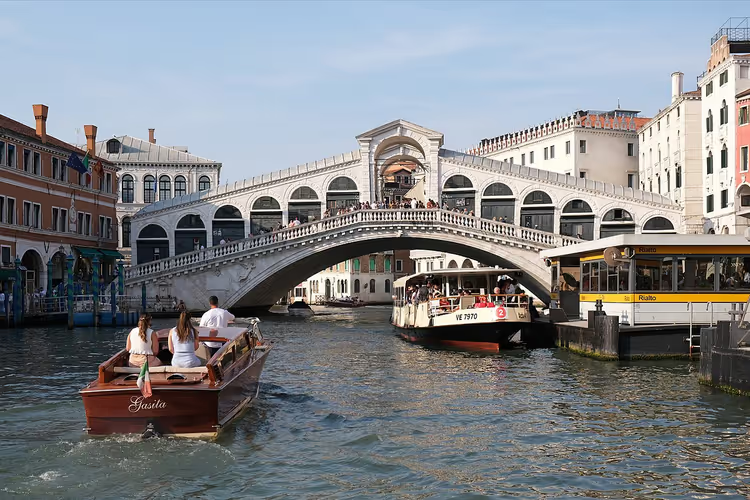 © kallerna · CC BY-SAPhoto: kallerna, CC BY-SA (https://creativecommons.org/licenses/by-sa/4.0), Wikimedia Commons
The Rialto Bridge is the oldest and most recognizable of the four bridges over the Grand Canal. A crossing has existed at this spot since the 12th century, and the stone bridge designed by Antonio da Ponte was built in the second half of the 16th century.
The design competition was won by a then little-known architect; among the losers was Michelangelo himself. Today the Rialto graces postcards and is mentioned in Shakespeare's "The Merchant of Venice."
From the top of the span you get the best free view of the canal. The best time for photos: early morning or sunset, when soft light hangs over the water.
- The catch: souvenirs in the shops on the bridge itself are noticeably more expensive than in the alleys behind the market. Walk past the stalls and buy a little further away.
San Giorgio Maggiore
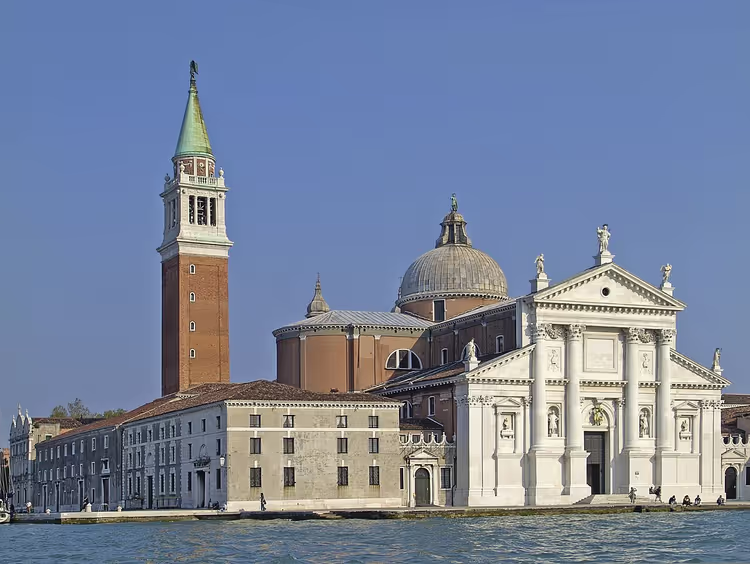 © Didier Descouens · CC BY-SAPhoto: Didier Descouens, CC BY-SA (https://creativecommons.org/licenses/by-sa/4.0), Wikimedia Commons
Opposite St. Mark's Square lies the island of San Giorgio Maggiore. It is almost entirely occupied by the 16th-century basilica of the same name, with a snow-white facade and red-brick walls.
It is worth coming here for the bell tower. From its observation deck you see St. Mark's Square as if in the palm of your hand, and the ticket costs less than for the Campanile. There are almost no lines either.
You can get there by vaporetto line 2, one or two stops from San Marco. A good idea: combine the trip with a boat tour to Murano and Burano to see the entire lagoon in one outing.
Campanile Bell Tower
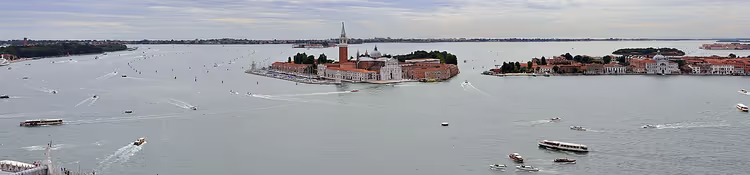 © Moonik · CC BY-SAPhoto: Moonik, CC BY-SA (https://creativecommons.org/licenses/by-sa/3.0), Wikimedia Commons
The Campanile is the bell tower of St. Mark's Basilica and the highest point in the city. You cover almost a hundred meters of height in an elevator, and half a minute later you're on the observation deck.
The current tower was built as an exact replica of the historic 10th-century bell tower, which collapsed in the early 20th century. In the Middle Ages, the old tower housed torture chambers, and now there's an elevator shaft there.
The climb costs 10 € (As of 09/2026, the basilica's official website). Opening hours depend on the season: from December to April the tower closes at 3:45 PM, and from July to September it's open until 9:00 PM.
A skip-the-line ticket to the observation deck will save you from the longest line on the square.
- The catch: in summer, the line for the elevator can take up to forty minutes. Go at opening time or closer to closing.
Loggetta Sansovino
 © This Photo was taken by Wolfgang Moroder . Feel free to use my photos, but please mention me as the author and send me a · CC BY-SAPhoto: This Photo was taken by Wolfgang Moroder . Feel free to use my photos, but please mention me as the author and send me a, CC BY-SA (https://creativecommons.org/licenses/by-sa/3.0), Wikimedia Commons
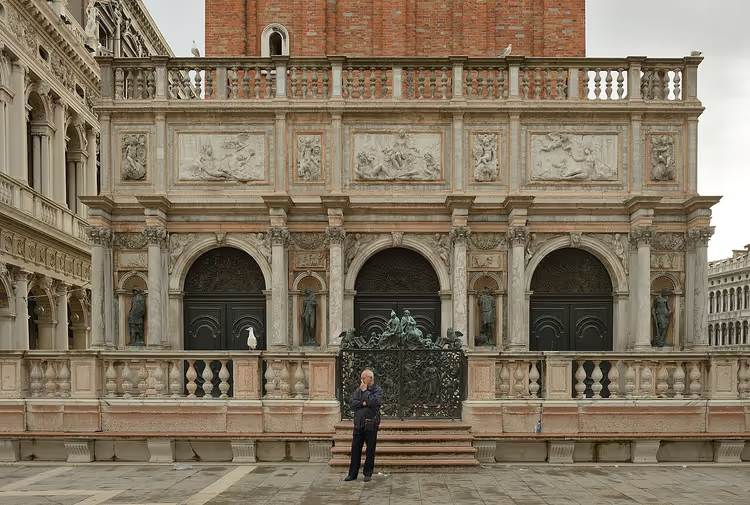
At the foot of the Campanile sits the Loggetta Sansovino, a marble structure from the mid-16th century. It was built by the sculptor Jacopo Sansovino as a ceremonial entrance to the tower.
Three arches, a balustrade, and niches with statues of Apollo, Peace, Mercury, and Pallas. When the tower collapsed, the loggetta was badly damaged, but it was restored in the 20th century.
Spend a couple of minutes here: it's the quietest corner of the bustling Piazza San Marco.
St. Mark's Clocktower
 © Paul Colin Hennig firstdorsal.eu · CC BY-SAPhoto: Paul Colin Hennig firstdorsal.eu, CC BY-SA (https://creativecommons.org/licenses/by-sa/4.0), Wikimedia Commons
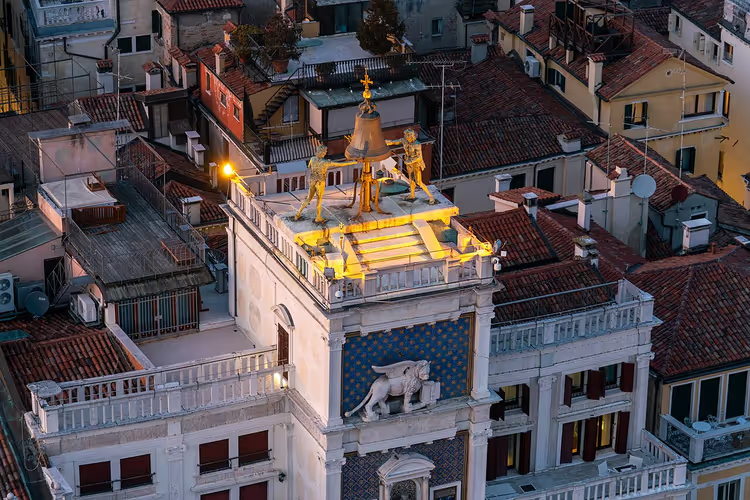
The clocktower stands in the northern part of St. Mark's Square and works as a giant city chronometer. It was built in the late 15th century and has been keeping time for all of Venice ever since.
Look at it from bottom to top. At the top, two bronze figures of Moors strike a large bell; below them sits a winged lion; further down stands a statue of the Madonna and Child; and beneath that runs a blue-and-gold dial with a zodiac circle and a rotating Moon.
Entry is only allowed with a guided tour in timed slots, and tickets are sold in advance. Check prices and schedules on the official Venice museums website.
While standing at the tower, turn your head south: from here you get a straight view of the entire St. Mark's Square ensemble.
Columns of St. Mark and St. Theodore
 © This Photo was taken by Wolfgang Moroder . Feel free to use my photos, but please mention me as the author and send me a · CC BY-SAPhoto: This Photo was taken by Wolfgang Moroder . Feel free to use my photos, but please mention me as the author and send me a, CC BY-SA (https://creativecommons.org/licenses/by-sa/3.0), Wikimedia Commons
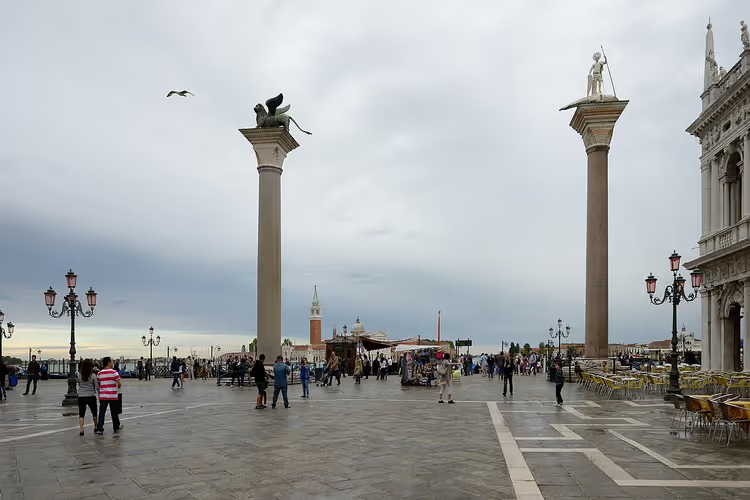
The two granite columns on the waterfront next to the Doge's Palace were brought from Constantinople in the 12th century. There were three columns, but one sank in the lagoon during unloading.
A bronze winged lion, the symbol of Venice, sits atop one of them; a statue of St. Theodore stands on the other. For centuries, executions were carried out between the columns, so locals long avoided this spot.
Today it's a popular photo point: from here you can see the lagoon and the island of San Giorgio Maggiore.
- The catch: the spot is almost always crowded, so getting a shot without people is difficult.
Giardini Papadopoli Park
 © Didier Descouens · CC BY-SAPhoto: Didier Descouens, CC BY-SA (https://creativecommons.org/licenses/by-sa/4.0), Wikimedia Commons
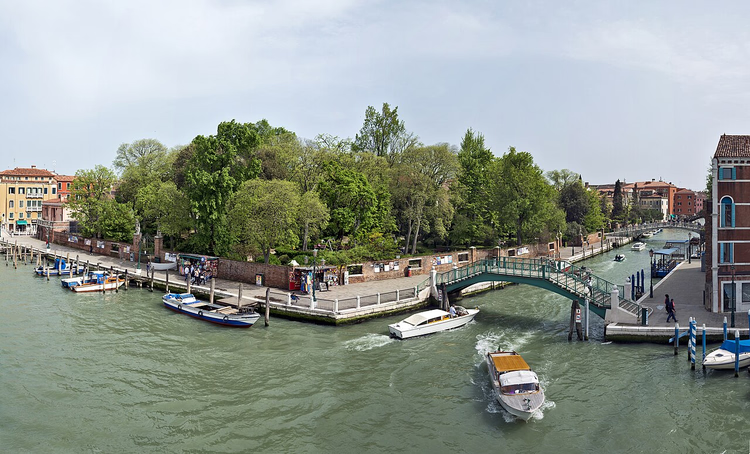
Among the canals and stone streets in the northwestern part of the city, near Piazzale Roma, hides the green Giardini Papadopoli park. It was laid out in the first third of the 19th century on the site of a demolished church and planted with palms, plane trees, and fruit trees.
Winding paths and secluded alleys offer a break from the city noise. There's a playground for children, and it's a rare spot in Venice where you can simply sit in the shade.
Stop by here if you're tired by midday. A quiet corner five minutes from Santa Lucia station.
Church of San Nicola da Tolentino
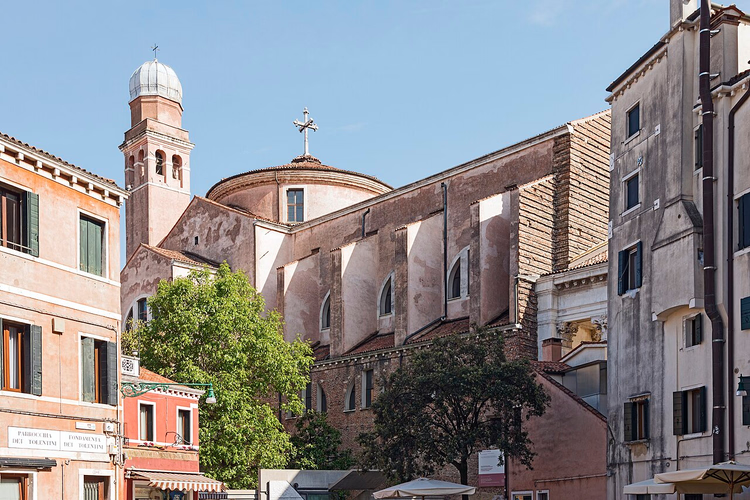 © Didier Descouens · CC BY-SAPhoto: Didier Descouens, CC BY-SA (https://creativecommons.org/licenses/by-sa/4.0), Wikimedia Commons
The Church of San Nicola da Tolentino stands near Piazzale Roma. Construction began in the late 16th century, and the bulky facade with Corinthian columns was only completed in the 18th century.
Because of its antique portico, the church looks like a Greco-Roman building rather than a medieval church. Look for a round hole in the wall: it's the mark of an Austrian cannonball that pierced the dome during a bombardment, after which the ball was sealed back into the wall.
- How to get there: a five-minute walk from Santa Lucia station or one vaporetto stop.
Church of San Simeone Piccolo
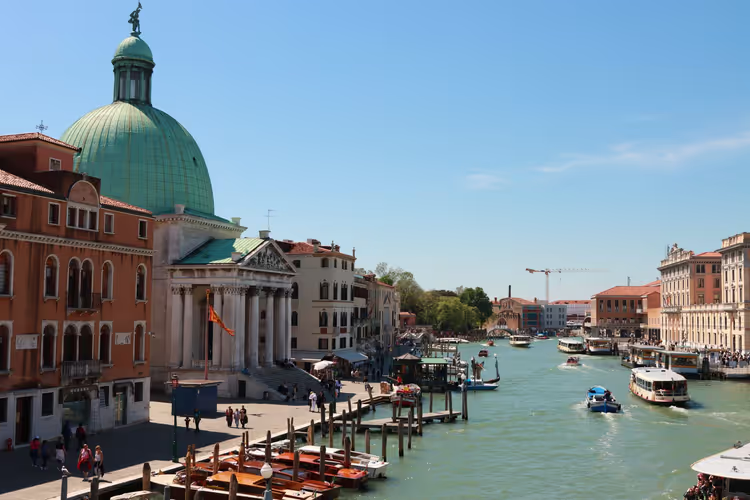
San Simeone Piccolo stands on the bank of the Grand Canal and stands out with its huge copper dome topped by a figure of the Savior. Because of it, Napoleon called the church "a dome without a church."
The church was built in the first half of the 18th century, and architect Giovanni Scalfarotto used the Roman Pantheon as his model. The interior is also circular, with altars featuring paintings by Italian artists around the perimeter.
The church is active, with services held on weekday mornings and on weekends. Plan your visit outside those hours, and no one will disturb you.
Ponte degli Scalzi
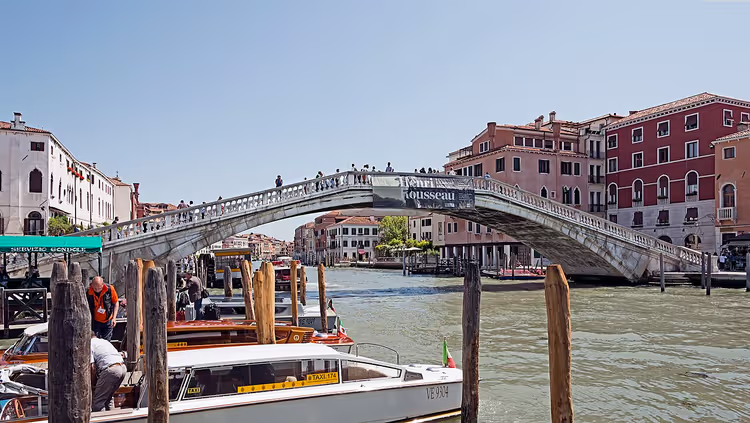 © Didier Descouens · CC BY-SAPhoto: Didier Descouens, CC BY-SA (https://creativecommons.org/licenses/by-sa/4.0), Wikimedia Commons
Ponte degli Scalzi spans the Grand Canal right by the railway station. Its steps are wide at the base and narrow toward the top of the span.
The first bridge on this site was built in the mid-19th century, and Venetians didn't like it. The metal and glass didn't fit the old look of the streets, and a few decades later the city replaced the structure with a version in the traditional style.
It's a convenient place to start or end a walk.
- The catch: in the morning and evening the bridge is packed with tourists with suitcases, so you won't get across quickly.
Santa Maria Gloriosa dei Frari
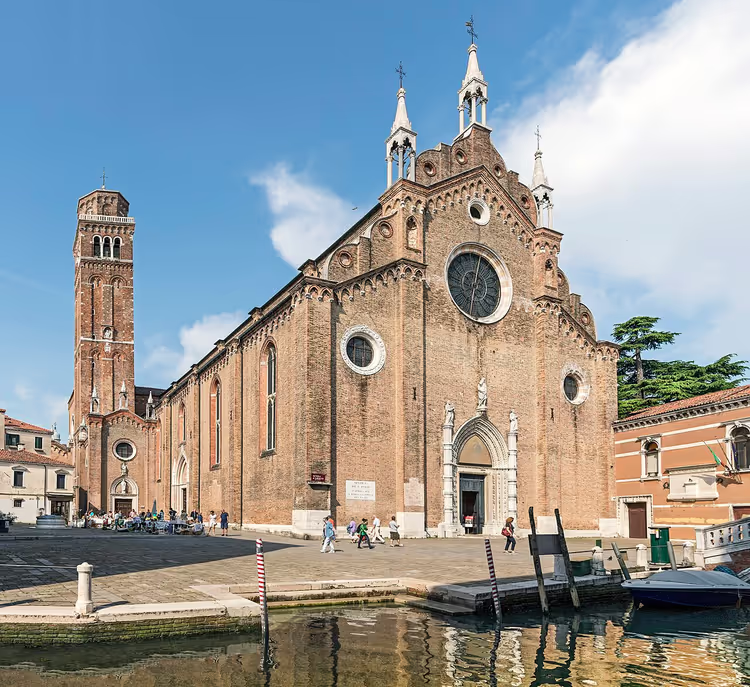 © Didier Descouens · CC BY-SAPhoto: Didier Descouens, CC BY-SA (https://creativecommons.org/licenses/by-sa/4.0), Wikimedia Commons
Santa Maria Gloriosa dei Frari is the city's main Gothic church, built of red brick. Construction stretched over centuries, and no wonder: its bell tower is second in height only to the Campanile.
Inside, the cathedral feels enormous. A colonnade of twelve columns divides it into three naves, and the vaults soar upward. The main treasures include Titian's "Pesaro Madonna" and the tomb of sculptor Canova, made from his own sketch.
Titian himself is also buried here. Check opening hours and admission on the Chorus Venezia website: the price is symbolic, but the schedule changes in summer.
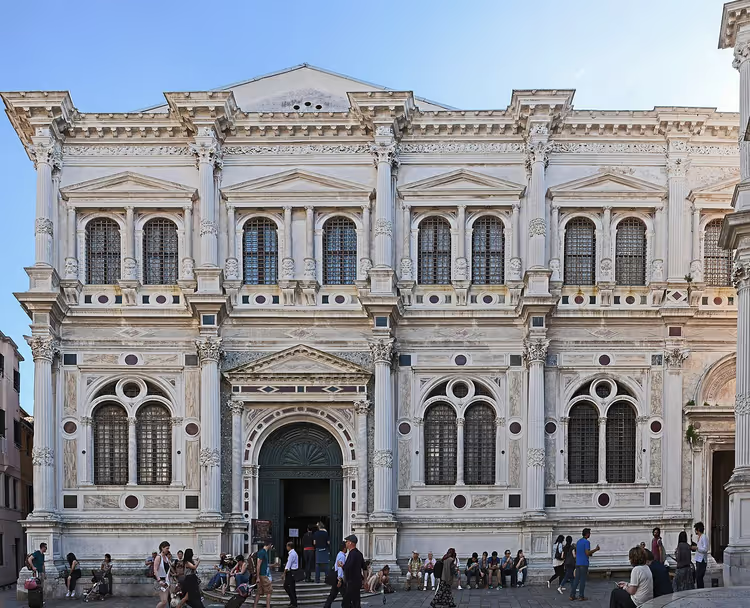
Scuola Grande di San Rocco
 © Didier Descouens · CC BY-SAPhoto: Didier Descouens, CC BY-SA (https://creativecommons.org/licenses/by-sa/4.0), Wikimedia Commons
Next to the Frari stands a scuola built in the mid-16th century in honor of Saint Roch, protector against the plague. It was built by the Brotherhood of San Rocco, which helped the sick, and the work took more than thirty years.
If Titian awaits you at the Frari, here you'll be looking at Tintoretto. The master painted the walls and ceilings of the scuola's upper halls, and today this collection is considered his main museum: dozens of canvases on biblical subjects.
A full tour takes over an hour. Tickets for the church and the upper halls are sold separately, so check the hours in advance on the Chorus Venezia schedule.
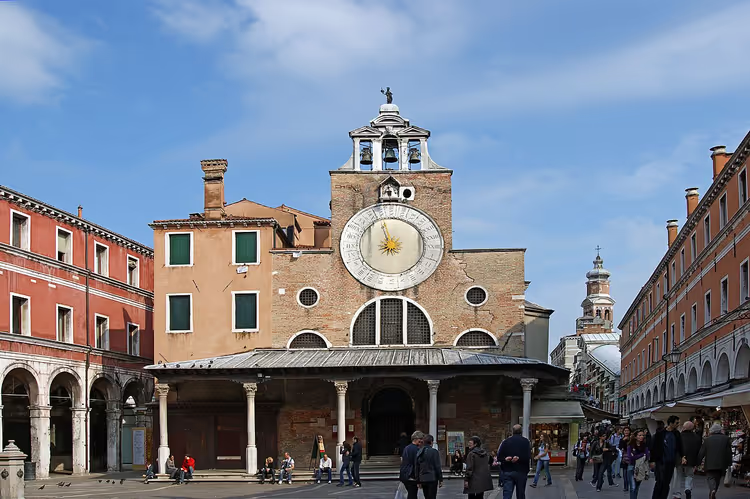
Church of San Giacomo di Rialto
San Giacomo di Rialto seems unremarkable at first glance, but it is one of the oldest churches in the city. Locals believe its foundation was laid in the 5th century, at the same time Venice itself was founded.
 © Didier Descouens · CC BY-SAPhoto: Didier Descouens, CC BY-SA (https://creativecommons.org/licenses/by-sa/4.0), Wikimedia Commons
The church is closely tied to the Rialto market. An inscription on the building's ledge reminds merchants to deal honestly, and the clock face on the wall is divided into twenty-four hours instead of the usual twelve.
Admission is free. The church is open only in the morning and in the afternoon, so it's best not to plan a visit around lunchtime.
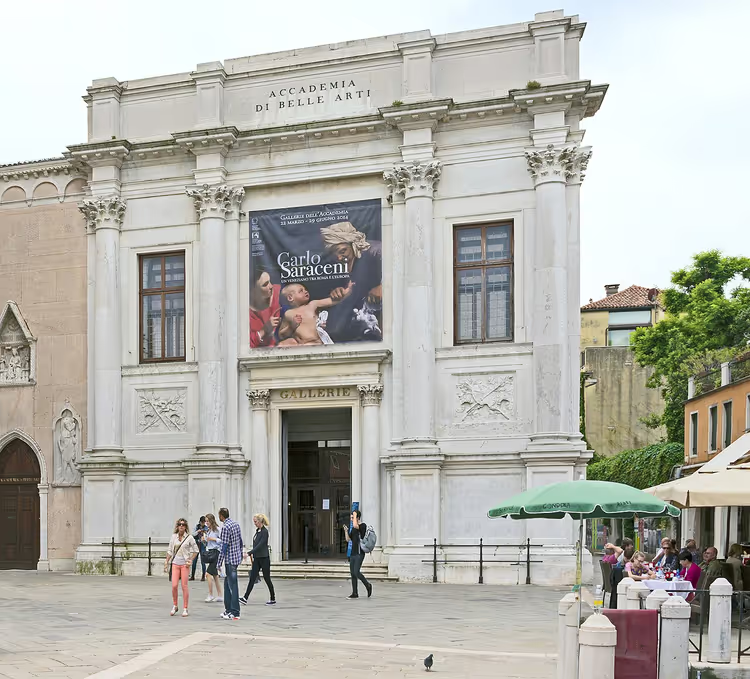
Gallerie dell'Accademia
 © Didier Descouens · CC BY-SAPhoto: Didier Descouens, CC BY-SA (https://creativecommons.org/licenses/by-sa/4.0), Wikimedia Commons
The Gallerie dell'Accademia is Venice's main art collection and one of Europe's strongest museums. It grew out of a painting school founded in the 18th century, and today it occupies a former monastery.
It houses Venetian painting from Byzantine icons to canvases by Titian, Veronese, and Tintoretto. The most famous work is Giorgione's "The Tempest," with Titian's "Feast in the House of Levi" and his late "Pietà" hanging nearby.
Admission is paid, and on Mondays the halls close earlier than usual. Check exact prices and hours on the gallery's official website; it's easier to buy tickets online.
- The catch: without a pre-booked time slot, you wait in the ticket line, and in high season that adds half an hour.
Santa Maria della Salute
 © Didier Descouens · CC BY-SAPhoto: Didier Descouens, CC BY-SA (https://creativecommons.org/licenses/by-sa/4.0), Wikimedia Commons
Santa Maria della Salute was built as thanks for deliverance from the plague. In the mid-17th century, the city vowed to build a church if the epidemic receded, and it kept its word: the baroque basilica took half a century to build.
The snow-white octagonal church with its sixty-meter dome seems to float above the waters of the Grand Canal. The marble facade is adorned with figures of archangels, columns, and pilasters, and inside are works by Titian and Pietro Liberi.
Come in the evening: when lit, the cathedral looks different than it does by day. Admission to the main part is free, you only pay for the sacristy and the dome climb; check rates and hours on the basilica's website.
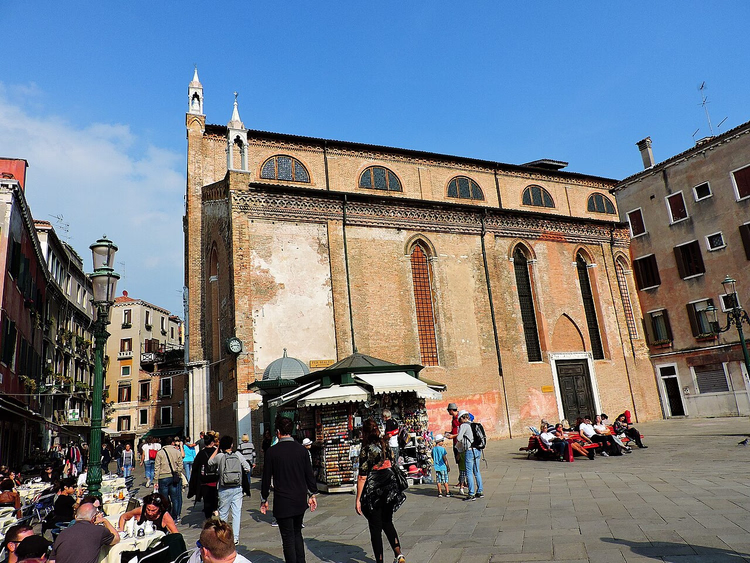
Santo Stefano
 © Dimitris Kamaras from Athens, Greece · CC BYPhoto: Dimitris Kamaras from Athens, Greece, CC BY (https://creativecommons.org/licenses/by/2.0), Wikimedia Commons
On Campo Santo Stefano stands a church with a grim reputation. Because of murders committed within its walls, the church was reconsecrated six times, and it received its gothic form in the 14th century.
The brick facade looks out of place among the bright neighboring buildings, but the interiors are done in Renaissance style. The wooden vault of the central nave resembles an upturned ship's keel, and the sacristy holds paintings by Venetian masters.
A lightning strike tilted the bell tower back in the 16th century, and it has leaned noticeably toward the canal ever since. The church is open during the day, on Sundays only after lunch, and you can view the paintings for a small fee.
Palazzo Grimani
 © Рустам Абдрахимов · CC BYPhoto: Рустам Абдрахимов, CC BY (https://creativecommons.org/licenses/by/3.0), Wikimedia Commons
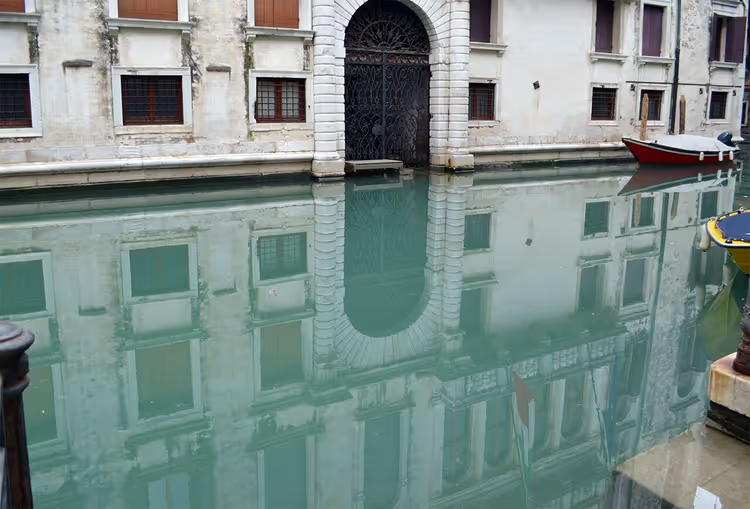
Palazzo Grimani is a large white Renaissance palace that stands out against the neighboring buildings. The building got its current appearance in the second half of the 16th century.
The facade is made of multicolored marble, and the interiors are decorated with frescoes by Italian painters. The palace witnessed Cardinal Grimani's rise to the throne.
Today the palace houses the court of appeals.
- The catch: tourists are not allowed inside, so you can only view the facade, and it's best to plan that on your way to San Giorgio Maggiore.
Ca' d'Oro Palace
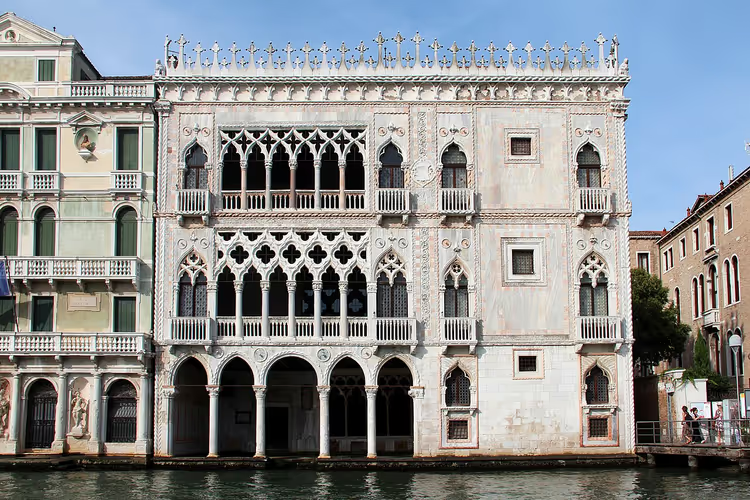
Ca' d'Oro means "Golden House," and it got its name from the gold leaf used in the facade decoration. The Gothic palazzo was built in the mid-15th century for the patrician Contarini, who wanted it to outshine every neighboring house in beauty.
 © Jean-Pol GRANDMONT · CC BYPhoto: Jean-Pol GRANDMONT, CC BY (https://creativecommons.org/licenses/by/4.0), Wikimedia Commons
Even after changing owners several times and undergoing renovations, the palace remains one of the most beautiful buildings in the city. Take a close look at the facade: the right side is solid, while the left is lacy and openwork, and this asymmetry makes the palazzo instantly recognizable.
Since the first half of the 20th century, the halls have housed the Franchetti Gallery with its collection of paintings and sculpture. The museum is currently closed for restoration (as of 10/2026), check the reopening date on the official website. From here it's a short walk to the Rialto market.
- The catch: the rooms are small, and on weekends it gets crowded inside.
How to get around Venice and when to go
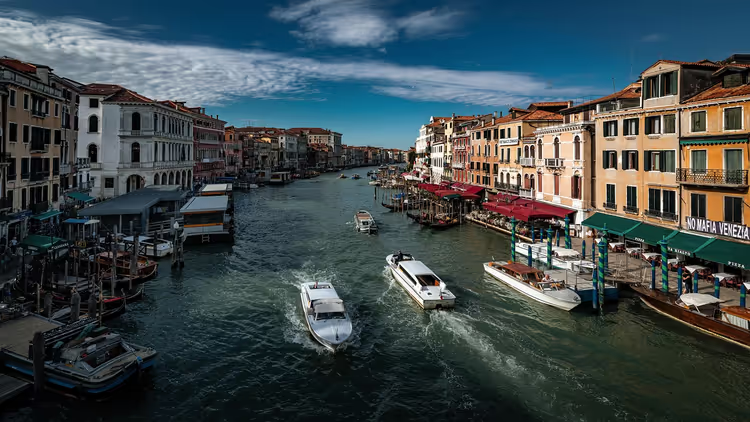
Venice sits on islands, and getting from one to another often means traveling by water. Vaporettos run on fixed routes, and where there are no bridges, the Grand Canal is crossed on traghetti. This is another form of public transport, and a ride costs less than a gondola.
A single vaporetto ticket is valid for 75 minutes and costs €9.50, while a 24-hour pass costs €25 (as of 09/2026, ACTV price list). If you plan more than two trips, the pass is the better deal. Get a public transport pass in advance so you don't have to hunt for a ticket machine at the dock.
When walking around the city, leave yourself extra time. The streets wind, bridges are scarce, and a route that looks familiar on the map easily turns into an extra kilometer.
Don't come to Venice with a suitcase on hard wheels. There is no fine for such luggage, but the wheels rattle on the paving stones, and you will have to carry the suitcase over the bridges by hand. Leave your bags at the luggage storage near Santa Lucia station.
The weather here is changeable at any time of year. Bring an umbrella and waterproof shoes even in summer: rain starts suddenly. The worst heat and crowds come in July and August, and late autumn is the calmest time.
Venice is among the most expensive cities in Europe. To save money, use public vaporettos instead of tourist boats and choose cafes away from St. Mark's Square: menu prices drop with every block you walk.
Tickets and opening hours: what to book in advance
Half the lines in Venice happen because of tickets bought at the door. Check the schedule in advance and book morning slots, so you move through your route without pauses.
Site | Admission | Best time |
|---|---|---|
Doge's Palace | combined ticket for four St. Mark's sites | right at opening |
St. Mark's Basilica | paid admission | before services begin |
Campanile bell tower | €10 | at opening or near closing |
Gallerie dell'Accademia | paid admission | weekday morning |
Santa Maria della Salute | paid admission | in the evening, when lit up |
San Giacomo di Rialto | free | morning and after lunch |
We checked the Campanile price on the basilica's official website (as of 09/2026, basilicasanmarco.it). Church schedules change by season, so check the Chorus Venezia website before your trip.
Tours and tickets in Venice
Guided tours, skip-the-line tickets and activities — most offers can be cancelled free of charge.
See offers on TiqetsThe widget loads once you give your consent.
Venice route map
It's convenient to keep all twenty-two sites on one map so you don't end up crossing the same bridge twice. Open it on your phone and move through the points in order.
A 1-day route through Venice
Places on the map
- 1Grand Canal The city's main waterway, vaporetto line 1 runs from Piazzale Roma to San Marco
- 2St Mark's Square The heart of the city with the Doge's Palace, the basilica and the Campanile, best visited by 8:30
- 3Doge's Palace Residence of Venice's rulers, Gothic look after a 15th-century fire
- 4St Mark's Basilica Holds the relics of St Mark, Byzantine domes and golden mosaics
- 5Rialto Bridge The oldest of the canal's four bridges, the best free view is from the top of the span
- 6San Giorgio Maggiore Island with a 16th-century basilica and a bell tower overlooking St Mark's Square
- 7Campanile Bell Tower The highest point in the city, a viewing platform at the top
- 8Loggetta del Sansovino Marble structure from the 16th century at the foot of the Campanile, with statues
- 9St Mark's Clock Tower 15th-century city clock with Moor figures and a zodiac dial
- 10Papadopoli Gardens Green park by Santa Lucia station with a playground
- 11Ponte degli Scalzi Bridge over the Grand Canal by the station, narrow at the midpoint of the span
- 12Santa Maria Gloriosa dei Frari Gothic church of red brick with works by Titian and Canova
- 13Scuola Grande di San Rocco Tintoretto's collection in the 16th-century halls of the Scuola di San Rocco
- 14Gallerie dell'Accademia Venice's main art collection, home to Giorgione's The Tempest
- 15Santo Stefano Gothic church with a leaning 16th-century bell tower
- 16Palazzo Grimani Renaissance palace with a marble facade, today the Court of Appeal
- 17Ca' d'Oro The Golden House with a lacy 15th-century Gothic facade by the Rialto market
⁉️🤔 Frequently asked questions
Is one day enough for Venice?
One day covers the compact historic center: St. Mark's Square, Rialto, Frari, and Ca' d'Oro. There's no time left for the islands of Murano and Burano, those need a separate outing. If you want to visit museums without rushing, plan at least two days.
How much money will you spend in a day?
Most of the money goes to tickets and transport. Prices for the Campanile and the vaporetto pass are listed in the sections above.
When are there the fewest tourists?
Early morning always works. In the morning St. Mark's Square is almost empty, and then the crowd grows until evening. Among seasons, late autumn and winter are the calmest, while July and August bring the worst heat and the longest lines.
Do you need to book tickets in advance?
Yes, for popular sites. The Doge's Palace and the Campanile sell timed entry slots in summer. Without a booking, you'll stand in line for over an hour at the Doge's Palace and up to forty minutes at the Campanile. In winter on weekdays you can risk it and buy on site.
Where can you eat cheaply near St. Mark's?
Walk at least two streets away from the square toward Rialto. There you'll find bacari with cicchetti and wine, where you can grab a bite for little money.
In short: what's worth booking
One day in Venice is realistic if you start early and set your priorities honestly. Below is a short matrix for your situation.
- If you only have half a day: do the Doge's Palace and St. Mark's Square, save the rest for later.
- If you're traveling with kids: go through Giardini Papadopoli park toward Ca' d'Oro, the pace will be calmer.
- If you want to save money: ride public vaporettos and snack at bacari near Rialto.
- If you love painting: Frari, Scuola Grande di San Rocco, and the Gallerie dell'Accademia take a full day, split the route into two.
Choose hotels in Venice on Trip.com in advance, and book your airport transfer before the trip.

A small editorial team writing guides for independent travel. We travel ourselves, but we haven’t been everywhere, so we check prices, opening hours and how to get there against official sources.