
















Plastihistoria: 20 plasticine scenes that retell history
Plasticine legionaries, Egyptian priests, and a tiny spaceship fit on a few tables. That is what Plastihistoria de la Humanidad looks like, an educational project by Fundación Educa from Valladolid, Spain. The history of humanity is told here through 20 scenes hand-sculpted from ordinary plasticine (as of 09/2026, official website).
The exhibition is a traveling one. The display is hosted by municipal cultural centers, museums, and parish halls across Spain, so the venue and dates change every season. According to Fundación Educa, the project is aimed primarily at schoolchildren, but adults study the scenes just as intently (as of 09/2026, foundation website).
We have put together what the exhibition includes, how long a visit takes, and how to catch a showing in Spanish cities.
Ad: this article contains affiliate links, we earn a commission if you book through them, at no extra cost to you.
An exhibition of 20 plasticine scenes
💡 In short:
- What it includes: 20 plasticine dioramas, a journey from the Paleolithic to globalization.
- Visit time: about an hour. Engaging for both children and adults.
- Contents and venues: 09/2026, verified on the official website.
 © Emilio J. Rodríguez Posada · CC BY-SAPhoto: Emilio J. Rodríguez Posada, CC BY-SA (https://creativecommons.org/licenses/by-sa/2.0), Wikimedia Commons
Plastihistoria de la Humanidad is part of a series of educational projects by Fundación Educa. This nonprofit organization from Valladolid works with children and young people, presenting history, science, and music through plasticine figures.
Each scene occupies its own table and is turned into a diorama. The figures are sculpted by hand, dressed in the fashion of their era, and placed among everyday objects. According to Fundación Educa, every small figure has its own facial expression, which lets you read the character's personality.
Besides people, the dioramas also feature supporting characters. These include plasticine cats, dogs, and a miniature replica of the Trojan Horse. You will not notice such details right away, because they are hidden deep within the scene.
The full list of scenes is provided below (as of 09/2026, Fundación Educa page).
What the 20 exhibition scenes show
All scenes follow a strict chronological order, so the show works well as a short history course. Below is the full Fundación Educa list, from the Paleolithic to the present day.
No. | Scene | Period |
|---|---|---|
1 | Paleolithic | prehistoric society |
2 | Neolithic | prehistoric society |
3 | Egypt | Ancient world |
4 | Persia | Ancient world |
5 | Phoenicians | Ancient world |
6 | Trojan Horse | Ancient world |
7 | Rome | Ancient world |
8 | Jesus of Nazareth | Antiquity |
9 | Crusades | Middle Ages |
10 | Middle Ages | Middle Ages |
11 | Renaissance | Renaissance |
12 | Discovery of America | Age of Discovery |
13 | Baroque | Early modern period |
14 | Francisco Goya | Early modern period |
15 | French Revolution | Early modern period |
16 | Conquest of the Wild West | 19th century |
17 | World War I | 20th century |
18 | World War II | 20th century |
19 | Space exploration | 20th century |
20 | Globalization | present day |
 © Emilio J. Rodríguez Posada · CC BY-SAPhoto: Emilio J. Rodríguez Posada, CC BY-SA (https://creativecommons.org/licenses/by-sa/2.0), Wikimedia Commons
Half of the list, ten scenes out of twenty, covers antiquity and the Middle Ages. The final scenes bring the viewer into the 20th century and the present. This order helps you see history as a whole rather than as separate fragments. You should pay special attention to the World War I and World War II dioramas: they contain the most small details for comparison.
How the plasticine scenes are made
 © Emilio J. Rodríguez Posada · CC BY-SAPhoto: Emilio J. Rodríguez Posada, CC BY-SA (https://creativecommons.org/licenses/by-sa/2.0), Wikimedia Commons
Fundación Educa's dioramas are assembled by hand, not printed or cast from plaster. Each scene is the result of several months of research and a sculptor's work, so the figures reproduce the costumes, weapons, and household items of a specific era (as of 09/2026, Fundación Educa website).
The work begins with historical sources. The creators select clothing, weapons, tableware, and furniture for each scene, then sculpt the characters and arrange them in the set.
One of the exhibition's creators is Javier Antón. His figures are shown in various Spanish cities, and the exhibition itself has long since expanded beyond Valladolid (Madrid press office).
This approach explains why families value the exhibition. A child recognizes familiar stories from a textbook, while you get to test your own school knowledge.
Tickets and opening hours
The project has no single ticket: each venue hosts the exhibition and sets its own opening hours. So before visiting, check the page of the hosting museum or cultural center, as well as the news section on the Fundación Educa website.
Plan your visit at a relaxed pace. About an hour is enough if you do not stop at every scene. Leave time for travel and check with the venue whether photography is allowed, since rules vary from place to place.
If you want to combine the show with a city walk, take a look at tours of Spain on GetYourGuide.
Tours and tickets
Guided tours, skip-the-line tickets and activities — most offers can be cancelled free of charge.
See offers on GetYourGuideThe widget loads once you give your consent.
Where the exhibition is held
Plastihistoria de la Humanidad does not stay in one place: the project has been traveling through Spanish cities for years, and the venue changes every season. The exhibition has been hosted by museums, palaces, and parish churches. In Teruel, the show took place in the Church of San Pedro (Iglesia de San Pedro), and that was not a random choice of venue.
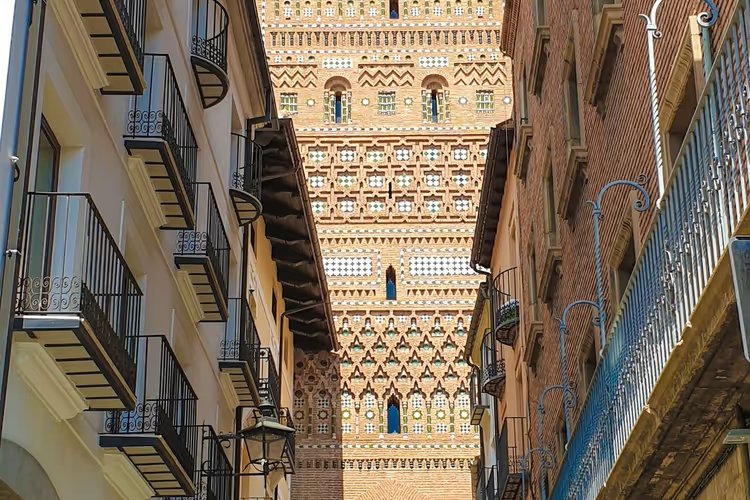
The Church of San Pedro was built in the 14th century, and its bell tower dates back to the 13th century (Wikipedia). In 1986, the Mudéjar monuments of Teruel were added to the UNESCO World Heritage List (Patrimonio Cultural de Aragón).
The Teruel showing has already ended. Check the foundation's website for the current venue.
Fundación Educa publishes upcoming locations in advance. Before traveling, open the foundation's official website and check whether the show is coming to your city.
⁉️🤔 Frequently asked questions
How many scenes does the exhibition include?
Exactly 20 dioramas. The full list with periods is provided in the table above.
What age is the show suitable for?
Fundación Educa designs the exhibition for children and young people, so schoolchildren can follow the scenes without preparation. Adults also find plenty to enjoy: the dioramas are full of historical details and gentle humor. The figures stand on tables, so the visit is meant for viewing rather than playing.
Do I need to buy a ticket in advance?
There is no single rule; each hosting venue decides. See the tickets and opening hours section above for details.
Where is the exhibition now?
The project is traveling, so it has no permanent address. The schedule changes every season, and the foundation announces each new city separately. In past years, the show has been hosted by museums and churches in various regions of Spain, including Teruel. Current venues are always listed on the official website.
Does Fundación Educa have other exhibitions?
Yes, more than one. Besides Plastihistoria de la Humanidad, the foundation presents Plastihistoria de la Ciencia and Plastihistoria de la Música, as well as a plasticine nativity scene with around 200 figures (as of 09/2026, foundation page).
In short: what to book
Plastihistoria de la Humanidad has no permanent museum. The exhibition moves, so your plans depend on the current venue.
- If the show has come to your city: arrive at opening time.
- If you are traveling to Aragon: the Teruel showing has already ended, but the city's Mudéjar towers can be seen without the exhibition.
- If you are planning an overnight stay in Teruel: hotels in Teruel on Trip.com.

A small editorial team writing guides for independent travel. We travel ourselves, but we haven’t been everywhere, so we check prices, opening hours and how to get there against official sources.