
















Gaudi architecture in Barcelona: 7 sites with addresses and tickets
Barcelona is recognizable by Gaudí at first glance. Seven of his buildings stand in different parts of the city, and seeing them all in one trip is realistic. If you're short on time, you'll take the three main ones. If you have a day, you'll cover all of them.
There's just one problem: the most famous houses admit visitors by time slots. In summer, tickets for convenient times sell out weeks in advance, and at the entrance you lose an hour in the heat. Get there at opening: lines are shorter then, and the light in the cathedral's stained glass is brighter.
Below are seven Gaudí sites with addresses and a viewing order. We built the route so you don't spend the day traveling between them.
Ad: this article contains affiliate links, we earn a commission if you book through them, at no extra cost to you.
What to see: seven Gaudí sites
💡 In short:
- Palau Güell, Casa Calvet, and Casa Vicens are easier to get tickets for, and lines there are shorter.
- Casa Batlló, Casa Milà, and Park Güell are best in the morning, entry is by time slot.
- Sagrada Família plan for two to three hours, the towers are sold separately.
- As of: 09/2026, verified on the official Casa Batlló website.
Site | Advance ticket | Best time | Highlight |
|---|---|---|---|
Palau Güell | needed | morning | parabolic dome and marble columns |
Casa Calvet | no interior access | any day, from outside | facade with stone "mushrooms" |
Casa Batlló | essential | before opening | dragon roof made of scales |
Casa Milà | essential | evening | roof and warrior chimneys |
Sagrada Família | essential, weeks ahead | early morning | stained glass and three facades |
Park Güell | essential | at opening or after six | hypostyle hall and mosaics |
Casa Vicens | needed | weekday | ceramic tile mosaic |
1. Palau Güell
 © Eric Fischer · CC BYPhoto: Eric Fischer, CC BY (https://creativecommons.org/licenses/by/2.0), Wikimedia Commons
An early major Gaudí commission, built after Casa Vicens. Palau Güell stands in the old town, at Carrer Nou de la Rambla, 3-5 (as of: 09/2026, official website). It was commissioned by the industrialist Eusebi Güell, who grew up in a poor district of Barcelona and wanted to leave a memorial to his parents.
A parabolic dome pierces all the floors. Through the shaped windows in the dome, light and air enter the interior, and a neo-Gothic staircase leads you upward. The decor reads with symbols of power: columns of Garraf marble, a fresco with Hercules, wooden ceilings with inlaid patterns.
From the outside, the palace looks just as rich. Two entrance arches are covered by wrought-iron grilles with an intricate pattern in which the initials of the owner and the architect can be discerned. In the center of the railing, on a metal lantern, sits an eagle with spread wings, a symbol of Catalonia's independence.
How to get there: Liceu or Drassanes metro, then walk along La Rambla.
Who it's for: those who want to see early Gaudí next to the quiet old town.
The catch: there aren't many rooms, you'll get through the palace in a couple of hours.
2. Casa Calvet
Casa Calvet stands in the Eixample, at Carrer de Casp, 48, and was completed in 1900 (as of: 09/2026, Barcelona tourism office). Gaudí built it for the widow of the textile magnate Calvet. The client wanted to combine a residence and the family office in one building.
The result was a building with a double face. Each floor is separated by elegant curves with "mushroom caps" above the windows. The entrance columns are shaped like textile bobbins, a nod to the family business. Under the roof, in a niche, stands a stucco bust of the dynasty's head. The decor leans on natural motifs: a bas-relief with a cypress above the main door, an olive tree, a cornucopia.
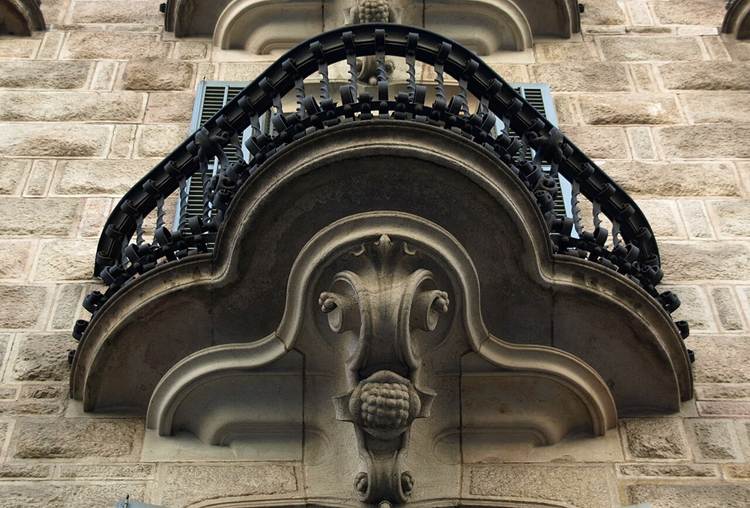
The balconies and railings deserve a separate look. Thin metal folds into openwork patterns, and under the balconies are hidden figured supports. The interior is not open to visitors: offices operate here. You can view the facade from the street at any time and without a ticket.
How to get there: Urquinaona or Passeig de Gràcia metro, then walk.
Who it's for: those who collect Gaudí facades and don't want to stand in line.
The catch: you can't get inside, only an exterior viewing is available.
3. Casa Batlló
 © Fred Romero · CC BYPhoto: Fred Romero, CC BY (https://creativecommons.org/licenses/by/2.0), Wikimedia Commons
Casa Batlló (Casa Batlló) stands at Passeig de Gràcia, 43 (as of 09/2026, official website). Gaudí completely rebuilt the old house of textile manufacturer Batlló and turned it into the city's most recognizable facade.
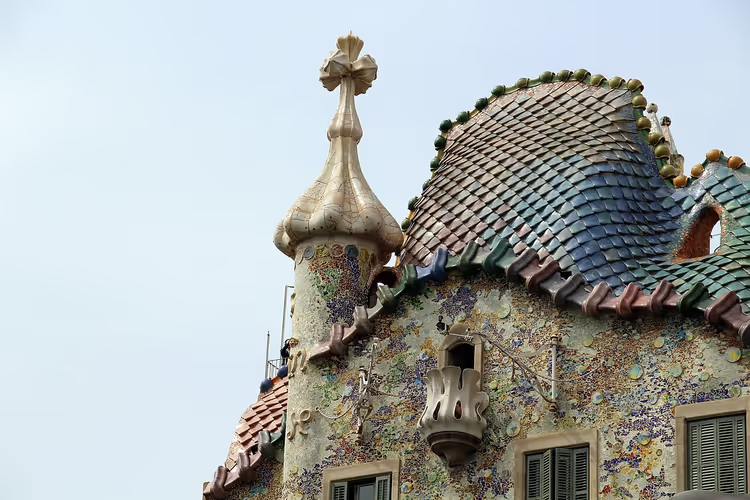
The symbolism reads in layers. Windows with blue mirrored glass, the curves of the floor boundaries, the colorful ceramic walls. The roof is shaped like a scaly dragon, and the turret with the cross of Saint George seems to pierce the monster. The balconies on molded bases look like skulls, and the dividing columns resemble bones. That's why locals nicknamed it the House of Bones.
The line here is long, so get skip-the-line tickets to Casa Batlló in advance. Children under 12 enter free (as of 09/2026, official website).
How to get there: Passeig de Gràcia metro station, the exit leads right to the facade.
Who it's for: those who want to see Gaudí at his highest concentration.
The catch: the ticket isn't cheap, and weekend slots should be booked first.
4. Casa Milà
 © Thomas Ledl · CC BY-SAPhoto: Thomas Ledl, CC BY-SA (https://creativecommons.org/licenses/by-sa/4.0), Wikimedia Commons
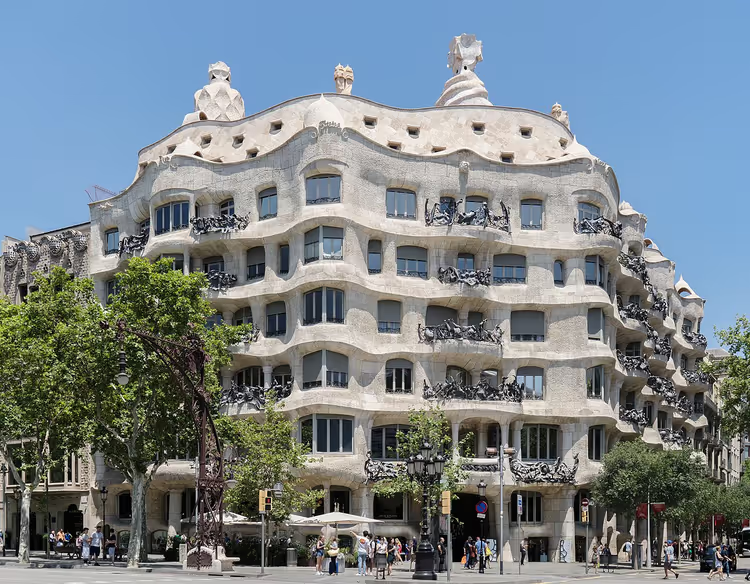
Casa Milà, also known as La Pedrera, stands at the corner of Passeig de Gràcia and Carrer de Provença. It's pure curvilinearity: there are almost no straight segments in the facade. Gaudí himself said he captured the curves of waves, clouds, leaves, and flowers in the building.
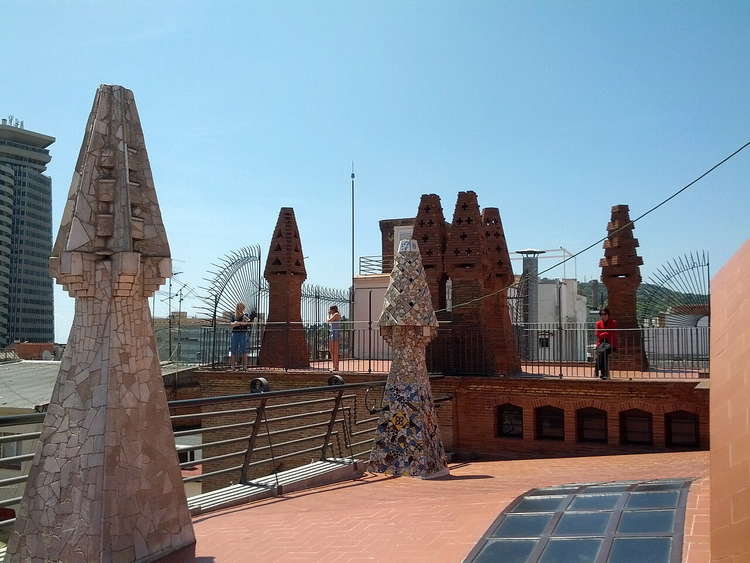
The rooftop deserves a separate visit. Chimneys shaped like warriors in helmets, a wavy parapet, elevator shafts in sculptural casings, you'll see all of it up top. The site is part of the UNESCO World Heritage list.
You need a time slot for both the entrance and the rooftop, so buy Casa Milà tickets with an audio guide in advance.
How to get there: Diagonal or Provença metro station, then walk.
Who it's for: those who want to see the rooftop and the wave-like facades.
The catch: without a pre-booked time slot, you may not get inside.
5. Sagrada Família
 © Canaan · CC BY-SAPhoto: Canaan, CC BY-SA (https://creativecommons.org/licenses/by-sa/4.0), Wikimedia Commons
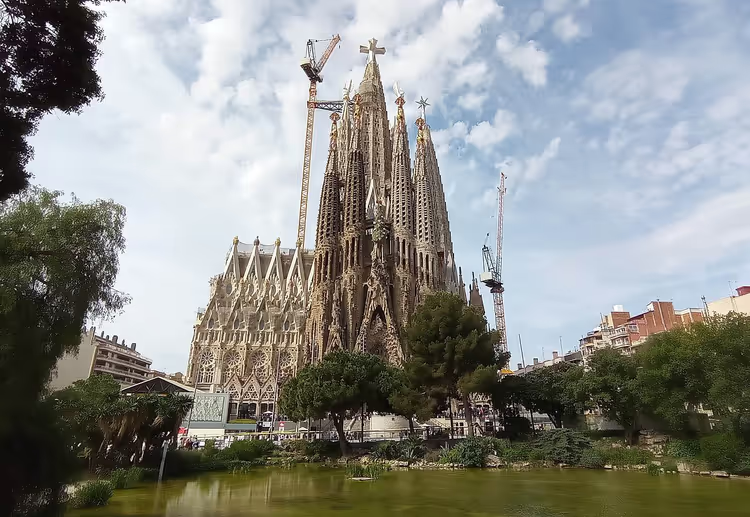
The Sagrada Família stands at Carrer de Mallorca, 401 (as of 09/2026, official website). Gaudí devoted more than forty years of his life to it and didn't live to finish it. Construction has been underway since 1882, and the temple is planned for completion in 2026.
From the outside, the basilica looks carved from a single rock. Inside, you enter a forest of columns that branch out at the top like trees. The stained glass floods the nave with color, and in the morning light the eastern side glows especially bright. The three facades tell the story of Christ from birth to the Passion.
A time slot is mandatory, and morning beats evening here. Get Sagrada Família tickets with an audio guide weeks in advance if you're traveling in summer.
How to get there: Sagrada Família metro station, the exit is right by the facade.
Who it's for: everyone visiting Barcelona for the first time.
The catch: morning slots in high season sell out first.
6. Park Güell
 © Canaan · CC BY-SAPhoto: Canaan, CC BY-SA (https://creativecommons.org/licenses/by-sa/4.0), Wikimedia Commons
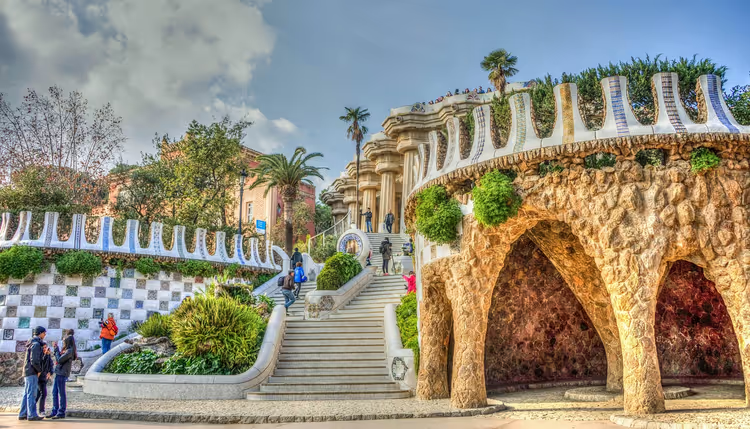
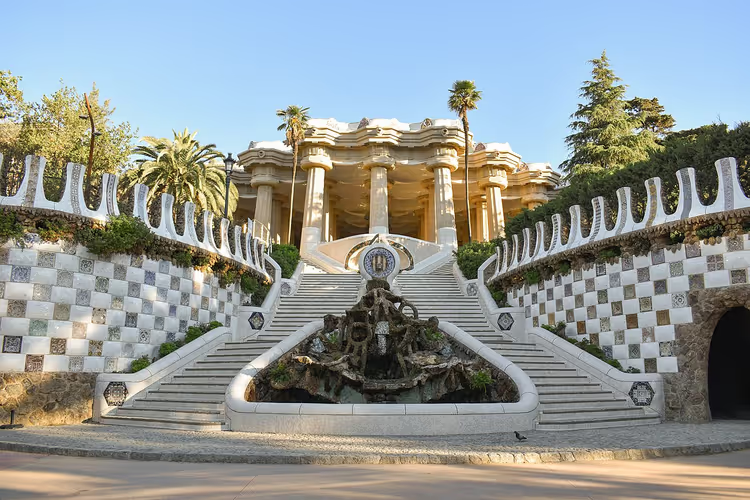
Park Güell rises above the city in the Gràcia district, on Carrer d'Olot (as of 09/2026, official website). Gaudí envisioned it as a neighborhood of private villas, but the project never took off, and the site became a park. The monumental zone is a UNESCO World Heritage Site.
Past the entrance, a mosaic salamander greets you, and beyond it stretches a hall with columns and painted ceiling vaults. The curved bench with a mosaic backrest offers the best view of the city. You can cover all of this at a relaxed pace in an hour.
In summer, tour groups fill the monumental zone, so Park Güell tickets with a morning slot are a better deal than evening ones.
Getting there: Lesseps or Vallcarca metro, then a walk uphill.
Who it's for: anyone who wants Gaudí mosaics and a city panorama.
The catch: only the park area is free; the monumental zone requires a ticket.
7. Casa Vicens
 © Canaan · CC BY-SAPhoto: Canaan, CC BY-SA (https://creativecommons.org/licenses/by-sa/4.0), Wikimedia Commons
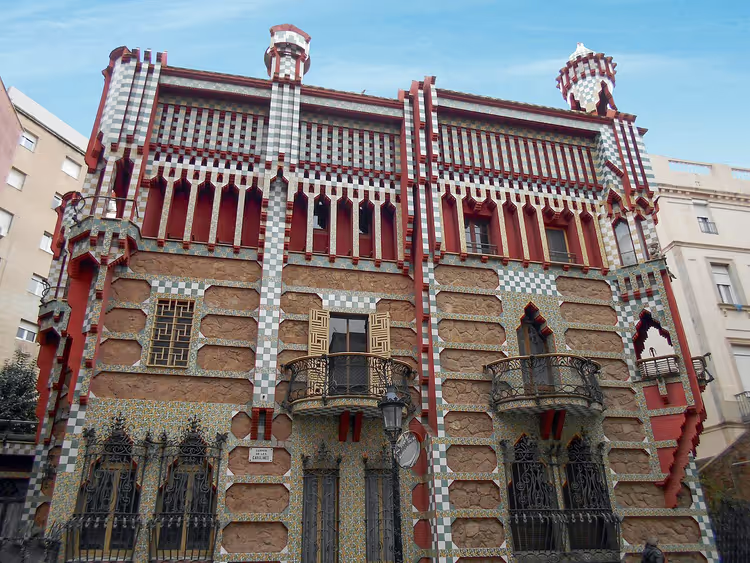
Casa Vicens closes out the route in the Gràcia district, at Carrer de les Carolines, 20-26 (as of 09/2026, official website). This is Gaudí's first major work as a licensed architect. He built the house for the owner of a brick factory and a decorative tile workshop.
Mosaic covers the entire facade. The patterns are assembled from ceramic tiles, and they reflect the client's profession. The villa used to open only once a year, on Saint Rita's day. Since 2017, the house has been restored and opened to visitors with tickets, so now you can see the interiors too.
Getting there: Fontana metro station, then a walk through Gràcia.
Who it's for: those who want to see Gaudí's first independent project.
The catch: the house is away from the other sites, so you'll need a separate trip.
How to save money in Barcelona
Each site sells tickets separately, and over a week-long trip the total adds up. Combined passes cover some of the tickets at a lower cost if you plan to see more than just Gaudí.
The Barcelona City Pass with Sagrada Família entry covers several of the city's major museums and gives you priority access. Timed tickets help you avoid waiting in line at the entrance.
Tours and tickets in Barcelona
Guided tours, skip-the-line tickets and activities — most offers can be cancelled free of charge.
See offers on TiqetsThe widget loads once you give your consent.
Where to stay in Barcelona
If you want to walk to Gaudí's sites, look for a hotel in Eixample along Passeig de Gràcia. From there you can reach Casa Batlló and Casa Milà without the metro, and the cathedral is just a couple of stops away. The Gràcia district is quieter and sits right next to Park Güell.
Find a hotel in Barcelona on Trip.com to compare neighborhoods and prices in one place.
Gaudí route on the map
All seven stops are collected on one map. The order is: Palau Güell, Casa Calvet, Casa Batlló, Casa Milà, Sagrada Família, Park Güell, Casa Vicens. Between Casa Batlló and Casa Milà you'll walk along Passeig de Gràcia, they're on neighboring blocks.
Route through Gaudí's works in Barcelona
Places on the map
- 1Güell Palace Gaudí's first major commission, a parabolic dome and marble columns
- 2Casa Calvet Facade with stone mushrooms above the windows, closed to the public
- 3Casa Batlló A scaled dragon-back roof and balconies on stucco bases
- 4Casa Milà La Pedrera with its wavy facade and warrior chimneys on the roof
- 5Sagrada Família Stained glass and three facades, two to three hours needed for a visit
- 6Park Güell Hall of columns, a mosaic salamander and a city view from the bench
- 7Casa Vicens Gaudí's first major work, facade of ceramic tiles
⁉️🤔 Frequently asked questions
How many Gaudí sites are there in Barcelona?
In this route we've gathered seven of Gaudí's main buildings in the city. Most of Gaudí's works in Barcelona are protected by UNESCO. Sagrada Família and Park Güell will take the most time; the rest you can see in one relaxed day.
Do I need to buy tickets in advance?
Yes, Casa Batlló, Casa Milà, Sagrada Família, and Park Güell are timed-entry only. In high season, morning tickets sell out weeks ahead. Book the cathedral first, then add the others as you go: that way you won't tie your whole day to one time slot.
How long does the route take?
The cathedral needs a couple of hours, Park Güell about an hour, and each house another hour. Without rushing, the whole route spreads over two days. If you stick to the essentials, you can do it in a day and still make it to dinner in Eixample.
Are there any free Gaudí sites?
You can walk through the park section of Park Güell for free; you only pay for the monumental zone. The facades of Casa Calvet, Casa Batlló, and Casa Milà can be viewed from the street without a ticket. The cathedral and museums are always paid, so there's no way to save there.
What should I see first?
If time is limited, start with Sagrada Família and Park Güell. Then add Casa Batlló and Casa Milà: they're on the same boulevard and don't require extra travel. Save Palau Güell and Casa Vicens for a second round.
In short: what's worth booking
If you're visiting Barcelona for the first time, get tickets to Sagrada Família and Park Güell: you can't get in without a time slot. If you love facades and mosaics, add Casa Batlló and Casa Milà. Some of these tickets can be bought cheaper as part of the Barcelona City Pass.

A small editorial team writing guides for independent travel. We travel ourselves, but we haven’t been everywhere, so we check prices, opening hours and how to get there against official sources.