
















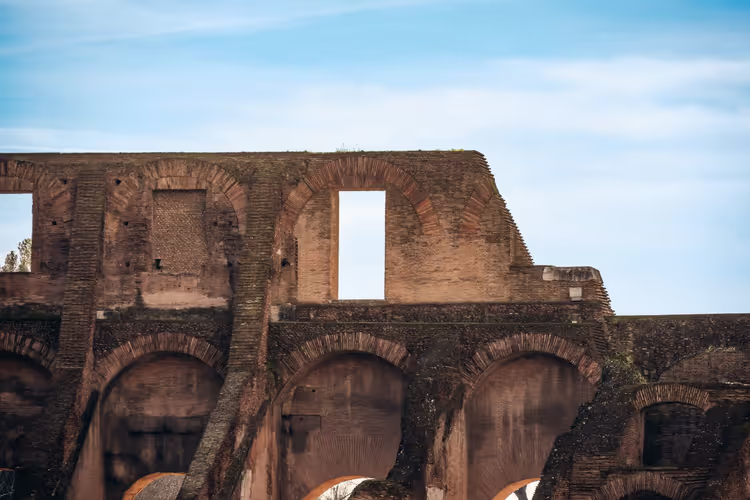
Imperial Rome on foot: 12 stops from the Colosseum to the Mouth of Truth
Twelve major monuments of Imperial Rome stand almost side by side. The entire route from the Colosseum to the Mouth of Truth is about three kilometers on the map, and you don't need a car. You can cover the route in one relaxed day.
The only challenge is that the sights are packed tightly together, and tickets and lines eat up time. Without a plan, you lose half a day at the entrance to the Colosseum and miss half of the Forum. The good news is that all of this is walkable, no sightseeing bus required.
We arranged the stops in the order that makes them easiest to see and checked the practical details. Below are twelve places: where to go, how long each takes, and where you need a ticket.
Ad: this article contains affiliate links, we earn a commission if you book through them, at no extra cost to you.
Imperial Rome in one day
💡 In short:
- Route: twelve stops, about three kilometers on foot on the map.
- Ticket: the Colosseum, Roman Forum, and Palatine Hill are covered by one day ticket.
- Start: the first morning slot at the Colosseum, ideally on a weekday.
- Prices: as of 09/2026, verified on the park's official ticket office.
The route is linear and passes through the city center. You start at the Colosseum, walk through the Forum to the Capitoline Hill, and finish at the Mouth of Truth.
Parameter | Details |
|---|---|
Length | about three kilometers on foot on the map |
Time | three to four hours without museums |
Ticket | one for the Colosseum, Forum, and Palatine Hill |
Start | Colosseum, morning slot |
All the stops are connected by pedestrian streets, so a car will only get in the way. You only need the metro to get to the starting point.
1. Colosseum
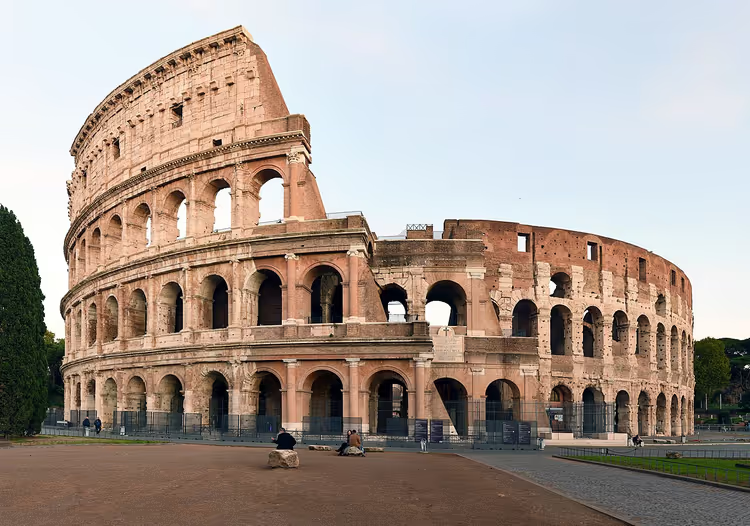
The Colosseum (Colosseo) is the largest amphitheater of the ancient world and the first stop on the route. Originally, this spot was a lake on the grounds of Nero's Golden House, and the amphitheater itself was built after the emperor's fall. The structure has survived earthquakes and looting, but it still impresses even from a distance.
 © FeaturedPics · CC BY-SAPhoto: FeaturedPics, CC BY-SA (https://creativecommons.org/licenses/by-sa/4.0), Wikimedia Commons
The Colosseum was the first venue in history to have numbered seats divided by social class. The nobility, priests, and the imperial family sat closest to the arena. The upper rows were reserved for women, foreigners, the poor, and slaves. That logic survives to this day: the ticket is tied to an entry time.
Under the arena, you can make out the service areas where animals and stage sets were kept. The line at the entrance forms by opening time, so book the first slot online. The amphitheater got its name from the colossal statue of Nero that stood nearby.
- The catch: in summer, without a time slot, you'll stand in line for over an hour.
2. Arch of Constantine
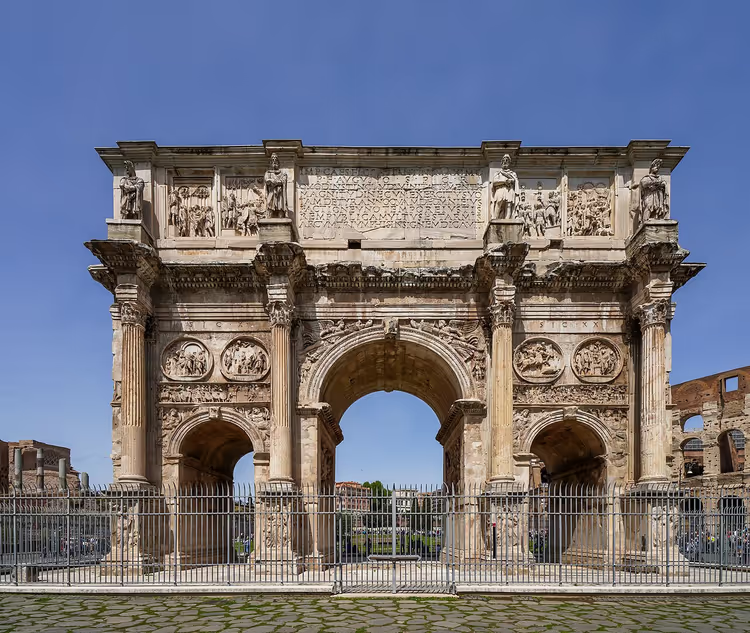
Just west of the Colosseum stands the Arch of Constantine (Arco di Costantino), about two hundred meters from the amphitheater on the map. It was erected in the early 4th century to commemorate the victory over Maxentius. It is the only arch in Rome dedicated not to a foreign enemy, but to the outcome of a civil war.
 © NikonZ7II (Paris Orlando) · CC BY-SAPhoto: NikonZ7II (Paris Orlando), CC BY-SA (https://creativecommons.org/licenses/by-sa/4.0), Wikimedia Commons
Much of the decoration was taken from earlier monuments, so sculptures from different eras are assembled on a single structure. It stands about twenty meters tall and is made of marble. A visit takes about ten minutes; it's a transition between the Colosseum and the Forum.
- The catch: the reliefs were moved from other buildings, so there's no unified design.
3. Roman Forum
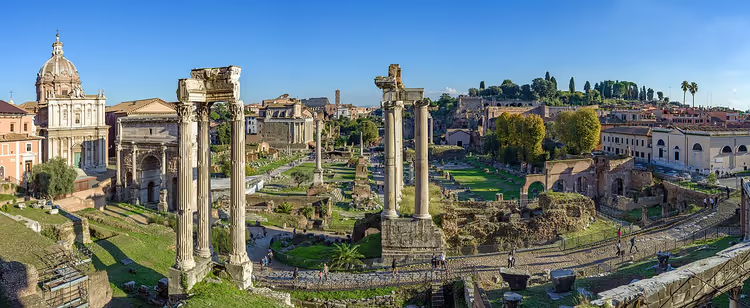
The route then leads to the Roman Forum, the main square of Ancient Rome. At first, trade took place here, then spaces for public assemblies appeared, along with the Curia, where the Senate met. The commercial center quickly became a political one.
 © This Photo was taken by Wolfgang Moroder . Feel free to use my photos, but please mention me as the author and send me a · CC BY-SAPhoto: This Photo was taken by Wolfgang Moroder . Feel free to use my photos, but please mention me as the author and send me a, CC BY-SA (https://creativecommons.org/licenses/by-sa/3.0), Wikimedia Commons
According to legend, this was once a marshy lowland with springs, where the first inhabitants were even buried. Roman houses stood on the neighboring hills, above the damp ground. That's why the Forum still reads as the heart of the city today.
With a guide, you'll figure out where the Curia stood and where the Rostra was. Guided tours of the Forum gather groups at the entrance and follow the Sacred Way.
- The catch: there's little shade in summer, bring water.
4. Sacred Way
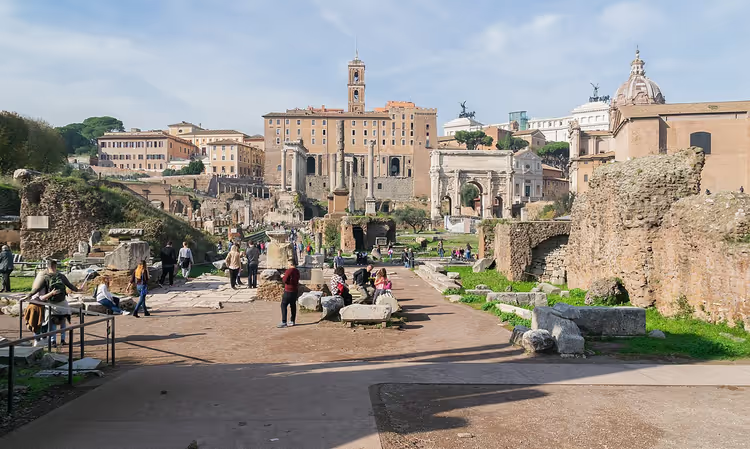
The Sacred Way (Via Sacra) leads you through the Forum, the most famous street of Ancient Rome. Distinguished guests, rulers, and their processions moved along it. The road runs from the Capitoline Hill to the Colosseum.
 © Krzysztof Golik · CC BY-SAPhoto: Krzysztof Golik, CC BY-SA (https://creativecommons.org/licenses/by-sa/4.0), Wikimedia Commons
The stone pavement was laid as early as the 5th century BC to escape rain and mud. Under Nero, the road was reinforced and decorated with colonnades, and its width reached three meters. Beneath the stones ran a drainage channel that carried water to the Cloaca Maxima.
Later, triumphal processions passed here after victories and on religious holidays. You walk the same route, just without chariots.
- The catch: the stones are uneven and slippery after rain.
5. Regia
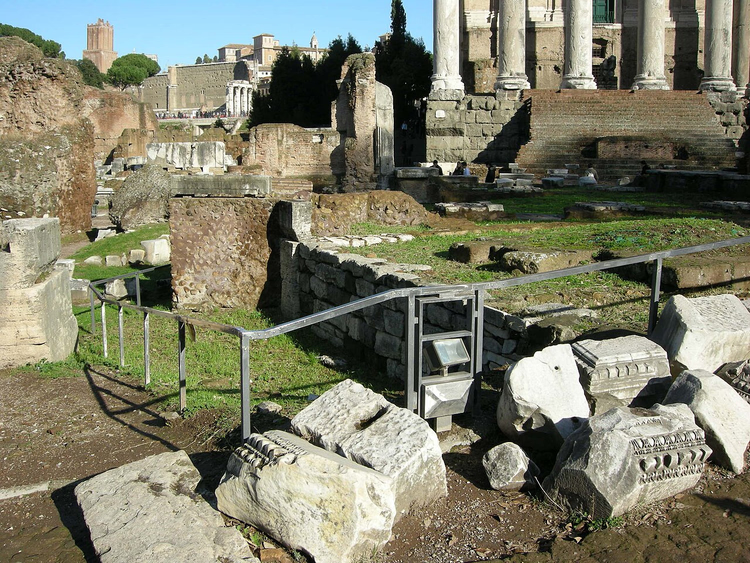
The Regia stood right at the foot of the Palatine Hill, on the Forum grounds. At first it was the residence of the kings, and later it housed the Pontifex Maximus. The name comes from the Latin "regia," meaning "royal house."
 © sailko · CC BYPhoto: sailko, CC BY (https://creativecommons.org/licenses/by/2.5), Wikimedia Commons
You'll see only the foundation and fragments of the facing. The building was repeatedly destroyed, rebuilt, and repurposed. The structure is associated with the name of Rome's second king, Numa Pompilius.
- The catch: only the foundation survives, so you have to fill in the details from diagrams.
6. Rostra
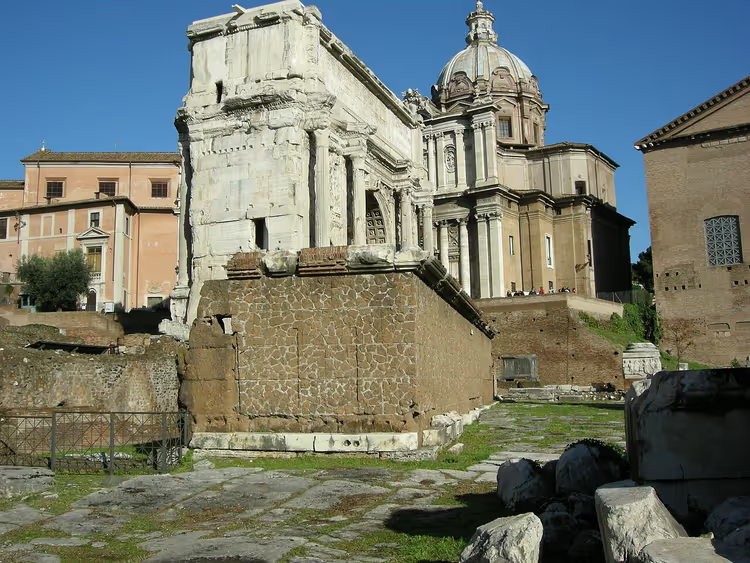
The Rostra is the speakers' platform, reconstructed by archaeologists. The original platform was restored after Augustus's victory over Cleopatra's fleet. The decoration featured the prows of captured Egyptian ships.
 © sailko · CC BYPhoto: sailko, CC BY (https://creativecommons.org/licenses/by/2.5), Wikimedia Commons
The platform got the name "rostra" earlier, from the ship prows of Antium in 338 BC. Politicians and generals addressed the city from it. Today you can make out only the layout and part of the facing.
- The catch: the ancient decoration is almost entirely gone.
7. Capitoline Wolf
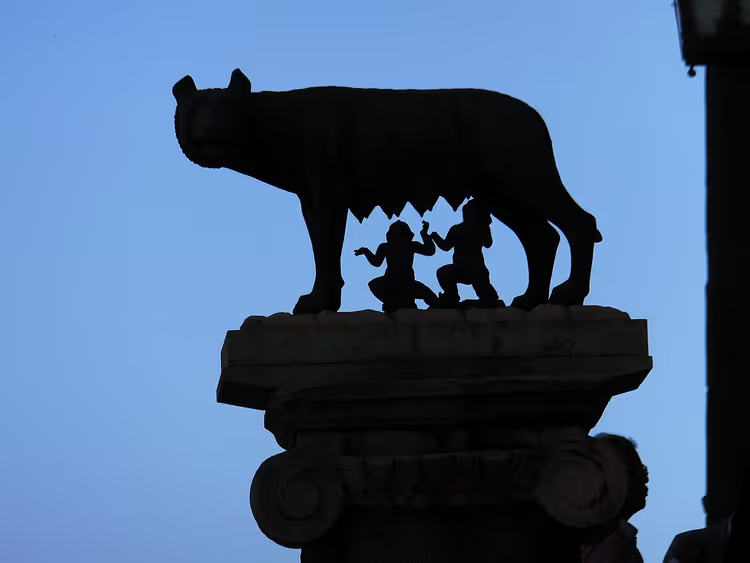
The Capitoline Wolf (Lupa Capitolina), the most recognizable bronze symbol of Ancient Rome. According to traditional dating, it was cast in the 5th century BC. It is linked to the legend of Romulus and Remus, who were suckled by a she-wolf.
 © lienyuan lee · CC BYPhoto: lienyuan lee, CC BY (https://creativecommons.org/licenses/by/3.0), Wikimedia Commons
According to legend, the brothers founded the Eternal City, and the she-wolf was a totem of the Etruscan tribes. Etruscan culture had a significant influence on the formation of Rome. You will see the figures of the infants next to the statue; they were added during the Renaissance.
- The catch: the original is in the Capitoline Museums, so you need an entrance ticket.
8. Capitoline Hill
The Capitoline Hill, the most famous of the seven hills of Rome. The city's main temple, the Temple of Jupiter, stood here, where the most important matters were decided. Both religious and state affairs converged at the temple.
 © Nicholas Gemini · CC BY-SAPhoto: Nicholas Gemini, CC BY-SA (https://creativecommons.org/licenses/by-sa/4.0), Wikimedia Commons
The ascent goes from the Forum and from the Capitoline Square. The square was designed by Michelangelo and has survived almost unchanged. From the top, you have a view of the Forum and the Colosseum.
- The catch: it is an uphill climb, and it is hard going in the heat.
9. Trajan's Column
Trajan's Column (Colonna Traiana) was erected in honor of the victory over the Dacians. It is almost forty meters high, with a spiral staircase inside leading to a viewing platform. The main decoration is a spiral band of bas-relief about two hundred meters long.
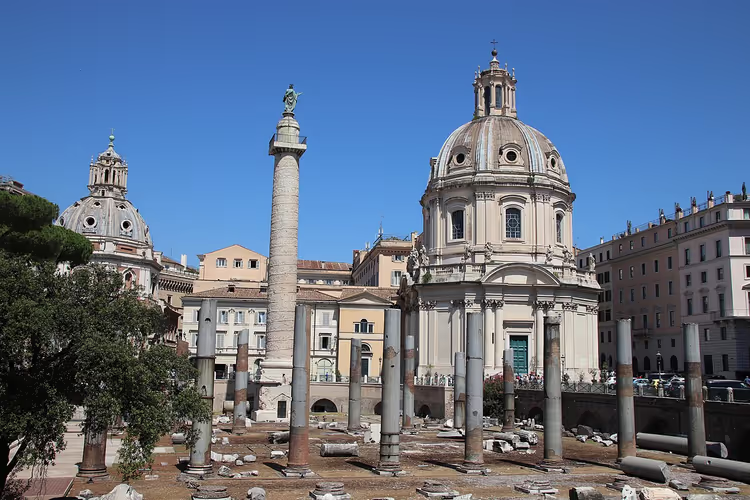
The band depicts episodes of the Dacian Wars. The column stands in Trajan's Forum, slightly away from the main circle of the Forum. It is convenient to view it from the level of the square.
- The catch: you cannot go inside; the staircase is closed to visitors.
10. Palatine Hill
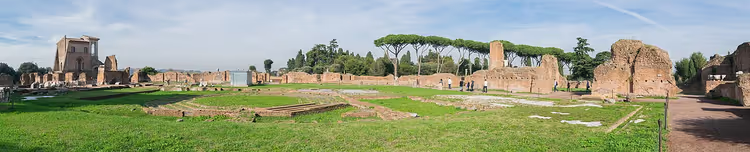
The Palatine Hill, the hill from which Rome began. The first settlements appeared here, and later imperial palaces grew up. The hill's name comes from Pales, the goddess of shepherds and protector of livestock.
 © Krzysztof Golik · CC BY-SAPhoto: Krzysztof Golik, CC BY-SA (https://creativecommons.org/licenses/by-sa/4.0), Wikimedia Commons
In earlier times, livestock grazed on the slopes and sacrifices were made to the gods. Later the hill was built up with imperial residences and became the most prestigious district of the city. From the Palatine you can see the Circus Maximus from above.
- The catch: it is an uphill climb and there is little shade in summer.
11. Circus Maximus
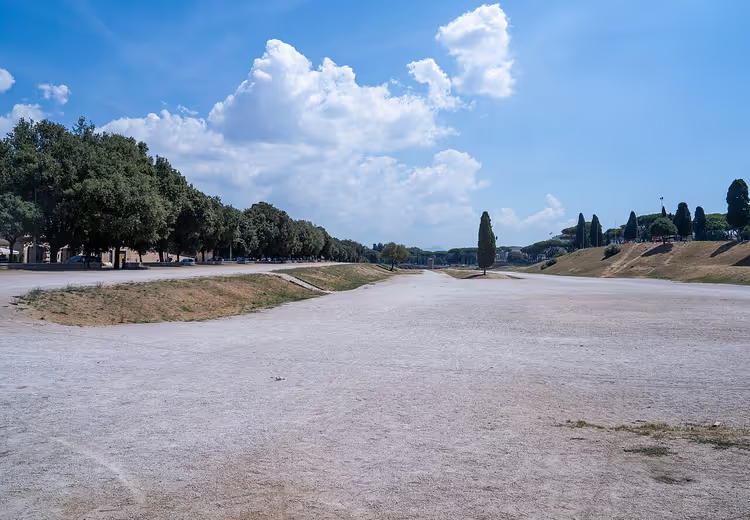
The Circus Maximus (Circo Massimo), the largest hippodrome of Ancient Rome. It lies in the valley between the Palatine and Aventine hills. Up to twelve chariots raced on the track at the same time.
 © Rione Colonna · CC BYPhoto: Rione Colonna, CC BY (https://creativecommons.org/licenses/by/4.0), Wikimedia Commons
The first such competitions were held as early as the first centuries of Rome. Today it is an open green area with free admission. Almost nothing remains of the stands and buildings, but the size of the site will surprise you.
- The catch: there is almost no shade, and it is hot here during the day.
12. Mouth of Truth
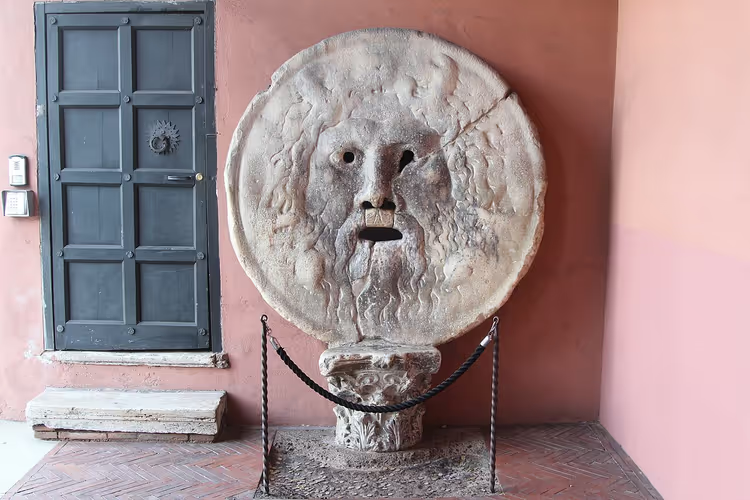
The route ends at the Mouth of Truth (Bocca della Verità), an ancient marble slab with a mask linked to Triton. The slab was carved from marble in the 1st century AD and moved to the church of Santa Maria in Cosmedin in the 17th century.
 © Fallaner · CC BY-SAPhoto: Fallaner, CC BY-SA (https://creativecommons.org/licenses/by-sa/4.0), Wikimedia Commons
Romans believed that if a liar put their hand into the open mouth, it would bite it off. The slab hangs in the church portico and is open to everyone. Entry to the church itself is free and takes about five minutes.
- The catch: a short line forms at the slab for photos.
Walking route on the map
The route is linear, with no return to the start at the Colosseum. From the Colosseum you walk through the Forum to the Capitoline Hill, then to Trajan's Column and back toward the Palatine. After that you head down to the Circus Maximus and finish at the Mouth of Truth.
All the stops sit in a compact area, so you don't need transport between them. Open the map to check the order of stops.
Imperial Rome on foot in one day
Places on the map
- 1Colosseum The largest amphitheatre of the ancient world, entry by time slot
- 2Arch of Constantine Two hundred metres from the Colosseum, about twenty metres high
- 3Roman Forum The main square of Ancient Rome, trade, assemblies and the curia
- 4Sacred Way The Via Sacra links the Capitoline to the Palatine, used for triumphs
- 5Regia Residence of the kings and the pontiff at the foot of the Palatine, only the foundation remains
- 6Rostra A speakers' platform decorated with the prows of Egyptian ships
- 7Capitoline Wolf The bronze symbol of Rome, the original stands in the Capitoline Museums
- 8Capitoline Hill Square designed by Michelangelo with a view of the Forum and the Colosseum
- 9Trajan's Column Almost forty metres, a spiral relief depicting the Dacian wars
- 10Palatine Hill The hill where Rome began, imperial palaces and a view of the circus
- 11Circus Maximus A racetrack in the valley between the Palatine and the Aventine, free entry
- 12Mouth of Truth A marble mask in the portico of the church of Santa Maria in Cosmedin
Tickets and opening hours (as of 09/2026)
Sort out the practical side in advance so you don't lose your morning in line.
What to see | Ticket | How it works |
|---|---|---|
Colosseum, Roman Forum, Palatine | €18 (as of 09/2026, official park ticket office) | 24 hours from entry |
Capitoline Museums and the she-wolf | paid, check the price on the official website | day of visit |
Circus Maximus | free entry | no restrictions |
Mouth of Truth | free entry, photo for a small donation | during church hours |
A single ticket covers three main sights at once: the Colosseum, the Roman Forum and the Palatine. It is valid for 24 hours from the moment you enter the Colosseum, and you get into the Forum with the same ticket. Check the price and opening hours on the official park ticket office before your trip.
Colosseum tickets are best bought online: tickets with a Colosseum time slot. That way you arrive at your time instead of standing in the general line.
Tours and tickets in Colosseum
Guided tours, skip-the-line tickets and activities — most offers can be cancelled free of charge.
See offers on TiqetsThe widget loads once you give your consent.
⁉️🤔 Frequently asked questions
How long does the route take?
Walking all twelve stops takes three to four hours at a relaxed pace. With museums and lunch, allow half a day. If you're short on time, skip Trajan's Column and the Capitoline Museums, they sit off the main loop.
Do I need a separate ticket for each sight?
No. The Colosseum, Roman Forum and Palatine are covered by one ticket for €18 (as of 09/2026). You only pay separately for the Capitoline Museums, where the she-wolf is kept.
What should I see first?
Start with the Colosseum at the first time slot, before the line builds. Then follow the Sacred Way out to the Forum and up to the Capitoline Hill. The Palatine, Circus Maximus and Mouth of Truth are easy to leave for the second half of the day.
When is the best time to visit the Mouth of Truth?
A short line forms at the slab in the portico of the church of Santa Maria in Cosmedin. It's best to come at opening time or closer to the evening. Photos are taken for a small donation, and entry to the church is free.
Can I do the route for free?
Partly. The Circus Maximus and Capitoline Square are open freely, and the Mouth of Truth is accessible in the church. You only need a ticket for the Colosseum, Forum and Palatine. Walks between the stops are free.
In short: what to book
You can cover the Imperial Rome route in one day and without a car. The main thing to sort out in advance: your Colosseum time slot and the ticket for the three sights.
If you have one day: take a morning Colosseum slot and walk all the way to the Mouth of Truth. If you're with kids: cut the route down to the Colosseum, Forum and Circus Maximus. If you love museums: add the Capitoline Museums for the she-wolf.
Stay within walking distance of the Colosseum so you don't waste time getting around. Hotels in central Rome on Trip.com. Arrange insurance in advance, compare insurance options in a couple of minutes.
Check your time slot and the weather, bring water, and the route will go smoothly.

A small editorial team writing guides for independent travel. We travel ourselves, but we haven’t been everywhere, so we check prices, opening hours and how to get there against official sources.