
















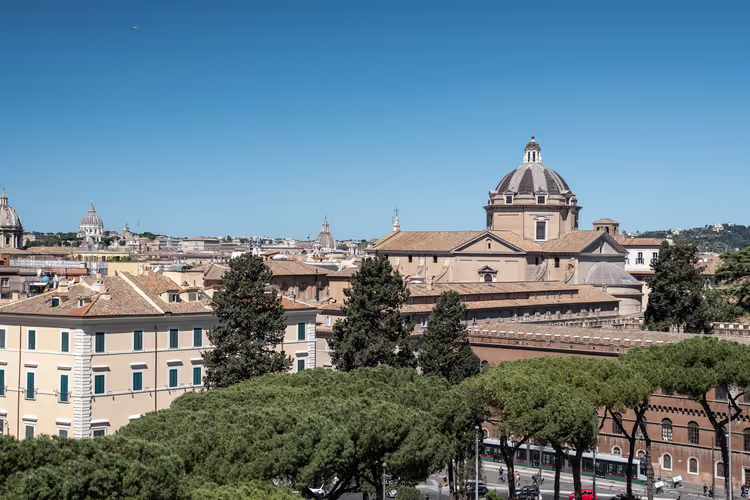
7 Hills of Rome: what to see on each and how to plan a route
Rome stands on seven hills, and each one plays its own role in the city. The Capitoline gave Rome power, the Aventine gave it panoramas, the Palatine gave it a point of origin. Many visitors walk right past: the climb seems unnecessary until you actually go up. The viewpoints on the Capitoline and Aventine are free, but tourists need a ticket for the Capitoline Museums (as of 09/2026, official website). Here's the full rundown: what to see on each hill and how to link them into a single walking route.
Ad: this article contains affiliate links, we earn a commission if you book through them, at no extra cost to you.
What the seven hills of Rome are
💡 In short:
- The seven hills are the Capitoline, Quirinal, Viminal, Esquiline, Palatine, Caelian, and Aventine.
- Allow between half an hour and an hour for each hill, and count museums separately.
- Tickets and opening hours: 09/2026, verified on the official Capitoline Museums website
The seven hills are the historical skeleton of the city, the frame around which Rome grew for more than two thousand years. The Palatine and Capitoline sit next to the Roman Forum, the Quirinal and Viminal face Termini station, and the Aventine and Caelian hold the southern edge along the Tiber. All seven points are genuinely walkable in two days, as long as you don't set out to inspect every last plaque in every museum.
The names of the hills explain both the topography and the character of the city. According to legend, Romulus and Remus grew up on the Palatine, the fate of the empire was decided on the Capitoline, and the Sovereign Military Order of Malta still has its residence on the Aventine. Understanding this geography helps you avoid crisscrossing Rome for nothing and wasting energy on climbs in the heat.
1. Capitoline Hill
 © Nicholas Gemini · CC BY-SAPhoto: Nicholas Gemini, CC BY-SA (https://creativecommons.org/licenses/by-sa/4.0), Wikimedia Commons
The Capitoline is the smallest and most significant of the seven hills. This is where the temples of Jupiter, Juno, Minerva, and Juno Moneta stood, in other words the religious and political center of ancient Rome. By the 16th century the buildings had fallen into disrepair, and the complex was rebuilt from scratch.
The project was designed by Michelangelo. He defined the look of the square and its staircase with the equestrian statues of Castor and Pollux, as well as the facades of the Palazzo Nuovo, Palazzo dei Conservatori, and Palazzo Senatorio. Minerva still stands over the fountain in front of the Senatorial Palace.
Inside you'll see fragments of the colossal statue of Emperor Constantine, the original equestrian statue of Marcus Aurelius, and the bronze Capitoline Wolf. A copy of Marcus Aurelius remains in the square, while the original has moved into the museum. From the picture gallery, a steep staircase takes you up to the Basilica of Santa Maria in Aracoeli, next to which there's a viewpoint and a cafe.
- Where the entrance is: the square from the cordonata, climb up from the Roman Forum or from Via del Teatro di Marcello.
- Tickets: as of February 2026 the museums are free for Rome residents, everyone else needs a ticket, the viewpoint is free (as of 09/2026, official website).
- Time: about two hours with the museums and half an hour for the square.
- With a guide: Rome tours on GetYourGuide help you keep track of all the emperors' names.
- The catch: a steep staircase leads up to the Basilica of Santa Maria in Aracoeli, so you can't get up there with a stroller.
2. Quirinal Hill
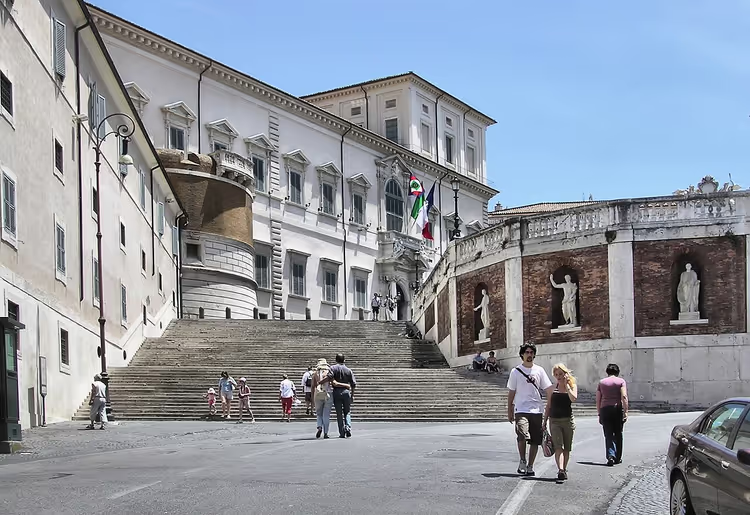
The Quirinal ranks second in importance, and it got its name from the god Quirinus. Unlike the warlike Mars, Quirinus, according to legend, settled disputes through diplomacy. Patricians built villas here to escape the summer heat and catch the breeze.
The hill caught the eye of Pope Gregory XIII, the creator of the Gregorian calendar. On his orders, the Quirinal Palace was built here, and construction stretched over two centuries. Lorenzo Bernini, Martino Longhi, and Domenico Fontana all worked on the project.
Nearby are gardens laid out in the classical style. On certain days, the palace halls are opened to visitors, including the Royal Hall with its frescoes. On the hill you'll find fountains, ancient sculptures, and 16th-century pavilions, and around it there are boutiques, cafes, and hotels. Villa Borghese is close by, book your Borghese Gallery ticket on GetYourGuide in advance: entry is by timed slot.
- Who it's for: those who want to see a living center, not just ruins.
- Location: about a fifteen-minute walk from the Trevi Fountain (on the map).
- The catch: the palace's interior halls are not open every day; on other days only the square is accessible.
3. Viminal Hill
 © Chabe01 · CC BY-SAPhoto: Chabe01, CC BY-SA (https://creativecommons.org/licenses/by-sa/4.0), Wikimedia Commons
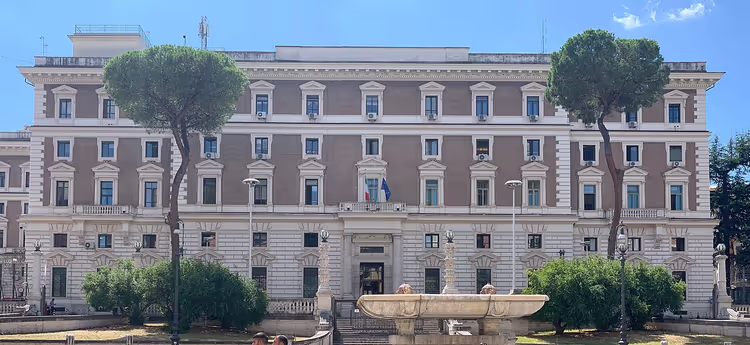
During the empire, the Viminal was settled by commoners. The slope was overgrown with willow, and the Romans called it "Willow Hill." The camp of the Praetorians, the emperor's personal guard, also stood here. Later, the Baths of Diocletian operated on the hill: they welcomed thousands of people and contained a library, gardens, and fountains inside.
Today, Termini Station stands next to the baths, and trains to all parts of Italy depart right from the foot of the hill. From there it's convenient to book trains and buses across Italy on Trip.com if you're continuing on to Florence or Naples. Few ancient structures remain, and the main ornament of the station square is the church of Santa Maria degli Angeli e dei Martiri, which Michelangelo rebuilt in the 16th century.
- Tickets: Museo Nazionale Romano is open Tuesday through Sunday from 9:00 to 19:00, last entry at 18:00, closed on Mondays (as of 09/2026, official website).
- How to get there: exit Termini Station onto Piazza della Repubblica, then about a five-minute walk (on the map).
- The catch: what remains of the ancient baths are museum halls, not open ruins.
4. Esquiline Hill
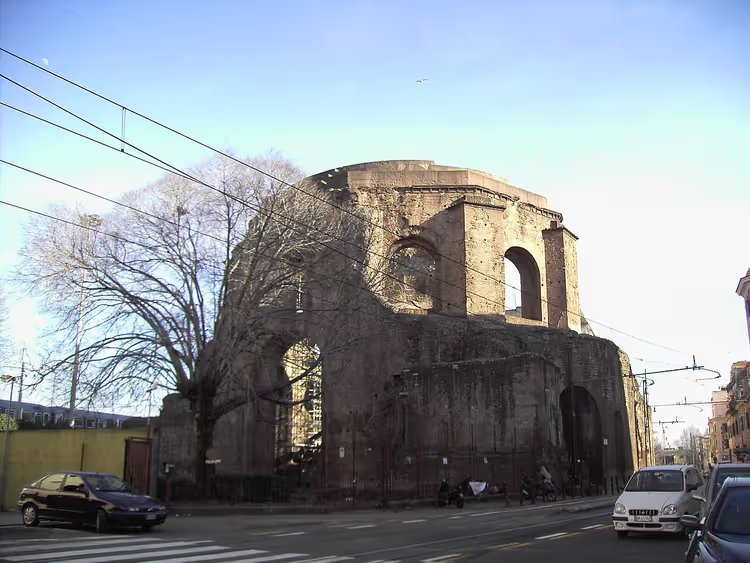
In antiquity, the Esquiline was a burial ground: ordinary Romans and rootless paupers were buried here. Later, on Augustus's orders, the Gardens of Maecenas were laid out on the site of the cemetery. Today the hill rests on two basilicas.
Santa Maria Maggiore is famous for its mosaics, gilded ceiling, and chapels, while the reliquary of San Pietro in Vincoli holds the chains that, according to tradition, fell from the apostle Peter. Both basilicas are active, and services proceed here as usual.
- Entry: admission to Santa Maria Maggiore is free; the basilica is open daily from 7:00 to 19:00, last entry at 18:30 (as of 09/2026, official website).
- Who it's for: those who want to see early Christian mosaics without a ticket.
- How to get there: about a ten-minute walk from Termini (on the map).
- The catch: the hill is densely built up; most monuments are hidden inside the basilicas rather than on the streets.
5. Palatine Hill
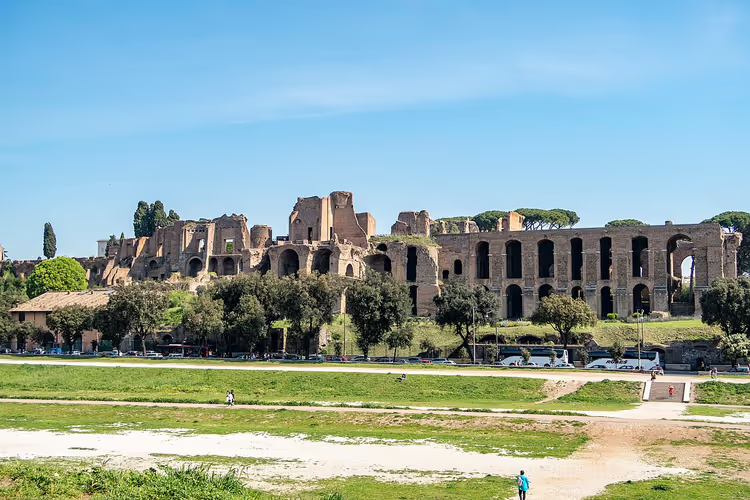 © Lil Herodotus · CC BY-SAPhoto: Lil Herodotus, CC BY-SA (https://creativecommons.org/licenses/by-sa/4.0), Wikimedia Commons
The Palatine is considered the place where the ancient Roman state was born. Here, by a fig tree, there was a cave near which, according to legend, a basket with Romulus and Remus was found. The boys were suckled by a she-wolf and raised by the shepherd Faustulus.
Part of this story is recognized as myth, but artifacts have survived. Among them are the House of Romulus, the Aqueduct of Claudius, and other sites, and from the top there is a view of the Roman Forum. Get your Colosseum, Roman Forum, and Palatine Hill ticket with a timed slot in advance, otherwise a morning slot simply won't be left.
- Tickets: a combined ticket for the Colosseum, Forum, and Palatine is sold online with a time slot (as of 09/2026, official park ticket office).
- Time: about three hours for the entire archaeological park.
- The catch: much of the legend is unconfirmed, and on site you mostly see foundations.
6. Caelian Hill
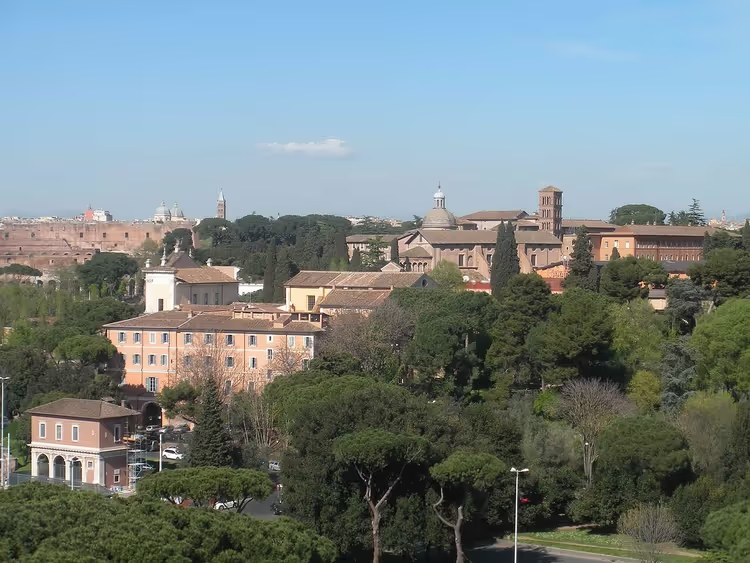 © Roundtheworld · CC BYPhoto: Roundtheworld, CC BY (https://creativecommons.org/licenses/by/3.0), Wikimedia Commons
The Caelian long remained a plebeian hill, but later the aristocracy took a liking to it. Notable sites include the Temple of the Divine Claudius, the ruins of an insula, meaning a multi-story apartment block, underground corridors, and the frescoes of the Basilica of Santi Giovanni e Paolo. Many of these monuments are not well studied, so you will see ruins and facades rather than finished exhibitions.
- Who it's for: for those tired of crowds who want to walk along quiet streets.
- Location: between the Colosseum and the Aventine, about a ten-minute walk from the Colosseum (on the map).
- The catch: some sites are not well studied, and the meaning of the frescoes and underground areas is best explored with a guide.
7. Aventine
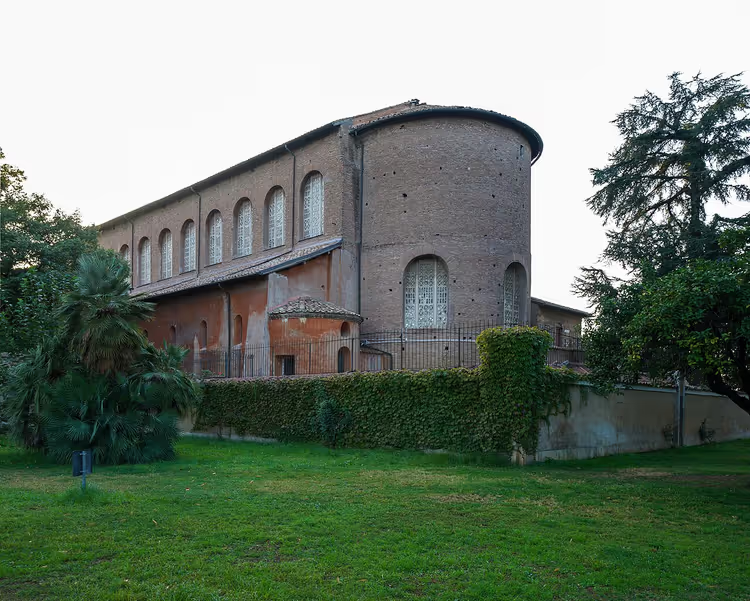 © Fiat 500e · CC BY-SAPhoto: Fiat 500e, CC BY-SA (https://creativecommons.org/licenses/by-sa/4.0), Wikimedia Commons
The Aventine is known for the Mouth of Truth, which people remember from the movie Roman Holiday. The stone disc is set into the wall of the Basilica of Santa Maria in Cosmedin, and a line forms of people wanting to test their hand. The residence of the Sovereign Military Order of Malta, which has the status of a separate state, also stands here, and nearby lies the Orange Garden with a viewing terrace. From there you can see a panorama of the city and domes in the distance.
If you don't feel like walking uphill, get a hop-on hop-off bus ticket for Rome and combine the hills with more distant areas.
- Hours: the Basilica of Santa Maria in Cosmedin is open daily from 9:30 to 17:50, and the Mouth of Truth is accessible during the same hours (as of 09/2026, official website).
- Access: the Orange Garden is free to enter, with the entrance on Piazza Pietro d'Illiria.
- The catch: the Mouth of Truth is inside an active basilica, so access is limited during services.
Tickets, opening hours, and map
Some ancient sites are covered by a single ticket, while others are sold separately. Set aside a separate day for the Vatican Museums and the Sistine Chapel: tickets to the Vatican Museums and Sistine Chapel are tied to an entry time.
Below is a selection of tickets for Rome: the cards with prices and available time slots update on the provider's side.
Tours and tickets in Rome
Guided tours, skip-the-line tickets and activities — most offers can be cancelled free of charge.
See offers on TiqetsThe widget loads once you give your consent.
The map shows how the hills are distributed across the city. The most convenient way to plan your route is to start from the Capitoline: from there you can reach the Palatine, Caelian, and Aventine in half a day.
7 hills of Rome
Places on the map
- 1Capitoline Hill Piazza del Campidoglio, the Capitoline Museums and a viewpoint by the Aracoeli
- 2Quirinal Hill Baroque Quirinal Palace, halls open on Sundays
- 3Viminal Hill Baths of Diocletian and Termini station at the foot of the hill
- 4Esquiline Hill Santa Maria Maggiore and San Pietro in Vincoli, free entry
- 5Palatine Hill The city's cradle, a single time-slot ticket for the Colosseum and Forum
- 6Caelian Hill A quiet hill with insula ruins and the frescoes of Santi Giovanni e Paolo
- 7Aventine Hill The Mouth of Truth, the seat of the Order of Malta and the Orange Garden
⁉️🤔 Frequently asked questions
How long does it take to visit all seven hills?
A relaxed walking route takes two days at four to six hours each. In one day you can cover the Capitoline, Palatine, Caelian, and Aventine if you skip the museums. The Quirinal, Viminal, and Esquiline are easy to add on the second day: they stand near Termini station and the Trevi Fountain.
Which hill should I visit first?
Start with the Capitoline: from here you can see the Roman Forum, and then you descend to the Palatine and the Colosseum along one route. If you arrive in the evening, consider the Palatine.
Do I need tickets to go up the hills?
Climbing the hills themselves is free. You pay for museums and archaeological zones: the Capitoline Museums, the Baths of Diocletian, the Colosseum with the Forum and the Palatine. The Basilica of Santa Maria Maggiore on the Esquiline and Santa Maria in Cosmedin on the Aventine are open free of charge.
Where can I see a panorama of Rome for free?
The viewing terrace at the Basilica of Santa Maria in Aracoeli on the Capitoline and the Orange Garden on the Aventine are free. On the Capitoline there is a cafe nearby, and from its terrace you can see the Forum and the rooftops. In summer, come after 6:00 PM, when the heat subsides and the light becomes softer.
Can I visit the hills with children?
Yes, but choose short stretches. The Capitoline and Palatine offer plenty of impressions with little walking, while steep staircases like the climb to Santa Maria in Aracoeli are better avoided. Bring water: the climbs to the Capitoline and Palatine are harder in the heat.
In short: what's worth booking
If you have two days, put the Colosseum with the Forum and the Palatine on the first day, and leave the Vatican Museums for the second. If you want less walking, stay near the Quirinal: from there you can walk to the Trevi Fountain, the Pantheon, and Villa Borghese.
- If you have one day: Capitoline, Palatine, Caelian, and Aventine.
- If you have two days: add the Quirinal, Viminal, and Esquiline with their basilicas.
- If you're tired of walking: hotels in central Rome on Trip.com are within walking distance of the Pantheon and the Trevi Fountain.

A small editorial team writing guides for independent travel. We travel ourselves, but we haven’t been everywhere, so we check prices, opening hours and how to get there against official sources.