
















What to see in Cancun: 30 places from Mayan pyramids to an underwater museum
Cancun sits on sand between the Caribbean Sea and the jungles of the Yucatan. Its story began as a fishing village, and today it is the country's top resort, where people come for both the beach and Mayan history.
In one day you can realistically get to the pyramids, swim in a cenote, and be back for dinner, but many sites are scattered dozens of kilometers apart. Some attractions are right in the hotel zone, while others lie 75-200 km from the hotels (on the map).
We've put together thirty places in Cancun and the surrounding area with prices, opening hours, and clear directions. You'll see what's worth booking in advance and what you can visit on a whim.
Ad: this article contains affiliate links, we earn a commission if you book through them, at no extra cost to you.
What to see in Cancun: our picks
💡 In short:
- Mayan ruins: Chichen Itza, Tulum, and Coba. One to three hours each way.
- Nature: cenotes and the eco-parks Xcaret, Xel-Há, Xplor. Buy tickets online in advance.
- City: markets, museums, and evening shows. These are easy to leave for a spontaneous evening.
- Prices and opening hours: 09/2026, verified on the official Xcaret website.
Cancun is divided into two parts: the hotel zone by the sea and the El Centro downtown, where locals live. The first entries on the list run along the coast, and the rest await you in the city and the jungle. Below we've organized them by type of experience so you can quickly pick what suits you.
Goal | Where to go | Book in advance |
|---|---|---|
Pyramids and Mayan ruins | Chichen Itza, Tulum, Coba, El Rey | Yes, ticket and transfer |
Swimming in a cenote | Ik Kil, Hubiku, "Seven Mouths" | Yes, in summer |
Parks with attractions | Xcaret, Xel-Há, Xplor | Yes, cheaper online |
Evening show | Coco Bongo, Captain Hook | Yes |
Museums and markets | Museo Maya de Cancún, Mercado 28 | No |
1. Chichen Itza
 © Daniel Schwen · CC BY-SAPhoto: Daniel Schwen, CC BY-SA (https://creativecommons.org/licenses/by-sa/4.0), Wikimedia Commons
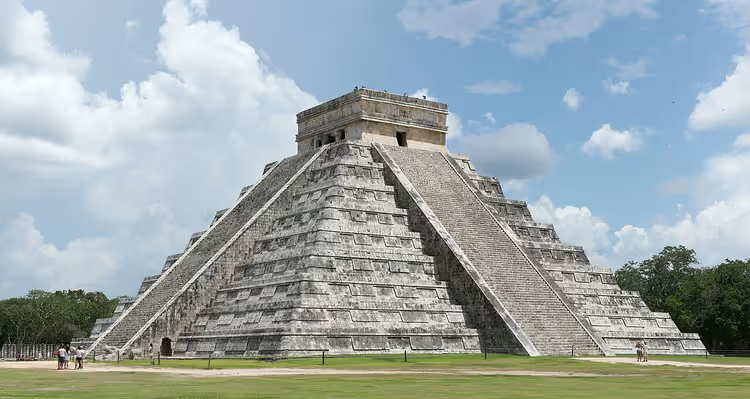
Chichen Itza has been protected by UNESCO as a World Heritage Site since 1988 (according to UNESCO). Only Teotihuacan draws more tourists in Mexico, so people arrive here at opening time, while the buses from the Riviera Maya are still on the road.
The most famous structure is called the Pyramid of Kukulkan, or El Castillo. During the day its steps get scorching hot, and a photo line forms at the base, so the best shots happen in the morning. Walk around the complex in a loop: nearby stand the Temple of the Warriors, the El Caracol observatory, and the sacred cenote.
The large ball court deserves special attention. Clap your hands near its wall, and the echo returns several times. The Maya built it so that sound carries across the entire field, and this effect still impresses visitors today.
A ticket for an adult foreign visitor in 2026 costs 697 MXN. That's the federal INAH fee plus the Yucatan state fee (as of 09/2026, Cultur Yucatán). Ticket offices are open daily, and exact hours are best confirmed on site before your trip.
There are almost no shops on the grounds, so bring water and a snack with you. A guide here will noticeably enrich the trip, because without one you'll just see rocks.
- How to get there: about 200 km from Cancun, two to three hours each way (on the map).
- Tour: Chichen Itza tours on GetYourGuide.
- The catch: from 11:00 to 14:00 there is almost no shade on the site. Bring water and a hat.
2. Isla Mujeres
 © dronepicr · CC BYPhoto: dronepicr, CC BY (https://creativecommons.org/licenses/by/2.0), Wikimedia Commons
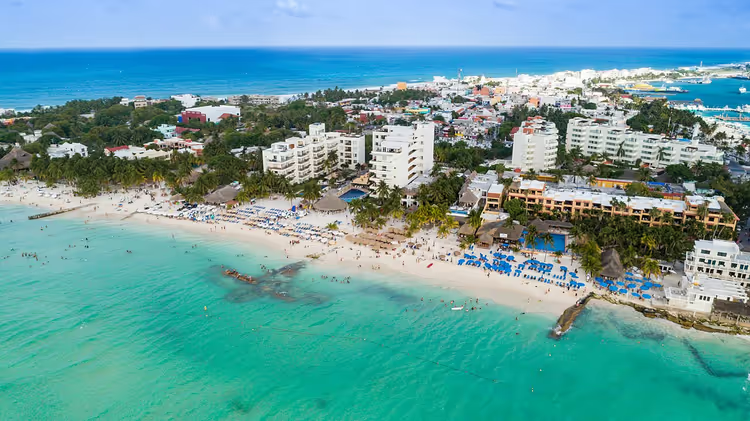
Isla Mujeres lies in the strait opposite Cancun and is considered the easternmost point of Mexico. Getting there is simple: you board a ferry and half an hour later you're standing on the white sand of Playa Norte, which has made it into global beach rankings.
The island is small. Fishermen live here, hotels and restaurants operate, and golf carts drive along the streets. The most popular spots: Playa Norte, Punta Sur with its viewpoint, and the ruins of the temple of the goddess Ixchel. A sculpture park is open next to the ruins.
For snorkeling, take a boat to the reef: the water is clear, and the reef itself starts close to shore. The island also has a turtle farm where you can see young turtles and learn about their conservation.
The Maya considered Ixchel the wife of the supreme god and asked her for health and good fortune. On January 1, locals come to Punta Sur to watch the sunrise, and tourists join them. Come in the morning, because before noon the beach is noticeably less crowded.
A golf cart is rented for the day, and it's the best way to get around the island without a taxi. In the evening, ferries run less frequently, so don't wait until the last departure.
- How to get there: ferries from the Puerto Juárez pier, about half an hour.
- Who it's for: those who want a beach without waves and one day away from the hotel.
- The catch: by lunchtime, the ferries and Playa Norte are packed. Morning is calmer.
3. Cenote Siete Bocas
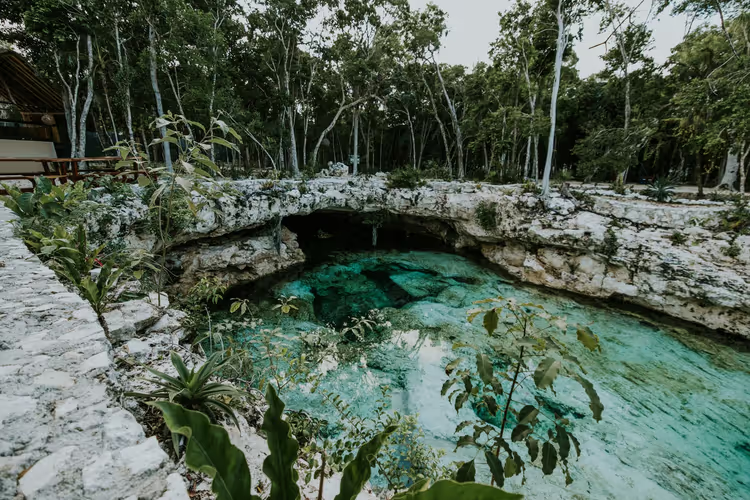
Cenotes formed in limestone as natural wells of fresh water. The Maya considered each well a mouth of the earth and revered the water as sacred. For them, descending into a cenote was a conversation with the underworld.
Siete Bocas connects several wells under one cave. Stalactites and stalagmites grow inside, and light comes through cracks in the ceiling. The system lies on private property near Cancun, so access here is organized by the landowners themselves.
The water here is fresh and clear, and it's shallow near the edge. Swimming is easy, even if you're not a strong swimmer. Bring a towel and non-slip footwear, and keep your belongings in a dry bag.
Inside the cave it's cool even in the heat, so going in feels pleasant. The lighting is dim, and photos come out better with a good camera or a phone with night mode.
- How to get there: with a tour or on a rented bus.
- Cost: paid entry, check the price on site.
- The catch: the water is cool, and the cave is damp. Keep your belongings in a dry bag.
4. Cenote Ik Kil
 © Dmadeo · CC BY-SAPhoto: Dmadeo, CC BY-SA (https://creativecommons.org/licenses/by-sa/3.0), Wikimedia Commons
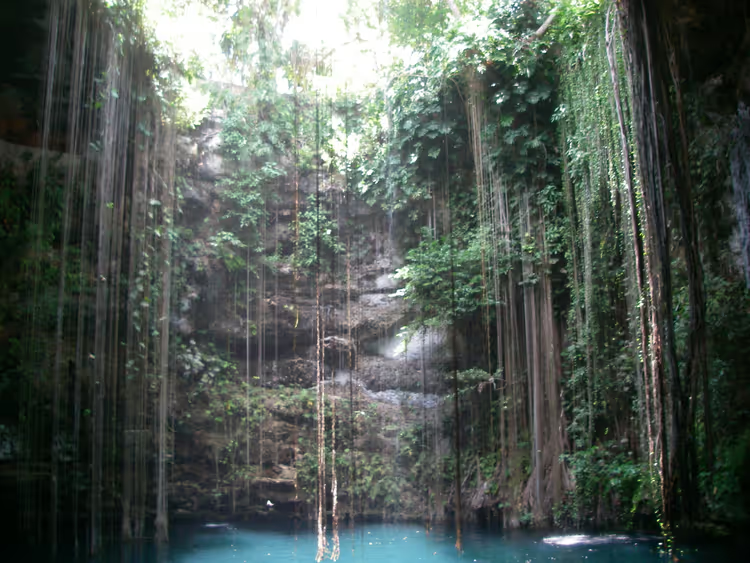
Ik Kil is considered the most popular cenote in Mexico, and people come here from all over the country. It's praised for its safe descent: a stone staircase leads down to the water along the wall. Even a beginner can go down without fear.
Above the water there are viewing platforms, a jumping platform, and an artificial beach. Small black fish live in the well, and souvenir shops and life jacket rentals operate on the surface. A life jacket is provided free of charge, so even kids can swim here.
Before entering the area, you're required to take a shower. The rule is simple, but it's enforced. Two mid-range hotels and a restaurant are nearby, so you can stay overnight and swim again in the morning.
Only confident swimmers should jump from the platform, and it's best to approach the stairs in water shoes. Swimming here is organized by rules, and a lifeguard watches everyone from the shore.
- Cost: paid entry, check the exact price on site.
- The catch: by lunchtime, groups gather at the stairs. Come in the morning.
5. Cenote Hubiku
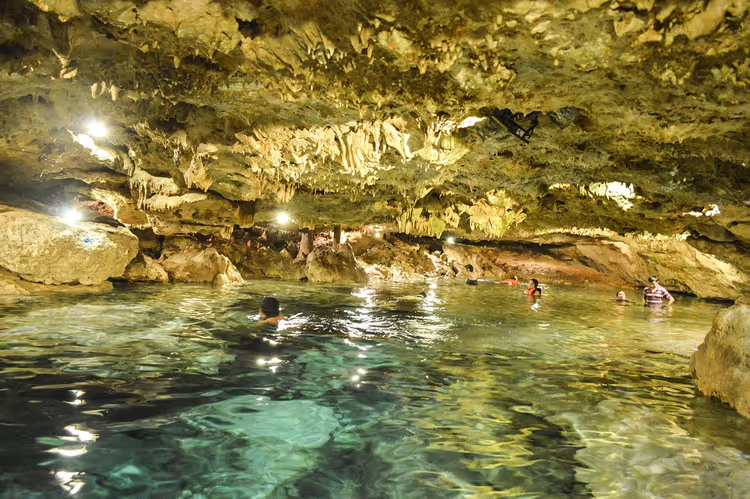
Hubiku is called the beauty king among cenotes. From the Mayan language, the name translates as "great lord," and a second version sounds like "iguana's nest," and guides happily repeat both versions.
The round basin goes deep, and long roots hang down into the cave from above. At noon, direct sunbeams break through the ceiling, and the water turns turquoise. That's what people come here for.
The descent is more than a hundred steps, and the water is cooler than at Ik Kil. Take a life jacket if you're not a confident swimmer. Small fish near the shore nibble at your feet, but it's just ticklish and not dangerous at all.
The Maya considered the iguana a messenger of the gods, so people come here not only for the water but also for the stories. Tours here are often combined with the pyramids and the old town of Valladolid.
- How to get there: included in most tours to Chichen Itza and in parks.
- The catch: the steps are wet and slippery. Hold on to the railing.
6. MUSA Underwater Museum
The MUSA museum grew out of a project by British sculptor Jason deCaires Taylor. He places figures made of marine concrete on the seabed to take pressure off the living reefs from the influx of divers.
The collection is called "The Silent Evolution." The sculptures depict people from different eras, and over time they become covered with polyps and algae. This is how concrete turns into an artificial reef, and fish get a new home.
You can see the museum from a glass-bottom boat, with a snorkel, or with scuba gear. Book diving with a licensed operator: they will show you the galleries and make sure you don't damage the figures. The water is clearer in the morning, so head out early.
Tours depart from the port of Cancun and last several hours. If you don't dive, take a glass-bottom boat: that way you'll see the figures without getting in the water.
- Cost: depends on the format, snorkeling is cheaper than diving.
- The catch: underwater visibility depends heavily on weather and wave conditions.
7. Xel-Há Park
 © Kirt Edblom from Albany, Oregon, United States · CC BY-SAPhoto: Kirt Edblom from Albany, Oregon, United States, CC BY-SA (https://creativecommons.org/licenses/by-sa/2.0), Wikimedia Commons
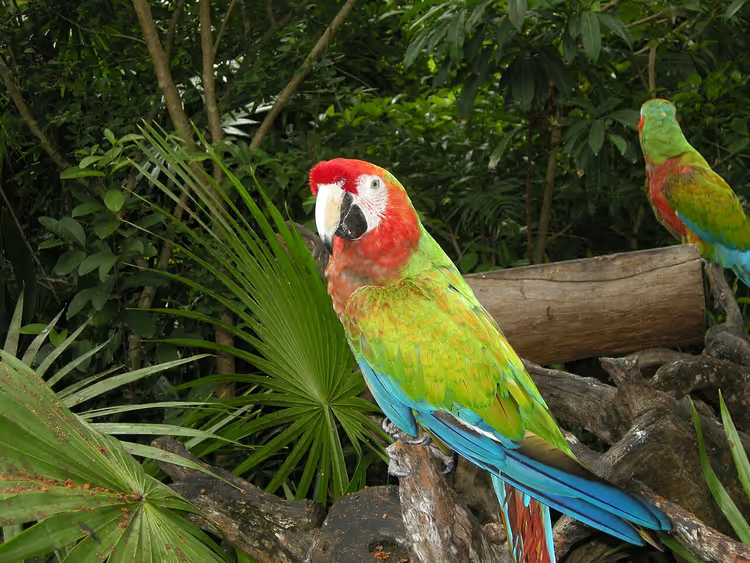
Xel-Há is named after the lagoon and is located about a hundred kilometers from Cancun (on the map). The park operates on an all-inclusive basis: food, drinks, and snorkeling are included in the ticket, and there's almost nothing to pay extra for on site.
Here you swim in the lagoon, swim with fish, float down the river on rafts, and try a temazcal. Deep in the park, the ruins of an ancient Maya port have been preserved, which once traded along the entire coast. Trails run through the jungle, so bring comfortable shoes.
The areas are open 8:30-18:00 (as of 09/2026, Xel-Há). Children under four get in free, and children 5-11 pay half price (according to the official website).
Bring a mask and snorkel if you don't have your own. Towels and lockers are provided on site, and sunscreen must be biodegradable, otherwise security won't let you into the water.
Buying tickets at the entrance is not worth it, so get them online in advance and arrive at opening. That way you'll have more time for the lagoon and snorkeling without rushing.
- Cost: a package with other parks is a better deal than a single ticket.
- The catch: in high season, lines build up at the entrance and at the snorkeling area.
8. Xcaret Park
 © Silvio Chiozini · CC BYPhoto: Silvio Chiozini, CC BY (https://creativecommons.org/licenses/by/3.0), Wikimedia Commons
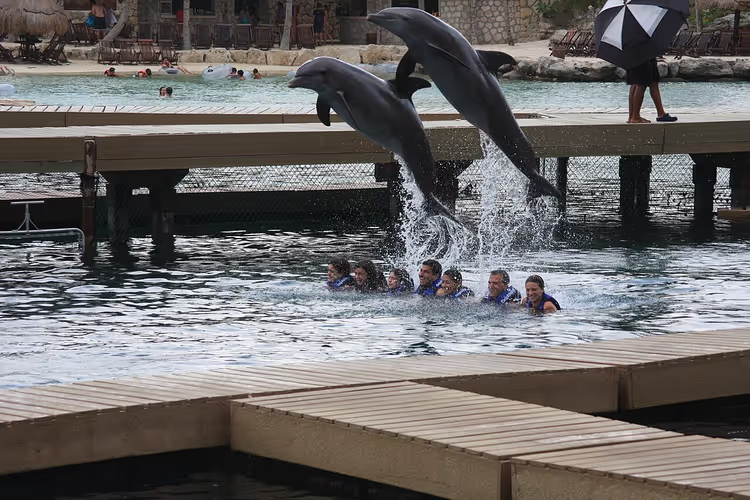
Xcaret combines nature, Maya culture, and entertainment in one park. It opened in the early 1990s and has remained Mexico's most famous park ever since, although tickets here are not cheap.
There are underground rivers, a lagoon, a butterfly pavilion, an orchid collection, and bird aviaries. In the evening, a big show about the country's history takes place. You can't cover the park in one day, so plan for a full day out and bring a change of clothes.
Buy tickets online, and you'll get in without waiting in line. Children 5-11 pay half price (as of 09/2026, official Xcaret website).
Some routes go through water, so bring a swimsuit right away. Life jackets are provided for the underground rivers, and you don't need to know how to swim.
The park is large, and it's easy to get between areas by following the signs. If you don't want to walk all day, pick two or three main areas first.
- Tour: Xcaret park tickets on GetYourGuide.
- The catch: heat and long walks. Bring a swimsuit and comfortable flip-flops.
9. La Isla Shopping Mall
 © Carlos Valenzuela · CC BY-SAPhoto: Carlos Valenzuela, CC BY-SA (https://creativecommons.org/licenses/by-sa/4.0), Wikimedia Commons
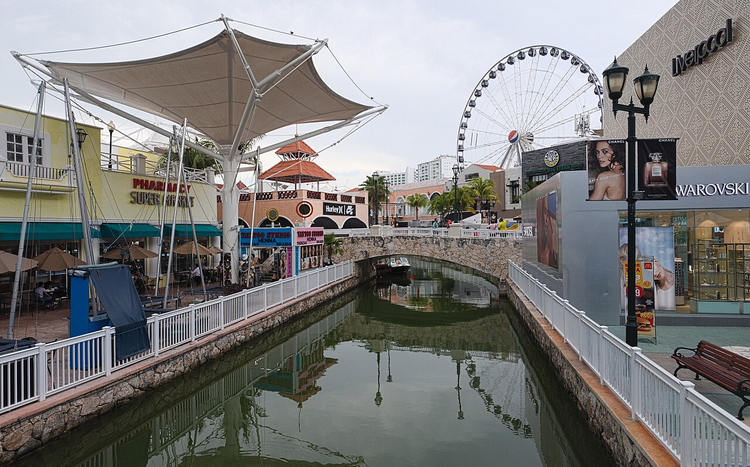
La Isla Shopping Village is designed like a little Venice: canals, bridges, and boats with rowers. There are more than two hundred shops here, plus a cinema, restaurants, and an aquarium.
Look for local brands and jewelry shops, not just global brands. Foreign visitors can use an expedited tax refund for non-food purchases, but you need to keep your receipts.
In the evenings, lights are turned on over the canals, and you can combine shopping with a stroll across the bridges. Gondola rides cost extra, and the route goes along the canals between shops and restaurants.
The mall is recognized as one of the most popular family destinations in Mexico. It's also home to an interactive aquarium, which is convenient to visit with kids between shopping stops.
- Getting there: in the hotel zone, some hotels are steps away from the entrance.
- The catch: prices are higher than at the city markets.
10. Mercado 28 Market
 © David Stanley from Nanaimo, Canada · CC BYPhoto: David Stanley from Nanaimo, Canada, CC BY (https://creativecommons.org/licenses/by/2.0), Wikimedia Commons
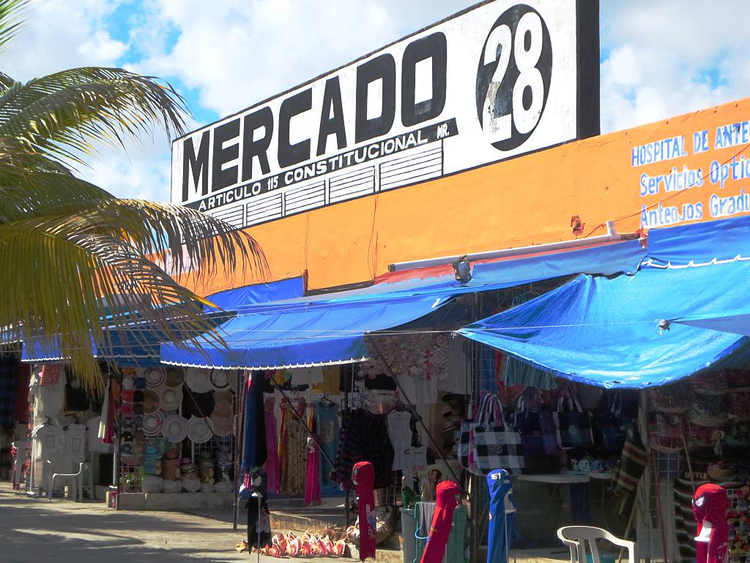
Mercado 28 is considered the largest market in Cancun. It's located in the center of El Centro and stretches across several rows of stalls, so it's easy to get lost here.
They sell souvenirs, masks, dishes, cosmetics, antiques, and clothing. Tourists are welcomed here, and almost all vendors speak English. Prices are higher than in a regular store, but you can and should haggle.
Cards aren't accepted everywhere, so keep cash and small bills on hand. If you're shopping for gifts, come in the morning while the stalls are still fully stocked.
The market consists of several specialized areas, and one of them sells fresh produce. There are also cafes with national cuisine here, a convenient place to rest after bargaining.
- Getting there: city center, take bus R1 or R2 from the hotel zone.
- The catch: pushy vendors at the entrance. Go deeper into the market.
11. Mercado 23 Market
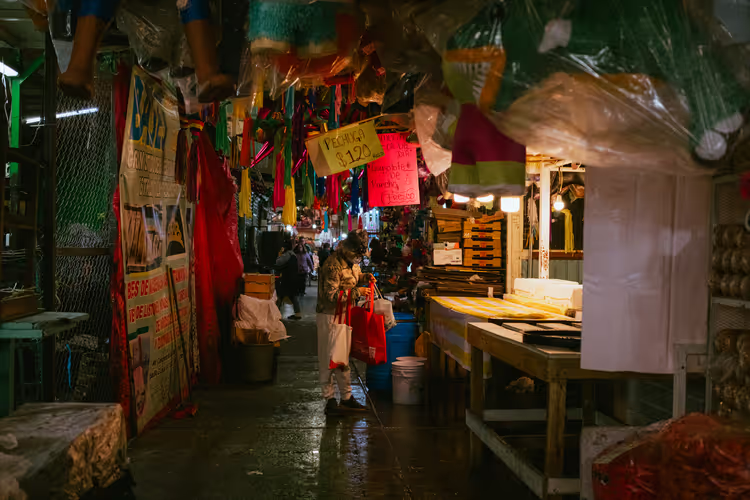
Mercado 23 is confused with Mercado 28 because of the similar name and proximity. The difference is in scale: there are fewer stalls here and noticeably lower prices, so locals come here to shop.
The main goods: vegetables, fruits, seafood, cheeses, spices, and herbs. People come here not for souvenirs, but for food and the everyday life of the city. Local cafes cook simple, hearty food, try the ceviche or tacos.
Haggling is also common here, and don't show that you really need an item. Fresh fish sells out in the morning, so come early for seafood.
The atmosphere here is festive, without the tourist gloss. If you want to see how ordinary Cancun lives, this market is a better fit than its hyped-up neighbor.
- Getting there: city center, next to Mercado 28.
- The catch: the market works during the day, stalls close in the evening.
12. Coco Bongo Club
 © MARELBU · CC BYPhoto: MARELBU, CC BY (https://creativecommons.org/licenses/by/3.0), Wikimedia Commons
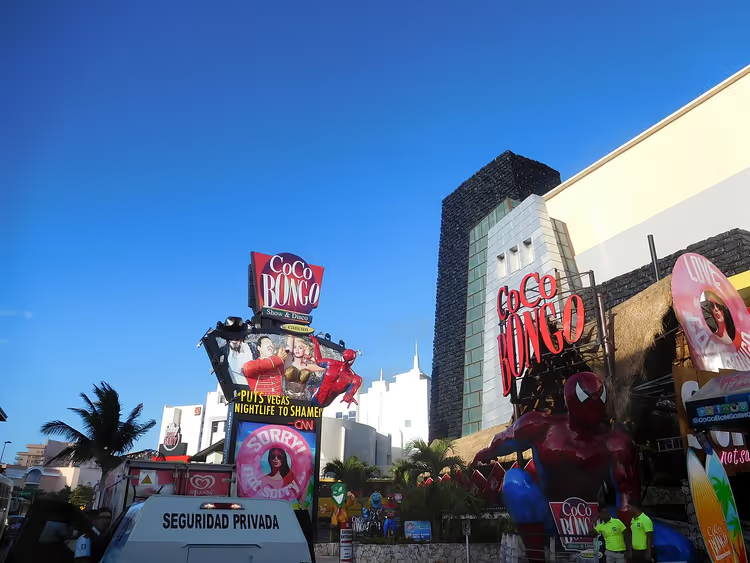
Coco Bongo holds the reputation of Cancun's main show club. Impersonators, acrobats, tightrope walkers, and dancers perform on stage, and the venue holds more than a thousand guests per night.
The ticket includes drinks. Smoking and entry for minors are prohibited inside, and bags are checked at the entrance. The club's name is connected to the movie "The Mask."
The program changes every week: some numbers are improvised, and some are rehearsed in advance. The music ranges from classics and Mexican tunes to rock and disco, so you won't get bored.
Shows run almost every night, and tickets sell out quickly in season. If you want a spot near the stage, book in advance and arrive at the start of the program.
It's customary to arrive at the club closer to evening, when the venue is already filling up. The dress code is casual, but many guests dress up for photos.
- Cost: packages depend on the zone and drinks, check the price on site.
- The catch: loud and very crowded. If you want it quieter, pick a weekday.
13. Museo Maya de Cancún
 © Oleg Yunakov · CC BY-SAPhoto: Oleg Yunakov, CC BY-SA (https://creativecommons.org/licenses/by-sa/4.0), Wikimedia Commons
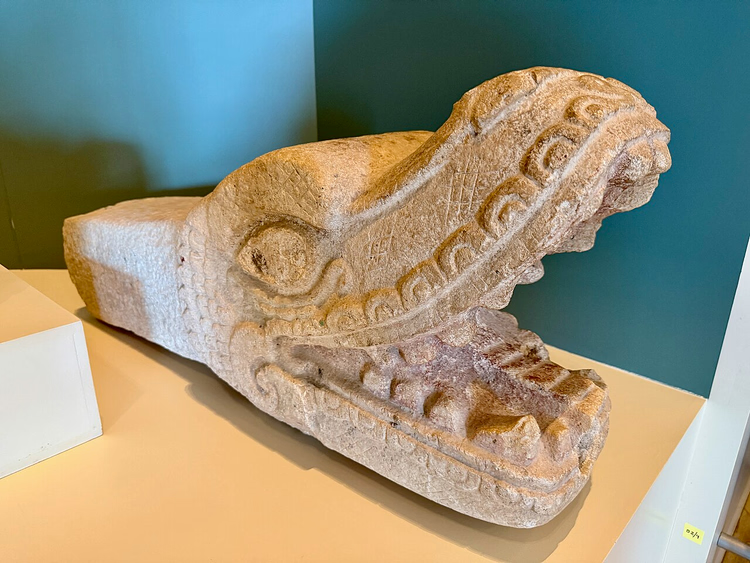
Museo Maya de Cancún belongs to the National Institute of Anthropology and History. It opened in the hotel zone and brings together three permanent halls.
The first hall covers the archaeology of the state of Quintana Roo, the second covers Maya culture, and the third covers indigenous art. The collection holds thousands of items, some of which are displayed on a rotating basis. From the first floor there is a passage to the San Miguelito ruins.
The museum is open seven days a week, unlike many city museums. You will see skulls, masks, and ornaments found during excavations across the Yucatan.
The building was designed by Mexican and Dutch architects. The first level was given over to a cafe and service areas, while the exhibition halls were raised higher to protect the collection from flooding.
The museum has an elevator and is accessible for wheelchair users. A visit takes about an hour, so it is easy to fit in between the beach and dinner.
- Cost: paid admission, with discounts for eligible groups.
- The catch: some exhibits rotate, so halls you already know may be closed.
14. Bullfighting arena
 © Sharon Hahn Darlin · CC BYPhoto: Sharon Hahn Darlin, CC BY (https://creativecommons.org/licenses/by/2.0), Wikimedia Commons
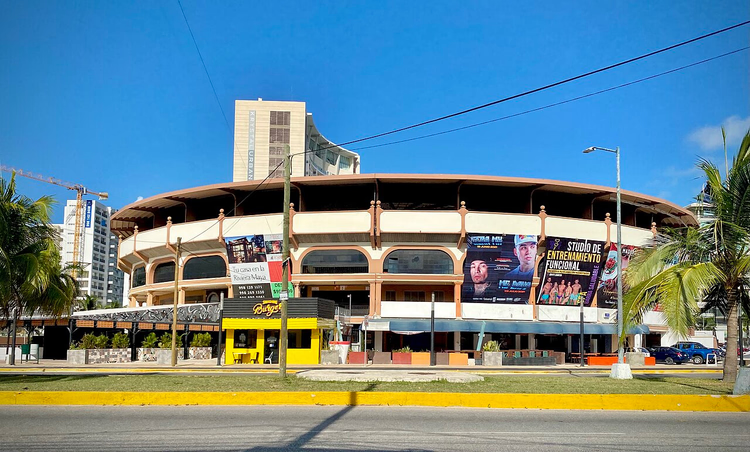
Bullfights in Cancun take place on Wednesdays: matadors enter the arena, and before the fights, cowboys in sombreros perform.
Mexican bullfighting is known for its spectacle: a torero can work with two bulls, and spectators get elements of a show. Unlike Spain and Portugal, tourists are sometimes allowed into the fight here. For a fee, a professional torero will train you and back you up during the fight.
The tradition came from Spain, but in Mexico it picked up local details and became more like theater. For travelers, it's more of a show than a sport.
Consider the ethics: for some travelers, fighting animals is unacceptable. The decision is yours.
Tickets are sold at the entrance, and the arena itself is next to the hotels. It's better to get seats in advance, since the venue fills up on Wednesdays.
- How to get there: the arena is in the hotel zone, a taxi takes minutes.
- The catch: it's not for everyone. We don't recommend bringing children.
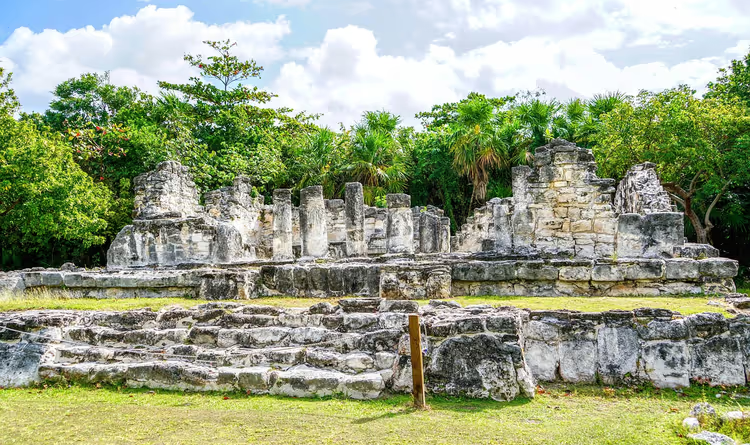
15. El Meco ruins
 © Rodrigo Pérez González · CC BY-SAPhoto: Rodrigo Pérez González, CC BY-SA (https://creativecommons.org/licenses/by-sa/4.0), Wikimedia Commons
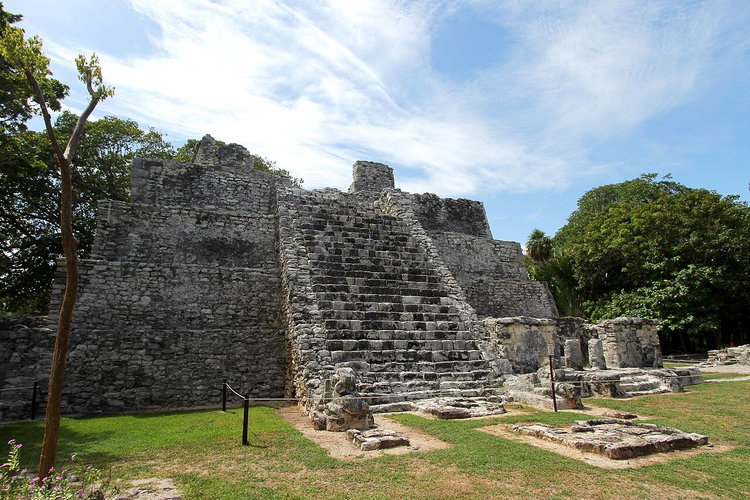
The El Meco archaeological zone lies eight kilometers from downtown Cancun (on the map). It's easy to reach by car, or you can take a taxi for little money.
The main structure is called El Castillo, and its height exceeds twelve meters. The Maya used the pyramid as a temple and as an observation point by the lagoon. The city lived on trade and the sea.
Dozens of structures have survived to this day. Excavations are still ongoing here, so new finds are still possible. You can walk the zone in under an hour and continue on your route.
The site is often empty, and you'll be walking almost alone. It's a rare chance to examine the masonry up close, without barriers or crowds.
- Cost: admission is paid, check the price on site.
- The catch: little shade and almost no infrastructure. Bring water.
16. Torre Escénica observation tower
Torre Escénica lifts guests to one hundred ten meters. The cabin slowly rotates around its axis, and you see Cancun from above without leaving it.
The tower operates daily, day and evening. Sunset looks especially good from here, but the glass always has glare, so it's better to take photos at the window opposite the sun.
The platform is small, so it's crowded at the top, and at peak hours you'll have to wait. But the ride up takes just minutes, and the observation deck won't tire you with a long climb.
Several dozen people fit on the platform at once. If you're going with a large group, go up in turns and meet downstairs.
- Cost: admission is paid, tickets are sold next to the tower.
- The catch: a line at sunset hours. Come an hour before sunset.
17. Wax museum
Cancún Wax Museum opened in the mid-2010s and has gathered about a hundred figures. The project was made by specialists from different countries, and part of the funding came from Brazil.
The figures are divided by theme: sports, politics, music, movies. There are children's halls with characters from books and films, as well as separate sections on the Wild West, pirates, and superheroes. Each hall has its own music playing.
The visit takes a couple of hours. Photos with the figures are allowed, so you'll leave with a whole gallery of shots.
The museum is in the hotel zone, next to other entertainment. It's easy to combine with shopping or dinner the same evening.
The exhibits are updated, so even on a repeat visit you'll find new characters. Kids usually like it here more than adults.
- Cost: admission is paid, cheaper for children.
- The catch: some copies noticeably fall short of the originals.
18. El Rey ruins
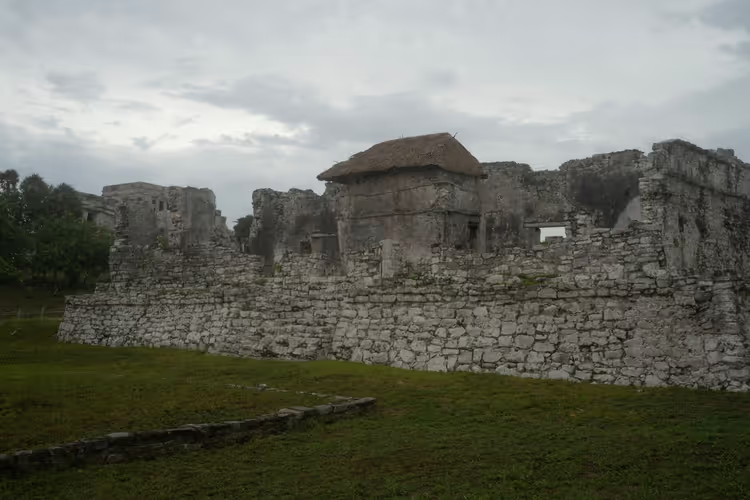
The El Rey ruins lie in the hotel zone, twenty-five kilometers from downtown (on the map). The name translates from Spanish as "king."
The sun god was worshipped here. Ruins are what remain of the structures, but earthquake-resistant platforms and wall paintings have survived. The settlement had tombs, later looted by treasure hunters.
The walk takes one and a half to two hours. It's quieter and calmer here than in the parks, so you'll get a break from crowds and noise.
Lizards bask on the stones and let you get close. Watch your step and don't touch the animals with your hands.
The site is open during daylight hours, and the gates close in the evening. Plan your walk for the morning or early evening.
- How to get there: in the hotel zone, some hotels are within walking distance.
- The catch: there aren't many structures. For scale, you need to travel farther.
19. San Miguelito ruins
San Miguelito lies right by the Museo Maya de Cancún. The entrance to the ruins is from the museum's first floor, so it's convenient to see them together, in one outing.
The complex holds dozens of Maya structures. The paths are short, and the walk takes under an hour, so you'll have time for both the museum and the beach the same day.
Come in the morning: the sun is softer, and there are fewer people on the paths. Shade is rare here, so bring a hat and water.
From the paths you can see the hotels of the hotel zone. You'll immediately understand how close history has come to the resort.
The ruins are well maintained for visitors, and it's pleasant to walk them without a guide. Signs explain what structure is in front of you.
- Cost: a combined ticket with the museum.
- The catch: little shade. Bring a hat.
20. Interactive aquarium
 © kajikawa · CC BYPhoto: kajikawa, CC BY (https://creativecommons.org/licenses/by/3.0), Wikimedia Commons
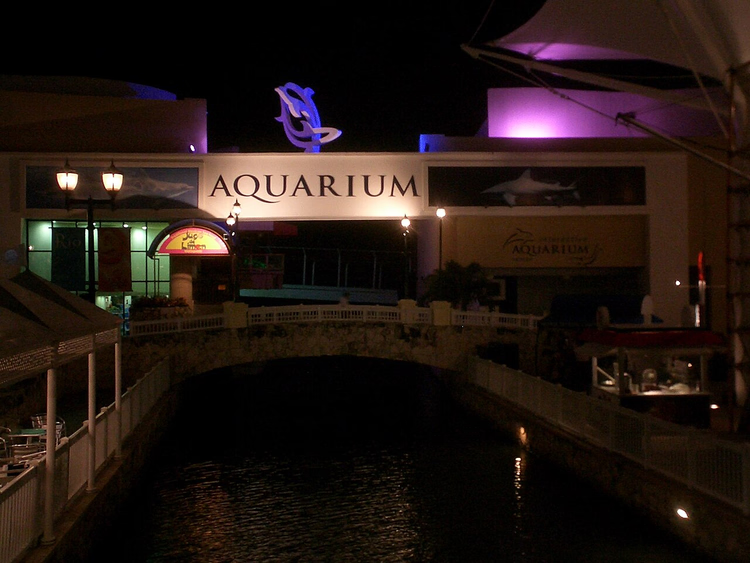
Interactive Aquarium is located in La Isla Shopping Village. The aquarium has been operating for several decades and is still being updated.
Sharks, rays, piranhas, jellyfish, and sea lions live here. You can feed sharks under staff supervision and swim with dolphins. Dolphins willingly pose for the camera, and you'll get shots without any preparation.
Swimming in the tanks with predators is not allowed, and everyone keeps their distance here. The rules are simple, and the staff enforces them strictly.
Shark feeding runs on a schedule, and the schedule is posted at the entrance. Check the time in advance so you don't miss the show.
- Cost: admission and swimming tickets are sold separately.
- The catch: dolphin shows are criticized for the animals' conditions.
21. Yamil Lu'um ruins
Yamil Lu'um lies on a hill between hotels in the hotel zone. The name translates as "hilly land."
Two temples have survived to this day: Templo del Alacrán and Templo de la Mano. Scholars debate which gods they were dedicated to. The Scorpion Temple is described in a separate section below. The hill served as a sanctuary and a lighthouse, and fires on the summit helped boats stay on course at night.
The area is sometimes closed for work, so check the entrance before heading up so you don't make the trip for nothing.
The climb is short but rocky. Shoes with non-slip soles will make the walk safer for you.
People stop here on the way to the beach, since the ruins stand right among the hotels. In half an hour you'll see everything and return to the sea.
- How to get there: right in the hotel zone, entrance from the street between hotels.
- The catch: boulders and steps without railings. The climb is slippery in the rain.
22. Dolphinarium in Cancun
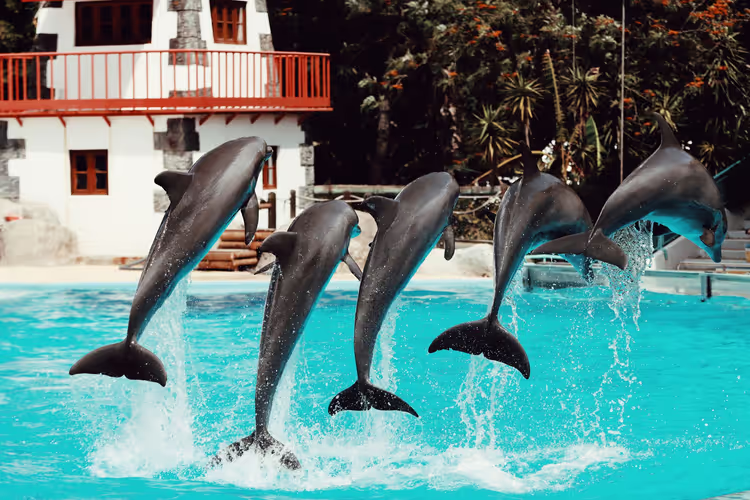
The dolphinarium in Cancun operates as a family attraction. Shows run forty to sixty minutes, and after them guests swim with dolphins in the pool.
Moray eels, jellyfish, and clownfish are kept here. There are scuba diving lessons and ecology classes for children. Adults will also find a program for themselves, including diving with an instructor.
Photo sessions and swimming are charged separately. Check prices before the show starts so you don't argue at the ticket counter later.
Restaurants with local and Thai cuisine work nearby. After the show, you can have lunch and stay on the beach until evening.
- The catch: conditions for the animals are controversial. If that matters to you, watch from the sidelines.
23. Ventura amusement park
Ventura Park is designed for a family day and is divided into six zones. The park has its own beach, bars, and restaurants.
It features a dolphinarium, an underground world with fantasy scenery, and a go-kart track. Slides and rope bridges between trees are built for children.
The "Amazonia" zone houses animals confiscated from poachers. The park invests part of its revenue in their care and shows them to guests.
Tickets come in full-package and basic options, so you choose the set of activities that fits your day.
It's convenient to plan the day's program in advance, since there are many zones and you can't cover them all in one day. Rides and dolphin shows are best scheduled for different halves of the day.
- Cost: tickets come in full-package and basic options.
- The catch: getting there without a car is inconvenient.
24. Templo del Alacrán
 © Travis K. Witt · CC BY-SAPhoto: Travis K. Witt, CC BY-SA (https://creativecommons.org/licenses/by-sa/4.0), Wikimedia Commons
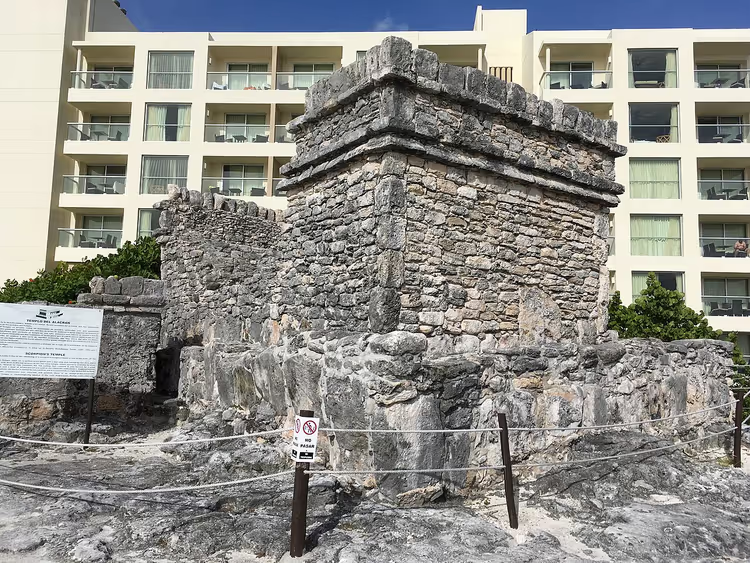
Templo del Alacrán is known as the Temple of the Scorpion. It stands in the settlement of Yamil Lu'um. The name comes from the scorpion drawings that archaeologists found.
The Maya associated the scorpion with bravery and rebirth. The inner room with the drawings is open to visitors, and it is considered a place of rituals.
Only the stone part of the temple has survived. The top was most likely wooden and has not come down to us. You can see it along with the neighboring ruins.
Entry here is free, and it is one of the few free spots in the hotel zone. Stay on the hill for the view of the sea between the hotels.
- Cost: entry is free.
- The catch: little has survived. It is not worth a separate trip.
25. Cancun Planetarium
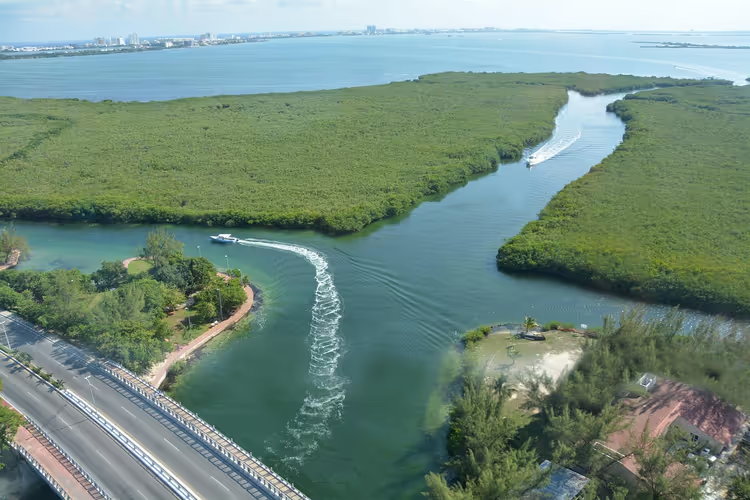
The Cancun Planetarium is housed in a white building. It serves as both an observatory and a museum, and in the evenings locals come here.
The main hall is small, but the lecture rooms accommodate more guests. One of the museums is dedicated to water and its role for life. The building was designed with energy savings and natural ventilation in mind.
Shows run on weekdays, and paid clubs operate on weekends. Locals also come here for eco-tech from local producers.
Here you can take a break from the beach and look at the stars at a relaxed pace.
Lecture topics change, so check the schedule before your visit. On Fridays they do science with kids in a playful format.
- Cost: check on site, prices change.
- The catch: the program is mostly in Spanish. Without the language it will be harder.
26. Tequila Museum
The Tequila Museum in Cancun opened in the hotel zone in the early 2010s. It is the second such museum in the country.
Guests are told about agave, mezcal, and the production process. Scientists believe that agave drinks were made in Mexico thousands of years ago, and the Spanish only improved the process.
The building has a tasting room. One of the sections is dedicated to the history of the Herradura brand.
You will learn how tequila differs from mezcal and try samples. For adults it is a short but entertaining tour.
The exhibition is small, and it takes less than an hour to see. It is convenient to fit it in before dinner, when you are already heading back to the hotel.
- Cost: entry is paid, tasting is included or sold separately.
- The catch: the space is small. Large groups feel cramped.
27. Captain Hook pirate party
Captain Hook runs a party on three galleons, replicas of 18th-century Spanish ships. One of them is named the "Black Pearl" after the pirate films.
The program includes dinner, a disco, a sea battle, and cannon fire. The show lasts several hours and starts in the evening. Children only go with adults.
The party is loved by both tourists and locals. You get both a show and a sea cruise in one ticket.
The ships go out to sea and return late, so decide in advance how you will get back to the hotel.
The program is led by performers in costumes, and guests often wear bandanas. The sea battle with the "enemy" ship features fireworks and gunfire.
- Cost: tickets with dinner and drinks, check the price with the operator.
- The catch: in bad weather the departure is canceled. Plan a backup evening.
28. Coba Pyramids
 © dronepicr · CC BYPhoto: dronepicr, CC BY (https://creativecommons.org/licenses/by/2.0), Wikimedia Commons
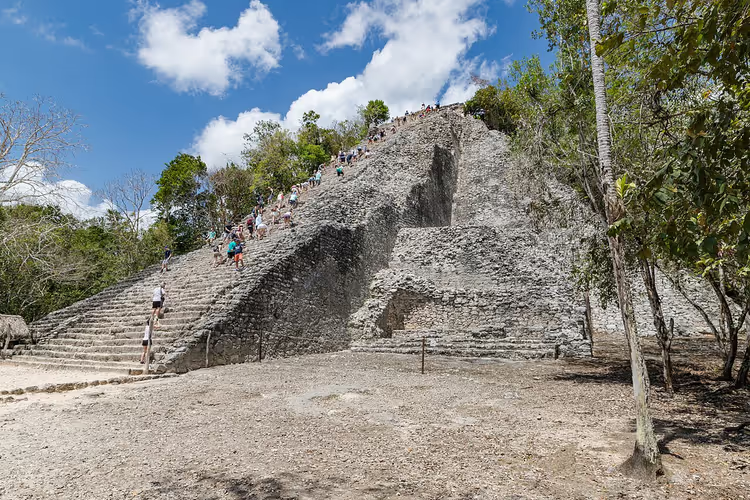
Coba hides in the jungle and remains one of the most ancient Maya cities. From Cancun it takes about three hours one way (by map).
The city stands around lakes where crocodiles still live today. Dozens of roads led from here to other cities, along which stone for the pyramids was transported. Most of the structures are still hidden by greenery, so scientists do not name the exact age of the complex.
Climbing the tallest pyramid, Nohoch Mul, is closed; it is viewed from below. Climbing the neighboring pyramid is also closed due to the risk of collapse.
Walking between the structures in the heat is tiring, so bring water and take your time.
- Cost: entry is paid, the rate for foreign visitors was raised in 2026 (as of 01/2026, news about new rates).
- The catch: three hours on the road and the heat. Bring water and closed-toe shoes.
29. Tulum
 © Erik Cleves Kristensen · CC BYPhoto: Erik Cleves Kristensen, CC BY (https://creativecommons.org/licenses/by/2.0), Wikimedia Commons
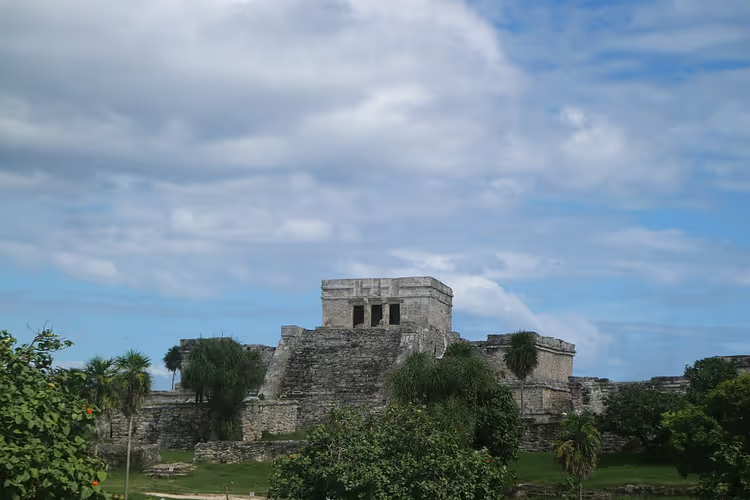
Tulum stands on a cliff above the sea, so everyone gets good photos here. It is about 130 kilometers from Cancun (by map).
The name translates as "wall." The city was a walled port. The most famous structure is called "The Castle," and higher up the "Temple of the Frescoes" with wall paintings is valued.
In 2026, entry for foreign visitors became more expensive (as of 01/2026, Mexican media). The site is open during the day, and check the exact hours on the INAH website.
Below the cliff there is a beach where you can go down after the tour. Bring a swimsuit; the water here is clean and warm.
Besides the ruins, a modern town with markets and rentals operates nearby. From here it is convenient to continue along the coast.
- How to get there: about 130 km, bus or car, the drive takes about two hours.
- The catch: from 10:00 tour groups arrive. Come at opening time.
30. Xplor Park
Xplor is designed for active adventures in caves and above the jungle. It opened in the late 2000s and operates during daytime hours.
Main activities: zip line flights, off-road buggy rides, rafting on an underground river, and swimming through caves with stalactites. The routes vary in difficulty, so you choose your own set of challenges.
The park operates on an all-inclusive basis: food, drinks, and transfer are included. Hours: 9:00-17:00 (as of 09/2026, Xplor).
If you are afraid of heights, you can skip some of the courses without losing the experience.
On the zip lines you fly over the jungle at great height, and the descent follows a long course. Closed-toe shoes are required, and put your things in a locker.
- Cost: the ticket is more expensive than a regular water park, but includes everything.
- The catch: wet and muddy. Bring a change of clothes.
Cancun attractions on the map
Plan your route in advance: mark the distant ruins and parks on one map so you don't drive the same way twice. El Rey is closest to the hotel, and Chichen Itza, Coba, and Tulum are the farthest.
Account for traffic within the city: at rush hour the highway to the hotel zone is jammed. Allow extra time for departure, especially if you are heading to the ferry or the airport.
Sights of Cancun
Places on the map
- 1Isla Mujeres Half-hour ferry ride, Playa Norte beach and Punta Sur cape
- 2MUSA Underwater Museum Sculptures on the seabed, viewed from a boat, with a mask or scuba gear
- 3La Isla A mall with canals and footbridges, more than two hundred shops
- 4Mercado 28 Market The city's largest market, souvenirs and masks, haggling required
- 5Mercado 23 Market A market for locals: vegetables, seafood and cafes without the tourist polish
- 6Coco Bongo Club Cancun's main show club, the ticket includes drinks
- 7Museo Maya de Cancun Three halls on the Maya and Quintana Roo, a walkway to the San Miguelito ruins
- 8Bullring Fights on Wednesdays, a spectacle not for everyone
- 9El Meco Ruins Eight kilometres from the centre, the El Castillo pyramid over 12 metres tall
- 10Torre Escenica Observation Tower A revolving cabin at 110 metres, the best view at sunset
- 11Wax Museum About a hundred themed figures, a couple of hours to see
- 12El Rey Ruins In the hotel zone, one and a half to two hours to walk, iguanas sun themselves on the rocks
- 13San Miguelito Ruins Entry from the ground floor of Museo Maya, single ticket, under an hour to see
- 14Interactive Aquarium At La Isla: sharks, rays and scheduled swims with dolphins
- 15Yamil Lu'um Ruins A hill between the hotels, two temples, a rocky climb
- 16Dolphinarium Shows of 40-60 minutes, followed by a swim with the dolphins
- 17Ventura Amusement Park Six zones, its own beach, a go-kart track and an Amazon zone
- 18Scorpion Temple The Templo del Alacran at Yamil Lu'um, free entry
- 19Cancun Planetarium An observatory and a water museum, sessions on weekdays, programme in Spanish
- 20Tequila Museum Agave, mezcal and a tasting room, under an hour to see
- 21Captain Hook Pirate Party Three galleons, dinner, a sea battle and cannon fire
⁉️🤔 Frequently asked questions
How many days do you need to see Cancun?
Three to four days is enough for the beach, nearby ruins, and one park. In a week you can add Chichen Itza, Tulum, and Coba without rushing. Plan one long trip per day, otherwise you will get tired from the heat and the road.
What should I see if I only have one day?
Start with Chichen Itza at opening time, then stop at a cenote on the way back. In the evening, walk around Mercado 28 and see a show at Coco Bongo. That way you cover both history and the city.
When is the best time to go to Cancun?
The dry season runs from December to April, and that is when the beach is most comfortable. In summer it is hot and humid, but prices are lower and there are enough cenotes for everyone. In September and October tropical downpours are possible, so keep that in mind.
Do I need a rental car in Cancun?
For the city and the hotel zone, buses and taxis are enough. A car helps on routes to El Meco, Coba, and Tulum, where you choose your own schedule. Leave it in a paid lot and don't park near beaches at night.
Can you swim in cenotes and parks?
Yes, everyone swims in the Ik Kil and Hubiku cenotes, and at Xel-Há snorkeling is included in the ticket. Only those who can swim should jump from the platform. Before entering you need to shower, and in some places they ask you not to apply sunscreen.
Tours and tickets in Cancun
Guided tours, skip-the-line tickets and activities — most offers can be cancelled free of charge.
See offers on TiqetsThe widget loads once you give your consent.
In short: what to book
If you have three to four days, take the beach, nearby ruins, and one park. If you have a week, add Chichen Itza, Coba, and Tulum. If you are traveling with kids, Ventura Park and Xcaret will suit you better than distant ruins.
Book tickets for parks and distant ruins in advance, and leave markets and the city for free evenings. That way you won't lose a day in line.
It's more convenient to book tickets and tours in advance: tours and tickets on GetYourGuide. For hotels in the hotel zone, check Trip.com.

A small editorial team writing guides for independent travel. We travel ourselves, but we haven’t been everywhere, so we check prices, opening hours and how to get there against official sources.