
















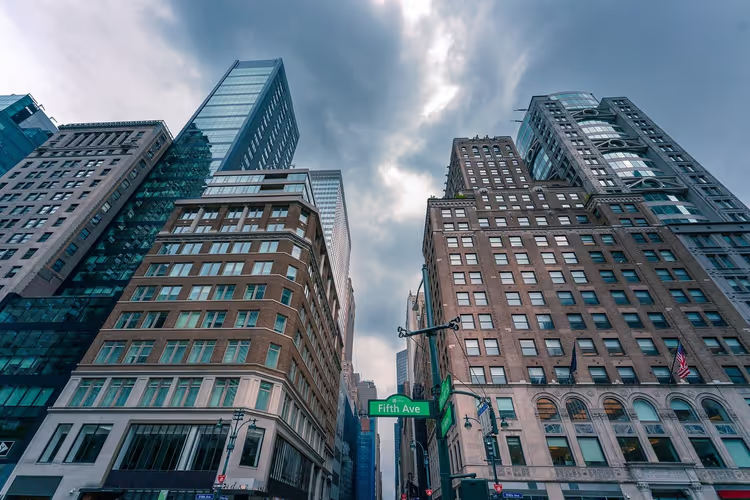
New York in 40 places: what's open, where you need a ticket and what's free
Forty places in New York won't fit into a single holiday. But they split neatly into clusters: Lower Manhattan, Midtown, Central Park with its museums, Brooklyn and the Bronx. You'll find the ferry fares for the Statue of Liberty in its own section (as of 09/2026, US National Park Service), and many parks and memorials are free to visit. We rechecked every entry in the old list: what has changed, where you need a ticket in advance and where you can walk in without queuing.
Ad: this article contains affiliate links, we earn a commission from them, and the price for you stays the same.
How to use this list of 40 places
💡 In short:
- Lower Manhattan in one day: the Freedom Tower, the 9/11 Memorial, Charging Bull, Federal Hall, Battery Park and the ferry to the Statue of Liberty.
- Midtown: Times Square, the Empire State Building, Rockefeller Center, St. Patrick's Cathedral, the public library and Bryant Park.
- Museums by Central Park: the Metropolitan Museum of Art, the Solomon R. Guggenheim Museum, the American Museum of Natural History.
- Free: Central Park, the High Line, Brooklyn Bridge, the 9/11 Memorial (the memorial itself, not the museum).
- Prices and opening hours: 09/2026, checked on the National Park Service website and the 9/11 Memorial website.
We kept the order of the original list, but within each entry we left only what will be useful on your trip. Where a figure appears on an official website, the source and the month we checked it are given alongside. Where there is no such figure, we write without numbers and suggest checking the hours before you set off. Prices are in US dollars, and in New York tax is often added to the price at the till.
If you care about | Start with | Admission |
|---|---|---|
Views from above | Empire State Building, Top of the Rock, One World Observatory | Paid, best booked online |
World-class museums | Metropolitan Museum of Art, MoMA, Guggenheim, Whitney | Paid, concessions available |
The city's history | Federal Hall, Castle Clinton, 9/11 Memorial | The memorial and the fort are free |
A walk with no tickets | Central Park, High Line, Brooklyn Bridge | Free |
A day out with kids | Bronx Zoo, Museum of Natural History, Madame Tussauds | Paid |
1. Freedom Tower (One World Trade Center)
The Freedom Tower stands on the site of the Twin Towers, destroyed in the terrorist attack of 11 September 2001. With its spire it rises to 541 metres, making it the tallest building in New York. Inside it is mostly offices. The top is open to visitors: the One World Observatory on floors 100-102. You can see the tower from almost anywhere in Lower Manhattan, its glass facade reflecting the sky and the water.
The ascent begins with the lift. In one minute the cabin travels more than a hundred floors, while a video on the walls shows how the city grew. At the top there is a short film on a screen, then the screen lifts and the panorama opens up on three sides. There is no open-air deck here, so you look through glass. On a clear day, though, you can see the Statue of Liberty, Brooklyn Bridge and New Jersey.
The observatory floors have a café, a bar and a gift shop. Prices there are higher than down on the street, but many people count a drink with a view of the Hudson as part of the experience. If you want to save money, take the evening package: after 20:00 the website promises a 50% discount (as of 09/2026, One World Observatory). There is an airport-style security check at the entrance, so it is best to leave large bags at your hotel.
- Getting there: subway to World Trade Center station (E line) or to Fulton Street, then follow the signs on foot.
- Tickets: online with a timed entry, One World Observatory tickets on Tiqets.
- The catch: on a cloudy day the view disappears, so check the forecast in the morning.
2. Woolworth Building
 © Marko Kudjerski from Toronto, Canada · CC BYPhoto: Marko Kudjerski from Toronto, Canada, CC BY (https://creativecommons.org/licenses/by/2.0), Wikimedia Commons
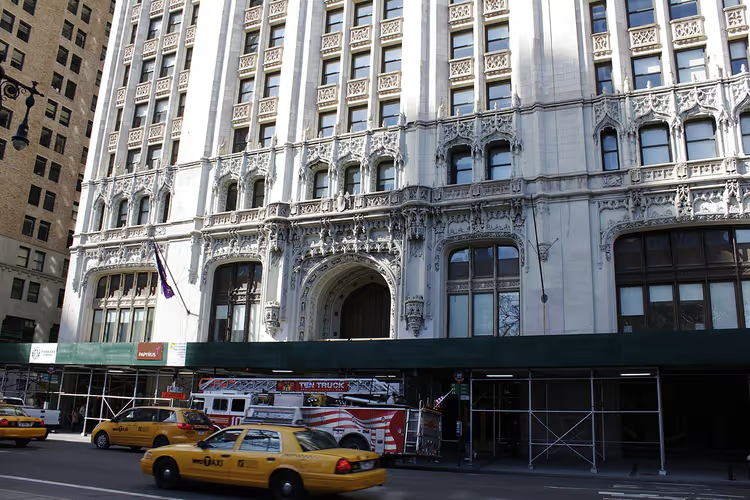
The Woolworth Building is a skyscraper that looks like a Gothic cathedral. It opened on Broadway in 1913 and was the tallest building in the world for almost two decades. Its carved turrets and pointed windows earned it the local nickname "Cathedral of Commerce". Among the glass towers of Lower Manhattan it looks like a visitor from another era. You will easily recognise it by its green copper roof.
The building was put up by Frank Woolworth. He started out as an ordinary shop assistant and came up with stores where every small item cost five or ten cents. The price was written on the tag, and there was no need to haggle. That idea grew into a chain across America. Woolworth paid for the skyscraper in cash, with no loan, and oversaw the lobby decoration himself.
The lobby, with its mosaic ceiling and marble staircases, was open to everyone for a long time. Today the building holds offices and private apartments, and free access is closed. You can only see the interior on a paid tour booked in advance, with the schedule published by the management company. From the outside, the facade can be seen around the clock. The best angle is from City Hall Park opposite, especially in the evening when the lights come on.
- Getting there: subway to City Hall (R, W lines) or Park Place (2, 3 lines).
- Who it's for: anyone who loves early 20th-century architecture.
- The catch: you can't get inside without a tour, and slots are snapped up in advance.
3. Metropolitan Museum of Art
 © TheCatalyst31 · CC BY-SAPhoto: TheCatalyst31, CC BY-SA (https://creativecommons.org/licenses/by-sa/4.0), Wikimedia Commons
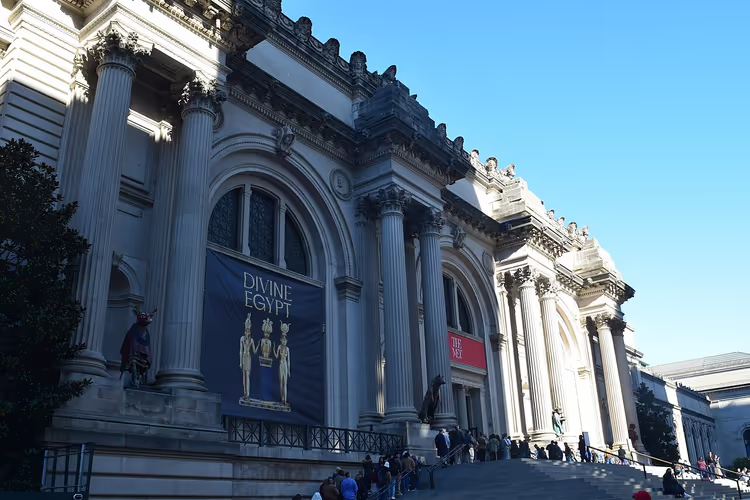
The Metropolitan Museum of Art stands on Fifth Avenue, on the eastern edge of Central Park. It is the largest art museum in the US. Most of the collection came from private holdings, and the museum still runs mainly on donations and sponsors' money. Even a week would not be enough to see everything. So pick two or three departments in advance and start with those.
The American art department consistently draws the most visitors. Nearby are the Egyptian Temple of Dendur in a glass hall, armour and classical sculpture. Lovers of painting should head for the Impressionist galleries: Renoir, Monet, Degas. A particular point of pride for the museum is its paintings by Johannes Vermeer, of which there are several here. Modern art and photography have galleries of their own.
The "pay what you wish" rule no longer applies to tourists. It survives only for residents of New York State and students at certain universities. Everyone else pays a fixed price, so check the current rate on the museum's website before your visit. Buy your ticket online: in season the queue for the ticket desk by the main staircase can be long. The old tin badges used instead of tickets are a thing of the past, and you now get a paper sticker or a QR code.
- Getting there: subway to 86th Street (4, 5, 6 lines), then about a 10-minute walk west.
- The catch: on weekend afternoons the Impressionist galleries are packed, so arrive at opening time.
4. Metropolitan Opera
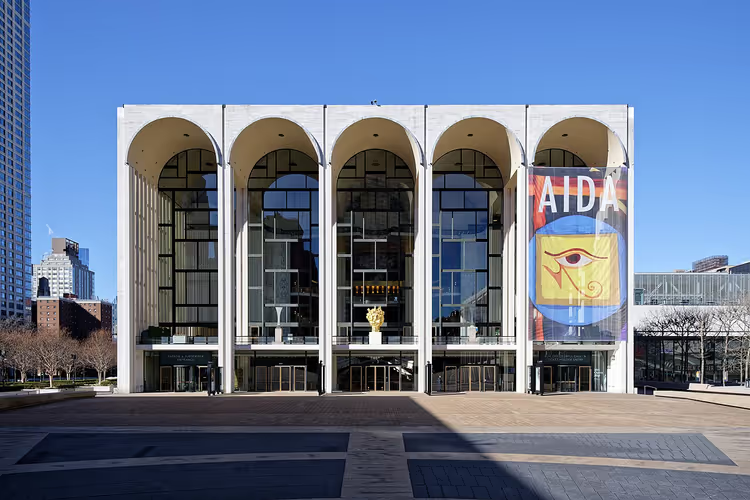
The Metropolitan Opera is one of the most famous opera stages in the world. Luciano Pavarotti, Plácido Domingo and Maria Callas all sang here. The company has existed since 1880, but for its first decades it performed in an old theatre on Broadway. The current building at Lincoln Center opened in 1966. You can see its five-arched facade from the plaza by the fountain.
Inside there is an auditorium with several thousand seats, red chairs and crystal chandeliers that rise to the ceiling before the performance. Two huge murals by Marc Chagall hang in the lobby, visible even from the street through the glass. Singers and critics praise the acoustics. Even if you sit in the top tier, the sound still reaches you clearly.
The season runs roughly from September to May, with performances almost every day. Popular productions sell out long before the date, so book your seats as soon as the programme is published on the Metropolitan Opera website. The price depends on the tier and the production: from inexpensive seats under the ceiling to stalls at the price of a good hotel. For visitors without a ticket, the lobby has a shop and there are backstage tours.
- Getting there: subway to 66 Street-Lincoln Center (1 line), with the exit right by the plaza.
- Who it's for: anyone willing to plan an evening in advance.
- The catch: in summer the main season is on pause and the choice of performances is small.
5. MoMA, the Museum of Modern Art
There are plenty of modern art museums today, but MoMA was one of the first and remains the most visited. It was founded in 1929 by three women patrons, among them Abby Aldrich Rockefeller. That is why the museum stands in Midtown, close to Rockefeller Center. From here you can walk to Fifth Avenue and St. Patrick's Cathedral.
 © diego_cue · CC BY-SAPhoto: diego_cue, CC BY-SA (https://creativecommons.org/licenses/by-sa/3.0), Wikimedia Commons
The current building has been rebuilt several times. A major renovation designed by the Japanese architect Yoshio Taniguchi was completed in 2004, and in 2019 the museum was expanded again and the collection rehung. The architecture itself is an exhibit here too: bright galleries, glass bridges, views of the Midtown streets. The displays change regularly, so old guides to "which floor shows what" no longer work.
The key works usually hang on the fifth floor. These include Van Gogh's "The Starry Night", Picasso's "Les Demoiselles d'Avignon", and works by Matisse, Malevich and Mondrian. Pop art, Warhol and Rothko are more often on the fourth. Other floors hold design, architecture, photography and film. Pick up a free map at the entrance, as it shows the current hang.
On the ground floor is the Abby Aldrich Rockefeller Sculpture Garden. It is one of the calmest spots in Midtown, and concerts are held there in summer. There is a cinema in the basement, and a ticket to a screening is often included in the admission price. Opening hours and prices change with the season, so check them on the museum's website on the day of your visit.
- Getting there: subway to 5 Av/53 St (E, M lines), with the exit a block from the entrance on 53rd Street.
- Tickets: with a timed entry, MoMA tickets on Tiqets.
- The catch: there is always a crowd around "The Starry Night", so go to it first.
6. Fifth Avenue
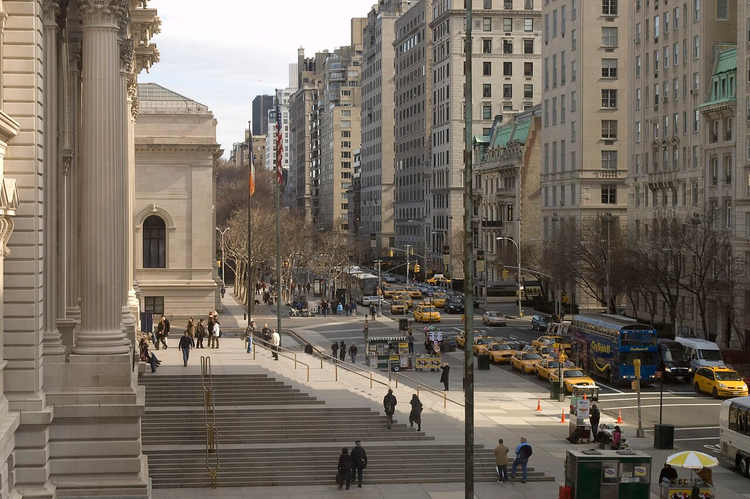 © A. Balet · CC BYPhoto: A. Balet, CC BY (https://creativecommons.org/licenses/by/3.0), Wikimedia Commons
Fifth Avenue is Manhattan's main shopping street and one of the most expensive streets in the world for rent. Tourists come here on their very first day, just as they head for the Champs-Élysées in Paris. The busiest stretch lies between 49th and 60th Streets. Here you will find brand flagships, the Saks Fifth Avenue department store and window displays that turn into an attraction of their own at Christmas.
But the street is about more than shopping. The northern part along Central Park is called Museum Mile: the Metropolitan Museum of Art, the Guggenheim, the Neue Galerie, the Museum of the City of New York. You can walk from one museum to the next in a day. For art lovers this is more convenient than crossing the city by subway.
The architecture holds your attention too. The Empire State Building stands on Fifth Avenue, and a little further north is the spiral Guggenheim building. Among the skyscrapers there was room for the neo-Gothic St. Patrick's Cathedral, and at 42nd Street you will find the public library with lions at its entrance.
At weekends some blocks are occasionally closed for parades, for example on St. Patrick's Day in March. The street stays lively until late in the evening. Start your walk at the library and head north towards the park: that way you will see five entries from this list in one go.
- Getting there: subway to 5 Av/53 St or 5 Av/59 St.
- The catch: in December the pavements by the window displays are jammed, and you have to move slowly.
7. Statue of Liberty
 © Christian David · CC BY-SAPhoto: Christian David, CC BY-SA (https://creativecommons.org/licenses/by-sa/4.0), Wikimedia Commons
The Statue of Liberty is considered the foremost symbol of the US. It was created by the Frenchman Frédéric Auguste Bartholdi, and the statue itself was a gift from France for the centenary of American independence. The framework was engineered by Gustave Eiffel. A curious detail: before this, Bartholdi had proposed a similar lighthouse figure for the entrance to the Suez Canal, but that project never happened. The statue was unveiled in 1886 on Liberty Island in New York Harbor.
The National Park Service itself does not sell admission to Liberty and Ellis Islands. You pay only for the ferry run by Statue City Cruises, the sole operator allowed to dock at the islands. An adult ticket costs $26, a child ticket for ages 4-12 costs $17, seniors aged 62 and over pay $23, and children under 4 travel free (as of 09/2026, National Park Service). The price includes the museums on both islands.
You can only go up to the pedestal and the crown with separate tickets, which are limited in number. There is no lift in the crown, and a narrow spiral staircase leads to the top. Crown tickets go several weeks ahead, so book them right after you buy your flights. The island has a statue museum with the original torch.
Ferries leave from Battery Park in Manhattan and from Liberty State Park in New Jersey. The queue is longer in Manhattan, and the security check is the same as at an airport. If all you need is a photo of the statue, take the free Staten Island Ferry: it passes the island. In the evening the floodlit silhouette looks especially striking.
- Getting there: subway to South Ferry (1 line) or Bowling Green (4, 5 lines), with the pier in Battery Park.
- Tours: Statue of Liberty tours on GetYourGuide.
- The catch: with security and the ferry, the trip takes half a day.
8. Times Square
 © Guillaume Gogo · CC BY-SAPhoto: Guillaume Gogo, CC BY-SA (https://creativecommons.org/licenses/by-sa/3.0), Wikimedia Commons
Times Square is the intersection of Broadway and Seventh Avenue, the busiest square in New York. It took its name from The New York Times, which moved here in 1904. The newsroom has long been based in another building, but the name stuck. The New Year's Eve ball drop, demonstrations and street events all take place here. You will find yourself in a stream of people at any hour of the day or night.
The square is now mostly pedestrianised. In the middle stand the red TKTS steps: underneath is a booth that sells discounted tickets to Broadway shows on the day of the performance. Dozens of screens glow overhead. Nearby is the studio of ABC's morning show Good Morning America, where passers-by behind the glass end up on air.
After that it all depends on your interests. Madame Tussauds is on 42nd Street, and around the square is the Theater District with dozens of Broadway theatres. The M&M's and Disney stores stay open late into the night. For dinner it is better to walk a couple of blocks to Ninth Avenue, where it is cheaper and quieter.
- Getting there: subway to Times Sq-42 St, where almost every line meets.
- The catch: costumed characters and "monks" work the square asking for money for photos; politely walk past.
9. Flatiron Building
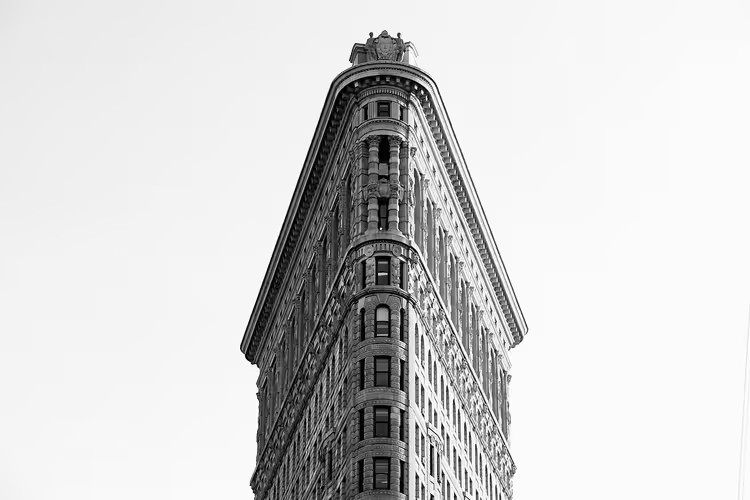
The Flatiron Building is one of New York's oldest skyscrapers. It was built in 1902. Today 22 storeys surprise no one, but at the time the building seemed a bold experiment. The triangular plot at the junction of Broadway and Fifth Avenue gave it the shape of a clothes iron, hence the nickname Flatiron. From its sharp corner it resembles the bow of a ship.
Its first name was the Fuller Building, after George Fuller's construction company. The firm commissioned the tower as its own office, and the size of the building was meant to show how serious the company was. Locals, however, started calling it "the flatiron" straight away, and the popular name pushed out the official one.
The facade is in the neo-Renaissance style. It is clad in limestone and terracotta with floral ornament, mascarons and medallions. As the light changes, the relief emerges and then vanishes. Walk all the way round the building: it looks different from every street, and from the north side it appears almost flat.
Inside are offices, and tourists are not allowed in. But the area in front of the building has been turned into a pedestrian zone with tables. Opposite lies Madison Square Park, where you can sit on a bench and study the facade at leisure. The best light for photos comes towards evening.
- Getting there: subway to 23 St (R, W or 6 lines), with the exit right by the building.
- The catch: the facade is often covered in scaffolding, so check recent photos before you go.
10. Central Park
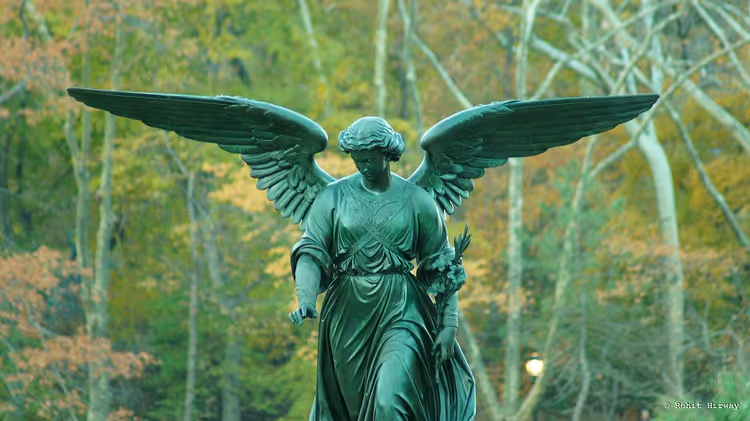 © Rohit Hirway · CC BY-SAPhoto: Rohit Hirway, CC BY-SA (https://creativecommons.org/licenses/by-sa/3.0), Wikimedia Commons
Central Park is Manhattan's main green space. It stretches from 59th to 110th Street between Fifth Avenue and Central Park West. There are ponds, rock outcrops, old trees and large lawns. The land under the park is worth a fortune, yet the city has left it unbuilt for more than a century and a half. The park is open from 6:00 to 1:00 and admission is free (as of 09/2026, Central Park Conservancy).
People run, cycle, play ball and have picnics in the park. There are cafés and kiosks, but not many, so plenty of people bring their own food. Barbecuing and lighting fires are prohibited. The squirrels here are almost tame, and in spring you will see cherry trees in blossom by the lake.
Children will enjoy the Central Park Zoo in the southern part, the very one shown in the animated film "Madagascar". The Metropolitan Museum of Art stands on the park's eastern edge, by Fifth Avenue. Belvedere Castle and the Delacorte Theater are in the middle, not far from the Great Lawn.
In summer the open-air stages host free concerts and "Shakespeare in the Park" performances. In winter the ice rinks open and the snow-covered paths fall quiet. The zoo, the rinks and the boathouse charge admission. The park has several dozen bridges, each one different, so bring a map.
- Getting there: subway to 59 St-Columbus Circle (A, C, B, D, 1 lines) or 5 Av/59 St.
- Who it's for: everyone who wants a breather between museums.
- The catch: the northern part of the park is large and deserted, so after dark it is better to stick to the southern part.
11. Brooklyn Bridge
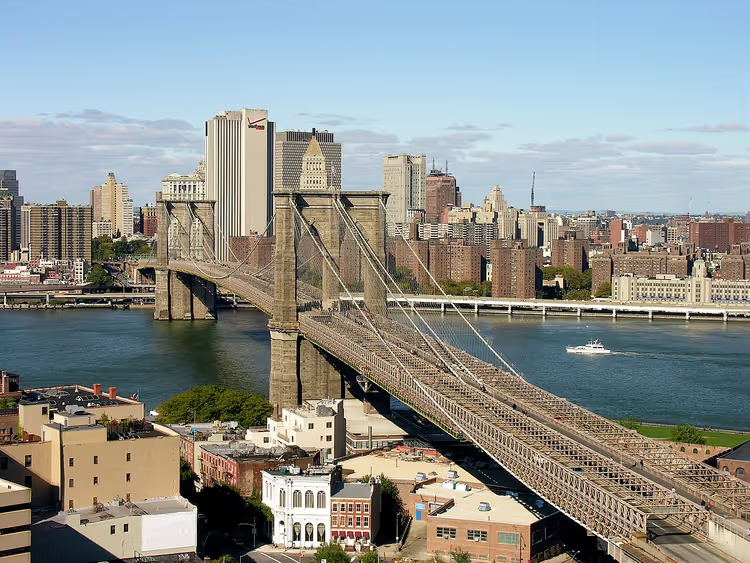 © Taken by Jeffrey Bary, uploaded by CPacker · CC BYPhoto: Taken by Jeffrey Bary, uploaded by CPacker, CC BY (https://creativecommons.org/licenses/by/2.0), Wikimedia Commons
Brooklyn Bridge links Lower Manhattan and Brooklyn Heights across the East River. It means to New York what Tower Bridge means to London. It was designed by the engineer John Roebling. Construction ran from 1869 to 1883, and in the year it opened it was the longest suspension bridge in the world (as of 09/2026, New York City Department of Transportation).
The story of its construction is a tragic one. John Roebling was injured on site before work even began and died. His son Washington carried on, but decompression sickness left him bedridden. His wife Emily effectively took over the management: she relayed her husband's instructions to the engineers and studied the calculations herself. A plaque on the bridge tower commemorates the Roebling family.
The bridge still carries a full load today. According to the same department, in 2024 an average of about 29,000 pedestrians crossed it each day and more than 100,000 vehicles drove over it. A wooden pedestrian walkway runs above the roadway, and the cycle lane has been moved to a separate route. The full length including the approaches is about 1.8 km.
The walk across the bridge is free and takes 30-40 minutes if you stop for photos. Start from the Brooklyn side: that way Manhattan is in front of you the whole time. Below, Brooklyn Bridge Park has beach lawns and a pier, and almost every river cruise passes under the bridge.
- Getting there: on the Brooklyn side, subway to High St (A, C lines); on the Manhattan side, to Brooklyn Bridge-City Hall.
- With a guide: walks across the bridge and around Brooklyn on GetYourGuide.
- The catch: the walkway is cramped during the day, so come at sunrise.
12. Brooklyn Museum
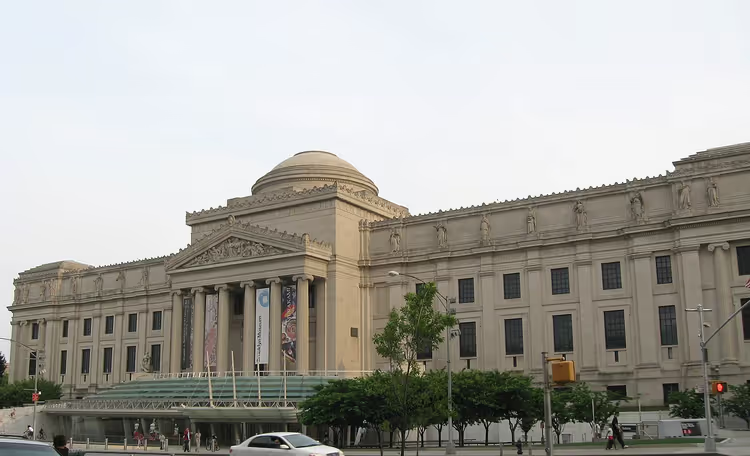
The Brooklyn Museum is one of the largest art museums in the US. Its collection holds about one and a half million objects, from ancient Egyptian statues to contemporary painting. Tourists come here less often than to the Manhattan museums. So you will hardly meet any crowds in the galleries.
The museum's story began in 1823 with a library for apprentices in Brooklyn. That is where the first exhibits ended up. The current Beaux-Arts palace was built from the 1890s, at a time when Brooklyn was still a separate city and wanted to rival Manhattan. The design was conceived on a vast scale, but only part of the building was ever constructed.
When the palace opened, its own collection was modest. The galleries then quickly filled with private collections and finds from expeditions. Museum staff consider the Egyptian department their greatest pride, and it is one of the best in America. There are also strong galleries of African and Oceanic art, American painting and feminist art, including Judy Chicago's installation "The Dinner Party".
The museum stands at 200 Eastern Parkway, next to the Brooklyn Botanic Garden. Closing days and hours change from time to time, so check them on the museum's website before your visit. On the first Saturday of many months there is an evening programme with music.
- Getting there: subway to Eastern Pkwy-Brooklyn Museum (2, 3 lines), with the exit right at the entrance.
- The catch: the journey from Midtown takes about 40 minutes each way.
13. Manhattan
 © Anthony Quintano · CC BYPhoto: Anthony Quintano, CC BY (https://creativecommons.org/licenses/by/2.0), Wikimedia Commons
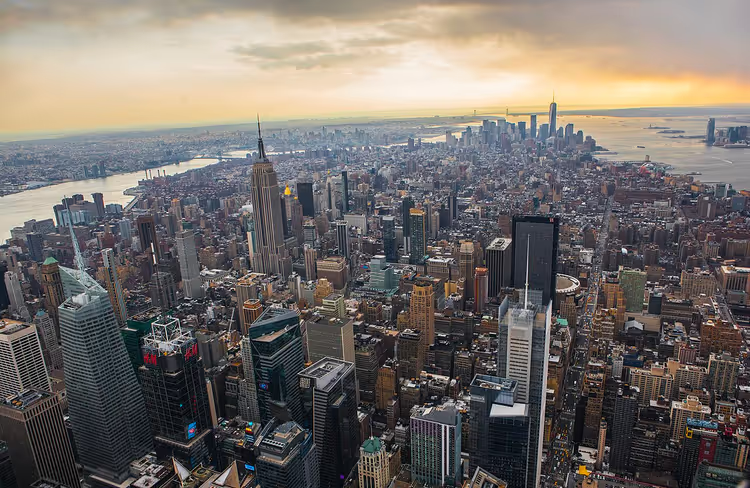
Manhattan is an island and one of the five boroughs of New York, alongside Brooklyn, the Bronx, Queens and Staten Island. It is the smallest by area and the biggest by income and building density. The name comes from the language of the Lenape people. Legend has it that the Dutch bought the island from the local inhabitants for goods worth a few dozen guilders, though historians argue over the details of that deal.
Most of the places on our list are right here. Lower Manhattan with Wall Street handles finance, Midtown has the offices and theatres, and the Upper East Side has the museums. Nowhere else has such a density of skyscrapers. The island is conveniently divided by a street grid: avenues run south to north, streets run west to east, and you will quickly learn to find your way by the numbers.
Within the island are dozens of neighbourhoods, each with its own character. Chinatown and Little Italy, Harlem with its jazz clubs, SoHo with its cast-iron facades, Greenwich Village with its cafés. Catholic cathedrals, synagogues, Buddhist temples and Orthodox churches stand side by side. Pick two neighbouring districts for half a day and go on foot: you will see the city better that way than from a bus window.
14. Grand Central Terminal
 © Nan Palmero from San Antonio, TX, USA · CC BYPhoto: Nan Palmero from San Antonio, TX, USA, CC BY (https://creativecommons.org/licenses/by/2.0), Wikimedia Commons
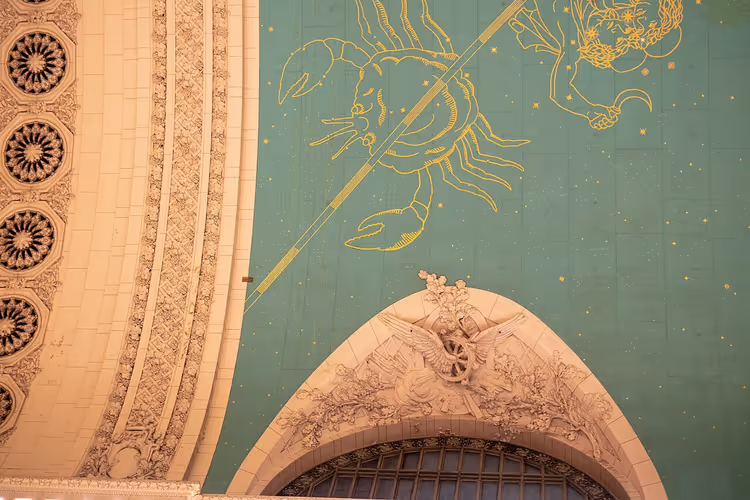
Grand Central Terminal looks more like a theatre than a station. The Beaux-Arts facade is decorated with arched windows and a sculptural group with a clock on the roof. The first station on this site opened in 1871, and the current building in 1913. By number of platforms, Grand Central is considered the largest station in the world.
You will recognise the main concourse by its turquoise vault with a starry sky and the gilded clock above the information booth. Metro-North commuter trains leave from here for upstate New York and Connecticut. Downstairs are a food court and the Oyster Bar, which has been open since the station first opened. Stand in the corner by the restaurant entrance and whisper into the wall: in the "Whispering Gallery" your friend will hear you at the opposite arch.
- Getting there: subway to Grand Central-42 St (4, 5, 6, 7, S lines).
- The catch: at rush hour the concourse fills with commuters, so come on a weekend morning for photos.
15. Broadway
Broadway is Manhattan's longest street. It runs from Bowling Green at the southern end of the island through the whole of Manhattan into the Bronx and on beyond the city limits. Unlike the strict grid of avenues, Broadway cuts diagonally and follows an old Native American trail. Where it crosses the avenues, squares are formed: Times Square, Herald Square, Union Square.
In recent years several stretches of the street have been turned into pedestrian zones with tables and flower beds. There are fewer cars and more people. Each section has its own character. In Lower Manhattan it is a business district, by Times Square it is billboards and crowds, and on the Upper West Side it is residential blocks and food markets.
For tourists the key stretch is called the Theater District. It has around forty major theatres staging "The Lion King", "Chicago", "Hamilton" and other musicals. When you talk about "going to Broadway", you mean precisely these few blocks around Times Square.
Many entries on this list stand on Broadway or right beside it: the Flatiron Building, Macy's department store, Lincoln Center with the Metropolitan Opera, Columbia University. You won't manage to walk the whole street in one day. Choose the stretch from Union Square to Times Square, which is about two hours at a leisurely pace.
- Getting there: the 1, R and W subway lines run along Broadway.
- The catch: tickets for the hits are expensive, and it is cheaper to buy them at the TKTS booth on the day of the show.
16. Brighton Beach
 © Андрей Бобровский · CC BYPhoto: Андрей Бобровский, CC BY (https://creativecommons.org/licenses/by/3.0), Wikimedia Commons
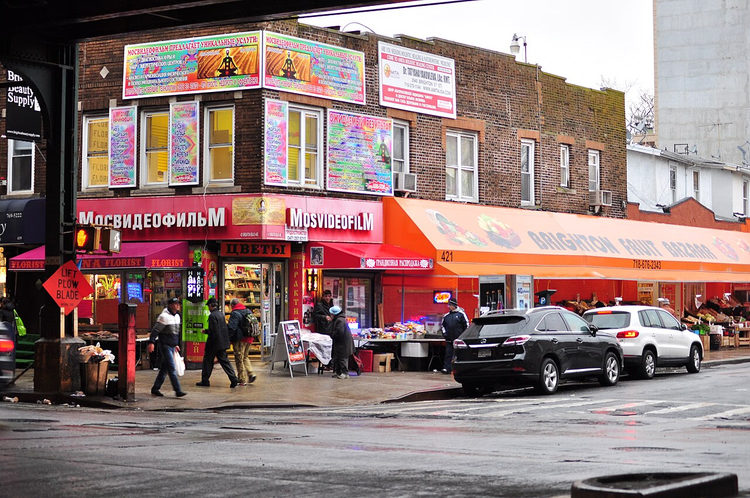
Brighton Beach is a seaside neighbourhood in southern Brooklyn, on the Atlantic coast. It sits next to Coney Island, and the two are linked by a wooden boardwalk along the beach. The name speaks for itself: this is a beach neighbourhood. It is only a couple of blocks from the main street to the sand.
The neighbourhood's main street is Brighton Beach Avenue. An elevated subway line runs above it, so it is always noisy here and a little dark even during the day. Under the tracks stretch grocery shops, pharmacies, bakeries and small markets. The area has been taking in immigrants from many countries for decades, and you will see signs in several languages.
Most tourists come here in summer for the beach and the boardwalk. You can walk along the boards to Coney Island with its amusement park, Ferris wheel and aquarium. Swimming is allowed in season, when lifeguards are on duty. In the evening the boardwalk cafés fill up with locals.
- Getting there: subway to Brighton Beach (B, Q lines), about an hour from Midtown.
- The catch: outside the summer season the beach is empty, and the trip is a long one for a single neighbourhood.
17. High Line
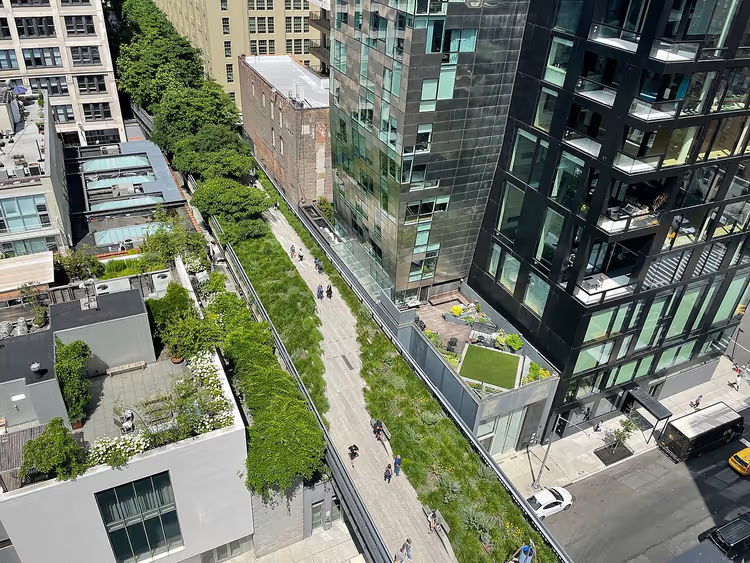 © Wil Fyfordy · CC BY-SAPhoto: Wil Fyfordy, CC BY-SA (https://creativecommons.org/licenses/by-sa/4.0), Wikimedia Commons
The High Line is a park on an old freight rail viaduct that runs above the streets of Manhattan's West Side. Trains stopped using it in 1980, and the trackbed became overgrown with grass. There were plans to demolish it, but local residents campaigned successfully to have the viaduct turned into a park. The first section opened in 2009.
Today it is a pedestrian promenade about 2.3 km long, from Gansevoort Street in the Meatpacking District to Hudson Yards at 34th Street. The path runs several storeys above the ground. In places the old rails have been kept right among the flower beds. The planting is chosen so that something is in bloom from spring to late autumn.
Along the way you will find lounger benches, an amphitheatre with a window onto Tenth Avenue, street art and coffee kiosks in the warmer months. From the viaduct there are good views of the Chelsea facades, the Hudson and the new towers of Hudson Yards. Admission is free, and opening hours change with the season.
- Getting there: the southern entrance is by the Whitney Museum, subway to 14 St (A, C, E, L lines); the northern one is by Vessel.
- The catch: on weekend afternoons the narrow sections are thick with people, so go in the morning.
18. Battery Park
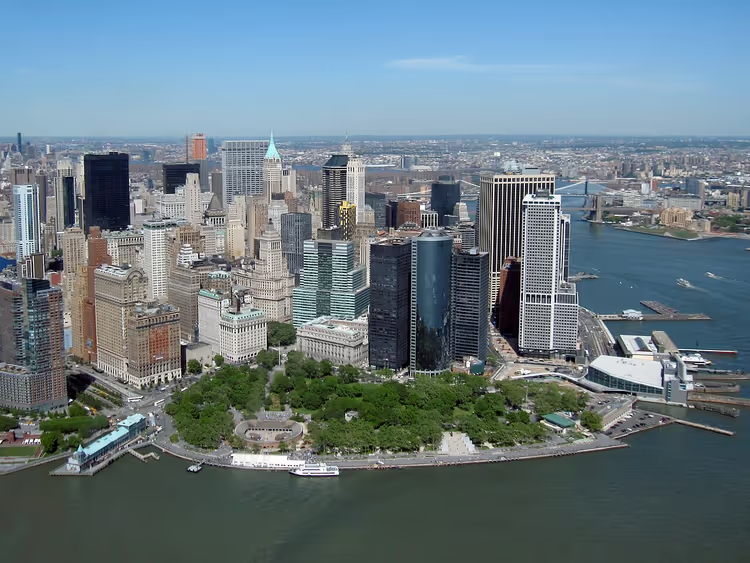 © Gryffindor · CC BY-SAPhoto: Gryffindor, CC BY-SA (https://creativecommons.org/licenses/by-sa/3.0), Wikimedia Commons
Battery Park occupies the southern tip of Manhattan. On the city side it is hemmed in by the high-rises of the Financial District, and on the water side by the harbour and a view of the Statue of Liberty. The park has plenty of trees, lawns and monuments, with paths running along the waterfront. You will find a free bench by the water even in high season.
The park takes its name from the artillery battery that defended the city in colonial times. Here too stands Castle Clinton, a fort built before the War of 1812. It later served as an immigration station and is now a historic monument. Tickets for the ferry to the Statue of Liberty and Ellis Island are sold inside the fort.
The park is home to Fritz Koenig's bronze "Sphere". It once adorned the plaza between the Twin Towers, survived the 2001 attack and now serves as a memorial. Nearby, in the former customs house, is the National Museum of the American Indian, which is free to enter.
North of the park lies the small Bowling Green square, where Charging Bull stands. Broadway begins there too. Cyclists and rollerbladers ride along the waterfront, and at the SeaGlass Carousel playground there is a carousel in the shape of sea fish.
- Getting there: subway to South Ferry (1 line), Bowling Green (4, 5 lines) or Whitehall St (R, W lines).
- The catch: unofficial ticket sellers work near the ferry ticket office, so buy only inside the fort or online.
19. Empire State Building
The Empire State Building opened in 1931. The building is 381 metres tall, or about 443 metres with its antenna. For almost 40 years it was the tallest skyscraper in the world. New York now has taller buildings, but its tiered silhouette and spire remain the defining image of the city.
The main observation deck is on the 86th floor and is open to the sky. Higher up there is a glass-enclosed deck on the 102nd floor. In September 2026 the observation decks were open from 10:00 to 23:00, and a basic ticket to the 86th floor cost from $46 (as of 09/2026, Empire State Building website). On the way up you pass through a museum on the second floor, which tells the story of the construction and the film "King Kong".
Every year a stair race is held here up to the 86th floor, which is more than one and a half thousand steps. The lighting on the spire changes colour for holidays and events. If you want to photograph the skyscraper itself, don't go up here but to Top of the Rock instead.
- Getting there: subway to 34 St-Herald Sq (B, D, F, M, N, Q, R, W lines), with the entrance on Fifth Avenue.
- Tickets: Empire State Building tickets on Tiqets.
- The catch: at sunset the queue for the lifts can be over an hour, so book a time slot in advance.
20. Chrysler Building
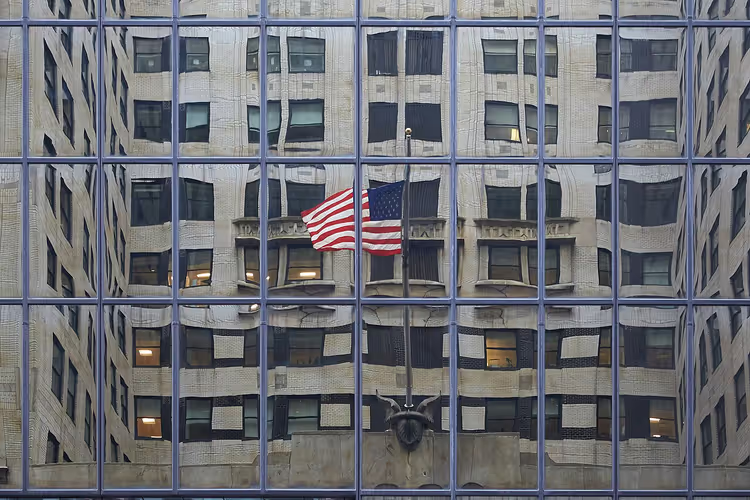 © Axel Tschentscher · CC BY-SAPhoto: Axel Tschentscher, CC BY-SA (https://creativecommons.org/licenses/by-sa/4.0), Wikimedia Commons
Many people call the Chrysler Building the most beautiful skyscraper in New York. It was built for the Chrysler car company and opened in 1930. It is 319 metres tall. The steel spire was assembled inside the building and raised into place in an hour and a half, to beat the rivals in the race for the height record.
The Art Deco facade is decorated with automotive symbols: eagles, wings and patterns shaped like hubcaps. At night the stainless steel crown glows in semicircles. Inside are offices, and tourists are not allowed in. You can only see the lobby with its marble walls and painted ceiling, and even then only during working hours.
- Getting there: the corner of Lexington Avenue and 42nd Street, two blocks from Grand Central Terminal.
- The catch: from below the spire is barely visible, so for photos you need an observation deck or the corner of 42nd Street and Third Avenue.
21. Rockefeller Center
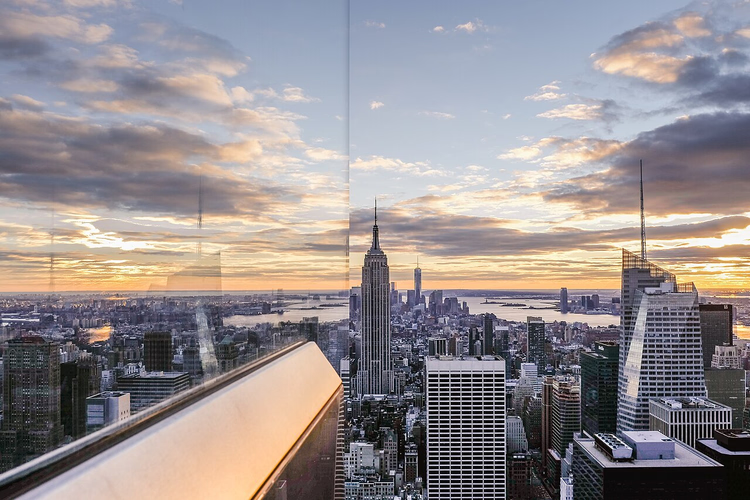
Rockefeller Center is a complex of 19 buildings in Midtown between Fifth and Sixth Avenues. It was built in the 1930s with money from John D. Rockefeller Jr., at the height of the Great Depression. In 1987 the complex was designated a National Historic Landmark. It holds offices, shops, restaurants, the NBC television studios and the Radio City Music Hall concert venue.
In winter the plaza gets the city's main Christmas tree and an ice rink. The tree is lit in early December, and during those weeks the plaza is very crowded. The Top of the Rock observation deck is on floors 67-70 and has three levels, some of them open-air. From here you can see both the Empire State Building and the whole of Central Park. Paid tours are run around the NBC studios.
- Getting there: subway to 47-50 Sts-Rockefeller Ctr (B, D, F, M lines).
- Tickets: Top of the Rock tickets on Tiqets.
- The catch: in December visitors are let through to the tree in a queue between barriers.
22. Charging Bull
 © Tdorante10 · CC BY-SAPhoto: Tdorante10, CC BY-SA (https://creativecommons.org/licenses/by-sa/4.0), Wikimedia Commons
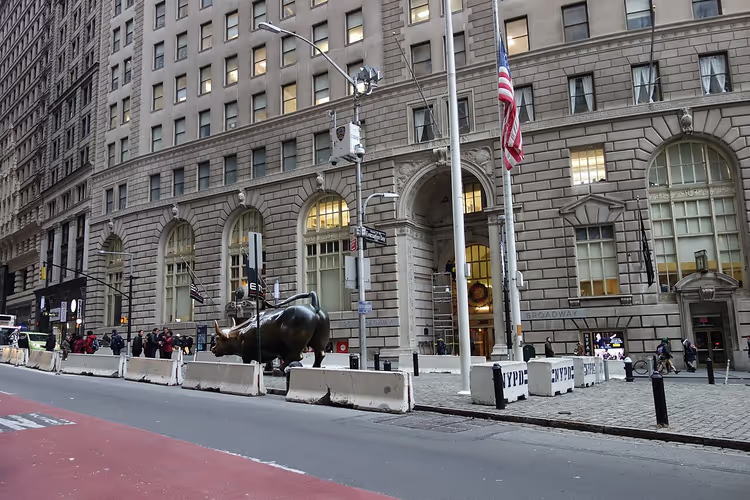
Charging Bull stands in Bowling Green, not far from Wall Street. The sculptor Arturo Di Modica cast it at his own expense after the 1987 stock market crash as a symbol of the strength and resilience of the American market. One night in December 1989 he placed the bull in front of the New York Stock Exchange without permission. The city removed the sculpture, but after protests from New Yorkers moved it to its present spot.
The bull weighs about three tonnes. Its lowered head, flared nostrils and tensed legs convey the charge. In 2017 the "Fearless Girl" figure was placed facing it, and Di Modica protested publicly. The girl was later moved to the stock exchange building, where she still stands. There is almost always a crowd around the bull, with people waiting their turn for a photo.
- Getting there: subway to Bowling Green (4, 5 lines).
- The catch: during the day you won't get a photo without strangers in the frame, so come before 8:00.
23. 9/11 Memorial
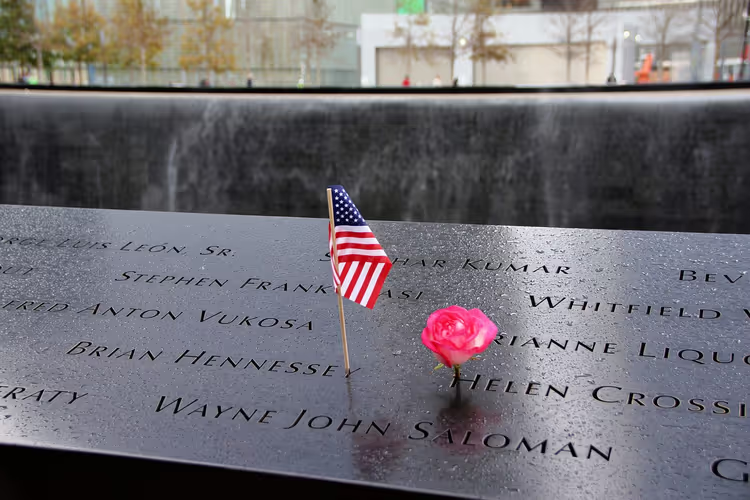
The 9/11 Memorial is on the site of the Twin Towers of the World Trade Center. The attack of 11 September 2001 took the lives of almost three thousand people. Now two enormous pools sit in the footprints of the towers, with water falling down the walls into the depths. The names of the dead are cut into the bronze parapets, including the victims of the 1993 bombing. The memorial itself is open daily from 8:00 to 20:00, and admission is free.
Beneath the plaza is the 9/11 Museum. The exhibition descends to the foundations of the towers. Preserved here are the retaining wall that held back the waters of the Hudson, twisted steel structures and personal belongings of the victims. The museum is open Wednesday to Monday and on selected Tuesdays from 9:00 to 19:00, with last entry at 17:30 (as of 09/2026, 9/11 Memorial & Museum). Admission to the museum is paid, and it is best to get a timed ticket online.
- Getting there: subway to WTC Cortlandt (1 line) or World Trade Center (E line).
- The catch: the exhibition is emotionally heavy, so think ahead if you have small children.
24. Solomon R. Guggenheim Museum
 © Jean-Christophe BENOIST · CC BYPhoto: Jean-Christophe BENOIST, CC BY (https://creativecommons.org/licenses/by/3.0), Wikimedia Commons
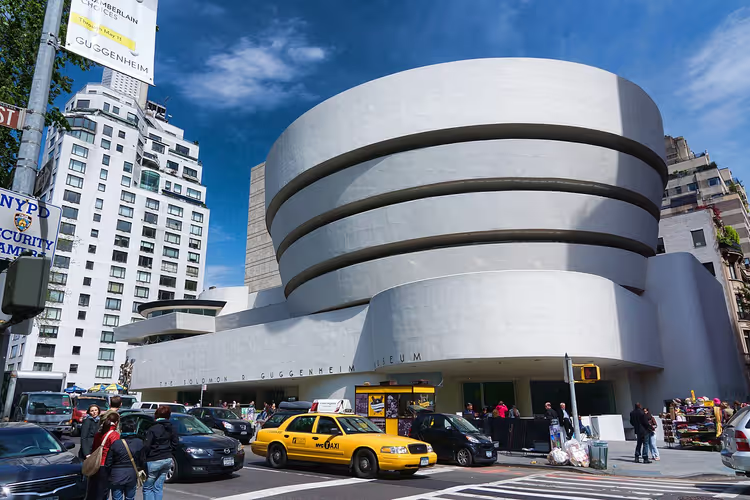
You won't mistake the Guggenheim Museum building for anything else. The white spiral on Fifth Avenue stands out among the rectangular buildings of the Upper East Side. The industrialist Solomon Guggenheim collected paintings from the late 19th and the 20th century on the advice of the artist Hilla von Rebay. His foundation opened its first gallery in 1939.
The current building was designed by Frank Lloyd Wright. It opened in 1959, after the death of both the collector and the architect himself. Inside is one long spiral ramp. It is easier to take the lift to the top and walk down the ramp, so that you descend without effort and see the exhibition in order.
The permanent collection includes Kandinsky, Picasso, Chagall and Impressionists from the Thannhauser collection. The ramp usually hosts temporary exhibitions. Hours and prices change, and the current details are published on the Guggenheim website.
- Getting there: subway to 86 St (4, 5, 6 lines), then about a 10-minute walk to Fifth Avenue.
- The catch: while exhibitions are being changed over, part of the ramp is closed.
25. Cathedral of St. John the Divine
 © Franco Folini · CC BY-SAPhoto: Franco Folini, CC BY-SA (https://creativecommons.org/licenses/by-sa/2.0), Wikimedia Commons
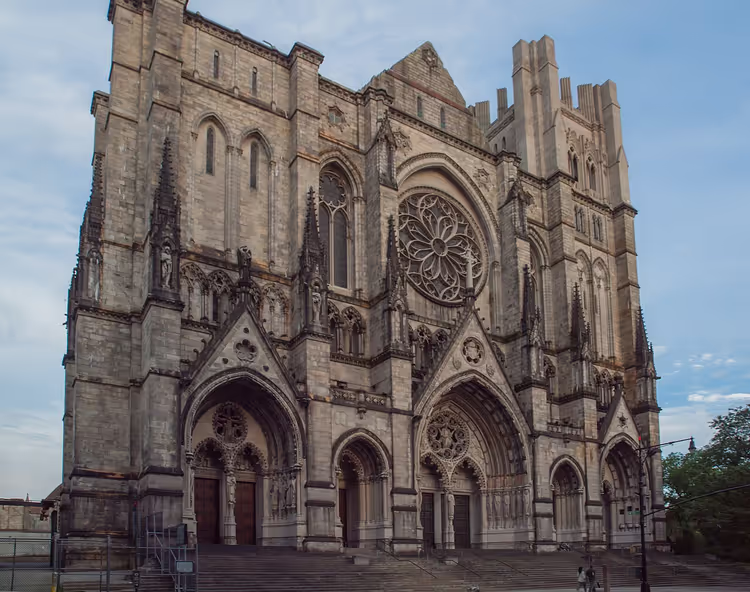
The Cathedral of St. John the Divine stands on Amsterdam Avenue in Morningside Heights. It is a cathedral of the Episcopal Church in the US, the American branch of Anglicanism. It is one of the largest Christian churches in the world by floor area. Construction is still officially unfinished, which is why locals joke about "St. John the Unfinished".
The cornerstone was laid in 1892. The first design was in the Byzantine-Romanesque style, then the architects changed and the nave was completed in Gothic. Work went slowly, interrupted by wars and a shortage of money. The Episcopal community wanted a church larger than the Catholic St. Patrick's Cathedral on Fifth Avenue, and in terms of size it succeeded.
Inside you will see a huge rose window above the entrance, bronze doors with biblical scenes and chapels of various national communities. The cathedral is known for its openness: it hosts concerts, exhibitions and a blessing of the animals in October. On the south side stands the sculptural "Peace Fountain" with a figure of the Archangel Michael. Peacocks roam freely around the grounds.
- Getting there: subway to Cathedral Pkwy-110 St (1 line), then about a 5-minute walk.
- The catch: the cathedral is far from the main routes, so combine it with Columbia University.
26. New York Public Library
 © ajay_suresh · CC BYPhoto: ajay_suresh, CC BY (https://creativecommons.org/licenses/by/2.0), Wikimedia Commons
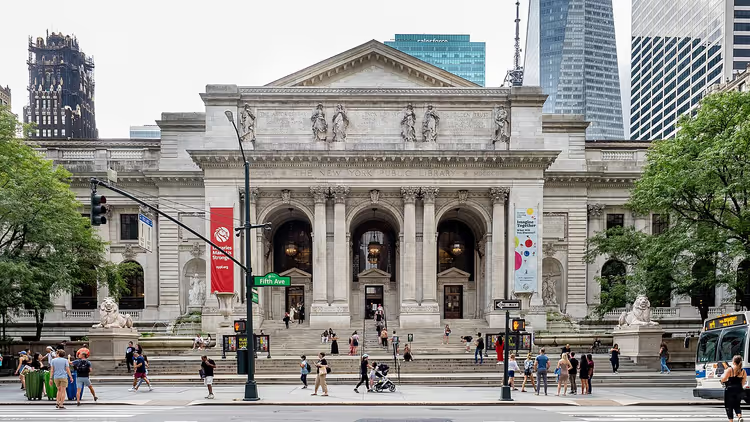
The main building of the New York Public Library stands on Fifth Avenue between 40th and 42nd Streets. It is now called the Stephen A. Schwarzman Building. The design competition was won by the firm Carrère & Hastings, and the library opened in 1911. The marble facade with its columns is guarded by two stone lions named Patience and Fortitude.
The library grew out of the merger of several private collections: the Astor and Lenox libraries and the Tilden Trust. The building was put up on the site of the old Croton Reservoir. Entry is free for everyone, and you don't need a passport or a library card. You can walk in and look around the halls and the exhibitions drawn from the library's holdings.
The highlight here is the Rose Main Reading Room on the third floor. It is almost two city blocks long, with a painted ceiling, clouds in the murals and massive chandeliers. The tables with brass lamps are in real use, and the room is quiet. Go in without flash and don't disturb those who are studying.
The library system holds millions of books, maps, manuscripts and photographs, some of them digitised and available online. Rarities are sometimes displayed on the ground floor, such as one of the first Gutenberg Bibles or the original Winnie-the-Pooh toys. Bryant Park begins behind the library, so you can combine the two.
- Getting there: subway to 5 Av (7 line) or 42 St-Bryant Pk (B, D, F, M lines).
- The catch: the reading room is sometimes closed for events, so check the schedule on the library's website.
27. American Museum of Natural History
 © Vicpeters · CC BYPhoto: Vicpeters, CC BY (https://creativecommons.org/licenses/by/4.0), Wikimedia Commons
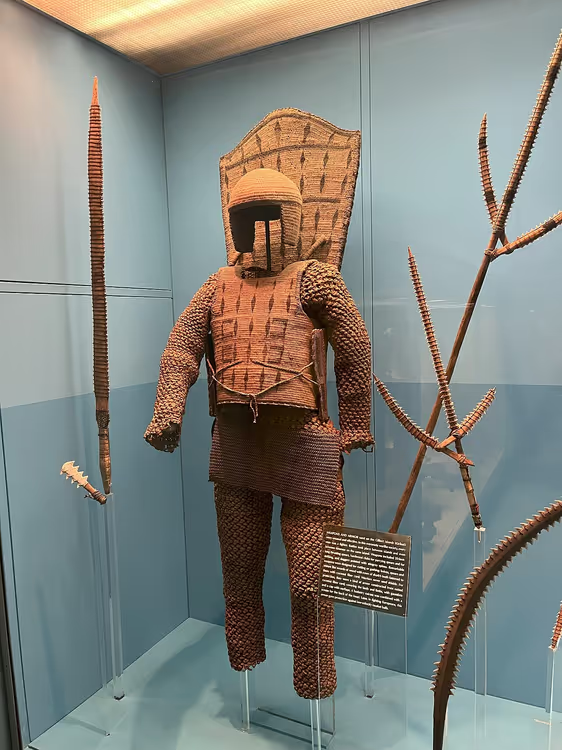
Many people know this museum from the film "Night at the Museum". The American Museum of Natural History stands by Central Park on the Upper West Side. It was founded in 1869 and remains one of the largest natural history museums in the world. The museum has research departments in anthropology, palaeontology, mineralogy and astrophysics.
At first the collection was kept in the Arsenal building in Central Park. In 1877 the museum moved into its own building, which has since grown to fill an entire block. In 2023 the new Gilder Center opened with an insectarium and a butterfly pavilion. Next door is the Hayden Planetarium in its glass cube.
The main halls are devoted to dinosaurs: the Tyrannosaurus and Apatosaurus skeletons stand on the fourth floor. Children can't be dragged away from the Hall of Ocean Life, where a life-size blue whale hangs from the ceiling. There are also dioramas of African and North American animals, meteorites and minerals. In one day you will see only a part, so pick three or four halls.
- Getting there: subway to 81 St-Museum of Natural History (B, C lines), with the exit leading straight into the building.
- Who it's for: families with children, because many of the halls are interactive.
- The catch: tickets for special shows and the planetarium are sold separately from admission.
28. St. Patrick's Cathedral
 © MARIA JOSE REYGADAS · CC BY-SAPhoto: MARIA JOSE REYGADAS, CC BY-SA (https://creativecommons.org/licenses/by-sa/3.0), Wikimedia Commons
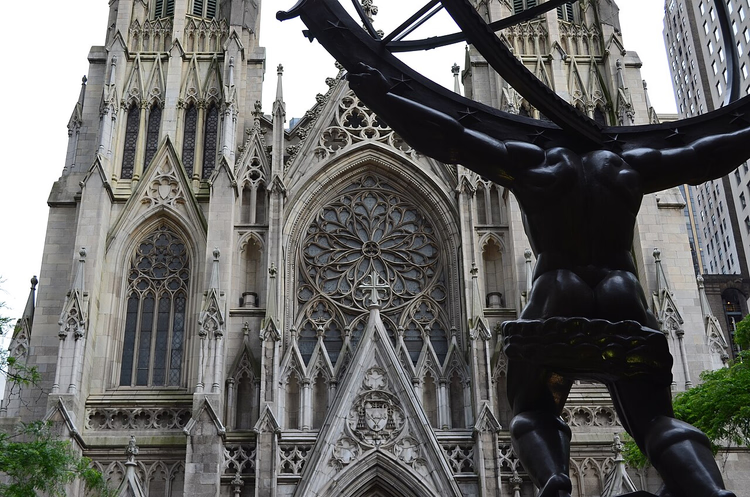
St. Patrick's Cathedral stands on Fifth Avenue opposite Rockefeller Center. It is the largest neo-Gothic Catholic cathedral in the US. Its white spires against the glass towers make for one of the most recognisable views in Midtown. When the site was chosen, the plot lay beyond the city limits and the project was called madness. Now it is the very centre.
The cathedral was built for the Catholic community, mainly Irish immigrants. The first stone was laid in 1858, the church was consecrated in 1879, and the spires were completed later. The architect James Renwick drew inspiration from the cathedrals of Cologne and Reims. Inside you will see the altar, stained glass from France and England, and the Lady Chapel behind the high altar.
The Old St. Patrick's Cathedral on Mott Street in Nolita is older. In the mid-19th century a wall was built around that church to protect parishioners from attacks by anti-Catholics. The current cathedral was built in calmer times. A major restoration was completed in 2015, and the facade is bright once more.
- Getting there: subway to 5 Av/53 St (E, M lines) or 47-50 Sts-Rockefeller Ctr.
- The catch: access is restricted during Mass, so tourists are better off coming between services.
29. Vessel
 © Anthony Quintano from Mount Laurel, United States · CC BYPhoto: Anthony Quintano from Mount Laurel, United States, CC BY (https://creativecommons.org/licenses/by/2.0), Wikimedia Commons
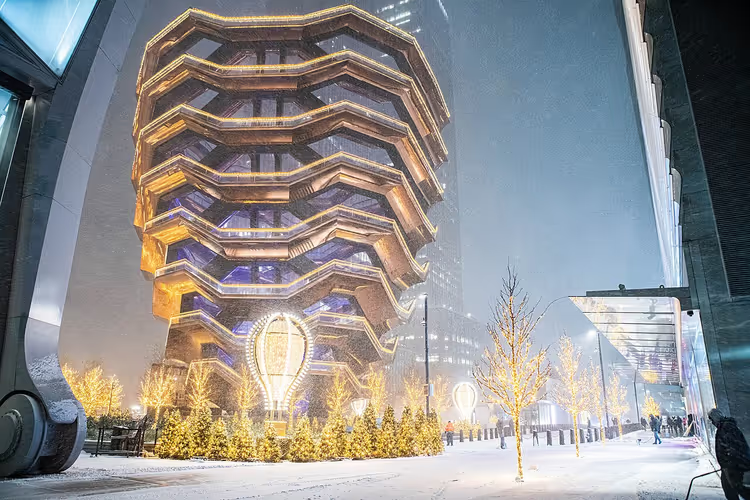
Vessel is a climbable structure made of staircases in the Hudson Yards development on Manhattan's West Side. It was designed by Thomas Heatherwick's British studio, and Vessel opened in 2019. From the outside it looks like a copper honeycomb or a basket. Inside, the staircases interlock and lead to dozens of landings.
According to its designers, Vessel has 154 flights of stairs, almost 2,500 steps and 80 landings. It stands next to the northern end of the High Line, so it is convenient to walk the park and finish here. The structure stands out sharply among the glass towers of Hudson Yards, and that is the point.
After several tragic incidents, Vessel was closed to visitors. It has now reopened, but with safety netting on the barriers. Admission is paid, with timed tickets sold on the Hudson Yards website. The free entry of the early years no longer exists.
Nearby are the Edge observation deck with its glass floor, a shopping centre and the Mercado Little Spain food market. If you don't want to climb, Vessel looks good from the plaza below as well.
- Getting there: subway to 34 St-Hudson Yards (7 line).
- The catch: the upper levels are narrow, and people with a fear of heights will be uncomfortable.
30. Madame Tussauds
 © Laslovarga ; cropped by Beyond My Ken ( talk ) 23:50, 2 May 2010 (UTC) · CC BY-SAPhoto: Laslovarga ; cropped by Beyond My Ken ( talk ) 23:50, 2 May 2010 (UTC), CC BY-SA (http://creativecommons.org/licenses/by-sa/3.0/), Wikimedia Commons
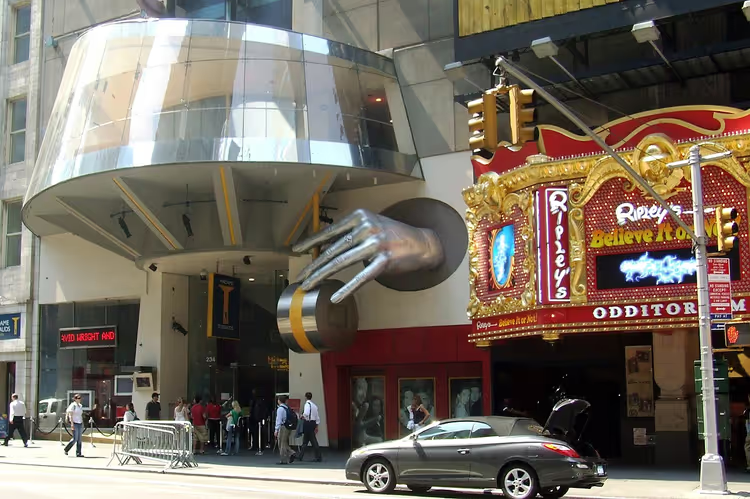
The Madame Tussauds wax museum is on 42nd Street by Times Square. You will recognise the entrance by the enormous hand above the door. The figures are made with great precision, right down to eye colour and wrinkles. Most visitors come for photos with stars of film, music and sport.
The rooms are arranged by theme: Hollywood, music, sport, Marvel superheroes, American presidents. You can stand next to Lady Gaga, Elvis Presley or George Washington. The figures are not behind glass, and touching and posing are allowed. There are separate interactive zones for children.
Opening hours vary by day. On the day we checked, the museum was open from 10:00 to 19:00 (as of 09/2026, Madame Tussauds New York website). Online tickets are usually cheaper than at the door and are often sold in combos with other Times Square attractions.
- Getting there: subway to Times Sq-42 St.
- Tickets: Madame Tussauds tickets on Tiqets.
- The catch: a visit takes about an hour and a half, yet the price is on a par with world-class museums.
31. Bryant Park
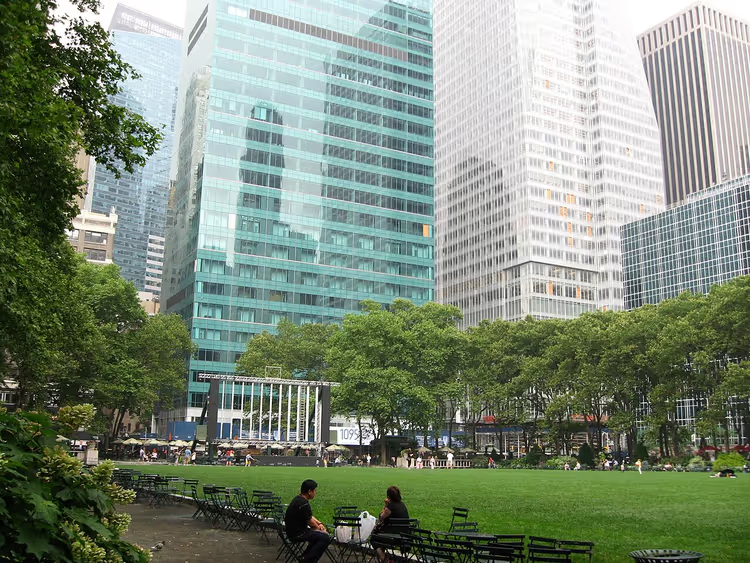
Bryant Park lies between Fifth and Sixth Avenues, right behind the public library. It is more modest in size than Central Park, more of a large lawn among the Midtown skyscrapers. It is named after the poet and editor William Cullen Bryant, an advocate for the creation of Central Park. This site was once a paupers' cemetery, then a reservoir, and now a park.
The Bryant memorial stands by the rear wall of the library. The park has the French-style Le Carrousel, tables for chess and ping-pong, and an open-air reading room with books and magazines. On summer evenings films are shown on the lawn under the open sky. You can take a chair and sit wherever you like, as the chairs are not bolted down.
In winter the lawn becomes an ice rink, and around it opens the Winter Village Christmas market with dozens of stalls. Entry to the rink is free, and you only pay for skate hire. The park is never empty, even in the rain: office workers have lunch here all year round.
- Getting there: subway to 42 St-Bryant Pk (B, D, F, M lines).
- The catch: at lunchtime a free chair is hard to find.
32. United Nations Headquarters
 © Superbass · CC BY-SAPhoto: Superbass, CC BY-SA (https://creativecommons.org/licenses/by-sa/4.0), Wikimedia Commons
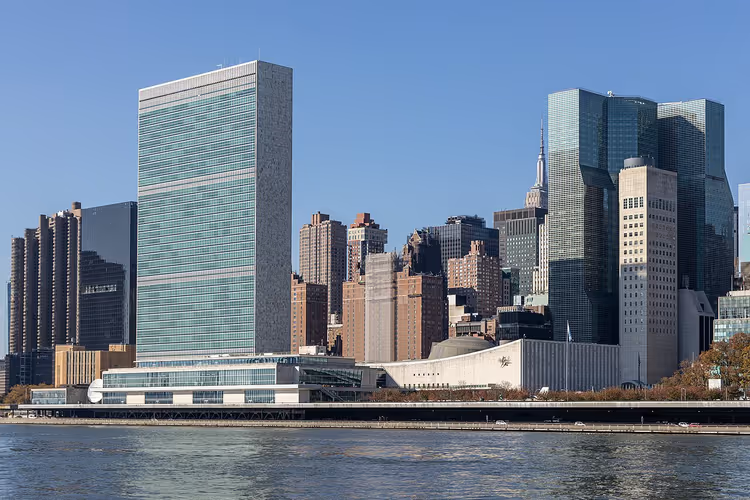
The United Nations Headquarters stands on the bank of the East River in the eastern part of Midtown. The complex includes the 39-storey Secretariat building, the General Assembly Hall, the Dag Hammarskjöld Library and the Conference Building. Under an agreement with the US, the territory is administered by the UN and has a special status. The land for the site was bought and donated to the organisation by John D. Rockefeller Jr.
The Secretariat was under construction from 1949. Before Manhattan was chosen, other sites were considered, among them Navy Island near Niagara Falls. In front of the entrance stands the sculpture "Non-Violence", a revolver with its barrel tied in a knot. In the garden is the statue "Let Us Beat Swords into Ploughshares", and the Japanese "Peace Bell" is rung at the start of sessions.
You can only get inside on a tour. Guided groups run on weekdays, the visitor service is open from 9:00 to 17:00, and before the visit every guest must register on the UN security website. During the General Debate of the General Assembly the headquarters is closed: in 2026 from 12 September to 4 October (as of 09/2026, UN Visitor Centre).
- Getting there: subway to Grand Central-42 St, then about a 15-minute walk east, with the entrance on First Avenue at 46th Street.
- The catch: without a booking and registration you will see only the plaza by the flags.
33. Radio City Music Hall
 © William Warby from London, England · CC BYPhoto: William Warby from London, England, CC BY (https://creativecommons.org/licenses/by/2.0), Wikimedia Commons
Radio City Music Hall is a concert venue at Rockefeller Center, on the corner of Sixth Avenue and 50th Street. It opened in 1932, at the height of the Great Depression. Many projects were being shelved at the time, but Rockefeller decided to build. The red neon sign on the corner became one of the symbols of Midtown.
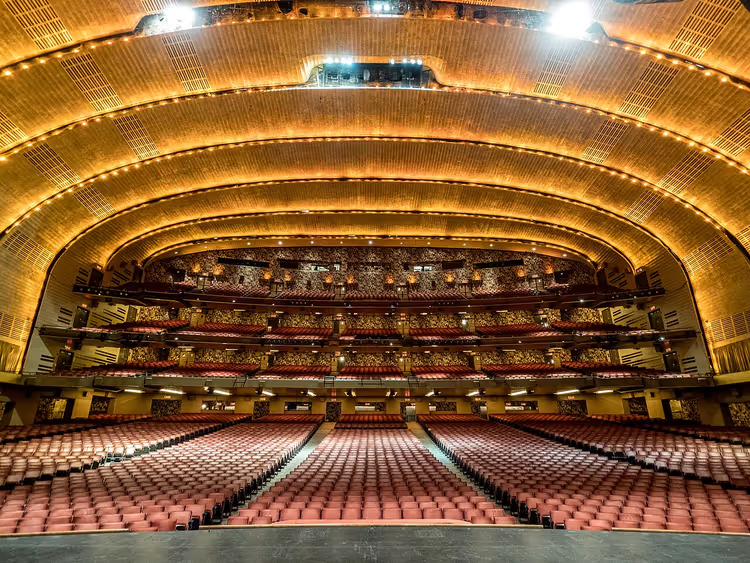
The Art Deco interiors have barely changed since opening. The auditorium resembles a semicircular shell with golden arches, and the lobby has a huge chandelier and a mural. There are about six thousand seats. The stage, with its lifting platforms, can bring out an orchestra, a choir and dozens of dancers at once, and the Wurlitzer organ fills the whole hall.
The hall has hosted the Grammy and Tony award ceremonies several times, concerts by world stars and film premieres. The main show of the year is the Christmas programme with the Rockettes dance troupe, which runs from November to early January. You will find the concert schedule on the Radio City Music Hall website. On days without concerts, tours of the hall are offered.
- Getting there: subway to 47-50 Sts-Rockefeller Ctr (B, D, F, M lines).
- The catch: good seats for the Christmas show sell out as early as summer.
34. Castle Clinton
 © Reading Tom from Reading, UK · CC BYPhoto: Reading Tom from Reading, UK, CC BY (https://creativecommons.org/licenses/by/2.0), Wikimedia Commons
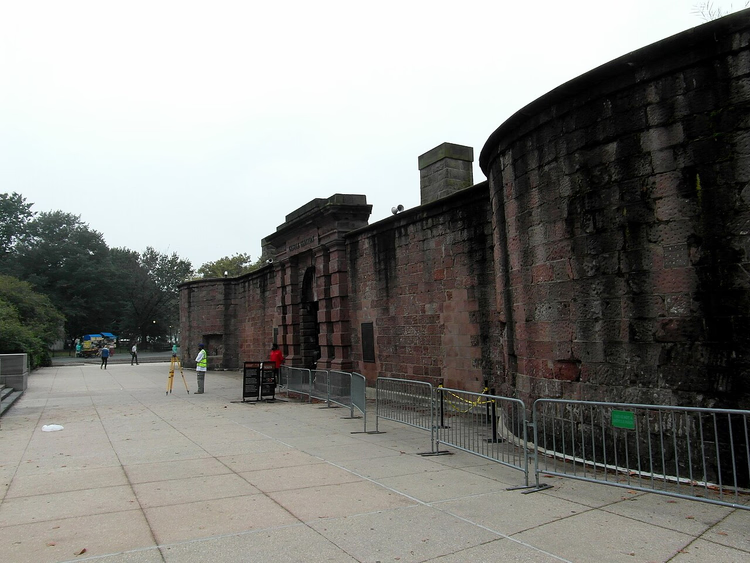
Castle Clinton is a circular stone fort in Battery Park. It was built in 1808-1811 to a design by Jonathan Williams and John McComb to defend the harbour ahead of the war with Britain. At the time the fort stood on an artificial island, and the shoreline was later filled in. It never saw action.
When the army left, the fort became a public venue and changed roles many times. It housed the Castle Garden theatre and concert hall, then the city's immigration station, then the New York Aquarium. Millions of people entered America through this station, among them future celebrities: Joseph Pulitzer, Nikola Tesla, Harry Houdini. After Ellis Island opened, immigrant processing moved there.
In the mid-20th century the fort was due to be demolished, but the public saved it. It is now a national monument run by the National Park Service. The fort is open daily from 7:45 to 17:00 and closed on Thanksgiving and Christmas Day (as of 09/2026, National Park Service). Inside are the ticket office for ferries to the Statue of Liberty, a small exhibition and free ranger-led tours.
- Getting there: subway to Bowling Green (4, 5 lines) or South Ferry (1 line).
- The catch: the fort itself takes 15 minutes to see, and what mostly keeps you here is the ferry queue.
35. Federal Hall
 © Ajay Suresh from New York, NY, USA · CC BYPhoto: Ajay Suresh from New York, NY, USA, CC BY (https://creativecommons.org/licenses/by/2.0), Wikimedia Commons
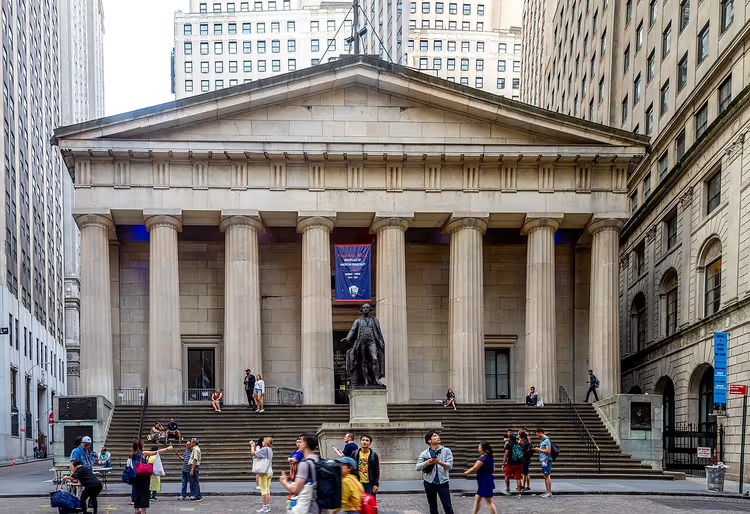
Federal Hall stands on Wall Street facing the end of Broad Street. The building with its Doric columns looks like a Greek temple, while inside it has a dome like that of the Roman Pantheon. It took several years to build and opened in 1842 as a customs house. It later housed a branch of the US Treasury.
The site matters more than the building itself. On this plot stood the earlier Federal Hall, where in 1789 George Washington took the oath of office as the first President of the United States. The first Congress also sat there and proposed the Bill of Rights. The capital was then moved, and the old building was demolished. The bronze statue of Washington on the steps marks the spot of the inauguration.
It is now a national memorial with a museum on the history of the early republic. Admission is free, and the visitor entrance is at 15 Pine Street (as of 09/2026, National Park Service). Inside you will see the Bible on which Washington swore his oath, unless it has been taken away for an exhibition.
- Getting there: subway to Wall St (2, 3 or 4, 5 lines).
- The catch: the memorial's opening hours are shorter than those of neighbouring attractions, so check them in advance.
36. Belvedere Castle
 © Christian David · CC BY-SAPhoto: Christian David, CC BY-SA (https://creativecommons.org/licenses/by-sa/4.0), Wikimedia Commons
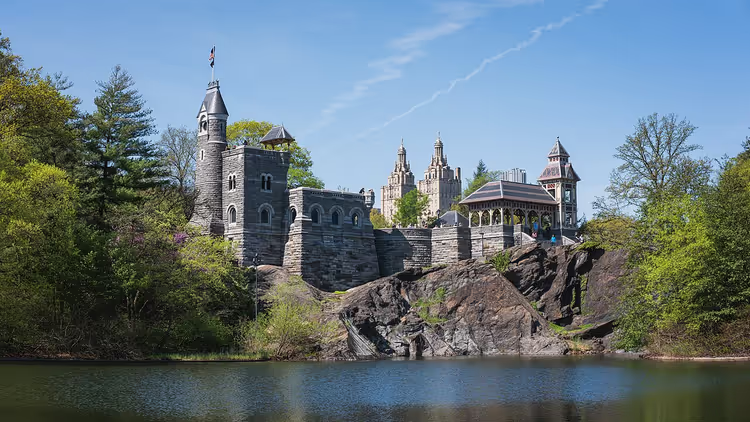
Belvedere Castle is a small castle on Vista Rock in the middle of Central Park. The Italian word belvedere means "beautiful view". The park's architects conceived the castle as a lookout tower, a decorative structure with no living quarters. Around the rock are Turtle Pond, the Delacorte Theater and the Great Lawn.
The building combines Gothic and Romanesque features. In the 1970s the castle fell into disrepair and was closed, but it was restored in the 1980s. Another major restoration was carried out in 2019. A National Weather Service station has operated here since 1919, and its instruments still measure the weather for Central Park.
From the terraces you can see the pond, the lawns and the rooftops of the Upper West Side. Inside is a small exhibition on the park's wildlife, and visitors can borrow a birdwatching kit. The castle is open daily from 10:00 to 17:00, with last entry to the terrace at 16:55 (as of 09/2026, Central Park Conservancy).
- Getting there: enter the park at 79th Street from Fifth Avenue or Central Park West.
- The catch: there are no toilets in the castle, and the nearest are by the Delacorte Theater.
37. Riverside Park
 © Momos · CC BY-SAPhoto: Momos, CC BY-SA (http://creativecommons.org/licenses/by-sa/3.0/), Wikimedia Commons
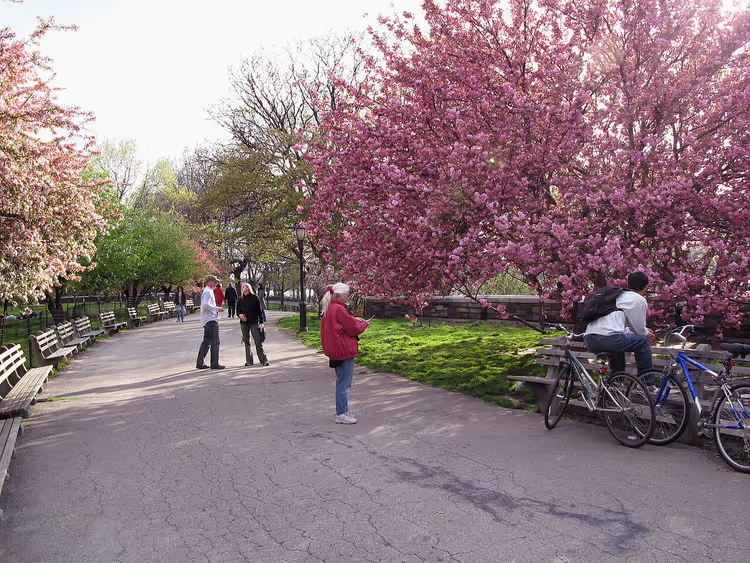
Riverside Park stretches in a narrow strip along the Hudson on the Upper West Side, from 72nd to 158th Street. It is one of the longest parks in Manhattan. In the 19th century a railway ran here, and the city bought up the slopes between the tracks and the residential blocks. The first plan for the park was drawn up by Frederick Olmsted, co-designer of Central Park.
Terraces were later built over the tracks, and the Henry Hudson Parkway was laid along the water. The work was directed at various times by Calvert Vaux and Samuel Parsons. Along the park stand the Soldiers' and Sailors' Monument, Grant's Tomb and Riverside Church. At 79th Street there is a boat basin and a rotunda with a café.
Locals come here to run, play basketball and tennis, and walk their dogs. There are few tourists. If you are tired of the crowds in Central Park, take a walk along the waterfront at sunset: the sun goes down right over the Hudson.
- Getting there: subway to 72 St, 79 St or 96 St (1 line), then a few blocks west.
- The catch: the park stretches for several kilometres, so pick one section.
38. Bronx Zoo

The Bronx Zoo is one of the largest urban zoos in the US. It opened in 1899. At first a few hundred animals lived here, mostly birds, bears and hoofed animals. Today the grounds cover more than 100 hectares, and the New York Botanical Garden lies next door.
The zoo now has thousands of animals, among them species on the brink of extinction. Many enclosures are laid out as natural landscapes: Asian jungle, African savannah, a forest with Congo gorillas. In the warm season the Wild Asia monorail runs above the tiger and elephant enclosures. For children there is a separate zoo with petting areas.
The zoo was one of the first in the US to keep animals not in cages but in open areas behind moats. Every enclosure has an enclosed section where the animals can rest away from visitors. From 2 April to 31 October 2026 the zoo is open on weekdays from 10:00 to 17:00 and at weekends until 17:30; from November to March it is open daily from 10:00 to 16:30 (as of 09/2026, Bronx Zoo).
The grounds are large, and you will need a full day to see everything. Comfortable shoes are a must.
- Getting there: subway to West Farms Sq-E Tremont Av (2, 5 lines) or the BxM11 express bus from Midtown.
- The catch: some attractions inside are charged separately from the admission ticket.
39. Whitney Museum of American Art
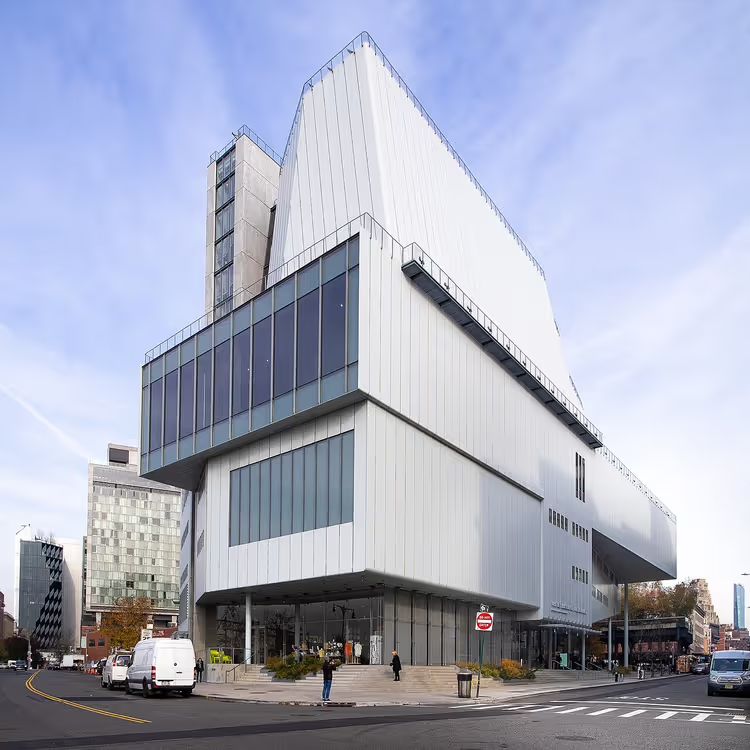 © Ajay Suresh from New York, NY, USA · CC BYPhoto: Ajay Suresh from New York, NY, USA, CC BY (https://creativecommons.org/licenses/by/2.0), Wikimedia Commons
The Whitney Museum is devoted to American art of the 20th and 21st centuries. It was founded by the sculptor and patron Gertrude Vanderbilt Whitney in 1930. For many years the museum was housed in Marcel Breuer's concrete building on Madison Avenue. In 2015 it moved to a new building by Renzo Piano in the Meatpacking District, next to the southern entrance to the High Line.
The museum's address is now 99 Gansevoort Street. It is closed on Tuesdays, open from 10:30 to 18:00 on Monday, Wednesday and Thursday, and admission is free for visitors aged 25 and under (as of 09/2026, Whitney Museum website). Booking tickets online in advance is recommended.
The collection consists solely of works by American artists: Edward Hopper, Georgia O'Keeffe, Andy Warhol, Jean-Michel Basquiat. Every two years it hosts the Whitney Biennial, the leading survey of contemporary American art. From the open terraces on the upper floors you can see the Hudson and the rooftops of Chelsea.
- Getting there: subway to 14 St/8 Av (A, C, E, L lines), then about a 10-minute walk.
- The catch: on weekend afternoons the terraces are crowded, so arrive at opening time.
40. Lincoln Center
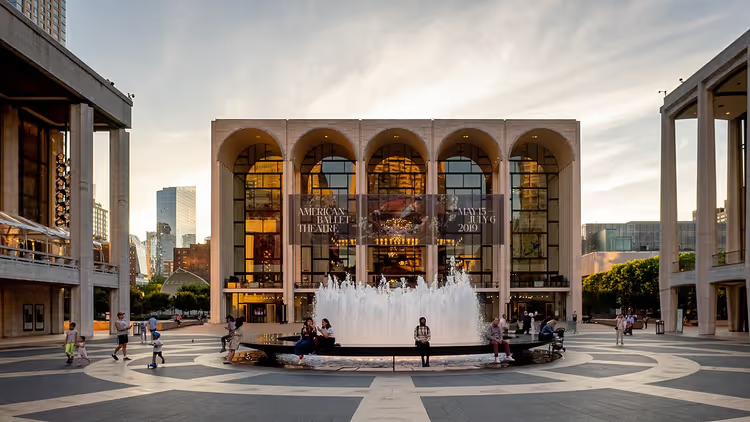 © Ajay Suresh from New York, NY, USA · CC BYPhoto: Ajay Suresh from New York, NY, USA, CC BY (https://creativecommons.org/licenses/by/2.0), Wikimedia Commons
Lincoln Center is New York's largest performing arts complex, on the Upper West Side. Around the plaza with its fountain stand the Metropolitan Opera, David Geffen Hall with the New York Philharmonic, and the David H. Koch Theater, home of the New York City Ballet. The Juilliard School and the School of American Ballet are next door.
The complex also includes the Film at Lincoln Center cinemas, which publish Film Comment magazine and run the New York Film Festival. The Library for the Performing Arts holds scores, recordings and performance archives, and is free to enter. The programme for all the venues is published on the Lincoln Center website.
In summer the plaza hosts free concerts and open-air dance evenings. You can come early, sit by the fountain and watch the audience gather. The plaza looks its best in the evening, when the facades are lit up.
- Getting there: subway to 66 St-Lincoln Center (1 line).
- The catch: tickets for high-profile premieres are expensive and sell long before the date.
How to plan tours in New York
The forty entries fit comfortably into four or five days. Give the first day to Lower Manhattan: the Freedom Tower, the 9/11 Memorial, Federal Hall, Charging Bull, Battery Park and the ferry. The second day suits Midtown, the third the museums by Central Park, and the fourth Brooklyn. If you want to save time on queues, book tours and tickets with a fixed entry time.
Tours and tickets in New York
Guided tours, skip-the-line tickets and activities — most offers can be cancelled free of charge.
See offers on GetYourGuideThe widget loads once you give your consent.
New York attractions on the map
All 40 places on the list are marked on the map below. Open it before you head out and plan your route by neighbourhood, not by number: that way you won't cross the whole city for a single stop.
New York Attractions
Places on the map
- 1One World Trade Center The city's tallest building, 541 metres, the One World Observatory on floors 100-102
- 2Woolworth Building A 1913 skyscraper shaped like a Gothic cathedral, entry only by guided tour booking
- 3The Metropolitan Museum of Art The largest art museum in the US on the edge of Central Park, buy tickets online
- 4Metropolitan Opera The opera stage at Lincoln Center with Chagall murals in the lobby, season September to May
- 5Museum of Modern Art (MoMA) Van Gogh's Starry Night and Picasso's Demoiselles d'Avignon on the fifth floor, a sculpture garden below
- 6Fifth Avenue Manhattan's main shopping street, its northern stretch along the park is called Museum Mile
- 7Statue of Liberty The symbol of the US on Liberty Island, adult ferry ticket 26 dollars, a separate ticket for the crown
- 8Times Square The intersection of Broadway and Seventh Avenue with screens and the red TKTS steps
- 9Flatiron Building A 1902 flatiron-shaped skyscraper on a triangular lot, offices inside, a pedestrian plaza outside
- 10Central Park Manhattan's main green space, open from 6am to 1am, free entry
- 11Brooklyn Bridge An 1883 suspension bridge, the walk is free and takes 30-40 minutes
- 12Brooklyn Museum One and a half million objects and one of America's finest Egyptian collections, few tourists
- 13Grand Central Terminal A 1913 Beaux-Arts station with a turquoise ceiling and the Whispering Gallery
- 14Broadway Manhattan's longest street, the Theater District starts near Times Square
- 15Brighton Beach A seaside district in southern Brooklyn, a boardwalk leads to Coney Island
- 16High Line A park on an old freight rail viaduct 2.3 km long, free entry
- 17Battery Park A park at the southern tip of Manhattan, ferries to the Statue of Liberty leave from here
- 18Empire State Building A 1931 skyscraper, an open deck on the 86th floor, basic ticket from 46 dollars
- 19Chrysler Building 1930 Art Deco with a steel crown, only the lobby is open to the public during working hours
- 20Rockefeller Center A complex of 19 buildings with an ice rink, the city's main Christmas tree and the Top of the Rock deck
- 21Charging Bull A three-tonne bronze sculpture in Bowling Green square, come before 8am for photos
- 22Solomon R. Guggenheim Museum Frank Lloyd Wright's white spiral on Fifth Avenue, Kandinsky, Picasso and Chagall
- 23Cathedral of St. John the Divine One of the largest Christian churches in the world, construction officially unfinished
- 24American Museum of Natural History Dinosaur skeletons and a blue whale hanging from the ceiling, the Hayden Planetarium nearby
- 25St. Patrick's Cathedral The largest neo-Gothic Catholic cathedral in the US, opposite Rockefeller Center
- 26Vessel A structure of 154 flights of stairs in Hudson Yards, timed paid entry
- 27Madame Tussauds Wax figures on 42nd Street near Times Square, about ninety minutes to see
- 28Bryant Park A large lawn between Midtown skyscrapers right behind the public library
- 29United Nations Headquarters
- 30Castle Clinton A fort from before the War of 1812 in Battery Park, ferry tickets are sold here
- 31Federal Hall A monument to the city's history in Lower Manhattan, free entry
- 32Belvedere Castle A castle in the middle of Central Park, the Delacorte Theater and Great Lawn nearby
- 33Riverside Park
- 34Bronx Zoo One of the spots for a day out with kids, paid entry
- 35Whitney Museum of American Art A museum at the southern entrance to the High Line in the Meatpacking district
- 36Radio City Music Hall A concert hall within Rockefeller Center
- 37Lincoln Center A complex of stages where the Metropolitan Opera has performed since 1966
⁉️🤔 Frequently asked questions
How much does a trip to the Statue of Liberty cost?
The US National Park Service does not charge for admission to Liberty and Ellis Islands. You pay only for the Statue City Cruises ferry. See the Statue of Liberty section for fares for all ages. Access to the crown is booked separately and in advance.
Which places on the list can you visit for free?
Without a ticket you can see Central Park, the High Line, Brooklyn Bridge, Battery Park, Bryant Park, Times Square and the 9/11 Memorial itself with its pools. The public library, Castle Clinton, Federal Hall and Belvedere Castle are free to enter. The museums, observation decks, the 9/11 Museum and the ferry to the Statue of Liberty remain paid.
Which observation deck should you choose?
At the Empire State Building the 86th-floor deck is open-air, and a basic ticket costs from $46 (as of 09/2026). From Top of the Rock you can see both the Empire State Building itself and the whole of Central Park. One World Observatory is the highest of all, but only behind glass. Vessel is more an architectural landmark with a view of Hudson Yards than a panorama of the city.
Can you get inside the United Nations Headquarters?
Yes, but only on a weekday tour and after registering on the UN security website. The visitor service is open from 9:00 to 17:00. During the General Debate of the General Assembly the complex is closed to guests: in 2026 from 12 September to 4 October, with tours resuming on 5 October (as of 09/2026).
How many days do you need to see all 40 places?
Allow four or five full days. We set out a day-by-day plan in the section on planning tours. Group the places by neighbourhood using the map, otherwise a lot of time will go on the subway.
In brief: what's worth booking
New York wears you out quickly if you try to see everything at once. Split the 40 places by neighbourhood, buy tickets in advance for the ferry, an observation deck and your main museum, and leave the parks and bridges for your free hours. Check opening hours on the day of your visit: they change with the season.
If you have | Go for |
|---|---|
One day | Lower Manhattan, following the day-one plan from the planning section |
An interest in art | The Metropolitan Museum of Art, MoMA and the Whitney Museum with a walk along the High Line |
Children | The American Museum of Natural History, the Bronx Zoo, Central Park |
A love of views | The Empire State Building at sunset or Top of the Rock |
A budget with no extras | Brooklyn Bridge, Central Park, the public library and the Staten Island Ferry |
It is best to choose a hotel in Midtown or Lower Manhattan, close to the subway: see New York hotels on Trip.com and choose a New York tour on GetYourGuide.
You need internet in the US from the very first minute to open the subway map: get an eSIM for your trip to the US.

A small editorial team writing guides for independent travel. We travel ourselves, but we haven’t been everywhere, so we check prices, opening hours and how to get there against official sources.