
















What to see in Stuttgart: 20 places and what to choose first
Stuttgart is easy to see on foot. The main sights are in the center, within a radius of a couple of kilometers. One thing gets in the way: almost all museums are closed on Mondays, and you go up the Fernsehturm with a ticket that has a fixed entry time. We put together twenty places worth seeing and organized them by area and time.
First, decide how much time you have. In one day you can cover the old town, one car museum, and a viewing platform. In two days, add Wilhelma, and leave Residenzschloss Ludwigsburg outside the city for the third day. That way you won't have to crisscross Stuttgart twice.
Ad: this article contains affiliate links, we earn a commission if you book through them, at no extra cost to you.
How to choose from twenty places
💡 In short:
- Set aside half a day for the center: Altes Schloss, Neues Schloss, Schlossplatz, and Schillerplatz are right next to each other.
- Do one car museum in the morning, save the second for next time.
- Plan viewing platforms for a clear day, otherwise you'll see a cloud instead of a panorama.
- Tickets and opening hours: as of 09/2026, checked on the official websites of the sights.
Stuttgart is more compact than it seems. From Königstraße to Schlossplatz you can walk in five minutes, and the city rail will get you to Wilhelma. So twenty places are realistic to cover in two or three days without rushing.
The logic is simple: first the center and the palaces, then the museums, and save the views for the evening. That way you don't waste time traveling across the whole city.
If you have | See first | Why |
|---|---|---|
half a day | Altes Schloss, Schlossplatz, Stiftskirche | everything is steps apart |
a day for cars | Mercedes-Benz Museum or Porsche Museum | one museum takes half a day |
an evening and clear weather | Fernsehturm Stuttgart | you can see the whole city |
a trip with kids | Wilhelma and Residenzschloss Ludwigsburg | zoo, park, and Märchengarten |
1. Altes Schloss
 © Roland Geider ( Ogre ) · CC BY-SAPhoto: Roland Geider ( Ogre ), CC BY-SA (https://creativecommons.org/licenses/by-sa/3.0), Wikimedia Commons
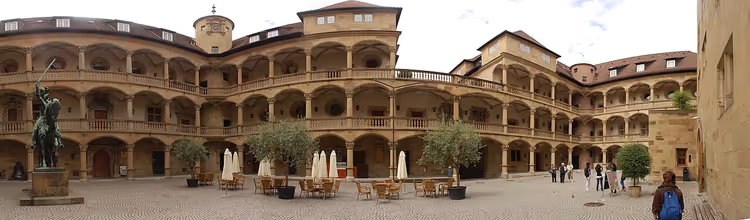
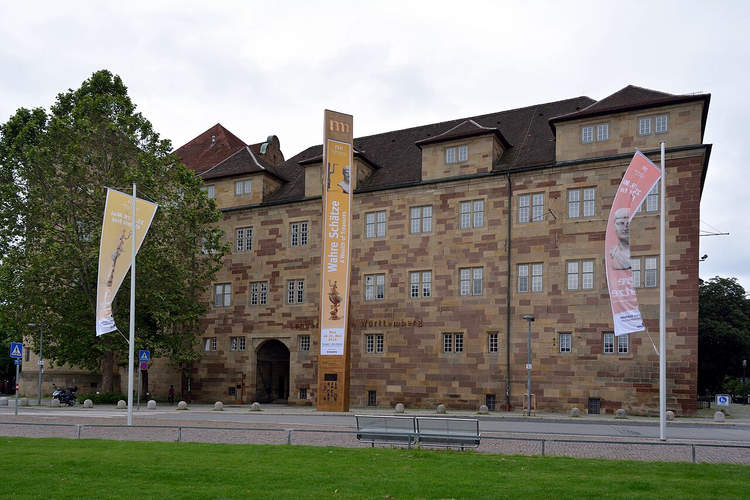
Altes Schloss began as a fortress, but the castle quickly lost its defensive purpose: pedigree horses were kept here. After restoration it became the residence of the Dukes of Württemberg. Today the Landesmuseum Württemberg operates within these walls.
You go inside for the 16th-century bronze bell, the arcaded inner courtyard, and the permanent exhibitions on the region's history. The ornate facade is considered a prime example of Renaissance architecture. The castle is closed on Mondays.
- How to get there: in the center, entrance from Schillerplatz.
- Cost: paid entry, one ticket covers all exhibitions.
2. Neues Schloss
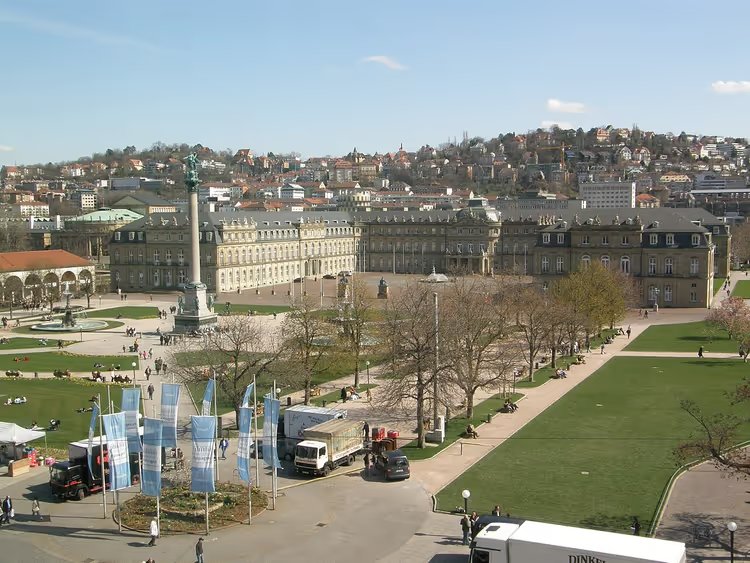
Neues Schloss was built in the second half of the 18th century as a "second Versailles" for Duke Charles Eugene. The wings around the central building form an enclosed courtyard, and the facade faces Schlossplatz. Richard von Weizsäcker, who later became president of Germany, was born within these walls.
A government ministry now operates inside, so there is no open access. Visiting times are confirmed separately by phone. From the outside you can appreciate the domes and the inner courtyard, and they are worth it.
- How to get there: right on Schlossplatz, down Königstraße from Hauptbahnhof.
- The catch: it's a working government office, not a museum.
3. Schlossplatz
 © Julian Herzog ( Website ) · CC BYPhoto: Julian Herzog ( Website ), CC BY (https://creativecommons.org/licenses/by/4.0), Wikimedia Commons
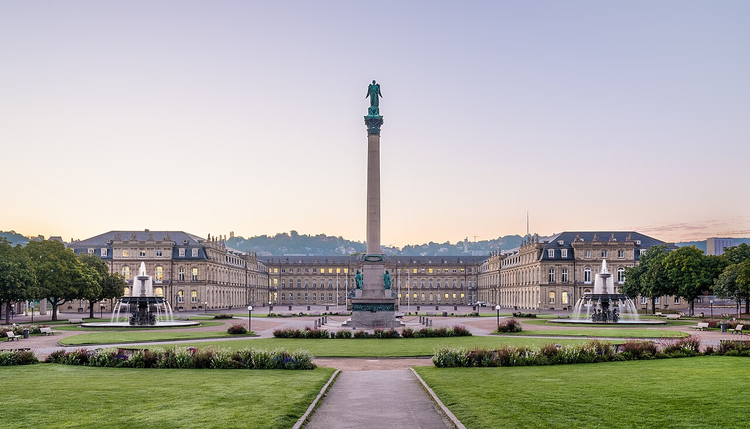
Schlossplatz appeared on the site of the Military Palace and is considered one of the city's most beautiful squares. A green park, flower beds with live blooms, and the Jubilee Column honoring the coronation of Wilhelm I hold the whole composition together.
The central gates of the royal house open onto the square, with Neues Schloss and Kunstmuseum standing nearby. In summer, open-air movies are shown here, and on holidays the square hosts city events. You should come here in the evening, when the lights come on.
- How to get there: five minutes on foot from Hauptbahnhof.
- The catch: on weekends the square is crowded, making it hard to get a photo without people.
4. Schillerplatz
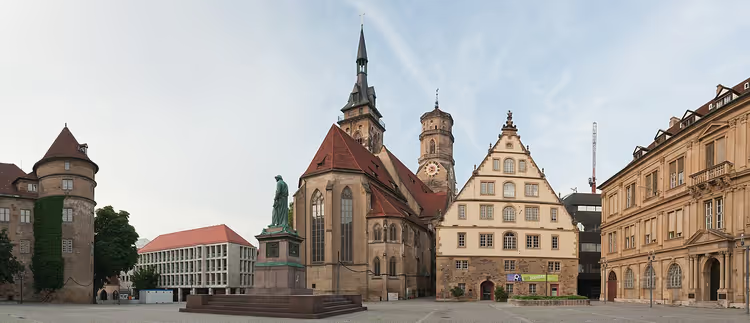 © Julian Herzog ( Website ) · CC BYPhoto: Julian Herzog ( Website ), CC BY (https://creativecommons.org/licenses/by/4.0), Wikimedia Commons
Schillerplatz was laid out in the late 16th century, when the residential buildings between Stiftskirche and Alte Kanzlei were demolished. For a long time it was ducal territory, and townspeople were only allowed in at the beginning of the 20th century.
In the center stands the Schiller monument by Thorvaldsen. Three times a week the square hosts a flower market, in August the Wine Village tents appear, and in December they are replaced by the Weihnachtsmarkt. You will see the square at its best in its floral decoration.
- How to get there: near Schlossplatz, past Altes Schloss.
- When to go: on flower market days or around Christmas, when the fairs are on.
5. Schloss Solitude
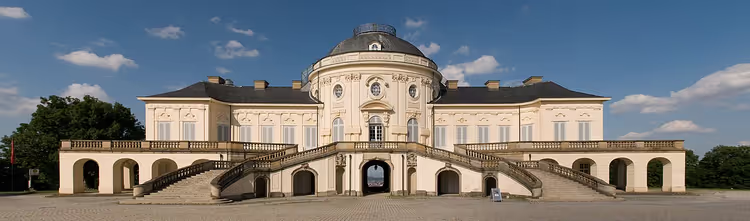 © pjt56 --- If you use the picture outside Wikipedia I would appreciate a short e-mail to pjt56@gmx.net · CC BY-SAPhoto: pjt56 --- If you use the picture outside Wikipedia I would appreciate a short e-mail to pjt56@gmx.net, CC BY-SA (https://creativecommons.org/licenses/by-sa/3.0), Wikimedia Commons
Schloss Solitude was built in the mid-18th century for a duke who loved seclusion. A straight avenue connected the palace with Residenzschloss Ludwigsburg, and later a higher school run by Schiller's father operated here.
Today the palace houses exhibition halls, an academy, and a villa for artist fellows. You can get here along a scenic road through vineyards. The palace is open Tuesday through Sunday, with a lunch break; Monday is closed.
- How to get there: outside the city, easier by car or city bus.
- Cost: admission to the palace halls is paid.
6. Schloss Rosenstein
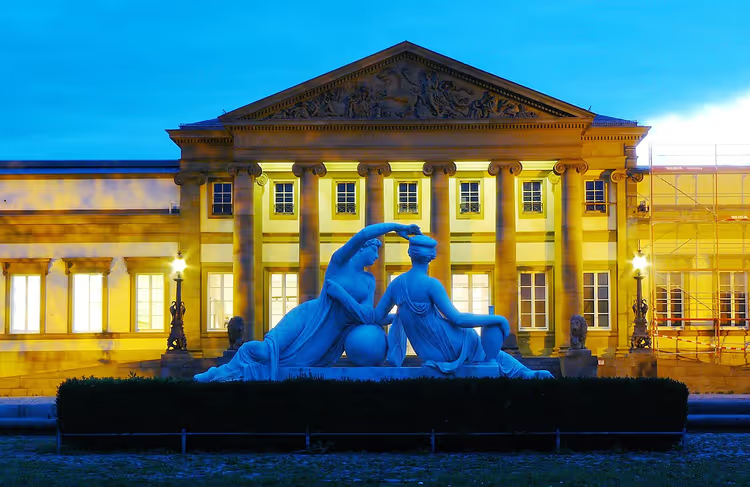 © CatalpaSpirit · CC BY-SAPhoto: CatalpaSpirit, CC BY-SA (https://creativecommons.org/licenses/by-sa/4.0), Wikimedia Commons
Schloss Rosenstein appeared at the beginning of the 19th century under King Wilhelm I. It was named after the queen's favorite flower. The palace pediments are decorated with scenes from Greek mythology, and you will find them without any hints.
The king died here in 1864. Later the building opened as a natural history museum with taxidermy, skeletons, and a mineral collection. The museum is open on weekdays and weekends; Monday is closed.
- How to get there: by public transport to Rosenstein Park, then through the park.
- Who it's for: good for families with children, because the exhibition is designed for schoolchildren.
7. Residenzschloss Ludwigsburg
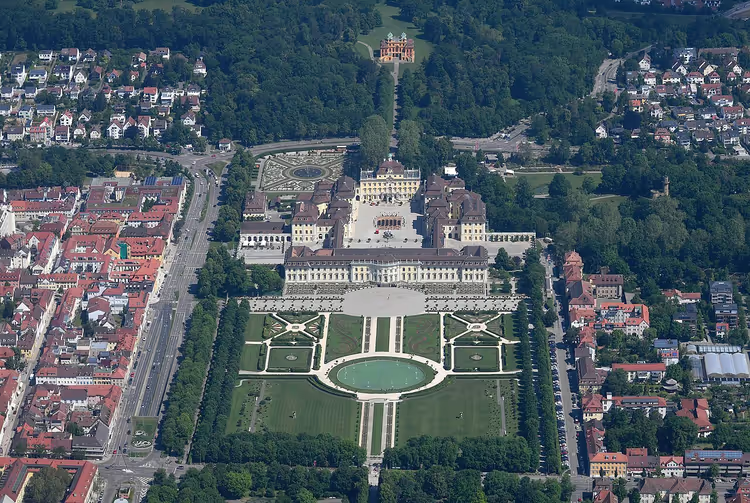 © Carsten Steger · CC BY-SAPhoto: Carsten Steger, CC BY-SA (https://creativecommons.org/licenses/by-sa/4.0), Wikimedia Commons
Residenzschloss Ludwigsburg was the residence of the Württemberg rulers, and the town of Ludwigsburg grew up around it. The main Baroque building was constructed at the beginning of the 18th century. Inside, furniture and carpets from the former owners have been preserved.
A large park was laid out around it with museums of ceramics, theater, and fashion, which are open daily. In 1805 Napoleon, Elector Friedrich, and Emperor Alexander met here. Children enjoy the Märchengarten, where fairy-tale figures stand and old carousels operate.
- How to get there: S-Bahn from Stuttgart to Ludwigsburg station, then on foot.
- Cost: park admission is paid, attractions inside are free.
- The catch: the park ticket is bought separately from the museums, so together it costs more.
8. Stiftskirche
 © Marek Śliwecki · CC BY-SAPhoto: Marek Śliwecki, CC BY-SA (https://creativecommons.org/licenses/by-sa/3.0), Wikimedia Commons
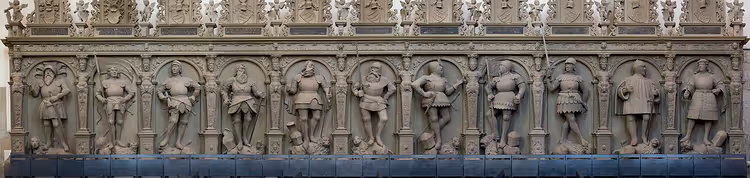
Stiftskirche is considered Stuttgart's main Protestant church and its symbol. Construction began as early as the 10th century, and it is the only building that survived from the Hohenstaufen era. The semi-basement level in the Romanesque style is the best preserved.
The Romanesque basilica eventually gave way to late Gothic. Inside you will see the monument to Ulrich and a sculptural composition with the rulers of Stuttgart. After the war the church was restored, and services continue to this day.
- How to get there: right on Schillerplatz.
- When to go: in the mornings it is quiet inside, with almost no tourists.
9. Linden-Museum
 © Till Westermayer from Freiburg, Germany · CC BY-SAPhoto: Till Westermayer from Freiburg, Germany, CC BY-SA (https://creativecommons.org/licenses/by-sa/2.0), Wikimedia Commons
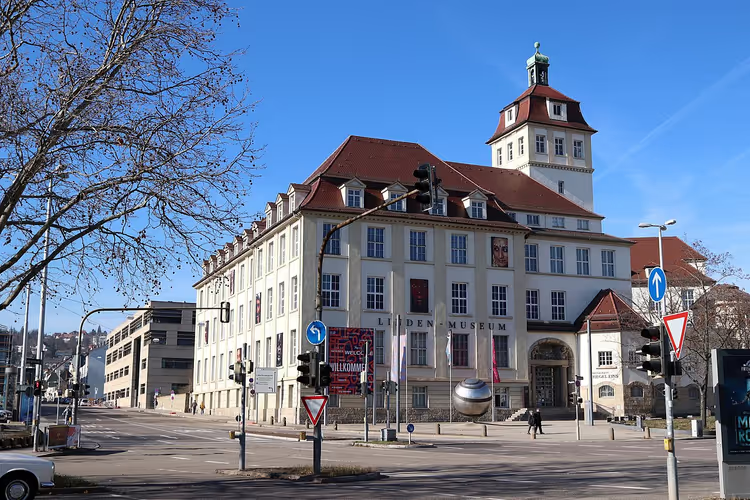
Linden-Museum, the state museum of ethnography, is considered one of the largest in Europe. The Neoclassical building opened in 1911, while the collection had been assembled since the 19th century. The museum was named after Count von Linden, chairman of the geographical society.
The halls are divided by world regions. Lectures and academic presentations take place here, and the collection itself numbers tens of thousands of items. You will see masks, textiles, and ritual objects from different cultures, often with explanations in English.
- How to get there: not far from the center, near Hegelplatz.
- Cost: admission is paid.
10. Mercedes-Benz Museum
 © Julian Herzog ( Website ) · CC BYPhoto: Julian Herzog ( Website ), CC BY (https://creativecommons.org/licenses/by/4.0), Wikimedia Commons
The Mercedes-Benz Museum occupies a cloverleaf-shaped building with a triangular platform in the middle. The exhibition traces the history of transportation from carriages to racing cars. You'll see vehicles belonging to Kaiser Wilhelm and Japanese Emperor Hirohito, as well as buses and fire engines.
The museum is open daily except Monday, from 9 am to 6 pm (as of 09/2026, Mercedes-Benz Museum). A visit takes half a day or more, so don't plan a second museum for the same day.
- How to get there: S-Bahn to Neckarpark station, then follow the signs.
- The catch: one visit is unlikely to be enough, the collection is very large.
11. Porsche Museum
 © qwesy qwesy · CC BYPhoto: qwesy qwesy, CC BY (https://creativecommons.org/licenses/by/3.0), Wikimedia Commons
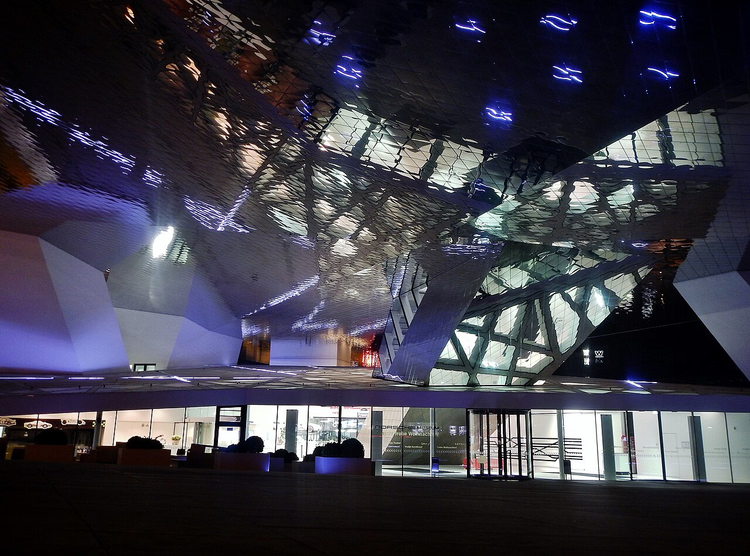
The Porsche Museum opened in 2009. The exhibition halls seem to float in the air: the structure rests on three concrete supports that weigh about as much as the Eiffel Tower. Dozens of cars are on display, plus hundreds of smaller exhibits.
The museum is open from 9 am to 6 pm, closed on Mondays (as of 09/2026, Porsche Museum). From January 18 to February 1, 2027, the museum is closed for renovation (as of 09/2026, Porsche).
- How to get there: S-Bahn to Neckarpark, the museum is next to the Mercedes-Benz Museum.
- The catch: closure dates change, check them before your trip.
12. Schweinemuseum
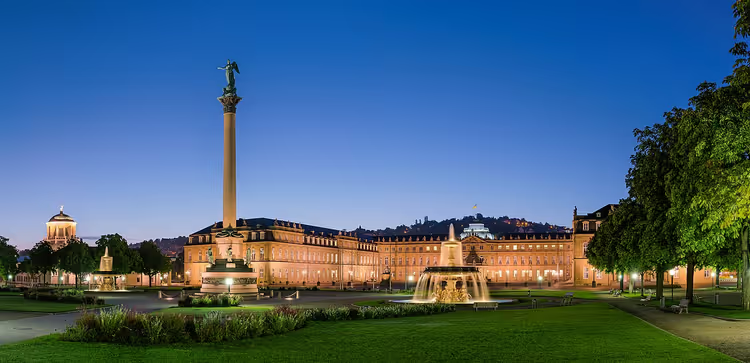
The Schweinemuseum looks like an actual pigsty, and that's part of the concept. In German tradition, the pig brings good luck, so the city has assembled a collection of figurines from around the world. You'll be surprised how many glass, porcelain, and wooden piggies are here.
 © Julian Herzog ( Website ) · CC BYPhoto: Julian Herzog ( Website ), CC BY (https://creativecommons.org/licenses/by/4.0), Wikimedia Commons
The rooms answer questions about pig biology, their behavior, and their role in art and religion. The museum is listed in the Guinness Book of Records. Despite the name, it doesn't smell at all inside.
- Cost: admission is paid.
- When to go: the museum is open every day, check the hours before your visit.
13. Staatsgalerie Stuttgart
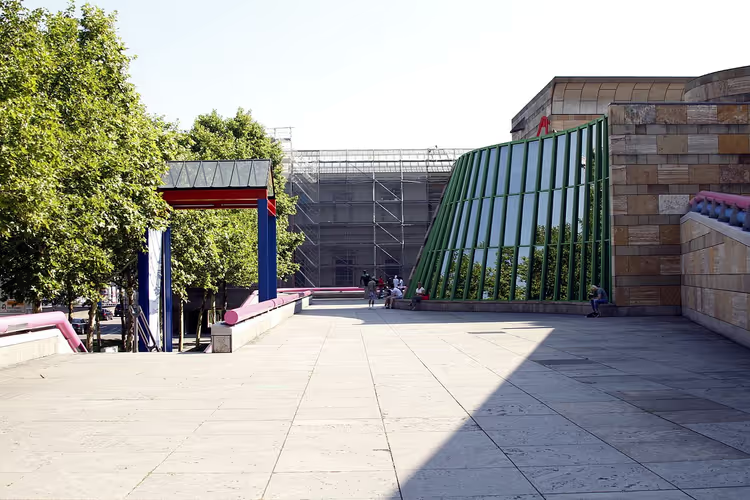 © José Luiz · CC BY-SAPhoto: José Luiz, CC BY-SA (https://creativecommons.org/licenses/by-sa/4.0), Wikimedia Commons
The Staatsgalerie Stuttgart opened in the mid-19th century. The new gallery designed by James Stirling and a third building housing graphic works turned the museum into an entire quarter. One of the new buildings resembles a ship racing across green waves.
In the galleries you'll see Rubens and Dürer, Monet and Renoir, as well as sculptures and photographs. Its Picasso collection is the largest in the country. On Thursdays the gallery stays open late into the evening, and collection tickets are sold online (as of 09/2026, Staatsgalerie).
- How to get there: about a ten-minute walk from Hauptbahnhof, past Schlossplatz.
- The catch: special exhibitions sometimes require a separate ticket.
14. Kunstmuseum Stuttgart
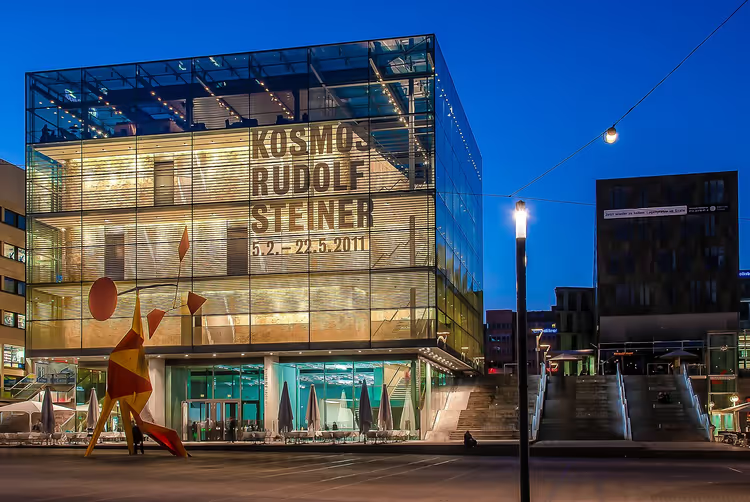 © pjt56 --- If you use the picture outside Wikipedia I would appreciate a short e-mail to pjt56@gmx.net · CC BY-SAPhoto: pjt56 --- If you use the picture outside Wikipedia I would appreciate a short e-mail to pjt56@gmx.net, CC BY-SA (https://creativecommons.org/licenses/by-sa/3.0), Wikimedia Commons
The Kunstmuseum Stuttgart stands in the center as a glass cube visible from Schlossplatz. The design was created by the architecture firm Hascher Jehle. The collection grew out of Count di Casanova's holdings and now numbers thousands of works.
A wide staircase leads both to the above-ground galleries and to the underground level, where you descend to the temporary exhibitions. The museum has its own library. Closed on Mondays, and on Fridays the museum stays open later than usual.
- How to get there: right on Schlossplatz, entrance from the square.
- Cost: admission is paid.
15. Stadtbibliothek Stuttgart
 © Pjt56 --- If you use the picture outside Wikipedia I would appreciate a short e-mail to pjt56@gmx.net or a message on my · CC BY-SAPhoto: Pjt56 --- If you use the picture outside Wikipedia I would appreciate a short e-mail to pjt56@gmx.net or a message on my, CC BY-SA (https://creativecommons.org/licenses/by-sa/4.0), Wikimedia Commons
Stuttgart City Library occupies a cube-shaped building near the train station, with wall-to-wall shelving and staircases inside. The library regularly appears on lists of the world's most beautiful libraries. Its collection includes books in dozens of languages.
Go up to the top to see the full interior structure: from above, the reading room looks like a white labyrinth. You can also borrow CDs, paintings, and photographs here. The library is open six days a week, closed on Sundays.
- How to get there: opposite Hauptbahnhof, on Mailänder Platz.
- Cost: free entry, the reading room is open to everyone.
16. Staatsoper Stuttgart
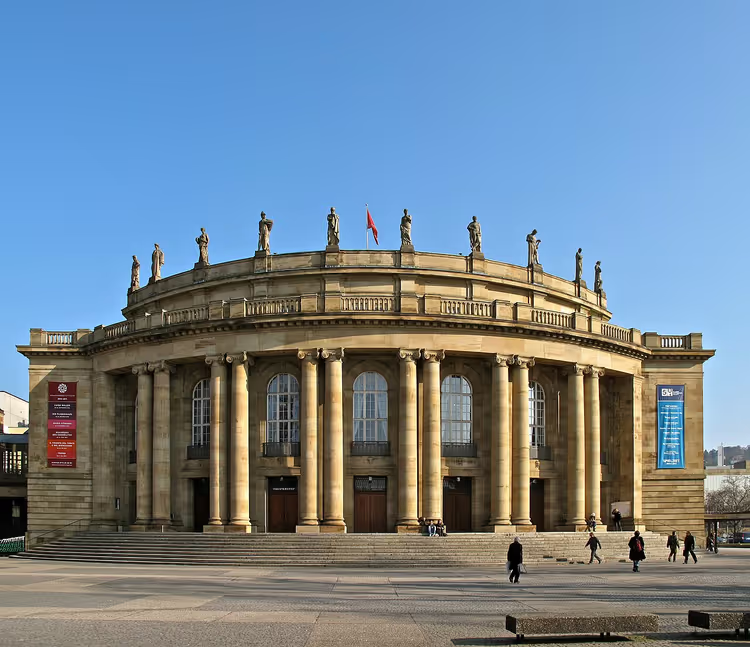 © Schlaier · CC BY-SAPhoto: Schlaier, CC BY-SA (https://creativecommons.org/licenses/by-sa/3.0), Wikimedia Commons
Staatsoper Stuttgart was designed by Max Littmann and opened in 1912, seating around 1,500 people. Many operas premiered here, and the company has repeatedly been named Opera House of the Year.
The building was restored after the war, but a major rebuild is still under discussion. The 2026/27 season runs in the historic hall, and tickets sell out well in advance (as of 09/2026, Staatsoper schedule). Productions are recorded and released on disc, so you can hear this orchestra at home too.
- How to get there: walk from Hauptbahnhof along Königstraße.
- The catch: tickets for popular productions sell out months ahead.
17. Königstraße
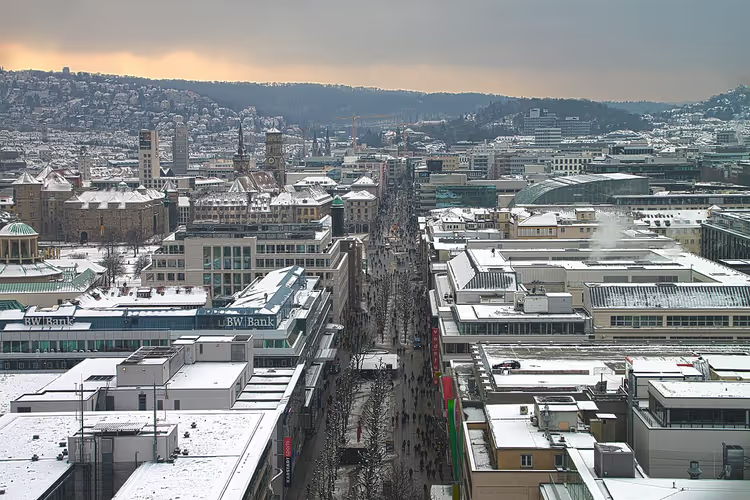 © Marek Śliwecki · CC BY-SAPhoto: Marek Śliwecki, CC BY-SA (https://creativecommons.org/licenses/by-sa/3.0), Wikimedia Commons
Königstraße is the city's main pedestrian street. It was laid out in the 19th century by order of King Frederick I, and the tram lines were later moved underground. The Royal Gate and stables once stood at the start of the street.
This is where you'll find the most shops and shopping centers, and Königstraße is a convenient starting point for reaching Schlossplatz. You can buy local wines and handmade souvenirs here. The street starts right at the train station, so it's hard to get lost.
- How to get there: starts at Hauptbahnhof.
- The catch: the street is packed in the evening and on Saturdays.
18. Killesbergturm
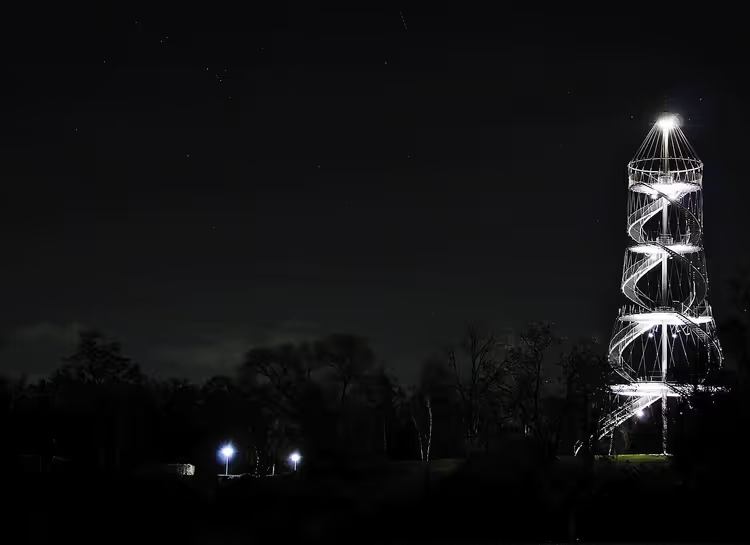 © qwesy qwesy · CC BYPhoto: qwesy qwesy, CC BY (https://creativecommons.org/licenses/by/3.0), Wikimedia Commons
Killesbergturm is an open structure with four levels, each with an observation deck. Not everyone dares to climb it: both the stairs and the platforms are enclosed only by transparent railings. This makes the tower feel like it's floating in the air.
You climb an open spiral staircase and see the city from the height of the park. The platforms offer clear views of the hills, vineyards, and surrounding neighborhoods. The view from here is calmer than from Fernsehturm, and there are noticeably fewer people.
- How to get there: take the tram to Killesberg, then walk through the park.
- The catch: the height and glass railings aren't for everyone.
19. Fernsehturm Stuttgart
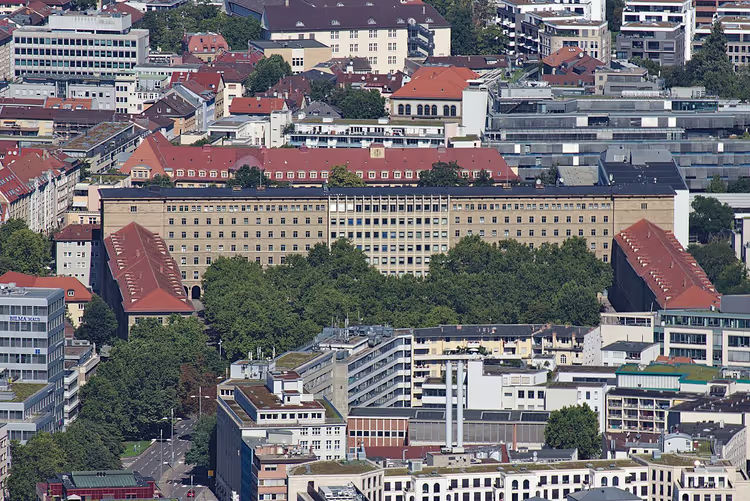 © Zinnmann · CC BY-SAPhoto: Zinnmann, CC BY-SA (https://creativecommons.org/licenses/by-sa/3.0), Wikimedia Commons
Fernsehturm Stuttgart was built in the middle of the last century in under two years. It was the world's first concrete TV tower, standing 216 meters tall (as of 09/2026, official website). Access to the observation decks is by timed-entry ticket (as of 09/2026, Stuttgart Tourist).
From the top you'll see not only the city but also the Alps on a clear day. A leisurely visit takes about an hour and a half. Restaurant tables should be booked in advance, but the view from the deck is just as good.
- How to get there: U-Bahn to Ruhbank (Fernsehturm), then a few minutes on foot.
20. Wilhelma
 © -- Nightflyer ( talk ) 20:08, 12 June 2016 (UTC) · CC BYPhoto: -- Nightflyer ( talk ) 20:08, 12 June 2016 (UTC), CC BY (https://creativecommons.org/licenses/by/4.0), Wikimedia Commons
Wilhelma combines a zoo and a botanical garden in a single park, the only one of its kind in Europe. It was established in the mid-19th century by order of King Wilhelm I. It is home to animals and plants from different climate zones.
You'll spend almost the whole day here: old sequoias, a magnolia grove, and rare orchid varieties take up a lot of time. Entry starts at 8:15 (as of 09/2026, Wilhelma, hours), and tickets are sold online and at the ticket offices (as of 09/2026, Wilhelma tickets).
- How to get there: from Hauptbahnhof, take a tram or S-Bahn to the Wilhelma stop.
- Who it's for: families with kids, because it's both a zoo and a park at the same time.
- The catch: the park is large, and in winter some tours are available by appointment only.
Stuttgart attractions on the map
Most points are within walking distance of the center, but Schloss Solitude, Residenzschloss Ludwigsburg, and Fernsehturm are outside it. Open the map to build a route based on your list and avoid unnecessary detours.
Landmarks of Stuttgart
Places on the map
- 1Altes Schloss Castle with a 16th-century bronze bell, now the Landesmuseum Württemberg
- 2Neues Schloss A "second Versailles" for Duke Carl Eugen, now a ministry building
- 3Schlossplatz One of the city's most beautiful squares, with the Jubilee Column
- 4Schillerplatz Square with a monument to Schiller, flower market and fairs
- 5Schloss Solitude Palace of the reclusive duke, now exhibition halls and an academy
- 6Schloss Rosenstein Natural history museum in a former royal residence
- 7Residenzschloss Ludwigsburg Baroque residence of the Württemberg rulers with the Märchengarten park
- 8Stiftskirche The city's main Protestant church, a symbol of Stuttgart
- 9Linden-Museum State ethnographic museum, one of the largest in Europe
- 10Mercedes-Benz Museum History of transport from carriages to racing cars
- 11Porsche Museum Exhibition halls on three concrete supports
- 12Schweinemuseum Collection of pig figurines listed in the Guinness Book of Records
- 13Staatsgalerie Stuttgart Rubens, Dürer, Monet and the country's largest Picasso collection
- 14Kunstmuseum Stuttgart Glass cube on Schlossplatz, the Count Casanova collection
- 15Stadtbibliothek Stuttgart Cube-shaped library building, one of the most beautiful in the world
- 16Staatsoper Stuttgart Opera house from 1912 seating almost fifteen hundred spectators
- 17Königstraße The main pedestrian street with shops and souvenirs
- 18Killesbergturm Four-level observation tower in Killesberg Park
- 19Fernsehturm Stuttgart The world's first concrete TV tower, 216 metres tall
- 20Wilhelma Zoo and botanical garden in one park, the only one of its kind in Europe
Tours and tickets with time slots
In summer, lines at museums and observation decks are long. If you don't want to wait at the ticket office, book a timed entry ticket or a guided walk in advance.
Tours and tickets
Guided tours, skip-the-line tickets and activities — most offers can be cancelled free of charge.
See offers on GetYourGuideThe widget loads once you give your consent.
⁉️🤔 Frequently asked questions
How many days do you need for Stuttgart?
One day is enough for the city center and one car museum: each takes half a day. Give the second day to Wilhelma, it takes almost the whole day. Leave Schloss Solitude and Ludwigsburg outside the city for the third day, each requires half a day.
When is the best time to go?
May, June, and September are the quietest. In summer, Schlossplatz and Königstraße are crowded with tourists, and in December the center is taken over by Christmas markets. In winter, some park tours run by appointment only.
What is closed on Mondays?
Most museums: Mercedes-Benz Museum, Porsche Museum, Linden-Museum, and Kunstmuseum Stuttgart. Monday is a good day for walking along Königstraße, Schlossplatz, and Schillerplatz. Check the venues' websites before your trip, as museum closing days change.
The S-Bahn runs from Stuttgart Airport to Hauptbahnhof, and the trip takes about half an hour. Königstraße starts right around the corner from the station, and trams and S-Bahn lines run to Wilhelma and the museums on the Neckar. Buy a public transport ticket from a machine or in the app.
Is it worth buying tickets in advance?
For Fernsehturm and Wilhelma, yes: entry there is time-slotted, and weekend slots sell out. Mercedes-Benz Museum, Porsche Museum, and Staatsgalerie also accept regular tickets at the door. Check the rules on the official websites, as they change by season.
In short: what to book
If you have one day, take the city center and one car museum, and save the second museum for later. For a family, Wilhelma and Märchengarten in Ludwigsburg make more sense. Tickets for observation decks and some museums are easier to buy in advance so you don't have to wait at the ticket office.

A small editorial team writing guides for independent travel. We travel ourselves, but we haven’t been everywhere, so we check prices, opening hours and how to get there against official sources.