














SIM card in Georgia 2026: where to buy and how to activate a number
You can't get a taxi in Tbilisi without an app. Taxi apps, maps, and translators only work with internet access, and roaming with a European carrier in Georgia costs more than a local data package. That's why almost every tourist buys a local SIM card upon arrival.
The short answer: almost every tourist needs a SIM card, and Georgia is one of the easiest countries to buy one. A passport, a few minutes at a carrier's office, and you have a Georgian number with a data package. We compared three networks and broke down Magti's 2026 plans.
Below you'll find prices in lari, office addresses in Tbilisi, Batumi, and Kutaisi, step-by-step registration in the MyMagti app, and eSIM options for those who don't want to swap out their physical card. All prices and opening hours were checked in September 2026.
Ad: this article contains affiliate links. We earn a commission if you book through them, at no extra cost to you.
Do tourists need a SIM card in Georgia
💡 In short:
- A local SIM card solves the taxi, maps, and messaging problem for your entire trip.
- A week of data costs less than one taxi ride from the airport.
- Prices and packages: 09/2026, verified on the Magti internet packages page.
Georgia ranks 17th in the world for mobile internet speed: the median download speed in the country is 156.3 Mbps (Speedtest Global Index, 06/2026, Speedtest Global Index). That's faster than many EU countries, and the connection works even in mountain villages, although there's no continuous coverage in the mountains.
Wi-Fi is available almost everywhere in Georgia: hotels, guesthouses, cafes, shopping malls, and even mountain villages. In central Tbilisi you can pick up the free city network Tbilisi Loves You, but an open network is only good for maps and messaging; it's best not to open banking apps on it.
Starlink has been operating in the country since November 2023 (starlink.com), and it's gradually improving connectivity in remote areas. Power outages still happen in Tbilisi, especially in older buildings, so if you work remotely, keep a data package as a backup and tether from your phone.
A local number is needed more often than you'd think. Taxis in Tbilisi, Batumi, and Kutaisi are ordered through an app, the sulfur baths in Tbilisi take room bookings by phone, and accommodation hosts and drivers message you on WhatsApp. Without a local card, you're left with roaming, where a megabyte costs as much as a local gigabyte.
A Georgian number also comes in handy for everyday things: a Wolt courier calls when they can't find your building entrance, and the front desk at a guesthouse in Mestia asks you to confirm your booking by phone. Messaging apps cover most tasks, but you still need a number to register for taxi and delivery apps.
Another argument for a local card is time. The Magti counter at Tbilisi airport is open 24/7, but it mostly sells 15-day tourist packages. In the city, offices are open from morning to evening, and the selection of packages is wider there.
What to know before buying
- Your phone must be unlocked for any SIM card. Check this at home, before you fly.
- You need a physical passport, not a photo on your phone, otherwise the card won't be registered.
- Magti sells regular SIM and eSIM at the same price, 10 GEL, and that's just the price of the card (Magti eSIM page, as of 09/2026).
- Global eSIM brands often connect you to a weaker network, and in the mountains that's noticeable.
- Most tourists have enough data, because calls and SMS in Georgia are replaced by WhatsApp.
- One card doesn't work across the entire South Caucasus: for Armenia and Azerbaijan, get a separate SIM or eSIM.
 © Jelger Groeneveld · CC BYPhoto: Jelger Groeneveld, CC BY (https://creativecommons.org/licenses/by/4.0), Wikimedia Commons
Plan for two payments on the card: one for the SIM card itself, one for the data package. The card costs 10 GEL, and if you want, 1 GEL is credited back to your account (as of 09/2026, Magti terms), which is only enough to check the connection and load one short page in the browser.
You can pay in cash in lari or by Visa and Mastercard. Magti offices accept both, and we didn't see a separate card payment fee, but still keep some cash on hand: in a small town, there's sometimes only one ATM in the entire area.
If your itinerary includes three Caucasus countries, decide in advance. One physical card doesn't cover the region, roaming on a Georgian number is expensive, and global eSIMs don't cover Armenia. For travel to Armenia and Azerbaijan, it's cheaper to buy a local card in each country.
At the office, you'll be asked to sign a contract, so bring a pen if you want to read the text at your own pace. The contract is in English, and the terms are standard: a prepaid plan with no commitments and no cancellation process.
Is Wi-Fi and roaming enough
Roaming in Georgia is among the most expensive in the region, because European carriers bill traffic by the megabyte. Navigation and photo uploads eat through your budget in a couple of days, and Wi-Fi only helps in cafes and hotels.
If you're planning to rent a car in Georgia, you need internet constantly. On the Georgian Military Road, in Svaneti and Kakheti, coverage drops in places, and it's better to download offline maps at home, before leaving Tbilisi.
Your own mobile router is also an option: Magti sells portable MiFi devices, and for a family of three it's sometimes cheaper than three separate SIM cards with packages.
The purchase process in Georgia is simple. You go to an office with your passport, choose a package, sign a contract in English, and leave with a working card. There are no activation codes and no residence registration.
Georgia is more convenient than many countries in this regard. You don't need a local tax ID, the number is activated immediately, and nobody asks about the purpose of your visit. You show your passport once, at registration.
Georgia's three carriers: Magti, Silknet, and Cellfie
Three mobile networks operate in the country: Magticom (Magti), Silknet (formerly Geocell), and Cellfie (formerly Beeline). You'll find offices of all three in Tbilisi, Kutaisi, Batumi, Telavi, and Zugdidi, and the difference between carriers isn't the price of the SIM card but coverage outside the cities.
Cellfie is the cheapest option, and it's enough for a short trip to Tbilisi. Outside the city the network gets weaker: in Upper Svaneti and near Vardzia coverage is patchy, so in the mountains you may end up with no internet at all.
Silknet has noticeably improved its network in recent years and was the first in the country to offer a convenient eSIM. Coverage has become more consistent, but in high-mountain areas it still trails Magti; on the other hand, the carrier has dedicated tourist packages (Silknet tourist packages, as of 09/2026).
We recommend Magti as your primary SIM for the trip. According to the carrier, the network covers 99% of the country's populated areas (Magti coverage profile, as of 09/2026).
A separate reason to choose Magti is underground coverage. You can comfortably use your phone at Tbilisi metro stations and in basement restaurants in the center, while the other two carriers often lose signal in underground passages.
Below is a comparison of all three carriers by practical criteria.
Carrier | Coverage outside cities | Key strength | Best for |
|---|---|---|---|
Magti | most consistent, including mountain areas | speed and stability | country-wide routes, remote work |
Silknet | consistent in major cities | its own eSIM and tourist packages | trips to Tbilisi and Batumi |
Cellfie | weaker in the mountains | lowest SIM price | short city trips |
The rule of thumb is simple: the farther you go from Tbilisi, the more coverage matters, and the less sense it makes to save on the SIM. The price difference between carriers is small, while the difference in connectivity in Svaneti or Tusheti is huge.
Speeds in cities and in the mountains differ. In Tbilisi and Batumi you get 5G and fast downloads, while in mountain villages you're left with LTE, which is enough for maps, messengers, and uploading photos, but not always for video calls.
You can check coverage before buying on the carrier's website: Magti publishes a coverage map (Magti coverage map, as of 09/2026). If a point on your route is marked as a weak-signal zone, plan offline maps in advance.
SIM cards are sold not only in the capital, so buying one on the way to Kakheti or the coast is easy. In small towns the selection of packages is sometimes thinner than in Tbilisi, and the staff member may speak only Georgian.
Registration is the same across all three carriers. They only record your name and document number in the system. Nobody asks for hotel booking details or travel dates.
A second SIM is often bought for a tablet or a second phone. A separate SIM with a small package costs less than tethering from your main phone all day: the battery drains faster and speeds drop.
If you work remotely, check your neighborhood. In central Tbilisi the network gets congested in the evening, and in old buildings with thick walls the signal is weaker. In that situation, a spot by the window or a mobile router with an external antenna helps.
eSIM deserves a separate mention. Silknet launched it first and sells it online more easily than anyone; Magti added eSIM later, but at the same price as a physical SIM. Both carriers issue a local number, so taxi and delivery apps work without restrictions.
The tourist bundle and a regular package differ in duration and price. The bundle is sold at the airport together with a free SIM, lasts 15 days, and has no unlimited data. A regular package is selected in the app and can be changed at any time.
Plans change every season, so check the carrier's website before your trip. The prices we list below were verified in September 2026, and that's enough for budget planning: the discrepancy is usually small.
In remote corners like Vashlovani Nature Reserve, any carrier can lose signal. When planning a trip to such places, download maps in advance and don't rely solely on the mobile network.
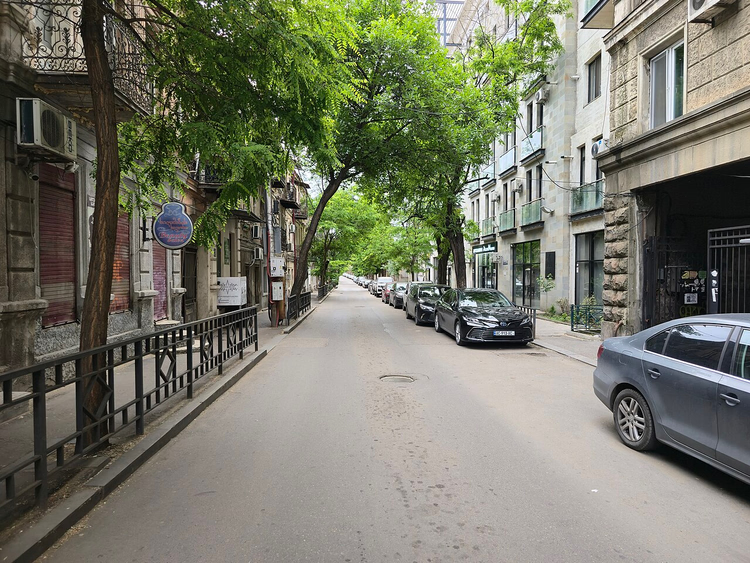 © David1010 · CC BY-SAPhoto: David1010, CC BY-SA (https://creativecommons.org/licenses/by-sa/4.0), Wikimedia Commons
Why we recommend Magti
- Coverage. The best network in the country, including mountain areas and the Tbilisi metro.
- Speed. 5G in most cities, national median of 156.3 Mbps (Speedtest Global Index, 06/2026, Speedtest country ranking).
- Prices. Cocktail packages are assembled to fit your duration (as of 09/2026, Magti internet packages).
- Validity. Most packages last 30 days (as of 09/2026, Magti internet packages), so you don't need to renew them every week.
- Activation. No codes or checks: you leave the office with a working number.
- App. Through MyMagti you can check your balance and buy new packages with an international card.
- Tethering. Hotspot works, and your laptop connects to your phone without restrictions.
- eSIM. You can activate the SIM without plastic, in the office or before you fly out from home.
For a family of several people, get SIMs for everyone. One SIM won't let you conveniently call two taxis and won't share internet across five devices.
You'll barely need to contact the carrier. Activation happens in the office, top-ups go through the app, and support responds in chat in English. This is noticeably easier than in countries where the number gets activated a day after purchase.
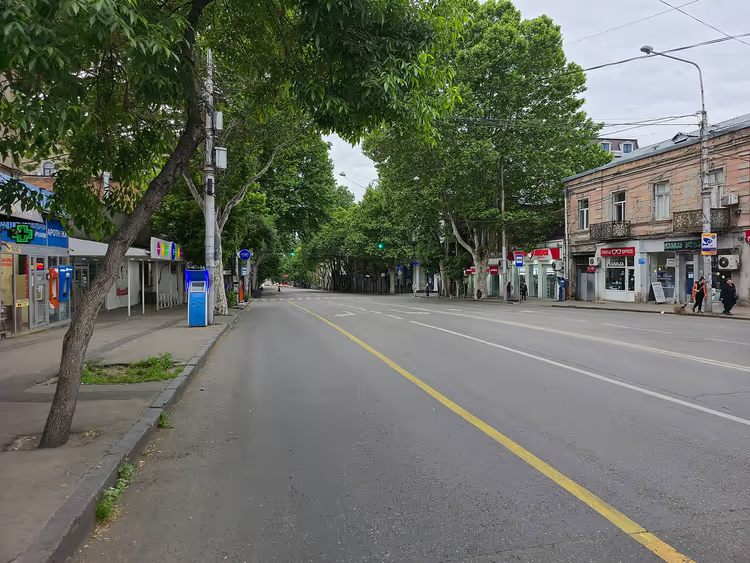 © David1010 · CC BY-SAPhoto: David1010, CC BY-SA (https://creativecommons.org/licenses/by-sa/4.0), Wikimedia Commons
Magti prices in 2026
We've put the prices into two tables: the first covers the SIM itself, the second covers data packages. All amounts are in lari, according to the carrier (as of 09/2026, Magti terms, Magti internet packages).
SIM type | Price | Notes |
|---|---|---|
Universal SIM Card | 10 GEL | optionally 1 GEL is credited back to your account |
Dual SIM-Card | 10 GEL | two numbers on one card |
Magti eSIM | 10 GEL | no plastic; this is the price of activating a number on eSIM |
Data package | Price | Validity |
|---|---|---|
1 GB | 5 GEL | 30 days |
3 GB | 9 GEL | 30 days |
5 GB | 12 GEL | 30 days |
20 GB | 30 GEL | 30 days |
Unlimited | 35 GEL | 30 days |
Unlimited | 10 GEL | 7 days |
Unlimited | 2 GEL | 24 hours |
Calls and SMS are rarely needed by tourists, but the rates are worth knowing. Call initiation costs 12 tetri, a minute within the country costs 24 tetri, SMS costs 6 tetri, and internet without a package costs 10 tetri per megabyte (as of 09/2026, Magti standard plan).
Which Magti plans to choose based on trip length
Choose a plan not by data volume, but by trip length, and below are four scenarios that cover almost every visit to Georgia. All prices are based on the operator's data (as of 09/2026, Magti internet plans).
Trip of 7 days or less. Get the 7-day unlimited plan for 10 GEL through the app, and together with the SIM card for 10 GEL, a week of internet costs 20 GEL total. If you don't need unlimited data, Tbilisi and Kutaisi airports have a 15-day bundle: 5 GB for 15 GEL, with the SIM card included free (as of 09/2026, Magti tourist bundles).
Trip of 7-15 days. Two consecutive 7-day unlimited plans bought in the app cost only 20 GEL: you buy the second plan from your phone in a couple of minutes, and leftover data stops being a concern.
More than 15 days, data only. One 30-day plan: 5 GB for 12 GEL or unlimited for 35 GEL. For remote work we recommend unlimited, because video calls burn through gigabytes fast, while a 5 GB plan is enough for occasional email checks.
More than 15 days, calls needed. First get a data plan, then add a separate minutes plan; check its price in the MyMagti app. Without a plan, calls within Georgia cost 24 tetri per minute plus a 12 tetri connection fee (as of 09/2026, Magti standard rate), so a plan pays for itself as soon as you start calling hotels, drivers, and accommodation hosts.
Tourist bundles at airports
All three operators sell ready-made bundles at the airport; Magti calls them Welcome Packages. At Tbilisi and Kutaisi airports, Magti offers two bundles, and the SIM card is free in both (as of 09/2026, Magti tourist bundles):
- 15 GEL: 5 GB of data and local SMS/MMS for 15 days
- 30 GEL: 3 GB of data, 30 minutes of international calls, free local calls and SMS for 15 days
Airports used to sell other bundles too, for 7, 14, and 30 days, but they are no longer listed on the operator's website. For comparison, app prices (as of 09/2026, Magti internet plans):
- unlimited for 7 days for 10 GEL, plus SIM card for 10 GEL
- 5 GB for 30 days for 12 GEL
- 20 GB for 30 days for 30 GEL
- unlimited for 30 days for 35 GEL
For a week-long trip with unlimited data, the app is the better deal: 20 GEL for the SIM card and 7 days of unlimited data. If 5 GB is enough for two weeks, the airport bundle for 15 GEL with a free SIM card is even cheaper than buying the card and plan in the city. The 30 GEL bundle only makes sense if you need international minutes.
If you need unlimited data, buy the SIM card at a regular office in the city. If you're heading straight to Mestia or Kazbegi, get a bundle at the airport right after landing.
Cocktail plans and data rollover
Magti has Cocktail plans where you build your own bundle of data, minutes, and SMS. For a two-week trip, this is a convenient middle ground between pure data and a bundle with international calls, and you overpay less than at the airport.
Leftover data doesn't expire instantly. If you top up your balance within 7 days, unused data from the previous period carries over to the new one (Magti data rollover, as of 09/2026). Check your balance in advance so you don't lose gigabytes.
Where to buy a SIM card in Georgia
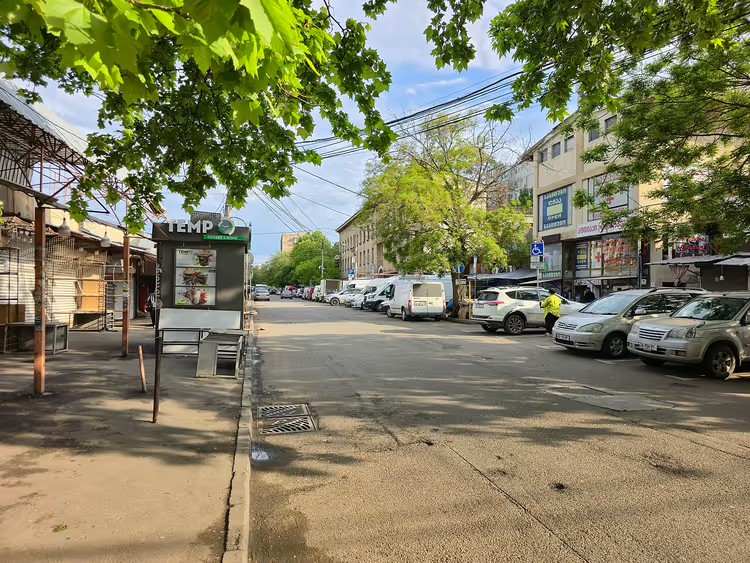 © David1010 · CC BY-SAPhoto: David1010, CC BY-SA (https://creativecommons.org/licenses/by-sa/4.0), Wikimedia Commons
Buying at the airport
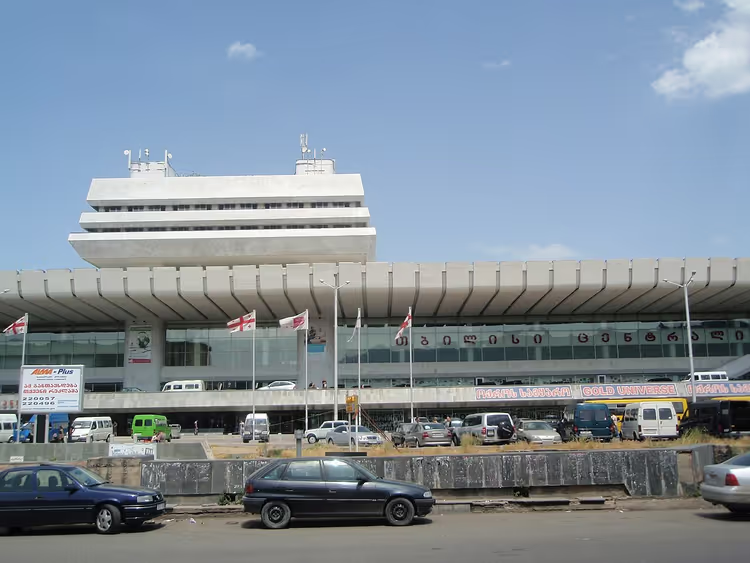
Magti shops in the arrivals halls at Tbilisi and Kutaisi airports operate around the clock: as long as planes are landing, a staff member is on site. The operator specifically notes that these are counters with tourist bundles (Magti airport counters, as of 09/2026).
The catch at the airport is just one thing: they sell tourist bundles there. Sometimes you'll be allowed to buy a regular SIM card and top it up with the amount you need, but don't count on it.
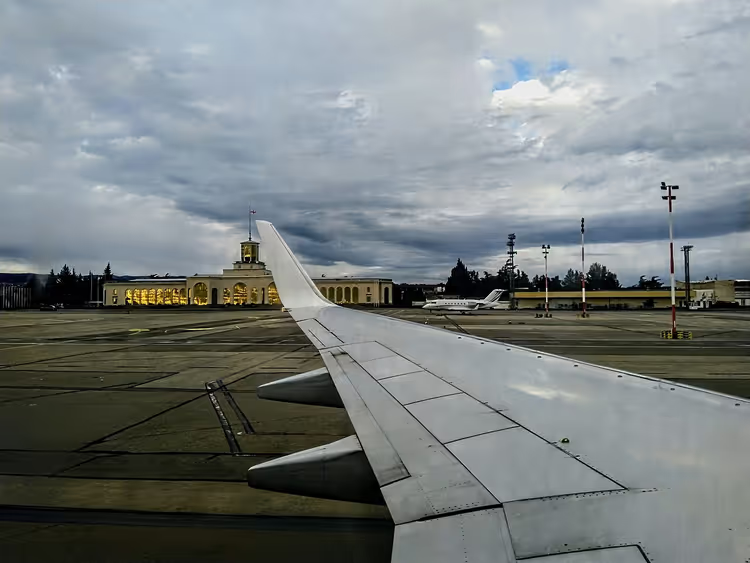 © Jelger Groeneveld · CC BYPhoto: Jelger Groeneveld, CC BY (https://creativecommons.org/licenses/by/2.0), Wikimedia Commons
Buying at a city office
Magti offices are located in all major cities and most small towns, with two important exceptions: Kazbegi (Stepantsminda) and Mestia, where the operator has no offices. If these places are on your route, buy the SIM card in advance, in Tbilisi or Kutaisi.
Keep opening hours in mind. Most offices are closed on Sundays; in Tbilisi, only select branches operate seven days a week, such as the one on Rustaveli Avenue. All branches are closed on national holidays.
Tbilisi has more than 15 Magti locations, and three of them are the most convenient for tourists. We've marked each one on the map; opening hours were verified in September 2026:
- Rustaveli Avenue, 22 on the map: closest to Freedom Square, open 9:00-21:00 on weekdays and 9:00-18:00 on weekends
- Aghmashenebeli Avenue, 109 on the map: near Fabrika, open 9:00-18:00 Monday through Saturday
- Chavchavadze Avenue, 2 on the map: Vera district and Stamba Hotel nearby, open 9:00-18:00 Monday through Saturday
In Kutaisi, the office is on Saint Nino Street, in the northwest corner of the park (Kutaisi office on the map, hours as of: 09/2026), and is open 9:00-18:00 on weekdays and 10:00-17:00 on weekends.
In Batumi, you'll find the office on Abashidze Street near the Old Town (Batumi office on the map, hours as of: 09/2026). The schedule is the same: 9:00-18:00 on weekdays, 10:00-17:00 on weekends.
If you're entering Georgia by land, you can get a SIM in Sadakhlo after the Armenian border, as well as in Kabali and Gardabani after the Azerbaijani border (Sadakhlo office on the map, hours as of: 09/2026). From the Turkish border in Sarpi, the nearest offices are in Batumi.
Ordering an eSIM online
Magti sells eSIMs for the same 10 GEL, and you can order one from home before your trip. You'll find detailed setup instructions in the eSIM section below, and we recommend this option for anyone with a newer phone that has no physical SIM slot.
How to buy a Magti SIM: step-by-step guide
Decide on a plan before you visit the office, and you'll be in and out in a few minutes. Here's what to do:
- Take a ticket from the electronic queue. The on-screen language can be switched to English.
- Tell the staff member you need a new SIM and a data plan. You can choose your own number for an extra fee or take a random one.
- Hand over your passport for registration. One passport is enough for several SIMs.
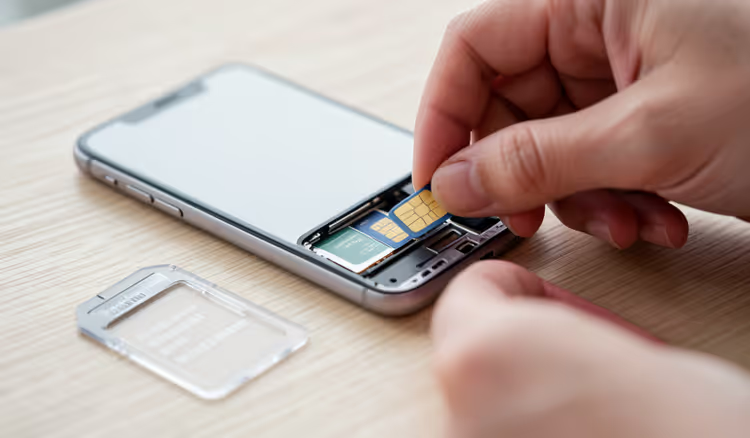
- Wait for the SIM to be installed and check your connection before leaving the office. If you don't have internet, ask for help right away.
- Keep the plastic card holder. It has your number and the PUC code you'll need if you move the SIM to another phone.
- Sign the contract. Two copies in English, take yours with you.
- Pay in cash in lari or by card.
 AIIllustrative image: AI-generated
You can check your connection right there in the office: open a map or a messaging app and make sure the page loads. Magti activation usually requires no settings and takes less than a minute, but the SIM sometimes doesn't turn on immediately, so don't leave without verifying your internet works.
If something isn't working, the issue can be resolved on the spot. The staff member will check your balance, APN settings, and plan status, and replace the SIM if necessary. Coming back to the office with a broken SIM is more of a hassle than sorting it out right away.
How to top up your balance with the MyMagti app
The MyMagti app is the main tool for staying connected in Georgia, and we recommend installing it right after buying your SIM, while the office is still open. Registration takes a few minutes:
- Switch the language to English in the top right corner of the screen.
- Tap the registration button at the very bottom and enter your number. It is printed on the plastic frame you took from the office.
- Wait for an SMS with a four-digit code and enter it (MyMagti app on the Magti website, as of 09/2026).
- Create a password. A six-letter word works fine, numbers and special characters are not required.
- After that, the app keeps you logged in, so you do not need to enter the password every time.
Inside, you can see your remaining data and minutes, buy new packages, and claim promotions. For a tourist, the main benefit is the ability to buy extra data in two taps when your balance is running low.
Promo packages in the app are cheaper than airport ones (as of 09/2026, Magti internet packages). These packages save you when home Wi-Fi goes down along with the power, which happens regularly in old Tbilisi buildings.
Topping up with cash and card
There are three ways to top up your balance. You can visit a Magti office and pay with cash or card, deposit cash through a payment kiosk, or pay for a package separately in the app with a Visa, Mastercard, or AMEX card.
Payment kiosks operate 24/7 and are often more conveniently located than offices, but for that convenience kiosks usually charge a small fee, and the amount depends on the terminal. Larger amounts are better deposited at an office or in the app.
With an international card, the process works like this: first you choose a package in the app, then select card payment and enter your card details. The payment is secured by TBC Bank, and the details are entered from scratch each time, so keep your card handy.
If you have an account with TBC or Bank of Georgia, topping up takes seconds through online banking. Auto top-up from a Georgian account can also be enabled in the app, but we prefer to pay manually to control spending and avoid unexpected charges after you leave.
ESIM for Georgia: options
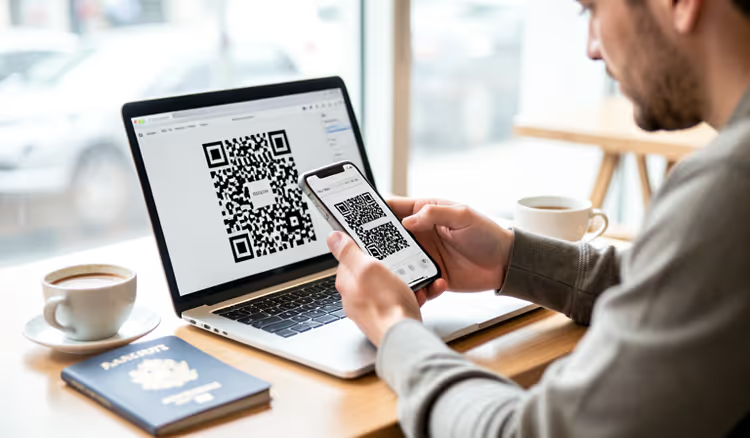
An eSIM is more convenient than a physical SIM if your phone supports it: the card is activated via QR code or in the carrier's app, and the physical SIM slot stays free for your home number. We recommend getting an eSIM from a local carrier, ideally Magti, to get a Georgian number and the best network in the country.
 AIIllustrative image: AI-generated
Option 1: Magti eSIM
Magti sells an eSIM for the same 10 GEL as a regular SIM, and you can buy it at an office or online (how to order a Magti eSIM, as of 09/2026).
 © Robot8A · CC BY-SAPhoto: Robot8A, CC BY-SA (https://creativecommons.org/licenses/by-sa/4.0), Wikimedia Commons
For an online order, you first need an account on magticom.ge. Instead of a customer number, you provide an email address, and verification is done with a photo of your passport and face.
Then the process goes like this:
- Open the online order page on the carrier's website.
- Select the option to buy a number and set both the minimum and maximum price to 0 GEL.
- Choose a number and write it down somewhere safe.
- Decline the promo offer and select eSIM on the next step.
- Pay by card or Google Pay.
One important note about payment. Foreign bank cards sometimes fail on the Magti website, and the payment shows a decline. In that case, the only option is to contact support in the chat and provide the number you tried to buy, after which the operator completes the transaction manually.
Until your card is verified, buying an eSIM online is risky. If the payment fails and you are already in Tbilisi, it is easier to get an eSIM at an office: the process takes the same few minutes as with a physical SIM, and activation happens on the spot.
Option 2: Silknet eSIM
Silknet offers its own eSIM, which is easier to buy online. You also get a local number for taxis and bookings, and the entire process is done through the carrier's website (eSIM from Silknet, as of 09/2026).
Silknet packages are cheaper, and the carrier has a plan with unlimited internet and domestic calls for the duration of your trip. Check the price on the website, because Silknet's rates change more often than Magti's. We recommend Silknet for those staying in cities, where the carrier's network is consistent.
Option 3: global eSIM for multiple countries
If you are planning to visit several Caucasus countries plus Turkey, look into global eSIMs. According to providers, these plans cover several dozen countries, including Georgia, Azerbaijan, and Turkey, but not Armenia.
A global eSIM has two catches. You do not get a local number, which means you cannot register in taxi apps, and the network is often weaker than Magti's, which is especially noticeable in the mountains. On the plus side, one card covers your entire route, and you do not need to pay extra for roaming.
You can compare plans and order a global eSIM in this selection of eSIMs for Georgia. Buy it in advance, at home, and activate it once you land at Tbilisi airport.
Apps you will find useful in Georgia
Besides MyMagti, you will need a few more apps, and we have gathered the ones that actually work in the country.
- MyMagti. Balance and data package purchases.
- Bolt. The main taxi app in Tbilisi, Batumi, and Kutaisi.
- 112 Georgia. The official emergency services app in English, Georgian, and Russian, with geolocation and an SOS button.
- WhatsApp. The country's main messenger, used to communicate with accommodation hosts and drivers.
- yr.no. The most accurate weather forecast for mountain areas.
- Tbilisi Transport and Tbilisi Bus Live. Schedules and real-time bus arrival times; the second app is Android-only.
- TKT.GE. Buying train and concert tickets.
- Maps.Me and Wikiloc. Offline maps and hiking tracks around Kazbegi.
- Wolt and Wenu. Food delivery and ordering from cafes from your phone.
It is also worth installing a translator with Georgian. Google Translate handles Georgian worse than European languages, so it is better to keep an app with an offline dictionary on hand, especially in mountain areas without coverage.
Tours and tickets in Tbilisi are easier to buy in the GetYourGuide app, which also works in Georgia. This comes in handy if you are planning a day trip to the monasteries of Mtskheta, the wine region of Kakheti, or the mountains of Svaneti.
Two things are worth doing before your trip. Save the contract from the carrier in your email and write down your number and PUK code in your phone's notes: the plastic frame is easy to lose, and without the code, transferring your SIM to a new phone turns into a separate visit to the office.
Also check that your phone supports the frequencies used by Georgian carriers. Devices made for the US and Japanese markets sometimes do not pick up European bands, and then even a working SIM will not give you internet, even though the package fee is charged.
And one last thing: do not throw away your home SIM. At the airport, you will put it back in the slot and keep the Georgian one as a souvenir or save it for your next trip, as long as you top it up occasionally.
How to block spam SMS
Since March 1, 2024, Georgia has had a law on advertising messages: businesses cannot send messages without the subscriber's consent (Magti's terms for messaging, as of 09/2026). In practice, spam still comes through, especially in the first days after registering a number.
Turning off ads on Magti is simple. Dial 182# and press 1 in the dialog box, and the second code, 297#, disables messages from a specific company, MS Group, which bothers subscribers more than most.
These two actions remove most of the messages, but not all of them. If ads come from small senders, it's easier to block the number on your phone and not waste time complaining to the operator.
A separate story is SMS in phonetic transliteration. Georgian text often arrives in Latin script, and you read it through a converter and then translate it. For short messages from hosts and drivers this is rarely necessary, they're usually in English.
Numbers in Georgia are reused, so calls from strangers are quite likely. Your number may have belonged to someone else, and someone will be looking for an acquaintance. If someone calls you expecting a different person, say "Inglisuri itsi?" (do you speak English?) or simply "Ar vitsi" (I don't know).
⁉️🤔 Frequently asked questions
How do I check the balance on a Georgian number?
Open the MyMagti app, your data and minutes balance is visible on the home screen. Without internet, dial 1111# and you'll get an SMS with your remaining balance (Magti codes for balance, as of 09/2026). These codes work for Magti; other operators have different codes.
Why does my balance go negative?
A small fee is regularly deducted from the number, for example to support the 112 emergency call service; the operator states the exact amount in the contract terms. If your balance is zero, the amount accumulates as debt. Service usually still works with a negative balance, but a new data package won't activate until the account is topped up.
What should I do if the internet doesn't work?
First check your APN settings, that's the most common cause. If the network didn't reconnect after your package ran out, top up your balance and switch your network preference from 4G to 2G and back. If that doesn't help, go to a Magti office: they'll fix the settings for free in a couple of minutes.
How long does an unused SIM card last?
A Magti number with no payments goes into partial disconnection mode after 60 days. To keep it for 180 days, activate the Number Maintenance service for 1 GEL (as of 09/2026, Magti terms). This is convenient if you return to Georgia several times a year and don't want to buy a new card each time.
Does a Georgian SIM work in Abkhazia and South Ossetia?
No. Abkhazia (part of Georgia under international law) and South Ossetia operate on separate mobile networks, and a regular Georgian SIM doesn't work there. If these areas are on your route, sort out connectivity in advance and don't count on a number bought in Tbilisi.
Do I need separate roaming for Armenia and Azerbaijan?
Yes, roaming must be enabled before you leave Georgia. Magti's roaming packages cost noticeably more than local ones; check current prices by country in the MyMagti app. For a trip to Yerevan or Baku, it's cheaper to buy a local SIM: in Armenia that's Team Telecom, in Azerbaijan Azercell.
Will I have enough data in the mountains?
For navigation and messaging, a 5 GB package is enough, but in Svaneti and Tusheti coverage drops out in places for all operators. Download offline maps and tracks in advance, and bring a power bank for mountain overnight stays: guesthouses don't always have outlets in every room.
In short: what to book
Before a trip to Georgia, two things need sorting out: connectivity and accommodation. Connectivity is handled by a Magti SIM card bought in the city, not at the airport, while accommodation and everything else are easier to book in advance.
If you're on a short city trip, take a hotel in central Tbilisi and don't spend your budget on transport. If you're traveling around the country for two weeks, look for accommodation with parking and plan your car rental in advance. To get to know the city and Kakheti, one day with a guide is enough.
Accommodation in Tbilisi and Batumi: hotels on Trip.com
Flights to Tbilisi: tickets on Kiwi.com
City tours: tours on GetYourGuide
Buy the SIM card on your very first day. With it you can call a taxi, find your hotel, check your remaining data in MyMagti, and head off to Svaneti or Kakheti without worry.

A small editorial team writing guides for independent travel. We travel ourselves, but we haven’t been everywhere, so we check prices, opening hours and how to get there against official sources.