
















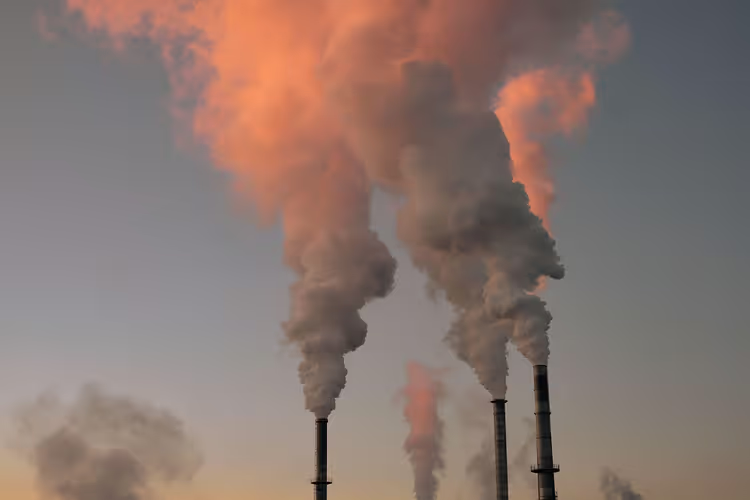
Smog in Delhi: why the air in India's capital worsens every autumn
Every November, the sky over Delhi turns gray, and the smog doesn't leave for two or three months. It repeats year after year, but the winter of 2025 was especially harsh: air quality was rated as "severe," and visibility dropped to a few meters (as of 11/2025, Reuters). You breathe this mixture every time you step outside, and it's dangerous, especially for children and the elderly.
What's happening in Delhi right now
💡 In short:
- Pollution is measured by the AQI index: the higher the value, the more dangerous the air.
- During smog season, schools and construction sites are closed, and some flights are canceled.
A dark gray haze hangs over the city, and the sun is barely visible through it. October 2025 was the second worst in five years: the average monthly AQI reached 223 (as of 11/2025, The Indian Express).
Pollution is measured in PM2.5 particles, which penetrate deep into the lungs. The average annual level in Delhi exceeds 101 µg/m³: that's 2.5 times the national limit and 20 times the WHO recommendation (as of 11/2025, The New Indian Express). The WHO recommends no more than 5 µg/m³ as an annual average and no more than 15 µg/m³ as a daily average (WHO).
You feel this kind of air immediately: your throat gets scratchy, your eyes water, some people develop a fever, and those who work outdoors all day have it the hardest.
How smog changes daily life in the city
Many people in Delhi are poor: they go outside to earn money for food, and a closed door won't help them.
Authorities introduce emergency measures. Schools close, and children study online if the family has a laptop or smartphone. Some employees switch to remote work, construction sites are halted, and old diesel vehicles are banned from the city (as of 11/2025, according to Reuters).
Smog also hits transportation. Low visibility causes flight cancellations: on one day, about 100 flights were canceled at Delhi airport and several hundred more were delayed (as of 11/2025, NDTV), and trains run late on such days. That's how a city lives where millions of people go to work outdoors every day.
Why air quality deteriorates specifically in late October
The city produces some pollution year-round: vehicle exhaust, dust from construction sites, and smoke from burning trash. But starting in late October, two more factors come into play.
The first factor is weather: the air cools down, and cold layers settle over the city like a lid. There's almost no wind, so the smog isn't carried away; instead, it accumulates day after day, and you can see it in the gray sky above the rooftops.
The second factor is crop stubble burning in the fields around Delhi: starting in late October, farmers in Punjab and Haryana burn stubble to quickly prepare fields for the next planting. Officially, this practice is banned. But it's cheaper than any alternative, so many keep burning.
But stubble isn't the main cause: according to scientists' calculations, it accounts for about 14% of fine particles in Delhi's air (as of 2025, The Hindu). Vehicle exhaust and construction contribute more, and stubble just adds the autumn peak.
Why authorities don't solve the problem
Politicians prefer emergency measures that don't address the root cause. With one hand they close schools, and with the other they look for someone to blame: the blame usually falls on neighboring states where fields are burned, the previous government, and other agencies.
In 2019, the government adopted the National Clean Air Programme. The document is non-binding, so it can't be enforced through the courts (as of 2025, Economic Times). The Supreme Court has repeatedly demanded action, and in November 2025 it called the measures taken a "complete failure" (as of 11/2025, Hindustan Times).
While agencies argue among themselves, the air remains dirty. Residents can't influence this; all they can do is wait for the smog to clear on its own.
Why people don't protest
People are used to authorities paying little attention to their daily lives. Politicians mostly make themselves known around elections: promises get louder before voting day.
For poor families, the task is simpler: earn enough in a day for food, and dirty air is secondary compared to that concern.
And almost everyone is confident that the smog will go away on its own in two or three months, and that's usually what happens. Long-term health consequences are rarely noticed, even though the harm from PM2.5 particles accumulates over years.
⁉️🤔 Frequently asked questions
When is Delhi's air the dirtiest?
The peak comes in late October, November, and December. During this time, cold air settles over the city like a lid, there's almost no wind, and farmers around the city burn their fields. This combination of conditions creates the thickest smog, which lingers for two or three months.
Is it dangerous to travel to Delhi in winter?
A short trip is usually not dangerous for a healthy person, but the air during smog season is unpleasant for everyone. If you have lung or heart conditions, it's better to postpone your trip to spring. Before flying, check the current AQI index and decide whether you're willing to breathe this mixture for a week.
Why can't stubble burning simply be banned?
Formally, a ban exists, but monitoring thousands of hectares is difficult. Farmers don't have cheap equipment to clear stubble any other way, and paying a fine is easier for them than restructuring their operations. Until an affordable alternative appears, burning will repeat every autumn.
Does closing schools help?
Closed schools reduce the burden on children: they spend less time outdoors and don't breathe exhaust near roads. But the source of pollution doesn't go away. So this measure has almost no effect on overall smog levels, and its impact is short-lived.
What do residents themselves do?
Those who can stay home, close windows, and run an air purifier. Those who can't keep working outdoors and wear a mask. Some families temporarily leave the city to stay with relatives in other areas. Many believe the smog will soon clear on its own.
In short: what's important to know
Smog in Delhi repeats every autumn. It's a seasonal problem, not a one-time accident: it's caused by exhaust and construction, while cold air and stubble burning add the autumn peak. The country still has no mandatory program with real fines, so the city relies on emergency measures and waits for the wind.
If you're planning a winter trip, check the current AQI index before flying and bring FFP2 masks. If someone in your group has asthma, move the visit to spring. If you're interested in the season itself, look at CPCB's November statistics.

A small editorial team writing guides for independent travel. We travel ourselves, but we haven’t been everywhere, so we check prices, opening hours and how to get there against official sources.