
















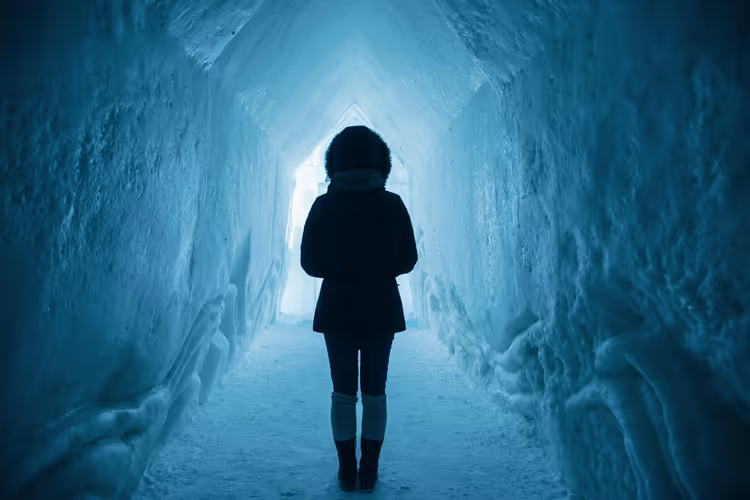
Ice caves of Iceland: how to choose a tour and what is inside
The ice cave in Iceland lives for one season. Every winter, guides search for new entrances under the glaciers, and what you saw in last year's photos may have already collapsed and melted. So the main question is not "which cave is the best" but "which tour is actually running this winter."
We've put together working options for the 2026-2027 season: where caves are opening, how much tours cost, what gear is included, and how studio photos differ from what you'll actually see inside. Below you'll find prices with verification dates and honest catches that almost nobody writes about.
Ad: this article contains affiliate links, we earn a commission if you book through them, at no extra cost to you.
What to choose: the short answer
💡 In short:
- In winter, from November to March, choose a tour to the Jökulsárlón caves under the Vatnajökull glacier.
- If you're driving yourself, book a short 3-hour tour directly from Jökulsárlón.
- In summer you have only two options: the black Katla cave from Vík or the man-made Langjökull tunnel.
- Season and access conditions: 09/2026, as of Visit Vatnajökull.
Below we break down all the options in order: first the season, then logistics and gear, and finally prices and a list of tours.
In winter: Jökulsárlón and the Vatnajökull glacier
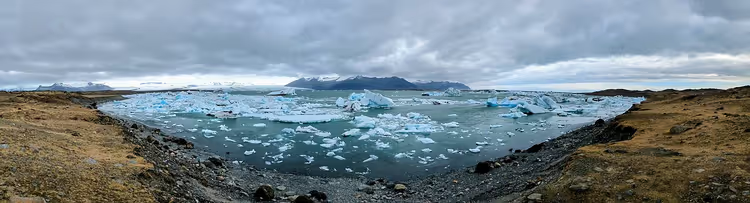
You'll see real blue ice only in the cold season. Natural caves are open in winter, and most tours depart from the Jökulsárlón area in the southeast of the country. Here, entrances into the ice are found anew every year, so cave names and brochure photos change constantly.
The most convenient format for a self-drive trip is a small group tour of about 3 hours. You park at Jökulsárlón, transfer to a super jeep, and drive to the glacier, then they bring you back to the same spot. You don't need a hotel in Reykjavík for this kind of tour, and it saves a lot of time.
 © Manticorp · CC BYPhoto: Manticorp, CC BY (https://creativecommons.org/licenses/by/4.0), Wikimedia Commons
In summer: the Katla cave and the Langjökull tunnel
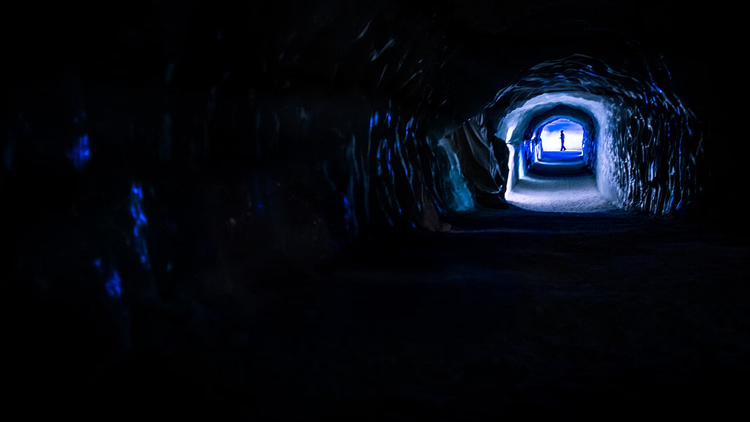
From May to September, natural caves are closed, so the choice narrows down to two options. The first is the black Katla cave under the Mýrdalsjökull glacier. It operates year-round, and tours start from Vík or from Reykjavík. Inside, you'll see a mix of volcanic ash and blue ice, and part of the ceiling is open to the sky. In summer, the cave's condition depends heavily on the weather and access may be limited.
 © Giuseppe Milo · CC BYPhoto: Giuseppe Milo, CC BY (https://creativecommons.org/licenses/by/3.0), Wikimedia Commons
The second summer option is the man-made tunnel inside the Langjökull glacier. It's not as scenic as a natural cave, but you descend 40 meters under the ice and walk along even corridors in any weather.
Is it worth going: what photos don't show
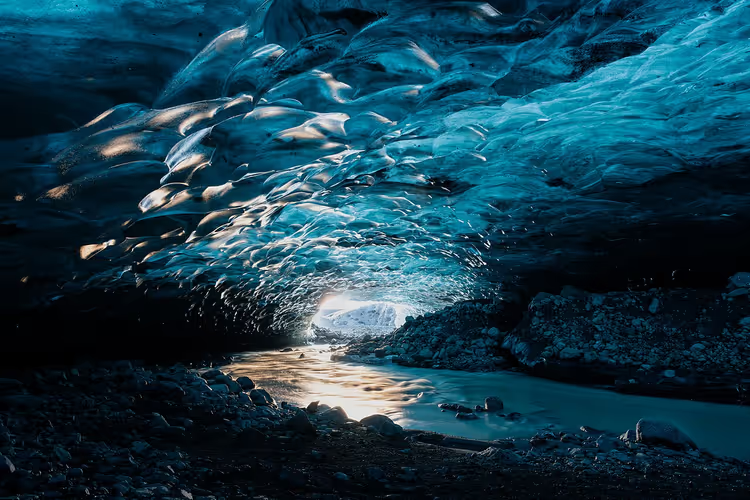
The short answer: yes, if you're not expecting the picture from the ad. Professional photographers shoot caves with wide-angle lenses and light the ice, so in photos the caverns look bigger and brighter than they actually are. In reality, the cave is often smaller, and the color is softer and calmer.
The second point: ice lives its own life. Every summer old caves disappear, and in autumn guides find new ones. Even if a cave keeps its old name, the shape inside will be different. So don't get attached to a specific name from the internet, and book a tour for the season, not for the name.
 © Eric Kilby from Somerville, MA, USA · CC BY-SAPhoto: Eric Kilby from Somerville, MA, USA, CC BY-SA (https://creativecommons.org/licenses/by-sa/2.0), Wikimedia Commons
When ice cave season is open
The natural ice cave season in Iceland is short. As of the Visit Vatnajökull tourist office, caves in glaciers form in winter, and entering requires stable freezing temperatures. In practice, tours run from November to March, sometimes until early April.
Why so late? Glaciers exist year-round, but they move. The cold isn't for beauty, it's for safety: only with a sustained freeze does the cave ceiling hold its shape. If you arrive too early, the tour may be canceled on the last day, and you'll be left without a program.
Where the caves are and how to get there
There are no ice caves near Reykjavík. They all lie several hours' drive along Route 1, and the last stretch you cover in a super jeep. The most famous caves are around Jökulsárlón in the southeast.
From Reykjavík to Jökulsárlón is about 5 hours' drive along Route 1, plus at least 45 minutes by off-road vehicle to the glacier itself (on the map). So a day trip from the capital turns into a very long day behind the wheel. If you don't want to drive, take a two-day south coast tour where the cave is already included in the itinerary.
In winter, Route 1 is sometimes closed due to snow and wind. Before heading out, check the status on the official safetravel.is website. A closure can happen even on the morning of your trip, so check the map before every leg.
Do you need a car in winter
If you're driving yourself, take a compact car: village streets are narrow, and a large SUV is inconvenient there. Full insurance costs extra money, but in winter it removes unnecessary stress and covers minor damage from rocks. Car availability in February melts quickly, so book in advance.
Compare car rental prices in Iceland
Can you enter a cave on your own
No, you cannot enter an ice cave without a guide. The ice is unpredictable, and the entrance is often hidden under fresh snow. Access requires a super jeep that can find the way past the marker, and a guide who knows this season's current route.
The good news: you don't have to book the tour from Reykjavík. If you're traveling around the country on your own, you can join a group right in Vík or at Jökulsárlón and pay only for the off-road portion. That saves you a day on the road.
Before entering, you're given gear: crampons, a helmet, and a headlamp. Bring your own small flashlight too, because group lamps often run down and go out. Most tours are easy: you're driven almost to the entrance, and there's almost no walking required.
Some tours combine the cave with a glacier hike. In that case the physical demand is higher, and you should choose a program based on your fitness level. If you don't do long distances, look for a tour marked easy.
How safety is checked
A tour starts only when the ice is stable enough. Every morning, guides assess the temperature and the condition of the road to the cave. In some caverns, part of the ceiling is deliberately removed and replaced with wooden supports to keep the vault from collapsing.
Weather rules almost everything. The operator will write to you on the day of the trip, but the final decision is often made at the last moment. So assume you won't see everything: whatever opens up is already a bonus to the trip.
How ice caves form
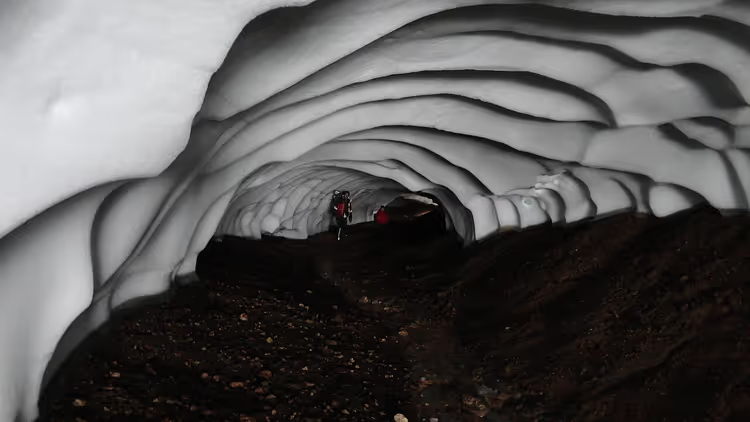
What we call an ice cave is, scientifically, a glacier cave. It appears when meltwater flows under or through a glacier and washes out a cavity in the ice mass.
In Iceland, water has two reasons to flow under the ice. The first is summer melting on the surface: water goes into crevasses and washes out channels. The second is geothermal heat from below, which melts the ice from the inside.
 © Gaianauta · CC BY-SAPhoto: Gaianauta, CC BY-SA (https://creativecommons.org/licenses/by-sa/3.0), Wikimedia Commons
Every year, expert teams find entrances anew. Ceiling height always varies: in some places you walk upright, in others you have to bend down. In one blue cave, guides even carved steps to make the entrance easier for regular tourists.
Why ice is blue, and sometimes black
Where the blue color comes from
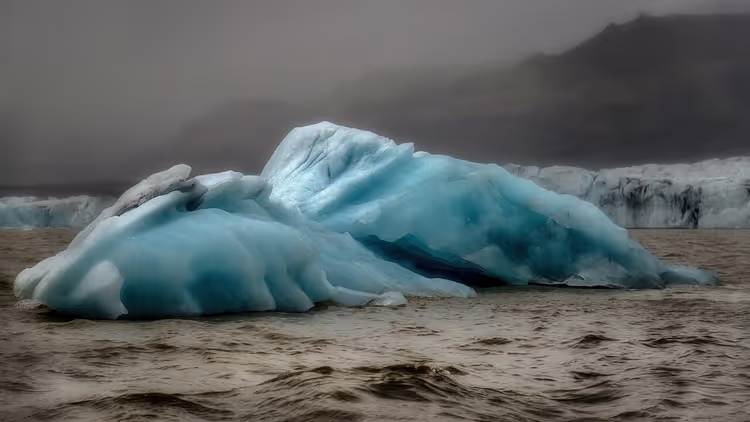
Many people expect the cave to have the neon blue of a poster. In reality, the color is there, but it's calmer than in professional photos. Glacier ice is dense because it's been compressed by tons of mass above. This kind of ice absorbs all colors of the spectrum except blue, and that blue is what you see on the walls.
 © Bernd Thaller · CC BYPhoto: Bernd Thaller, CC BY (https://creativecommons.org/licenses/by/2.0), Wikimedia Commons
Phone photos inside often come out pale, while the eye sees a real, deep shade. If you want to capture the color in a photo, shoot without flash and hold the camera level.
Where black ice comes from
A black cave looks completely different. The ice there is mixed with volcanic ash, because Iceland sits on volcanoes. The ash settles in thin waves, and the surface resembles polished stone with a pattern. Looking at it up close is more interesting than photographing it.
 © Zairon · CC BY-SAPhoto: Zairon, CC BY-SA (https://creativecommons.org/licenses/by-sa/3.0), Wikimedia Commons
On some tours you visit both a blue and a black cave in one day. This is the best way to understand the difference, because the two caverns are close to each other and the contrast is immediately visible.
Where to stay for a winter trip
If you are heading to the caves for several days, it makes sense to change your base. Reykjavik works for the first and last evening. Selfoss sits between the Golden Circle and the south coast. Vik is convenient near the waterfalls and glaciers, and Hofn is the gateway to the eastern fjords.
Farther north, the bases become Egilsstadir between the fjords, Reykjahlid by Lake Myvatn, Akureyri in the north, and Grundarfjordur on the Snaefellsnes peninsula. These towns make it easy to build a ring road trip around the entire island.
Prices rise in high season, and hotels near Jokulsarlon get booked up well in advance. Book early or compare options in towns along your route.
See Reykjavik hotels on Trip.com
Jokulsarlon: Vatnajokull glacier caves
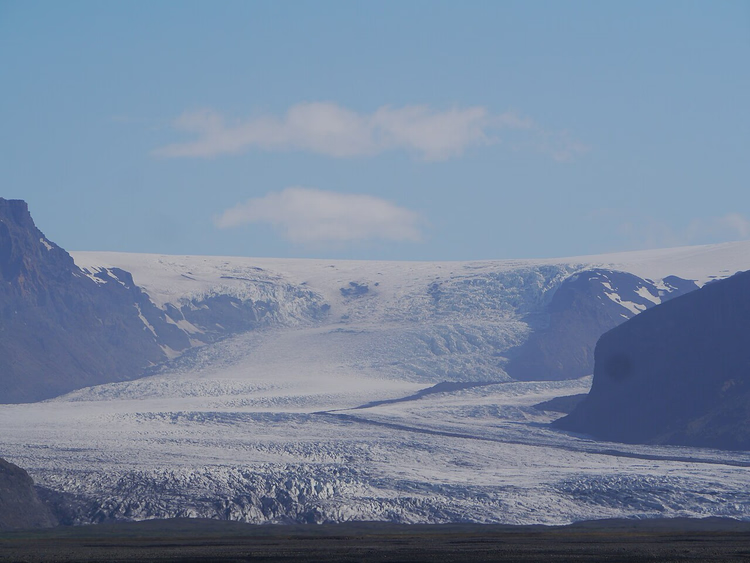
The most popular tours leave from Jokulsarlon. The place itself is well known, so it is a convenient starting point for trips to the Vatnajokull glacier caves. Several companies operate from the parking lot, and from there you head out in a large 4x4.
 © Eric Kilby · CC BY-SAPhoto: Eric Kilby, CC BY-SA (https://creativecommons.org/licenses/by-sa/2.0), Wikimedia Commons
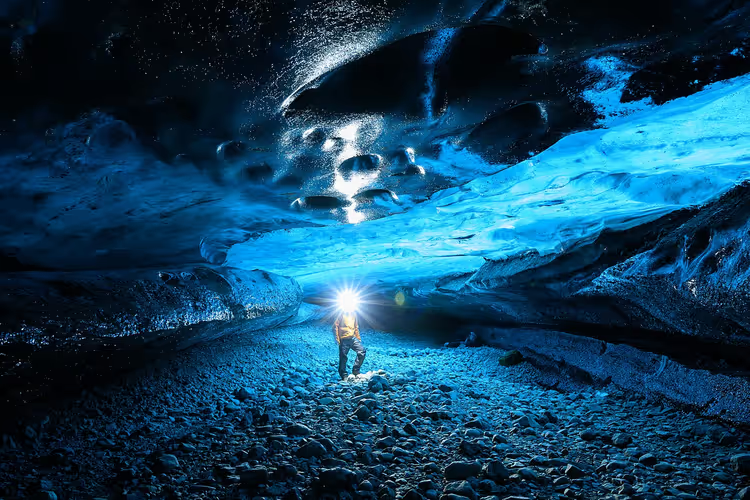
You will read many articles about the Crystal cave. The key thing to know: that particular cave is gone, and new entrances are found every year. Sometimes they look like last year's, sometimes completely different. Companies use attractive names and striking photos to get you to book a tour. You will not see exactly what is in the pictures, but the trip is still worth it.
A short tour lasts about 3 hours: the drive, the visit, and the return. Spots fill up fast, so book in advance, especially for New Year's dates.
A tour to two caves at once
One of the best formats is a small group that, in good conditions, visits both the blue and the black cave. Only two companies run these tours, so the group stays small and the guide has time to tell you about each cavern. See ice cave tours on GetYourGuide.
Blue Diamond and Sapphire caves
The names Blue Diamond and Sapphire are known from the best Jokulsarlon photos. But the original caves have already disappeared. Tours with these names take you to new caverns that formed in the same area. Every season is a surprise, so do not get hung up on a specific name and look at reviews of the tour itself.
From Reykjavik
If you do not have a car, a day trip from Reykjavik will be very long. It makes more sense to take a 2-3 day tour with an overnight stay: the itinerary usually includes waterfalls, the black sand beach, and Diamond beach. That way the drive does not eat up the whole day, and the cave becomes one of the stops along the route.
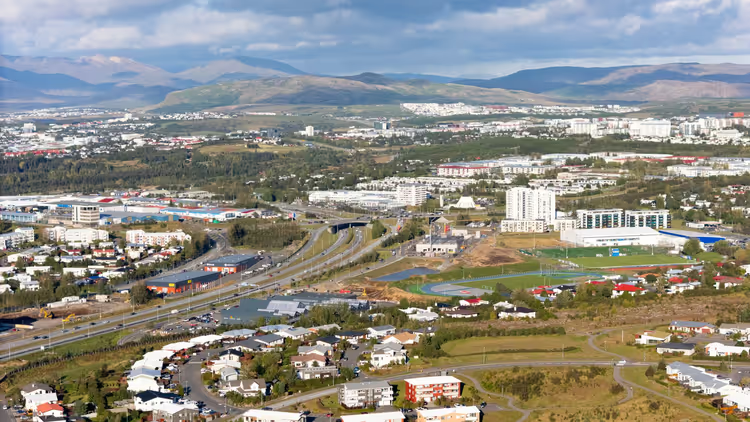
In practice, a two-day tour is more relaxed: you are not rushing back at night and you get to see more stops along the way. In winter, that matters more than an extra item on the itinerary.
Tours and tickets in Iceland
Guided tours, skip-the-line tickets and activities — most offers can be cancelled free of charge.
See offers on GetYourGuideThe widget loads once you give your consent.
Other tours: Skaftafell and Katla
Skaftafell: ice plus a hike
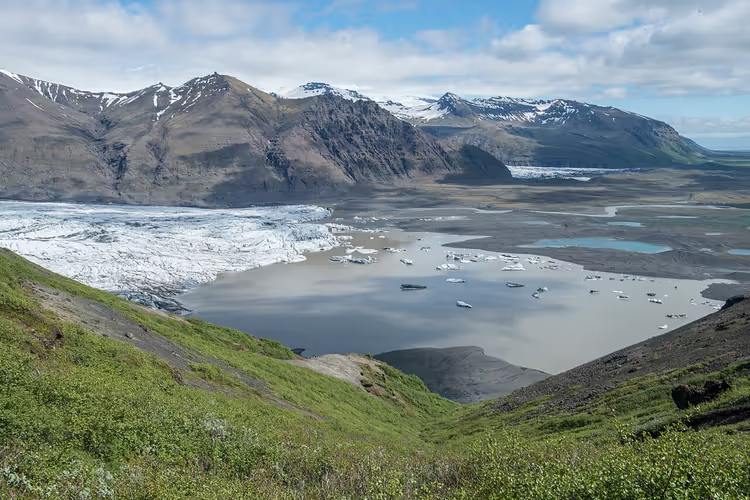
In Skaftafell National Park, the tour is combined with a glacier hike. This is the full glacier experience: you walk on the ice in crampons and then descend into a small cave. The catch is that the caves here are smaller and more modest than those at Jokulsarlon.
 © Anjali Kiggal · CC BY-SAPhoto: Anjali Kiggal, CC BY-SA (https://creativecommons.org/licenses/by-sa/4.0), Wikimedia Commons
Groups are small, and the tour lasts about 4 hours. You need a basic level of fitness, because part of the route goes up a sloping glacier. If you specifically want a large blue cavern, Skaftafell is less suitable.
Katla cave from Vik
From Reykjavik or Vik, you can join a tour to the Katla cave, also called the Secret ice cave. The cave operates year-round because the entrance is open from the edge of the glacier, not from above. The colors here are mixed, with a lot of black, since a volcano is nearby. Part of the cavern has no roof, so the feeling of being inside a closed cave is weaker than at Jokulsarlon. Sometimes a small blue cave is found inside.
Katla cave tour from Vik on GetYourGuide
What else to do in winter
Besides the caves, in winter in Iceland it is worth planning whale watching, hunting for the northern lights, and a horseback ride. These activities are easy to combine with ice tours if you have 3-4 days on the south coast. Do the cave on one of the days, and leave the northern lights for an evening with no scheduled plans.
Langjokull ice tunnel: Into the Glacier
Another ice activity is available in both winter and summer. This is the Langjokull tunnel, the Into the Glacier project. A quick heads-up: the experience here is completely different from a natural cave, and you should not expect blue halls.
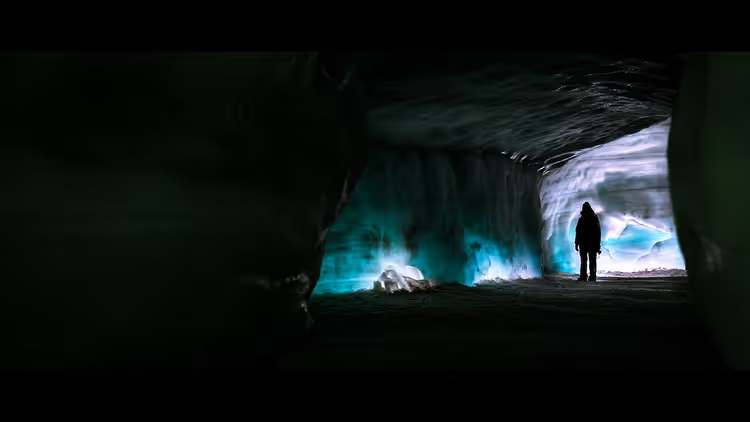
The tunnel was carved into the glacier over 14 months, and it goes 40 meters deep (according to intotheglacier.is, checked 09/15/2026). A guide leads you through corridors and halls where displays explain glaciers and climate. Walking is easy, the floor is level, so the route suits almost everyone.
 © Giuseppe Milo · CC BYPhoto: Giuseppe Milo, CC BY (https://creativecommons.org/licenses/by/3.0), Wikimedia Commons
The ice in the tunnel is smooth and doesn't look natural, because it was cut by a machine, not water. But from inside you can see a crevasse in the glacier, and you won't get that angle anywhere else.
You can get there from Husafell in a large off-road vehicle that drives right onto the glacier. There's also a day trip from Reykjavik, often combined with the Vidgelmir lava cave and Hraunfossar waterfall. The Classic tour lasts 3-4 hours and costs from 24,900 ISK (as of 09/2026, official website).
Into the Glacier tour on GetYourGuide
Book in advance: the tunnel is also popular in summer and during the New Year holidays, even though it doesn't depend on freezing temperatures. The catch, to be honest: the tunnel feels man-made, not like living ice.
The lighting inside the tunnel is even, so photos come out sharp even in winter. Bring a spare camera battery, because batteries drain faster in the cold.
⁉️🤔 Frequently asked questions
When is the best time to visit Iceland's ice caves?
The optimal window is November to March, when glaciers are stable. Weather and road conditions are checked every morning, so even mid-season a tour can be rescheduled. In summer, only the Katla cave from Vik and the man-made Langjokull tunnel remain. Plan your trip so you have one backup day for weather.
Can you see a blue ice cave in summer?
Natural blue caves are closed in summer. The only natural option is the Katla cave under the Myrdalsjokull glacier, but in summer it's often black and very small. If blue ice matters to you, move your trip to winter. You won't get the poster-blue color in summer.
How much does an ice cave tour cost?
Prices depend on tour length and starting point. A short tour from Jokulsarlon costs less, while day programs from Reykjavik cost more due to transport and the drive. Reference point for the Langjokull tunnel: from 24,900 ISK for the Classic tour (as of 09/2026, tour operator's website). Check the exact price for your date with the operator.
Do you need your own car to get to the cave?
Your own car helps you reach the starting point, but you still ride to the cave itself in a super jeep with a guide. If you don't want to drive, take a tour with transfer from Reykjavik or join a group right in Vik or at Jokulsarlon. In winter, check roads on safetravel.is before heading out.
What should you bring to an ice cave?
Bring a warm waterproof layer, gloves, and a hat, because it's always below freezing inside. Crampons, a helmet, and a headlamp are provided on site, but your own small flashlight won't hurt: group lamps often die. Footwear should support your ankle; regular sneakers don't work in winter.
In short: what to book
The choice depends on how much time you have and whether you have a car.
- If you have 3-4 days and your own car: take a short tour from Jokulsarlon.
- If you don't have a car and want to see everything: look at a 2-day south coast tour with waterfalls and a cave.
- If you're visiting in summer: choose the Katla cave from Vik or the Langjokull tunnel.
- If you're traveling with kids or don't want a glacier hike: the Into the Glacier tunnel is easier physically.
Winter tours sell out by fall, so book early and keep one backup day for weather.

A small editorial team writing guides for independent travel. We travel ourselves, but we haven’t been everywhere, so we check prices, opening hours and how to get there against official sources.