
















How drones "complete" the Colosseum and Sagrada Familia in the sky
You come to old ruins at sunset, and above them a whole Colosseum suddenly rises.
There are no scaffolds or restorers here. Hundreds of drones with lighting line up into the contours of the building and restore the appearance it lost centuries ago. That is how the joint project of the Dutch studio DRIFT and the Dubai-based company Cyberdrone works.
Such works are called "aerial sculptures." Drones assemble an entire building in the sky from glowing points: each one holds its position, and together they draw what has long been absent from the ground.
Below you will learn which monuments have already been "completed" in the night sky and how such a show works.
Light instead of scaffolding
💡 In short:
- DRIFT and Cyberdrone complete with light what has been lost: ruins and unfinished buildings.
- The project already includes Whitby Abbey, the theater in Plovdiv, the Colosseum, Ephesus, and Sagrada Familia.
- There is no fixed schedule for the shows; follow the studios' announcements.
Ordinary restoration strengthens walls but does not return lost parts to a building. A drone show does the opposite: it builds nothing, but draws what is missing with light. Since 2020, the artists have been assembling "aerial sculptures" in the sky (according to DRIFT studio). From a distance, everything looks as if the ruins have become whole again.
The project is not tied to one country: it includes sites in the United Kingdom, Bulgaria, Italy, Turkey, and Spain. Below we examine each site and see what they have in common.
Whitby Abbey, England
 © aude · CC BY-SAPhoto: aude, CC BY-SA (https://creativecommons.org/licenses/by-sa/3.0), Wikimedia Commons
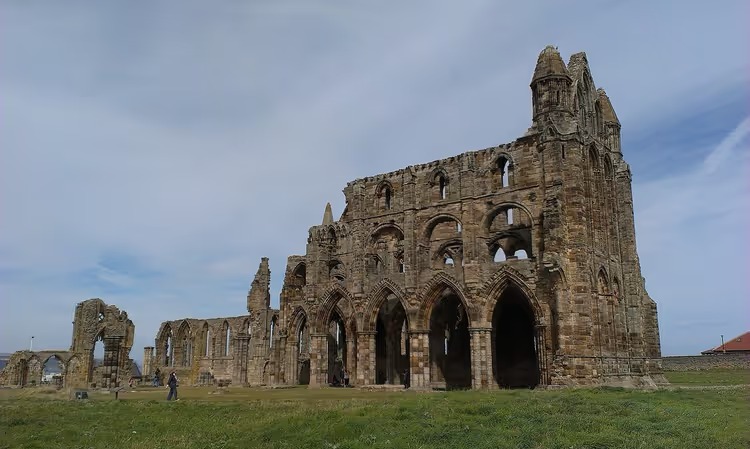
Whitby Abbey was founded in 657. The monastery stood on a hill above the sea, and its tower served as a landmark for sailors for centuries. In 1539, during the dissolution of the monasteries, the abbey was dismantled, and in 1914 German ships shelled the town from the sea and damaged the west front (according to the history of the abbey).
The walls have stood without a roof for almost five centuries. If you climb the hill at sunset, you will see only a stone frame. In the sky it is "completed" with a light outline, and for a minute the abbey looks like a working monastery. The ruins inspired Bram Stoker's image of Dracula.
Ancient theater in Plovdiv, Bulgaria
 © Община Пловдив · CC BY-SAPhoto: Община Пловдив, CC BY-SA (https://creativecommons.org/licenses/by-sa/4.0), Wikimedia Commons
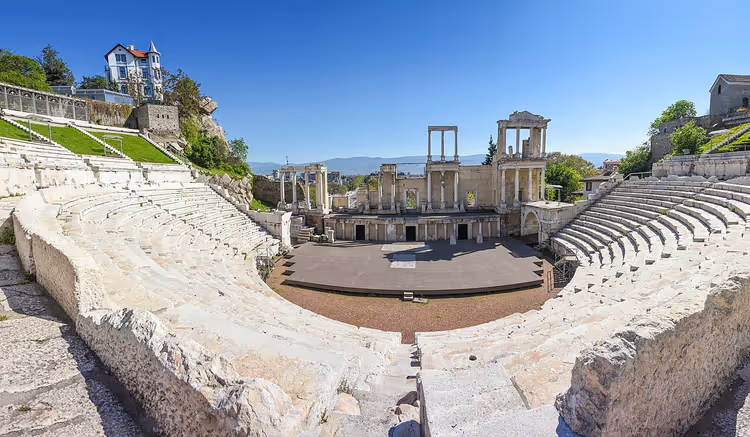
The Roman theater in Plovdiv seated about 7,000 spectators. It was built in the late 1st and early 2nd century between two hills of the old town. The theater was discovered during excavations in the 1970s (as of 09/2026, Wikipedia).
Part of the seating had to be restored, but the stage and lower rows are original. If you get to an evening concert, you sit almost the same way as ancient spectators once sat here.
Colosseum, Rome, Italy
 © Jon Gudorf Photography · CC BY-SAPhoto: Jon Gudorf Photography, CC BY-SA (https://creativecommons.org/licenses/by-sa/2.0), Wikimedia Commons
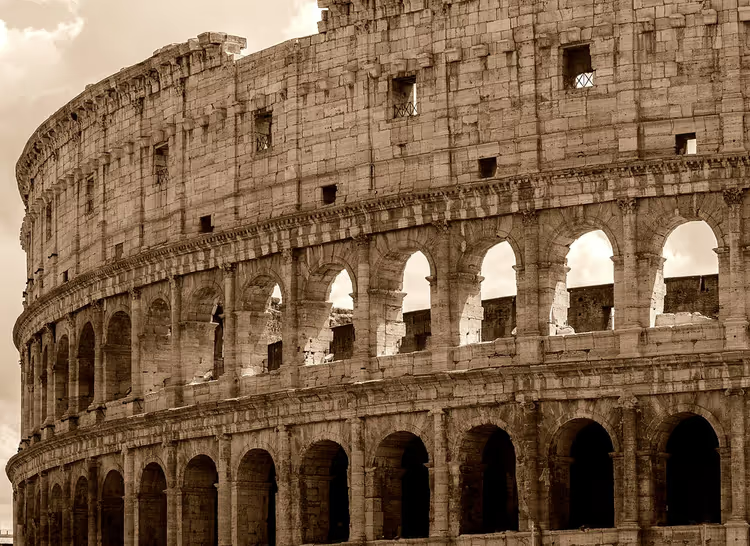
Construction of the Colosseum began in 72 and it opened in 80 (according to Wikipedia). The amphitheater seated about 50,000 spectators. Gladiator fights and animal hunts took place in the arena, and beneath it were hidden chambers, cages, and lifts.
The structure survived a fire, several earthquakes, and looting: part of the stone was taken for other buildings. Later the Colosseum came under the care of the Catholic Church. Today you see it as a recognizable symbol of Rome and as ruins to which light has restored the former outline of the arena.
Ephesus, Turkey
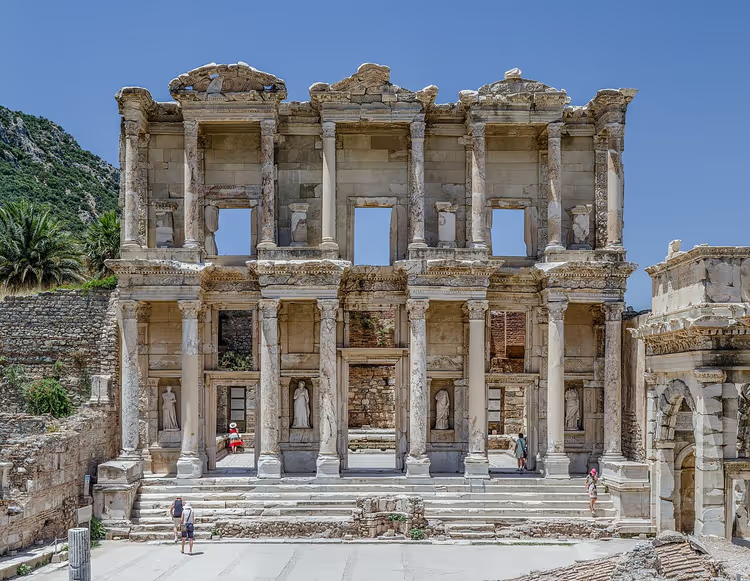 © Benh LIEU SONG · CC BY-SAPhoto: Benh LIEU SONG, CC BY-SA (https://creativecommons.org/licenses/by-sa/3.0), Wikimedia Commons
Ephesus is one of the major ancient cities on the Aegean coast. The Great Theater here seated about 25,000 people, and the Library of Celsus has survived almost intact (according to Wikipedia).
Much was destroyed by earthquakes, and excavations continue to this day. Some streets are already open to tourists, while others are still being dug out. Such a city looks especially good in a drone show: light based on measurements returns entire blocks to their places, of which only foundations remain.
Sagrada familia, Barcelona, Spain
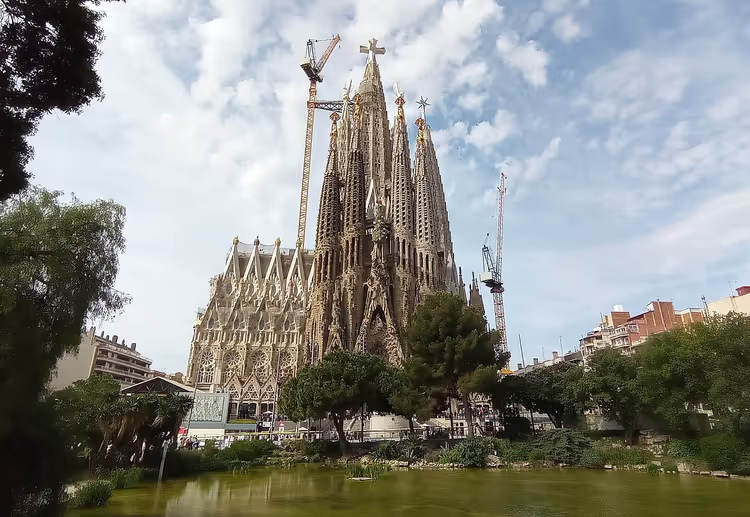 © Canaan · CC BY-SAPhoto: Canaan, CC BY-SA (https://creativecommons.org/licenses/by-sa/4.0), Wikimedia Commons
Construction of the Sagrada Familia basilica began in 1882. In 2026 the Tower of Jesus is being completed, and full completion with the Glory facade is expected later (according to the official website). Money is raised mainly from donations, which is why construction has stretched over more than a century.
Of all the sites on the list, only Sagrada Familia is being completed for real, not with light in the sky. Locals joke that when the cathedral is finally finished, the world will end. If you find yourself in Barcelona, go inside during the day: light through the stained glass completely transforms the interior.
How drone light shows work
Cyberdrone makes light shows and is based in Dubai. The company's specialists develop the mechanics, electronics, onboard and ground software themselves (according to Cyberdrone). A swarm of fast drones is launched into the air, with flight time reaching up to 18 minutes.
Each drone holds its position and switches on at the right moment. Hundreds of glowing points in the sky form a three-dimensional image. The authors were inspired to work with historic buildings by the fire at Notre-Dame Cathedral in Paris: after it, it became clear that light can show what no longer exists.
⁉️🤔 Frequently asked questions
What is the DRIFT and Cyberdrone project?
A series of light installations in which drones line up into the contours of buildings. DRIFT is a Dutch studio of artists Ralph Nauta and Lonneke Gordijn, and Cyberdrone produces shows from Dubai. Together they "complete" ruins and unfinished buildings with light.
Are these real structures or a special effect?
Only a light drawing. The drones do not touch the walls and do not attach anything to them. They fly at a set altitude and switch on their lighting at the right moment. The viewer sees a three-dimensional image, and by day not a trace of it remains.
How many drones take part in such a show?
The exact number depends on the order and the complexity of the scene. Cyberdrone has fast drones with flight time of up to 18 minutes (according to the Cyberdrone website). For an outline like the Colosseum or a cathedral, hundreds of aircraft are needed, otherwise the line will be too rough.
Can you see such a show live?
Shows are tied to a specific event and city; they have no fixed schedule. Follow the studios' announcements. And if the monuments themselves matter more to you, visit them during the day: the Colosseum, Ephesus, and Sagrada Familia are open to visitors all year round.
Will Sagrada Familia really be completed?
Yes, work continues. The temple has been under construction since 1882 (according to the Sagrada Familia website). The deadlines have already been moved several times, so it is better to check them on the website before your trip.
In short: what to book
The light show takes place in the evening and lasts only a few minutes, while the monuments themselves are open all day. Here is how to combine one with the other:
If your route starts in Rome: get a Colosseum ticket with a time slot for the morning.
If you are in Barcelona: Sagrada Familia, a ticket for a specific time.
If your route goes through England: Whitby Abbey on the hill, entry by ticket.
If you are heading to Turkey: Ephesus is best seen in the morning, before it gets hot.
If you find yourself in Bulgaria: an evening concert at the theater in Plovdiv.
DRIFT and Cyberdrone show their performances all over the world. Follow the studios' announcements and try to catch the nearest show to you.


A small editorial team writing guides for independent travel. We travel ourselves, but we haven’t been everywhere, so we check prices, opening hours and how to get there against official sources.