
















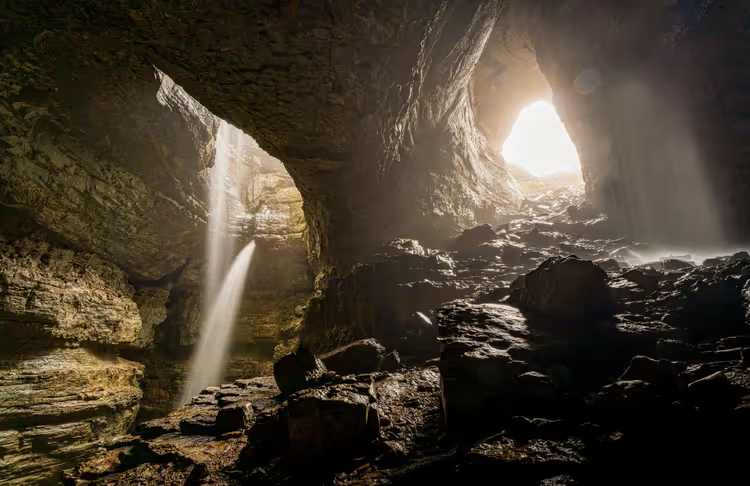
8 Amazing caves of the world: what makes them special, when to go and how to get there
Caves are frightening and mesmerizing at the same time. For millions of years, water has carved halls, tunnels, and underground forests into the rock. We picked eight caves around the world that are worth seeing at least once.
The longest cave system on the planet stretches for more than 650 km (as of 09/2026, according to the National Park Service). Other spots on the list win not by size, but by light, acoustics, or crystals. For each cave, you'll find what makes it special and how to get there.
We checked the information against official websites in September 2026. Before your trip, check again: schedules depend on the season and weather.
Ad: this article contains affiliate links, we earn a commission if you book through them, at no extra cost to you.
How to choose a cave for your trip
💡 In short:
- Decide what matters more to you: an underground river, glowworms, or giant chambers.
- Check the season: some caves close due to high water.
- Book tickets in advance; popular sites have timed entry.
- Mammoth Cave tours: 09/2026, verified on the official National Park Service website.
Start with the table. It lists eight caves and what makes each one worth the trip.
Cave | Country | Main highlight | Season |
|---|---|---|---|
Mammoth Cave | USA | the longest system in the world | year-round |
Waitomo Caves | New Zealand | glowworms on the ceiling | year-round |
Fingal's Cave | Scotland | basalt columns and acoustics | April to September |
Pak Ou Caves | Laos | thousands of Buddha statues | November to March |
Marble Cathedral | Chile and Argentina | marble grottoes | November to March |
Son Doong Cave | Vietnam | underground jungle | February to August |
Blue Grotto | Italy | glowing water | April to October |
Cave of the Crystals | Mexico | giant gypsum crystals | closed to tourists |
1. Mammoth Cave
 © Daniel Schwen · CC BY-SAPhoto: Daniel Schwen, CC BY-SA (https://creativecommons.org/licenses/by-sa/4.0), Wikimedia Commons
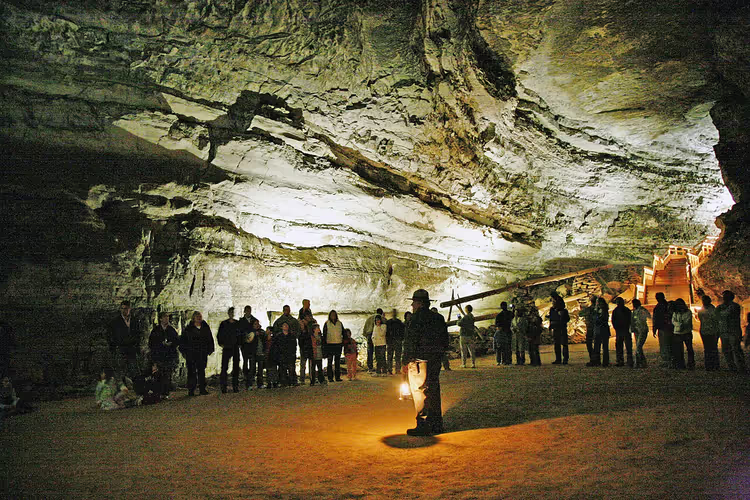
This is the longest cave system in the world, and it keeps growing. The explored passages stretch for more than 650 km (as of 09/2026, US National Park Service). Every year, speleologists document new branches.
The name has nothing to do with mammoths: it was given for the sheer scale of the chambers. Several levels are connected by narrow passages, and inside flow the underground rivers Styx and Echo, along with Lake Lethe. Some chambers feature columns of stalactites, while others have frozen "waterfalls" and stone lacework of flowstone hanging from the ceilings.
The history of the place is just as impressive. Native Americans buried their chiefs here thousands of years ago, and later saltpeter was mined in the cave. The area gained national park status in the middle of the last century, and today it is a UNESCO World Heritage Site.
We recommend booking tour tickets in advance: popular routes sell out weeks ahead (as of 09/2026, NPS). There are short walks and half-day descents. Choose a route that matches your fitness level and wear closed-toe shoes.
- How to get there: about an hour and a half by car from Louisville, with parking at the visitor center.
- Cost: park entry is free; you only pay for the cave tour.
- The catch: on long routes, you'll have to squeeze through muddy narrow tunnels and dusty shafts.
2. Waitomo Caves
 © Donnie Ray Jones · CC BYPhoto: Donnie Ray Jones, CC BY (https://creativecommons.org/licenses/by/2.0), Wikimedia Commons
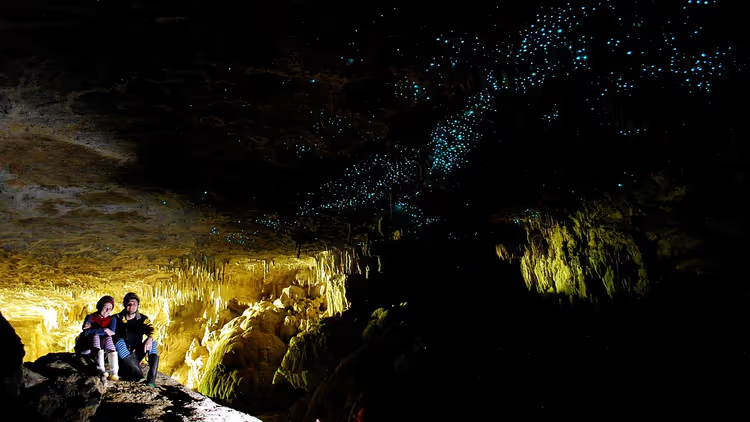
In Waitomo, on New Zealand's North Island, colonies of glowworms live. Their glow floods the cave with turquoise light, and the silk threads of their nests hang from the ceiling like garlands. People come from all over the world for this sight.
The limestone of the complex is millions of years old and was once part of a marine landscape. Today, routes run through three levels. First, you walk through the two upper tiers. At the end of the tour, you board a boat on the lower level, where the glowworms live.
The boat portion takes about 20 minutes (as of 09/2026, Waitomo Caves). Staff constantly monitor the temperature and carbon dioxide levels: without this, the local fauna would not survive. That's why you can't make noise or touch the nest threads inside.
If you want to see more, book a combined tour on GetYourGuide: it includes the neighboring Ruakuri and Aranui caves.
- How to get there: about two hours by car from Auckland, and bus tours are also available.
- Cost: tickets are sold by time slot and already include the boat; child and family rates are cheaper.
- The catch: groups move through continuously, so a quiet solo walk isn't possible.
3. Fingal's Cave
 © Lobster1 · CC BY-SAPhoto: Lobster1, CC BY-SA (https://creativecommons.org/licenses/by-sa/3.0), Wikimedia Commons
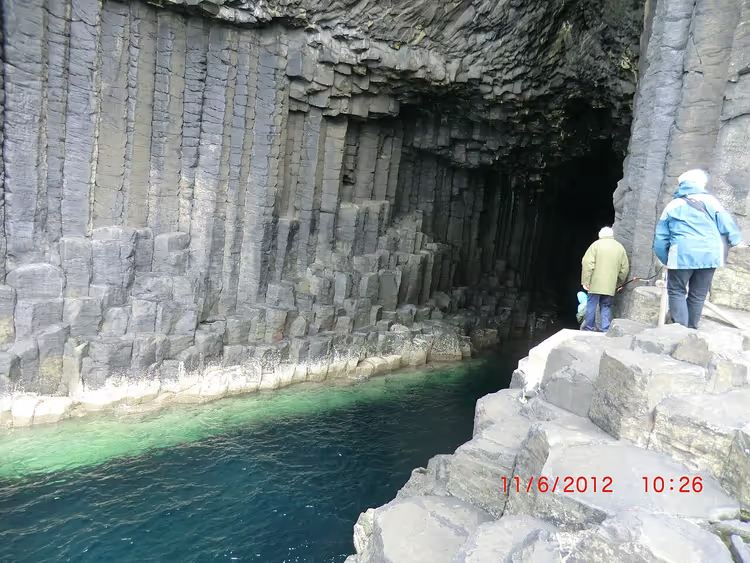
Fingal's Cave is located on the uninhabited island of Staffa off the coast of Scotland. The volcanic island is made up of polygonal basalt columns. The cave's vaulted ceiling is also formed from these columns and resembles a giant organ.
Inside, the cave has cathedral-like acoustics. Instead of a choir, the wind and waves "perform" here, and the sound carries through the vaults. This is what inspired composer Felix Mendelssohn to write the Hebrides Overture.
The cave became known in the late 18th century, and its name is linked to James Macpherson's poem "Fingal." The only way to get there is by water: boat tours depart from Oban and the Isle of Mull (as of 09/2026, National Trust for Scotland). Landing depends on the weather, so allow extra time.
- How to get there: boat from the piers in Oban or Mull, book your tour in advance.
- Cost: entry to the island is free, you pay only for the boat tour with the operator.
- The catch: trips are often canceled due to wind and waves, with no date guarantees.
4. Pak Ou Caves
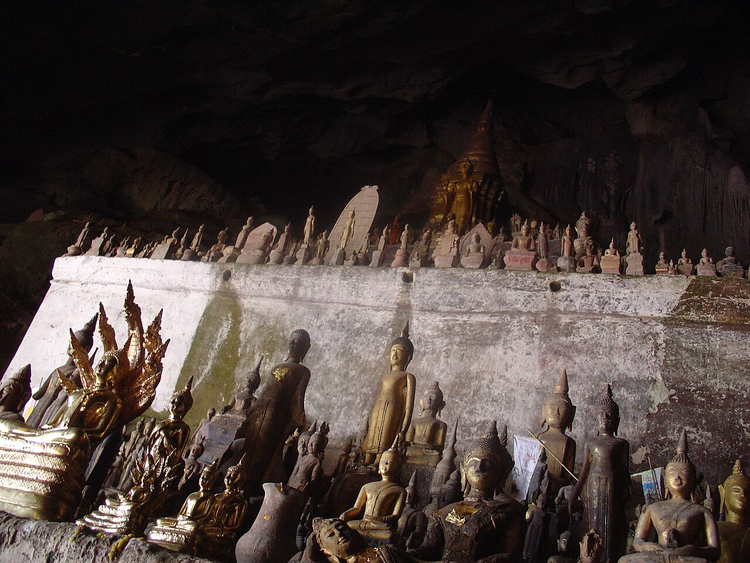 © Walter.jenner · CC BY-SAPhoto: Walter.jenner, CC BY-SA (http://creativecommons.org/licenses/by-sa/3.0/), Wikimedia Commons
The two Pak Ou grottoes sit in a cliff above the Mekong River in northern Laos. The only way to reach them is by boat, most often from the town of Luang Prabang. On the way there, people usually stop at villages and waterfalls further up the river.
Under the vaults stand hundreds and thousands of Buddha figurines. They were made from wood, bronze, and stone, and were brought by pilgrims from different eras. Today the site attracts more tourists than worshippers, and new figurines are no longer left here.
The lower grotto, Tham Ting, sits right at the water's edge, while you climb a long staircase to reach the upper one, Tham Theung. It's dark inside, so bring a flashlight and don't put off your visit until evening.
- How to get there: by boat along the Mekong, the trip takes about two hours each way.
- Cost: you pay for the boat and a small entrance fee at the pier.
- The catch: a steep staircase leads to the upper grotto, and there is almost no light inside.
5. Marble Cathedral
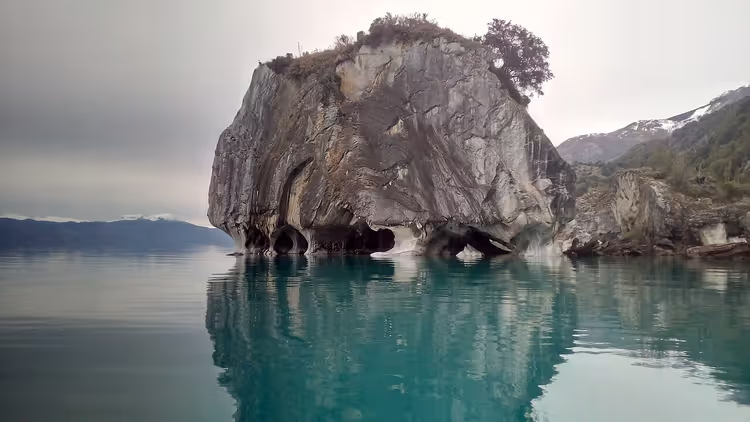 © Jpmorenosanchez · CC BY-SAPhoto: Jpmorenosanchez, CC BY-SA (https://creativecommons.org/licenses/by-sa/4.0), Wikimedia Commons
On the border between Chile and Argentina lies a lake with two names: Chileans call it Lago General Carrera, while Argentinians call it Lago Buenos Aires. Hidden in its cliffs are grottoes, tunnels, and entire chambers known as the "Marble Cathedral."
Waves carved these passages over thousands of years. The cliffs here are made of real marble, and its texture is clearly visible from a boat. The blue and white patterns on the walls are created by the minerals themselves.
You won't be able to boat into the deepest part of the cave: the passage is too narrow. But during the dry season, the lake's water level drops, revealing new tunnels.
- How to get there: boat tours depart from the village of Puerto Río Tranquilo in Chile.
- Cost: the price depends on the route length, you pay only for the boat.
- The catch: the weather in Patagonia changes quickly, and trips are canceled due to strong winds.
6. Son Doong Cave
Son Doong in Vietnam is considered the largest cave in the world by volume. It was discovered by a local resident in 1991 (as of 09/2026, Oxalis Adventure). The name translates as "mountain river," and there really is a river inside.
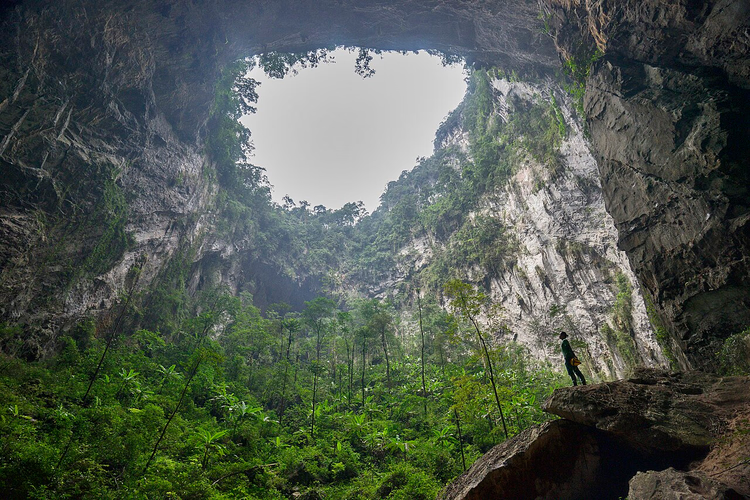 © Dave Bunnell · CC BY-SAPhoto: Dave Bunnell, CC BY-SA (https://creativecommons.org/licenses/by-sa/4.0), Wikimedia Commons
That river created the ecosystem here. Where light and water reach, real jungle has grown. Monkeys, hornbills, flying foxes, and snakes live in it.
The cave has its own records. The tallest known stalagmite rises about 70 meters (as of 09/2026, Oxalis operator data). The walls contain small stones that look like scattered beads.
Humidity inside is high, and the air is cool. When warm air gets under the ceiling, underground clouds form. To see them, it's worth picking the right time and watching the forecast.
Getting here is not easy. You need to be in good physical shape: first a trek through the river and jungle, then a descent down the rocks. Expeditions have a limited number of participants, so they are booked months in advance.
- How to get there: through Phong Nha-Ke Bang National Park, only as part of an expedition.
- Cost: a multi-day tour is expensive; check the exact price with the operator.
- The catch: the expedition lasts several days and leaves almost no time for rest.
7. Blue Grotto
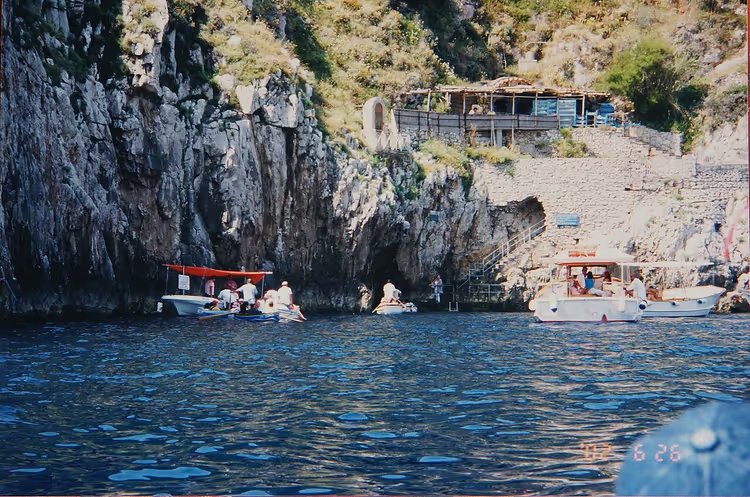 © lienyuan lee · CC BYPhoto: lienyuan lee, CC BY (https://creativecommons.org/licenses/by/3.0), Wikimedia Commons
The Blue Grotto is on the Italian island of Capri. Sailors once avoided it and considered it an evil place. Today tourists come here specifically for the glowing water.
You can only get inside by boat through a narrow opening right at the waterline. Light enters through that same opening, and the water starts glowing bright blue. You'll see the strongest glow on a clear day.
Swimming in the grotto is prohibited, but that doesn't stop everyone. The grotto operates on a seasonal schedule: from April to September roughly 8:30 a.m. to 6:00 p.m., with shorter hours in other months (as of 09/2026, CoopCulture). If the sea is rough, entry is closed.
Get timed tickets on Tiqets so you don't stand in line at the dock.
- How to get there: ferry from Naples or Sorrento to Marina Grande, then onward by boat.
- Cost: you pay separately for entry and for the boat; cash is accepted on site.
- The catch: in high season there's a line at the entrance, and the grotto closes when there are waves.
8. Cave of the Crystals
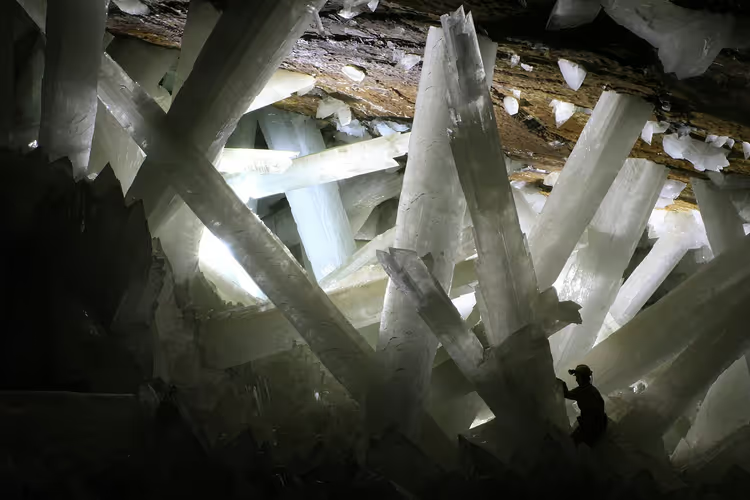 © Alexander Van Driessche · CC BYPhoto: Alexander Van Driessche, CC BY (https://creativecommons.org/licenses/by/3.0), Wikimedia Commons
The Cave of the Crystals in the Mexican state of Chihuahua is unlike anything else. Inside stand selenite crystals several meters long, resembling concrete beams. Crystals this large have never been found anywhere else.
They were discovered by accident. First, miners found small crystals in the neighboring Cave of Swords, and only later, at greater depth, they discovered the main chamber.
Conditions inside are dangerous for humans. The temperature rises above fifty degrees, and humidity is close to one hundred percent. Even scientists in cooling suits work here for less than an hour.
The cave is closed to tourists. You cannot get inside: only researchers descend here. Scientists study the crystals remotely so as not to damage them.
- How to get there: no tourist access; only scientific teams descend inside.
- Cost: visiting is impossible, so there is nothing to pay.
- The catch: this is not a tourist site but a closed scientific facility.
⁉️🤔 Frequently asked questions
Which of these caves is easiest to visit?
The easiest are Mammoth Cave and the Waitomo caves. They have regular tours year-round, tickets are sold online, and the trip from major cities takes a few hours. The only difficulty: in high season, time slots sell out in advance, so book a couple of weeks ahead.
How much does cave entry cost?
Prices vary widely. At Mammoth Cave National Park, entry is free; you only pay for the tour. At Waitomo, the boat ride is already included in the ticket. At the Blue Grotto, the ticket and the boat are paid for separately. Always check exact amounts on official websites: rates change every season, and some caves only accept payment on site.
When is the best time to go?
Season and weather matter for caves. Sea grottoes, Fingal's Cave and the Blue Grotto, depend on waves and work best in summer. In Southeast Asia, choose the dry season, and in Patagonia avoid the southern hemisphere winter.
Which cave requires physical fitness?
The hardest expedition awaits you at Son Doong. There you have to trek through a river and jungle, climb up and down rocks, and the tour itself lasts several days. For Mammoth Cave, it's enough to choose a long route and honestly assess your stamina.
Can you swim in the caves?
Swimming in the Blue Grotto is prohibited, but that doesn't always stop visitors. At Waitomo the water is cold, and you shouldn't touch it during the tour. At the Marble Cathedral, swimming is also not part of the plan: people come for the views, not for swimming.
In short: what to book
Seven caves on the list are open to tourists, while the Cave of the Crystals is closed. The best choice depends on the type of trip. If you want a relaxed family day, go for Mammoth Cave or Waitomo. If you're drawn to adventure, plan Son Doong well ahead: it has a limited number of participants. Sea grottoes, the Blue Grotto and Fingal's Cave, depend on the weather, so leave some flexibility in your itinerary.
- If you're traveling with kids: Mammoth Cave and the Waitomo caves.
- If you love adventure: Son Doong and the Marble Cathedral.
- If you want views without effort: the Blue Grotto and Fingal's Cave.
Before your trip, double-check tickets and schedules, and browse cave tours on GetYourGuide.

A small editorial team writing guides for independent travel. We travel ourselves, but we haven’t been everywhere, so we check prices, opening hours and how to get there against official sources.