
















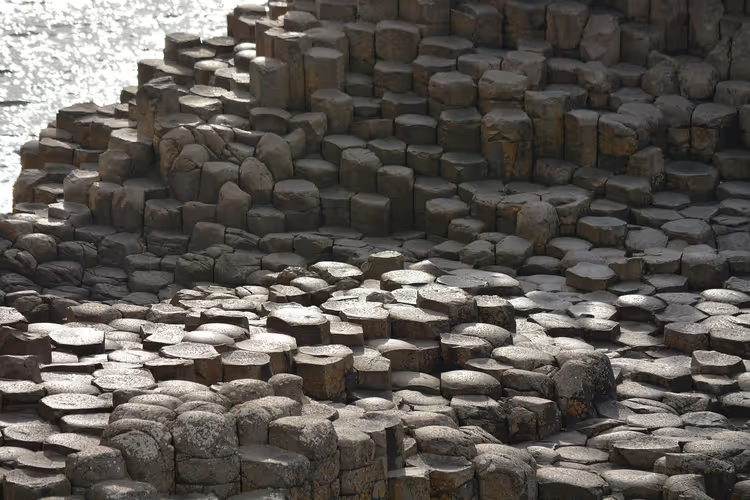
Giant's Causeway: 40,000 basalt columns and the legend of Finn MacCool
The Giant's Causeway on the coast of County Antrim looks like the work of giants. Around 40,000 basalt columns disappear beneath the waters of the North Channel. Many people come here for a couple of hours and leave without ever figuring out what exactly they should be looking at.
This article answers three questions: why the columns are hexagonal, what to look for among the stones, and how much a day on the coast will cost you. Below you'll get a ready-made walking plan, verified timings, and the honest catches of the place. The site itself is in Northern Ireland, although legend connects it with Scotland.
The short answer: the Giant's Causeway occupies a stretch of coastline with basalt columns 4.8 km from the town of Bushmills. Arrive at opening time, before the columns get crowded.
Ad: this article contains affiliate links, we earn a commission if you book through them, at no extra cost to you.
The legend of Finn and Benandonner
💡 In short:
- Arrive at opening time: by 9:00 there's almost no one at the columns.
- Wear shoes with good grip, the stones are slippery after rain.
Legend attributes the columns to the Irish giant Finn McCool. In mythology he is known as Fionn mac Cumhaill, leader of a band of warriors called the Fianna. According to one version, the Scottish giant Benandonner challenged him to a fight, and Finn built a stone causeway across the North Channel to meet his rival.
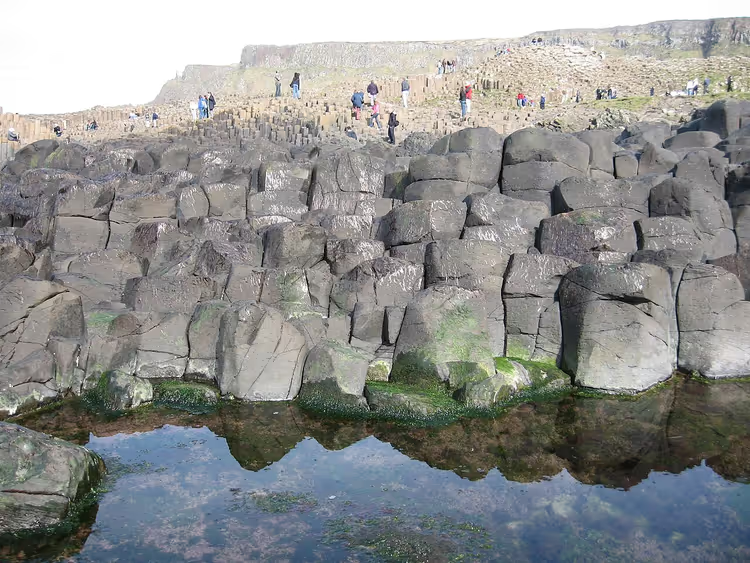
From there, the retelling diverges. In one version, Finn wins in a fair fight. In another, he realizes the enemy is noticeably larger and hides. His wife Sadhbh wraps her husband like a baby and lays him in a cradle. The guest sees a "child" the size of a grown giant and decides that the father of this infant must be even more terrifying.
Fleeing, Benandonner destroys the causeway behind him. That is why part of the columns now lie underwater. This is how the legend explains both the causeway itself and its abrupt end at the shore.
There's no way to verify the age of the story. No written versions survive from before the 17th century, and Finn himself in mythology is not a giant at all, but a hero with unusual abilities. The Irish name of the place, Clochán na bhFomhórach, translates as "the stepping stones of the Fomorians," another tribe of mythical giants.
How the basalt columns formed
Geologists have a precise answer. Around 50-60 million years ago, the area of Ulster was volcanically active. Liquid basalt rose through chalk beds and flooded a vast plateau. The lava cooled, contracted, and cracked just like drying mud.
The cracks penetrated downward slowly and evenly. Hence the shape: most columns are hexagonal, but faces range from four to eight sides. The tallest rise to 12 meters. In the cliffs, solidified lava lies in layers up to 28 meters thick in places.
The explanation didn't come quickly. For centuries, debaters saw crystals grown on the floor of an ancient ocean, or a petrified bamboo forest. Today's cooled-lava theory puts those guesses to rest. Scientists don't pass by a place like this either: there is no other mass accumulation of columns like this anywhere else.
Recognition came in the 20th century. In 1986, UNESCO added the Giant's Causeway and the entire coastline to the World Heritage list, and a year later the area became a national nature reserve. In a 2005 Radio Times poll, the site was named the fourth greatest natural wonder in the United Kingdom.
What to see: areas and stones
The columns are divided into three groups, each with its own character. The first, the Grand Causeway, starts at the cliffs and looks like a monumental staircase. Individual steps rise up to six meters. Closer to the water, the path becomes gentler and more even.
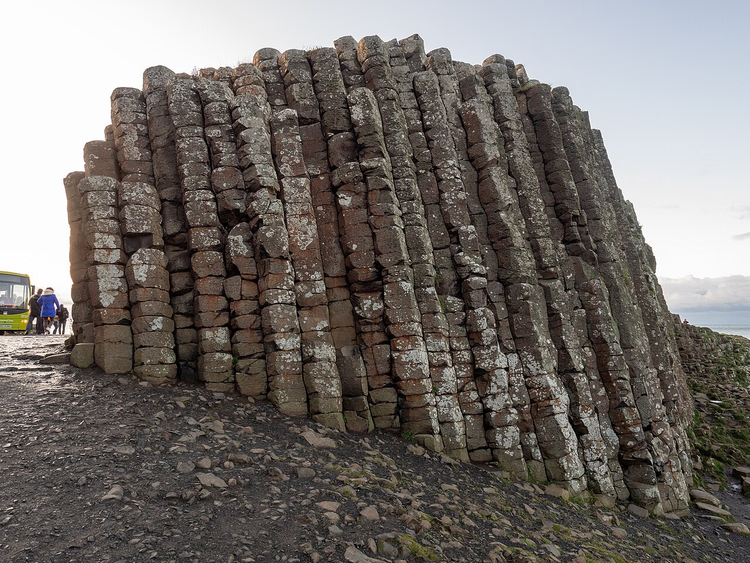 © Ajay Suresh from New York, NY, USA · CC BYPhoto: Ajay Suresh from New York, NY, USA, CC BY (https://creativecommons.org/licenses/by/2.0), Wikimedia Commons
The second group, the Middle and Little Causeways, stands next to the main one. Here the columns resemble not a road but individual mounds. You can step from one pillar to another, but be careful: the height differences are significant. The third group is the farthest and the quietest.
Over time, people gave the unusual stones their own names. On the shore you'll find The Organ and The Harp, The Loom, The Cannons, and the Giant's Boot. According to legend, the boot belonged to a real giant. Some columns seen from the sea resemble chimney stacks, and that resemblance once played a cruel trick on sailors. More on that below, in the story of the galleass La Girona.
- Who it's for: those who love geology, legends, and cliff-top views.
- Not for: those who want a beach and warm sea: swimming here isn't appealing.
- The catch: the weather on the open coast changes quickly, bring a raincoat even in summer.
The island of Staffa and Fingal's cave
A separate stop on the route awaits you across the channel. It's the uninhabited island of Staffa, which lies off the coast of Scotland. Its name translates as "island of pillars."
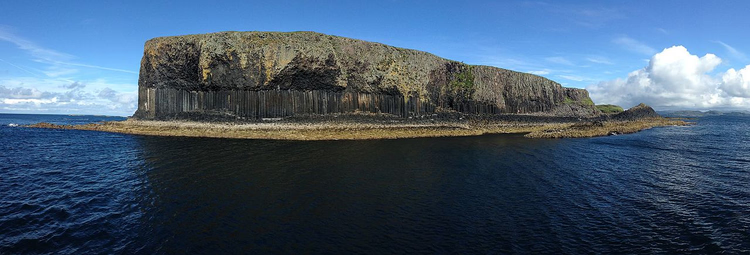 © Roͬͬ͠͠͡͠͠͠͠͠͠͠͠sͬͬ͠͠͠͠͠͠͠͠͠aͬͬ͠͠͠͠͠͠͠ Menkman from amsterdam, Netherlands · CC BYPhoto: Roͬͬ͠͠͡͠͠͠͠͠͠͠͠sͬͬ͠͠͠͠͠͠͠͠͠aͬͬ͠͠͠͠͠͠͠ Menkman from amsterdam, Netherlands, CC BY (https://creativecommons.org/licenses/by/2.0), Wikimedia Commons
On Staffa stands Fingal's Cave, made of the same hexagonal columns. The sea grotto is about 70 meters long, and inside it is known for its unusual acoustics. The columns here came from the same ancient lava flow as those at the Giant's Causeway. It is probably this similarity that gave rise to the legend of two warring giants on opposite sides of the channel.
The island belongs to Scotland and lies in the Inner Hebrides group. You can only get there by water, from ports on the Isle of Mull. For a short trip to the Northern Ireland coast, Staffa remains a separate item, so plan it in advance.
Tickets and opening hours
The main thing to know: access to the columns themselves is free. You only pay for the visitor center, parking, and facilities if you use them. So you can reach the stones without a ticket, via the public coastal path (as of 09/2026, verified on the official website).
Opening hours vary by season, and entry to the visitor center is sometimes by timed slots. Check the times on the website before your trip: in winter daylight hours are short, and you'll have less time for the whole route.
Tours and tickets in Belfast
Guided tours, skip-the-line tickets and activities — most offers can be cancelled free of charge.
See offers on GetYourGuideThe widget loads once you give your consent.
How to get there from Belfast
You can get there without a car. From Belfast, take the train to Coleraine, which takes just over an hour. The bus station is right at the train station, and from there bus 402 goes to the columns. Bus 402 is known as the Causeway Rambler and stops right at the entrance.
By car, you drive along the Antrim Coast Road. The road itself is scenic, so leave time for stops. If you prefer a guide and no transfers, you can book a Giant's Causeway tour in advance.
The sunken gold of the "Invincible Armada"
The coast also holds historical evidence. In 1588, the galleass La Girona from the Spanish "Invincible Armada" was wrecked here. The ship was sailing east along Ulster and sank off Lacada Point near the Giant's Causeway.
 © Colin Park · CC BY-SAPhoto: Colin Park, CC BY-SA (https://creativecommons.org/licenses/by-sa/2.0), Wikimedia Commons
An estimated 1,300 people were on board; nine survived. In the 20th century, gold, silver, weapons, and sailors' belongings were recovered from the wreck. Today this collection is held at the Ulster Museum in Belfast. If you're interested in more than just stones, set aside a separate day for the museum.
⁉️🤔 Frequently asked questions
How much does it cost to enter the Giant's Causeway?
Access to the columns themselves is free; you only pay for the visitor center and parking. Check service prices on the official National Trust operator's website before your trip.
How much time should I allow for the walk?
The columns themselves take 2-3 hours including the descent and climb back up. If you want to cover the Middle and Little Causeways too, add another hour. Arrive in the morning: by midday the Grand Causeway gets noticeably crowded.
Can I get there without a car?
Yes. A train runs from Belfast to Coleraine, and local buses go from the station to the columns. The transfer is convenient because the bus station is right next to the railway station.
When is the best time to visit?
The best time: morning, ideally right at opening. In summer, groups gather at the Grand Causeway by midday.
In short: what to book
If you're going for one day from Belfast, take a guided tour and don't waste time on transfers. If you want freedom, travel by train and bus and explore on your own.

A small editorial team writing guides for independent travel. We travel ourselves, but we haven’t been everywhere, so we check prices, opening hours and how to get there against official sources.