

















4 National parks of Vietnam: caves, jungles and elephants
Four national parks in Vietnam show the country from its wild side. There is a cave big enough to fit a city block of skyscrapers, a crocodile lake, and the last elephants of the highlands.
There is no single ticket covering all the parks: in Phong Nha-Ke Bang you pay separately for each cave, while in Yok Don you buy one entrance ticket. The drive from Hanoi to Cat Ba takes about three hours (according to the map), and the parks themselves are scattered from the northern delta to the highlands in the south.
Usually people build an itinerary around one or two places rather than trying to cover everything in a week. Below are four reserves with directions and honest catches.
Ad: this article contains affiliate links. We earn a commission if you book through them, at no extra cost to you.
1. Phong Nha-Ke Bang national park
💡 In short:
- The planet's largest cave, Son Doong, is located right here.
- Entry to the park itself is free; you pay for each cave and boat separately.
- Prices and opening hours: as of 09/2026, verified on the official website of the Phong Nha-Ke Bang tourism center.
Phong Nha-Ke Bang lies in the central province of Quang Binh. Limestone cliffs are riddled with hundreds of caves and grottoes, which is why the park is listed as a UNESCO World Heritage Site. Its main claim to fame is Son Doong Cave, the largest on the planet (according to the tourism center). Inside it grows its own forest, and the ceiling rises so high that clouds drift in through the opening.
The most accessible way to see the karst chambers is a boat trip through Phong Nha Cave. You will be offered a vessel that passes under the stone arch and travels along an underground river. Traces of the Cham people have been found inside the cave: inscriptions on the walls and remnants of altars. Rains feed the underground rivers and waterfalls, so the rumble of water can be heard even in the distant galleries.
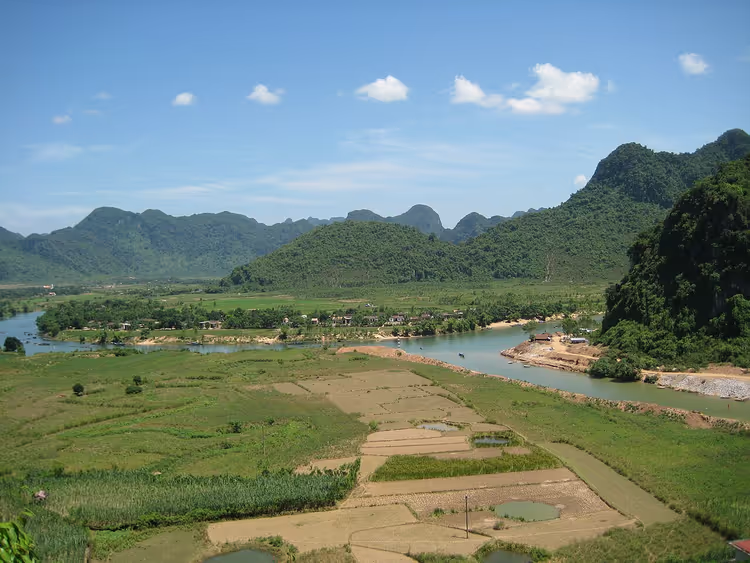
The park's forests shelter rare animals. Protected species include the Sunda pangolin, Chinese serow, Tonkin langur, and stump-tailed macaque. Tropical butterflies circle above the flowers, and bright birds keep to the treetops. For active visitors there are trekking and rock climbing routes, and speleologists come for new galleries.
- How to get there: an hour by car from Dong Hoi, which is served by trains and planes (according to the map).
- Entry and hours: there is no general park ticket; each cave sells its own (as of 09/2026, tourism center).
- The catch: the nearest airport is only in Dong Hoi, and then it is another hour on the road.
2. Cat Ba National Park
Cat Ba occupies one of the country's largest islands in Ha Long Bay near Hai Phong. The Cat Ba Archipelago, together with the bay, is listed as a UNESCO World Heritage Site, and the island itself is recognized as a biosphere reserve (according to the official park website). The park covers more than half of the island, and it has preserved mangrove forests, limestone cliffs, and quiet lagoons.
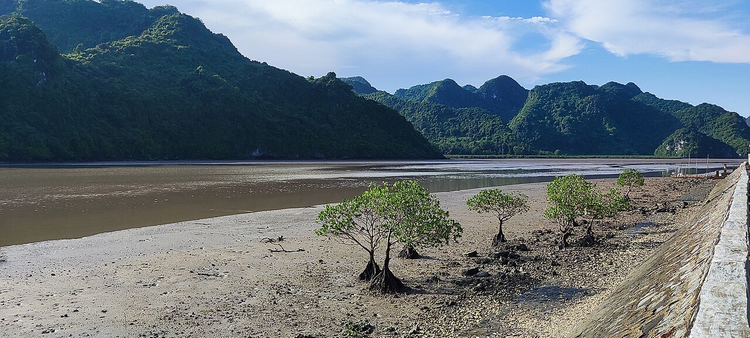 © Shyamal · CC BY-SAPhoto: Shyamal, CC BY-SA (https://creativecommons.org/licenses/by-sa/4.0), Wikimedia Commons
The mangroves give way to floating fishing villages that bob on the waters of the bay. In the island's interior hide lakes, sandy and pebble beaches, and grottoes. This is home to the Cat Ba langur, the world's rarest primate: the population has shrunk to a critical minimum, and the animal is now found only deep inside the park. Cat Ba also serves as a base for boat trips around Lan Ha Bay. The Cat Co beaches are a half-hour walk from the village, but in summer they fill up with vacationers from Hanoi, so it is better to arrive in the morning. Tours to Cat Ba and Ha Long Bay are best booked in advance: compare tours on GetYourGuide.
- Who it's for: those who want to combine forest with sea and beaches.
- How to get there: bus to Hai Phong, then ferry or speedboat (according to the map).
- Entry and hours: the park is open from 7:00 to 17:00; the fee was recently revised (as of 09/2026, official website).
- The catch: the island is accessible only by water, and in bad weather departures are rescheduled.
3. Cat Tien national park
Cat Tien spreads across a plain in Dong Nai province, a couple of hours from Ho Chi Minh City. The park is a UNESCO biosphere reserve, and its crocodile lake Bau Sau is listed as a Ramsar wetland (according to the official website). What sets it apart from the mountain parks of the north is its flat terrain, dense bamboo thickets, and the Dong Nai River.
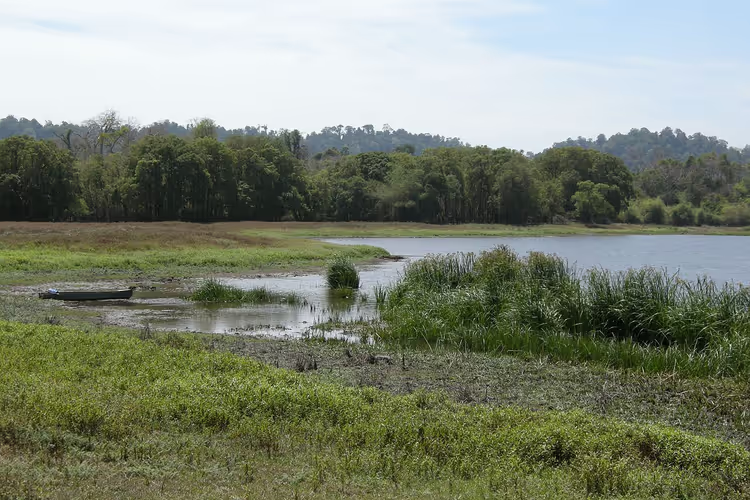 © Vyacheslav Argenberg · CC BYPhoto: Vyacheslav Argenberg, CC BY (https://creativecommons.org/licenses/by/2.0), Wikimedia Commons
A boat takes you across the Dong Nai to the park headquarters. Beyond that, you enter humid forests and meadows that are home to yellow-cheeked gibbons, green peafowl, pheasants, hornbills, and monitor lizards. Thousands of butterflies hover over the flowers, and crocodiles emerge on Bau Sau lake at dusk. The scars of war are still visible here: part of the evergreen forests never recovered after the US Army sprayed chemicals, and those areas now grow mostly bamboo and tall grasses. Staying overnight in the park's guesthouses lets you be the first one out on the dawn trail.
- Getting there: a couple of hours by car from Ho Chi Minh City, then a boat crossing to the park headquarters (see map).
- Admission: for foreign visitors, the ticket costs tens of thousands of dong (as of 09/2026, official website).
- The catch: longer trails are only accessible with a guide.
4. Yok Don National Park
Yok Don, Vietnam's largest national park, lies on a dry plateau in Dak Lak province near the Cambodian border. The terrain is flat and the forests are sparse. In the dry season, rivers dry up and the landscape resembles a savanna. The park is known for its elephants, and local authorities were the first in the country to shift to an elephant-friendly tourism model without riding the animals (according to the official website).
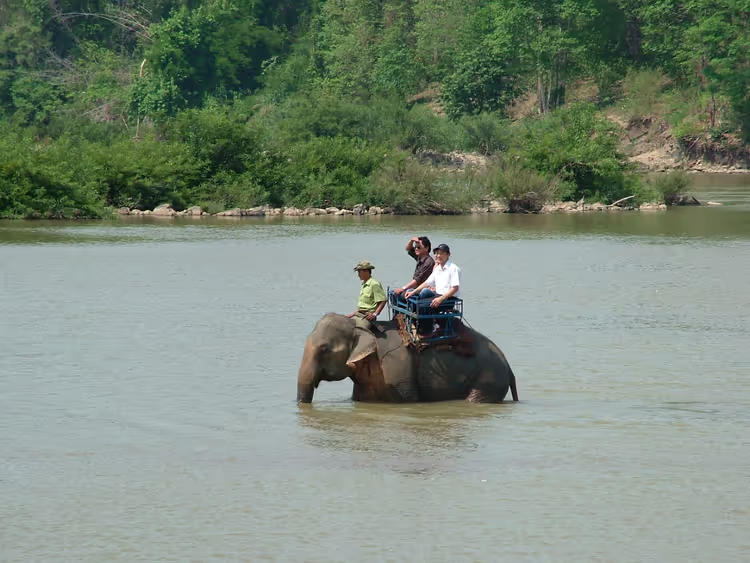 © Đỗ Tuấn Hưng · CC BY-SAPhoto: Đỗ Tuấn Hưng, CC BY-SA (http://creativecommons.org/licenses/by-sa/3.0/), Wikimedia Commons
The plains are home to gibbons, gaurs, bantengs, Asian elephants, and many bird species. Green peafowl and orioles stay in the Srepok River basin. The best way to see elephants is on a guided tour: the animals are part of an observation program, not a riding one. Local guides point out tracks from nighttime movements and teach you how to read the dry forest. We recommend booking elephant eco-tours in advance: see eco-tours on GetYourGuide.
- Getting there: about an hour by car from Buon Ma Thuot, which has an airport (see map).
- Admission: 60,000 dong for an adult, about €2 (as of 09/2026, Yok Don official website).
- The catch: in the dry season, rivers dry up and some trails are rerouted.
⁉️🤔 Frequently asked questions
When is the best time to visit Vietnam's national parks?
In the south, the dry season runs from November to April. Roads are dry, there is less rain, and temperatures are mild. In the center, in Phong Nha-Ke Bang, rains and floods occur roughly from September to December. Son Doong tours run roughly from February to August. In the north, on Cat Ba, summers are hot and crowded, but the sea is warm. Start your hike at dawn: animals and birds are more active in the morning and retreat into the shade by midday.
How much does park admission cost?
Admission to Yok Don costs 60,000 dong for an adult (as of 09/2026, official website). In Cat Tien, a ticket for foreigners is more expensive than for locals. Check the exact amounts on the parks' official websites before your trip.
Where can you see elephants in Vietnam?
Elephants are hosted by Yok Don National Park in Dak Lak Province. It runs an observation program rather than rides: the animals are watched in their natural environment. Tours are limited in the number of guests and the number of elephants, so you need to book them in advance, a couple of weeks before your trip.
What is the largest cave in Vietnam?
The planet's largest cave, Son Doong, lies in Phong Nha-Ke Bang National Park. You can only get there with a licensed group and by prior reservation: the number of spots per season is strictly limited, and the route takes several days.
Can you visit the parks without a tour?
Yes, in most parks you walk on your own along marked trails. In Cat Tien, some of the longer trails are only open with a guide, and in Phong Nha-Ke Bang you buy a boat ride and a ticket on the spot. A tour is needed where a site is closed to individual visitors.
In short: which parks to book
Park | Region | Main highlight | Who it's for |
|---|---|---|---|
Phong Nha-Ke Bang | Central, Quang Binh | Caves and underground rivers | Cave lovers |
Cat Ba | North, Hai Phong | Mangroves, lagoons and the sea | Those combining a park with the beach |
Cat Tien | South, Dong Nai | Crocodile Lake and gibbons | Those coming from Ho Chi Minh City |
Yok Don | Central Highlands, Dak Lak | Elephants and dry savanna | Those who want to see elephants |
If you only have a couple of days, pick one park near a city: Cat Tien from Ho Chi Minh City or Cat Ba from Hanoi. If you're traveling through the country from north to south, add Phong Nha-Ke Bang on the way between Hanoi and Hue. For elephants and dry forests, head up to the Central Highlands and Yok Don. It's best to plan the route between all these points in advance: find trains across Vietnam on Trip.com.

A small editorial team writing guides for independent travel. We travel ourselves, but we haven’t been everywhere, so we check prices, opening hours and how to get there against official sources.