
















How hotels, airports and airlines reduce emissions: 6 working examples
Hotels throw away mountains of garbage every day. Planes burn kerosene, and airports have long been considered zones of poor ecology. But some companies have flipped this logic.
Since 2025, Helsinki-Vantaa has reached zero emissions from its own operations (according to the Finavia report, 09/2026). Soneva Fushi in the Maldives recycles about 90% of the island's waste. We've gathered six properties from the Czech Republic to the Galapagos where ecology has become a working practice, not a banner.
How we evaluated sustainability
💡 In short:
- We looked at verifiable solutions: renewable energy, waste recycling, local products, water conservation.
- We checked each property on its official website, not by advertising claims.
- Properties without confirmed data were not included in the selection.
- As of: 09/2026, verified on official websites.
Below you'll find six properties that passed this check. We've put them in one table.
Property | Type | What it does |
|---|---|---|
Chateau Mcely | hotel, Czech Republic | local furniture, farm products, manual sorting |
Soneva Fushi | hotel, Maldives | eco-fee on stays, waste recycling into glass |
Refuge du Goûter | mountain hut, France | solar panels, snow instead of plumbing, dry toilet |
Helsinki-Vantaa | airport, Finland | zero emissions from its own operations |
Seymour | airport, Ecuador | world's first eco-airport, LEED Gold |
Finnair | airline, Finland | first transatlantic flight on biofuel |
1. Chateau Mcely, Czech Republic
A castle on a hill an hour's drive from Prague has been open to guests since 2006 (according to the official Chateau Mcely website, 09/2026). The 17th-century noble estate was restored with an eye on nature. Furniture was commissioned from Czech craftsmen so it wouldn't have to be shipped halfway around the world.
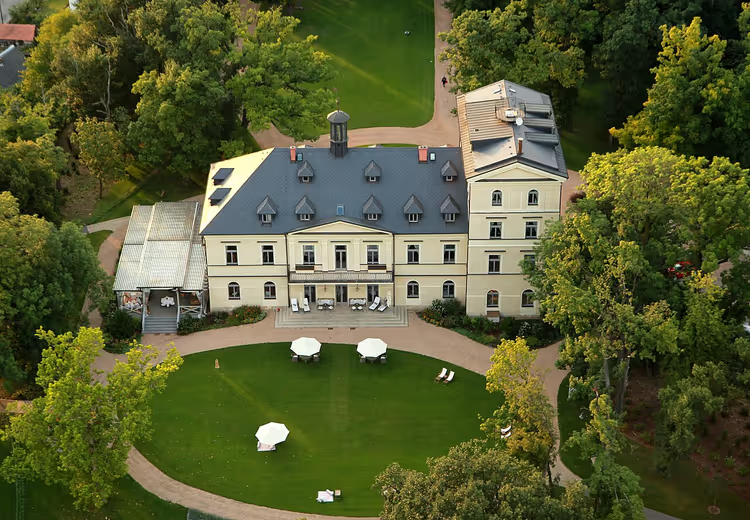 © Zdeněk Fiedler , edited by Pavel Hrdlička ( Packa ) · CC BY-SAPhoto: Zdeněk Fiedler , edited by Pavel Hrdlička ( Packa ), CC BY-SA (https://creativecommons.org/licenses/by-sa/3.0), Wikimedia Commons
The kitchen works with local products, mostly farm-sourced. Herbs, flowers, and berries for the restaurant grow right next to the castle. Even the plants by the pond were chosen to help keep the water clean.
In 2007, the hotel received Green Hotel status and became the only five-star green hotel in the Czech Republic and the second in Europe (according to Chateau Mcely, 09/2026). Heating comes from an energy-efficient stove, and electricity comes from renewable sources. Waste is sorted by hand here, and part of it goes to recycling.
You won't find excess plastic in the rooms: no bottles, no packaging. If you use one towel for several days, there will be less laundry.
- Who it's for: guests who want a quiet castle outside the city, not a hotel in the center.
- The catch: it's far from the city, not a convenient base for exploring Prague.
2. Soneva Fushi, Maldives
Soneva Fushi resort is built from sustainably sourced wood and fast-growing bamboo. The interior and decor were made by local craftsmen by hand. Insects are managed here using methods that are safe for the island's fauna.
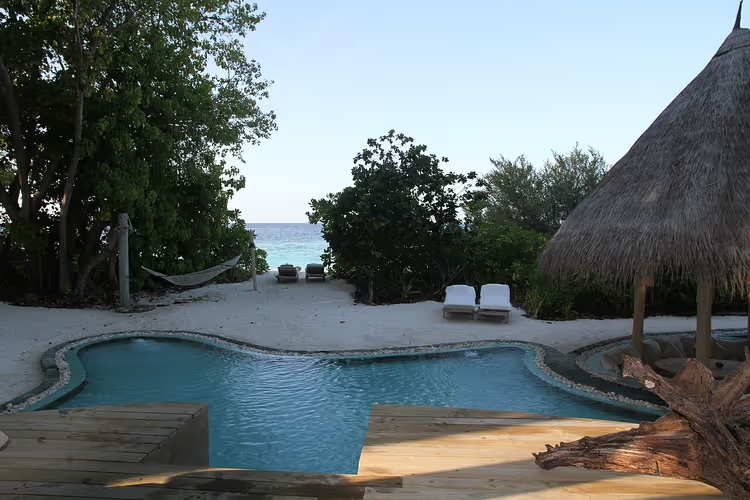 © 7777777kz · CC BYPhoto: 7777777kz, CC BY (https://creativecommons.org/licenses/by/3.0), Wikimedia Commons
Guests pay a 2% environmental fee on all types of stays (according to Soneva, 09/2026). The money goes to projects with environmental and social impact. You can separately offset the direct and indirect carbon emissions from your flight.
Waste on the island is treated as a resource. About 90% of solid waste is recycled, and part of it is turned into glass in the resort's own workshop (according to Soneva, 09/2026). Drinking water is purified and mineralized, then bottled in glass instead of plastic bottles.
- The catch: a separate eco-fee is added to your bill on top.
3. Refuge du Goûter, France
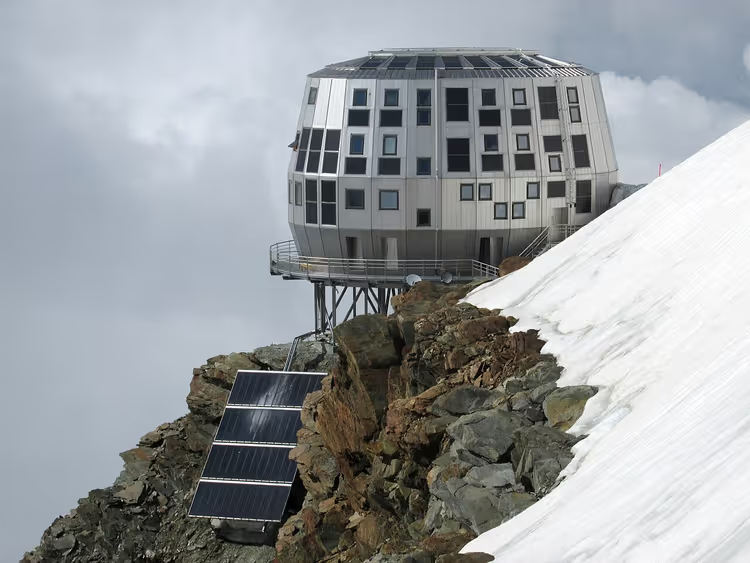
Refuge du Goûter sits at an altitude of 3,835 m on the classic Mont Blanc ascent route (according to FFCAM, 09/2026). It's the highest hut in France and one of the most eco-friendly. If you're heading to the summit, the hut will be your last stop before the climb.
 © Coronium · CC BY-SAPhoto: Coronium, CC BY-SA (https://creativecommons.org/licenses/by-sa/3.0), Wikimedia Commons
The building is anchored on a metal platform in a convenient spot on the ridge. Inside there are wooden columns and beams, outside stainless steel. All elements were manufactured in the valley and assembled on site so that machinery wouldn't have to be driven up the slope.
Electricity and heat come from solar panels and a cogeneration unit running on rapeseed oil. Water for household needs is obtained by melting snow with a solar-powered system. A dry toilet eliminates the need for wastewater.
- The catch: sleeping spots are in shared dormitories, comfort at altitude is minimal.
4. Helsinki-Vantaa, Finland
In 2025, Helsinki-Vantaa reached zero emissions from its own operations (according to Finavia, 09/2026). It's the main air gateway to Finland and the country's largest hub by passenger numbers.
 © Markus Trienke · CC BY-SAPhoto: Markus Trienke, CC BY-SA (https://creativecommons.org/licenses/by-sa/2.0), Wikimedia Commons
A solar power plant on the roof of the passenger terminal covers part of the airport's needs. The rest of the energy comes from wind turbines. This is how the hub's operations are being fully transitioned to renewable sources.
Most of Finland's international traffic passes through Helsinki-Vantaa, including connecting flights. If you're flying with a layover in Helsinki, you'll have a chance to appreciate the green infrastructure of the terminals. It's not just electricity that's changing here, but also aircraft servicing at the gates.
5. Seymour, Galapagos Islands, Ecuador
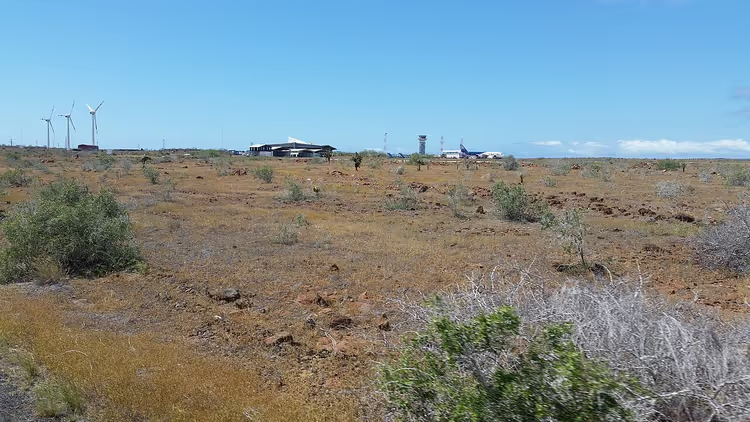
Seymour Airport on Baltra Island opened after reconstruction in 2012 and became the world's first ecological airport (according to ECOGAL, 09/2026). It serves the entire Galapagos archipelago.
 © Pi3.124 · CC BY-SAPhoto: Pi3.124, CC BY-SA (https://creativecommons.org/licenses/by-sa/4.0), Wikimedia Commons
Almost all of the terminal's electricity comes from the sun and wind. Clean water is drawn from the sea through its own desalination plant. During the rebuild, most of the materials from the old building were reused.
The project relied on natural lighting and ventilation, so air conditioners and extra lamps are barely needed. Staff collect litter across the entire island and restore local flora and fauna. Iguanas on the airfield are a common sight here, you'll see them right by the terminal.
- The catch: Baltra has almost no hotels or restaurants, it's a transit island.
6. Finnair and other airlines
Identifying the greenest carrier is difficult: many publish carbon dioxide emission reports, but their methodologies differ. It's more honest to compare airlines by specific actions rather than by rankings.
 © Alan Wilson from Stilton, Peterborough, Cambs, UK · CC BY-SAPhoto: Alan Wilson from Stilton, Peterborough, Cambs, UK, CC BY-SA (https://creativecommons.org/licenses/by-sa/2.0), Wikimedia Commons
Finnair was the first to operate a transatlantic flight from Helsinki to New York on biofuel (as of: 09/2026, Travel Daily News). Part of the fuel blend was made from recycled cooking oil.
Baggage weight also affects fuel consumption. The less you bring with you, the lower the carbon footprint of your flight.
- The catch: biofuel is still only part of the fuel blend, fully green flights are almost nonexistent.
⁉️🤔 Frequently asked questions
Which property in the selection is the most eco-friendly?
There's no clear leader. Soneva Fushi recycles about 90% of the island's waste and collects a separate eco-fee. Refuge du Goûter runs on solar energy and snowmelt water. These are different challenges: one solves the waste problem on an island, the other maintains self-sufficiency in the mountains. Both approaches are worth keeping in mind when comparing hotels and mountain huts.
Why is Helsinki-Vantaa cited as an example?
The airport reached zero emissions from its own operations and was the first in the Finavia network to clear that bar. For you, that means fewer emissions on the ground, although the flight itself remains the heaviest stage in terms of carbon footprint.
Is it true that the Galapagos airport is the first in the world?
Yes, Seymour on Baltra Island received the status of the world's first ecological airport and LEED Gold certification. That said, flying to the Galapagos leaves a footprint, and it's better to offset it separately.
Do airlines actually fly on biofuel?
Partially, for now. Finnair was the first to operate a transatlantic flight on a blend with recycled cooking oil. Today, biofuel is added to regular kerosene in a small proportion, so emissions are reduced but don't disappear completely.
What should you check when choosing an eco-friendly hotel?
Look not at the word "eco" on the website, but at specifics. Renewable energy, separate waste collection, local products, no plastic in rooms. If a hotel publishes such a report, you can trust it more than a colorful banner.
How aviation is transitioning to sustainable fuel is covered in detail in a short video.
In short: what's worth booking
Ecology in tourism starts with decisions that are visible from the inside. Chateau Mcely shows how a castle lives on local products and manual sorting. Soneva Fushi proves that island waste can be turned into a resource. Helsinki-Vantaa and Seymour show how an airport runs on renewable energy.
If you have a short trip departing from Prague, go with Chateau Mcely. If you want an island where about 90% of waste is recycled, look at Soneva Fushi. If you're climbing Mont Blanc, stay overnight at Refuge du Goûter.
Choose a hotel by its sustainability report, not by a green logo. Pick the option that publishes concrete goals and numbers, and your trip will leave a smaller footprint.

A small editorial team writing guides for independent travel. We travel ourselves, but we haven’t been everywhere, so we check prices, opening hours and how to get there against official sources.