
















What you can and cannot do in India: 10 rules of conduct for a tourist
India is generous to tourists, but not to ignorance. Locals will forgive you a confused look, but they may read a wrong gesture as disrespect.
The scale of travel confirms this. In the 2024-25 financial year, the Taj Mahal in Agra alone welcomed 6.26 million domestic and 645 thousand foreign visitors (as of 2025, Economic Times). Each of them interacts with dozens of locals every day.
To avoid looking like a boor, it is enough to know a dozen simple norms. Below are ten rituals and rules of India that most often affect how people treat you.
What to know about rituals in India
💡 In short:
- Greet with the word "namaste" instead of a handshake: palms at your chest, slight bow.
- Pass food and money only with your right hand; the left is considered "unclean" here.
- Before entering a temple, remove your shoes and cover your shoulders, head, and knees.
- Etiquette and temple visit rules: 09/2026, verified on the official tourism portal of India.
A cheat sheet for common situations:
Situation | The right way | What to avoid |
|---|---|---|
Greeting | "Namaste," palms at your chest | Hugs and kisses in public |
At the table | Right hand, empty plate | Left hand, loud conversations |
Shoes | Remove them in temples and homes | Soles pointed at a person |
Temple | Covered clothing and a scarf | Bare shoulders, shorts |
Wedding | A gift and a modest outfit | Filming ceremonies without permission |
1. A cow on the street is considered sacred
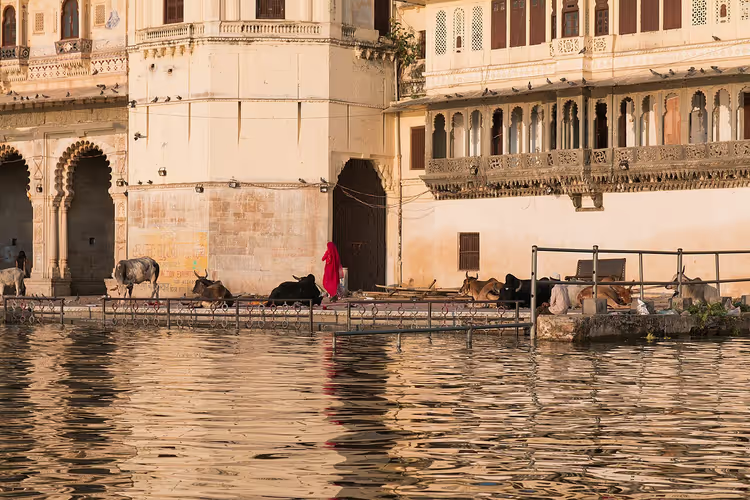
In India, the cow is considered a sacred animal, and it is allowed almost anything. The animals sleep in the middle of the road, wander into markets, and eat straight from the stalls. You can encounter them both in villages and on the avenues of major cities.
In several states, harming a cow carries criminal liability, up to imprisonment. A tourist just needs to keep their distance. Do not pet the cow, do not shoo it away yourself, and do not honk near it: locals react painfully to that.
 © Daniel VILLAFRUELA · CC BY-SAPhoto: Daniel VILLAFRUELA, CC BY-SA (https://creativecommons.org/licenses/by-sa/3.0), Wikimedia Commons
- The right way: walk around the animal and give it the right of way.
- What to avoid: feeding the cow sweets or touching its face.
2. Greet with the word "namaste"
A handshake in India is common in business circles, but in everyday life it is replaced by namaste. You bring your palms together at chest level, bow slightly, and say "namaste." This is how both men and women are greeted.
Do not extend your hand to a woman first: wait until she offers hers. A smile and a short nod are enough in response. The same rule applies in shops and at the hotel front desk.
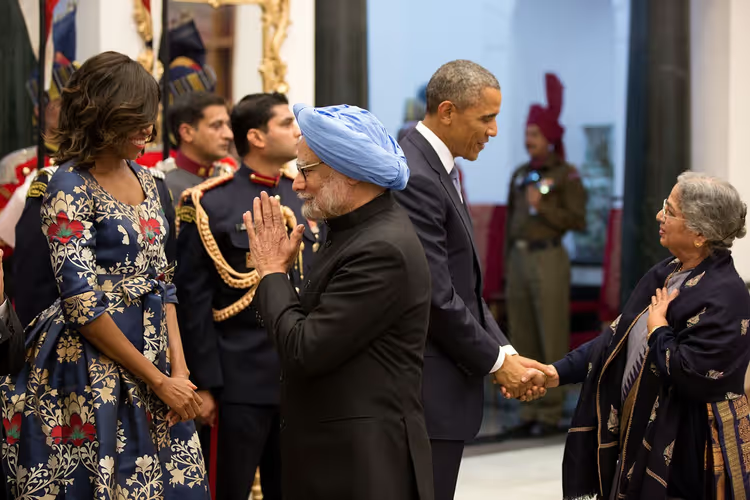
- The right way: palms at your chest, slight bow, the word "namaste."
- What to avoid: grabbing the other person by the hand or shoulder.
3. Do not put your feelings on display
Hugs, kisses, and holding hands in public are considered vulgar in India. A gesture that is normal in Europe reads here as disrespect to those standing nearby.
Touching the shoulder or back of someone you barely know is best avoided. On tourist beaches the norms are looser, but in the city keep it restrained.
- The right way: keep your distance and minimize touching.
- What to avoid: hugs, kisses, and hands on the waist in public.
4. Watch your fingers and soles
In India, the index finger is replaced by an open palm or a chin nod. Pointing at a person with your finger is as rude here as calling a dog.
The second subtlety has to do with feet. A sole turned toward the person you are talking to will be taken as a personal insult. So do not sit cross-legged and do not stretch your feet forward.
- The right way: point with an open palm, nod, or shift your gaze.
- What to avoid: sitting cross-legged and pointing your feet at a person.
5. Eat and pass food with your right hand
At the table, Indians use their right hand: it is considered clean. They use it to take food and pass dishes to neighbors. The left hand is perceived as unclean, so it does not touch food or people.
In a restaurant for foreigners, you will be given utensils, and a fork will not bother anyone. But if you are invited into a home, take food with your right hand. Food here is considered a gift from the gods, and the meal itself proceeds as a ritual. Hands are always washed before eating.
- The right way: take food and pass plates with your right hand.
- What to avoid: taking food with your left hand and touching people with it.
6. Do not leave food on your plate
Leftovers on the plate can be read by the host as disrespect for the table. Try everything that is offered and take small portions: seconds are served with pleasure here.
During the meal, Indians rarely have lively conversations. This is not a ban on talking, but a calm ritual. If you need to explain something, speak quietly and briefly.
- The right way: take small portions and finish them.
- What to avoid: leaving half the dish and chatting at the table.
7. In temples, remove your shoes and cover your shoulders
Before entering an Indian temple, take off your shoes. Clothing should be modest and covered, especially for women: no bare head, shoulders, or legs. A scarf and a long skirt are not a formality here, but a condition of entry.
Shoes are left at the entrance, often under the watch of an attendant. Check the rules for visiting a specific temple on the official tourism portal of India.
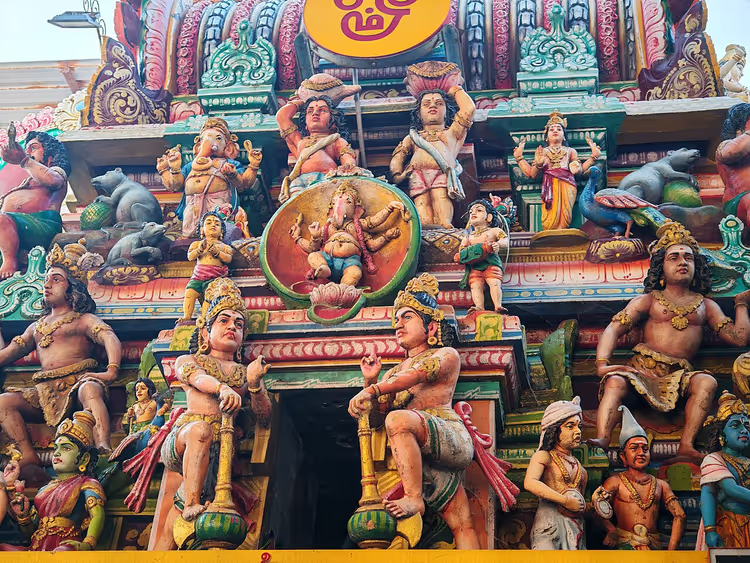
- The right way: remove your shoes and wear covered clothing.
- What to avoid: entering in shorts or with bare shoulders.
8. An Indian wedding lasts three days
Indian weddings are celebrated not for one evening, but for three days. The tradition of arranged marriage is still alive here: parents choose a partner for their child, sometimes comparing horoscopes. In Hinduism, marriage is considered to be for life.
If you are invited to the celebration, come with a small gift and in covered clothing. Film the ceremonies only with the hosts' permission. Ask in advance what is customary to wear: festive clothing is appropriate here.
- The right way: a gift, a modest outfit, and permission for photos.
- What to avoid: showing up uninvited and empty-handed.
9. Baksheesh is given only for a service
India has many beggars who approach tourists asking for alms. The local name for such money, baksheesh, is tied to a service: you reward a person for something they did for you.
If there was no service, giving is not customary. Otherwise, alms will quickly eat up your cash: there really are many people asking near train stations and on tourist streets. Calmly say "no" and keep walking.
- The right way: pay baksheesh for help, advice, or a service.
- What to avoid: handing out money to everyone you meet.
10. Varanasi and cremation on the banks of the Ganges
Cremation in India is considered the main method of burial. Death here is perceived not as a misfortune, but as the liberation of the soul for a new form of existence. Burning the body, according to local beliefs, helps the spirit find its way between worlds.
The most revered place for the rite is Varanasi on the banks of the Ganges. It is believed that a person cremated here immediately attains moksha, bypassing the cycle of rebirths. The body is burned only on a pyre of natural wood. The fire on the ghats burns around the clock, every day, and the ashes are lowered into the river.
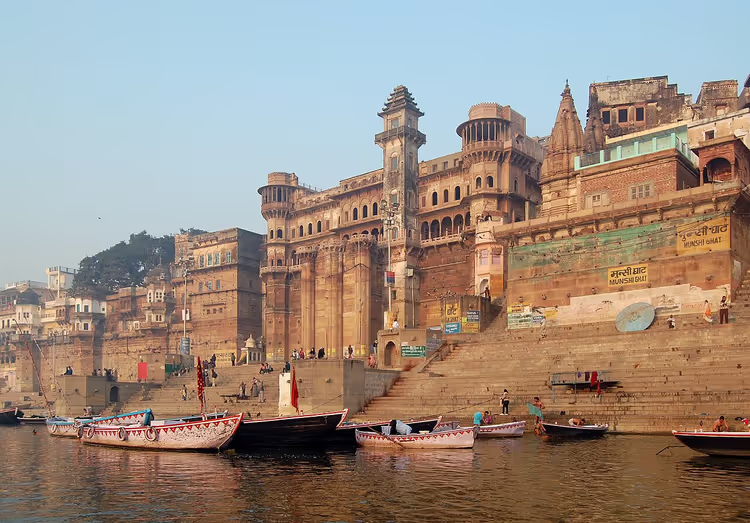 © Marcin Białek · CC BY-SAPhoto: Marcin Białek, CC BY-SA (https://creativecommons.org/licenses/by-sa/3.0), Wikimedia Commons
- The right way: observe silently and from a distance.
- What to avoid: filming the rites with flash and approaching the pyres.
⁉️🤔 Frequently asked questions
Is it true that harming a cow can lead to jail?
In several Indian states, cow slaughter is restricted by law, and cruelty is punishable by fines and prison terms. It is not worth testing this in practice. Just stay away from the animals. To move a cow away from your car, it is better to ask a local driver or passerby.
Do you need to remove your shoes in all Indian temples?
Shoes are removed in almost every temple and in any home. At the entrance you will see a pile of sandals and a person who will keep an eye on your pair. Keep your socks on: in summer the stone at the entrance is scorching hot. Large temples usually have a shoe storage point nearby.
Can you photograph cremation in Varanasi?
There is no direct ban, but this is a place of grief, not a tourist attraction. Before filming, ask permission from an attendant. It is better not to use flash at all, and some ghats are closed to photographers. Many tourists simply stand aside and watch silently.
In short: what to book
India rewards the attentive. Remember three basic rules: namaste instead of a handshake, the right hand at the table, and covered clothing in the temple. The locals will tell you the rest; just watch them.
If you are still planning your trip, check the official tourism portal of India: it has the rules for visiting temples and monuments.

A small editorial team writing guides for independent travel. We travel ourselves, but we haven’t been everywhere, so we check prices, opening hours and how to get there against official sources.