

















What travel will become: 4 technologies changing tourism
Space tourism is no longer science fiction. At the same time, some high-profile projects quietly shut down. We'll also cover the defunct Hyperloop One and the canceled lunar flyby.
We looked at four technologies that are changing travel and checked their status as of 09/2026. You'll see where tickets are already on sale and where they're still just promises.
Ad: this article contains affiliate links. We earn a commission if you book through them, at no extra cost to you.
1. Vacuum trains accelerate to 623 km/h
💡 In short:
- A vacuum train travels in a tube without air and accelerates on a magnetic cushion.
- China's T-Flight set a speed record of 623 km/h in February 2024.
The idea is simple. A capsule travels through a tube from which the air has been pumped out. Magnetic levitation eliminates friction, and the vacuum eliminates air resistance. In theory, such a train can accelerate to 1,000 km/h. That's faster than a typical airliner.
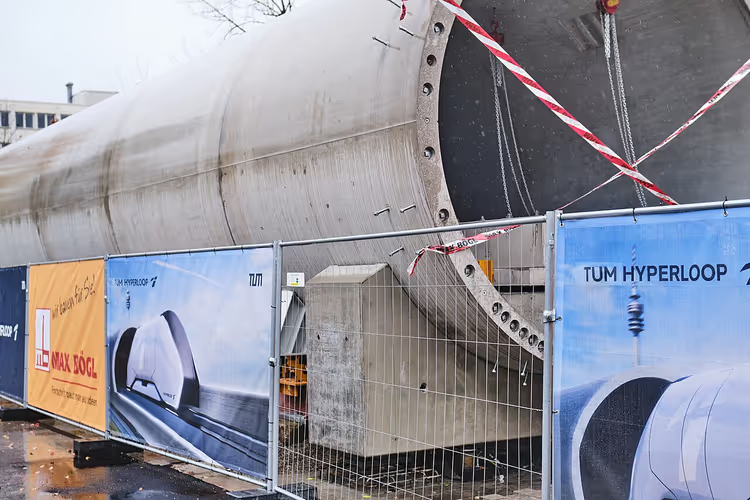
The most prominent project was Hyperloop One. The company raised about $450 million, built a track in Nevada, and conducted manned tests. In December 2023, it ceased operations without ever signing commercial contracts (according to Born To Engineer).
China went further. The T-Flight system from CASIC accelerated to 623 km/h on a test section about 2 km long in February 2024 (according to The Debrief). That's a world record for trains of this class. Chinese engineers are aiming noticeably higher.
 © Photo MF · CC BY-SAPhoto: Photo MF, CC BY-SA (https://creativecommons.org/licenses/by-sa/4.0), Wikimedia Commons
There's movement in Europe too. The Netherlands' Hardt Hyperloop demonstrated switching between tracks at 85 km/h. Switzerland's Swisspod is testing a scaled-down model in a tube. They're still far from a line with passengers.
- The catch: no company has signed a commercial contract yet, so there are no regular services.
- Who it's for: useful if you follow the future of transportation and want to understand how much of this is real.
2. Air taxis instead of flying cars
Flying car startups have almost all evolved into air taxis. These are electric vertical takeoff aircraft that carry a couple of passengers above traffic jams. Uber ran such a project for a while but shut down its public program.
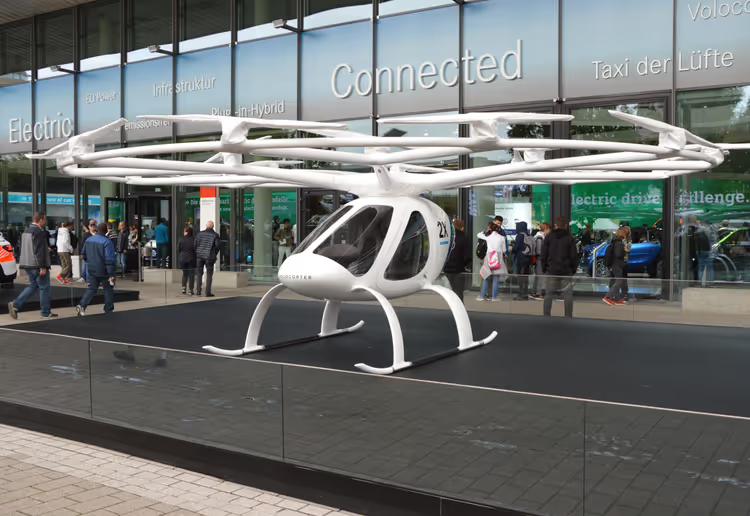
Germany's Volocopter was the first to show an unmanned air taxi. By 2026, its European ambitions collapsed: the company didn't complete certification (according to DataDeep). It's the loudest air taxi failure in Europe.
 © Spielvogel · CC BY-SAPhoto: Spielvogel, CC BY-SA (https://creativecommons.org/licenses/by-sa/4.0), Wikimedia Commons
The leaders are now different. America's Joby has passed stage four of five in FAA certification and is launching flights in Dubai. Archer is preparing a launch in Abu Dhabi and is already receiving its first commercial payments (according to The Bryant). Both companies are building vertiports near airports.
Today, only China's EHang carries passengers on a commercial basis. Joby and Archer are still going through checks. Full FAA certification for American air taxis is not expected before mid-2027 (according to DataDeep analytics).
- The catch: there are still no rules for urban air traffic, and without certification, passengers won't be allowed on board.
- Who it's for: those waiting for short flights between cities without traffic.
3. Lunar tourism and tickets to Mars
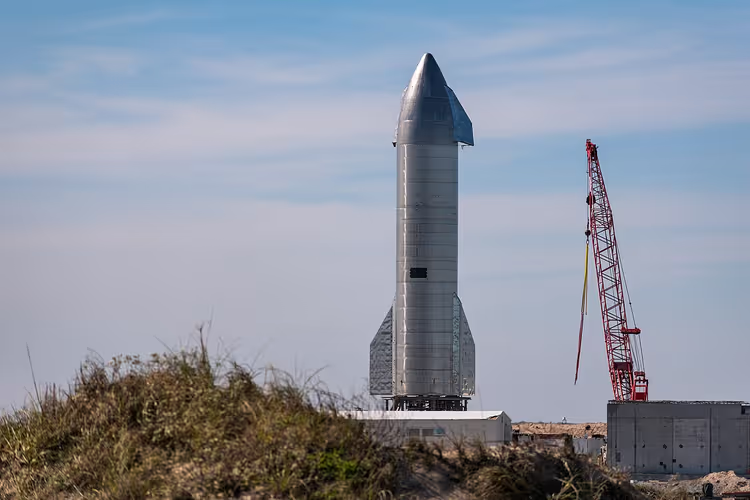
A lunar flyby remains a dream. Japanese billionaire Yusaku Maezawa bought out all seats on Starship and announced an open selection of participants. The project was named dearMoon. In June 2024, it was canceled because the Starship timeline proved unrealistic (according to Ars Technica).
 © Jared Krahn · CC BY-SAPhoto: Jared Krahn, CC BY-SA (https://creativecommons.org/licenses/by-sa/4.0), Wikimedia Commons
There are no private lunar flybys today. Only Starship could perform a flyby, but it is still undergoing testing. No seats on it are being sold.
Mars is even further off. Some futurists promise regular flights by 2050. For now, that is a forecast, not a schedule. Conditions on the Red Planet are poorly suited to an ordinary tourist, so it is too early to talk about tickets.
- The catch: the dearMoon project is closed, and no Starship seats are on sale.
- Who it's for: if you want to go to space, suborbital flights are the more realistic option.
4. Space is already for sale: suborbital flights
A suborbital flight lasts about 11 minutes and gives you a few minutes of weightlessness. It is the most accessible entry into space for a tourist. In 2026, these were already being sold and flown.
Blue Origin sent six passengers past the Karman line in the first human flight of the year. It was the company's 38th mission (according to a CNBC-TV18 report). The company does not officially publish the price for New Shepard, so seats are discussed individually.
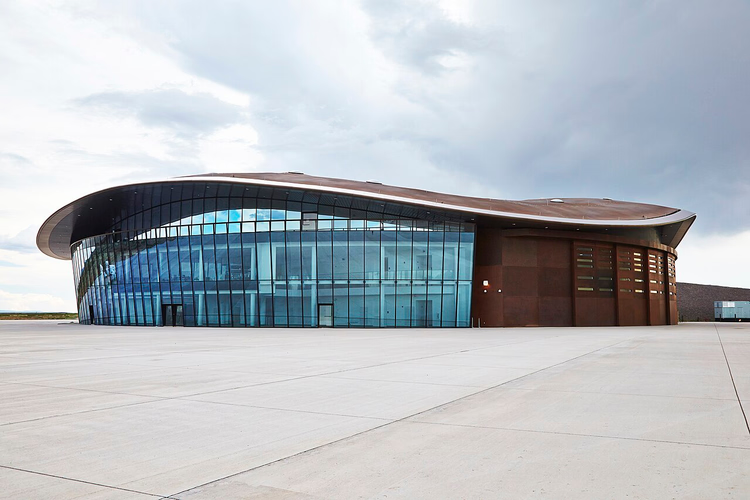
Virgin Galactic works differently. The old VSS Unity spacecraft has been retired, and the new Delta-class will not begin commercial flights before February 2027. The seat price has passed $750,000 (as of 09/2026, Latteluxury News).
 © Land Rover MENA · CC BYPhoto: Land Rover MENA, CC BY (https://creativecommons.org/licenses/by/2.0), Wikimedia Commons
There is also an orbital level. For now, these are SpaceX flights, including to the ISS with Axiom Space, and their price goes far beyond a tourist budget. For most travelers, space remains an exotic experience, not a vacation.
- The catch: Virgin Galactic commercial flights will not start before 2027 (as of 09/2026, Virgin Galactic).
- Who it's for: those saving up for an unusual experience and willing to wait.
⁉️🤔 Frequently asked questions
Is the hyperloop working right now?
No. Vacuum trains remain an experiment. There is no regular passenger line in either China or Europe. Hyperloop One shut down in December 2023. For now, regular high-speed trains are what you have.
When will flying taxis appear?
The first commercial air taxi routes are being prepared in Dubai and Abu Dhabi, where Joby and Archer plan to launch. In the US, full FAA certification is not expected before mid-2027. In Europe, the Volocopter project did not work out. So in the coming years, you are more likely to encounter air taxis in Asia and the Middle East.
Can I buy a ticket to the Moon?
Not yet. The only private lunar flyby project was canceled in June 2024. No Starship seats are being sold, and there are no regular flights to the Moon. The closest alternative for a tourist is a suborbital flight.
How much does a spaceflight cost?
A seat on Virgin Galactic costs hundreds of thousands of dollars; we gave the exact price in the section on suborbital flights. Blue Origin does not publish a price, and a seat on New Shepard is discussed individually. Orbital flights cost even more. For most tourists, this is not a vacation but a once-in-a-lifetime experience.
How is a suborbital flight different from an orbital one?
A suborbital flight is short and gives you a few minutes of weightlessness. You fly to the Karman line and come right back. An orbital flight takes you into Earth orbit, lasts for days, and costs many times more. Today, SpaceX operates such flights, and they go not only to the ISS.
In short: what to book
Space is still out of reach on price, so book the actual ground portion of the trip. If you need fast connections between European cities, check out high-speed train tickets on Trip.com. For longer routes, compare flights on Kiwi.com.
The bottom line is simple. We'll see the hyperloop in tests, air taxis are taking off in Dubai and Abu Dhabi, and the Moon has been postponed until better times. What you can book today is a train or a plane, and space can stay on your wish list for now.

A small editorial team writing guides for independent travel. We travel ourselves, but we haven’t been everywhere, so we check prices, opening hours and how to get there against official sources.