
















 AIIllustrative image: AI-generated
Treptow Park in Berlin: where 7000 Soviet soldiers are buried
Treptower Park lies on the banks of the Spree in the southeastern part of Berlin. It's easy to get here by city rail. There's one main reason to come: the Soviet War Memorial, the largest in Germany.
The memorial opened in May 1949, and more than 7,000 Red Army soldiers rest beneath the trees (as of 09/2026, according to the City of Berlin). We've put together what to see here, when to go, and how to get there.
Ad: this article contains affiliate links, we earn a commission if you book through them, at no extra cost to you.
History of Treptower Park
💡 In short:
- The main thing here: the Soviet War Memorial, the largest Red Army military burial site in Germany.
- The easiest way to get here is by city rail to Treptower Park station.
- Admission is free, and the park and memorial are open year-round.
- Admission and opening hours: 09/2026, verified on the memorial page at berlin.de.
 © Steffen Zahn from Berlin, Germany · CC BYPhoto: Steffen Zahn from Berlin, Germany, CC BY (https://creativecommons.org/licenses/by/2.0), Wikimedia Commons
The park was laid out on the site of an old apple orchard. The design was prepared by landscape architect Gustav Meyer, the creator of many of Berlin's green spaces. He was involved only in the initial planting and didn't live to see the opening, but his layout was preserved in full. Today you see the same layout that the first visitors saw.
Meyer designed the wide avenues, ponds, and lawns as a public recreation area (according to the Treptow-Köpenick tourism office). Today it's one of the city's largest parks.
The rose garden was added in the mid-20th century and is still maintained today. In summer, thousands of bushes bloom here, and benches in the shade line the paths. Walking through the park is pleasant at any time of year, but it's especially beautiful in spring and early summer.
What to see in Treptower Park
The park has everything you need for a stroll.
The park is designed as a classic German public park. It has everything for a long walk: shady avenues, ponds with fish, fountains, and sports areas. A bust of Gustav Meyer stands beneath the trees.
In summer, people boat on the Spree, and a boat rental operates by the water. Kids will find playgrounds with slides, and you can relax at a café with ice cream. Bring water: a leisurely visit takes a couple of hours.
There's a separate area for children with swings and wooden playhouses. Adults will find the waterfront more interesting: from here you get a view of the Spree and the boat rental dock. Bring a blanket to have a picnic on the lawn.
- Who it's for: families, waterfront walks, and history lovers.
- Not for: those expecting rides and loud shows.
- How to get there: by city rail to Treptower Park station, then on foot.
- Cost: admission is free.
- The catch: on memorial dates and summer weekends, the memorial gets crowded.
If you want to see all of Berlin in one day, the Berlin hop-on hop-off bus tour comes in handy.
The soviet war memorial
This is the largest war memorial to the Red Army in Germany. More than 7,000 soldiers who died in the battles for Berlin are buried beneath the park's trees (as of 09/2026, berlin.de). The memorial took almost four years to build and was opened in May 1949.
 © Cyberfreak77 · CC BY-SAPhoto: Cyberfreak77, CC BY-SA (https://creativecommons.org/licenses/by-sa/4.0), Wikimedia Commons
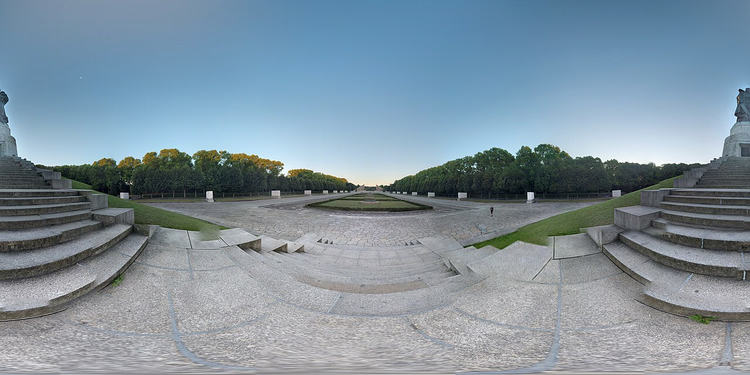
The monument stands on a burial mound beneath a tall white pedestal. Inside the pedestal is the Hall of Memory and Sorrow, which you can enter. Two rows of Russian birch trees lead from the entrance to the main statue.
The grounds are large, so allow extra time for your visit.
How the memorial was created
The site was approved immediately after the war, and the best design was selected through a competition.
 © Mehman Ibragimov · CC BY-SAPhoto: Mehman Ibragimov, CC BY-SA (https://creativecommons.org/licenses/by-sa/4.0), Wikimedia Commons
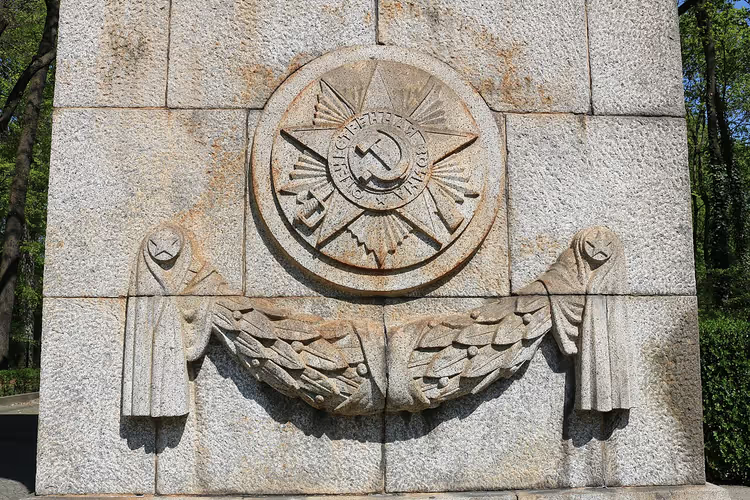
The winners were architect Yakov Belopoltsev and sculptor Yevgeny Vuchetich. A large team worked on the memorial: dozens of sculptors, hundreds of stonemasons, and laborers. Granite from the former Reich Chancellery was used for the cladding, which you can see on the pedestal.
In total, the complex required about 40,000 cubic meters of stone (berlin.de on the memorial).
The story behind the Soldier-Liberator monument
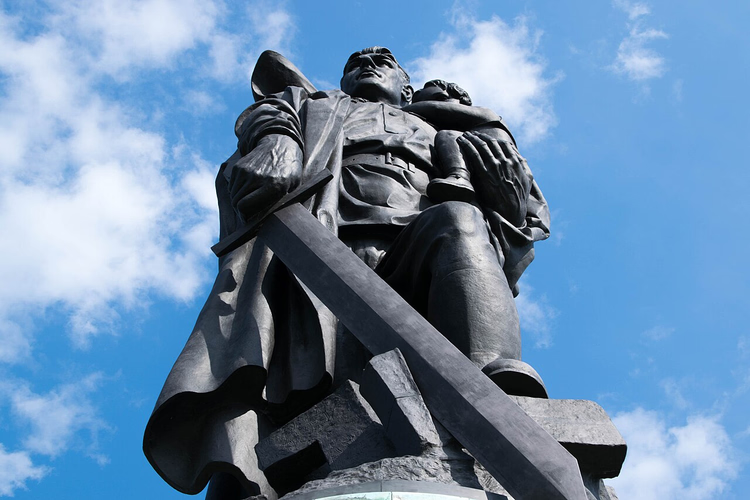
The prototype for the main figure was Sergeant Nikolai Masalov.
 © Raghavendra Tandon · CC BY-SAPhoto: Raghavendra Tandon, CC BY-SA (https://creativecommons.org/licenses/by-sa/4.0), Wikimedia Commons
He carried a German girl out from under fire during the storming of Berlin. Marshal Chuikov wrote about this in his memoirs. So a real episode of the war comes to life before your eyes.
There were many similar stories, which is why the sculptor chose this particular scene. Later, soldiers Ivan Odarchenko and Viktor Gunaz posed for the artist. The girl was portrayed by Svetlana Kotikova, the daughter of the Berlin commandant.
Sculptural symbols
The soldier holds a sword in one hand and a child in the other.
 © Keanu Dölle · CC BYPhoto: Keanu Dölle, CC BY (https://creativecommons.org/licenses/by/3.0), Wikimedia Commons
The sword cuts through a swastika, just as Saint George's spear strikes the serpent. The sculptor modeled the weapon on the sword of Prince Vsevolod of Pskov. On the blade you can read the inscription: "I will yield my honor to no one." In this way the artist emphasized the idea of defending one's homeland and the victory of good over evil.
Hall of Memory and Sorrow
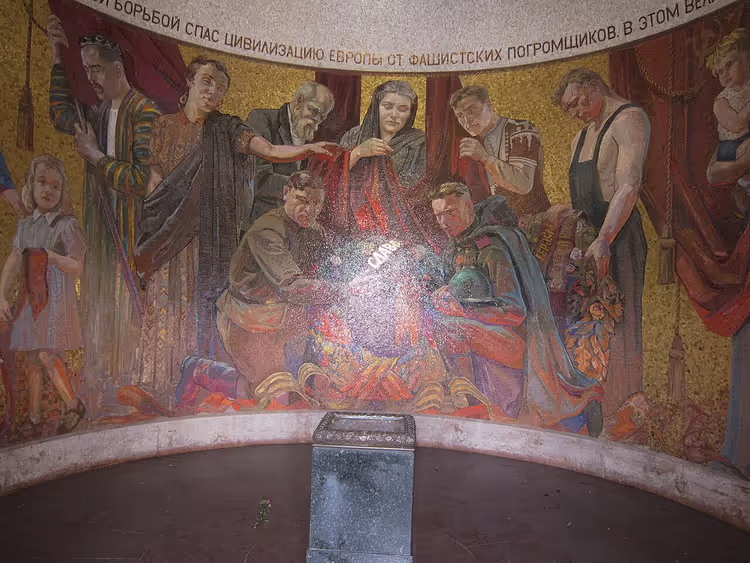
The walls of the hall are covered with mosaics depicting people of different nationalities.
 © Thomas Quine · CC BYPhoto: Thomas Quine, CC BY (https://creativecommons.org/licenses/by/2.0), Wikimedia Commons
They lay wreaths at the graves of the fallen. The ceiling features a chandelier in the shape of the Order of Victory, made of rubies and rock crystal. Inside you will see a parchment folio with a velvet binding.
It records the names of all those buried in the mass grave. The hall is almost always decorated with fresh flowers and wreaths.
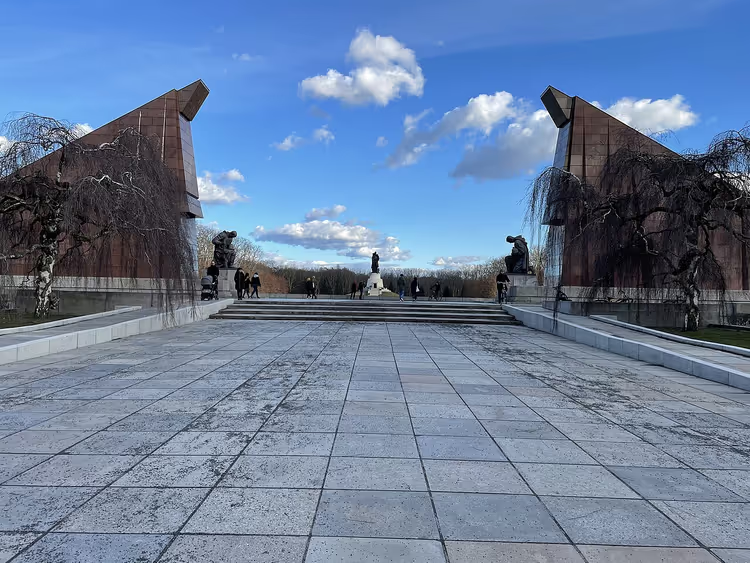
The memorial grounds and sculptures
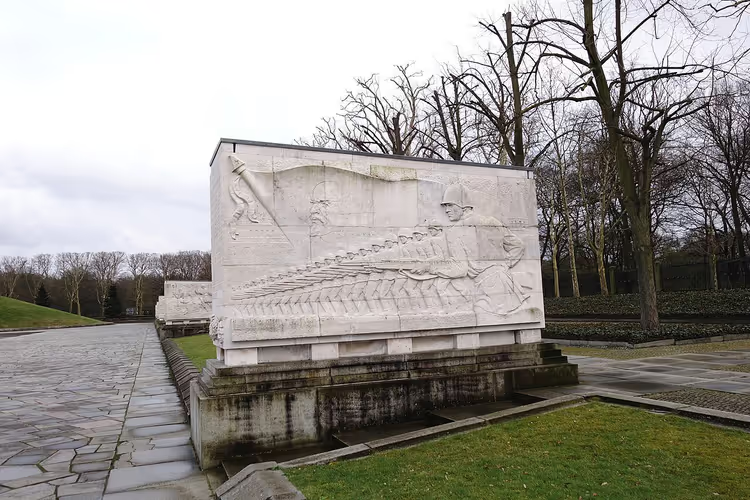
You will walk past five mass graves with marble sarcophagi.
 © Jens Cederskjold · CC BYPhoto: Jens Cederskjold, CC BY (https://creativecommons.org/licenses/by/3.0), Wikimedia Commons
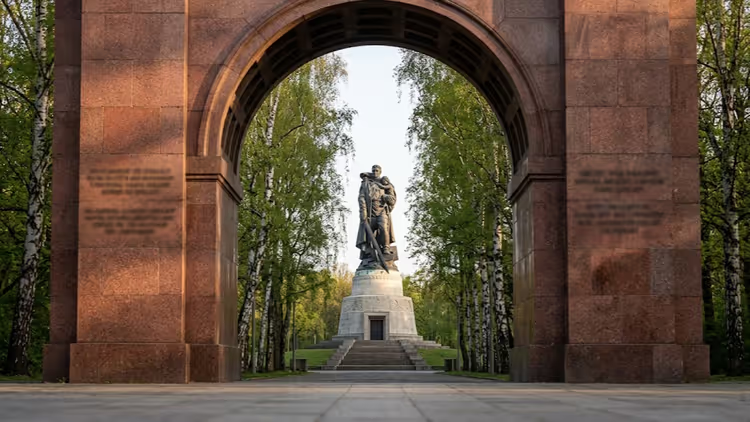
An eternal flame burns in granite bowls. Lines from Stalin's speeches are carved on the sarcophagi, which German officials later tried to contest. At the entrance stand symbolic gates made of two lowered banners of red granite.
Beneath them are frozen figures of a young and an old soldier. In front of the entrance stands the sculpture "Grieving Mother," a symbol of all mothers who lost their sons.
Nearby is the figure of a kneeling soldier. He has removed his helmet and bowed his head, but firmly grips his submachine gun. In this pose you can read both grief and the readiness to defend again.
Status of the memorial
The memorial was solemnly opened on May 9, 1949, in the presence of Soviet and German authorities (as of 09/2026, berlin.de).
Hundreds of Berliners came to pay their respects to the fallen. The two countries signed an agreement with no expiration date: the monument came under the jurisdiction of Berlin. The agreement obliges the city to maintain order and carry out restoration work.
The main statue has already been restored, and the surrounding area is well maintained. On commemorative dates, people come here to lay flowers and honor the memory of the fallen.
Tours and tickets in Berlin
Guided tours, skip-the-line tickets and activities — most offers can be cancelled free of charge.
See offers on GetYourGuideThe widget loads once you give your consent.
Treptower Park today
The park lives its measured life all year round.
In spring and summer, tourists and locals stroll here.
It's a relaxed way to spend half a day. Bring a light jacket: it gets cool by the water in the evening.
In autumn it's quiet and uncrowded here, and in winter the paths are cleared for walking. Boats operate only in the warm season, so plan a winter walk without boating.
Archenhold Observatory
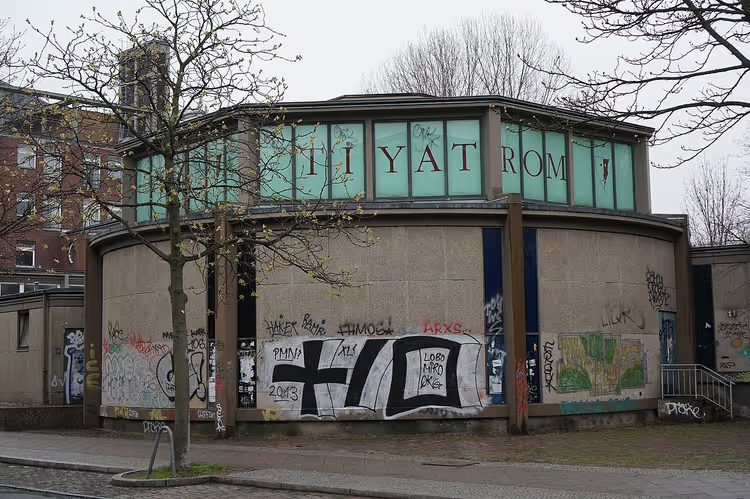
The Archenhold Observatory stands right in the park, by the Spree.
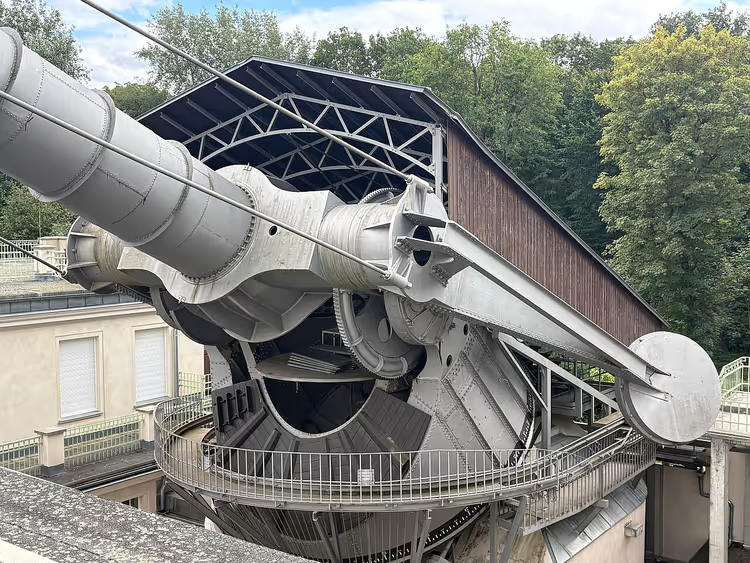
This is Berlin's oldest and largest public observatory. It opened in the late 19th century, and the current building was constructed in the early 20th century. More than a century ago, Einstein first presented his theory of relativity here.
The observatory houses a museum of celestial sciences. The museum is open during event hours, and admission is free (according to Stiftung Planetarium Berlin). Together with the German Museum of Technology, the observatory hosts public lectures and observation sessions. Evening telescope viewings are held on a schedule published by the observatory itself.
If you also want to visit the city's museums, the 3-day Museum Pass Berlin is a good value.
Music festivals in the park
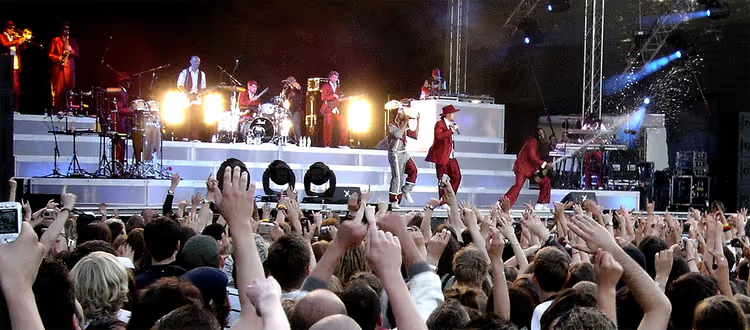
Large-scale events regularly take place in the park.
 © The original uploader was Scoob at German Wikipedia . · CC BYPhoto: The original uploader was Scoob at German Wikipedia ., CC BY, Wikimedia Commons
In 2016, the Lollapalooza Berlin festival was held here (according to Tagesspiegel). After that, the venue was moved to the Hoppegarten racecourse. At the time, local residents and memorial advocates were concerned about the monument.
The organizers fenced off the memorial with a tall barrier. Serious damage was avoided. If you attend the festival, check the lineup and route in advance.
How to get to the park
The easiest way to reach the park is by city rail. Get off at S Treptower Park station, then it's about a 15-minute walk along Puschkinallee. The station is served by the ring lines S41 and S42 (according to S-Bahn Berlin).
Buses 165, 166, and 265 drop you off almost at the entrance. The stop you need is called Sowjetisches Ehrenmal, and the entrance address is Am Treptower Park 50, 12435 Berlin (according to the Berlin city portal).
The park is about 5 km from central Berlin, which is over an hour on foot. For getting around the city, the Berlin WelcomeCard with transit and discounts is a convenient option.
A smooth paved path leads from the station to the memorial, so you can manage it with a stroller. If you don't have a car, the city rail remains the fastest option.
⁉️🤔 Frequently asked questions
Can I visit the memorial for free?
Yes, admission is free. The park and memorial are open year-round, and no ticket is required. The observatory is a different story: its museum operates on an event schedule. Come on a weekday morning, when there are almost no people at the main statue and you can take everything in at your own pace.
How much time do I need to see it?
An hour is enough for the memorial itself. If you add a walk along the avenues, the observatory, and a stroll down to the Spree, allow two to three hours. Bring water and comfortable shoes: the grounds are large, and there's little shade near the entrance in summer.
How do I get there from central Berlin?
The most convenient way is by city rail to Treptower Park station, then on foot along Puschkinallee. An alternative is the bus to the Sowjetisches Ehrenmal stop right at the entrance. Walking from the center is about 5 km, which takes over an hour.
When should I go to avoid crowds?
Come on a weekday morning or in early autumn. In summer and on commemorative dates, the memorial draws the largest crowds. In winter the park is empty, but the paths are cleared, so a walk is possible in any season.
Do festivals take place in the park?
Yes, the park often hosts large-scale events. The memorial is fenced off during such events to protect it from vandalism.
In short: what to book
Treptower Park is worth visiting for the memorial and a peaceful walk by the water. If you want to add observation decks and Berlin museums to your trip, book ahead: lines are long in summer.
- Want to get above the city: Berlin TV Tower ticket.
- Interested in museums: Pergamon Museum tickets.

A small editorial team writing guides for independent travel. We travel ourselves, but we haven’t been everywhere, so we check prices, opening hours and how to get there against official sources.