
















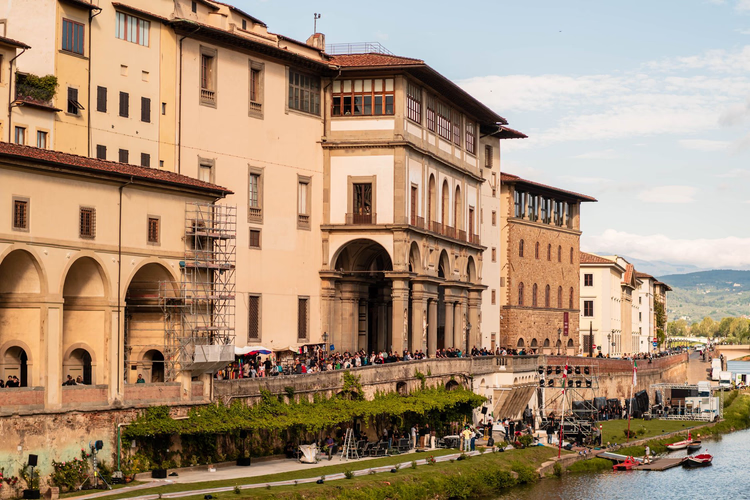
Uffizi gallery: how much tickets cost and what to see first
The Uffizi Gallery in Florence houses the main masterpieces of the Italian Renaissance. In summer, the line at the entrance stretches along the entire Piazzale degli Uffizi. A morning time slot solves the problem: you enter with the first group and approach Botticelli with almost no people around.
A ticket to the Uffizi Gallery costs 25 € on the day of your visit and 29 € when purchased in advance (as of 09/2026, official gallery website). Inside, two floors of painting from the 13th to 18th centuries await you (Uffizi Gallery floor plan, as of 09/2026). Below are prices, opening hours, the main masterpieces, and the route from the train station.
We have put together practical information for an independent trip. You will learn when the museum is closed, which rooms you cannot skip, and how to avoid losing half a day in line. We verified all prices and hours on the gallery's official website.
Ad: this article contains affiliate links, we earn a commission if you book through them, at no extra cost to you.
The Uffizi in one day: what you need to know
💡 In short:
- Ticket 25 € on the day of your visit and 29 € in advance; after 4:00 PM entry is 16 € on the day of your visit and 20 € in advance (as of 09/2026, official price list).
- The museum is open Tuesday through Sunday, from 8:15 AM to 6:30 PM, closed on Mondays (as of 09/2026, opening schedule).
- The main masterpieces are on the third floor: Botticelli, Leonardo da Vinci, Michelangelo, and Caravaggio.
History: from Medici offices to a museum
The gallery grew out of an administrative building. In 1560, Duke Cosimo I de' Medici commissioned the architect Giorgio Vasari to bring Florence's thirteen state offices under one roof. Construction was completed in 1581 under Bernardo Buontalenti (history of the Uffizi, as of 09/2026).
Cosimo's son, Francesco I, was the first to move the family treasures to the top floor: paintings, miniatures, and ancient sculptures. The collection was expanded by Ferdinando I and Princess Vittoria della Rovere of Urbino. It was she who brought to Florence the collection of Italian painting known as the "Urbino legacy."
In 1737, Anna Maria Luisa, the last representative of the Medici family, transferred the gallery to the Dukes of Lorraine on the condition that the collection remain in Florence (terms of the collection transfer, as of 09/2026). Thanks to this, the museum remains public. Today you see only part of the holdings; the rest is kept in storage and periodically appears in exhibitions.
Palace architecture and the Vasari Corridor
 © Arek N. · CC BY-SAPhoto: Arek N., CC BY-SA (https://creativecommons.org/licenses/by-sa/3.0), Wikimedia Commons
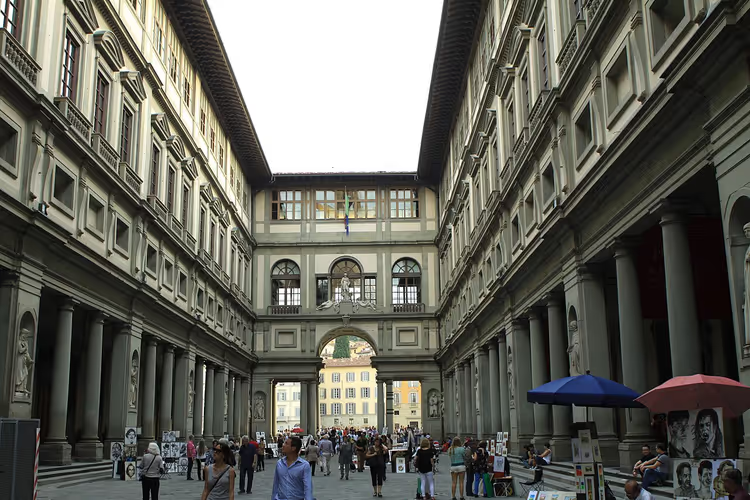
The building is made of gray natural stone and faced with light Florentine plaster. Its shape resembles an elongated letter "U," and the roof is covered with terracotta tiles. From the north, the gallery adjoins the square in front of the Palazzo Vecchio; through the southern passage you exit to the embankment of the Arno River.
In the 19th century, the deep niches between the columns were filled with sculptures. Today they hold 28 marble figures of Tuscan thinkers, architects, and artists (facade description, as of 09/2026). Above the main entrance stands a bust of the collection's founder, Francesco I, and the Medici family coat of arms.
The Vasari Corridor was built in 1565 in less than six months. It connected the Palazzo Vecchio and the Pitti Palace via the Ponte Vecchio so the duke could move between the buildings discreetly. For many years the corridor was closed, and today it is shown with a separate ticket: admission to the gallery together with the corridor costs €43 on the day of your visit and €47 in advance (as of 09/2026, Uffizi and Vasari Corridor tickets).
When the corridor was built, part of the old church of San Pier Scheraggio was demolished. What remains is a basilica, now used as a hall with frescoes by Andrea del Castagno and Sandro Botticelli's "Annunciation" from 1481 (gallery halls, as of 09/2026). We recommend setting aside at least half an hour for the architecture, because the gallery's corridors themselves are an exhibit. If you get a ticket that includes the corridor, allow at least three hours for the visit.
Collection: paintings, prints, and self-portraits
For three centuries the Medici bought works from the Florentine school and masters from other cities. The first inventory of the holdings was compiled in the early 18th century and took up more than ten volumes of handwritten text (gallery collections, as of 09/2026). Today the collections include paintings, tapestries, frescoes, sculptures, drawings, and prints: from medieval painters to portraits of 20th-century artists.
The gallery is proud of its self-portrait collection, which contains more than 700 works. The artists include Rubens, Raphael, and Diego Velazquez (self-portrait collection, as of 09/2026). The portrait of Albrecht Durer remains the only copy in this collection. It is one of the largest self-portrait collections in the world. After the Vasari Corridor opened in 2024, the self-portraits are no longer displayed there.
The octagonal Tribuna hall was the first hall opened under Francesco I. Here you will see the ancient sculpture Venus de' Medici and portraits of the Medici dynasty on the walls. Some exhibits are regularly taken away for restoration, so individual halls are closed temporarily (Tribuna hall, as of 09/2026).
Main masterpieces: what not to miss
The exhibition is arranged chronologically, from the Byzantine era to the Baroque. Seeing all the halls will take a full day, so we have put the works worth seeing first into a table. We checked the hall numbers against the Uffizi museum map.
Work | Artist | Hall |
|---|---|---|
"The Birth of Venus" | Sandro Botticelli | halls 10-14 |
"Primavera" | Sandro Botticelli | halls 10-14 |
"Annunciation" | Leonardo da Vinci | hall 35 |
"Doni Tondo" | Michelangelo | hall 35 |
"Ognissanti Madonna" | Giotto di Bondone | hall 2 |
"Medusa" | Caravaggio | hall 90 |
The remaining halls (5-6, 7, 8, 15, 66, 83) are devoted to the early Renaissance and the Venetian school, with works by Masaccio, Masolino, Paolo Uccello, and Raphael (list of museum halls, as of 09/2026). A full list of works with numbers is available on the free visitor map.
The gallery's layout helps you avoid fatigue. Follow the chronology, don't go back, and don't try to see everything. After the Botticelli halls, you have already seen the highlights.
Opening hours and ticket prices
The gallery is open Tuesday through Sunday, from 8:15 to 18:30 (museum opening hours, as of 09/2026). Monday is closed year-round. The museum is also closed on January 1 and December 25. The ticket office sells tickets until 17:30, and at 18:30 you will be asked to leave the halls.
Ticket prices:
- Standard ticket on the day of your visit: 25 €.
- Ticket purchased online in advance: 29 €.
- Evening rate after 4:00 PM: 16 € on the day of your visit and 20 € if purchased in advance (as of 09/2026, day discount on the gallery website).
- Reduced ticket: 2 €.
- Free admission: the first Sunday of every month and for certain visitor categories.
All prices were checked in 09/2026 on the 2026 ticket price list. An audio guide costs around 6-7 € and is handed out at the entrance (as of 09/2026, gallery services). The cloakroom is free, but you will have to leave umbrellas, backpacks, and bulky bags there. Water bottles are not allowed into the galleries.
Tours and tickets in Uffizi
Guided tours, skip-the-line tickets and activities — most offers can be cancelled free of charge.
See offers on TiqetsThe widget loads once you give your consent.
How to skip the line
Visitor numbers at the Uffizi keep growing, so both individual tourists and large guided groups stand at the entrance. We recommend booking a time slot in advance. You show your timed ticket at a separate entrance and exchange it for a regular one, without waiting in the general line.
The approach is simple. Pick the first morning slot (8:15 AM) or a time after 4:00 PM: fewer people, and the evening rate is also cheaper (Uffizi opening hours, as of 09/2026). Cross Monday off your list right away. July and August are the busiest months, while March and November are noticeably calmer.
If you arrive without a reservation, come when the ticket office opens. By 8:00 AM the line is shorter than during the day. Still, the more reliable option is to book Uffizi tickets with a reserved time slot online in advance.
Guided tour of the Uffizi
With a guide, you cover the rooms in two to three hours and don't miss the highlights. The route follows a chronological path, from Giotto to Caravaggio. The guide explains the difference between the Florentine and Venetian schools and points out details that are easy to overlook.
This format suits first-time visitors who want to see "The Birth of Venus" and "Primavera" without a long search. Take a morning group; by lunchtime the rooms get noisy. priority entrance to the Uffizi with a guide.
Tour with an art historian
If you want to understand the periods, take a thematic tour. An art historian shows how painting moved from Gothic to Renaissance and Baroque, and explains why landscape becomes an independent genre in Leonardo's work.
This kind of walk moves more slowly than a standard tour, but you leave with a clear picture of how Italian painting developed from the 13th to the 18th century. Slots with these guides are limited, so book in advance. Uffizi tour with an art historian.
Uffizi with kids
Guides for children turn the visit into a game. Kids search for flowers, birds, and animals on the canvases, listen to myths about Perseus and Medusa, and find the heroes in the paintings themselves. Adults also learn something new about the masterpieces along the way.
Even elementary school children can handle this format: two hours in the galleries goes more smoothly than a self-guided walk. If you're traveling with kids, choose a short route and don't try to cover the entire third floor. family tours in Florence.
What else to see in Florence
The city's main landmarks are concentrated right next to the Uffizi. We've added three places that make sense to combine with the gallery in a single day.
Michelangelo's David and the Galleria dell'Accademia
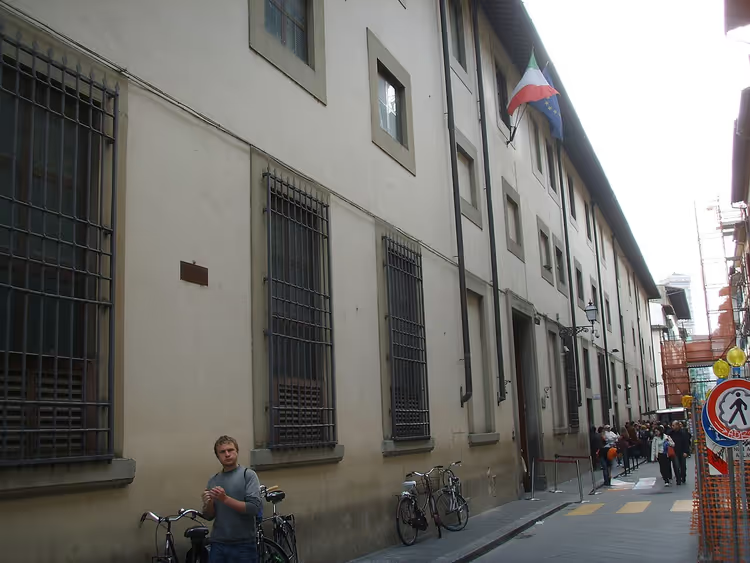
The original "David" stands in the Galleria dell'Accademia, about a 10-minute walk from the Uffizi (see map). The line here is comparable to the Uffizi's, so it's best to book a time slot. Accademia entrance with a fixed time.
 © sailko · CC BYPhoto: sailko, CC BY (https://creativecommons.org/licenses/by/2.5), Wikimedia Commons
Santa maria del fiore cathedral and Brunelleschi's dome
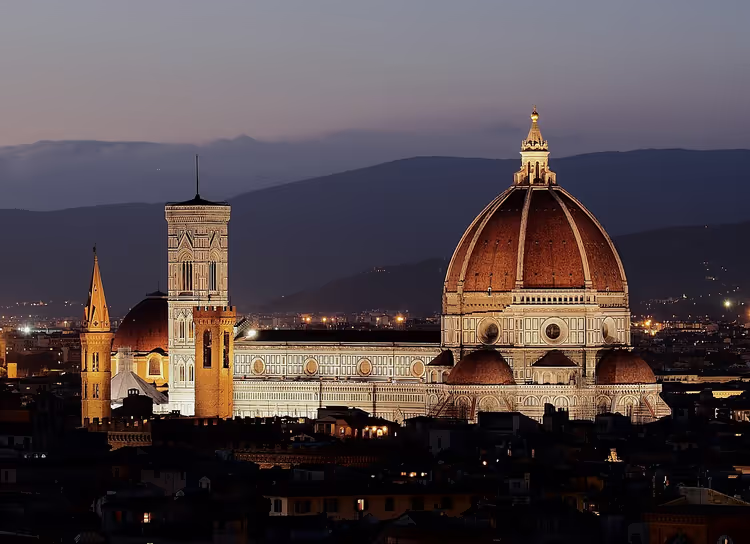
The cathedral is a 5-minute walk from the gallery (see map). Climbing Brunelleschi's dome runs on a schedule, and slots sell out in advance. If you want to see the city from above, get a ticket with a timed dome entry. cathedral and dome with a reserved time.
 © Petar Milošević · CC BY-SAPhoto: Petar Milošević, CC BY-SA (https://creativecommons.org/licenses/by-sa/4.0), Wikimedia Commons
Palazzo Vecchio
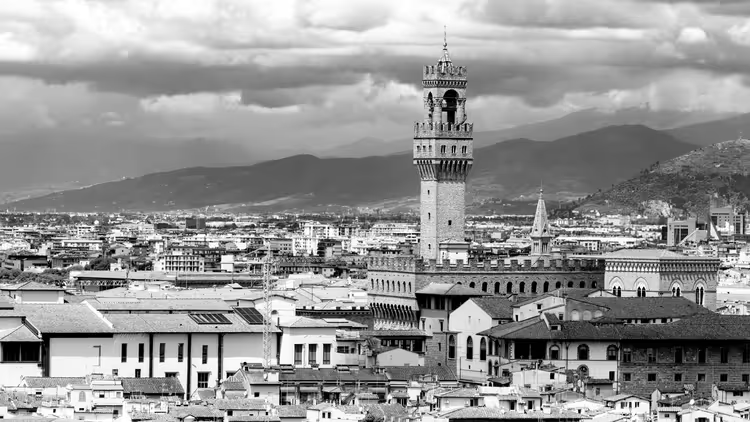
Palazzo Vecchio adjoins the Uffizi; it was the former Medici residence. Inside are frescoed halls and the secret Studiolo of Francesco I. The visit takes about two hours. skip-the-line entrance to Palazzo Vecchio.
Location and how to get there
Address: Piazzale degli Uffizi, 6, 50122 Firenze. The gallery is in the historic center, between Piazza della Signoria and the Arno River (gallery address on the museum website, as of 09/2026).
On foot, the easiest route is from Firenze Santa Maria Novella station: the walk takes 10-15 minutes (on the map). From the station you follow Via de' Panzani and Via de' Calzaiuoli straight to the gallery.
If you are driving, leave your car at the underground parking near Santa Maria Novella station. Access to the historic center is restricted by the ZTL zone, so it is better to continue on foot.
Uffizi Gallery on the map
The gallery is located between Piazzale degli Uffizi and the Arno embankment, next to Piazza della Signoria. Open on the map.
⁉️🤔 Frequently asked questions
How much does a ticket to the Uffizi Gallery cost?
A standard ticket costs 25 € on the day of your visit and 29 € if purchased in advance (as of 09/2026, Uffizi ticket prices). Evening rates, discounts and free days are listed in the prices section above.
When is the Uffizi Gallery closed?
The museum is closed on Mondays, January 1 and December 25 (as of 09/2026, museum opening hours). Opening hours for the halls and ticket office are in the prices section above.
Do I need to buy tickets in advance?
In summer, definitely. In July and August the line at the entrance can take an hour or more, so a timed entry slot saves you half a day. In winter you can arrive when the ticket office opens. An online ticket costs 4 € more, but you enter at your chosen time without waiting.
What should I see first at the Uffizi?
The main masterpieces are on the third floor: Botticelli's "The Birth of Venus" and "Primavera", Leonardo da Vinci's "Annunciation", Michelangelo's "Doni Tondo", Giotto's "Ognissanti Madonna" and Caravaggio's "Medusa". These take two to three hours, the rest depends on your pace.
Can I visit the Vasari Corridor?
Yes, the corridor is open with a separate ticket. A combined "Uffizi and Vasari Corridor" ticket costs 43 € on the day of your visit and 47 € in advance (as of 09/2026, Vasari Corridor ticket). Gallery entry opens two hours before your corridor visit time.
How much time do I need to see the gallery?
Allow at least three hours. In two hours you can cover the main halls, but you will miss the Venetian school and the early Renaissance. An audio guide makes it easier because you set your own pace (as of 09/2026, visitor services).
In short: what to book
If you are visiting Florence for the first time, get an Uffizi ticket with a morning time slot. That way you enter at your chosen time and can reach the cathedral by lunchtime. If you are traveling with children, add a short family-friendly guided format. If you want to see the entire Medici complex, pay extra for the Vasari Corridor.
Selection matrix:
- First visit: 8:15 slot and an overview tour.
- Small budget: evening rate after 4:00 PM.
- With children: a short two-hour tour.
- For connoisseurs: a ticket with the Vasari Corridor.

A small editorial team writing guides for independent travel. We travel ourselves, but we haven’t been everywhere, so we check prices, opening hours and how to get there against official sources.