
















Santa Croce in Florence: what to see inside and how much entry costs
The Basilica of Santa Croce stands 800 m from Florence’s Duomo (according to Wikipedia on Santa Croce). It is the city’s main Franciscan church and the largest basilica of the order in the world. Inside you will find frescoes by Giotto, Donatello’s wooden "Crucifix," and the tombs of Michelangelo, Galileo, and Machiavelli.
The church is called the "Temple of the Italian Glories" (Tempio dell'Itale Glorie) because the people who created Italian culture are buried here. Admission is paid, and opening hours depend on the day. Below we break down the opening hours, the chapels, and a convenient route through the basilica.
Ad: this article contains affiliate links. We earn a commission if you book through them, at no extra cost to you.
Construction history
💡 In short:
- Santa Croce was built starting in 1294, but was only consecrated in 1442.
- Admission is paid, tickets are best bought in advance, and hours are shorter on Sundays.
- Tombs, frescoes, and dimensions: according to Wikipedia; check hours and tickets on the basilica’s website.
 © Grueslayer · CC BY-SAPhoto: Grueslayer, CC BY-SA (https://creativecommons.org/licenses/by-sa/4.0), Wikimedia Commons
Legend has it that the first stone of the basilica was laid by Francis of Assisi himself, the founder of the Franciscan Order. The legend does not hold up to scrutiny: Francis died in 1226, while the current church was only begun in 1294 (Wikipedia data on the construction). The saint may have consecrated a small church that stood here earlier, but no documents survive.
The new church was built by Franciscan monks who had outgrown the old building. The architect was Arnolfo di Cambio, and for him this project became the main work of his career. Construction took almost a century and was completed around 1385 (Wikipedia information).
Money for the church was collected from all over the city. The Ghibellines were expelled from Florence, and their property remained in the city, with part of those funds going to new churches. Townspeople also donated large sums: artisans, merchants, traders, and nobles. In return for their generosity, wealthy families received the right to a family chapel.
That is how the Bardi, Peruzzi, Castellani, Baroncelli, and Medici chapels came to be in the basilica. The location was not chosen by chance: the Santa Croce district was home to the poor, an ideal flock for a mendicant order. Later, artisans and builders who were constructing the church moved into the area.
The Franciscans competed with the Dominicans for parishioners and won. Frescoes helped: for illiterate townspeople, the wall paintings served as a visual scripture. The interior was painted by Giotto, Giovanni da Milano, Maso di Banco, and other masters.
In 1442 the basilica was consecrated by Pope Eugene IV (Italian Wikipedia). The church also has a dark page in its history. In 1966 the Arno River flooded Florence, the water rose several meters and entered the basilica along with mud and fuel oil. Some of the paintings and wooden works were damaged beyond repair.
The church had a monastery attached to it. In the late 19th century the city decided to establish a museum here, and today the Museo dell'Opera di Santa Croce occupies the former refectory. The former monks’ dormitory houses the Scuola del Cuoio, a leatherworking school where you can see how bags and wallets are sewn. The basilica has long become a center of tourist pilgrimage and even made it into the game Assassin's Creed II.
In 1866, the complex became state property: the Italian government was closing monasteries across the country at the time (Wikipedia on the history of the church). That was also when the frescoes of the Bardi Chapel, previously hidden behind the altar, were uncovered.
Architecture of the basilica
Santa Croce was built in the Gothic style, but individual parts were rebuilt over the centuries, so the appearance blends Gothic, Renaissance, and Neo-Gothic elements. The plan follows the shape of the letter T (the Tau cross, a symbol of Francis): one wide nave and two side aisles, separated by rows of octagonal columns. The basilica is over 115 m long, making it the largest Franciscan church in the world (Wikipedia on the architecture).
 © Prof. Mortel · CC BYPhoto: Prof. Mortel, CC BY (https://creativecommons.org/licenses/by/2.0), Wikimedia Commons
The 19th-century facade
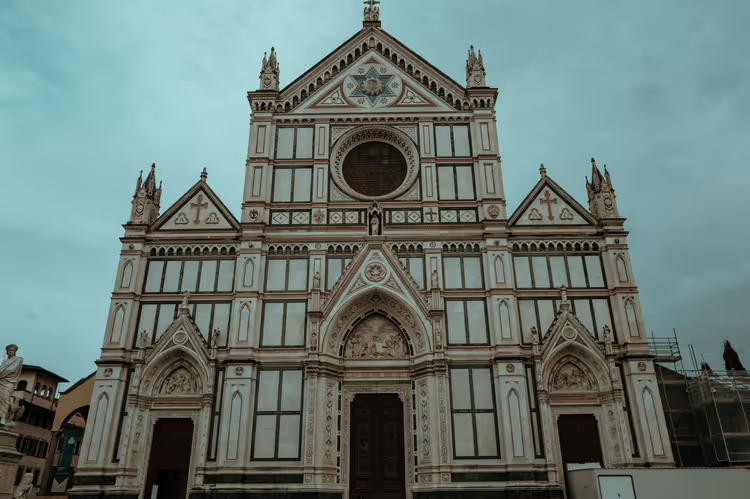
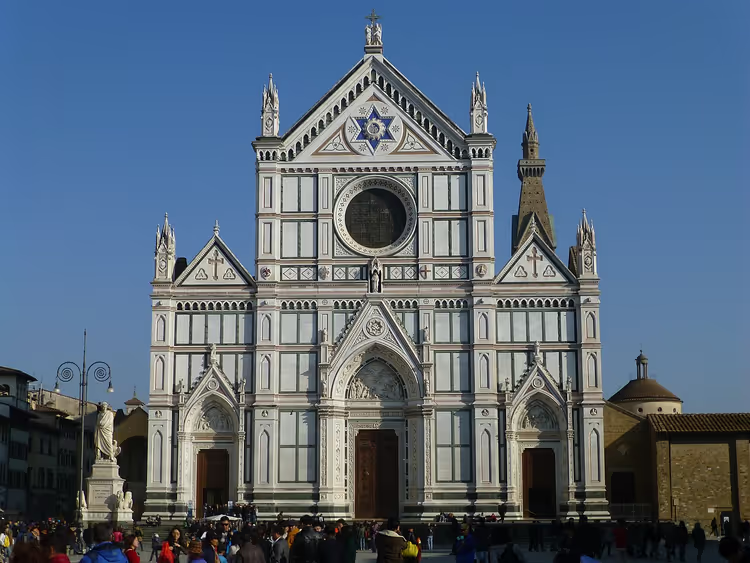
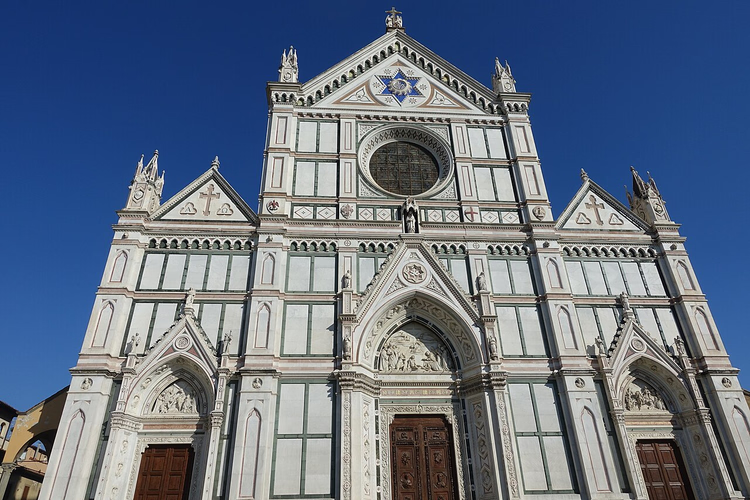
For more than five hundred years, the basilica had no decorative facade: the western wall remained bare brick. Only in 1857-1863 did the Florentine architect Niccolò Matas clad it in white and green marble (Wikipedia on the facade). Matas incorporated the Star of David into the composition in memory of his Jewish heritage. He could not be buried next to Michelangelo: the Franciscans did not allow the sarcophagus of a Jew inside a Catholic church. The architect is buried at the very threshold, under the entrance.
 © Joseolgon · CC BY-SAPhoto: Joseolgon, CC BY-SA (https://creativecommons.org/licenses/by-sa/4.0), Wikimedia Commons
The interior
 © Sailko · CC BYPhoto: Sailko, CC BY (https://creativecommons.org/licenses/by/3.0), Wikimedia Commons
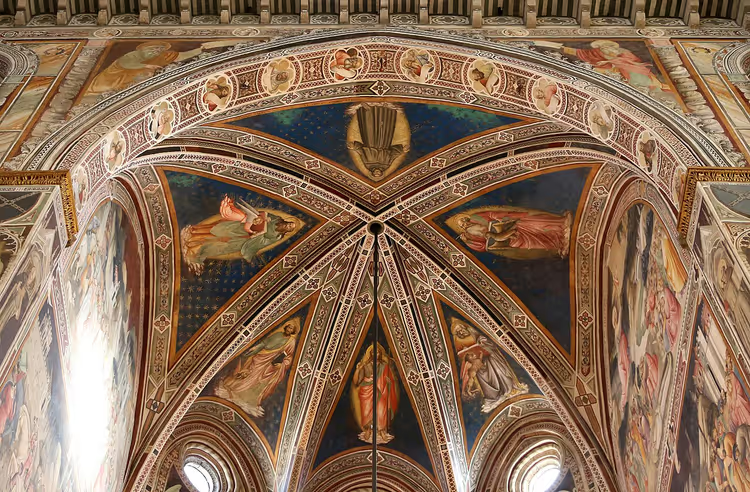
Inside, the basilica is like an art history textbook: frescoes, stucco, and stained glass cover almost every wall. The three aisles are separated by elegant arches and massive columns, and the central nave is slightly higher than the side aisles. The walls along the nave are painted with scenes from the life of Saint Francis, and you can easily follow his story step by step. The nave has a wooden ceiling; there are no paintings on the vaults.
The bell tower and cloister
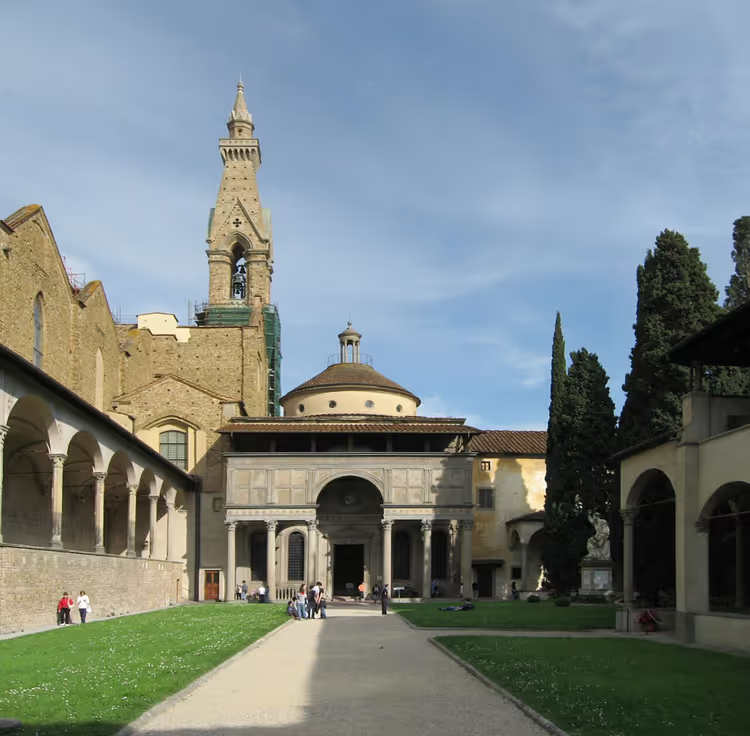
A monastic complex adjoins the basilica. In the first cloister stands the Cappella dei Pazzi, the chapter house chapel that Filippo Brunelleschi designed in the 1429-1440s (Wikipedia on the cloister). The bell tower was built in 1842 to replace the previous one, which had been damaged by lightning. You can enter the museum and cloister with an extended ticket, which is sometimes sold together with admission to the church.
 © Gryffindor · CC BY-SAPhoto: Gryffindor, CC BY-SA (http://creativecommons.org/licenses/by-sa/3.0/), Wikimedia Commons
The south aisle
The right (south) aisle is a succession of family chapels, and each one looks like a separate little church. Here you will find the Bardi and Peruzzi Chapels with frescoes by Giotto, as well as the Castellani and Baroncelli Chapels. On the south wall you will see the Cavalcanti Annunciation, carved by Donatello from sandstone: it is both a sculpture and a perspectival painting at the same time.
The north aisle
The left (north) aisle leads to the apse past the Bardi di Vernio Chapel. This is where Donatello's wooden Crucifix stands, which will be discussed below. From this aisle you get a good view of the apse stained glass and the paintings of the main altar, and nothing stops you from studying them for as long as you like.
Chapels of the basilica of Santa Croce
The basilica has sixteen chapels in total, and most of them are named (Wikipedia on the chapels). A chapel is a separate small church inside a larger one, with its own altar and vault. Some of Giotto's frescoes have not survived: in the Middle Ages, plague raged in Florence, the church served as a hospital, and the paintings were plastered over and whitewashed. The plague in Europe was even called the Florentine plague, and Boccaccio and Petrarch mentioned it in their books.
Donatello's Crucifix
One of the church's major works, Donatello's wooden "Crucifix," stands in the Bardi di Vernio Chapel (Wikipedia on the sculpture). This is an early work by the sculptor, and in it he argues with his teacher Lorenzo Ghiberti. Donatello's Christ is muscular and alive, not ideally beautiful: the master sought the truth of the body, not ancient harmony. It is precisely this difference that makes the "Crucifix" such a powerful work.
 © Francesco Bini · CC BY-SAPhoto: Francesco Bini, CC BY-SA (https://creativecommons.org/licenses/by-sa/4.0), Wikimedia Commons
The main altar
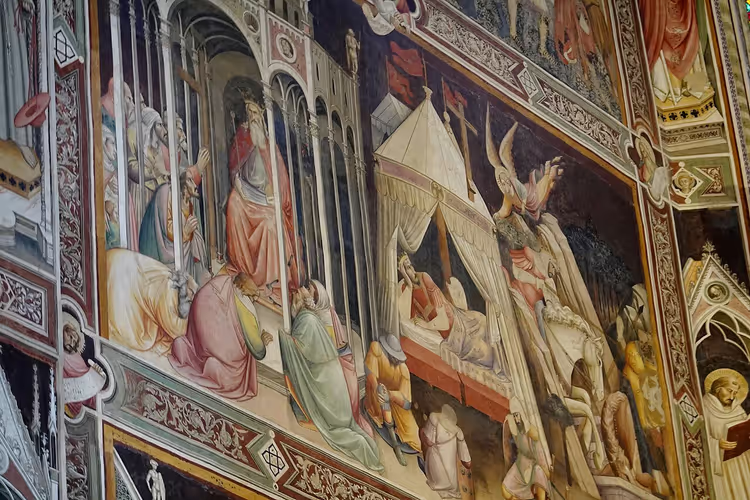
The apse of the basilica is decorated with Agnolo Gaddi's fresco cycle "The Legend of the True Cross" (Wikipedia on the altar). On the walls, the Archangel Michael, the Queen of Sheba, Saint Helena, and scenes of the finding of the True Cross come to life. The same Gaddi designed the apse's stained glass windows: they were positioned so that light would fall on the main nave. The paintings were created in the late 14th century and are considered the artist's major work.
 © Agnolo Gaddi · CC BYPhoto: Agnolo Gaddi, CC BY (https://creativecommons.org/licenses/by/2.0), Wikimedia Commons
The Castellani and Baroncelli chapels
 © Ricardalovesmonuments · CC BY-SAPhoto: Ricardalovesmonuments, CC BY-SA (https://creativecommons.org/licenses/by-sa/4.0), Wikimedia Commons
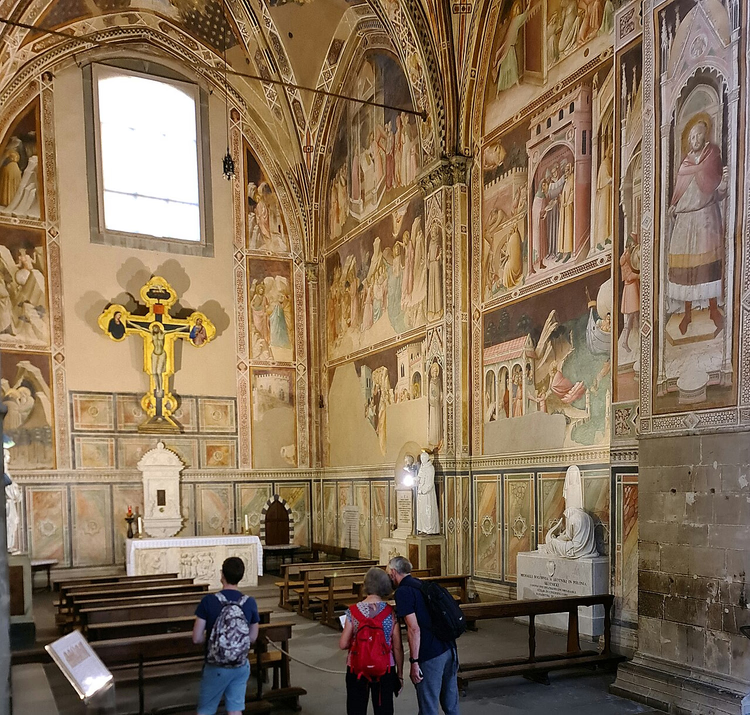
The Castellani Chapel was painted by Agnolo Gaddi: on the walls are stories of Saints Anthony, John the Baptist, and Nicholas. Some of the scenes are grim, including a dragon devouring an infant and the martyr Apollonia having her teeth knocked out by her executioners. The Baroncelli Chapel looks calmer: its walls were painted by Taddeo Gaddi, Agnolo's father, and the main theme here is the life of the Virgin Mary.
The Bardi and Peruzzi chapels
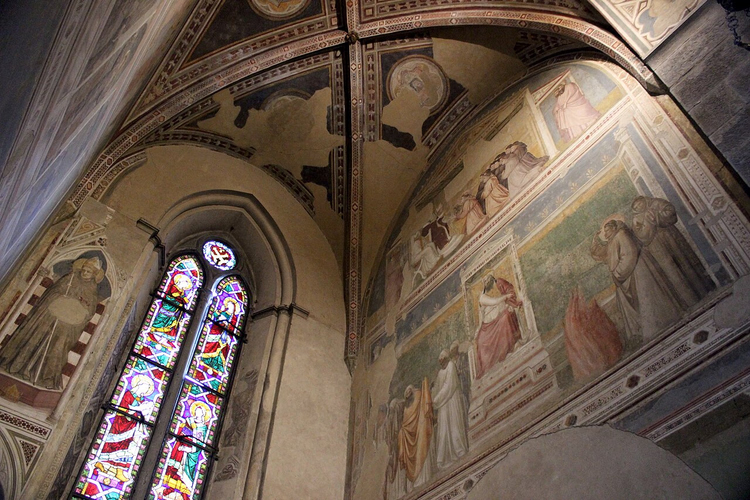
Two neighboring chapels were painted by Giotto. In the Bardi Chapel, there is a fresco cycle on the life of Saint Francis. In the Peruzzi Chapel, the painter depicts John the Baptist and John the Evangelist. During the Counter-Reformation, the Bardi Chapel was closed off by an altar and whitewashed, and Giotto's frescoes were only discovered in the 19th century (Wikipedia on Giotto). Restorers uncovered the original painting, but part of it remained lost.
 © Miguel Hermoso Cuesta · CC BY-SAPhoto: Miguel Hermoso Cuesta, CC BY-SA (https://creativecommons.org/licenses/by-sa/4.0), Wikimedia Commons
The Medici Chapel
 © Prof. Mortel · CC BYPhoto: Prof. Mortel, CC BY (https://creativecommons.org/licenses/by/2.0), Wikimedia Commons
The Medici family produced several popes and two queens of France, so their chapel is considered one of the most ornate in the church. The altar is decorated with glazed terracotta by Andrea della Robbia, and the walls feature paintings by renowned masters (Wikipedia on the Medici Chapel). It is a small, self-contained space within the church, and it is worth viewing separately from the other chapels.
Tombs of great Italians
 © Prof. Mortel · CC BYPhoto: Prof. Mortel, CC BY (https://creativecommons.org/licenses/by/2.0), Wikimedia Commons
The basilica contains more than three hundred tombs: politicians, philosophers, artists, sculptors, writers, and scientists (Wikipedia on the tombs). The most famous names are Michelangelo, Galileo Galilei, Niccolò Machiavelli, the composer Gioachino Rossini, and the poet Ugo Foscolo. It is because of them that Santa Croce earned its second name, the "Temple of the Italian Glories."
A special place belongs to Dante Alighieri, a native of Florence and the author of the "Divine Comedy." The poet was exiled from his home city, spent his final years in Ravenna, and died there of malaria. Florence realized its mistake too late and demanded the return of his remains, but Ravenna refused. In the basilica, an empty sarcophagus stands for Dante: a cenotaph in case his remains ever come home.
Nearby lie Leonardo Bruni, the sculptor Lorenzo Ghiberti, and other notable Florentines. At their tombs you will see how the city honored its masters, and you will understand why the church is called the pantheon of Italian culture.
Tickets and opening hours
 © Vladimir.grujeski · CC BY-SAPhoto: Vladimir.grujeski, CC BY-SA (https://creativecommons.org/licenses/by-sa/4.0), Wikimedia Commons
The basilica is open daily, but the schedule depends on the day. On weekdays and Saturdays you can enter from morning to evening, while on Sundays and holidays the hours are shorter due to services. A full ticket costs in the low double digits in euros, with a reduced rate for students, children, and seniors. Check the current hours and prices on the basilica's official website before your visit.
It is more convenient to buy tickets in advance: tickets on Tiqets help you avoid the line at the entrance.
An audio guide in several languages is available at the entrance for a small extra charge. If you want to see the entire complex, including the museum and the cloister, allow at least two hours.
Tours and tickets in Florence
Guided tours, skip-the-line tickets and activities — most offers can be cancelled free of charge.
See offers on TiqetsThe widget loads once you give your consent.
Location and how to get there
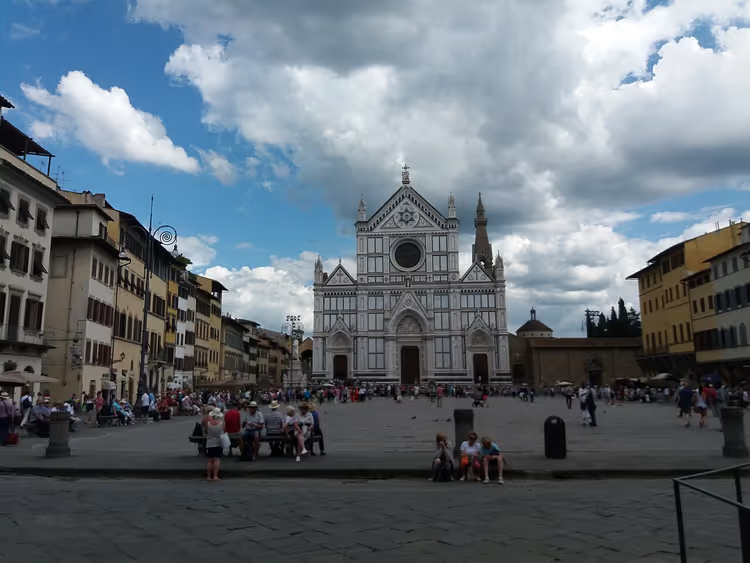
The basilica stands on Piazza Santa Croce, 16, in the historic center of Florence. It is about 800 m from the Duomo (Wikipedia on the address), and about 1.2 km on foot from Santa Maria Novella station, a 15-20 minute walk through the center. You can also take a bus: city routes C1, C2, C3, and 23 go to the square, and a taxi drops you right at the entrance.
It is hard to miss the basilica: the snow-white facade is visible from the square, and Piazza Santa Croce is one of the largest squares in the city. Your walk through the neighborhood where artisans lived and worked also passes through here.
In summer, the square hosts concerts, theater and music festivals, and also matches of historic Florentine football in costume. If you want to catch a show, check the events calendar before your trip. Entry to the square is free, and you can simply sit by the facade.
Basilica of Santa Croce on the map
Below is an interactive map. Open it on your phone to plot a walking route from your hotel.
What to see nearby in Florence
Santa Croce stands a stone's throw from other symbols of Florence. About 800 m to the northwest is the Duomo with Brunelleschi's dome, and nearby are the Uffizi Gallery and Palazzo Vecchio (Wikipedia on the center of Florence). The Galleria dell'Accademia with Michelangelo's "David" is about a 15-minute walk away.
If you are short on time, take a combo: the basilica in the morning, the Uffizi in the afternoon, and "David" in the evening. It is better to book a ticket to Michelangelo's main work in advance: ticket to "David" on GetYourGuide.
⁉️🤔 Frequently asked questions
How much does it cost to enter Santa Croce?
A full ticket costs in the low double digits in euros, with a reduced rate for students, children, and seniors. A combined ticket with the museum and cloister is sometimes sold. Check current prices on the basilica's official website; they are updated every season.
How is Santa Croce different from Santa Maria Novella?
They are two different churches. Santa Croce belongs to the Franciscans, while Santa Maria Novella is a Dominican church near the main train station. The first stands on Piazza Santa Croce, the second next to the station. If you are planning your route, do not confuse them: the churches are about a 15-minute walk apart.
How much time do I need to see it?
Allow at least two hours: one hour for the basilica and chapels, and another hour for the museum and cloister. If you want to examine Giotto's frescoes in detail, take three hours. Start with the Bardi and Peruzzi chapels while your energy is fresh.
Where can I see Donatello's "Crucifix"?
The wooden "Crucifix" stands in the Bardi di Vernio Chapel in the left, northern nave. It is an early work by Donatello, in which he moves away from the manner of his teacher Lorenzo Ghiberti. The chapel is easy to find by the wooden sculpture of the crucified Christ: it differs noticeably from other crucifixes in the church.
How to get from the train station to the basilica?
From Santa Maria Novella station to the basilica it's about 1.2 km, a 15-20 minute walk through the center. Walking is more pleasant than riding: along the way you'll pass the Duomo. By bus, routes to Piazza Santa Croce work well, and a taxi will take you right to the entrance.
In short: what's worth booking
Santa Croce is a church-museum where the history of Italy lies beneath your feet. If you're visiting Florence for the first time, set aside half a day for the basilica and get your ticket in advance. For a walk around the center, Florence tours on GetYourGuide are a good fit, and accommodation near the square is easy to find through Florence hotels on Trip.com.
If you have one day: the basilica in the morning, the Uffizi in the afternoon. If you're with kids: start with Piazza Santa Croce, and get your ticket in advance. If you want a relaxed visit: choose a weekday and arrive at opening time.

A small editorial team writing guides for independent travel. We travel ourselves, but we haven’t been everywhere, so we check prices, opening hours and how to get there against official sources.