
















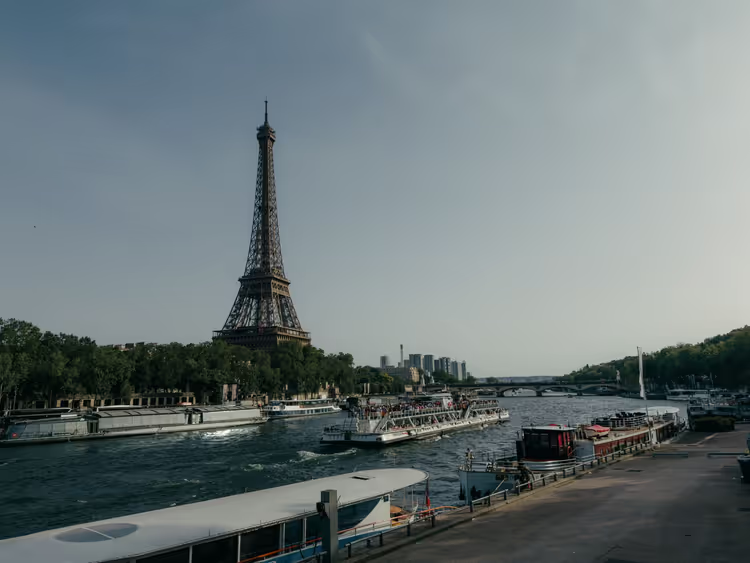
Paris walking route: from the Louvre to the Eiffel Tower in one day
From the Louvre to the Eiffel Tower, you can walk in one day. Almost all the main attractions of Paris are lined up along the Seine, so you won't need the metro.
You walk from the glass pyramid through the Tuileries Garden to Place de la Concorde, cross the Pont Alexandre III, and finish at the tower on the Champ de Mars. At a leisurely pace, the whole route is about five kilometers on the map, and with stops for photos and lunch it takes four to five hours.
Below we've laid out ten points along the route in order. For each one, we've noted what to see, how long it takes to walk to the next point, and where to get tickets in advance.
Ad: this article contains affiliate links, we earn a commission if you book through them, at no extra cost to you.
Route from the Louvre to the Eiffel Tower
💡 In short:
- Start at the Louvre Pyramid in the morning, while the line is short.
- Walk along the Seine through the Tuileries Garden and Place de la Concorde.
- Finish at the Eiffel Tower, and go up to the observation deck in the evening.
- Tickets and Louvre opening hours and Eiffel Tower: 09/2026, verified on the Paris tourist office website.
The route goes along the right bank, then the left bank, and requires almost no transport. Here are all the points and the approximate walking time between them.
Section | On foot | What to see |
|---|---|---|
From the Louvre to the Tuileries Garden | 0.5 km (on the map) | the Louvre Pyramid, the Arc de Triomphe du Carrousel |
From the Tuileries to Place de la Concorde | 1 km (on the map) | garden alleys, the Luxor Obelisk |
From Place de la Concorde to Les Invalides | 1.5 km (on the map) | the Grand Palais, Pont Alexandre III |
From Les Invalides to the Eiffel Tower | 1.7 km (on the map) | the Champ de Mars |
Open the map below on your phone and follow the points in order.
Route from the Louvre to the Eiffel Tower
Places on the map
- 1Louvre Ticket 22 euros for EEA citizens and 32 euros for others, closed on Tuesdays
- 2Louvre Pyramid Glass pyramid in the Cour Napoléon, lit up from inside in the evening
- 3Arc de Triomphe du Carrousel The start of the city's historic axis, topped with the Quadriga of Apollo
- 4Tuileries Garden Formal Le Nôtre park, free entry, you can sit on the lawns
- 5Place de la Concorde The city's largest square, with the Luxor Obelisk at its centre
- 6Grand Palais Glass dome over the gallery and museum, facade facing the Champs-Élysées
- 7Pont Alexandre III Nymphs of the Seine and the Neva, pegasi and lamps, view of Les Invalides
- 8Les Invalides 17th-century veterans' home and museum complex under a golden dome
- 9Champ de Mars Lawns at the foot of the tower and the best view of it whole at sunset
- 10Eiffel Tower Tickets from 14.2 to 35.3 euros, evening slots sell out first
Louvre
The Louvre opened to the public in the late 18th century and became the first public museum of this scale. The exhibition halls cover tens of thousands of square meters, and the collection numbers hundreds of thousands of works. Only a portion of them is on display at any given time.
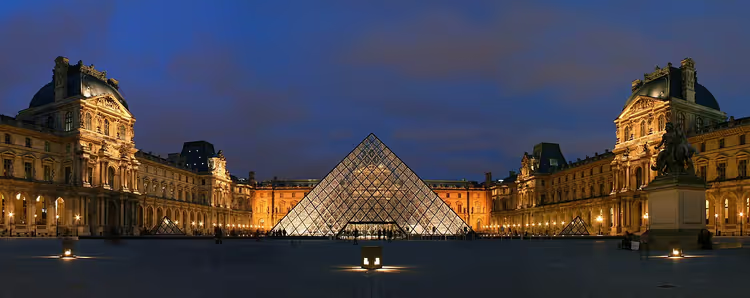 © Benh LIEU SONG · CC BYPhoto: Benh LIEU SONG, CC BY (https://creativecommons.org/licenses/by/2.5), Wikimedia Commons
Even if you don't go inside, the palace of the French rulers itself deserves special attention. It was built up over centuries, and its appearance shows features of different eras, while inside you'll find stucco work, painted ceilings, and grand enfilades.
Tickets cost €22 for EEA residents and €32 for other adults, and visitors under 18 enter free (as of 09/2026, official Louvre website). The museum is closed on Tuesdays, opens at 9:00 on other days, and stays open until 21:00 on Wednesdays and Fridays.
A timed entry slot saves you over an hour in line, so book it in advance: Louvre tickets with a time slot.
Louvre Pyramid
The glass pyramid opened in the Cour Napoléon in 1989 as part of the Grand Louvre project. Architect I. M. Pei was chosen by President Mitterrand without a competition.
During the day, the glass reflects the sky and the old palace facade, and after sunset the pyramid is lit from within and looks completely different. Three small pyramids and fountains stand nearby.
Arc de Triomphe du Carrousel
The Arc de Triomphe du Carrousel stands directly in front of the Louvre and continues the historical axis of Paris. It is more modest than the Arc de Triomphe at Place de l'Étoile, but it is where the city's grand ceremonial perspective begins.
 © Thesupermat · CC BY-SAPhoto: Thesupermat, CC BY-SA (https://creativecommons.org/licenses/by-sa/3.0), Wikimedia Commons
The arch is crowned by Bosio's quadriga "Peace Riding in a Chariot," drawn by four horses. Originally, the Horses of Saint Mark, which Napoleon had taken from Venice, stood here. In 1815, the allies returned them to Italy. Bosio's current quadriga is not a copy but an original work.
Tuileries Garden
The Tuileries Garden was laid out in the 16th century under Catherine de' Medici. Later, André Le Nôtre redesigned it as a formal garden, and it was here that the French style of symmetrical alleys took shape.
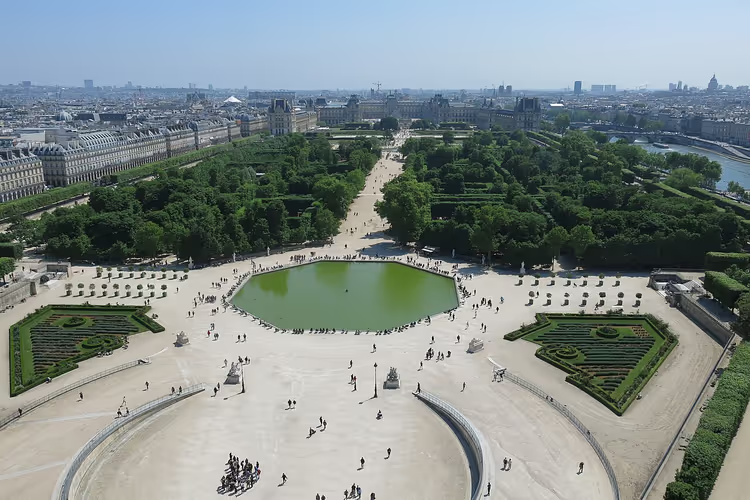
Admission is free, and the garden is open every day: in summer it stays open late, and in winter it closes before dark. Sculptures are placed among the flower beds, and sitting on the lawns is allowed. If you're tired, this is a good place for your first long break.
Place de la Concorde
Place de la Concorde stretches between the Tuileries and the Champs-Élysées and is considered the largest square in Paris. At its center stands the Luxor Obelisk made of pink granite.
 © Cristian Bortes from Cluj-Napoca, Romania · CC BYPhoto: Cristian Bortes from Cluj-Napoca, Romania, CC BY (https://creativecommons.org/licenses/by/2.0), Wikimedia Commons
Egypt gave the obelisk to France, and the monument is thousands of years old. The hieroglyphs on the granite glorify the pharaohs, and the small golden pyramid on top adds a bright finishing touch. From here there is a straight view down the Champs-Élysées.
Grand Palais
The Grand Palais faces the Champs-Élysées. It was built for the World's Fair, combining Renaissance and Baroque in its appearance, and topped with an enormous glass dome.
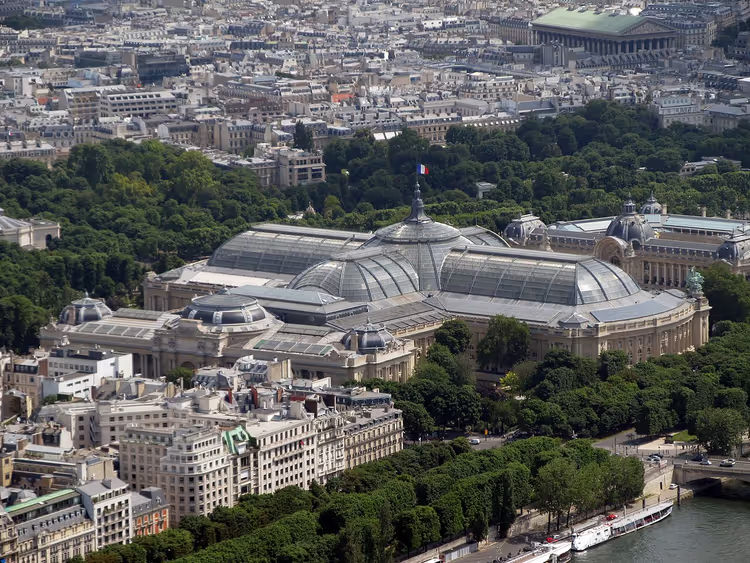 © daryl_mitchell from Saskatoon, Saskatchewan, Canada · CC BY-SAPhoto: daryl_mitchell from Saskatoon, Saskatchewan, Canada, CC BY-SA (https://creativecommons.org/licenses/by-sa/2.0), Wikimedia Commons
Inside there is an art gallery and the Palais de la Découverte museum, and fashion shows and exhibitions are also regularly held here. Even from the outside you can see how richly decorated the facade is: columns, reliefs, and statues.
Pont Alexandre III
Pont Alexandre III connects the Champs-Élysées with Les Invalides. It was given to Paris as a symbol of the alliance with Russia, and it was named in honor of the father of Emperor Nicholas II.

In the center of the span you can see the nymph of the Seine on one side and the nymph of the Neva with the coat of arms of Saint Petersburg on the other. The span is decorated with pegasi, angels, and lamps, so the bridge is photographed no less often than the Eiffel Tower.
If you want to see the center with a guide, compare options in advance: Paris tours on GetYourGuide.
Les Invalides
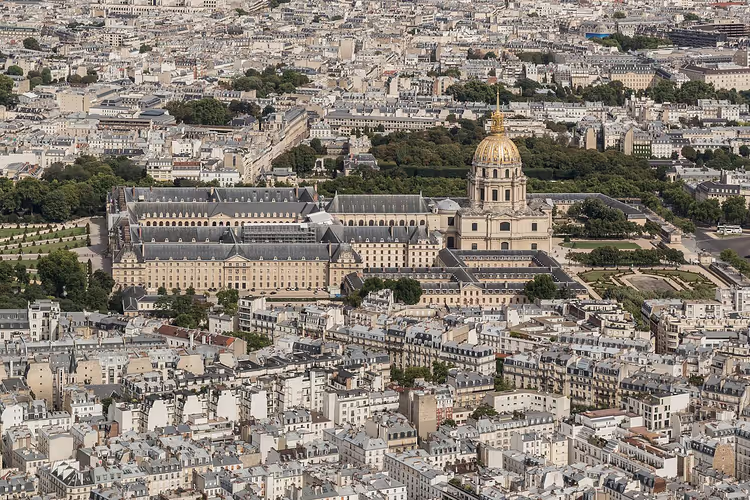
Les Invalides was founded in the 17th century by order of Louis XIV. It became the first home in Europe for disabled veterans: here they were given shelter, food, and work they could manage.
 © Another one of my pictures: This photograph was taken by Medium69 (William Crochot) and released under the license state · CC BY-SAPhoto: Another one of my pictures: This photograph was taken by Medium69 (William Crochot) and released under the license state, CC BY-SA (https://creativecommons.org/licenses/by-sa/4.0), Wikimedia Commons
The cathedral domes are covered in gold and visible from afar. Today most of the building is occupied by a museum complex, but the institution itself still takes in veterans.
Champ de Mars
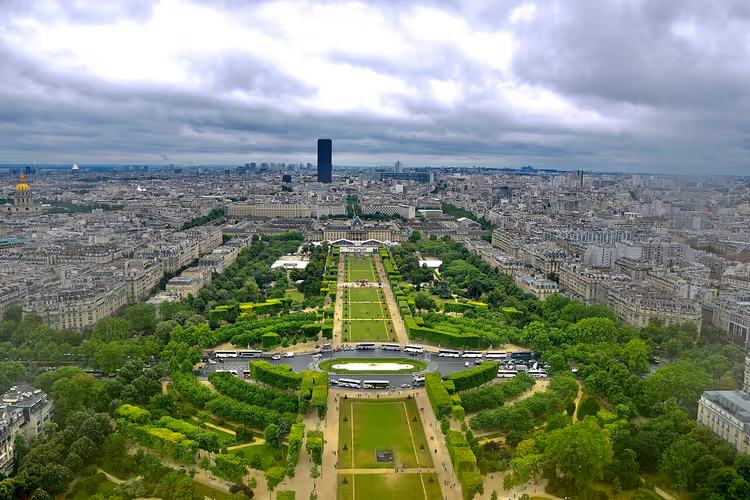
The Champ de Mars lies right at the foot of the Eiffel Tower. The park is older than the tower itself, and its lawns are open to everyone: people sit, lie down, and have picnics here.
 © Ank Kumar · CC BY-SAPhoto: Ank Kumar, CC BY-SA (https://creativecommons.org/licenses/by-sa/4.0), Wikimedia Commons
From here you get the best view of the whole tower, especially at sunset. Take a spot on the lawn before the lights come on, and you will see the tower light up all at once.
Eiffel Tower
The route ends at the Eiffel Tower. By day it seems austere and grandiose, and in the evening it turns into a tower of light.
 © Yann Caradec from Paris, France · CC BY-SAPhoto: Yann Caradec from Paris, France, CC BY-SA (https://creativecommons.org/licenses/by-sa/2.0), Wikimedia Commons
The tower was nearly dismantled two decades after it opened, but radio antennas were installed on top, and that saved the structure. Technical progress preserved the symbol of Paris.
An adult ticket costs from €14.20 to €35.30: the elevator is more expensive, the stairs are cheaper, and the price depends on the floor (as of 09/2026, official Eiffel Tower website). Evening slots sell out first, so book in advance: Eiffel Tower ticket to the 2nd floor.
Tours and tickets in Paris
Guided tours, skip-the-line tickets and activities — most offers can be cancelled free of charge.
See offers on GetYourGuideThe widget loads once you give your consent.
⁉️🤔 Frequently asked questions
How long does the route from the Louvre to the Eiffel Tower take?
At a leisurely pace, the whole route takes four to five hours with stops, and with a visit to the Louvre it takes a full day. Don't try to squeeze it into a couple of hours, otherwise you'll only see the facades. Set aside a full day and leave time to rest.
Do I need to buy tickets in advance?
Yes, in high season, Louvre and Eiffel Tower time slots sell out several days ahead. A timed ticket saves you over an hour in line. Compare options in advance and pick the one that fits your schedule.
When is the best time to go up the Eiffel Tower?
In the evening, an hour before sunset: you'll see the city in warm light, and then the illumination. During the day the line is usually longer, especially in summer. In the off-season there are noticeably fewer visitors, and the ascent is more relaxed.
Is the route suitable for children?
Yes, if you're ready for a long walk and frequent breaks. The Tuileries Garden and the Champ de Mars give children room to run around, and the Louvre has short routes. Bring water and don't plan to spend more than two hours in the museum.
What should you do if you get tired along the way?
The route runs along the Seine, so you can always get to a metro station and ride part of the way. But it's more convenient to split the walk into two days: first the Louvre and the Tuileries, then the bridge, Les Invalides, and the tower.
Paris on video
A short video will show you what the Seine embankment looks like and what to pay attention to on the way from the Louvre to the tower.
In short: what to book
The route is long, so it is better to get tickets for the two main sights in advance. If you have one day, start with the Louvre in the morning and leave the Eiffel Tower for the evening.
If you only need the Louvre, get a timed-entry ticket. If you want to see the city from the water, choose an evening Seine cruise. If you are going up the tower, book a second-floor time slot in advance.
Choose your options ahead of time: hotels along the route on Trip.com and an evening Seine cruise.

A small editorial team writing guides for independent travel. We travel ourselves, but we haven’t been everywhere, so we check prices, opening hours and how to get there against official sources.