
















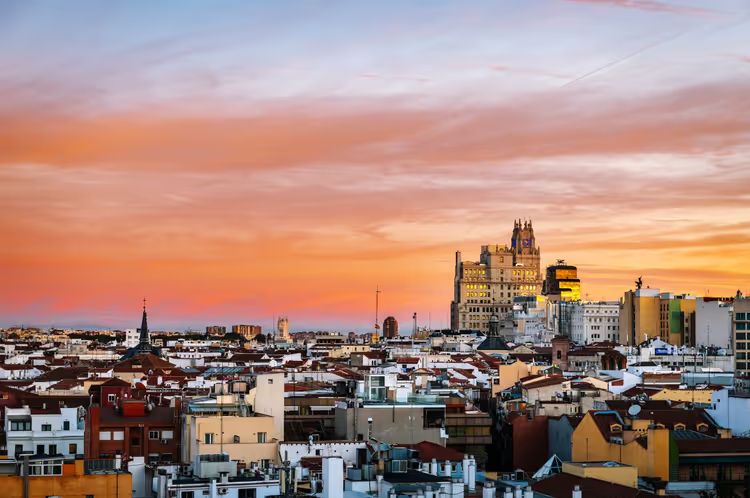
What to see in Madrid in one day: a route through 20 places
Madrid sits in the center of Spain, far from the sea. At the same time, almost everything that matters is concentrated in the center, within a couple of kilometers. In one day you can cover both the old town and the museum triangle. Below are twenty points in a sensible order, with opening hours and tickets.
The order is this. Give the morning to the old town and the Royal Palace, and the second half of the day to the museums on Paseo del Prado. In winter the palace is open Monday through Saturday from 10:00 to 18:00, on Sunday until 16:00 (as of 09/2026, Royal Palace ticket page).
Ad: this article contains affiliate links, we earn a commission if you book through them, at no extra cost to you.
How to see the highlights in one day
💡 In short:
- Start in the morning at Puerta del Sol: before the museums open you can easily walk through Plaza Mayor and the San Miguel Market.
- Get Prado tickets, the Royal Palace, and the Thyssen-Bornemisza Museum online in advance: in summer the entry line stretches to over an hour.
- You can cover the center on foot; the metro is only useful for the far points near the Manzanares.
- Prices and opening hours: 09/2026, checked on the Royal Palace website.
Next, a loop through the center. First the square and markets, then the palaces and the cathedral, and at the end the museum triangle, the park, and the riverfront. Walking between neighboring points takes from ten to twenty-five minutes.
The route is designed for a full day, from morning to evening. You spend the first hours outdoors while it is cool, and leave the museum part for the second half. If you are only here for a day, do not try to cover everything: take the center and one museum, and leave the rest for next time.
Some sites run on their own schedules, so check opening hours on official websites before heading out. In summer the heat lasts into the evening, so bring water and take breaks in the shade.
1. Las Ventas Arena
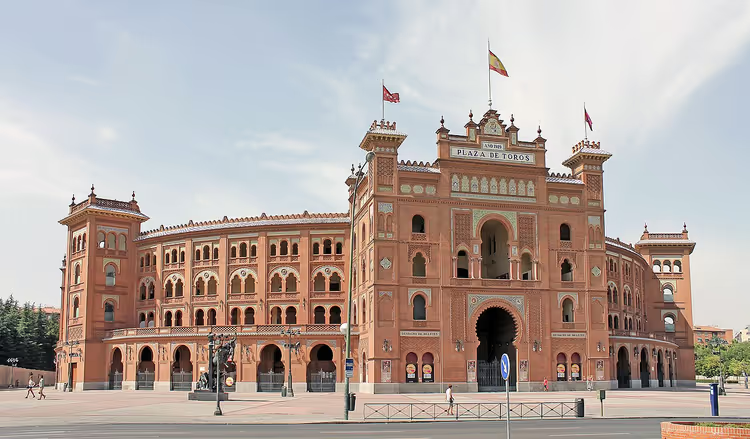 © Luis García ( Zaqarbal ) · CC BY-SAPhoto: Luis García ( Zaqarbal ), CC BY-SA (https://creativecommons.org/licenses/by-sa/3.0), Wikimedia Commons
Las Ventas Arena stands in the Salamanca district and is considered the country's main bullfighting arena. The red-brick building in Neo-Mudéjar style surrounds a round sand ring with four tiers of arches. The fighting season runs from spring to autumn; in the other months concerts and shows are held here.
Monuments to fallen bullfighters stand by the facades, and a bullfighting museum operates at the arena. The arena seats almost twenty-four thousand spectators. Nearby stands a monument to the doctor Fleming, who discovered penicillin. Forty minutes is enough if you are not attending a performance.
2. Retiro Park
 © pictures Jettcom · CC BYPhoto: pictures Jettcom, CC BY (https://creativecommons.org/licenses/by/3.0), Wikimedia Commons
Retiro Park lies in the center and is on the UNESCO World Heritage list. It has more than fifteen thousand trees on an area of about one hundred and twenty-five hectares. There is a large pond with boats, exhibition palaces, and alleys with sculptures.
A boat station operates on the shore of the large pond. Deep in the park stands a memorial to King Alfonso XII, worked on by twenty sculptors. You can walk through the park straight to the museums and save time.
Park entry is free, while boats and exhibitions in the Velázquez Palace are paid separately. Allow an hour and a half for the walk: the park is large, and there is little shade at midday.
3. Crystal Palace
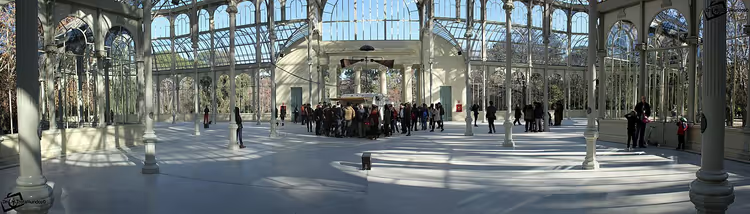 © DnTrotaMundos ☮ · CC BYPhoto: DnTrotaMundos ☮, CC BY (https://creativecommons.org/licenses/by/3.0), Wikimedia Commons
The Crystal Palace was built in Retiro Park at the end of the 19th century. The wrought-iron and glass frame was set on a brick-and-stone platform with ceramic cladding. It is Spain's first glass building, and today it hosts exhibitions.
The palace stands at the edge of an artificial lake, and from the water it seems to float. The dome and balustrade are visible from afar, which makes it the most photographed spot in the park. The tiles for the platform were made by the ceramicist Daniel Zuloaga.
Entry to the palace is free. Step inside: the structures look even more interesting from within, and the exhibitions change regularly.
4. Alcalá Gate
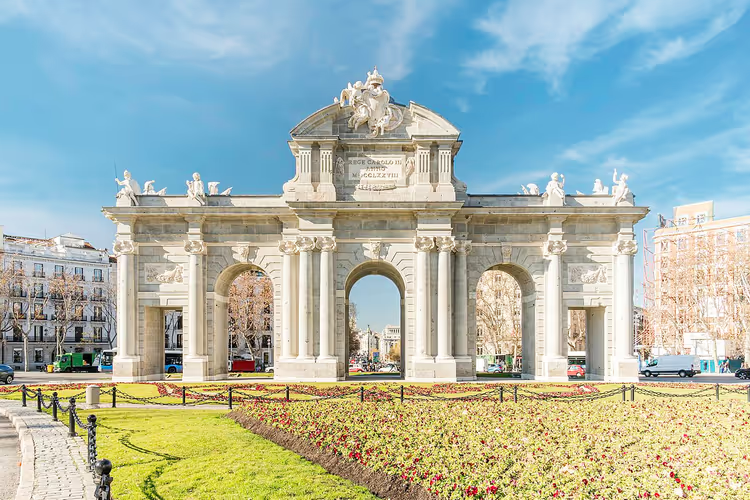 © Fernando Pascullo · CC BY-SAPhoto: Fernando Pascullo, CC BY-SA (https://creativecommons.org/licenses/by-sa/4.0), Wikimedia Commons
The Alcalá Gate stands on the border between Retiro and the old town. The granite arch with five spans was erected at the end of the 18th century by order of King Charles III. Today it is a monument on Independence Square, next to the Retiro metro station.
The facade faces Alcalá Street and is decorated with columns and sculptures. Above the central arch the king's name and the construction date were carved, and above that stand figures of mythological heroes. Ten minutes is enough: the details read well right from the square.
5. Cibeles Palace
 © Carlos Delgado · CC BY-SAPhoto: Carlos Delgado, CC BY-SA (https://creativecommons.org/licenses/by-sa/3.0), Wikimedia Commons
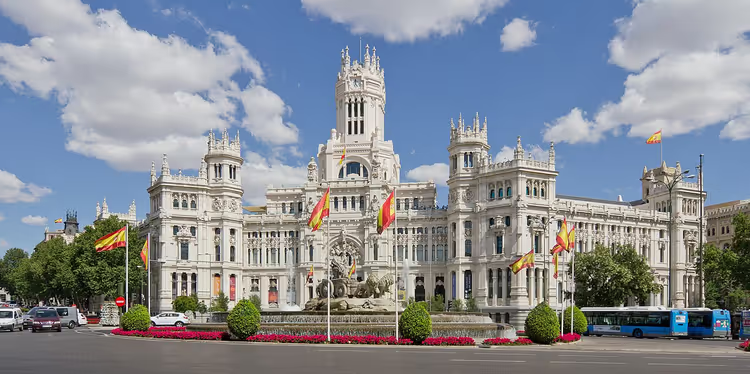
The Cibeles Palace stands on Plaza de Cibeles and serves as the city hall. The white building was constructed from 1904 to 1918 and opened in the spring of 1919 as the Palace of Telecommunications. It only received the name Cibeles in 2009, when the city government moved in (description of the Cibeles Palace).
An observation deck is set up on the seventh floor. It offers a panoramic view of Castellana, Gran Via, and the greenery of Paseo del Prado. Check admission to the observation deck on site: opening hours change, and the deck is sometimes closed on holidays.
Locals nicknamed the palace the "wedding cake" because of its turrets, columns, and spires. The facade is best photographed from the opposite side of the square, where there is less traffic.
6. Thyssen-Bornemisza Museum
 © Kyle Magnuson from Los Angeles, United States · CC BYPhoto: Kyle Magnuson from Los Angeles, United States, CC BY (https://creativecommons.org/licenses/by/2.0), Wikimedia Commons
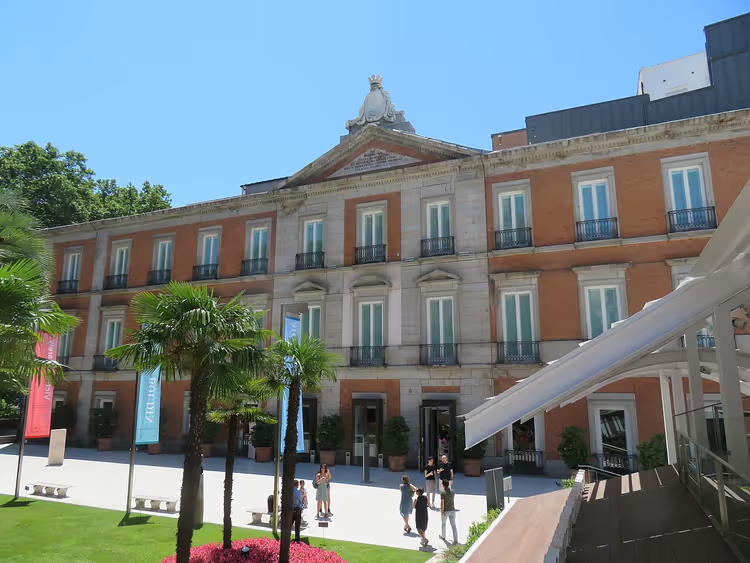
The Thyssen-Bornemisza Museum is part of the "golden triangle of art" along with the Prado and the Reina Sofia Art Center. The collection spans eight centuries of European painting, from old masters to impressionists and the avant-garde.
The upper floor features Cranach, Memling, and Holbein, alongside Titian's "Madonna" and Rembrandt's "Self-Portrait." The lower floors display American painting with Pollock and Lichtenstein (Thyssen-Bornemisza collection page).
The collection was assembled by the Thyssen father and son, who received the title of Barons Bornemisza. You can see the museum in two to three hours if you don't read every label. It's best to book tickets in advance, see tickets for the Thyssen-Bornemisza.
The collection is arranged chronologically, so it's convenient to go floor by floor. Old masters hang at the top, and 19th- and 20th-century painting begins below.
A separate room is dedicated to the impressionists: five works by Monet, Degas's "Ballerina," canvases by Gauguin, and five paintings by Van Gogh. Further on are the post-impressionists and the avant-garde: Picasso, Dali, Kandinsky, and Chagall. Guides at the entrance will help you find your way through the rooms.
7. Prado Museum
 © Emilio J. Rodríguez Posada · CC BY-SAPhoto: Emilio J. Rodríguez Posada, CC BY-SA (https://creativecommons.org/licenses/by-sa/2.0), Wikimedia Commons
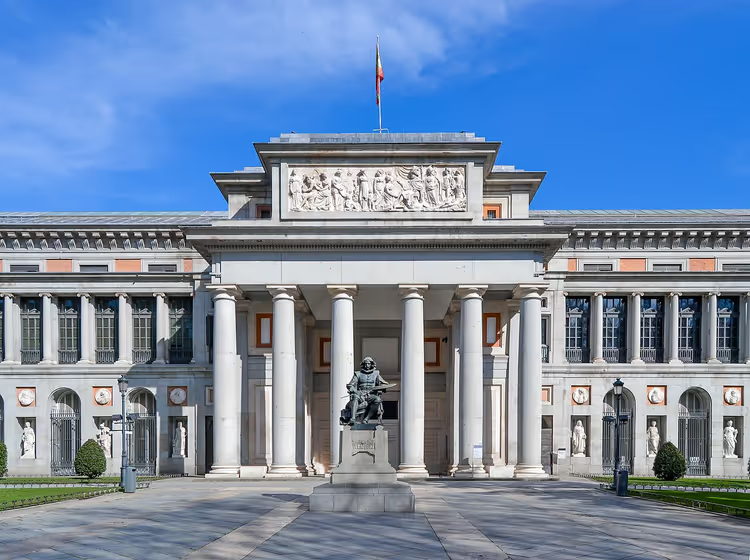
The Prado Museum opened in the early 19th century, and today it is one of Europe's major museums. The core of the collection consists of Spanish masters: Velazquez, Goya, El Greco, and Zurbaran. The collection includes thousands of canvases, but only part of the holdings are shown in the galleries (official Prado Museum website).
The Prado stands on Paseo del Prado boulevard, one block from the Thyssen-Bornemisza. Besides the Spanish painters, it displays Raphael, Botticelli, Titian, Bosch, and Durer. Allow three hours for the main galleries, and if you're in a hurry, choose Velazquez and Goya.
- The catch: because of the size of the holdings, only a small portion of the paintings are exhibited in the galleries, so decide in advance what to see.
It's easier to buy skip-the-line Prado tickets online.
8. Royal Botanical Garden
 © David Short from Windsor, UK · CC BYPhoto: David Short from Windsor, UK, CC BY (https://creativecommons.org/licenses/by/2.0), Wikimedia Commons
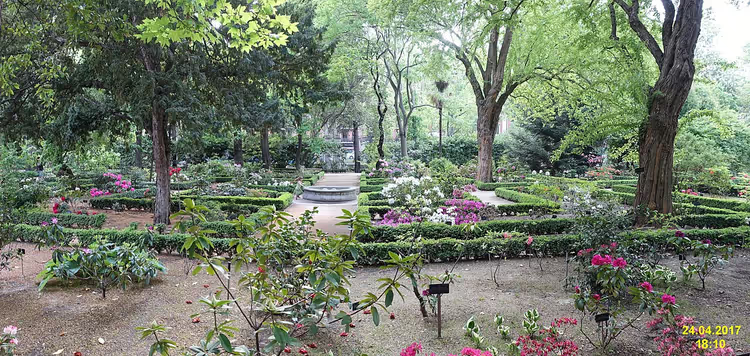
The Royal Botanical Garden adjoins the Prado Museum, with the entrance on Paseo del Prado. More than five thousand plant species are gathered on about eight hectares, and the grounds are divided into four terraces.
The garden is part of CSIC and operates as a research center. The lower terraces grow ornamental and fruit crops, while the middle one displays an evolutionary series of flora. The upper terrace is divided into twenty-five sectors with a greenhouse, a pond, and an exhibition pavilion (Botanical Garden page on the Madrid portal).
The garden was founded as part of a royal push for the sciences, and in the 19th century greenhouses, a library, and botany classrooms were added. Today it ranks among the best botanical gardens in Europe.
In spring, roses and magnolias bloom here, and in summer the trees provide dense shade. You can't miss the garden: it sits right between the Prado and the boulevard.
The collection was moved here in the late 18th century from the banks of the Manzanares. Rest in the shade by the fountain: after the museums, the garden offers a breather. On the upper terrace stands a gazebo with a bust of Carl Linnaeus.
9. Toledo Bridge
 © M a n u e l from Valdemoro, Spain · CC BYPhoto: M a n u e l from Valdemoro, Spain, CC BY (https://creativecommons.org/licenses/by/2.0), Wikimedia Commons
Toledo Bridge spans the Manzanares River at the southern edge of the old town. The stone crossing with nine arches was built in the 18th century to replace a bridge destroyed by flooding. The piers were shaped so that water would flow around them during high water.
Since the middle of the last century, the bridge has been pedestrian-only; a tram used to run across it before that. Statues of Saint Isidore and Maria Torribia stand in the central section. Come at sunset: the bridge offers views of the river and baroque ornamentation, with lawns and flower beds laid out around it.
10. Toledo Gate
 © FouPic · CC BYPhoto: FouPic, CC BY (https://creativecommons.org/licenses/by/2.0), Wikimedia Commons
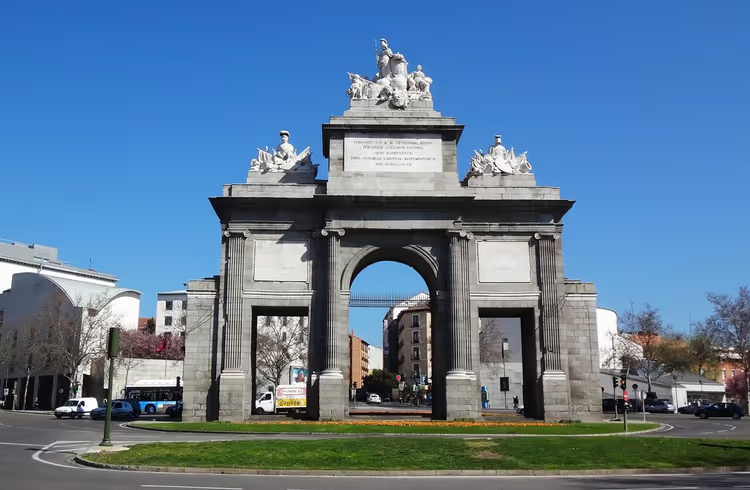
Toledo Gate stands at the entrance to the old town. The gray granite monument with three arches was erected in the early 19th century on the site of the old fortress gates. The monument is dedicated to King Ferdinand VII.
The central arch is taller than the side arches and is framed by Ionic half-columns. On the city side, the coat of arms of Madrid, supported by angels, is visible at the top. A visit takes five minutes, and then you continue on to the San Miguel Market.
11. Las Vistillas Gardens
Las Vistillas Gardens are laid out in the city's oldest district, not far from Toledo Gate. Here you'll find quiet lawns, gazebos, and several viewing terraces. From the highest point on a clear day you can see the Sierra de Guadarrama.
 © Concepcion AMAT ORTA… · CC BYPhoto: Concepcion AMAT ORTA…, CC BY (https://creativecommons.org/licenses/by/3.0), Wikimedia Commons
A viaduct over a Manzanares tributary also stands here. The bridge was built in the middle of the last century, and in the nineties it was enclosed with a tall plastic fence.
- The catch: the fence partially blocks the view from the viaduct, so it's better to take photos from the cafe terrace.
12. Plaza Mayor
 © Draceane · CC BY-SAPhoto: Draceane, CC BY-SA (https://creativecommons.org/licenses/by-sa/4.0), Wikimedia Commons
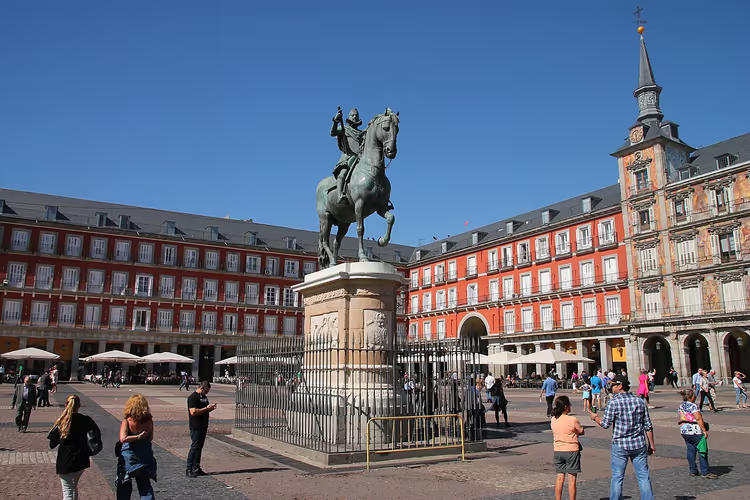
Plaza Mayor serves as the main square of old Madrid. The Casa de la Panadería with its arches and hundreds of balconies stands along the perimeter, and the square itself took shape back in the 17th century.
The Casa de la Panadería is famous for its frescoes; the facade is refreshed every few years. In total, the perimeter has 237 balconies and 9 arched entrances facing the four cardinal directions.
Once a bustling market and the site of Inquisition executions, the square is now a place to have lunch and listen to street musicians. Before Christmas, a souvenir fair is set up here, and in the evening the lights come on.
13. El Rastro Market
 © Dmitry Dzhus from London · CC BYPhoto: Dmitry Dzhus from London, CC BY (https://creativecommons.org/licenses/by/2.0), Wikimedia Commons
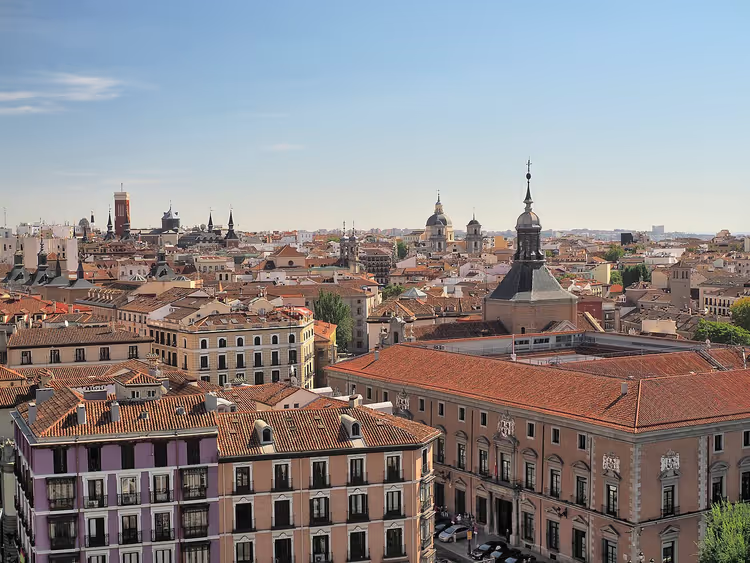
El Rastro Market operates on Sundays and is considered Spain's oldest flea market. The name comes from the trail of blood left when hides were brought here from slaughterhouses. Vendors sell antiques, old records, books, and all sorts of small items.
The streets are organized by theme: artists in one area, collectors and film buffs in another. Come at opening time, while vendors are still laying out their goods, otherwise the best items will be gone.
- The catch: the market is crowded and noisy, and it's easy to lose your group in the crowd, so agree on a meeting point in advance.
14. San Miguel Market
 © Juan Antonio Flores Segal from Madrid ( Spain ) · CC BYPhoto: Juan Antonio Flores Segal from Madrid ( Spain ), CC BY (https://creativecommons.org/licenses/by/2.0), Wikimedia Commons
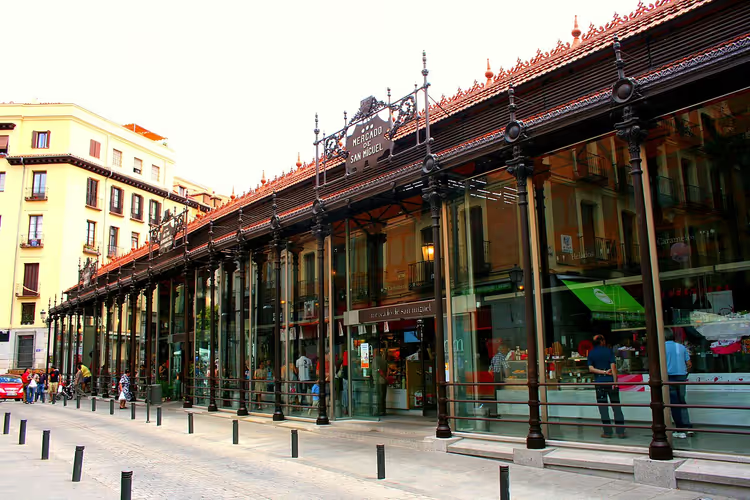
San Miguel Market operates as a gourmet food hall with tapas bars. The metal-and-glass pavilion was erected on the site of a burned-down church in 1916.
The pavilion is divided into three sections. The first sells bread, pastries, and desserts; the second is dominated by seafood: scallops, shrimp, crab, and octopus. The third is occupied by tapas bars with cheeses, olives, pintxos, and paella. Here you can get oysters and jamón, and a few small plates add up to a full dinner.
Prices are higher than at regular bars, but everything is in one place. Come at opening time or after three: at lunchtime the hall is packed and you won't find a free table.
15. Almudena Cathedral
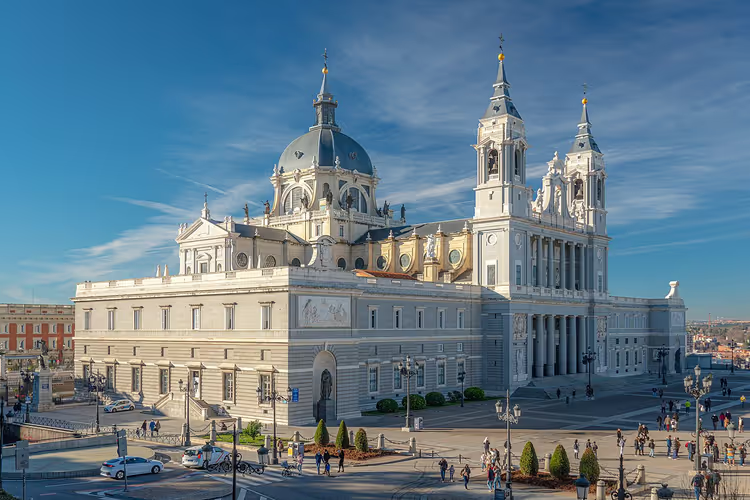 © Fernando · CC BY-SAPhoto: Fernando, CC BY-SA (https://creativecommons.org/licenses/by-sa/4.0), Wikimedia Commons
Almudena Cathedral stands next to the Royal Palace and bears the name of Madrid's patron saint. The church took more than a century to build: the cornerstone was laid in the late 19th century, and it was consecrated by Pope John Paul II only in 1993 (guide to Almudena Cathedral).
The facades are decorated with bas-reliefs depicting biblical scenes, and the interior is filled with light from large stained-glass windows. The main altar is made of green marble. According to legend, the statue of the Virgin was brought to the city by the Apostle James.
Access to the observation deck above the dome requires a separate ticket. From the deck you can see the Royal Palace and the rooftops of the old town, so plan your visit for sunset.
16. Royal Palace
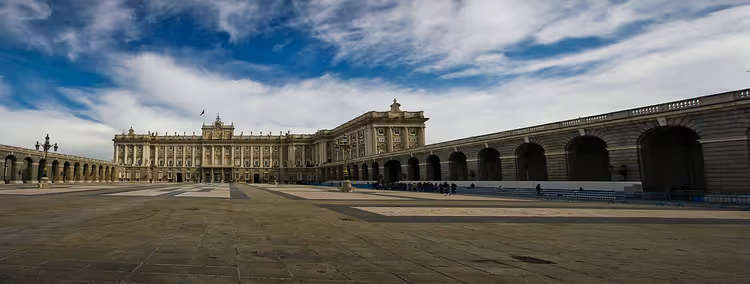 © D.Rovchak · CC BY-SAPhoto: D.Rovchak, CC BY-SA (https://creativecommons.org/licenses/by-sa/4.0), Wikimedia Commons
The Royal Palace is considered the largest palace in Europe by floor area. A standard ticket costs €18, and a combined ticket with the Royal Collections Gallery costs €24 (as of 09/2026, palace tickets and hours page). On weekday evenings, EU citizens have a free-entry window, but tickets are issued only at the ticket office.
The palace took twenty-six years to build in the 18th century for Charles III, based on a design by Italian architects Sabatini and Sacchetti. Inside there are more than three thousand rooms, frescoes, tapestries, and a weapons collection.
The Stradivarius violin collection and the Royal Armory deserve special attention. Touring the rooms takes about an hour.
- The catch: entering without an online ticket during peak season costs time; there is a separate line at the ticket office.
Tickets with time slots are more convenient to book in advance, see tickets to the Royal Palace.
The palace stands on Plaza de Oriente, opposite the Royal Theatre. From Ópera metro station you can walk there in a couple of minutes, and the visitor entrance starts on the Almudena side. An audio guide is available inside, and without it, making sense of the hundreds of rooms is difficult.
The state rooms feature frescoes by the finest masters of the era, and crystal chandeliers and tapestries stand next to the thrones. After your visit, head down to the Campo del Moro park with the Carriage Museum: from there you get a view of the palace from below and of the river.
17. Teleférico cable car
 © Concepcion AMAT ORTA… · CC BYPhoto: Concepcion AMAT ORTA…, CC BY (https://creativecommons.org/licenses/by/3.0), Wikimedia Commons
The Teleférico cable car flies over the Manzanares River and Casa de Campo park. A one-way ride costs €4.50, round trip €6.00 (as of: 09/2026, official cable car website).
The route is about two and a half kilometers long and takes around ten minutes. During that time you see the palace, the cathedral, and the park from above. In summer the cable car runs every day, from October to March only on weekends, so check the calendar before your trip.
- The catch: in strong winds the cable car shuts down, so don't leave it as the last item of your day.
18. Temple of Debod
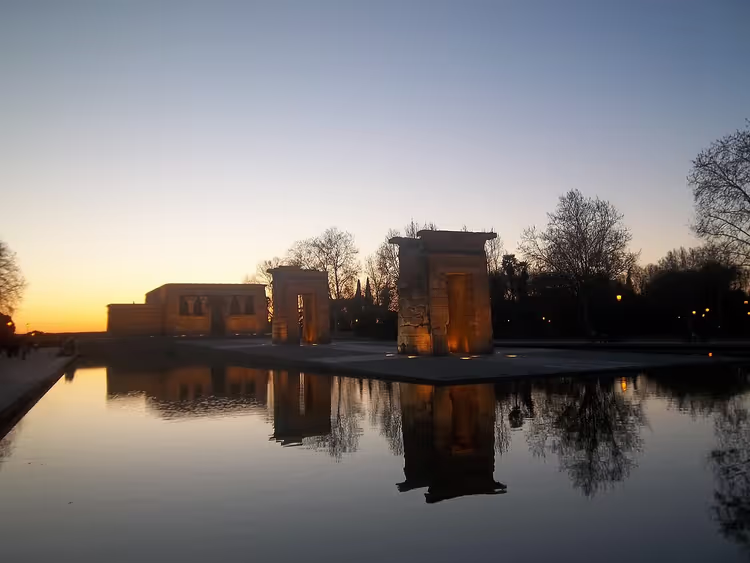 © Leandro Kibisz · CC BY-SAPhoto: Leandro Kibisz, CC BY-SA (https://creativecommons.org/licenses/by-sa/3.0/es/deed.en), Wikimedia Commons
The Temple of Debod stands in Parque del Oeste and remains a genuine Egyptian temple. It was built in ancient Nubia before our era and dedicated to the goddess Isis. Egypt gave it to Spain in gratitude for helping save the temples of Nubia.
The structure was moved to Madrid in the late sixties and opened to the public in 1972, reassembled from thousands of stones (Temple of Debod page). The chapel is the best preserved part, its walls covered with bas-reliefs and hieroglyphs.
Admission to the temple is free. It is especially beautiful at sunset: it stands on a hill above the river, and the stones change color in the light. The Manzanares embankment runs nearby, so you can combine both spots in one evening.
19. Victory Arch
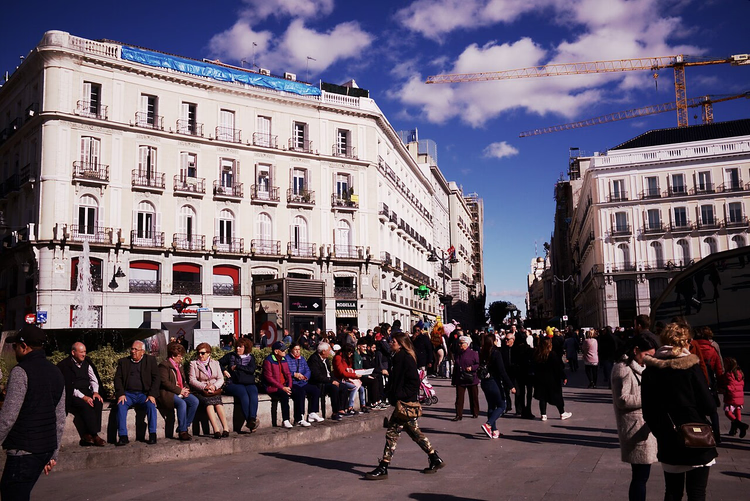
The Victory Arch stands in Plaza de Moncloa in the northwest of the city. It was erected in the 1950s to commemorate the victory in the Civil War. The forty-meter monument is crowned with a bronze quadriga driven by Minerva.
The arch was built to a design by architects Otero and Sanfeliu. Inscriptions in Latin tell of the victory and the rebuilding of the university campus, which was damaged during the war.
- The catch: you can't go inside, the arch is closed to visitors and can only be viewed from the outside. It makes sense to come here if you're heading to the cable car or Casa de Campo park.
20. Manzanares riverfront
 © Concepcion AMAT ORTA… · CC BYPhoto: Concepcion AMAT ORTA…, CC BY (https://creativecommons.org/licenses/by/3.0), Wikimedia Commons
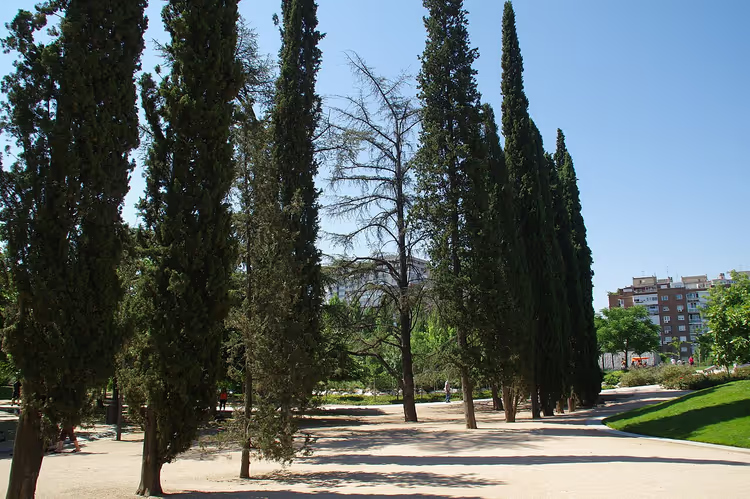
The Manzanares riverfront runs along the river where a highway used to be. The Madrid Río project opened in 2011, moving traffic underground (Manzanares riverfront page).
More than six hundred hectares were turned into lawns, gardens, and dozens of recreational areas. Fruit and ornamental gardens, playgrounds, and sports facilities were built along the river, and separate tanks were installed for rainwater. Pedestrian bridges cross the river, including the stainless steel Arganzuela Bridge.
This is a good place to end the day: bike paths, picnic areas, and a view of the sunset over the river. You can rent a bike or scooter at the park entrance.
Barajas is connected to the center by metro and express bus. From the terminals you can reach Nuevos Ministerios in fifteen minutes, then transfer to lines heading downtown (as of 09/2026, Madrid metro schedule). The express bus takes about forty minutes to the center, and you buy the ticket from the driver. If you have luggage and want to avoid transfers, book an airport transfer from Barajas or take a regular taxi.
You can also look at one-day city tours as a separate option:
Tours and tickets in Madrid
Guided tours, skip-the-line tickets and activities — most offers can be cancelled free of charge.
See offers on GetYourGuideThe widget loads once you give your consent.
Madrid walking route on the map
Below is a suggested order for seeing the sights. It is not rigid: if you like something, stay longer and push the rest to later.
The morning starts at Puerta del Sol. From here you walk to Plaza Mayor and the San Miguel Market, then take a short walk to the Royal Palace and Almudena Cathedral. The palace and cathedral are easy to see together, since they are only five minutes apart on foot.
After lunch, head down to the Toledo Gate and Toledo Bridge, then along the river to Las Vistillas Gardens. From there it is a short walk to the old town, but you already covered that in the morning, so turn toward the museums.
The Prado, the Thyssen-Bornemisza Museum, and the Botanical Garden all sit along Paseo del Prado, so walking between them is easy. The day ends at the Manzanares riverfront and the riverside park.
The outlying sights, Las Ventas Arena, the cable car, and the Victory Arch, are grouped separately. They take half a day, so include them only if you have time to spare.
If you are traveling with children, skip the outlying sights and keep Retiro Park, the Prado, and the riverfront. That makes for a calmer day and less fatigue.
A multi-ride metro ticket is cheaper than single tickets.
Plan lunch in advance: tourist areas have lines. The quickest places to grab a bite are in the side streets near Plaza Mayor or by San Antón Market.
Taxi fares in the center are high because of traffic, so walking is often faster. In the evening it is pleasant to stroll along Gran Vía and return to Plaza Mayor to see it lit up.
If you stay out until night, head to the river: the riverfront is illuminated and noticeably quieter than the squares. That way the day ends calmly, without rushing.
All the points are marked on the map below. Save it to your phone in advance so you do not waste data or have to search for it again.
What to see in Madrid in 1 day — 20 most interesting places
Places on the map
- 1Las Ventas Bullring The country's main bullring, with a museum on site
- 2Retiro Park UNESCO site with the Great Pond and a boat rental station
- 3Crystal Palace Spain's first glass building, by a lake
- 4Puerta de Alcalá Granite arch with five bays from the late 18th century
- 5Cibeles Palace City hall with a viewing platform on the seventh floor
- 6Thyssen-Bornemisza Museum Eight centuries of European painting
- 7Prado Museum Velázquez, Goya, El Greco and Spain's leading masters
- 8Royal Botanical Garden Over five thousand plant species across four terraces
- 9Toledo Bridge Stone crossing with nine arches from the 18th century
- 10Puerta de Toledo Granite monument with three arches honouring Ferdinand VII
- 11Las Vistillas Gardens Viewing terraces overlooking the Sierra de Guadarrama
- 12Plaza Mayor Main square of old Madrid, with the Casa de la Panadería
- 13El Rastro Market Spain's oldest Sunday flea market
- 14San Miguel Market Gastronomic pavilion with tapas bars
- 15Almudena Cathedral Church of Madrid's patroness, with a viewpoint above the dome
- 16Royal Palace Europe's largest palace by floor area
- 17Teleférico cable car A flight over the Manzanares and Casa de Campo park
- 18Temple of Debod A genuine Egyptian temple, gifted to Spain
- 19Arco de la Victoria Forty-metre monument with a bronze quadriga
- 20Manzanares Riverbank The Madrid Río project, with parks along the river
⁉️🤔 Frequently asked questions
How much does it cost to see Madrid in one day?
The main expenses are museum tickets and transport. Buy Prado, Royal Palace, and Thyssen-Bornemisza tickets online so you do not waste time in lines. Lunch at San Miguel Market costs more than at a regular bar. Check exact prices on the official museum websites (as of 09/2026).
Is one day enough for the Prado and the Royal Palace?
Yes, they fit into two halves of the day. The palace is best seen in the morning before the line forms, and the Prado should be left for the second half. If time is tight, pick one museum and add a walk through Retiro Park.
When is admission to Madrid museums free?
The Royal Palace has an evening free-entry window for EU citizens on weekdays (as of 09/2026, tickets and free hours). The Prado and Thyssen-Bornemisza also have free-entry hours, but the lines are longer. These tickets are usually issued only on site and with an ID.
How to get from Barajas Airport to the center?
The cheapest option is the metro: it connects all terminals to the center, and the trip takes about forty minutes with a transfer. The express bus goes to Cibeles Square and costs about five euros (as of 09/2026, Madrid metro website). With luggage, a taxi or a pre-booked transfer is more convenient.
What to see in Madrid in the evening?
After sunset, head to the Royal Palace and Almudena Cathedral: they are illuminated, and the square in front of them empties out. Then walk down to Plaza Mayor, where restaurants are open, or to the Manzanares riverfront for the river view. In summer it gets dark late, so the walk starts after nine.
Find hotels
Compare prices across booking sites and filter for rooms with free cancellation.
Compare prices on Discover CarsThe widget loads once you give your consent.
In short: what to book
Madrid in a day fits into a simple loop: the old town, the palace and cathedral, then the museum triangle and the riverfront. If you only have a few hours, pick the palace and the Prado, and leave the rest for a second visit.
Selection matrix. If you are traveling with kids: Retiro Park with its boats and the Manzanares riverfront. If you are into history: the Royal Palace and the Gate of Toledo. If you are into art: the Prado and the Thyssen-Bornemisza Museum. If you only need a view: the Cibeles Palace observation deck and the cable car.
If you are staying for several days, add Casa de Campo park on the second day. On the third day, take a trip to Toledo or the Guadarrama mountains: both are about an hour from Madrid.
For a short trip, the center is enough: the old town and the palace in the morning, museums after lunch. Buy tickets online, otherwise part of the day will be lost to lines. Do not forget comfortable shoes: you will walk more than a few kilometers around the center.
Hotels in the center sell out quickly, so book your hotel in advance: see hotels in central Madrid.

A small editorial team writing guides for independent travel. We travel ourselves, but we haven’t been everywhere, so we check prices, opening hours and how to get there against official sources.