
















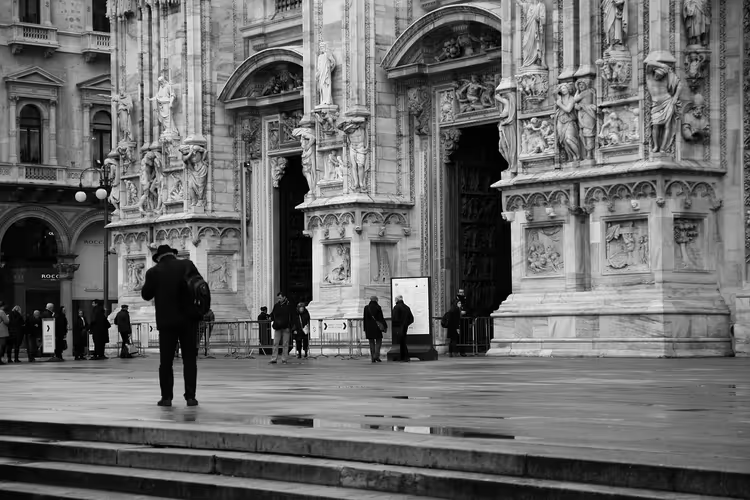
Milan on foot in one day: 16 stops from the monumental cemetery to the Duomo
Milan is genuinely walkable in one day. It's a compact city, and the 16 places below connect into a single line from the Monumental Cemetery in the north to the Duomo in the center. On the map it works out to about 12 kilometers; without rushing, that's 8-9 hours with stops for coffee and lunch.
The main challenge isn't the distances, it's the lines. The Duomo terraces and the Museum of Science and Technology each eat up an hour if you show up without a ticket. That's why below I note what to book in advance and what to see along the way without any preparation. Each place comes with the price, opening hours, and an honest catch.
We left the center with the Duomo for the second half of the day. You walk through Navigli in the middle of the day and have lunch right by the canal. The route finishes at Centrale station.
Ad: this article contains affiliate links, we earn a commission if you book through them, at no extra cost to you.
One-day route in numbers
💡 In short:
- Start with the Monumental Cemetery: admission is free, closed on Mondays.
- Walk to the Duomo through Parco Sempione and Sforza Castle, that's the flattest stretch of the route.
- Book the Duomo terraces in advance; current Duomo terrace rates are on the cathedral's official website.
- Have lunch in Navigli, and end the day at Centrale station.
- Prices and opening hours: 09/2026, verified on the official Sforza Castle website.
Segment | What to see | Walking, km (on the map) | Tickets in advance |
|---|---|---|---|
Cemetery and Arch of Peace | Monumental Cemetery, Arch of Peace | 2.5 | not needed |
Park and castle | Parco Sempione, Sforza Castle | 1.5 | castle museums, €5 (official castle website) |
To Sant'Ambrogio | Piazza Affari, Basilica of Sant'Ambrogio, Museum of Science | 2 | Museum of Science, website |
Navigli | Naviglio Grande, Porta Ticinese gate | 1.5 | not needed |
Center | Duomo, Galleria, La Scala, Piazza Mercanti | 2.5 | Duomo terraces, official cathedral website |
To the station | San Carlo al Corso, Centrale station | 1.5 | not needed |
From here we go in route order. Each place comes with a photo, the distance on the map, and a practical note.
1. Monumental Cemetery
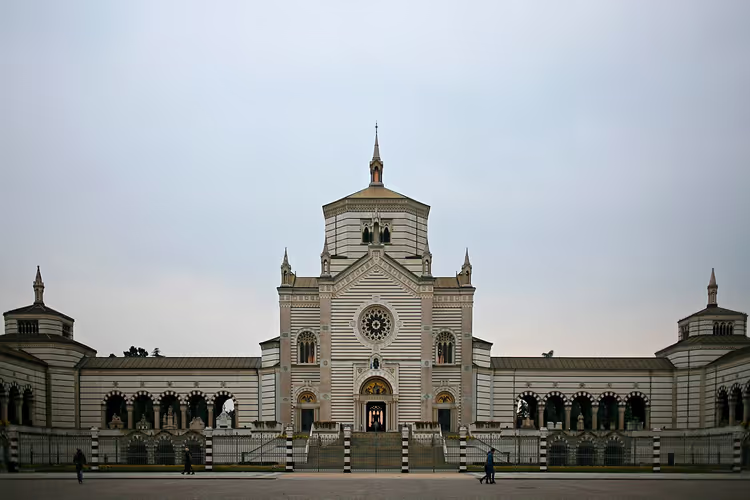 © Paolobon140 · CC BY-SAPhoto: Paolobon140, CC BY-SA (https://creativecommons.org/licenses/by-sa/4.0), Wikimedia Commons
The cemetery opened in 1866, designed by architect Carlo Maciachini. It's not an ordinary place of mourning but an open-air museum: stone pyramids, Greek temples, and family tombs by the best sculptors in Italy stand here.
You walk along the avenues between the gravestones of wealthy Milanese families. A stone replica of The Last Supper rises above the Campari family grave, and composers, writers, and artists lie nearby. The cemetery is closed on Mondays; on all other days admission is free.
- How to get there: metro M5, Monumentale station, exit toward the main entrance (on the map).
- Cost: admission is free (as of 09/2026, city cemetery portal).
- Who it's for: people who love sculpture and quiet in the middle of a metropolis.
- The catch: the gates are closed on Mondays.
2. Triumphal Arch of Peace
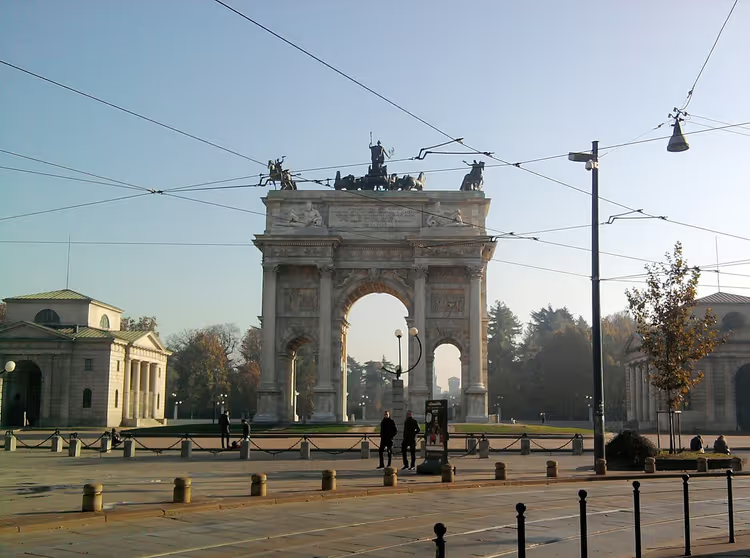 © Tobia09 · CC BY-SAPhoto: Tobia09, CC BY-SA (https://creativecommons.org/licenses/by-sa/3.0), Wikimedia Commons
The Arch of Peace was built in the northern part of the city, designed by Luigi Cagnola, and opened in September 1838. The monument was conceived in honor of Napoleon's victories, but the empire had ended by then, and the arch was dedicated to the peace that Europe signed at the Congress of Vienna.
The arch is about 25 meters high (according to the Milan tourism portal). The three spans are crowned by a bronze chariot with six horses.
- How to get there: tram to the stop near the park or on foot from Parco Sempione (see map).
- Cost: viewing the arch is free.
- Who it's for: for sunset photos.
3. Parco Sempione
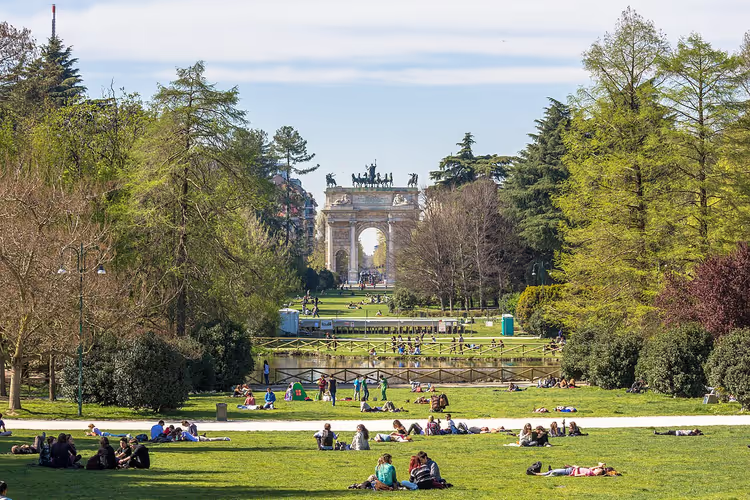 © Alessandro Perazzoli · CC BY-SAPhoto: Alessandro Perazzoli, CC BY-SA (https://creativecommons.org/licenses/by-sa/4.0), Wikimedia Commons
Parco Sempione lies between Castello Sforzesco and the Arco della Pace. The English landscape park was laid out here in 1893, and today it is the main green space in the city center.
The route goes straight through the park, so you walk from the castle to the arch without city noise. In summer, the fountains run and there are plenty of people on the lawns.
- How to get there: you enter the park from the Castello Sforzesco side (see map).
- Cost: entry is free, the park is open from morning to evening.
- Who it's for: for a relaxed walk between the two sights.
4. Castello Sforzesco
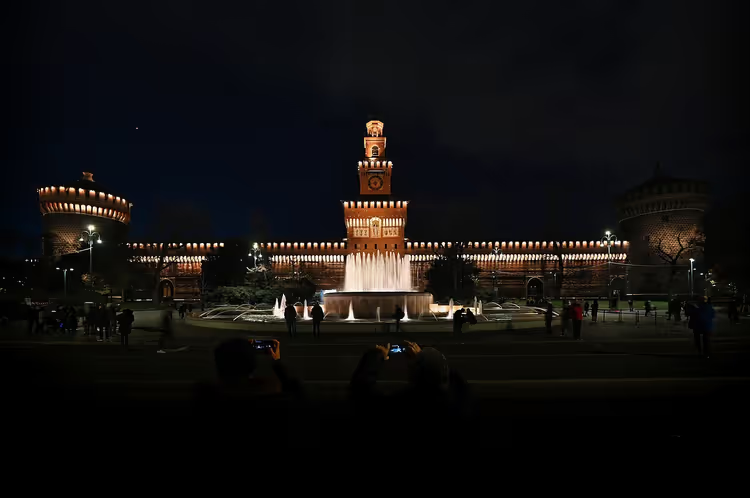 © TeKappa · CC BY-SAPhoto: TeKappa, CC BY-SA (https://creativecommons.org/licenses/by-sa/4.0), Wikimedia Commons
Castello Sforzesco was the residence of the Milanese dukes from the Visconti family, and later the Sforza family. The fortress with its massive towers rose on the ruins of an older fortification in the 15th century, and at the time it was considered the largest citadel in Europe.
Today the castle buildings house a museum complex. It includes an archaeological museum, a picture gallery, and the Museum of the Risorgimento, and in the courtyards you will see Michelangelo's Pietà Rondanini. Leonardo da Vinci worked on the palace's decoration, and his frescoes survive in the Sala delle Asse.
A museum ticket costs €5 for adults; the courtyards and ramparts are free to visit (as of 09/2026, castle's official website). The museums are open Tuesday through Sunday from 10:00 to 17:30, closed on Mondays. Book Milan museum tickets in advance on Tiqets.
- How to get there: metro M1 and M2, Cadorna station, then walk (see map).
- Price: museums €5, reduced €3 (as of 09/2026, castle website).
- Who it's for: for fans of Michelangelo and the history of Lombardy.
- Not for: if your plan only includes the Duomo, the castle museums will eat up two hours.
- The catch: the museums are closed on Mondays.
5. Piazza Affari
Piazza Affari is popularly known as the square of deals; the stock exchange palace, Palazzo Mezzanotte, stands here. Beneath the current square there was once an ancient Roman theater, and you can see its layout on a panel by the building.
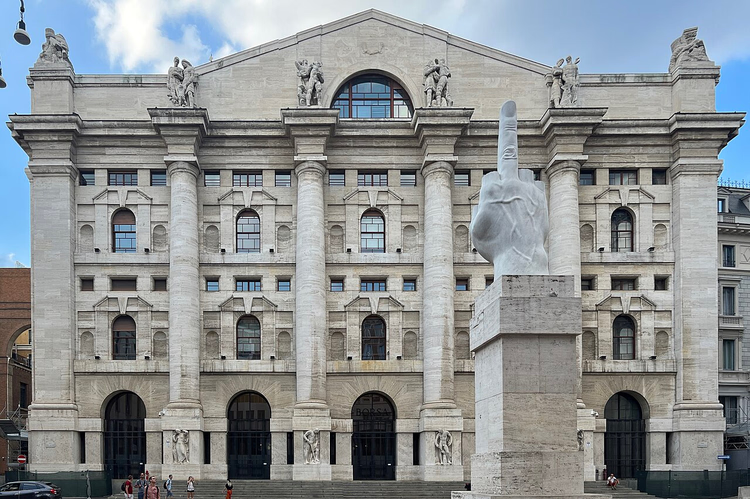 © Chabe01 · CC BY-SAPhoto: Chabe01, CC BY-SA (https://creativecommons.org/licenses/by-sa/4.0), Wikimedia Commons
In 2010, Maurizio Cattelan's sculpture L.O.V.E., a hand nearly four meters tall, was installed in the center of the square. The austere palace houses the Sala delle Grida, the "shouting room" where traders once bargained at the top of their voices.
- How to get there: metro to Cordusio station or tram 16, bus NM1 (see map).
- Cost: viewing the square is free.
- Who it's for: for a short stop on the way to the Basilica of Sant'Ambrogio.
6. Basilica of Sant'Ambrogio
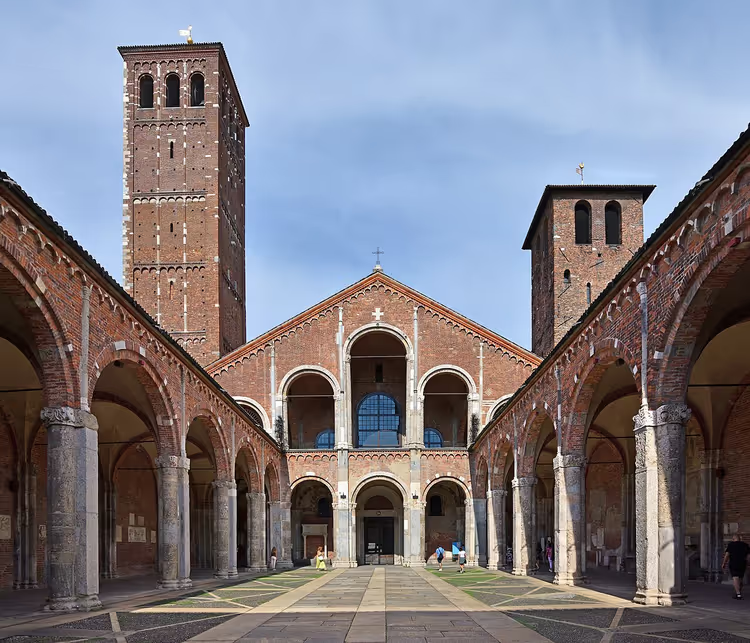 © Ludvig14 · CC BY-SAPhoto: Ludvig14, CC BY-SA (https://creativecommons.org/licenses/by-sa/4.0), Wikimedia Commons
The Basilica of Sant'Ambrogio was built in 1128 on the burial site of early Christian martyrs. It is one of the oldest churches in the city, and you will recognize it by the two brick towers on the square.
Inside are the relics of Saint Ambrose of Milan, the martyrs Gervasius and Protasius, and a 9th-century golden altar. In the center stands the Column of the Serpent, a bronze serpent on a granite column, the work of Byzantine craftsmen. Next to the church you will find a white column known as the "Devil's Pillar."
The basilica is open Monday through Saturday from 10:00 to 12:00 and from 14:30 to 18:00, on Sundays from 15:00 to 17:00. Entry for individual visitors is free (as of 09/2026, basilica's official website).
- How to get there: metro M2, Sant'Ambrogio station, exit toward the square (see map).
- Cost: entry to the basilica is free, the museum is paid.
- Who it's for: for those interested in early Christianity and mosaics.
- The catch: there is a long midday break, with doors closed from 12:00 to 14:30.
7. National museum of science and technology Leonardo da Vinci
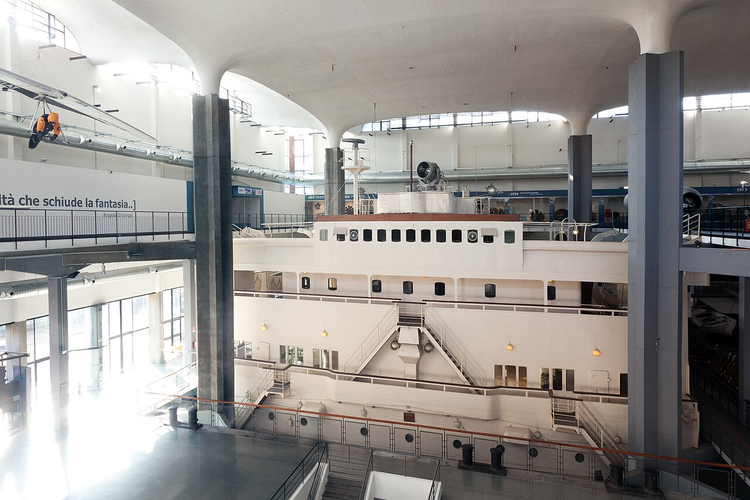 © Alessandro Nassiri · CC BYPhoto: Alessandro Nassiri, CC BY (https://creativecommons.org/licenses/by/4.0), Wikimedia Commons
The Leonardo da Vinci Museum of Science and Technology occupies a former monastery on Via San Vittore. It opened in 1953 and today is one of the largest technical museums in Europe.
Seven departments house thousands of exhibits. Drawings and wooden models of Leonardo's machines, halls of automobiles, engines, electrical engineering and clocks, a collection of tools. A separate pavilion holds the submarine Enrico Toti, which you enter on a timed schedule.
Tickets are sold on the official website, book your entry time in advance. The museum is closed on Mondays, so put it on a different day in your itinerary.
- Getting there: buses 94, 50 and 58 or metro M2 to Sant'Ambrogio station (using the map).
- Price: buy your ticket on the official website, where the reduced rate is also listed.
- Who it's for: families with children and anyone interested in technology.
- The catch: closed on Mondays.
8. Naviglio Grande canal
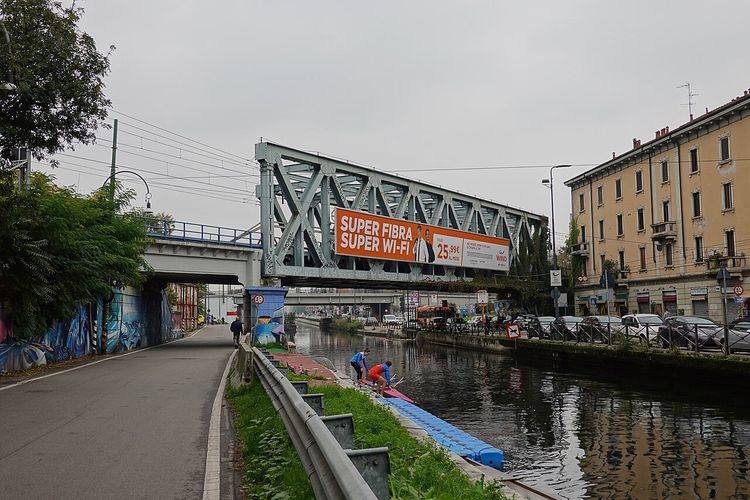 © Guilhem Vellut · CC BYPhoto: Guilhem Vellut, CC BY (https://creativecommons.org/licenses/by/2.0), Wikimedia Commons
The Navigli begin at Piazza XXIV Maggio next to the Porta Ticinese gate. Of Milan's old canals, two survive, Naviglio Grande and Pavese, and boat traffic on them still operates today.
As far back as the 15th century, engineers were building canals to the sea to move cargo. White marble for the Duomo was delivered to the city along the Naviglio Grande, and the Conca di Viarenna lock was improved by Leonardo da Vinci. The canal is about 50 kilometers long (according to the tourism portal).
Artists' workshops and small shops line the water, and bars and trattorias operate in the courtyards. A flea market takes place here every last Sunday of the month.
- Getting there: from the Porta Ticinese gate, walk down to the water (see map).
- Cost: the walk is free; buy a canal cruise on site.
- Who it's for: for dinner and an evening stroll by the water.
- The catch: the embankment gets very crowded on weekend evenings.
9. Porta Ticinese gate
 © Paolobon140 · CC BY-SAPhoto: Paolobon140, CC BY-SA (https://creativecommons.org/licenses/by-sa/4.0), Wikimedia Commons
The Porta Ticinese gate stands on the site of a Roman city gate on the road to Pavia. The current neoclassical arch was built under Napoleon to a design by Luigi Cagnola, and the side passages through the towers were cut in 1861.
Through the gate you enter the Ticino district, with its narrow streets and colorful three-story houses. It was once called Porta Marengo in honor of the French victory at Marengo, and its first name, Porta Cicca, is tied to local legends.
- Getting there: tram along Corso di Porta Ticinese, or walk from the basilica (see map).
- Cost: viewing the gate is free.
- Who it's for: for those who like districts with old buildings.
10. Duomo cathedral
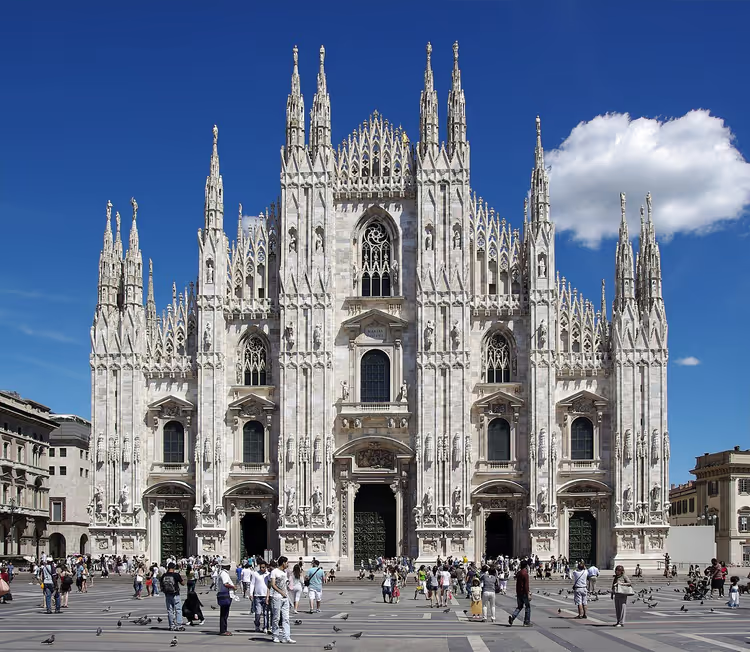 © Jakub Hałun · CC BY-SAPhoto: Jakub Hałun, CC BY-SA (https://creativecommons.org/licenses/by-sa/4.0), Wikimedia Commons
Milan Cathedral took nearly seven centuries to build; work was officially completed only in 1965. White marble, dozens of lacy spires, and thousands of statues on the facade make the Duomo the city's most recognizable building.
You enter the cathedral with a ticket, and the roof terraces are reached by stairs or elevator. Climbing by stairs costs €16, by elevator €18, and fast-track priority entry €28 (as of 09/2026, official ticket portal). From the terraces you can see the entire center, and on a clear day your gaze reaches the Alps.
The cathedral is open daily from 9:00 to 19:00 (as of 09/2026, official website). Book your terrace ticket in advance: by midday the entry line stretches along the square. Skip-the-line Duomo terrace access on GetYourGuide.
- Getting there: metro M1 and M3, Duomo station, exit to the square (see map).
- Price: terraces €16-28 depending on how you go up (as of 09/2026, portal).
- Who it's for: for the city panorama and the marble facade.
- The catch: there is no shade on the terraces, and the marble gets very hot during the day.
11. Galleria Vittorio Emanuele II
 © Paolobon140 · CC BY-SAPhoto: Paolobon140, CC BY-SA (https://creativecommons.org/licenses/by-sa/4.0), Wikimedia Commons
The Galleria Vittorio Emanuele II opened in 1877 and is one of Europe's first shopping arcades. A glass dome covers a cross formed by two streets, and the floor is laid with mosaics bearing the coats of arms of Italian cities.
The gallery connects the square by the Duomo with Piazza della Scala, so you pass through it on the way between the two sights. Boutiques and cafes stand under the dome, and the first Prada store operates here. The passage is open around the clock; shops are open from 10:00 to 22:00.
- Getting there: entrance from Piazza del Duomo, between the cathedral and La Scala (see map).
- Cost: free entry.
- Who it's for: for shopping and an evening stroll under the dome.
- The catch: the arcade gets very noisy on weekend evenings.
12. Piazza della Scala
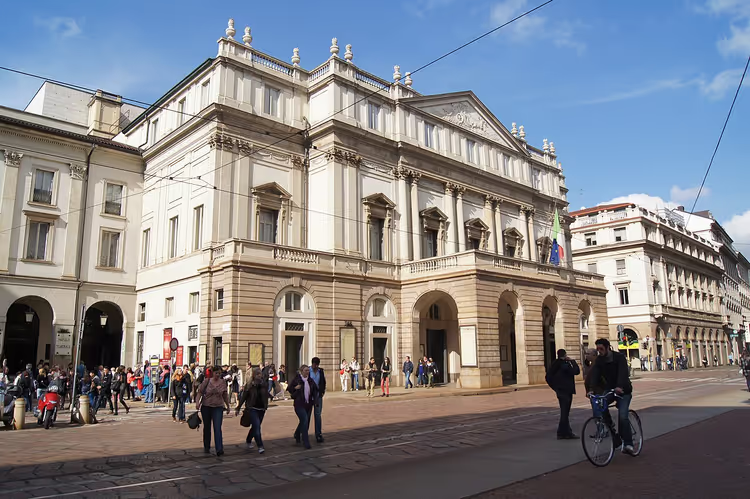 © Emanuela Meme Giudic… · CC BYPhoto: Emanuela Meme Giudic…, CC BY (https://creativecommons.org/licenses/by/3.0), Wikimedia Commons
Piazza della Scala took shape around the city hall, Palazzo Marino, which the city acquired in 1861. Today the square is framed by the galleria, the palace, and the opera house itself.
Teatro alla Scala opened in 1778, and its acoustics are known worldwide. The theater museum operates in the right wing of the building, and a monument to Leonardo da Vinci has stood in the center of the square since 1872. If walking all over the city is hard for you, get a hop-on hop-off bus ticket.
- How to get there: from the Duomo through the Galleria Vittorio Emanuele II, about five minutes on foot (see map).
- Cost: the square is free, the La Scala museum is paid.
- Who it's for: for those who want to catch a performance or visit the theater museum.
13. Piazza Mercanti
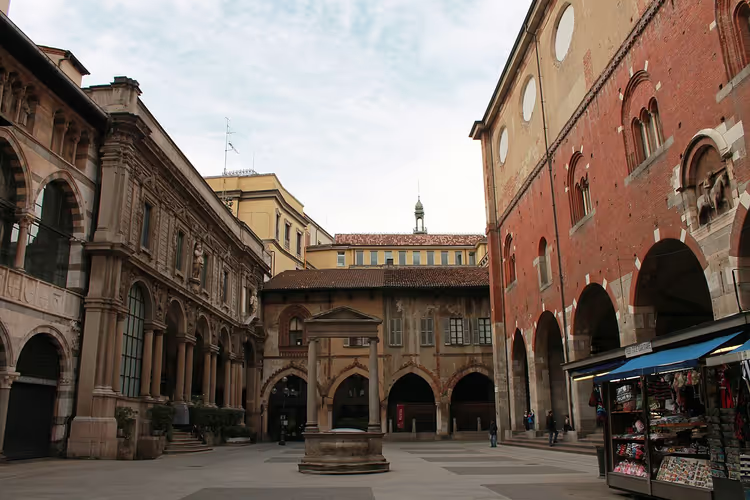 © Stefano Stabile · CC BY-SAPhoto: Stefano Stabile, CC BY-SA (https://creativecommons.org/licenses/by-sa/3.0), Wikimedia Commons
Piazza Mercanti was long the center of Milan's civic life. Medieval buildings survive here: the Loggia degli Osii in white and black marble and the Panigarola house with Gothic windows.
Today the square has cafes, restaurants, and antique shops. In the center stands a 16th-century well with two columns, and around it you'll most often see tourists with cameras.
- How to get there: on foot from the Duomo, behind the palazzo, about five minutes (see map).
- Cost: free to see.
- Who it's for: for a short stop between the Duomo and the stock exchange.
14. Palazzo dei Giureconsulti
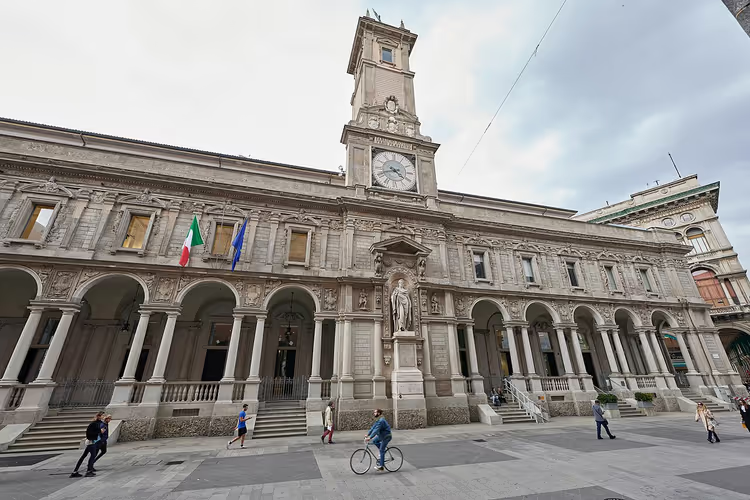
Palazzo dei Giureconsulti was built in 1562 to a design by architect Vincenzo Seregni around the old 13th-century Torre dei Napo Torriani. The tower first had bells, later replaced by a clock.
A sculpture of the city's patron saint, Saint Ambrose, stands in a niche of the tower. The building itself has four floors clad in cocoa-colored ashlar, and a gallery with columns and balustrades runs along the ground floor. It housed the college of doctors of law, the stock exchange, and the chamber of commerce.
- Address: Piazza dei Mercanti, 2 (see map).
- Cost: viewing the exterior is free; you go inside for exhibitions and conferences.
- Who it's for: for those who study facades and read the city's details.
15. San Carlo al Corso
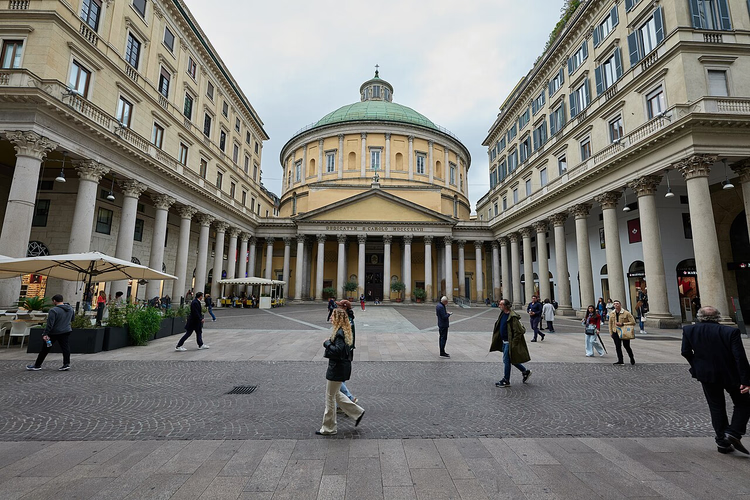
The Church of San Carlo al Corso was built in honor of Bishop Carlo Borromeo, who helped the city during the 16th-century plague. He was canonized in 1610, and construction was completed in 1847 on the site of the old Church of St. Mary.
Thirty-six granite columns stand at the entrance, and a high dome rises above them, so the church resembles the Roman Pantheon. Inside you'll see frescoes, mosaics, and a wooden crucifix above the altar.
- How to get there: on Corso Vittorio Emanuele II between the Duomo and the station (see map).
- Cost: free entry.
- Who it's for: for a quiet stop on the way to Milano Centrale.
16. Milano Centrale
 © Daniel Case · CC BY-SAPhoto: Daniel Case, CC BY-SA (https://creativecommons.org/licenses/by-sa/3.0), Wikimedia Commons
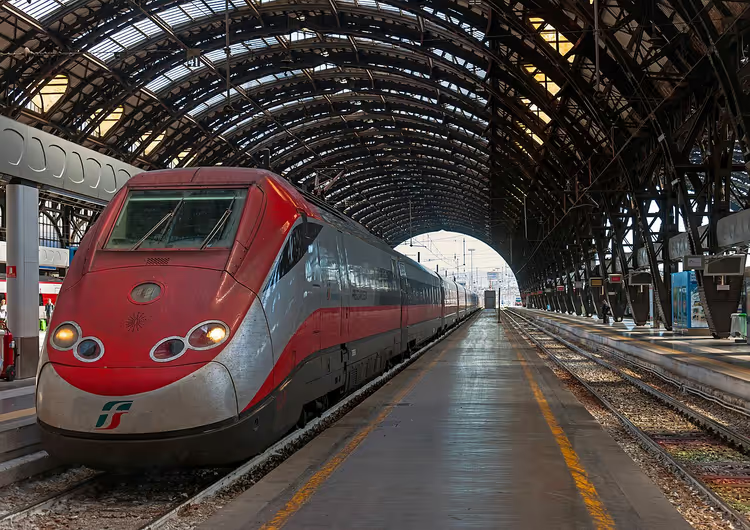
Milan's central station opened in 1931, and today it is one of the largest stations in Europe. You won't mistake the building, with its huge steel dome, frescoes, and Latin inscriptions, for anything else.
Trains depart from the platforms to Rome, Venice, Turin, and Zurich. Inside there are cafes, shops, luggage storage, and escalators to the metro. If you're continuing through Italy, allow extra time to get to your platform.
- How to get there: metro M2 and M3, Centrale FS station (see map).
- Cost: entry to the station building is free.
- Who it's for: for departing and changing to trains around the country.
Tours and tickets in Milan
Guided tours, skip-the-line tickets and activities — most offers can be cancelled free of charge.
See offers on TiqetsThe widget loads once you give your consent.
⁉️🤔 Frequently asked questions
How many hours does the whole route take?
The 16 stops take 8-9 hours on foot if you don't go inside the museums. With the Duomo terraces, the Science Museum, and dinner in Navigli, plan a full day from morning to evening. You can cover part of the route by tram or metro, which cuts the day down by a couple of hours.
Is it worth booking a Duomo terraces ticket in advance?
Yes, especially from April through October. See the cathedral section for lift prices, source: official portal. In the afternoon you'll wait noticeably longer at the entrance, and the route puts the cathedral right at that time.
What's closed on Mondays in Milan?
On Mondays the Sforza Castle museums, the Science and Technology Museum, and the Monumental Cemetery are closed. Plan your day so these three places fall on another day of the week. The Duomo, the gallery, La Scala, and Navigli are open all week.
Where to have lunch along the route?
Cheaper and calmer in Navigli: trattorias with a set daily menu line the canal. In the center near the gallery prices are higher, so have lunch before 1:00 PM or after 2:30 PM. In the evening popular places have a line, so it's better to book a table in advance.
Do I need insurance for a one-day trip?
For a day within the city insurance isn't mandatory, but if you're traveling by train from another country it covers flight cancellation and medical care. Compare insurance terms in advance, the rate depends on the duration and coverage.
In short: what's worth booking
If you have one day, book only the Duomo terraces and trains in advance. You'll see the rest of the places on the route without an entry ticket.
- Want a panorama and an audio guide: Duomo ticket with terraces on GetYourGuide.
- Interested in the city's museums: Milan museum tickets on Tiqets.
- Staying for several days: Milan hotels on Trip.com.
You can cover the 16-stop route on foot in a day, with lunch in Navigli by the canal.

A small editorial team writing guides for independent travel. We travel ourselves, but we haven’t been everywhere, so we check prices, opening hours and how to get there against official sources.