
















Valley of the Kings in 2026: open tombs, tickets and prices
The Valley of the Kings opens at six in the morning, but by ten the entrance to the tombs turns into a line.
Tickets are sold at the valley entrance and online, prices are revised every season, and some tombs are closed for restoration without notice. We put together a practical guide so you don't lose half a day on site and can immediately pick the tombs worth traveling for.
With one visit you get three tombs out of the ten included in the main ticket. You pay extra for the tombs of Seti I, Tutankhamun, Ramesses V and VI, and for the tomb of Ay in the West Valley. The main ticket costs 750 Egyptian pounds, the tram to the tombs costs 20 pounds (as of 2026, official ticket portal).
In this guide: how to get there from Luxor, which tombs are open in 2026, how much time to allow, and what hours have fewer people.
Ad: this article contains affiliate links, we earn a commission if you book through them, at no extra cost to you.
What the Valley of the Kings is
💡 In short:
- The Valley of the Kings is the necropolis of New Kingdom pharaohs on the west bank of the Nile, opposite Luxor.
- The main ticket includes ten tombs, and you can visit three of them.
- Tickets and prices: 09/2026, verified on the official website.
The Valley of the Kings is the main necropolis of New Kingdom pharaohs. Rulers of the 18th, 19th, and 20th dynasties were buried here: Tutankhamun, Ramesses II, Thutmose III, Seti I, as well as officials, wives, and children of kings.
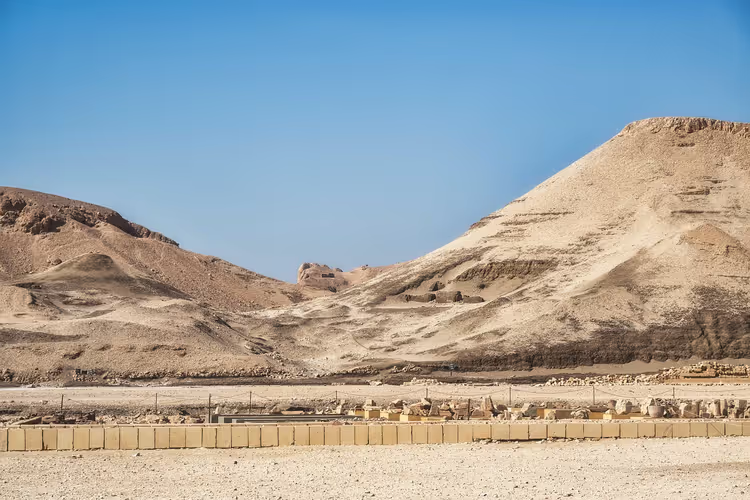
The tombs were cut into the limestone hills of the Nile's west bank between 1539 and 1075 BC. In total there are more than sixty tombs here, and almost every one was covered with reliefs and paintings. Above the valley rises the mountain of el-Qurn, whose pyramid-shaped peak echoes the silhouette of the Pyramids of Giza.
 © Chabe01 · CC BY-SAPhoto: Chabe01, CC BY-SA (https://creativecommons.org/licenses/by-sa/4.0), Wikimedia Commons
The Valley of the Kings, with the mountain of el-Qurn in the background.
The site for the necropolis was chosen for a practical reason. By that time, the tombs at Giza and in the Nile Delta had almost all been looted. Tombs cut deep into the rock seemed more secure, and the pharaohs believed that the sarcophagus with the mummy, shrines, and burial goods would remain untouched.
Inside each tomb they placed everything a king needed in the afterlife: the sarcophagus, shrines, jewelry, and burial objects. Some corridors extend more than a hundred meters into the rock.
Construction went on for almost five hundred years. The early tombs of the 18th dynasty were cut right at the cliff face, while later ones go deep inside with long corridors and chambers. The rulers of the New Kingdom had one thing in common: each wanted to hide his tomb as deep as possible.
Each tomb is marked with a KV code, meaning Kings Valley. The numbering runs from KV1 (Ramesses VII) to KV65, and the list may grow if archaeologists find a new tomb.
The valley is divided into two parts. Almost all open tombs are in the East Valley, while in the West Valley only the tomb of Ay (KV23) is accessible to visitors. Since 1979 the Valley of the Kings has been a UNESCO World Heritage Site.
The KV numbering does not mean the tombs stand in a row. Some tombs were cut one after another in the same rock, others are scattered across the slopes. From the entrance to the farthest one is about a ten-minute walk, so a map of the valley will come in handy within your first hour.
A tomb's name is almost always linked to the pharaoh for whom it was cut. Later, other family members were sometimes buried in the same tombs, so one code can hide two tombs. That is what happened with Tausert and Setnakht (KV14).
How to get to the Valley of the Kings
With an organized tour
Tours from Luxor to the west bank include the Nile crossing, a car, and an Egyptologist guide. For a first visit this is the most relaxed option: you don't need to find a taxi, haggle over the price, or figure out where the tomb you want is. Valley of the Kings tours on GetYourGuide pick up the group from your hotel or from the dock.
The guide works only up to the valley entrance. Guides are not allowed inside the tombs: you walk the tomb route on your own, and that is worth keeping in mind when choosing a tour.
Compare two formats before buying. A short tour goes only to the Valley of the Kings, while a long day covers the entire west bank. In the second case you will have less time for each tomb.
By taxi or ferry
Independent travelers take a taxi from Luxor. The drive takes about forty-five minutes, because the car goes over the Luxor Bridge south of the city. It is more convenient to take a taxi for the whole day: then you can also see other monuments on the west bank.
The second option is cheaper. First you cross the Nile by ferry, then you get a car on the west bank. Ferries run every ten to fifteen minutes and cost a few Egyptian pounds. This route saves money but eats up time.
If you go on your own, agree with the driver on a full day in advance. The exact daily price is set on the spot, so ask your hotel for the average level so you don't haggle blind.
Plan to leave in the morning. From Luxor to the valley takes about forty-five minutes, and after that you still have the tram and the climbs between tombs. If you take a car for the whole day, tell the driver your return time right away and agree on the price.
The Valley of the Kings is only part of the west bank. Other monuments are nearby, so a car for the whole day pays off if you are seeing more than one site. Taxi drivers in Luxor know the route well and will suggest the order of stops.
How the entrance works: tickets, tram, and security check
Your visit starts at the visitor center. Here you buy the main ticket, tickets for the extra tombs, and the tram ticket. There are no ticket offices inside the valley itself, so get all your tickets at once.
From there a tram takes you to the tombs. The ride takes three minutes and costs 20 Egyptian pounds per person round trip (as of 2026, ticket fares). From the tram stop to the tomb entrances you walk uphill, and it is a noticeable climb in the open sun.
The tram line itself is short, so getting stuck on it is unlikely. More time goes to the security check at the gate and to walking between tombs, so don't leave your backpack with water on the bus.
Which tombs are open in 2026
The Valley of the Kings has more than sixty-five tombs, but far from all of them are open. Some are closed for restoration, and some are held back to reduce the flow of people inside. The list changes several times a year, so check the page of open tombs before your trip.
Tombs included in the main ticket:
Code | Pharaoh |
|---|---|
KV1 | Ramesses VII |
KV2 | Ramesses IV |
KV6 | Ramesses IX |
KV8 | Merneptah |
KV11 | Ramesses III |
KV14 | Tausert and Setnakht |
KV15 | Seti II |
KV16 | Ramesses I |
KV43 | Thutmose IV |
KV47 | Siptah |
As of 2026, the main ticket includes ten tombs, and you can visit three of them (as of: 2026, current ticket list). If you want more, each additional tomb is paid for separately.
The ticket system looks simple. The main ticket gives you entry to the valley and three tombs from the list. Each additional tomb is paid for separately, and the tram is a separate line on your receipt. The attendant at the entrance punches your ticket, so you cannot see a fourth tomb with the main ticket.
It is more convenient to plan your visit from the list rather than from the map. First pick the tombs you want, then check how long it takes to walk between them.
Four tombs are sold at an extra charge:
Code | Tomb | Price per person |
|---|---|---|
KV9 | Ramesses V and VI | 220 EGP |
KV17 | Seti I | 2,000 EGP |
KV62 | Tutankhamun | 700 EGP |
KV23 | Ay | 200 EGP |
How much tickets cost
The main ticket costs 750 Egyptian pounds, 375 for students (as of: 2026, entry cost). The tram is paid for separately and costs 20 pounds per person round trip.
Children under five enter free. From six to twelve years old, there is a 50 percent discount. Travelers under thirty also pay half if they have an ISIC card (as of: 2026, official ISIC website). Bring the plastic card with you: ticket inspectors usually do not accept a photo or a copy.
 © Marc Ryckaert · CC BY-SAPhoto: Marc Ryckaert, CC BY-SA (https://creativecommons.org/licenses/by-sa/4.0), Wikimedia Commons
Tombs with an extra charge
The additional tombs are worth the money. They have almost no tour groups, and the wall paintings are noticeably better preserved than in most tombs on the main list. Even if you are going only to Tutankhamun, you still have to buy the main valley ticket.
KV9 (Ramesses V and VI) costs 220 Egyptian pounds, 110 for students. The tomb of Seti I will cost 2,000 pounds, with no student discount here. The tomb of Tutankhamun costs 700 pounds, 350 for students. The tomb of Ay in the Western Valley costs 200 pounds, 100 for students (as of: 2026, prices for extra-charge tombs).
 © EditorfromMars · CC BY-SAPhoto: EditorfromMars, CC BY-SA (https://creativecommons.org/licenses/by-sa/4.0), Wikimedia Commons
List of open tombs at the valley entrance.
Is the Luxor Pass worth buying
The Luxor Pass is a single ticket for all monuments on the east and west bank of Luxor. The standard version costs 130 dollars for adults and 70 dollars for those under thirty (as of: 2026, Luxor Pass terms). The tombs of Seti I and Nefertari are not included.
The premium version opens these two tombs as well. It costs 250 dollars for adults and 130 dollars for students (as of: 2026, premium version of the pass). Both passes are valid for five days.
The pass pays off if you spend two days in Luxor and see several monuments on both banks. For a single visit to the Valley of the Kings, you do not need it: regular tickets will be cheaper.
Do you need a photo pass
A separate photo pass for shooting inside the tombs is no longer sold. You can now take photos with a regular camera, including a DSLR (as of 2026, photography rules). Do not use flash inside, and leave your tripod at the hotel.
How much the whole visit costs
If you take only the main ticket and the tram, the trip will cost 770 Egyptian pounds per person. That is about 16 dollars (as of 2026, final rates).
With three additional tombs, the total rises to 3,690 pounds. Cash is no longer accepted in the valley; payment is by card. This is convenient for you: no need to hunt for an ATM to get pounds.
Compare the options in advance (as of 2026, price summary):
Option | Price per person |
|---|---|
Three tombs from the main ticket | 770 EGP |
Plus the tomb of Seti I | 2,770 EGP |
Plus all four paid tombs | 3,890 EGP |
The amounts add up quickly. Only the tomb of Seti I costs more than the main ticket itself, so choose your add-ons deliberately.
Paintings inside the tomb of Ramesses III.
If you want to visit the valley with a guide and without exhausting on-site negotiations, check out ready-made tours from Luxor.
Tours and tickets in Luxor
Guided tours, skip-the-line tickets and activities — most offers can be cancelled free of charge.
See offers on GetYourGuideThe widget loads once you give your consent.
Which tombs are worth choosing
Choosing three out of the ten tombs on the main ticket is not easy. The strongest impressions come from the tombs of Ramesses IV, Tausert and Setnakht, Ramesses IX, and Ramesses III.
The paid tombs look different. There are fewer people and noticeably better preservation of the paintings: bright colors, fine stone carving, painted ceilings. So they are worth visiting if your budget allows.
 © Kristi DeCourcy · CC BY-SAPhoto: Kristi DeCourcy, CC BY-SA (https://creativecommons.org/licenses/by-sa/2.0), Wikimedia Commons
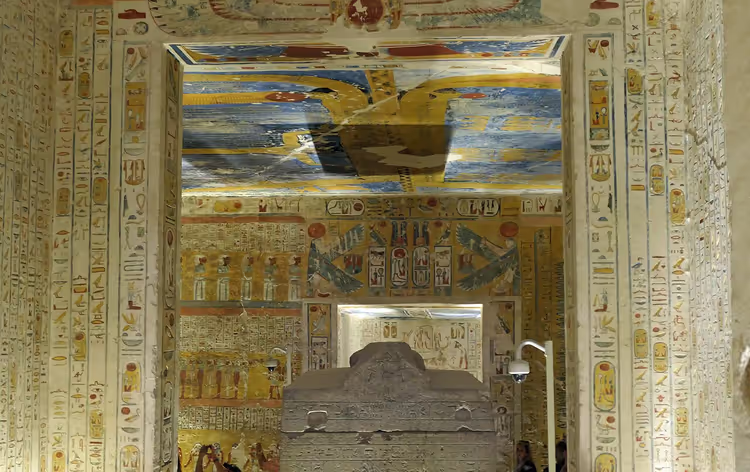
Reliefs in the tomb of Seti I.
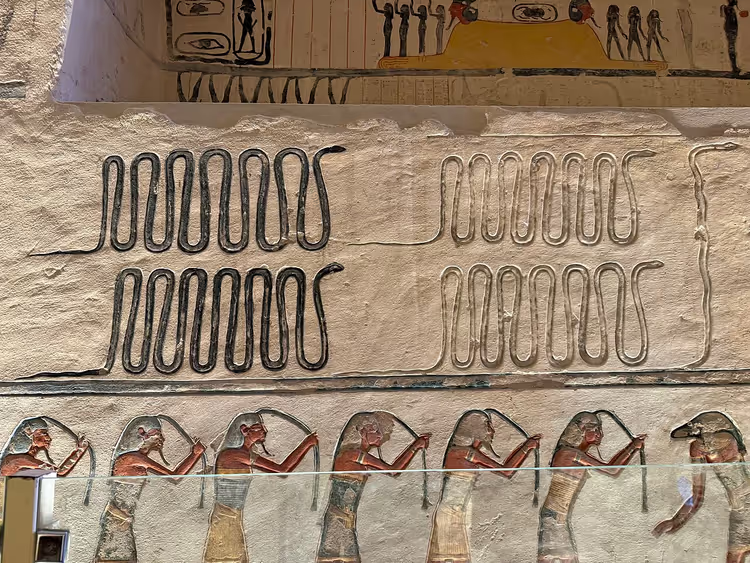
The tomb of Seti I is considered one of the most beautiful in the valley. The corridors and columned halls are covered with reliefs from top to bottom, and the huge burial chamber is decorated with scenes and an astronomical ceiling.
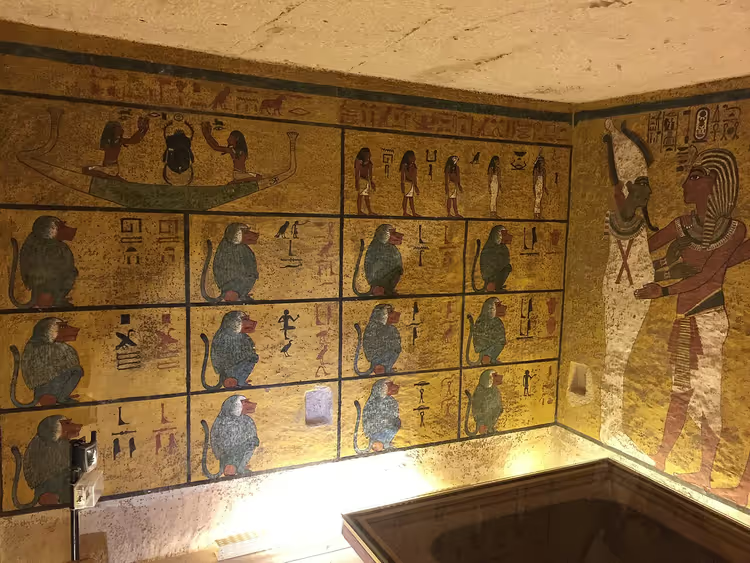
The burial chamber of Tutankhamun's tomb.
Tutankhamun's tomb is among the smallest and most modest. Its main value is the king's mummy in the burial chamber, not the paintings.
The columned hall of the tomb of Ramesses V and VI.
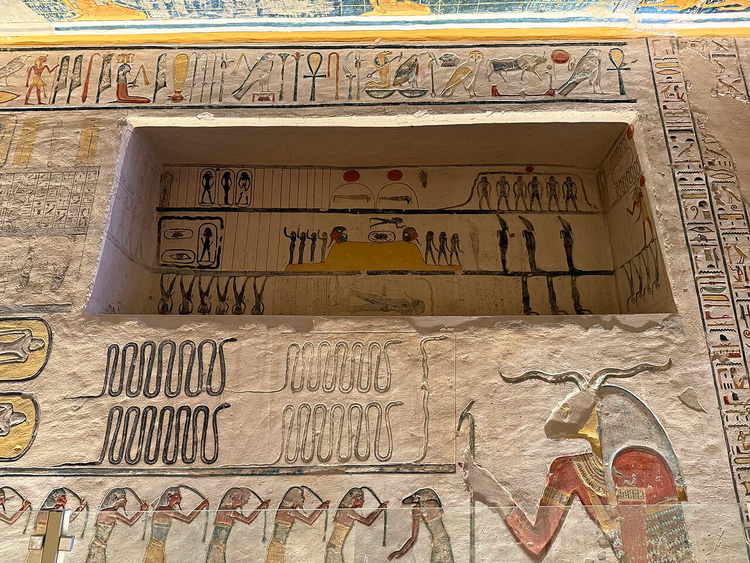
The tomb of Ramesses V and VI often becomes the highlight of the trip. The columned hall in the middle of the tomb is enormous, and the ceiling is painted with the Book of the Heavens, showing scenes of the sun disk's movement. If you are taking one of the four paid tombs, take this one or Seti I.
Remember a couple more tombs from the main list. The tomb of Ramesses III (KV11) is not inferior to its neighbors in the power of its paintings, and Tausert and Setnakht (KV14) was cut for two rulers.
You will get through the paid tombs faster than you might think. There are almost no groups there, but you will want to study the halls longer than usual. Plan your route like this: two or three tombs from the main ticket, then one paid tomb.
If you are short on time, do not take both major paid tombs in one day. The columned hall of Ramesses V and VI and the reliefs of Seti I require a calm pace, not rushing between ticket offices.
All the tombs on the list are in the East Valley. The only exception awaits you below.
The tomb of Ay in the West Valley
Besides the eastern part, the Valley of the Kings has a western section. Several tombs have been excavated there, but only the tomb of Ay (KV23) is open to visitors.
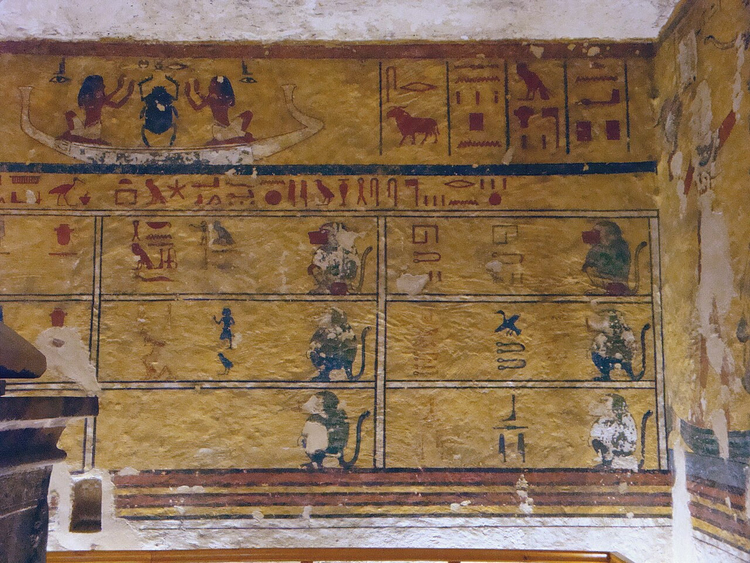 © kairoinfo4u: Mutnedjmet · CC BY-SAPhoto: kairoinfo4u: Mutnedjmet, CC BY-SA (https://creativecommons.org/licenses/by-sa/2.0), Wikimedia Commons
A ticket for it is bought separately at the visitor center and costs 200 Egyptian pounds, 100 for students (as of 2026, tomb rates).
The path to the entrance goes over the hills from the parking lot and takes more time than the visit itself. But it is almost always empty here. If you like quiet and are ready for a walk, the extra charge for Ay is worth it.
Do you need a guide in the Valley of the Kings
A guide is not mandatory, but with an Egyptologist you understand more. The site is huge, and without explanations the paintings quickly turn into a set of pictures.
Guides are not allowed inside the tombs. They do their part at the entrance: they tell the general history and point out what to look for in each tomb. After that, you go on your own and no longer have to rush after a group.
If you came mainly for photos, you do not need a guide. Take a map of the valley and follow it.
Before booking, check whether the guide speaks German or English. Complex scenes on the walls lose their meaning without translation, and a retelling of someone else's emotions is unlikely to help you.
What awaits you on site
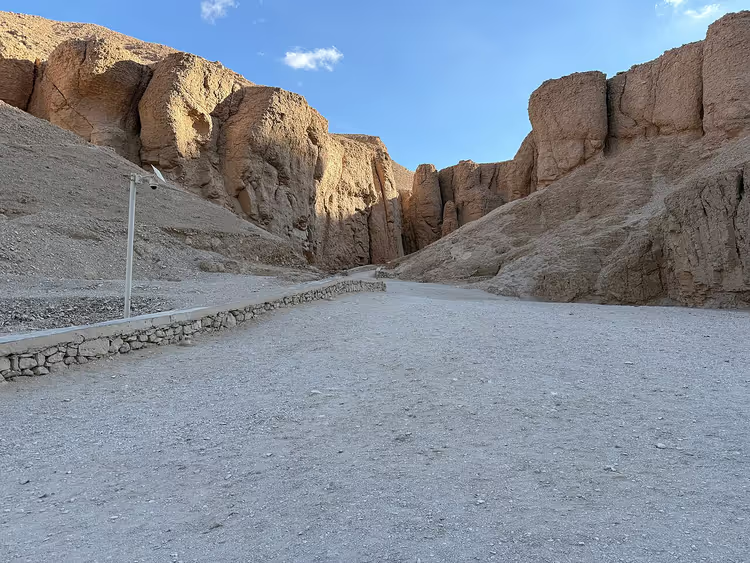
The visit starts at the visitor center. In the middle of the hall stands a large three-dimensional map of the Valley of the Kings with labels for each tomb. Look under the map: there you can see how long tunnels cut into the rock toward each tomb.
 © Chabe01 · CC BY-SAPhoto: Chabe01, CC BY-SA (https://creativecommons.org/licenses/by-sa/4.0), Wikimedia Commons
The visitor center has restrooms, and they are noticeably cleaner than the ones inside the valley itself. Use them right away, because there will be fewer facilities further on.
Then you walk through the building and exit outside. In front of you there is a road and trams that take visitors to the tombs. Turn right, toward the ticket offices for the main ticket and the tram.
Important: tickets are sold only at the visitor center. There are no ticket offices inside the valley, and if you change your mind and want to add another tomb, you will have to take the tram back to the center.
The tram takes you to the gate, where a guard checks your ticket. Past the gate there is a shaded area with benches, and to the right stands a small trailer with restrooms. From the entrance to the farthest tomb is about a ten-minute walk.
View of the Valley of the Kings from the cafe terrace.
If you are going without a guide, take a photo of the valley map. These boards are placed in several spots, and with a photo you can quickly find the tombs you need. With a guide it is easier: they will point you toward your tombs.
Each tomb has a sign with its name and a plan of the interior rooms. Check it so you do not miss the main chamber.
At the entrance, an attendant checks your ticket and punches a hole in it. After the third hole your main ticket is used up: you have seen three tombs.
Wall paintings in the tomb of Ramesses IV.
From the corridor you enter a large chamber. Some corridors are long and fully covered with paintings, others are almost bare. You go down steps, so the way back is always uphill.
Inside the tombs it is hot, and the deeper you go, the warmer the air becomes. Even in December some chambers remain stuffy, so bring water.
Choose comfortable shoes. Between tombs you walk on rocky paths and climb uphill, and inside you descend steps. Thin-soled sandals are not the best choice here.
There is no transport between tombs. The tram only runs from the visitor center and back, and inside the valley you get around on foot.
Visit nearby tombs one after another so you do not have to walk back across the whole valley. The ticket is not tied to a time, so you can enter in any order.
Groups arrive at the popular tombs included in the main ticket in waves. Wait out the crowd at a neighboring tomb and come back when it is less busy.
Keep small Egyptian pounds for tips. Attendants help with photos and show side rooms, and it is customary to leave a small amount for this.
Attendants walk through the halls and keep order. Sometimes they offer to take your photo or show a side room. It is customary to give a small tip for this service. If you do not need a photo, say "la shukran," which means "no, thank you."
Quiet inside is maintained deliberately. Loud groups are asked to speak more quietly, so in the far halls you are often alone with the paintings.
Lines only form at the popular tombs included in the main ticket. At the tomb of Ramesses IX we stood for about ten minutes. The extra-fee tombs are almost empty.
Viewing one tomb takes about ten minutes. In Seti I and at Ramesses V and VI we stayed longer: there you want to examine every wall.
When you finish, walk back to the entrance and take the tram to the visitor center. On the way out you pass through a large souvenir shop. Vendors can be pushy, just keep walking and repeat "la shukran."
You already paid for the return tram at the ticket office, so there is no separate charge.
Do not rush to the parking lot. At the entrance there is a shaded area with benches where you can rest after the climbs and finish your water.
How much time you need for the visit
If you want to quickly see three tombs and take a few photos, an hour or an hour and a half is enough. You will have to keep moving without stops.
For a relaxed visit with a guide, allow two hours. That is enough for three tombs and a break in the shade.
With three additional tombs, meaning six tombs total, the visit stretches to three hours. Plus the drive from Luxor and back.
 © Chabe01 · CC BY-SAPhoto: Chabe01, CC BY-SA (https://creativecommons.org/licenses/by-sa/4.0), Wikimedia Commons
Chamber in the tomb of Ramesses V and VI.
If you are traveling with children, plan the short option. Long climbs and heat tire them out faster than the halls themselves.
Leave extra time and do not schedule a second excursion right after the valley. Lines at the ticket office, security checks, and climbs can easily shift your schedule by half an hour. If you are on a short trip, it is better to make the Valley of the Kings the only major stop for that day.
When is the best time to visit the Valley of the Kings
Opening hours
The Valley of the Kings is open from 6:00 to 17:00, the same in summer and winter (as of 2026, opening hours). The last groups enter one hour before closing.
Crowds
The heaviest flow comes in the middle of the day, roughly from ten to two. At that time groups stand one after another at the popular tombs.
Arrive at opening, at six in the morning, and you will get through the included tombs almost without a line. The last two hours before closing are also calm.
The order of viewing also helps. Take the tombs from the main ticket first, and leave the extra-fee ones for the end. That way you spread out the crowds and finish your visit with the strongest halls.
Season
In winter the days are cooler, and the climbs between tombs feel easier. In summer the valley is extremely hot, and without water and a hat you risk running out of energy by noon.
The difference is felt inside the tombs too. In the cool season the stone chambers breathe easier, while at the height of summer the air there feels heavy.
 © Marc Ryckaert · CC BY-SAPhoto: Marc Ryckaert, CC BY-SA (https://creativecommons.org/licenses/by-sa/4.0), Wikimedia Commons
Ceiling painting in the tomb of Seti I.
What to bring and how to pay
Tickets in the valley are paid for by card, cash is no longer accepted here. Still, keep a small amount in Egyptian pounds on you: it will come in handy for small purchases and tips for attendants.
Bring water and sunscreen. Between tombs you walk a lot in the open sun, and without protection you tire quickly.
The nearest restroom is at the entrance next to the tram stop. From the far tombs it is a five to ten minute walk, so plan ahead.
Buy all tickets at once at the visitor center. There are no ticket offices inside the valley, and for an additional ticket you will have to go back by tram.
Bring a hat. The only shade in the valley is under the canopy at the entrance, and between tombs you walk in the open sun.
Leave extra time for travel. An hour and a half in the valley plus about forty-five minutes each way is already half a day.
Buy tickets for additional tombs on site: you are unlikely to decide in advance how many halls you can manage in one visit.
⁉️🤔 Frequently asked questions
Can you buy a ticket to the Valley of the Kings on site?
Yes. Tickets are sold at the visitor center at the valley entrance, and online sales go through the ticket sales website. The main ticket costs 750 Egyptian pounds, 375 for students, the tram is 20 pounds (as of: 2026). Arrive at opening time: by ten in the morning the line at the ticket office grows.
Do you need to buy a ticket in advance?
No, the main ticket is sold on site on the day of your visit. Only guided tours are booked in advance, because there are fewer available spots in the morning. In high season, arrive at opening time: ticket offices open early in the morning, and the line already grows by ten o'clock.
How many tombs are included in the main ticket?
Three. The ticket includes ten tombs to choose from, but the attendant punches only three holes. If you want more, buy each additional entry separately: from 200 pounds for the tomb of Ay to 2,000 pounds for Seti I (as of: 2026, portal data).
Is it worth paying extra for the tomb of Seti I?
Yes, if your budget allows. Seti I costs 2,000 Egyptian pounds, there are no discounts, but it is one of the most beautiful tombs in the valley. The corridors are covered with reliefs, and the burial chamber is painted with astronomical scenes (as of: 2026, Seti I tomb prices). There are almost no tour groups here.
Can you take photos inside the tombs?
Yes. A separate photo pass is no longer sold, and visitors freely shoot with regular cameras, including DSLRs (as of: 2026, photography terms). Do not use flash and do not bring a tripod. Attendants sometimes offer to take a photo of you themselves.
How much time do you need for the Valley of the Kings?
Allow one and a half to two hours for three tombs from the main ticket. With three additional tombs, the visit takes about three hours. Add the trip from Luxor and back, which is about another hour and a half, so it is better to leave in the morning.
In short: what to book
The Valley of the Kings operates on a single ticket, but you choose three tombs out of ten yourself. If you are short on time, pick Ramesses IV, Tausert and Setnakht, and Ramesses IX. If you are willing to pay extra, Seti I offers the most striking paintings, and Ramesses V and VI has the largest hall. For quiet, head to the tomb of Ay in the West Valley.
Buy tickets at the visitor center at the entrance, look for guided tours on GetYourGuide, and find accommodation in Luxor hotels on Trip.com.

A small editorial team writing guides for independent travel. We travel ourselves, but we haven’t been everywhere, so we check prices, opening hours and how to get there against official sources.