
















Where to stay in Venice: districts, hotels and how to save on lodging
Venice hits your wallet before breakfast. Accommodation here costs more than in most cities in Italy, especially in the historic part near St. Mark's Square. Good, reasonably priced options get booked months in advance.
It's not just about price. First you decide where exactly to stay. In the very center, near the beach on Lido, on the quiet lagoon islands, or on the mainland in Mestre. Your budget depends on this. And so does how much time you'll spend on the water.
The range is huge. In the center, a double room is rarely cheap. On the mainland you pay several times less for the same night, but you still have to get to St. Mark's. The trip from the mainland takes about fifteen minutes by tram.
Below we break down accommodation by area. What makes each one convenient, who it suits, and which hotels to look at first. We'll start with general rules, then go through the neighborhoods and islands.
Ad: this article contains affiliate links, we earn a commission if you book through them, at no extra cost to you.
General tips for accommodation in Venice
💡 In short:
- The historic center gives you all the postcard views of Venice, but also the highest prices.
- Want to save: look at Cannaregio and Castello in the center, Lido near the beach, or Mestre on the mainland.
- Water transport is expensive. Budget for it the same way you budget for the hotel.
- A car can't enter the center. Parking is only on the west side of the island or in Mestre.
- Transport and pass prices: 09/2026, verified on the City of Venice website.
A seagull on the waterfront in Venice
There's no denying it: accommodation in the historic center is expensive. The city is small, there are a lot of tourists, and hotels take advantage of that. Demand pushes prices up all year round, and most of all in summer.
Before you look at options, decide what you need in a room. A kitchenette will help you avoid eating out three times a day. In Venice, that saves a noticeable amount on food. Air conditioning in summer is also not a luxury, it's a necessity.
It helps when a vaporetto stop is nearby. That way you get into the city faster and don't drag yourself on foot with a suitcase across bridges. A canal view from the window is nice, but you pay extra for it. If you're arriving by car, check parking in advance. There is none in the center at all; cars are left in a garage on the west side of the island or in Mestre.
Now about transport costs. A single vaporetto ride costs €9.50 (as of 09/2026, official Venice portal). That's expensive for city transport. If you stay outside the center and ride often, a cheap hotel quickly loses its advantage.
A pass helps. A 24-hour ticket costs €25, 48 hours €35, 72 hours €45, a weekly pass €65 (as of 09/2026, city transport page). The clock starts from the first validation, not from midnight. Get a pass that matches your dates, not "just in case."
Also remember the tourist tax. It's charged per person per night, for a maximum of five consecutive nights. The amount depends on the accommodation category, and it's added to the bill at check-in. Ask about it when booking so the total doesn't surprise you.
Don't confuse this tax with the entry fee. Since 2024, Venice charges a separate fee for day-trippers (Contributo di Accesso). If you're staying overnight in the city, it doesn't apply to you. Hotel guests pay the accommodation tax instead. So when calculating your budget, keep three expense items in mind: the accommodation itself, the accommodation tax, and water transport.
Also plan your route from the airport in advance. From Marco Polo, buses go to Piazzale Roma and boats go by water; from Treviso there are only buses. If you're staying in Mestre, getting there from the airport is often faster and cheaper than reaching the islands. That's another argument in favor of the mainland for a short trip.
And the last rule is simple: book early. The best and relatively affordable options in the center get taken months in advance, especially for spring and autumn. The later you act, the less choice and the higher the price. In summer, heat and peak tourist crowds add to this, so early booking helps twice over. If you travel in high season without a reservation, be ready to fall back on the islands or the mainland.
The main decision is made in advance: where to stay. Below we break down the pros and cons of the center, the neighboring lagoon islands (Lido, Giudecca, Murano), and mainland Mestre. Choose the area to match your travel style, not the other way around.
Accommodation in the historic center of Venice
 © This Photo was taken by Wolfgang Moroder . Feel free to use my photos, but please mention me as the author and send me a · CC BY-SAPhoto: This Photo was taken by Wolfgang Moroder . Feel free to use my photos, but please mention me as the author and send me a, CC BY-SA (https://creativecommons.org/licenses/by-sa/3.0), Wikimedia Commons
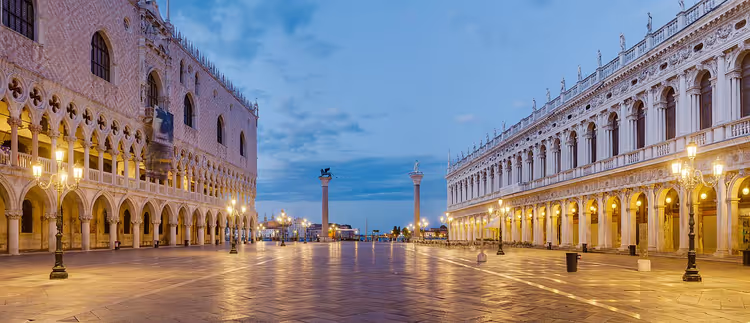
Crowds of tourists in St. Mark's Square during the day
If you can afford it, stay in the historic center. Here you get exactly the Venice people come for: canals, bridges, palazzos, and St. Mark's Square steps from your hotel. The center lies in the middle of the lagoon, and the main sights are within easy reach.
The neighborhoods here are called not districts but "sixths" (sestieri). There are exactly six: San Marco, San Polo, Santa Croce, Dorsoduro, Cannaregio, and Castello. They differ noticeably in price and in how many tourists there are.
- Who it's for: those coming for a couple of days who want all the main sights right outside their window.
- Not for: those looking for quiet or saving every euro.
- The catch: the highest prices in the city, crowds at the main sights, and rooms often booked up in advance. You can't bring a car here: the center is pedestrian-only, with no parking.
Next we'll go through all six sestieri, from the busiest to the quiet ones.
San Marco: in the heart of the city
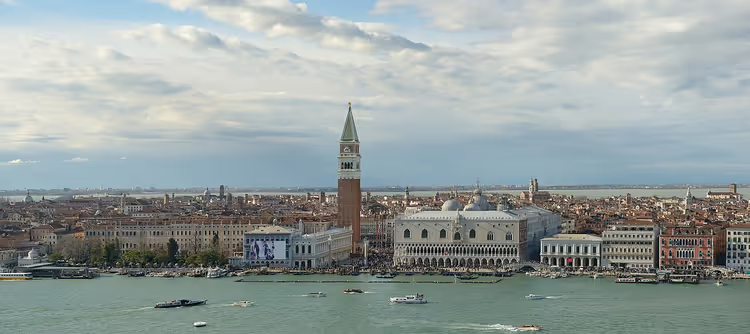
Rooftops of San Marco and the cathedral bell tower
In the center of San Marco stands the square of the same name with St. Mark's Basilica and the Doge's Palace. Because of this, the district holds first place for tourist numbers in the entire city. On the other hand, the main sights are literally outside your door, which is convenient for a short trip.
The premium location is reflected in the prices. Cheap rooms are almost nonexistent, and options start appearing in the mid-range segment. But highly rated places here come in every style.
Staying in San Marco is worth it to save time. From your hotel you can walk to the basilica, the Doge's Palace, and the Rialto Bridge in minutes. If you only have a day or two, that proximity matters more than the extra cost. But don't come here for peace and quiet: the square is always crowded during the day.
In the most affordable segment, San Marco Experience Guest House* sits 200 meters from the square, with doubles with shared bathrooms and beds in a female dorm.
Hotel Orion, a solid two-star option with good ratings, from which you can walk to both the square and the Rialto Bridge in a few minutes.
40.17 SAN MARCO, a guesthouse on a canal between the square and the Rialto, in a picturesque spot.
Hotel Montecarlo is 100 meters from the square and has thousands of excellent reviews.
Ai Cherubini holds one of the best ratings in the city and is an above-average option in price.
The catch: this is the most expensive and most crowded part of Venice.
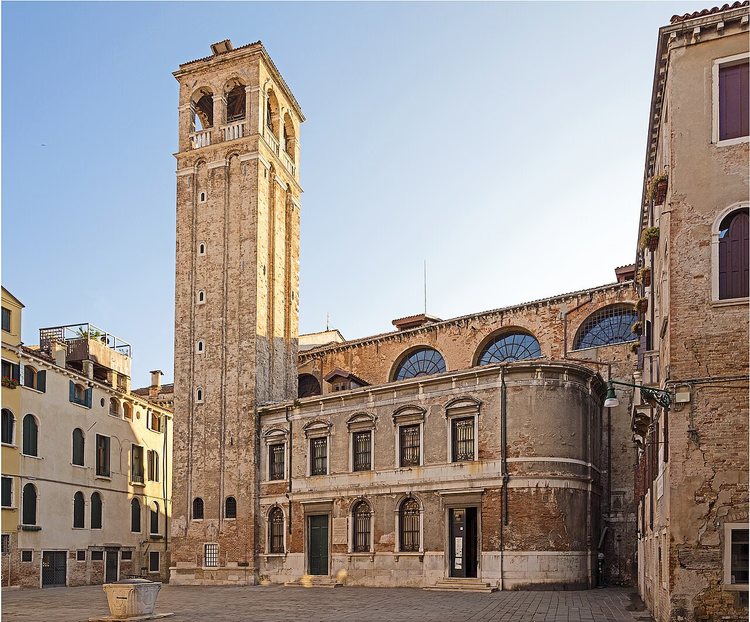
San Polo: near the Rialto
 © Didier Descouens · CC BY-SAPhoto: Didier Descouens, CC BY-SA (https://creativecommons.org/licenses/by-sa/4.0), Wikimedia Commons
Narrow streets of the San Polo district
San Polo lies just west of San Marco, and there are almost as many people here. The Rialto Bridge connects the two sestieri. They're close in price, but San Polo has one advantage: getting to the train station and Piazzale Roma is faster.
This is convenient if you're arriving and departing by train. You won't have to drag your suitcase across bridges for long. At the same time, the main sights at the Rialto and San Marco are a stone's throw away. A good compromise between a central location and logistics.
The cheapest option is San Polo Star, a guesthouse closer to the station with solid double rooms.
Mario Apartment 3 is roughly between the station and St. Mark's Square and has a kitchenette. Cooking lets you save money instead of relying on expensive restaurants.
Rialto Suite 707, a newly renovated room less than two minutes from the Rialto.
Residenza Corte Molin* is set in a historic 14th-century house with very high guest ratings.
The catch: the central part of San Polo is just as crowded as San Marco.
Santa Croce: convenient for short trips
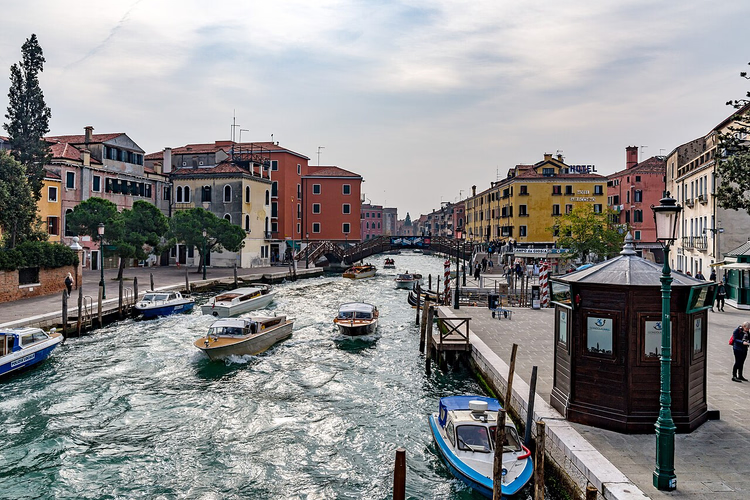
Santa Croce lies to the west and north of San Polo. From here it's close to the train station and to Piazzale Roma with its bus terminal and parking garages. It's a strategically convenient location.
 © joergens.mi · CC BY-SAPhoto: joergens.mi, CC BY-SA (https://creativecommons.org/licenses/by-sa/3.0), Wikimedia Commons
The neighborhood is good for short visits. You get from the station to your hotel quickly, and from there you're just as quick to reach the main sights. If you arrive by bus or leave your car in a garage at Piazzale Roma, Santa Croce is often the most convenient starting point.
The crowds right at the square are smaller here than in San Marco or San Polo. There are also fewer atmospheric postcard views, but you save time traveling in both directions.
Casa Burchielle* is conveniently located, close to Piazzale Roma and the train station.
B&B Da Nina Venice is also near Piazzale Roma. One of the rooms has a small terrace.
Dimora Al Doge Beato maintains high ratings, and the windows overlook one of the picturesque canals.
The catch: the neighborhood itself isn't the most atmospheric; people choose it for logistics.
Dorsoduro: quieter to the west
 © Didier Descouens · CC BY-SAPhoto: Didier Descouens, CC BY-SA (https://creativecommons.org/licenses/by-sa/4.0), Wikimedia Commons
Basilica di Santa Maria della Salute on the edge of Dorsoduro
Eastern Dorsoduro lies close to the main sights. The western part of the neighborhood is quieter: here it's easier to see the real Venice without the crowds on tourist routes.
The eastern edge is marked by the Basilica di Santa Maria della Salute right at the water. From here it's close to the museums and to the crossings into the center. The western part is quieter and, as a rule, cheaper. These slightly more remote corners are exactly what helps you experience the city without the crush.
Hotel Tiziano, a well-kept three-star option in the western part, away from the crowds.
Locanda Gaffaro is located not far from Piazzale Roma. Prices are sometimes gentle for Venice, and there's access to a small garden.
Modern, stylishly furnished rooms are offered by B&B Venetian Experience* with excellent reviews in a convenient location.
The catch: the eastern part near the sights is crowded; look for quiet further west.
Cannaregio: the best choice for budget travelers
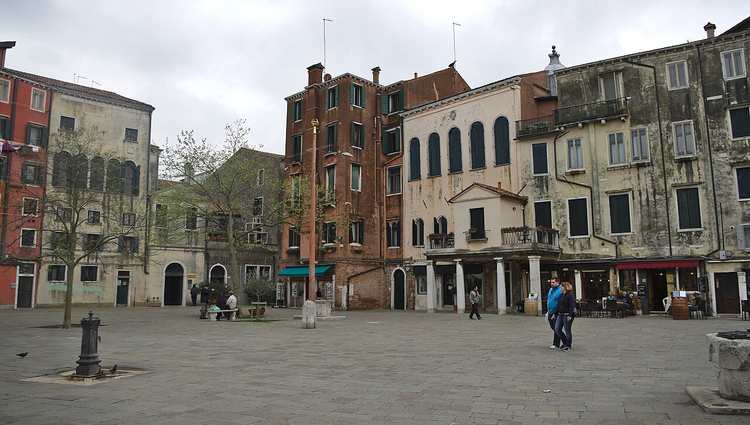
In the northern part of Cannaregio you'll find a genuinely lively neighborhood without big crowds. Few buildings here have been turned into second homes, so there are plenty of bars and restaurants for locals, not just for tourists.
 © Clément Bucco-Lechat · CC BY-SAPhoto: Clément Bucco-Lechat, CC BY-SA (https://creativecommons.org/licenses/by-sa/3.0), Wikimedia Commons
There are noticeably more decent options in the lower price segment here. Cannaregio suits you if you're watching your budget and don't want to stay in the thick of things.
The neighborhood has preserved its historic Jewish quarter, and in the evenings the local bars are filled mostly with Venetians. During the day you can walk from here to the train station and to San Marco in a matter of minutes, and in the evening you return to quiet alleys. That combination is rare in the center.
Hotel Casa Boccassini*, a small hotel with a charming inner courtyard and some of the lowest double-room prices in the old city.
Hotel Vecellio Venice Lagoon View offers similarly affordable doubles at a vaporetto stop in the non-touristy north. Some rooms have lagoon views.
Ca' Pozzo Inn maintains clean, modern rooms with a good price-to-quality ratio, roughly halfway between the train station and the Jewish quarter.
The catch: the busiest squares are a longer walk than from San Marco.
Castello: the quiet east of the island
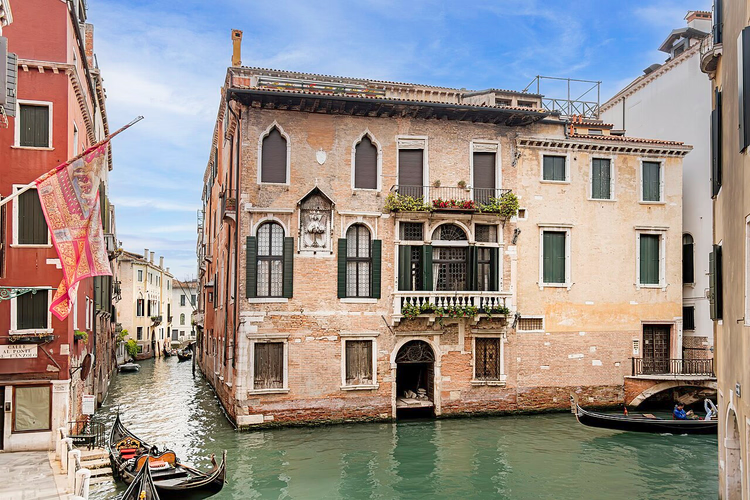
Quiet waterfront in the Castello neighborhood
 © Didier Descouens · CC BY-SAPhoto: Didier Descouens, CC BY-SA (https://creativecommons.org/licenses/by-sa/4.0), Wikimedia Commons
Castello is the beautiful eastern edge of the main island, where few tourists venture. An excellent place to experience the city without the crush. At the same time, you can walk to Piazza San Marco from here quickly.
It's especially quiet near the Giardini della Biennale park. By the way, these gardens offer one of the best views of the sunset over the lagoon. Come here in the evening and there won't be any crowds.
All of Castello lives more calmly than the central sestieri. Here it's easier to see the city's everyday life and catch Venetians going about their ordinary business. At the same time, you can reach the main sights on foot, without any crossings.
Locanda SS. Giovanni e Paolo is located in eastern Castello, not far from San Marco, and offers a lot for little money.
La Locandiera, a cozy old-style guesthouse, a few minutes' walk from the square.
Residenza Ca' Malipiero* is set in a historic palazzo, and some rooms overlook Campo Santa Maria Formosa.
The catch: the eastern edge of the island takes longer to reach, but there are also fewer people.
Staying on other lagoon islands: Lido, Giudecca, and Murano
The neighboring islands come to the rescue, especially in high season when everything in the center is booked. Each has its own character. Let's look at Lido, Giudecca, and Murano one by one.
Lido: beach and lower prices
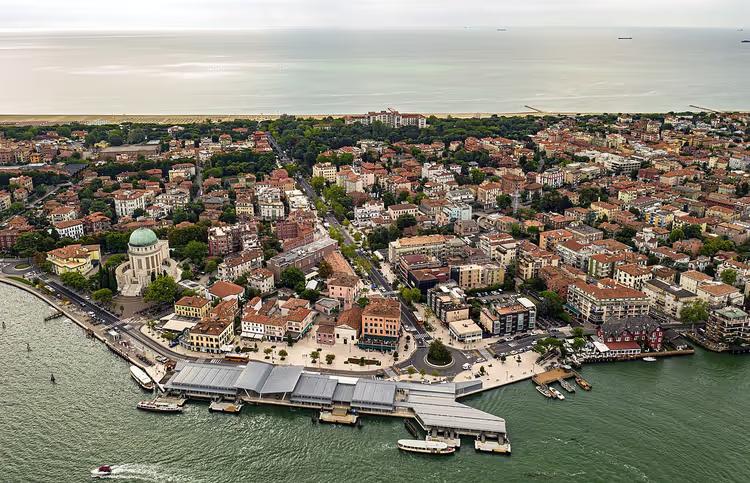 © Kasa Fue · CC BY-SAPhoto: Kasa Fue, CC BY-SA (https://creativecommons.org/licenses/by-sa/4.0), Wikimedia Commons
Wide sandy beach on the island of Lido
Lido is a long island to the southeast of the center, one of the most popular with visitors to the city. The reason is clear: there's a big beach here. The island is also known from Thomas Mann's novella "Death in Venice."
- Who it's for: those who want to combine the city with a beach vacation, and those traveling by car.
- Not for: those who care about the atmosphere of canals and gondolas.
- The catch: you need to take a vaporetto to reach the main sights, and in summer the boats are packed. The trip to San Marco takes about 15 minutes.
The beach stretches for several kilometers, and in summer half the city heads here. Unlike the center, cars are allowed on Lido. So parking and arriving by car are both easier here.
There are noticeably more affordable options here than in the center. Lido doesn't have the atmosphere of canals and gondolas, but it does have the sea right at hand. For a trip where you want to combine the city with the beach, this is a good option.
- Hotel Villa Tiziana, a simple three-star hotel with some of the most affordable doubles in all of Venice.
- Hotel La Pergola di Venezia keeps rooms at a similar price.
- Hotel Atlanta Augustus is located at a vaporetto stop, slightly away from the crowds, but the beach is close from here.
- Villa Venice Movie is located by a canal not far from the beach. Guests get free bicycles.
- Hotel Villa delle Palme*, a pleasant three-star hotel in a convenient location. It has a viewing terrace with a view of Venice.
Giudecca: quiet and close to San Marco
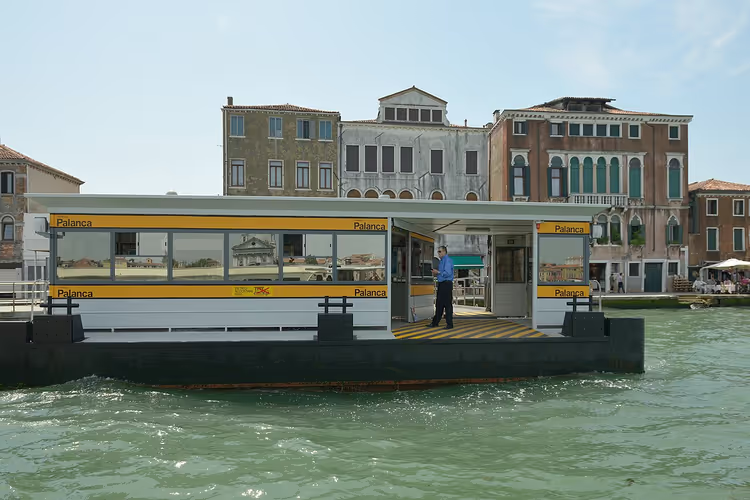 © This Photo was taken by Wolfgang Moroder . Feel free to use my photos, but please mention me as the author and send me a · CC BY-SAPhoto: This Photo was taken by Wolfgang Moroder . Feel free to use my photos, but please mention me as the author and send me a, CC BY-SA (https://creativecommons.org/licenses/by-sa/3.0), Wikimedia Commons
Giudecca island waterfront with a view of the city
Giudecca is a narrow island just south of Piazza San Marco, a few minutes away by vaporetto. Tourists hardly ever make it here. The result is a rare combination: the center is close, yet everything around is quiet.
- Who it's for: those who want peace and quiet while still being a quick ride from the main sights.
- Not for: those who like having a choice of cafes and restaurants right outside their door.
- The catch: the island is small, there are few places to eat or drink, and you still need to cross the water to reach the main island.
The Giudecca waterfront offers an excellent view toward San Marco. Even on Saturdays there are no crowds here, which is rare for Venice. Lodging options are limited, but they are good.
- Venice Home sits on Giudecca's lovely waterfront and has over a hundred excellent reviews.
- Blue Lagoon offers new, stylish apartments with a kitchenette for self-catering.
- It's convenient to browse all Giudecca lodging on Trip.com as a single list, there aren't many options.
Murano: canals and glass
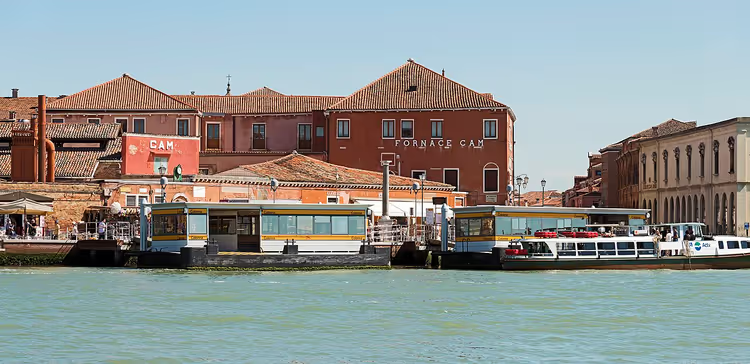 © Didier Descouens · CC BY-SAPhoto: Didier Descouens, CC BY-SA (https://creativecommons.org/licenses/by-sa/4.0), Wikimedia Commons
Canals and houses on the island of Murano
Murano is a group of islands northeast of the center, famous worldwide for glass. The glass workshops here are a favorite day-trip destination. But the island also works quite well as a place to stay.
- Who it's for: those who want the canal atmosphere without the crowds and also want to see the island of Burano.
- Not for: those who need to get to San Marco quickly.
- The catch: it takes only a few minutes by boat to the northern shore of Cannaregio, but the trip to San Marco takes about 30 minutes.
Thanks to its canals, Murano resembles the main island in places. Like the center, Murano is car-free, and that's a plus. The colorful island of Burano with its painted houses is a quick boat ride away, a popular half-day excursion.
- Casa Sulla Laguna*, rooms with water views and hundreds of excellent reviews, not far from the dock.
- Al Soffiador sits in a quiet spot near the vaporetto stop, and guests praise the staff.
- Murano SUITES Venezia offers very stylish suites with water views, with the dock almost at the door.
Overnight on the mainland: the Mestre district
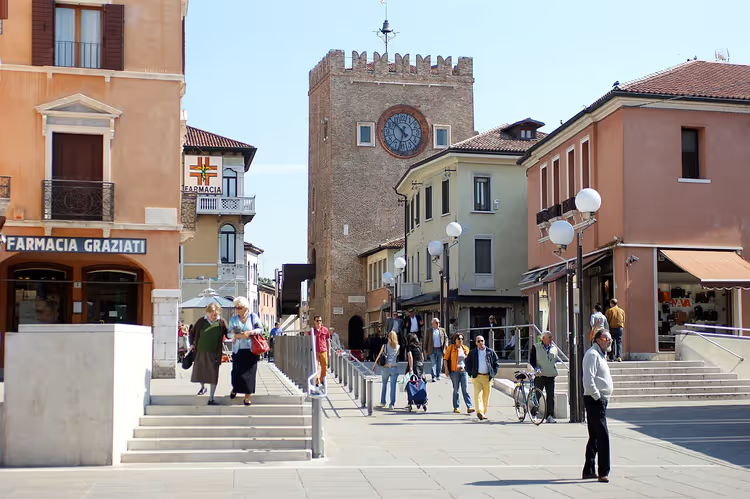 © Didier Descouens · CC BYPhoto: Didier Descouens, CC BY (https://creativecommons.org/licenses/by/4.0), Wikimedia Commons
The mainland district of Mestre and the route to the center
Venice includes not only the islands of the lagoon, but also the industrial mainland district of Mestre. It lies northwest of the center, and about 200,000 people live there. It is the most populated part of the city.
- Who it's for: those who want to save money, are driving, or are continuing through Italy by train.
- Not for: those who want to wake up in postcard Venice.
- The catch: Mestre has no atmosphere of its own, and there is a lot of industry around. To get to the island, you need a fifteen-minute tram or bus ride.
The district's advantages are substantial. There is plenty of parking, and many hotels offer their own spaces. Prices are noticeably lower than in the center, and you can find very cheap double rooms. The tram or bus to Piazzale Roma costs very little and runs quickly. Restaurants are also cheaper than near San Marco.
From here it is faster to reach Marco Polo and Treviso airports. Mestre is well connected to the rest of Italy by rail, so it is convenient to combine Venice with other cities. And if the island runs out of rooms in high season, the mainland almost always saves the day.
- ao Hotel Venezia Mestre, very cheap and clean rooms, from which you can walk to both Mestre station and the buses toward Venice in a few minutes.
- Anda Venice Hostel*, a highly rated hostel with cheap doubles and dorm beds, right next to Mestre station.
- Hotel Ca' dei Barcaroli is next to the tram toward Venice and has free parking in its inner courtyard.
- Residence Baco da Seta offers large, clean apartments with a big parking lot and a restaurant nearby, and a supermarket is also close by. The catch: it is a bit on the outskirts of central Mestre.
⁉️🤔 Frequently asked questions
Where is the cheapest place to stay in Venice?
The lowest prices are on the mainland in Mestre and on the island of Lido. In the historic center, Cannaregio and Castello are the most budget-friendly. But remember the travel costs: water transport is not cheap, and frequent crossings eat into the savings from a cheap hotel outside the center.
Should I stay in the center or is it better to go outside it?
If you are going for a couple of days and want all the main sights right outside your window: choose the center, despite the price. If you are watching your budget or looking for quiet: look at Mestre, Lido, or the quiet northern parts of Cannaregio and Castello. There is no universal answer; it all depends on your travel style.
How long does it take to get to San Marco from the islands and the mainland?
From Lido the vaporetto takes about 15 minutes, from Giudecca a few minutes, from Murano to San Marco about half an hour. From mainland Mestre, the tram or bus to Piazzale Roma takes about a quarter of an hour. After that you walk through the center.
Do I need a vaporetto pass?
Often yes. A single ticket costs €9.50, a 24-hour pass €25, and a 72-hour pass €45 (as of 09/2026, City of Venice portal). If you are staying outside the center and traveling several times a day, a pass for your dates is almost always cheaper than individual tickets.
Can I drive into the center?
No. The historic center is pedestrian-only, and there is no parking there. Cars are left in the garage on the west side of the island at Piazzale Roma or in Mestre. On Lido and in Mestre parking is easier, and cars are allowed there.
Have you decided on a district? It is convenient to compare current prices and availability across all of Venice in one place.
Find hotels in Venice
Compare prices across booking sites and filter for rooms with free cancellation.
Compare prices on Trip.comThe widget loads once you give your consent.
In short: what to book
Choosing in Venice comes down to one question: what matters more to you, proximity to the sights or saving money. The center costs more, but it saves you time and water crossings. The islands and the mainland are cheaper, but they add travel time. Book in advance: good options disappear months ahead.
- If you want all the main sights right outside your window: choose San Marco or San Polo.
- If you are watching your budget but do not want the mainland: look at Cannaregio, Castello, or Murano.
- If you are driving or continuing through Italy by train: choose Mestre.
- If you also want a beach: choose Lido.
Once you have decided on a district, compare hotel prices in Venice on Trip.com and book for your dates.

A small editorial team writing guides for independent travel. We travel ourselves, but we haven’t been everywhere, so we check prices, opening hours and how to get there against official sources.