
















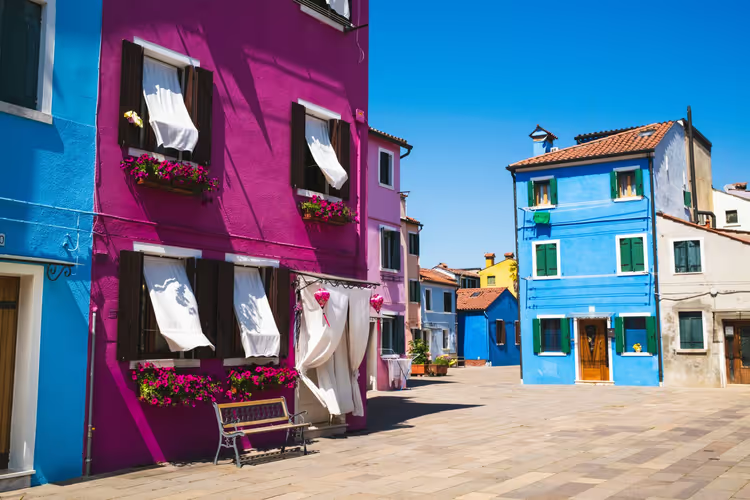
Burano in Venice: what to see and how to get there by vaporetto
Burano looks like a postcard colored in a hundred shades. But behind the bright facades lies a working island with a lace-making history and its own daily rhythm.
From Venice to Burano it's seven kilometers, and you can only get here by water. Three to four hours on the island itself will be enough.
Ad: this text contains affiliate links. We earn a commission from them, and the price for you stays the same.
Below we'll cover what to see on Burano and how to get there without unnecessary transfers.
What to see on Burano
💡 In short:
- Take vaporetto No. 12 from Venice; see the route and fares in the "Where it is and how to get there" section.
- Set aside three to four hours for the island: the lace museum, the San Martino bell tower, Piazza Galuppi.
- Book a lagoon fish lunch in advance if you're going on a weekend.
- Tickets and opening hours: 09/2026, verified on the museum's official website.
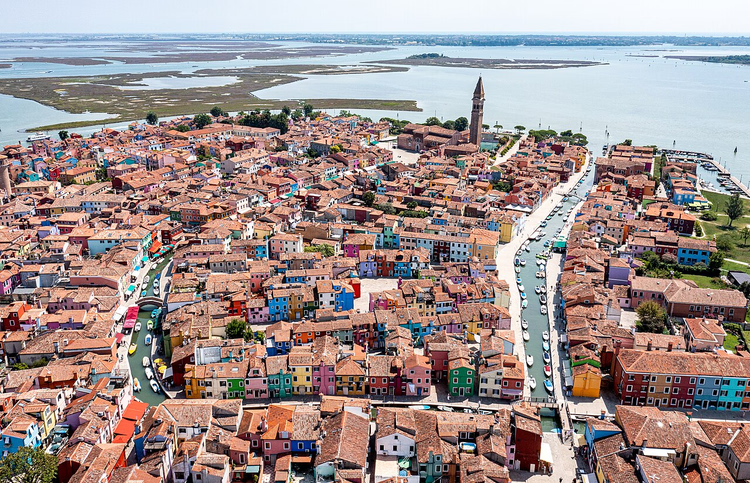
Burano is compact: from the pier to the far edge you'll walk in 15 minutes. The main sights are gathered around one square, and between them you'll find little bridges with views of the lagoon. Many people come here for half a day and stay until sunset, when the tour groups leave.
Lace museum (Museo del Merletto)
Lace made Burano famous across Europe. Local craftswomen embroidered it with a needle rather than bobbins, as in most European lace schools, and this technique is not repeated anywhere else.
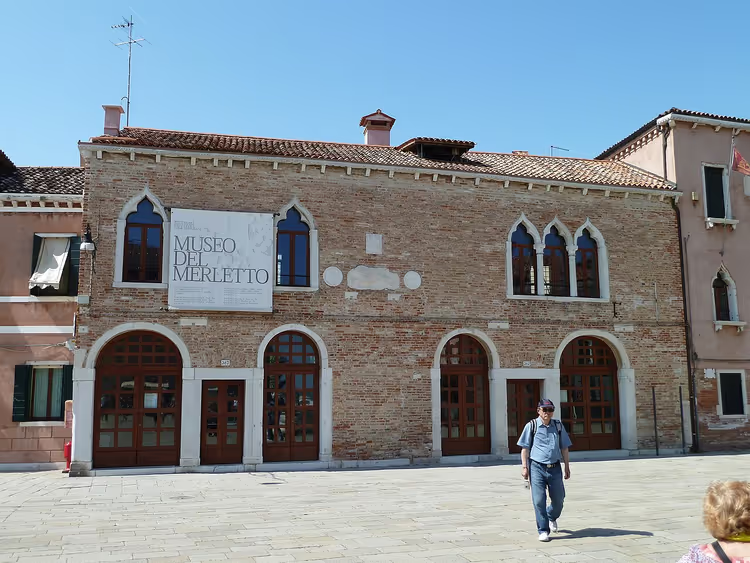 © Abxbay · CC BY-SAPhoto: Abxbay, CC BY-SA (https://creativecommons.org/licenses/by-sa/3.0), Wikimedia Commons
Museo del Merletto occupies the building of the former lace-making school on Piazza Galuppi. The school closed in 1979: young women didn't want to go into such painstaking craft. Today the museum preserves Venetian lace from the 16th to 20th centuries and shows a film about how it is made the old way.
- Admission: 7 € for adults, reduced 3.50 €; the combined "Island Museums" ticket with Murano and Torcello costs 20 € and is valid for three months (as of 09/2026, official website).
- Hours: Tuesday to Sunday 10:00-16:00, closed Monday; in summer open until 17:00 on Fridays and Saturdays (as of 09/2026, official website).
- Who it's for: those who want to understand what the island lived on before tourists.
- The catch: there are few rooms, and you'll get through them in under an hour.
San Martino bell tower
The San Martino bell tower was originally built with donations from residents. Because of ground subsidence, the tower leans from vertical by almost two meters. The work of the artist Tiepolo can be seen in the neighboring church of San Martino, not in the tower itself.
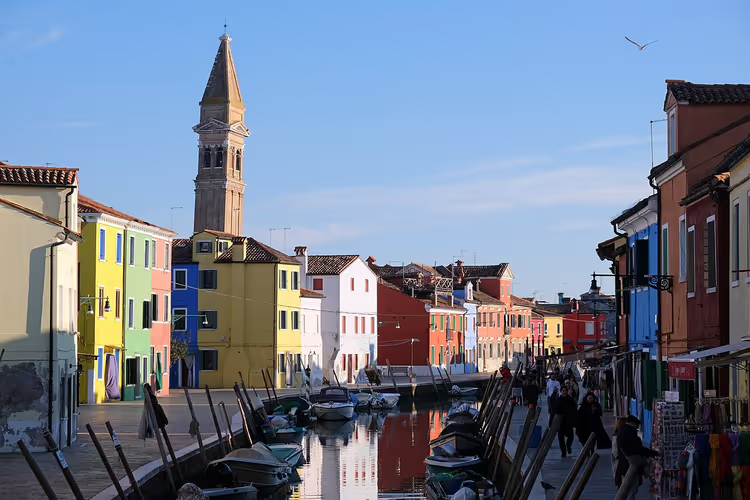 © kallerna · CC BY-SAPhoto: kallerna, CC BY-SA (https://creativecommons.org/licenses/by-sa/4.0), Wikimedia Commons
- How to get there: the tower stands on Piazza Galuppi, next to the pier.
- Cost: viewing it from outside is free.
- The catch: if you want the best angle, you'll have to wait for a free spot on the bridge.
Piazza Galuppi
The island's center bears the name Piazza Galuppi, named after the composer Baldassare Galuppi. He was born on Burano, wrote comic operas, and earned the nickname Il Buranello. His monument stands in the middle of the square, with cafes and lace shops around it.
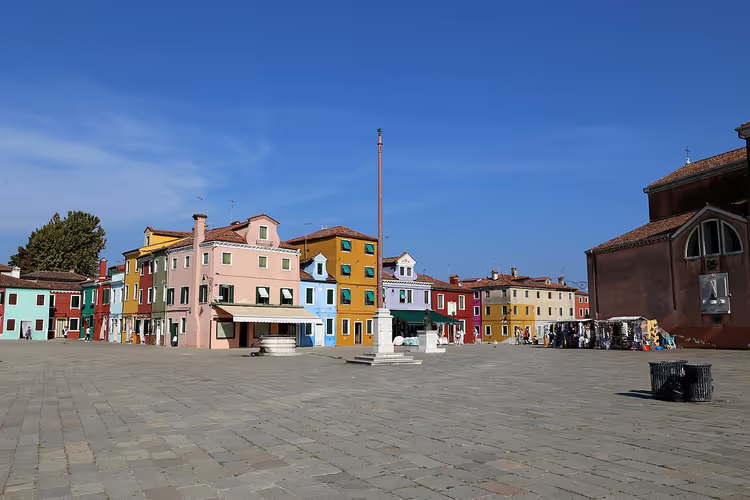 © Sailko · CC BYPhoto: Sailko, CC BY (https://creativecommons.org/licenses/by/3.0), Wikimedia Commons
- How to get there: the square starts right behind the Burano pier.
- Who it's for: those who want to take a break and watch local life.
- The catch: it's crowded here during the day; it's calmer in the morning and toward evening.
Fish restaurant Al Gatto Nero
On Burano it's worth having lunch with lagoon fish and seafood. For a full meal, Al Gatto Nero is a good choice: it's better to book a table in advance, especially on weekends.
 © Kasa Fue · CC BY-SAPhoto: Kasa Fue, CC BY-SA (https://creativecommons.org/licenses/by-sa/4.0), Wikimedia Commons
- Cost: the bill is above the Venice average, but portions are large; one hot plate is enough for two.
- Who it's for: those who want a fish lunch rather than a snack on the go.
- The catch: without a reservation in season you may end up without a table.
History and name
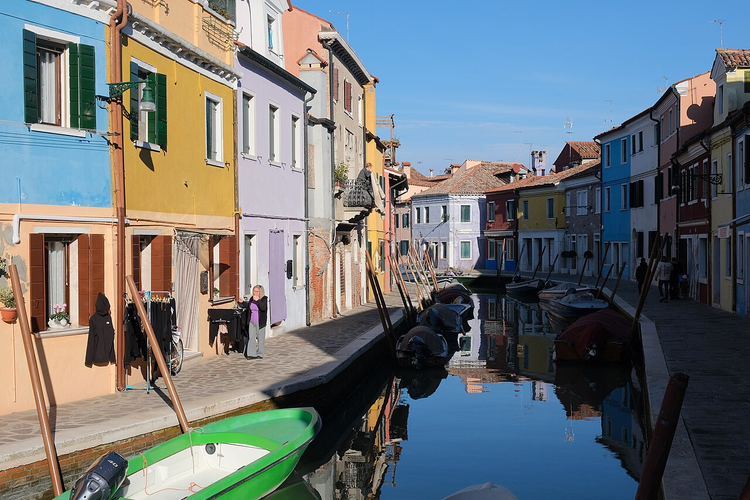
The first residents came to Burano not by choice. In the era of raids, people retreated to the most hidden corners of the Venetian Lagoon, where attackers couldn't reach them from the sea. Burano became one of those refuges.
 © kallerna · CC BY-SAPhoto: kallerna, CC BY-SA (https://creativecommons.org/licenses/by-sa/4.0), Wikimedia Commons
Where the name came from is not known for certain. Most often people mention a noble family with the surname Burano, who may have lived here. Until 1923 the island was considered a separate town, then it was incorporated into Venice as a district. Today about 2,800 people live here permanently (as of 09/2026, encyclopedia).
Burano is connected by a bridge to neighboring Mazzorbo, so it's easy to add one more lagoon stop to your route.
Why houses are painted in different colors
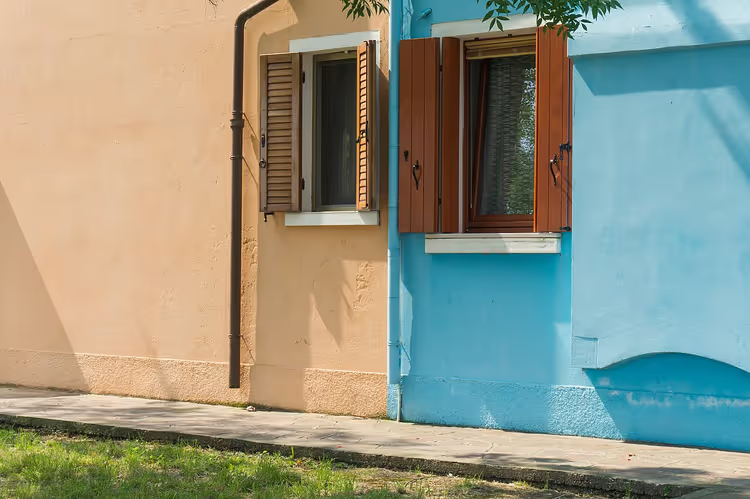
Historians don't know when the fashion for bright facades appeared on Burano. No documents survive, but there are legends that people happily retell.
 © Marco Ober · CC BY-SAPhoto: Marco Ober, CC BY-SA (https://creativecommons.org/licenses/by-sa/4.0), Wikimedia Commons
One version goes like this: a sailor would return from a voyage and stop at a tavern, and his wife would then mark his forehead with paint the color of their house, so neighbors could lead him to the right door. Another version is stricter: each family painted its houses in one color and thus distinguished its own from outsiders.
Today the tradition is upheld by law. You can't repaint a house, shutters, roof, or door without approval from the administration. It's precisely for the bright walls that tourists come to Burano from all over the world.
Where it is and how to get there
Burano sits in the northern part of the Venetian Lagoon, between Murano and Torcello. There is no land route from Venice, so the only way to reach the island is by water.
Route No. 12 runs from the Fondamenta Nuove pier in central Venice. The trip takes about 45 minutes, and it's better to plan the ride for the morning. A single vaporetto ticket costs 9.50 € and is valid for 75 minutes; a 24-hour pass costs 25 € (as of 09/2026, ACTV fares).
Tickets are sold on shore and from the conductor, and the price is the same. If you buy a ticket on shore, be sure to tap it at the validator, otherwise you'll be fined: fines for fare evasion in Venice are high. Before boarding, check the display board; it will tell you the right route, otherwise you can easily end up on the wrong island.
Tickets and opening hours
There is one paid attraction on Burano: Museo del Merletto. The museum's prices and opening hours are listed in its section above.
Transport is paid separately. ACTV fares are given in the "Where it is and how to get there" section.
Tours and tickets in Burano
Guided tours, skip-the-line tickets and activities — most offers can be cancelled free of charge.
See offers on GetYourGuideThe widget loads once you give your consent.
Burano island on the map
Burano stretches along a canal, and on the map you can clearly see how the neighborhoods converge on Piazza Galuppi. Open the map to sketch out your route from the pier.
⁉️🤔 Frequently asked questions
How much time do you need on Burano?
Set aside three to four hours for the island itself, not counting travel. The island itself can be walked in an hour, another hour goes to the lace museum and photos, and the rest to lunch. If you want to see the island without tour groups, arrive when the lace museum opens at 10:00 or after 16:00.
How do you get to Burano from Venice?
Vaporetto No. 12 runs from the Fondamenta Nuove pier. Travel time and ACTV fares are in the "Where it is and how to get there" section. Board vaporetto number 12 and check the final destination on the display board so you don't end up on another island.
How much does admission to the lace museum cost?
Ticket prices for Museo del Merletto are listed in the museum section above. The museum is small, but the collection of 16th to 20th century lace is densely packed, and its technique shows why Burano lace can't be confused with others.
When should you go to avoid the crowds?
Morning and evening. Arrive when the lace museum opens at 10:00, and the bridges and square will be almost empty. After 16:00 the tour groups leave, and the light on the walls becomes softer. At midday in season, Piazza Galuppi is crowded.
What else is worth seeing nearby?
Burano is connected by a bridge to Mazzorbo, where there are vineyards and almost no tourists. On the way from Venice, vaporetto No. 12 passes Murano with its Museo del Vetro, and a separate route runs from Burano to Torcello. Two islands will take you a full day.
In short: what's worth booking
If you have half a day in Venice, Burano is worth carving out separately. Plan around your own scenario:
- want the lagoon without crowds: take the morning vaporetto No. 12 and get off on Burano before the tour groups;
- interested in craft: add Museo del Merletto and its film about lace;
- planning lunch: book a table on Burano in advance; on weekends there are almost no free spots.

A small editorial team writing guides for independent travel. We travel ourselves, but we haven’t been everywhere, so we check prices, opening hours and how to get there against official sources.