
















Where tourists overpay in Vienna: 12 typical mistakes
Vienna looks like a simple city. The metro runs without turnstiles, signs are easy to understand, and cafe prices seem comparable to Berlin. That is exactly why a first visit often costs more than you planned: all the mistakes hide in small details you cannot see in a guidebook.
As of January 1, 2026, the fine for riding without a ticket in Vienna is 135 € if you pay on the spot (as of 09/2026, Wiener Linien fares and rules). A single-ride ticket costs 3.20 € on paper and 3.00 € in the app. Below we break down 12 mistakes that almost everyone makes on their first visit to Vienna, and we show the price of each one.
Ad: this article contains affiliate links, we earn a commission if you book through them, at no extra cost to you.
1. Riding the metro without a ticket
💡 In short:
- Buy your ticket in the Wiener Linien app: it is cheaper than paper and does not require validation.
- Check your airport transfer the day before departure, because construction has changed the CAT and S-Bahn train routes.
- Book your Schönbrunn entry time in advance, and save Sunday for museums.
- Fares and fines: 09/2026, verified on the official Wiener Linien website
The Vienna metro has no turnstiles, and you walk onto the platform freely. This feature creates the main tourist mistake: it feels like there are no ticket checks here at all. Checks do happen, inspectors work in plain clothes, and meeting them is expensive.
The fine for riding without a ticket increased on January 1, 2026. If you pay on the spot, it is 135 €; if you pay by invoice, it is 145 € (as of 09/2026, Wiener Linien). Older guidebooks cite the previous amount of 105 €, and you can no longer rely on that figure.
Price of the mistake: 135 € instead of 3.20 € (as of 09/2026, fare rules).
2. A paper ticket without validation
A paper ticket in Vienna is valid not from the moment of purchase, but from the moment of validation. You stamp it in a blue machine before entering the platform or directly on board. A purchased but unvalidated ticket is considered invalid by inspectors.
A digital ticket in the app eliminates this problem entirely: it is valid immediately after purchase or from the start time you select (as of 09/2026, Vienna transport). The price difference also favors the app, because a digital ticket is cheaper than a paper one.
Price of the mistake: 135 € even with a ticket you already paid for (as of 09/2026, carrier fares).
3. Assuming a city ticket is valid to the airport
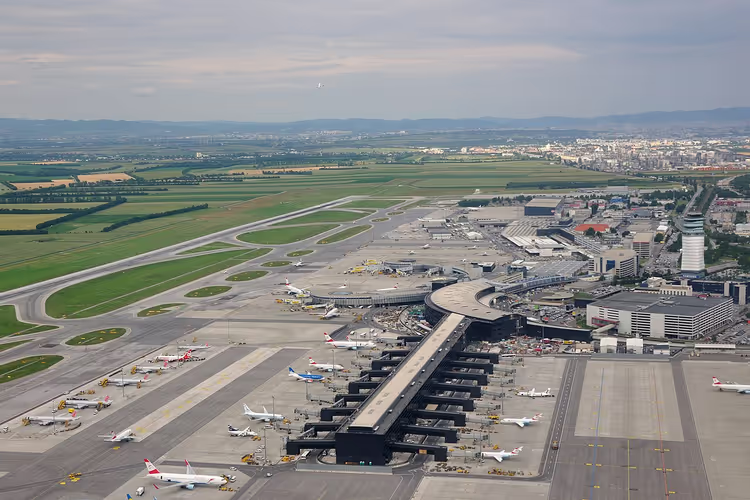
Vienna proper operates as a single fare zone, and all 24-, 48-, and 72-hour passes are valid only within it (Vienna passes). Schwechat Airport lies outside that zone. With a city pass in your pocket, you ride to the airport without a valid ticket for the final stretch of the journey.
 © Hansueli Krapf This file was uploaded with Commonist . · CC BY-SAPhoto: Hansueli Krapf This file was uploaded with Commonist ., CC BY-SA (https://creativecommons.org/licenses/by-sa/3.0), Wikimedia Commons
The outer zone requires a surcharge. A full S-Bahn trip to the airport costs less than ten euros, and with a transit pass you pay extra only for the outer segment (as of 09/2026, city fares). The surcharge is a couple of euros, while the fine runs into the hundreds.
The cost of a mistake: a fine instead of a small outer-zone surcharge.
4. Airport transfer based on an outdated guidebook
This is the most expensive mistake of 2026, and it is tied to construction. Due to modernization of the main city rail line, direct airport service to the center has been suspended since September 7, 2026, with work scheduled to run through late October 2027 (as of 09/2026, City Airport Train).
The CAT train, which used to carry passengers to Wien Mitte in 16 minutes, has been replaced by premium buses. They run every 12 minutes, the trip takes about 21 minutes, and children under 15 ride free (as of 09/2026, CAT operator).
Those who do not know this end up somewhere other than where they planned, and ultimately take a taxi to the center. Predictable alternatives exist: a regional train to Hauptbahnhof, Vienna Airport Lines buses, and a combination of S-Bahn plus tram from St. Marx. Before departure, check the status on the airport website, because construction phases change routes.
The cost of a mistake: several tens of euros in extra expenses one way.
5. Vienna City Card without doing the math
The Vienna City Card starts at 17 € for 24 hours and includes city transit plus discounts at more than 200 museums, cafes, and shops (as of 09/2026, transit and card discounts). It is a tourist card, not a transit ticket, and the two should not be confused.
Ticket | Price | When it pays off |
|---|---|---|
Single, paper | 3.20 € | one or two trips per day |
Single, app | 3.00 € | one or two trips per day |
24 hours, paper | 10.20 € | three or more trips |
24 hours, app | 9.70 € | three or more trips |
Vienna City Card, 24 hours | from 17 € | if you use museum discounts |
Table data as of 09/2026, fare overview table.
Do the math for your own itinerary. If you plan to visit museums and use the discounts, the card pays for itself. If you only need to get around, a regular 24-hour ticket is cheaper. And if you walk a lot, which is entirely realistic in the first district, two single tickets a day will be enough.
The cost of a mistake: a few euros overpaid every day.
6. A carriage ride without an agreed price
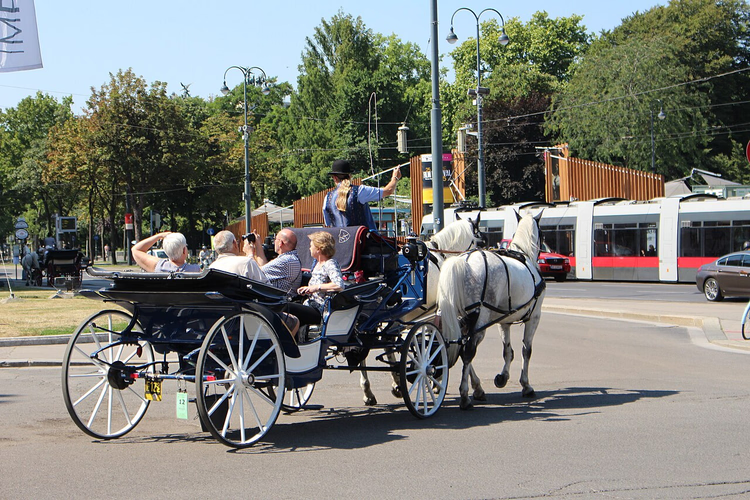
The Fiaker has long been part of the Viennese picture, and it comes with its own price. A short ride through the center lasts about twenty minutes and costs several tens of euros per carriage, while the grand tour takes twice as long and costs roughly twice as much (as of 09/2026, Wien.info).
 © traveljunction · CC BY-SAPhoto: traveljunction, CC BY-SA (https://creativecommons.org/licenses/by-sa/2.0), Wikimedia Commons
The price is quoted per carriage, not per person. For you, that means simple arithmetic: with two or four people, the ride costs very different money than it does solo.
The mistake rarely happens during the ride itself. The mistake happens at boarding, when the price was not agreed in advance. Ask for the route, duration, and total amount before you get into the carriage, and confirm the agreement out loud.
The cost of a mistake: a difference of tens of euros.
7. Shopping on Sunday
In Austria, shops are closed on Sundays, and more strictly than you may be used to in Germany. Cafes and restaurants are open, as are museums, some bakeries, shops at Hauptbahnhof and Westbahnhof stations, and retail outlets at the airport. Everything else is closed.
If you planned Sunday for souvenirs, you lose half a day. On the other hand, Sunday is the best day for museums: the city empties out, and ticket lines become noticeably shorter.
The cost of a mistake: half a day of your vacation.
8. Schönbrunn without a time slot
Schönbrunn Palace sells tickets for a specific entry time. In high season and on holidays, convenient morning slots are booked up several days in advance. Those who show up at the ticket office without a reservation get a late afternoon entry, or no entry at all.
 © Tournasol7 · CC BY-SAPhoto: Tournasol7, CC BY-SA (https://creativecommons.org/licenses/by-sa/4.0), Wikimedia Commons
The palace is open daily from 8:30 to 17:30, and the park is open from 6:30 to 20:00 (as of 09/2026, Schönbrunn official website). Tickets are sold only through imperialtickets.com, because fake sites actively copy the sales process. The combined Classic Pass for five attractions costs 49 € for an adult (as of 09/2026, tickets and prices).
Plan your palace routes in advance too. The short Imperial Tour shows fewer rooms than the Grand Tour. The park is free to enter, but you pay separately for the Privatgarten, Irrgarten, Gloriette, and the zoo.
Tours and tickets in Vienna
Guided tours, skip-the-line tickets and activities — most offers can be cancelled free of charge.
See offers on TiqetsThe widget loads once you give your consent.
If you want to book tickets and tours in one order, check out ticket options on Tiqets.
The cost of a mistake: a lost morning or a canceled visit.
9. A Viennese coffee house as a regular cafe
A Viennese coffee house works differently from a regular cafe. You place your order, get a glass of water with your coffee, and stay as long as you like. The waiter does not rush you to order again, and an open newspaper is considered normal here.
The mistake usually hides in the order itself. A Melange is not a latte macchiato, a Verlängerter is not an Americano, and asking for "just coffee, please" in a traditional coffee house tells the waiter nothing. If in doubt, order a Melange, Verlängerter, or Kleiner Brauner.
The bill is not brought automatically either. You ask for it yourself when you decide to leave, and only then does the visit end.
Cost of the mistake: zero euros and mild confusion on both sides.
10. Tips left on the table
In Austria, tips are included in the payment and the total is said out loud. The usual practice is to round the bill up or add about a tenth. Money left on the table in silence is read here as a sign of dissatisfaction, not gratitude.
When paying by card, you state the tip amount at the moment of the transaction, not after. A couple of euros on a small bill looks appropriate, while large American-style tips cause bewilderment.
Cost of the mistake: a few euros overpaid or a cold look in return.
11. Paying by card only
Vienna has become a digital city, but Austria remains a cash country in many small ways. Würstelstand, small Beisl, market stalls, Heurige outside the city, and some museum shops accept only cash or only local cards. Keep some cash in your pocket so you don't have to hunt for an ATM in a hurry.
If the terminal offers to charge the amount in another currency, choose euros. Conversion through a foreign currency costs more, and the markup with this choice can be noticeable.
Cost of the mistake: a markup of several percent or a canceled purchase.
12. Photos on the bike path and market traps
Vienna's bike paths often run as a red strip right next to the sidewalk, especially around Ringstraße and on Zweierlinie. Stopping for a photo on such a strip is dangerous, and locals react loudly to it. Step onto the sidewalk before taking out your phone.
 © Dietmar Rabich · CC BY-SAPhoto: Dietmar Rabich, CC BY-SA (https://creativecommons.org/licenses/by-sa/4.0), Wikimedia Commons
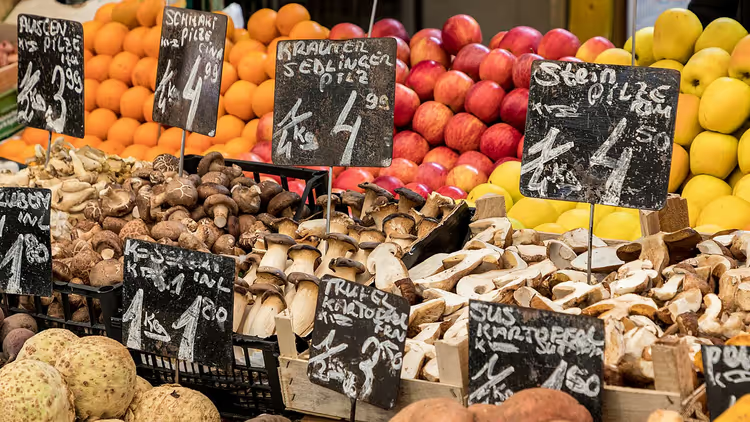
Then the money traps begin. Naschmarkt looks like a must-see, but in the front section with tourist stalls, prices are noticeably higher. If food matters to you, move to the back of the market or to a regular neighborhood market.
The line at Hotel Sacher can also be avoided. You can try Sachertorte without waiting: it is served at Café Sacher Eck and in other cafes around the city, and Konditorei Demel offers its own version without the wait. You save not so much money as half an hour of a pleasant stroll.
Cost of the mistake: half an hour in line and a markup at tourist stalls.
Practical takeaways before the trip
Vienna is easy to plan ahead, because almost every mistake here is fixed not with money but with attention to detail.
- Buy public transport tickets in the app: cheaper and no validation needed.
- Book your entry time for Schönbrunn and major museums in advance.
- A cash reserve of a few dozen euros solves half of everyday problems.
- State your tip when paying, don't leave it on the table.
- Give Sunday to museums and parks, and plan shopping for Saturday.
⁉️🤔 Frequently asked questions
How much does public transport cost in Vienna for a tourist?
A single ticket costs €3.20 on paper and €3.00 in the app, while a 24-hour ticket costs €10.20 on paper and €9.70 in the app (as of 09/2026, current fares). For three trips a day, the 24-hour ticket is the better deal; for one or two, single tickets are enough.
How to get from the airport to central Vienna?
Direct service is interrupted by construction: from September 7, 2026, the CAT train runs as premium buses every 12 minutes, and the journey takes about 21 minutes (as of 09/2026, official CAT website). The S-Bahn only goes as far as St. Marx; from there you'll need to transfer to a tram or bus.
Do I need to buy a Schönbrunn ticket in advance?
Yes, the palace operates with time slots, and in high season morning slots disappear several days ahead (as of 09/2026, palace and park). Tickets are sold on imperialtickets.com; fake websites copy the sale. If you want to see the state rooms, take the Grand Tour.
Are shops open in Vienna on Sunday?
No, Sunday remains a day off for retail. Cafes and restaurants, museums, some bakeries, and shops at Hauptbahnhof, Westbahnhof, and the airport are open. Plan Sunday for museums and parks, and move shopping to Saturday.
Is it true that Vienna only accepts cash?
No, cards are accepted almost everywhere, but exceptions are common. Würstelstand, small Beisl, market stalls, and Heurige outside the city often work with cash only. A reserve of a few dozen euros saves you from hunting for an ATM at the wrong moment.
Do people leave tips in Vienna?
Yes, tips are said out loud when paying: you round the bill up or add about a tenth of the amount. When paying by card, you state the amount at the moment of the transaction, not after. Leaving money on the table is not the custom, and a silent departure is read by the waiter as a sign of dissatisfaction.
In short: what to book
A first visit to Vienna is cheaper to plan than to fix on the spot. Check your airport transfer before departure, because construction is changing routes (as of 09/2026, construction information).
If you only have two days, take a hotel in the first district and don't waste hours traveling between districts. Check out hotel options in central Vienna on Trip.com and guided city tours on GetYourGuide.

A small editorial team writing guides for independent travel. We travel ourselves, but we haven’t been everywhere, so we check prices, opening hours and how to get there against official sources.