
















What to see in Barcelona: 30 places from La Rambla to Tibidabo
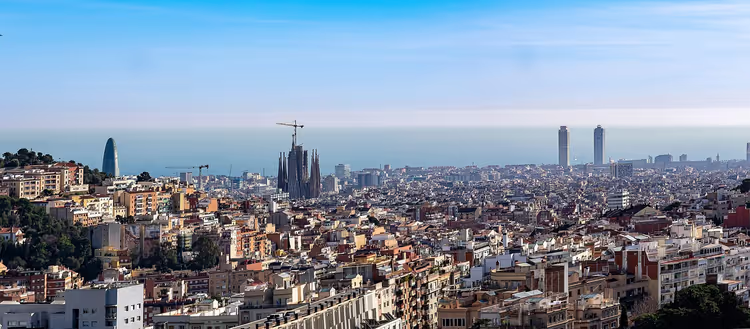
Thirty main places in Barcelona can't be covered in one day. The city stretches from the sea to the slopes of Tibidabo, and every district has its own rules. We put together a list that makes trip planning easier: where you need a ticket, what to see first, and where you can get in for free. Plan for two to three days. La Rambla and the Gothic Quarter can be walked in half a day. Sagrada Familia and Park Guell require a timed ticket. Montjuic and Tibidabo are best saved for a separate day outside the city center. Check opening hours and prices on official websites, they change every season.
Ad: this article contains affiliate links. We earn a commission if you book through them, at no extra cost to you.
1. La Rambla
💡 In short:
- In two days you can cover La Rambla, the Gothic Quarter, and Sagrada Familia.
- Get morning tickets for Park Guell and Casa Batllo, by midday the line is longer.
- Tickets and opening hours: 09/2026, verified on the official Barcelona tourism website.
La Rambla remains the city's main pedestrian artery. It connects Placa de Catalunya with the waterfront, stretches for more than a kilometer, and is divided into five distinct sections. Each has its own character, and you'll feel the mood shift as you walk toward the sea.
 © Enric · CC BY-SAPhoto: Enric, CC BY-SA (https://creativecommons.org/licenses/by-sa/4.0), Wikimedia Commons
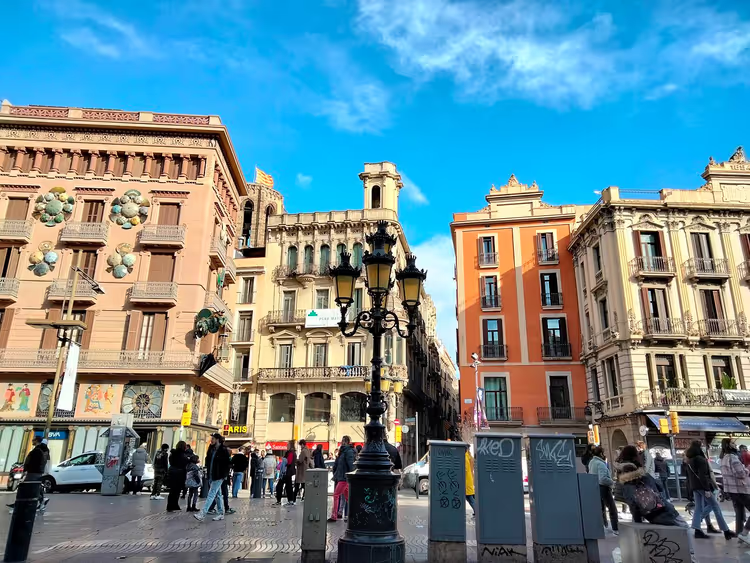
The first section is called Canaletes. Here stands a drinking fountain of unusual shape: a cast-iron vase with the coat of arms of Catalonia, topped by a decorative stand with 19th-century lanterns. According to legend, a sip of water from it promises you'll return to the city. Nearby, Barcelona fans argue about matches, and it gets loud here in the evenings.
The second section is called Rambla dels Estudis: a university once stood here, and the name stuck to the street. Now a bird market occupies the spot, selling everything from ordinary pigeons to exotic parrots. Nearby stands the former Royal Academy building from 1894 with a pink facade and columns, now home to the Poliorama Theater. This building is tied to street fighting during the Civil War, which George Orwell wrote about.
Further on, you'll find the Baroque Church of Our Lady of Bethlehem. Its central facade dates to 1680, and the interior was heavily damaged in the 1936 ransacking. The gilded statues and frescoes did not survive, but the church still impresses with its decor and the quiet inside.
Rambla de les Flors looks like one continuous flower garden made up of dozens of stalls. Walking this stretch is pleasant even without buying anything. Between the kiosks hides the 18th-century Baroque palace Palau de la Virreina, the former residence of the vicereine. It's now an exhibition center, and in the evenings it's quieter here than on the neighboring sections.
The Boqueria market buzzes on this same stretch. Locals buy fish and delicacies here well before noon. A bit further stands the Umbrella House, the former mansion of Bruno Quadras, where umbrellas were sold. During renovation, the facade was embellished with ancient Egyptian symbols, and now the building is impossible to confuse with anything else.
The main building of the Rambla dels Caputxins section is the Liceu opera house. It has three arched entrances, a balustrade, and stained-glass windows two stories high. After the 1994 fire, the interiors took five years to restore, and now world opera stars perform on this stage again.
The section ends with the Fountain of the Three Graces, next to which stand lampposts with unusual fixtures designed by a young Gaudi. From here it's a short walk to the Columbus Monument and the waterfront.
The last part, Rambla de Santa Monica, leads to Placa del Portal de la Pau. Here you'll find the Santa Monica Arts Center in a former monastery building, hosting contemporary art exhibitions. Beyond it begins Rambla de Mar with a futuristic pedestrian bridge. The wave-shaped bridge leads to the Maremagnum shopping center and is open around the clock.
If you want to walk the boulevard without the crowds, come by 9:00. By midday it's packed, and the shade is scarce. The nearest metro stations are Catalunya at the start and Drassanes at the end. For an evening stroll, take the brighter side and stay to the right, where there are fewer street performers with loud music.
2. Gothic Quarter
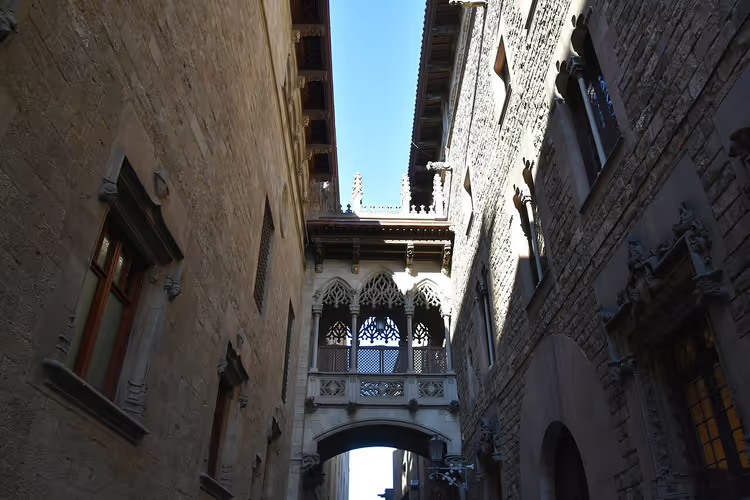
This quarter starts at Placa de Catalunya and runs toward La Rambla. Its narrow streets are paved with cobblestones, and the buildings date back to the Middle Ages. A walk through it turns into a journey through living history, and you quickly lose count of the turns.
 © Richard Mortel from Riyadh, Saudi Arabia · CC BYPhoto: Richard Mortel from Riyadh, Saudi Arabia, CC BY (https://creativecommons.org/licenses/by/2.0), Wikimedia Commons
The heart of the district is the Cathedral, covered in detail below. In honor of Saint Eulalia, the patron saint of Barcelona, the Festa Major festival with human towers takes place every year.
On Placa de Sant Jaume stand two Gothic mansions. One houses the city hall, the other the Parliament of Catalonia. Between them you'll find the Chapel of Saint George with a facade in the Catalan Gothic tradition. These are working buildings, so you can only enter on a schedule, not at any time.
On Placa del Rei, the Barcelona History Museum awaits. Its building is assembled from separate historical parts, and beneath it lie the remains of the Roman city. Nearby rises the Royal Palace with its throne room, the Chapel of Saint Agatha, and the King Martin Tower. The Frederic Mares Museum displays unusual everyday objects: keys, canes, umbrellas, and travel bags from the collector's personal collection.
On the corner with Carrer del Paradis, four columns of the ancient Temple of Augustus survive. To see them, step into the tourist office, the columns stand right behind the door. From there it's a short walk to the Jewish Quarter, a kind of museum of Jewish life before the 15th century. The shops sell old books and antiques, and for more details it's worth stopping by the Cal Info Center.
Placa del Pi actually unites three squares that flow into one another. The name comes from the pine tree, the symbol of the district, hence the Catalan word Pi. The main attraction here is the Church of Santa Maria del Pi. The arched vaults, octagonal towers, and rose window are done in Catalan Gothic style, and the facade looks austere and noble.
Wander the quarter without a map: that way you'll discover more inner courtyards and small squares. If you get tired, turn toward the market or the waterfront, they're five minutes away. In the evening, the lighting makes the streets very photogenic, but wear comfortable shoes, the cobblestones are uneven.
3. Casa Batllo
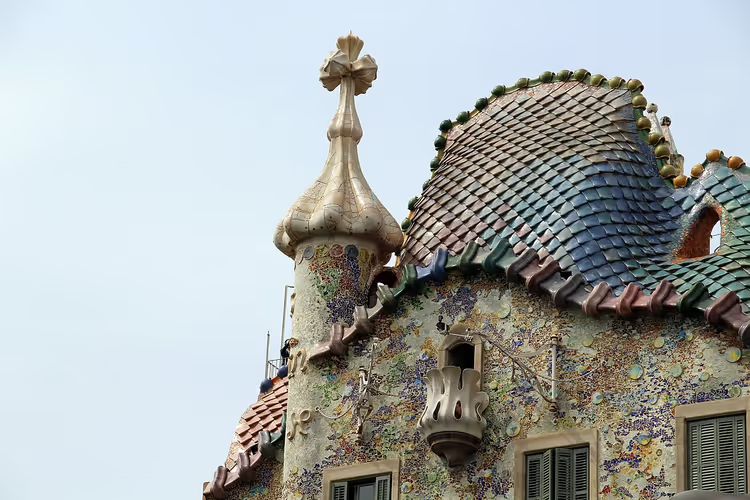
Casa Batllo came about after the renovation of an 1875 apartment building. Gaudi completely redesigned two facades and turned the building into a work of art. There are almost no straight lines here, every detail flows smoothly into the next. From a distance, the facade resembles a dragon with iridescent scales, and every tour guide repeats this comparison.
 © Fred Romero · CC BYPhoto: Fred Romero, CC BY (https://creativecommons.org/licenses/by/2.0), Wikimedia Commons
The columns on the first two floors are shaped like bones, which is why locals nicknamed the building the House of Bones. This was Gaudi's first work in this style, and it launched the series of his famous buildings. To appreciate the house, you only need to look at the facade from the sidewalk; people go inside for the interiors and the rooftop.
Tickets: Casa Batllo ticket with audio guide on GetYourGuide
The catch: in summer, morning slots get booked up in advance, leaving only midday heat times available.
Location: Passeig de Gracia, 43, Passeig de Gracia metro station is steps away.
4. Casa Mila
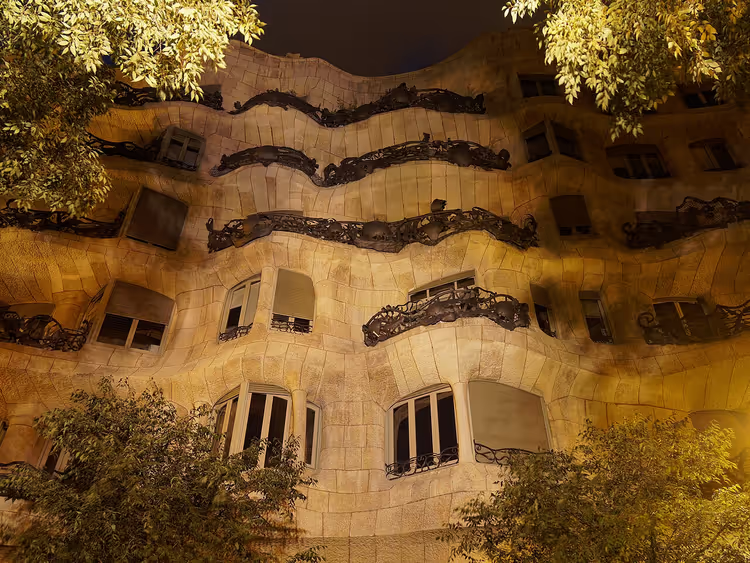
Casa Mila became Gaudi's last major project for a private client. It was built between 1906 and 1910 for Pere Mila, an owner of apartment buildings. The architect took a mountain as his inspiration and assembled the building from stone in the Art Nouveau style. The six-story house looks light, even though inside it's steel and concrete.
 © C messier · CC BY-SAPhoto: C messier, CC BY-SA (https://creativecommons.org/licenses/by-sa/4.0), Wikimedia Commons
Every detail here works to create the image: balcony railings, stained glass, and chimneys shaped like sculptures on the roof. Flowing lines and wave-like curves repeat on every level. You'll also hear locals call the house by its second name, La Pedrera.
Tickets: skip-the-line entry to Casa Milà with an audio guide
Who it's for: those who want to see the rooftop with its chimneys and the interior courtyards.
Location: 92 Passeig de Gràcia, a ten-minute walk from Casa Batlló.
5. Park Güell
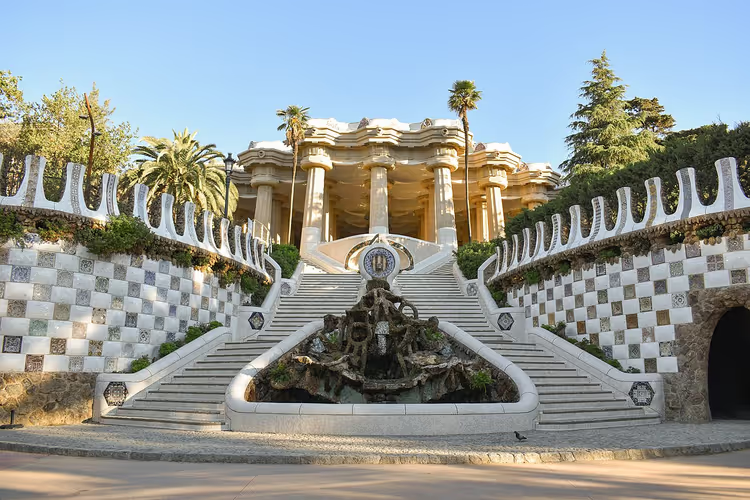
Park Güell spreads across 17 hectares, and almost everything here was designed by Gaudí. The wonders start right at the entrance: the little houses look like painted gingerbread, and a giant mosaic lizard sits on the lawn. The entire grounds are filled with magical structures and unusual objects.
 © Canaan · CC BY-SAPhoto: Canaan, CC BY-SA (https://creativecommons.org/licenses/by-sa/4.0), Wikimedia Commons
Originally Gaudí built several private houses here on commission from Eusebi Güell. The plans to sell plots didn't pan out, and the architect himself bought one of the houses. He lived there until his final days, and turned the rest of the land into a park with unusual architecture.
Who it's for: for those who want to see the mosaics and the city view from the terrace.
Location: Carrer d'Olot, Vallcarca or Lesseps metro station, then a walk uphill.
6. Barcelona Cathedral
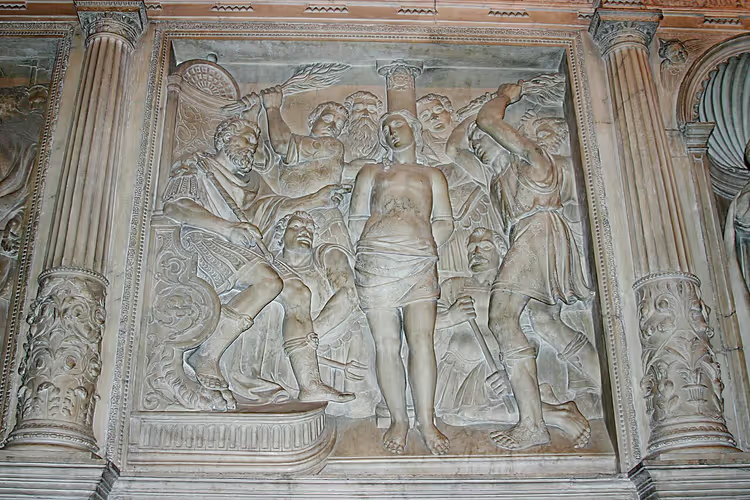
Barcelona Cathedral remains the city's main church and a national monument. The building took seven centuries to construct, so it mixes Gothic, classical, and Baroque styles. The Catalan Gothic facade was finished only in the early 20th century, while the first stones were laid in 1298 on the site of a Roman basilica.
 © José Luiz · CC BY-SAPhoto: José Luiz, CC BY-SA (https://creativecommons.org/licenses/by-sa/3.0), Wikimedia Commons
The bell towers rise nearly 100 meters. The facade features sculptures of biblical figures, including Christ and the apostles. The gutters are shaped as gargoyles, mythical creatures that battle demons. Up close you can make out the stone carvings; from a distance they're almost invisible.
Inside are the tomb of Saint Eulalia and a large organ, with concerts held almost every month. Six gates lead into the church, so even on holidays you'll find an entrance without crowds. Mornings here are quieter than afternoons.
Location: Pla de la Seu, Gothic Quarter, Jaume I metro.
7. Sagrada Família
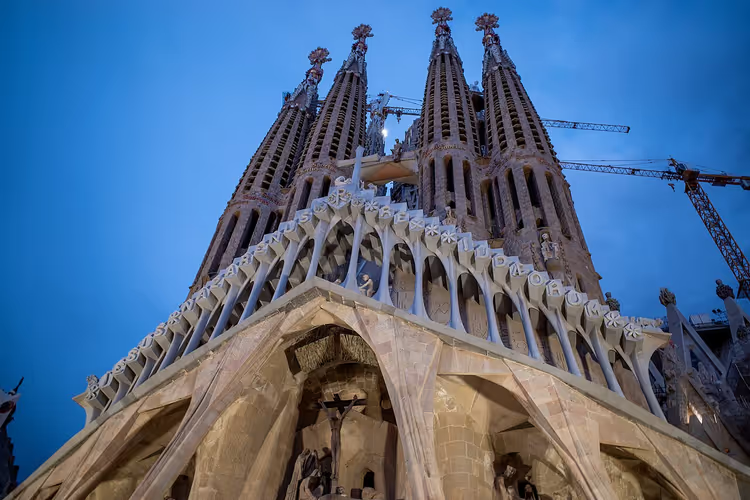
Sagrada Família is visible from afar thanks to its lacy towers. From a distance it looks like a finely crafted jewelry box, and it's hard to believe this building is real. Only up close to the facade can you make out the individual structures of the temple complex.
 © Nan Palmero from San Antonio, TX, USA · CC BYPhoto: Nan Palmero from San Antonio, TX, USA, CC BY (https://creativecommons.org/licenses/by/2.0), Wikimedia Commons
Construction is still unfinished, although Gaudí worked on it for decades. Completion is planned for 2026, the centenary of the architect's death. The interiors weave together Gothic, Baroque, Art Nouveau, and Moorish motifs. Contemporary architects continue working on the project.
Tickets: skip-the-line Sagrada Família ticket
The catch: tower time slots sell out weeks in advance, so book your ticket online ahead of time.
Location: Carrer de Mallorca, 401, Sagrada Família or Verdaguer metro stations.
8. Aquarium
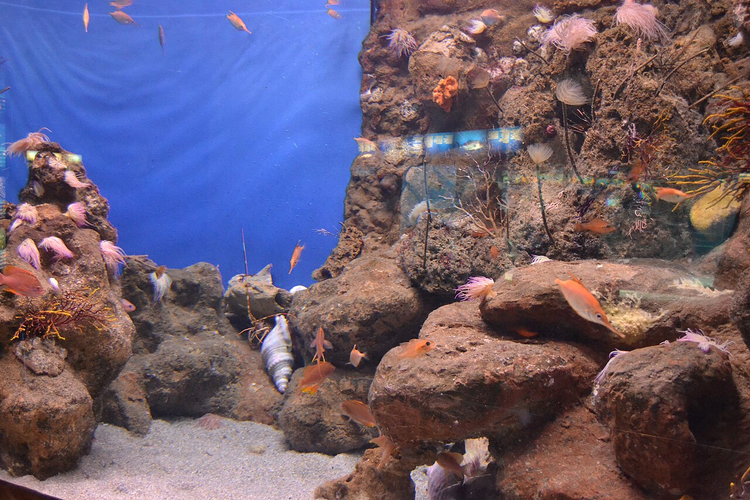
Barcelona Aquarium is a whole educational world, not just display cases with fish. It houses 14 aquarium ecosystems: rocks, sandy flats, kelp islands, coral reefs, and underwater caves. Walking through the glass tunnel, you'll find yourself surrounded by sharks and large fish.
 © Emilio J. Rodríguez Posada · CC BY-SAPhoto: Emilio J. Rodríguez Posada, CC BY-SA (https://creativecommons.org/licenses/by-sa/2.0), Wikimedia Commons
The diversity of inhabitants surprises even experienced underwater photography enthusiasts. From microscopic fish to large sharks, rare Mediterranean species are represented here. Certified divers are allowed to swim alongside the exotic residents.
Tickets: Aquarium tickets on GetYourGuide
Who it's for: for families with children, you can touch exhibits in the interactive zone here.
Location: Moll d'Espanya in the Old Port, Drassanes metro.
9. Torre Glòries
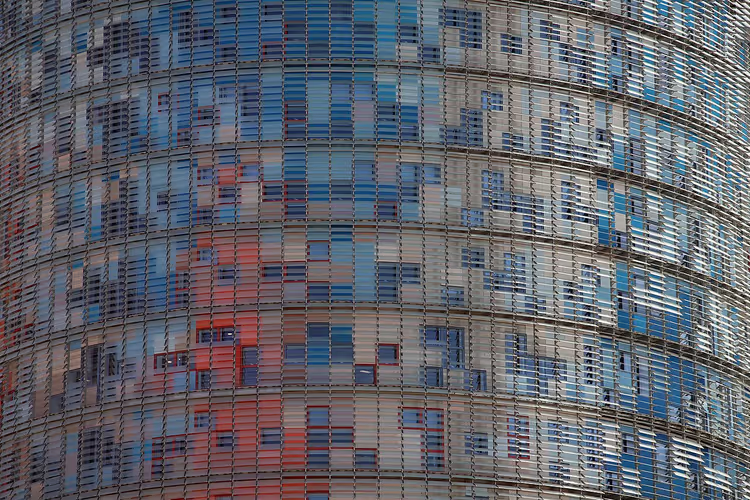
Barcelona is known not only for old palaces and churches. It also has modern high-tech masterpieces, and one of them is Torre Glòries. Its shape resembles a giant cucumber, with 38 floors and a total height of 145 meters. Four floors extend underground.
 © Fred Romero · CC BYPhoto: Fred Romero, CC BY (https://creativecommons.org/licenses/by/2.0), Wikimedia Commons
The building was originally constructed as the office of the city water utility. Once people saw how the tower glowed, they decided to open a five-star hotel here. While preparatory work was underway, the structure became a city landmark, and its lighting uses about 16 million shades.
The design is tailored to the mild climate. The first layer of walls is a concrete shell with sheet metal in blue, red, and pink tones, with 4,000 LEDs built in. The second layer of frosted glass louvers keeps heat in during winter and cool air in summer. By day the tower reflects the sky, and in the evening it shimmers in the glow of the lights. A promenade runs alongside it, perfect for a stroll before sunset.
10. Palau de la Música Catalana
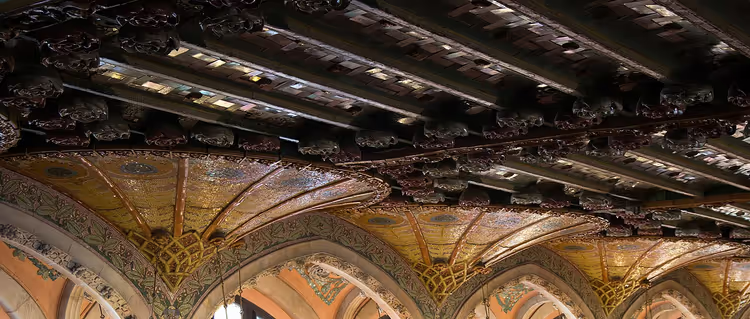
Palau de la Música Catalana is the city's main cultural center. The building was erected in 1905-1908 in the Art Nouveau style, and it still looks modern today. From the facade to the interior decor, everything here speaks of Catalans' love for their region.
 © bep · CC BY-SAPhoto: bep, CC BY-SA (https://creativecommons.org/licenses/by-sa/3.0), Wikimedia Commons
Life in the palace bustles almost daily. Concerts, conferences, exhibitions, and congresses take place here. If you're interested in Art Nouveau architecture, it's worth taking a tour of the halls, and staying for a performance in the evening.
11. Plaça d'Espanya
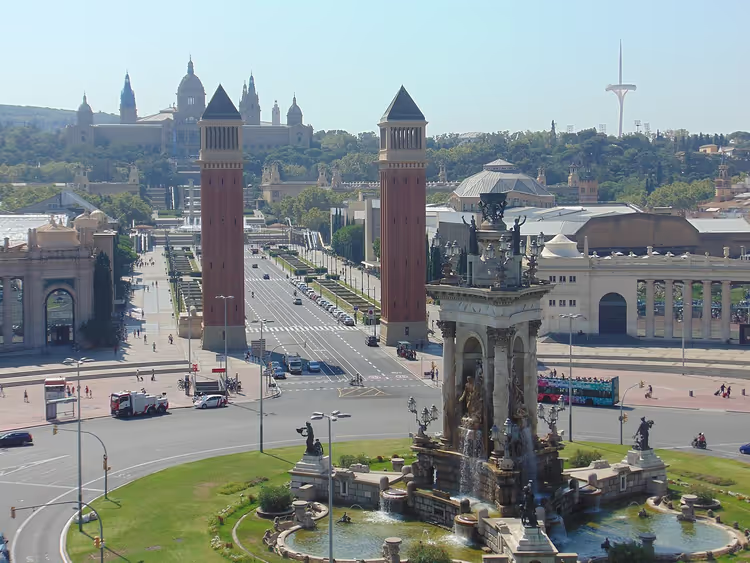
Spain Square covers 34,000 square meters. It is the second largest square in Barcelona, and it was opened for the 1929 World's Fair. Architect Josep Puig i Cadafalch designed it on the model of Venice's Piazza San Marco.
 © Nicholas Gemini · CC BY-SAPhoto: Nicholas Gemini, CC BY-SA (https://creativecommons.org/licenses/by-sa/4.0), Wikimedia Commons
Forty-meter columns lead to the exhibition center, with the Magic Fountain and the National Art Museum of Catalonia nearby. Across the road stands the round brick building of the Arenas shopping center. Until 1977 it hosted bullfights; now, for a symbolic euro, an elevator takes you up to the observation roof. From there you get a view of the fountain and the surrounding neighborhoods. The square is served by the red metro line L1, the green line L3, and suburban trains.
12. National art museum of Catalonia
The National Art Museum of Catalonia opened in 1934 in the National Palace building. The palace stands on Montjuïc hill and is surrounded by a large park area.
 © MARIA ROSA FERRE ✿ from Vilafranca del penedes, Catalunya · CC BY-SAPhoto: MARIA ROSA FERRE ✿ from Vilafranca del penedes, Catalunya, CC BY-SA (https://creativecommons.org/licenses/by-sa/2.0), Wikimedia Commons
The Romanesque hall houses a collection of Catalan painting from the 12th and 13th centuries: frescoes, woven icons, and wooden sculpture. The Gothic halls display paintings and sculptures by masters of the 14th to 16th centuries. The Renaissance is represented by works of Spanish, Italian, and French artists, including El Greco and Velázquez. The 19th and 20th century halls are devoted to modernists and avant-garde artists.
Tickets: museum tickets on GetYourGuide
Who it's for: for those who want to see Romanesque frescoes brought from mountain churches.
Location: Palau Nacional, Montjuïc, Espanya metro station, then a walk up the escalators.
13. Montjuïc
Montjuïc is not just a 173-meter hill but a whole staging ground for attractions. Ancient fortresses and modern facilities coexist on its slopes. Today the area is decorated with lawns and flower beds, and you can easily spend a whole day here.
 © Txllxt TxllxT · CC BY-SAPhoto: Txllxt TxllxT, CC BY-SA (https://creativecommons.org/licenses/by-sa/4.0), Wikimedia Commons
A military museum operates in Montjuïc Castle. Knight armor, muskets, and cast-iron cannons recall the fortress's past. From the walls you can descend to the Magic Fountain and watch cascades of jets set to music. The fountain was built in 1929, restored by 1992, and now draws crowds of tourists and locals.
The Joan Miró Museum is also here, with the artist's avant-garde works. The Mercury Fountain in a glass cube deserves special attention: instead of water, silvery cascades of liquid mercury flow from it. The main attraction of Montjuïc is the Olympic Stadium, opened for the 1992 Games. Two equestrian statues guard the entrance, and inside there is a museum gallery and the sports facilities of the Olympic Ring.
14. Poble Espanyol
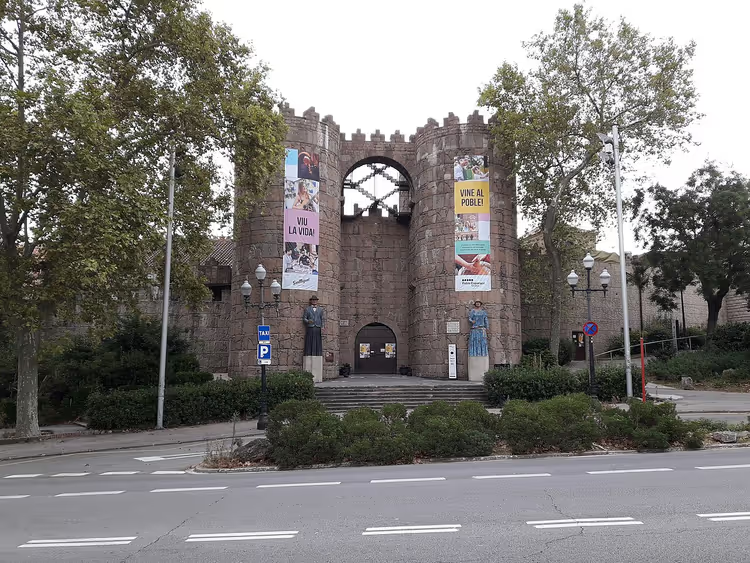
Near Montjuïc hill is Poble Espanyol, a favorite spot for tourists. It is Spain in miniature, where each region is represented by a characteristic structure. The village was created for the 1929 World's Fair.
 © pere prlpz · CC BY-SAPhoto: pere prlpz, CC BY-SA (https://creativecommons.org/licenses/by-sa/3.0), Wikimedia Commons
A group of architects and artists traveled through the provinces and selected the most significant buildings. On 49,000 square meters they assembled 117 houses, workshops, shops, temples, and bars. Here the town hall of Valderrobres, a Carmelite church, and an Aragonese tower stand side by side, although in reality they are separated by hundreds of kilometers. In the workshops you can watch glassblowing, lacemaking, or chocolate making. In the evening people come here for flamenco shows.
15. Tibidabo mountain and the Temple of the Sacred Heart
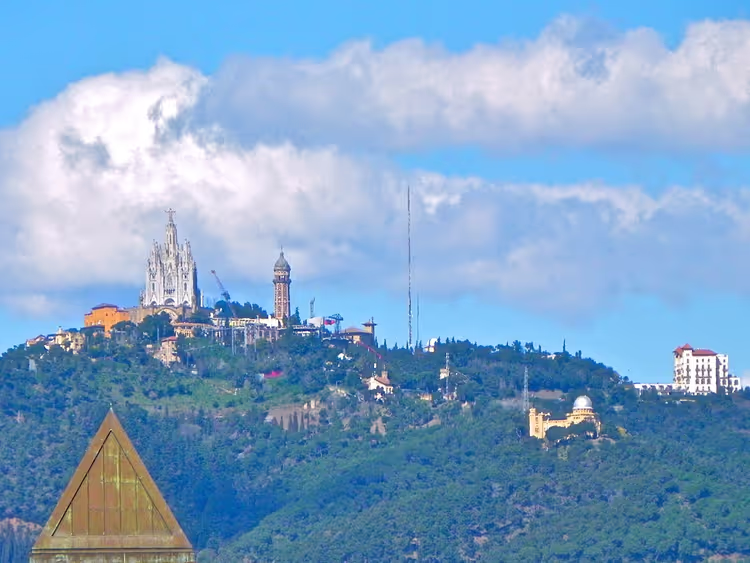
Tibidabo mountain rises 7 kilometers from the center, at an altitude of 512 meters. At the top, Jesus spreads his arms, a seven-meter sculpture by Josep Miret. It stands on the spire of the Temple of the Sacred Heart, and pilgrims and tourists alike make their way to this point.
 © jordi domènech · CC BY-SAPhoto: jordi domènech, CC BY-SA (https://creativecommons.org/licenses/by-sa/3.0), Wikimedia Commons
The site's history began as a private initiative. The devout Dorotea de Chopitea gave money to the poor after her husband's death and donated most of it to build a chapel. People began flocking to the mountain, and wealthy Barcelonans wanted to acquire the land for business. The Catholic council of the Knightly Order managed to buy the plot first and handed it over to the priest John Bosco.
The temple was designed by architect Enric Sagnier, who personally oversaw the construction but did not see it through to completion. His son continued the work, and in 1961 the building was finished. Next to the temple there is an amusement park with cafes, a restaurant, and a doll museum, so the entrepreneurs' dreams came true as well.
The easiest way up is by the Tibibus bus or the funicular from the Funikular del Tibidabo station. The temple has an observation deck called "At the Feet of Jesus," but it is closed during services. Services start at 8:00, 12:00, 17:00, and 19:00, so plan your ascent between them.
Tickets: Tibidabo amusement park tickets
Who it's for: those who want to combine a city panorama with an old amusement park.
Location: the summit of Tibidabo; take the metro to Avinguda Tibidabo and continue by bus or funicular.
16. Montserrat mountain and monastery
Montserrat mountain rises to 1,236 meters and stretches for almost 10 kilometers. Its oddly shaped rocks resemble sculptures, and many have been given names: "The Skull," "The Mummy," "The Bishop's Belly." But people come up here for the gilded wooden Madonna with child known as "La Moreneta," meaning "the little dark one."
 © Txllxt TxllxT · CC BY-SAPhoto: Txllxt TxllxT, CC BY-SA (https://creativecommons.org/licenses/by-sa/4.0), Wikimedia Commons
According to legend, the statue was carved by Saint Luke himself. Until the 9th century, the shrine's location remained unknown, until a shepherd boy stumbled upon the figure. The Monastery of the Holy Cave of Santa Cova was built on the site of the discovery in 1025. Later, Abbot Oliba built the basilica, which combines Gothic and Renaissance features.
By the 19th century, the monastery was so wealthy that it became a target for Napoleon. The monks were stormed, but the golden vessels were hidden in time and never fell into the invaders' hands. Today's approaches, observation decks, and the hotel were built in the 20th century. The openwork arcades were positioned so that the pilgrims' path stays in the shade and does not block the view of Barcelona.
The monastery has a museum with paintings by Spanish masters, including Caravaggio, El Greco, Monet, Degas, Picasso, and Dali. Sculpture, jewelry, and Orthodox icons are also on display. On Sundays during the 13:00 service, the Benedictine choir "Escolania" sings.
You can get there like this: from metro lines 1 and 3, take the R5 train to Montserrat-Aeri or Monistrol de Montserrat station. From the stations, a funicular goes up to the monastery. The Trans Montserrat combined ticket covers the round trip along with the funiculars, and the carrier revises its price every season, so check it on the FGC website before buying.
17. Picasso Museum
The Picasso Museum occupies the 15th-century Gothic mansion of Berenguer d'Aguilar on Montcada Street. It opened in 1963 on the initiative of the artist's secretary, Jaume Sabartes. The collection exceeds 3,800 pieces, making it one of the most visited museums in the city.
 © MARIA ROSA FERRE ✿ from Vilafranca del penedes, Catalunya · CC BY-SAPhoto: MARIA ROSA FERRE ✿ from Vilafranca del penedes, Catalunya, CC BY-SA (https://creativecommons.org/licenses/by-sa/2.0), Wikimedia Commons
It houses the 1957 "Doves" series, ceramics signed by the master, and gifts from the artist's widow Jacqueline. You will see works from the Blue, Rose, and Cubist periods, variations on Velazquez, and the famous harlequins and columbines. The museum is open six days a week, closed on Mondays. On Thursday evenings admission is free, but the line is long at that time.
The catch: the rooms are small, and on weekends it gets crowded inside.
Location: Carrer Montcada, 15-23, metro Jaume I or Arc de Triomf.
18. Camp Nou stadium
Camp Nou stadium was built in 1957 and seats almost 100,000 spectators. It is the largest football arena in Europe, designed by architect Francesc Mitjans. The stadium was expanded for the 1982 World Cup, when it hosted even more people.
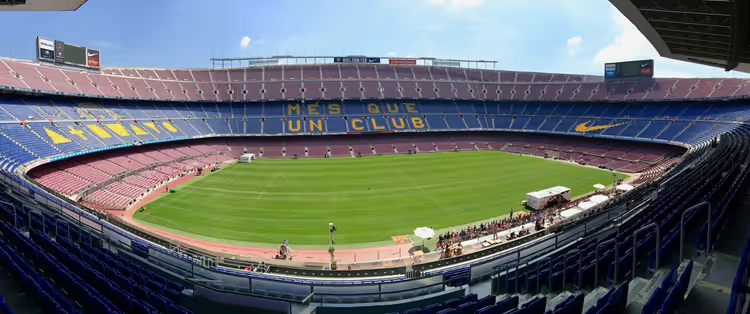
The 1992 Olympics brought changes: standing areas were removed and the stands became more comfortable. Out of eighty well-known firms, the English company Foster and Partners won the renovation tender.
The stadium is home to the club museum, founded in 1984. The exhibition takes up a lot of space and shows everything from the boot that scored a goal to trophies and portraits of champions. The ticket includes access to the stands, locker rooms, and the pitch. You can get there by metro to Collblanc station on the blue line.
Who it's for: football fans and those who want to see the arena from the inside.
Location: Carrer d'Arístides Maillol, 12, metro Collblanc or Les Corts.
19. La Boqueria market
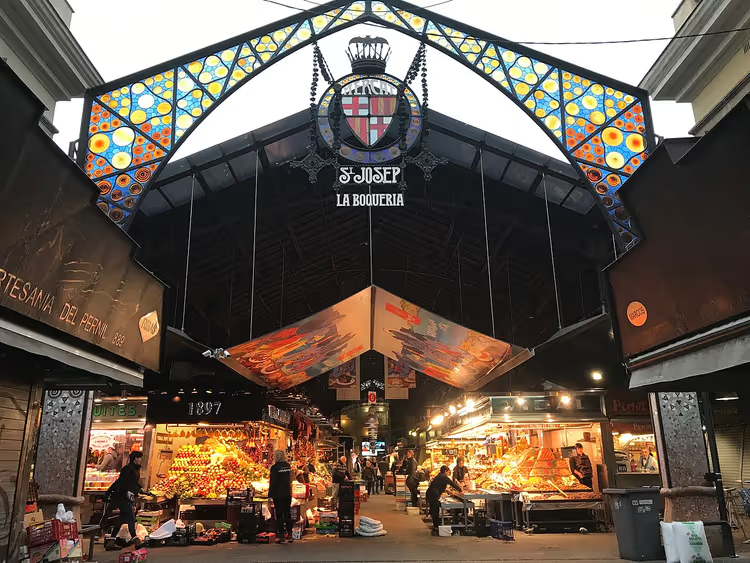
On the pedestrian Rambla you will find the covered La Boqueria market. It once stood outside the city wall and was a suburban market, but in 1237 the area was annexed to the city and began to be developed. The market got its current look in 1853 thanks to architect Mas Vila.
 © Thingstodoinbarcelona · CC BY-SAPhoto: Thingstodoinbarcelona, CC BY-SA (https://creativecommons.org/licenses/by-sa/4.0), Wikimedia Commons
In 1911-1914, fish stalls were added, gas was installed, and refrigerators were brought in. All vendors work until the afternoon siesta, so it is best to come in the morning. You will see and taste the bounty of Catalonia in one place: fish, jamon, fruit, and sweets.
The market is open from 8:00 to 20:30. Walk to it from Columbus Avenue toward the Liceu theater and the wax museum. From the old port it is about a kilometer, and buses 22, 42, 47, and 58 go to Placa de Catalunya.
20. Old port
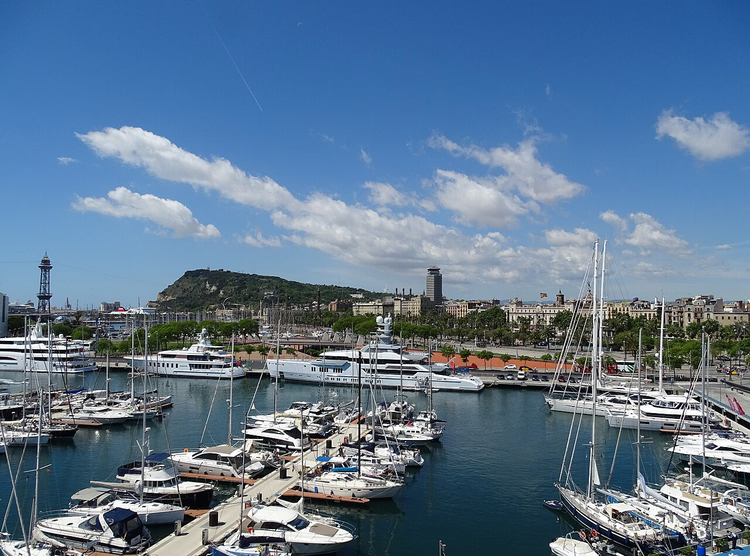
The old port, or Port Vell, dates back to the docks of King Peter III. The current quays are a legacy of King John II of Aragon. The modernist bridge was built for the 1992 Olympics.
 © Ad Meskens · CC BY-SAPhoto: Ad Meskens, CC BY-SA (https://creativecommons.org/licenses/by-sa/4.0), Wikimedia Commons
The place is perfect for strolling: the embankments are paved with boards, and on a hot day it is cool here. At night people come to watch the boats and yachts sway while sitting at cafe tables or right by the water. The Drassanes metro station on line 3 is nearby, so it is easy to reach.
21. Placa de Catalunya
Placa de Catalunya emerged on the site of the former city wall. In the 19th century, the wall was demolished to expand the city. The main square covers 50,000 square meters and was built according to Ildefons Cerda's design from granite with a sunray pattern.
 © Zioljda · CC BY-SAPhoto: Zioljda, CC BY-SA (https://creativecommons.org/licenses/by-sa/3.0), Wikimedia Commons
Three fountains operate on the square, one of them for drinking. The airport shuttle arrives here, four metro lines connect, and suburban trains stop here. City Tour sightseeing buses also depart from here. The carrier changes the day ticket price by season.
Until recently, the square was covered in pigeons. Now the city authorities have banned attracting and feeding them, citing sanitary regulations. For getting around the city, a multi-day travel pass is convenient.
Transportation: Hola BCN travel card for 2-5 days
22. Monument to Christopher Columbus
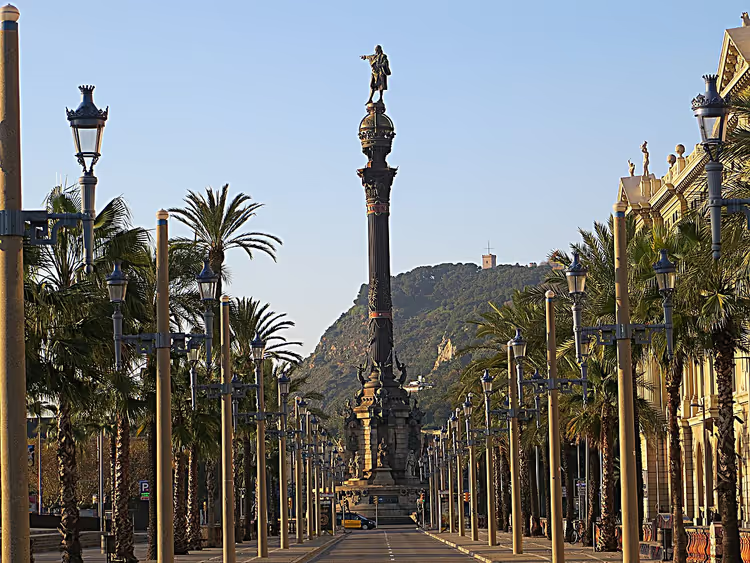
The monument to Christopher Columbus was erected in 1888 in the port of Barcelona. Its construction was timed to coincide with the opening of the World's Fair, and a group of Spanish sculptors worked on it. The monument stands in Plaça del Portal de la Pau, next to the Drassanes metro station.
 © Mister No · CC BYPhoto: Mister No, CC BY (https://creativecommons.org/licenses/by/3.0), Wikimedia Commons
At the base sits an octagonal pedestal with four figures representing Catalonia, Castile, Aragon and Leon. The lower bronze bas-reliefs tell the story of Columbus's voyages to the New World. A seven-meter sculpture of the navigator stands atop the 60-meter column, his hand pointing toward the sea.
Inside the hollow column there is an elevator for three people that takes you up to a circular observation deck. The ride is paid, and the elevator runs from morning to evening on a seasonal schedule, except December 25-26, January 1 and January 6. In 2012 a group of tourists got stuck at the top when the elevator broke down, and people had to be brought down with a crane, since there is no staircase inside the column. The cable car to Montjuïc starts right next to the monument.
23. Monastery of Santa Maria de Pedralbes
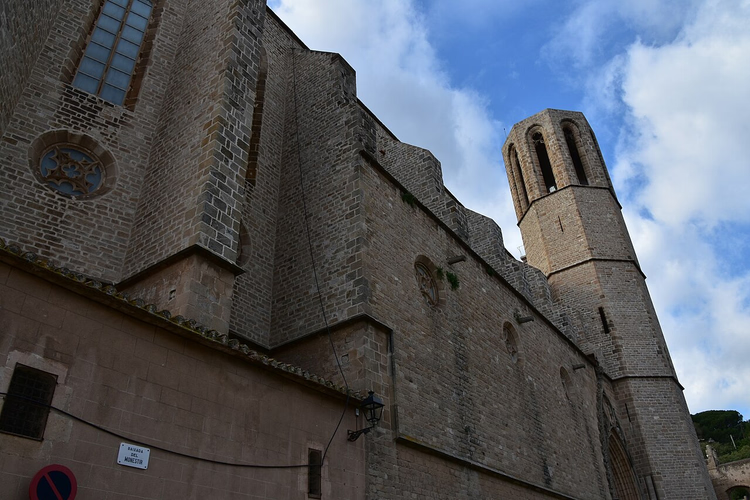
The Monastery of Santa Maria de Pedralbes was founded in 1327 by King James II and his wife Elisenda de Montcada. After her husband's death, the queen lived in a palace next to the convent until the end of her days. Her tomb is divided by a church wall, with sculptures on both sides: one shows Elisenda in royal attire, the other in a nun's habit.
 © Richard Mortel from Riyadh, Saudi Arabia · CC BYPhoto: Richard Mortel from Riyadh, Saudi Arabia, CC BY (https://creativecommons.org/licenses/by/2.0), Wikimedia Commons
In 1931 the monastery was declared a historic and cultural monument. The living conditions of the nuns of the Order of Saint Clare have been recreated in their original form: modest cells, a kitchen, a refectory, parlors and biblical wall paintings. The monastery is built in the Gothic style and remains an active convent.
The well-kept fruit garden in the inner courtyard deserves special attention. The monastery is located at Baixada del Monestir, 9, next to the Reina Elisenda metro station. It is open to visitors from 10:00 on a seasonal schedule. The ticket costs about €5, and on Sundays after 15:00 admission is free. The convent is closed every Monday, as well as on January 1, May 1, June 24, December 25 and Good Friday.
24. Bellesguard Tower
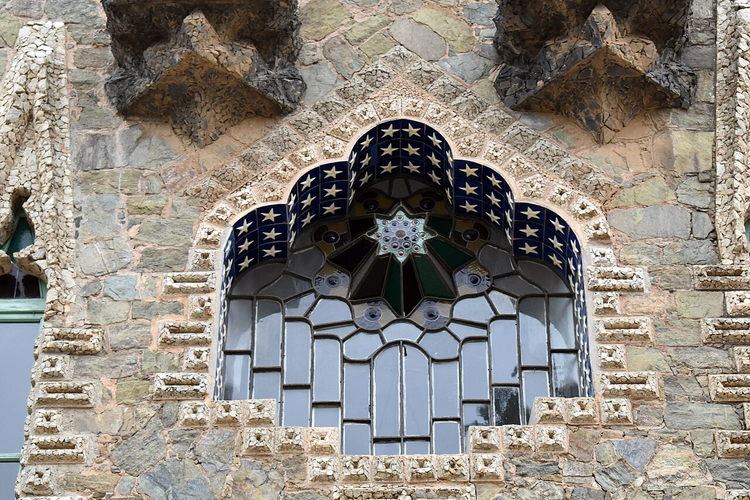
Bellesguard Tower was built in 1917 as a residence for the Figueras family. It stands on the site of a medieval castle at the foot of Tibidabo. The project was designed by Antoni Gaudí, who also oversaw the early stages of construction, while his student Domingo Sugrañes completed the work.
 © Canaan · CC BY-SAPhoto: Canaan, CC BY-SA (https://creativecommons.org/licenses/by-sa/4.0), Wikimedia Commons
The elongated shape of the building and the spire with Gaudí's signature cross visually increase the scale of the structure. The decoration hides symbolic meaning that is worth deciphering together with a guide. A spiral staircase leads to the upper floors, from where you get a view of the city.
Who it's for: those interested in late Gaudí without the crowds at the entrance.
Location: Carrer de Bellesguard, 16, open Tuesday through Sunday from 10:00 to 15:00, ticket about €9.
25. Maritime Museum
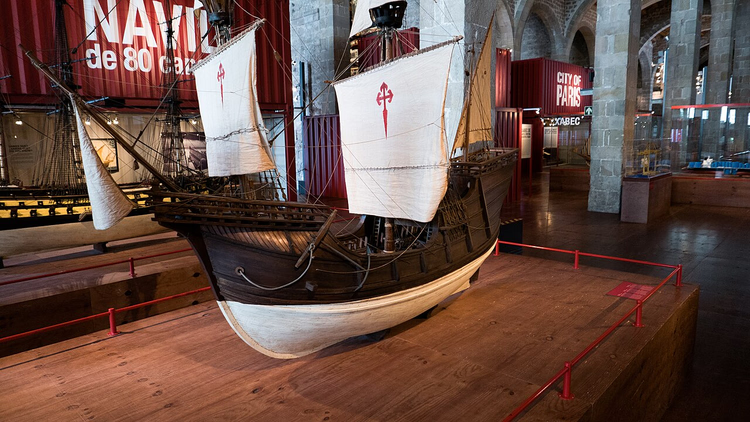
The Maritime Museum occupies the old royal shipyards of Drassanes, Gothic buildings from the 14th century. Ships were built and repaired here, and the museum itself opened in 1936. Its mission is simple: to tell the story of the maritime culture of the city and the country.
 © rameylady from Anderson, SC, USA · CC BYPhoto: rameylady from Anderson, SC, USA, CC BY (https://creativecommons.org/licenses/by/2.0), Wikimedia Commons
In the halls you will see ship caryatid figures, a collection of navigational instruments and ship models from the naval school. The most interesting exhibits are full-size replicas of a submarine, a sailing ship and a galley. The museum operates on Avinguda Drassanes daily from 10:00 to 20:00, except December 25 and 26, January 1 and January 6. Every Sunday after 15:00 admission is free.
26. Horta Labyrinth
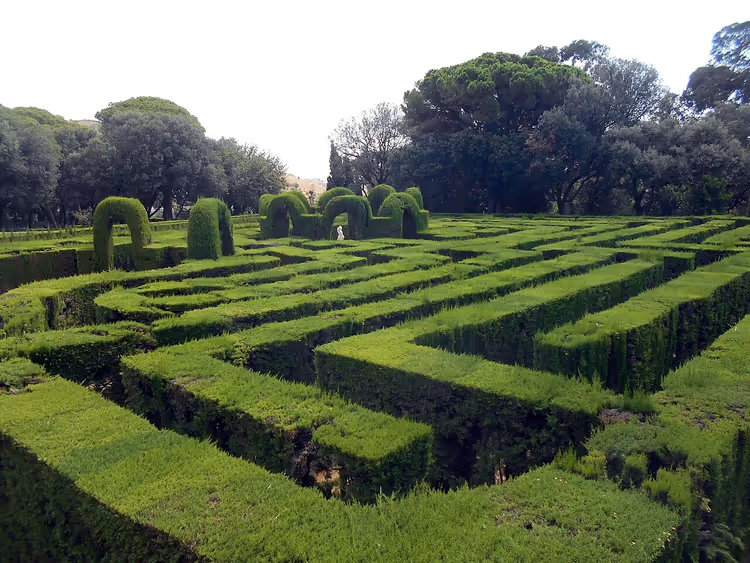
The Horta Labyrinth park was founded in 1791 by Marquis Joan Desvalls, and his descendants expanded the estate in the mid-19th century. Today it is a municipal open-air museum divided into two gardens. The park area covers 9.1 hectares and is surrounded by forest.
 © Canaan · CC BY-SAPhoto: Canaan, CC BY-SA (https://creativecommons.org/licenses/by-sa/4.0), Wikimedia Commons
The neoclassical garden consists of three terraces. There are sculptures of ancient Greek gods, grottoes and a natural pond, and the main attraction is a labyrinth of trimmed cypress trees 2.5 meters high and 750 meters long. The romantic garden features rare trees, flower beds and a waterfall.
Only walking is allowed in the park, and the number of visitors is limited to 750 people at a time. The visit takes about an hour, but with children you will stay longer. The park is located at Passeig dels Castanyers, 1-17, next to the Mundet metro station. It is open daily from 10:00 on a seasonal schedule, admission costs about €2.
27. Egyptian Museum
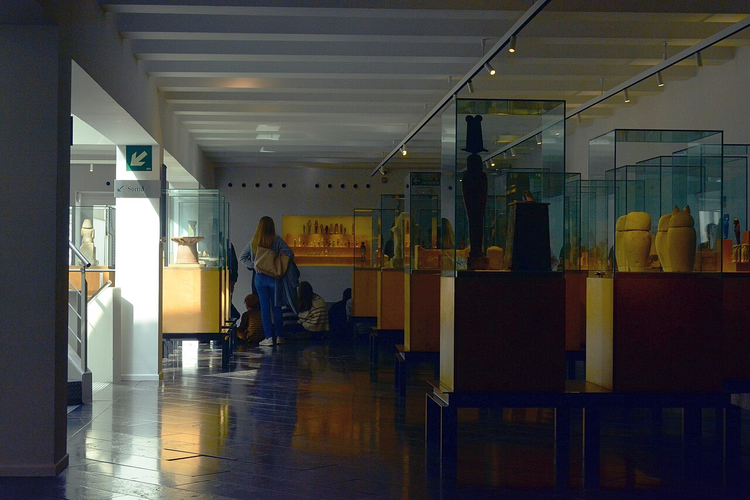
The Egyptian Museum was created by businessman and Egyptologist Jordi Clos Llombart based on his own collection. The exhibition is located at Valencia, 284, covering 2,000 square meters and three floors. The museum is open 362 days a year and displays 1,100 permanent exhibits, plus a library and classrooms.
 © Joe Mabel · CC BY-SAPhoto: Joe Mabel, CC BY-SA (https://creativecommons.org/licenses/by-sa/4.0), Wikimedia Commons
The halls feature sarcophagi, gold and precious stone jewelry, sculptures and open tombs with pharaoh mummies. Death masks of Egyptian rulers are also on display. Tours are conducted with an audio guide or with a professional Egyptologist.
In summer the museum is open until 20:00; the rest of the year the hours are the same but with a lunch break. On Saturdays admission is free, and on Sundays the museum closes earlier. By appointment, the museum organizes night tours with a tasting of fruit grown on the banks of the Nile.
28. Joan Miró Park
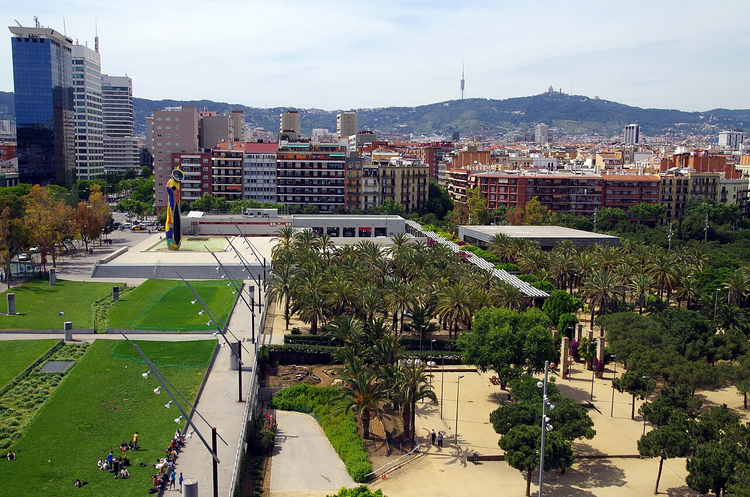
Joan Miró Park is located near Plaça d'Espanya at Carrer d'Aragó, 2. It occupies the site of the former city slaughterhouse. The area is divided into a green zone and a plaza with a sculptural composition.
 © Balou46 · CC BY-SAPhoto: Balou46, CC BY-SA (https://creativecommons.org/licenses/by-sa/3.0), Wikimedia Commons
In 1983 sculptor Joan Miró, together with Joan Artigas, presented the statue "Woman and Bird". It stands over 20 meters tall and is decorated with colorful tiles. The park is designed for relaxation, walking and cycling. The lower level features an artificial pond, palm alleys, pergolas and flower beds. The park is free to visit, and you can easily combine it with the museum on Montjuïc.
29. Olympic and Sports Museum
The Juan Antonio Samaranch Olympic and Sports Museum stands in the Olympic park on Montjuïc hill. It is dedicated to the Games that Barcelona hosted in 1992. An avenue with footprints of Olympic winners leads to the museum.
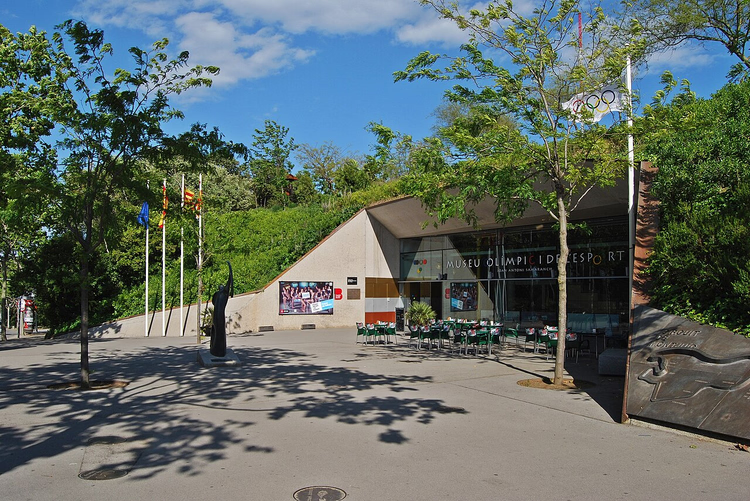 © Felix König · CC BYPhoto: Felix König, CC BY (https://creativecommons.org/licenses/by/3.0), Wikimedia Commons
The exhibition covers 4,000 square meters. It displays authentic cups, medals, and personal belongings of world-class athletes. Olympic torches, race cars, boots, and bicycles are also originals. For convenience, the halls are equipped with audiovisual and multimedia devices. The museum is open daily except Mondays and public holidays, the ticket costs €5.80, student ticket €3.60 (as of 09/2026, Olympic and Sports Museum).
30. CosmoCaixa Science Museum
The CosmoCaixa Museum is located at 26 Isaac Newton Street. It is one of the most visited museums in Barcelona among adults and children. The tour begins in the planetarium with a space video program and continues across six floors of exhibits.
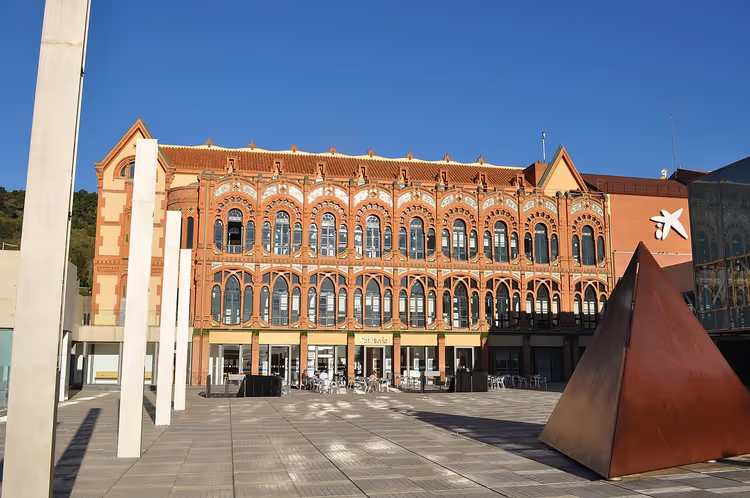 © Jirka Dl · CC BY-SAPhoto: Jirka Dl, CC BY-SA (https://creativecommons.org/licenses/by-sa/3.0), Wikimedia Commons
Visitors are shown a polar research laboratory and a piece of an iceberg. The microbiology hall explains how living creatures appeared on the planet. A separate zone is dedicated to geological strata, and there is also a recreated tropical forest with an Amazon ecosystem. In the children's rooms, young visitors are allowed to touch the exhibits with their hands.
The museum is open daily from 10:00 to 20:00 except Mondays. Closed days are December 25, January 1 and 6. The ticket costs €8, entry is free for children under 16, and on the first Sunday of the month the museum is open to everyone free of charge (as of 09/2026, CosmoCaixa).
Barcelona attractions on the map
All thirty places can be conveniently arranged into a route in advance. Below is a map with the main points, you can use it to plan the order of your walks and save time on getting around.
Barcelona landmarks
Places on the map
- 1La Rambla The main pedestrian artery from Plaça de Catalunya to the sea, over a kilometre long in five sections
- 2Gothic Quarter Narrow cobbled streets, the squares of Sant Jaume and the King, remains of the Roman city
- 3Casa Batlló Gaudí's house with a dragon facade and bone-shaped columns at Passeig de Gràcia, 43
- 4Casa Milà Gaudí's last private project of 1906-1910, also known as La Pedrera, chimneys on the roof
- 5Park Güell Seventeen hectares designed by Gaudí, a mosaic lizard and gingerbread-style houses at the entrance
- 6Barcelona Cathedral Founded in 1298, towers almost 100 metres high, inside the tomb of Saint Eulalia
- 7Sagrada Família Gaudí's main church, completion planned by 2026, tower slots should be booked ahead
- 8Barcelona Aquarium Fourteen ecosystems and a glass tunnel among sharks, a touch zone for children
- 9Torre Agbar A high-tech tower 38 storeys and 145 metres tall, lit by 4,000 LEDs in 16 million shades
- 10Palau de la Música Catalana Art Nouveau building of 1905-1908, concerts, exhibitions and tours of the halls
- 11Plaça d'Espanya The city's second-largest square, 34,000 square metres, opened for the 1929 exhibition
- 12National Museum of Catalan Art In the National Palace on Montjuïc, Romanesque frescoes, El Greco and Velázquez
- 13Montjuïc A 173-metre hill with a castle, a singing fountain, museums and the Olympic Stadium
- 14Poble Espanyol Spain in miniature for the 1929 exhibition, 117 houses and workshops, flamenco in the evening
- 15Temple of the Sacred Heart, Tibidabo A 512-metre peak and a seven-metre statue of Jesus, an amusement park nearby
- 16Museu Picasso A 15th-century Gothic mansion on Carrer Montcada, more than 3,800 exhibits
- 17Camp Nou Europe's largest football arena with a hundred thousand seats, with a club museum attached
- 18La Boqueria Market A covered market on La Rambla, open from 8:00 to 20:30, best visited in the morning
- 19Port Vell 13th-century quays and wooden waterfronts, next to the Drassanes metro station
- 20Plaça de Catalunya The main square, 50,000 square metres, the airport shuttle stops here
- 21Columbus Monument A 60-metre monument with a viewing platform, the lift ride is paid
- 22Monestir de Pedralbes A Gothic abbey from 1327, a working convent, admission about 5 euros
- 23Torre Bellesguard The Figueras house designed by Gaudí in 1917 at the foot of Tibidabo, admission about 9 euros
- 24Museu Marítim 14th-century Gothic Drassanes shipyards, replicas of a submarine, a sailing ship and a galley
- 25Parc del Laberint d'Horta A garden from 1791 covering 9.1 hectares, a eucalyptus maze 750 metres long
- 26Egyptian Museum of Barcelona A private collection at 284 Carrer de Valencia, sarcophagi, mummies and death masks
- 27Parc de Joan Miró On the site of a former slaughterhouse, the Woman and Bird statue over 20 metres tall, free admission
- 28Olympic and Sports Museum In the Olympic park on Montjuïc, ticket 5.80 euros, student ticket 3.60 euros
- 29CosmoCaixa A planetarium and six floors of exhibits, ticket 8 euros, free for children under 16
Focus on compact groups: the center and the waterfront can be covered on foot, while Montjuïc and Tibidabo should be set aside as separate outings.
Tours and tickets in Barcelona
Guided tours, skip-the-line tickets and activities — most offers can be cancelled free of charge.
See offers on TiqetsThe widget loads once you give your consent.
⁉️🤔 Frequently asked questions
How many days do you need to see the main sights?
For a first visit, two to three days is enough. In that time you can cover La Rambla, the Gothic Quarter, the Sagrada Família, and Park Güell. Montjuïc and Tibidabo are better saved for separate outings, since getting there takes half a day. If you're short on time, stick to the center and one Gaudí site.
When should you buy Sagrada Família tickets?
Tickets are sold for specific time slots, and morning slots sell out weeks in advance. Book online ahead of time, especially from April through October. Entering without a time slot in high season means a long line at the facade. If you want to go up the tower, add that option right when you buy.
What can you see in Barcelona for free?
The Joan Miró park, some of the beaches, and the Old Port promenade are free to access. Several museums offer free entry on Sundays after 3:00 PM, such as the Maritime Museum. The Picasso Museum has free admission on Thursday evenings. Check exact times on official websites before your trip.
How to get from the airport to the center?
The Aerobús shuttle runs from El Prat airport to Plaça de Catalunya. There's also a train to Passeig de Gràcia station, but with luggage the shuttle is more convenient. A taxi costs more, but it takes you straight to your hotel. The trip takes 30 to 45 minutes depending on traffic.
Which transit pass is best for a tourist?
For a short trip, get the Hola BCN card for two to five days; it covers the metro, buses, and some suburban trains. If you plan to walk a lot, single metro tickets will do. The pass pays off if you take three or more rides a day. You can buy it from machines at metro stations.
In short: what's worth booking
Barcelona rewards those who plan ahead. Thirty places from the list can easily be spread over three days without wasting time in lines. If you're on a tight budget, focus on the free parks and the waterfront.
- If you're short on time: book the Sagrada Família and Park Güell with morning tickets.
- If you're traveling with kids: plan for the Aquarium, CosmoCaixa museum, and the Tibidabo amusement park.
- If you love museums: put the National Art Museum of Catalonia and the Picasso Museum on your list.
- If you want to see the whole city: go up Montjuïc and Tibidabo.
- If you plan to move around a lot: get a transit pass and a hop-on hop-off bus in advance.

A small editorial team writing guides for independent travel. We travel ourselves, but we haven’t been everywhere, so we check prices, opening hours and how to get there against official sources.