
















Airport without panic: 7 techniques that ease pre-flight anxiety
Your flight is in the evening, but since morning you have been replaying lines and security checks in your head. A familiar picture for anyone who flies a few times a year. The good news: you can remove most of that stress in advance, while you are still at home.
Calculate your time buffer before departure based on Vienna Airport data, details in the second section. That buffer covers traffic, security, and a calm coffee at the gate.
Below are seven techniques that reduce anxiety before boarding. Each takes a couple of minutes and saves hours of nerves.
Ad: this article contains affiliate links, we earn a commission if you book through them, at no extra cost to you.
1. Acknowledge the anxiety and make a plan
💡 In short:
- Write down the steps from leaving your home to boarding the plane.
- Build in a time buffer for the road and security, details in the second section.
- Check online check-in and the terminal number the evening before.
- Travel time and security rules: 09/2026, verified on the Vienna Airport website.
Most passengers feel anxiety before a flight. The brain dislikes uncertainty and serves up the worst-case scenario: missing the flight, a lost suitcase, a canceled flight. Some of these fears are real, and you can work on them in advance.
Make a list of actions from leaving your home to boarding. Write down the departure time, terminal, check-in counter, and gate number. When the plan is in your notes, you do not have to hold everything in your head at once.
Check the evening before that online check-in is open. It saves you the line at the counter and extra minutes in the hall. If you are flying with baggage, find the baggage drop counter number in the airline app.
2. Arrive early and build in a buffer
You only partially control what happens at the airport. Security lines, technical failures, and weather eat up time. A buffer turns those surprises into minor inconveniences, not panic at an already closed gate.
How much time to allow is suggested by Vienna Airport recommendations: 2 hours before departure for flights up to 6 hours and 3 hours for long-haul flights. On Friday evenings and during peak vacation season, allow more. The security checkpoint gathers the longest line at those times.
Check the route in advance. Open the map on the morning of your departure and look at traffic, roadwork, and closures. If you are taking a taxi, book an airport transfer on Kiwitaxi and lock in the pickup time. That way you will not be left without a driver if they run late.
3. Check your baggage and carry-on
Confusion at the counter throws you off balance more than anything else. Weight and size almost always decide whether you get through check-in calmly or pay for excess baggage in front of a line of people.
Check the baggage allowance in your booking. For most carriers it depends on the fare, not the destination. The numbers on the airline's website matter more than advice from friends.
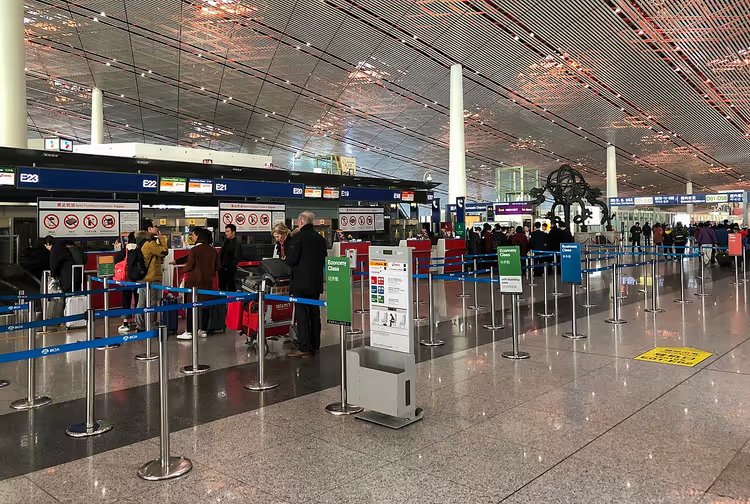
Usually liquids in carry-on must be in containers no larger than 100 ml (according to Schiphol). Some airports have raised this limit after replacing their scanners, so check your airport's rules. Put them in a clear bag in advance, while you are still at home. At the security belt you simply take out the bag and place it in the tray.
 © N509FZ · CC BY-SAPhoto: N509FZ, CC BY-SA (https://creativecommons.org/licenses/by-sa/4.0), Wikimedia Commons
If you are flying with a connection, put one change of clothes in your carry-on. If your baggage is lost, you will still have a clean shirt rather than empty hands.
4. Dress comfortably and in layers
Clothing affects how you feel more than it seems. Tight jeans and new shoes on a long walk add irritation that later grows into anxiety.
Choose soft layers: a t-shirt, a light sweater, and a jacket that is easy to take off. The temperature in the airport and in the cabin fluctuates, so you simply put the extra layer in your bag.
Shoes without laces speed up security. They are easier to take off and put on, and you will not have to stand on one foot in line. Bring spare socks in case you are asked to remove your shoes at security.
5. Breathe slowly and steadily
Breathing helps fastest, and it is always with you. No apps or pills needed, just a couple of minutes in line.
Take a slow breath in through your nose. Breathe out through your mouth even more slowly, so the exhale is longer than the inhale. That sends your body a signal that there is no danger nearby.
Repeat several cycles and check your shoulders. On the exhale, lower them and relax your jaw. Those two movements are invisible to others but release a noticeable amount of tension.
Breathe while you walk to the gate. It distracts you from the surrounding noise and conversations. If you feel dizzy, return to your normal rhythm and pause.
6. Occupy your mind and download content
Waiting drags on when you have nothing to do. An empty head in line quickly returns to anxious thoughts and worst-case scenarios.
Download a podcast, audiobook, or playlist in advance. Offline content works both on the plane and in areas without signal. Pick something light: a complex plot does not land well when you are anxious.
Set up a travel eSIM in advance so you have internet and navigation in an unfamiliar airport. That way you will not depend on expensive roaming and open Wi-Fi networks.
Make it a habit to check the gate in the app. It can change without warning. Fresh information removes one of the most common sources of anxiety.
7. Talk about the anxiety and know your rights
If you are flying with a companion, say your worries out loud. Talking releases some of the tension: you hear a second perspective and feel support. Silent anxiety grows faster.
It is also useful to know your rights. A departure delay entitles you to food, drinks, and communication at the carrier's expense. The threshold depends on distance: 2 hours for flights up to 1,500 km, 3 hours up to 3,500 km, 4 hours for longer flights. Cancellation or a long arrival delay brings compensation from 250 to 600 € (as of 09/2026, Your Europe).
You can check whether compensation applies to you through a claims service. Check your right to compensation for a flight delay in advance, so that on the day of a disruption you can act according to plan.
⁉️🤔 Frequently asked questions
How much time should I allow for the airport?
For a European flight up to 6 hours, 2 hours before departure is enough; for long-haul flights allow 3 hours (according to Vienna Airport). In high season, add a buffer for traffic and the security line. Online check-in and carry-on without checked baggage will save you time.
Can I bring water in my carry-on?
Yes, but usually in a container no larger than 100 ml (according to Schiphol airport rules). Put liquids and gels in one clear bag and take it out before security. Some airports have raised the limit after replacing their scanners, so check your airport's rules before departure.
What should I do if my flight is delayed or canceled?
The carrier must provide you with food, drinks, and communication if the delay exceeds the threshold. For flights up to 1,500 km that is 2 hours; for longer flights the threshold is higher. If the flight is canceled or arrival is delayed for a long time, compensation can range from 250 to 600 € (as of 09/2026, EU rules summary). Keep your boarding pass and receipts; they will be requested when you file a claim.
How can I calm down right before boarding?
Breathe with a long exhale and do not scroll the news feed. Put on a pre-downloaded podcast or music in your headphones and focus on it. A straight back, water, and a slow exhale lower your heart rate better than trying to convince yourself there is nothing to fear.
What should I do about a strong fear of flying?
A strong fear of flying is common and can be addressed with a specialist. Breathing, a travel plan, and support from loved ones relieve some of the tension, but they do not replace help from a psychologist. If anxiety keeps you from planning trips, discuss it with a doctor in advance, not on the day of departure.
In short: what is worth booking
Airport anxiety is almost always about uncertainty. The more steps you close out in advance, the calmer your departure day will be.
Before the trip, compare insurance options for delays, cancellations, and lost baggage. Also keep your boarding pass and receipts: they are needed for any claim.
Breathe steadily, arrive with a buffer, and keep your plan in your notes. Then your departure day will follow your script, not someone else's.

A small editorial team writing guides for independent travel. We travel ourselves, but we haven’t been everywhere, so we check prices, opening hours and how to get there against official sources.