


Baikal and national parks of Russia: why we removed these materials
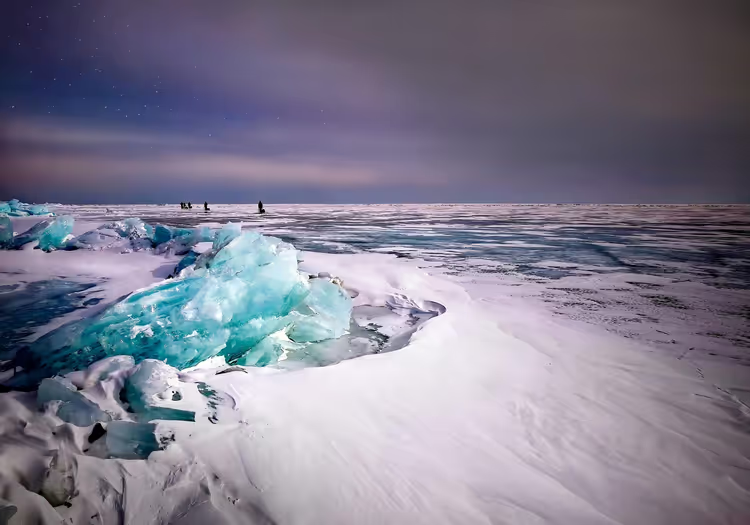
Here we had three texts about nature: an overnight stay on Lake Baikal without any infrastructure, an independent route to Valaam, and a list of thirty national parks in Russia. All three have been removed from every language version, and redirects from the Irkutsk and Petrozavodsk sections now point here.
A short answer to the question people usually come here with. Nature tourism has not been carved out from the ban. The European Union's ban on services directly related to tourism activities in Russia has no exceptions for ecotourism, hiking, or nature reserves, and the German Foreign Office's warning applies to the entire country, not to individual cities. There are no routes, entry points, or ways to get there here.
💡 At a glance:
- which three pieces were removed and how the nature genre differed from the rest
- why the sanctions text has no line about nature reserves and national parks
- what remoteness means when there is no consulate nearby and no working payment card
- where on the site the remaining sections about wilderness live
- Last updated: 09/2026
Why we deleted these guides
The three texts differed in format and were identical in what they promised. The first suggested sleeping on the shore of Lake Baikal "wild," meaning outside any infrastructure. The second explained how to reach the island on Lake Ladoga on your own and was essentially a road guide. The third was a catalog of thirty national parks from Karelia to the Far East. All old addresses now have a permanent redirect to this page.
The nature topic held on in our catalog longer than the others precisely because it seemed harmless. A lake makes no decisions, a forest does not vote, the taiga signs no decrees. But a text about a lake is not a text about a lake: it is an invitation to come, spend money on travel, lodging, permits, and gear, and return with the feeling that the country is open. After Russia's full-scale invasion of Ukraine, which began on February 24, 2022, we no longer make that invitation in any genre.
The money part of the argument sounds different from how it is usually presented, and we want to be precise. The oil and gas reference does not work here: the commodity share of Russia's federal budget has fallen to roughly 22 percent, down from 42 percent in 2022, and commodity export revenues for 2025 came to 8.48 trillion ₽, down from 11.13 trillion a year earlier (OSW Centre for Eastern Studies, 12/09/2025). The reverse figure has become the significant one: about 78 percent of the budget now comes from non-oil-and-gas revenue, which includes taxes from the services sector. The money a visitor leaves in transport, lodging, and gear goes exactly into that part.
Why nature has no separate regime
Council Regulation (EU) 2025/2033 of October 23, 2025 replaced paragraph 2 of Article 5n of Regulation 833/2014 with a direct formulation: it is prohibited to provide services directly related to tourism activities in Russia (EUR-Lex). The text of the rule says nothing about a nature reserve, national park, or hiking route being any different from a city tour. The transition period that applied to contracts concluded before October 24, 2025 ended on January 1, 2026, and after that date no carve-outs remain.
The ban covers services by travel agencies and tour operators, the work of guides, and advertising of all these services (analysis of the 19th sanctions package, Skadden, 11/2025). Online platforms, ticket sales, and visa assistance are separately addressed when connected to tourism (Fieldfisher). A guide on "how to reach the island on your own" was exactly that: a service replacing a guide and an agent, only free for the reader and paid for by advertising on our side.
What remoteness means
A nature trip differs from a city trip not in law but in the distance to help. Here it is worth listing what is known for certain, without speculation.
The German Foreign Office warns of the risk of arbitrary detention for German citizens and holders of dual German-Russian citizenship and separately notes that German missions in Russia generally do not issue replacement passport documents outside working hours (Auswärtiges Amt). For a person whose backpack with documents floated down the Angara on a Saturday, this is not a formality but a description of their situation.
The U.S. Department of State keeps Russia at Level 4 "Do Not Travel," reissued on December 29, 2025, and states directly that its ability to assist U.S. citizens in the country is limited: the embassy in Moscow has reduced staff, and all U.S. consulates in Russia have suspended operations, including consular services (U.S. Department of State; the reissue date is also confirmed by a Travel Market Report overview). An industry security reference records the same picture for regions outside the capitals (OSAC Russia Country Security Report).
We deliberately do not turn this into advice. We do not write what to bring, where to register, or whom to contact: any such line would be practical information about a trip, which this section does not carry by editorial decision.
What this means for you as a reader from the EU and the US
Item | Status 09/2026 | Source |
|---|---|---|
Services related to tourism in Russia | Prohibited by Article 5n(2) of Regulation 833/2014 as amended by Regulation 2025/2033 of 23.10.2025 | |
Exception for ecotourism and nature reserves | Not present in the rule; the transition period ended on 01.01.2026 | |
German Foreign Office advisory | "Vor Reisen in die Russische Föderation wird gewarnt" | |
Passport replacement outside working hours | German missions do not issue such documents | |
US consular assistance | All consulates have suspended operations, the embassy has been reduced | |
Payment cards from the EU | Not working since 10.03.2022 |
The last row matters more for a wilderness route than for a city trip. Visa and Mastercard suspended operations in Russia on March 10, 2022, and cards issued outside the country do not work there. A self-supported trip assumes that money will be needed suddenly and in places where there is no alternative.
Where to go instead
The original request was about water, silence, long days on foot, and nights without city light. The live sections of the site answer that: Finland with Lapland, Iceland, Norway and Sweden, Georgia with its Caucasus trails, and our nature destination hubs for Oceania and Antarctica. For a reader who came looking for Ladoga and Karelia, the closest answer in spirit is the Finnish side of the same landscape: the same granite, the same lakes, the same light in June.
Related texts in this section: our position on the Krasnaya Polyana mountain cluster and our position on the cities of the western border. The general explanation of the editorial decision is collected in the section hub.
Where we stand
We believe the argument that "it's just nature" does not hold up in practice. The road to any nature reserve runs through tickets, permits, transport, and lodging, which means through the very industry the sanctions rule addresses. In our assessment, it is impossible to publish a catalog of national parks in a country waging war against a neighboring state and at the same time call ourselves a publication with a clear position.
We also did not leave these texts with "a disclaimer at the top." A warning above a list of thirty parks does not change the fact that the list remains a list and works as an invitation.
We write about a state and its policies, not about people based on their passport. There are people in Russia who spoke out against the war and received prison sentences for it. Our decision not to publish guides to Russia is about money, sanctions, and reader safety, not nationality.
Publication date: September 3, 2026. Last updated: September 3, 2026.
⁉️🤔 Frequently asked questions
Lake Baikal is a natural World Heritage site, so how is it related to politics?
We are not disputing or discussing the site's status. The point is different: our text was not a description of the lake, but a suggestion to travel there. The EU ban covers services related to tourism activities in Russia and makes no exceptions based on a place's natural value.
Valaam is a monastery, not a state institution.
True, and we make no claims about the monastery or the people who live there. The deleted article was titled "how to get there on your own" and was a travel instruction. It is precisely instructions that we no longer publish.
You could have simply removed the booking links and kept the nature description.
We discussed that and decided against it. A description with a map, seasons, and ways to get there remains a practical text regardless of whether it contains commercial links. A half-measure would have looked like an attempt to keep the traffic without changing our position.
Why don't you write whether a specific airport or ferry crossing is currently operating?
Because we do not have a verified source for the current schedule, and a guess in a text that people read before traveling is unacceptable. We only state what is confirmed by a dated document.
In short
Three articles about Lake Baikal, Valaam, and Russia's national parks have been removed entirely, and the Irkutsk and Petrozavodsk sections now redirect to this page. There are no exceptions for nature tourism, and remoteness only increases the risks. The northern and Caucasus destinations we continue to cover are listed above.
How you can help
We are not raising money and receive nothing from the links below. These are official websites of organizations working with the consequences of the war:
- UNHCR, the UN Refugee Agency, unhcr.org
- UNICEF, unicef.org
- Ukrainian Red Cross, redcross.org.ua
Sources
- Council Regulation (EU) 2025/2033 of 23.10.2025 amending Regulation 833/2014, EUR-Lex. https://eur-lex.europa.eu/legal-content/EN/TXT/?uri=OJ:L_202502033
- Skadden, analysis of the EU's 19th sanctions package, 11.2025. https://www.skadden.com/insights/publications/2025/11/eu-adopts-19th-sanctions-package
- Fieldfisher, analysis of the EU's 19th sanctions package, 2025. https://www.fieldfisher.com/en/insights/the-eu-s-19th-sanctions-package-against-russia
- Auswärtiges Amt, Russische Föderation: Reise- und Sicherheitshinweise, as of 02.09.2026. https://www.auswaertiges-amt.de/de/service/laender/russischefoederation-node/russischefoederationsicherheit-201536?isLocal=false&isPreview=false
- U.S. Department of State, Russia Travel Advisory, Level 4, reissued 29.12.2025. https://travel.state.gov/en/international-travel/travel-advisories/russia.html
- Travel Market Report, confirmation of the advisory reissue date, 2026. https://www.travelmarketreport.com/destinations/articles/u-s-state-department-reissues-level-4-do-not-travel-warning-for-russia
- OSAC, Russia Country Security Report. https://www.osac.gov/Content/Report/f312a926-0723-427a-947f-1c391b3776e8
- The Moscow Times, on Visa and Mastercard suspending operations, 06.03.2022. https://www.themoscowtimes.com/2022/03/06/visa-mastercard-suspend-operations-in-russia-a76784
- Centre for Eastern Studies OSW, Russia's 2026 budget, 09.12.2025. https://www.osw.waw.pl/en/publikacje/osw-commentary/2025-12-09/russias-2026-budget-mounting-financial-challenges-and-economic
Link check date: 03.09.2026.

A small editorial team writing guides for independent travel. We travel ourselves, but we haven’t been everywhere, so we check prices, opening hours and how to get there against official sources.